Web3 & AI

SOLUTIONS

Products

Services

Web3 & AI

SOLUTIONS

Services

Products

Industries

Become Our Client

About Us

Resources

Web3 & AI

SOLUTIONS

Services

Products

Industries

Tokenization Guide 2026: Core Key Terms and Definitions Explained

Tokenization Guide 2026: Core Key Terms and Definitions Explained

Written by:

Written by:

Feb 27, 2026

Feb 27, 2026

TL;DR 

This article explains core terms related to tokenization. It defines concepts used in asset tokenization and blockchain systems. It clarifies infrastructure, token models, and settlement terminology. These definitions are organized into structured sections. Readers can use this guide as a reference document. It is hoped that readers will find it helpful in gaining a basic understanding before delving into more in-depth analysis.

What Is Tokenization?

Tokenization Definition

Tokenization is the process of converting rights into digital tokens. These tokens represent ownership, claims, or access permissions. Distributed ledgers record these tokens across network participants. The system enables direct transfer between approved parties. The process restructures how ownership is issued and settled. It does not create new economic value.

Tokenization in blockchain

The digital token is created and stored on a blockchain network. The blockchain acts as a shared online record ledger. The ledger shows who owns each tokenized asset. Participants can view ownership through the network. This blockchain system removes the need for paper certificates.

Tokenization vs Digitization vs Encryption vs Securitization

The concept of tokenization may sound similar to other financial terms. Many readers confuse it with digitization, encryption, or securitization. Each term serves a different purpose. The table below explains the key differences.

Term

What It Does

Main Purpose

Tokenization

Creates digital tokens that represent ownership rights

Records and transfers ownership digitally

Digitization

Converts physical information into digital format

Stores data in digital systems

Encryption

Scrambles data into unreadable coded text

Protects information from unauthorized access

Securitization

Packages assets into financial securities

Creates tradable investment products

Core Tokenization Infrastructure Terms

Tokenization depends on several core technical infrastructures. These systems support all the tokenization processes. The table below summarizes their main functions.

Infrastructure

Main Function

Blockchain

Records and updates token ownership across the network

Distributed Ledger

Shares transaction records between multiple participants

Public Blockchain

Allows open access to validate transactions

Private Blockchain

Restricts access to approved participants

Permissioned Network

Limits validation rights to selected entities

Permissionless Network

Allows anyone to participate in validation

Smart Contract

Automates transfer and compliance rules

Node

Stores and verifies network transaction data

Consensus Mechanism

Confirms transactions across network participants

Blockchain

Blockchain is a shared digital record system. It records who owns each tokenized asset. The blockchain system updates ownership after every verified transaction.

Distributed Ledger

Distributed ledger is a database shared across multiple participants. It shares tokenization transaction records across the network. It keeps ownership information consistent for all participants.

Public Blockchain

A public blockchain is an open network accessible to anyone. This network allows anyone to view any asset's tokenized transactions. In this way, public blockchains support open global participation in the token market.

Private Blockchain

A private blockchain is a restricted network with controlled access. This network limits tokenization control to approved participants only. Private blockchains are well-suited for institutional needs. Because they support governance and compliance controls with greater oversight.

Permissioned Network

Permissioned network is a system that can restrict participation. It allows only approved entities to validate token transactions. This way, only authorized entities can manage token transfers. This system allows for proper compliance management within tokenization projects.

Permissionless Network

A permissionless network is a system that allows open participation. This system allows anyone to validate token transfers across the network. Thus, it supports a decentralized token ownership model.

Smart Contract

Smart contract is a program deployed on a blockchain. It executes predefined rules automatically when conditions are met. It runs based on on-chain transaction inputs. It removes the need for manual execution.

Node

A node is a computer connected to a blockchain network. Nodes verify and store tokenized transactions within the system. Nodes help maintain accurate ownership records.

Consensus Mechanism

A consensus mechanism is a method for validating transactions. This mechanism ensures that participants agree on token ownership updates. This mechanism prevents duplicate recording of token transfers.

Asset Tokenization Terms

Digital Asset

Digital assets are tokens recorded in a blockchain system. These assets represent ownership, value, or access rights. These assets exist only in digital form.

Asset Tokenization

Asset tokenization is the conversion of asset ownership into digital tokens. These tokens represent financial or physical assets on a blockchain network. These tokens enable the digital transfer of ownership rights.

Real-World Asset (RWA)

Real-world asset is a physical or traditional financial asset. It includes real estate, bonds, equity, or commodities. It becomes tradable on blockchain after tokenization.
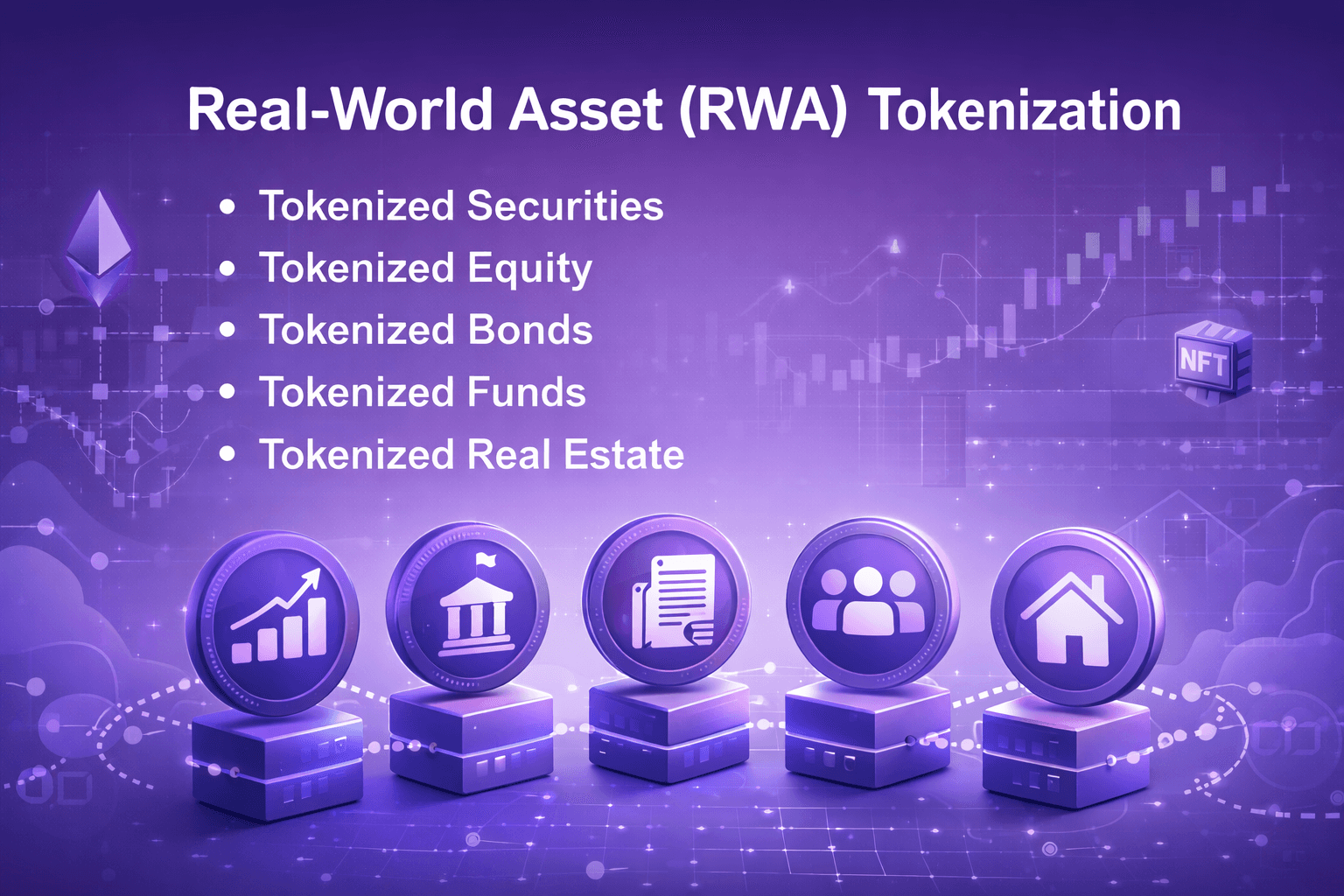

  • Tokenized Securities

Tokenized securities are financial instruments regulated and issued as digital tokens. These instruments represent equity, debt, or investment contracts.

  • Tokenized Equity

Tokenized equity is company ownership represented as a digital token. This grants holders rights similar to traditional shares. Ownership is recorded on a blockchain system.

  • Tokenized Bonds

Tokenized bonds are debt instruments issued as digital tokens. These tokens represent the borrower's repayment obligations. The coupon and settlement processes are automated through smart contracts.

  • Tokenized Funds

Tokenized funds are shares of investment funds issued as tokens. These tokens represent participation in a pooled investment portfolio. Ownership is recorded digitally on a blockchain network.

  • Tokenized Real Estate

Property tokenization is the representation of property ownership as a token. These tokens divide the property's value into smaller digital units. This allows for partial ownership through a blockchain system.

Token Design and Structure Terms in Tokenization

Token design determines how a token behaves within a system. It determines rights, supply, and transfer conditions. The terms below describe common token structures.

Asset-Backed Token vs 1:1 Backed Token

Asset-backed tokens are tokens backed by an underlying asset. These tokens represent a claim on a specific asset. Their value depends on the underlying asset.

A 1:1-backed token is a token fully backed by reserves. Each token is equivalent to one unit of the underlying asset. These tokens maintain parity through asset backing.

Utility Token

Utility tokens are tokens that provide access to services. These tokens allow holders to use platform features or products. These tokens do not represent ownership in a company.

Security Token

Security tokens are tokens that represent regulated investment rights. These tokens provide a financial claim or profit participation to their holders. These tokens comply with securities laws in relevant jurisdictions.

Governance Token

Governance tokens are tokens that grant voting rights. These tokens allow holders to participate in protocol decision-making. These tokens influence system updates or policy changes.

Collateralized Token

Collateralized tokens are tokens secured by pledged assets. The collateral backs the value of the issued tokens. The system can lock assets to maintain coverage.

Fractionalization

Fractionalization is the division of assets into smaller units. This allows multiple parties to have partial ownership. Fractionalization lowers the barriers to entry for investment participation.

Token Standard

A token standard is a set of technical rules for tokens. This standard defines how tokens interact on a blockchain network. This standard ensures compatibility across different wallets and platforms.

Tokenization Issuance and Operational Terms

1. Token Creation Terms

Issuance

Issuance is the release of new tokens into circulation. It defines how tokens enter the market. It may follow legal and technical requirements.

Minting

Minting is the technical creation of new tokens. It records new token units on blockchain systems. It increases the total token supply.

Token Supply

Token supply is the total number of existing tokens. It defines how many units are available in the system. It may be fixed or adjustable over time.

2. Token Storage and Control Terms

Custody

Custody is the safekeeping of digital tokens. It protects private keys that control ownership. It may use self-custody or third-party services.

Wallet

Wallet is a digital tool that stores private keys. It allows users to send and receive tokens. It manages access to token ownership.

3. Token Transfer and Settlement Terms

Settlement

Settlement is the final transfer of token ownership. It completes the transaction between participants. It updates the ledger with new records.

Atomic Settlement

Atomic settlement is a transaction that fully completes or fails. It prevents partial transfers between participants. It reduces transaction risk in token systems.

Transfer Restrictions

Transfer restrictions are rules limiting token movement. They define who can receive specific tokens. They support compliance in regulated tokenization projects.

4. Tokenization Compliance Terms

Compliance Layer

A compliance layer is a system enforcing regulatory rules. It checks eligibility before token transfers. It integrates identity verification mechanisms.

KYC / AML

KYC is identity verification of token participants. AML is monitoring suspicious financial activities. Both support regulatory compliance in tokenization systems.

Tokenization Regulatory and Market Terms

Tokenization operates within legal and financial market frameworks. These terms explain regulatory oversight and market activity. They clarify how tokenized assets interact with traditional finance.

Regulatory Terms

Securities Law

Securities law is the legal framework governing investment securities. It regulates issuance, disclosure, and trading of securities. It applies when tokens qualify as securities.

Prospectus

Prospectus is a formal disclosure document for investment offerings. It describes risks, financial terms, and issuer information. Regulators may require it for public securities offerings.

MiCA

MiCA is the European Union regulation for crypto-assets. It establishes rules for issuers and service providers. It sets licensing and compliance requirements within the EU.

SEC

SEC is the United States securities regulatory authority. It oversees securities markets and public offerings. It determines whether certain tokens qualify as securities.

CFTC

CFTC is the United States derivatives market regulator. It oversees commodity futures and derivatives markets. It regulates digital assets treated as commodities.

Market Terms

Secondary Market

The secondary market is a marketplace for trading issued tokens. This market allows participants to buy and sell tokenized assets. This market provides liquidity after the initial issuance.

Liquidity

Liquidity is the ease of buying or selling an asset. Liquidity measures how quickly an asset can be converted into cash. Higher liquidity reduces price volatility during trading.

Market Capitalization

Market capitalization is the total value of tokens in circulation. Market capitalization equals the token price multiplied by the circulating supply. Market capitalization reflects the overall market size of a token project.

Tokenize Your Business Assets with TokenMinds

TokenMinds supports businesses in designing and implementing tokenization strategies. This includes asset structuring, smart contract, or blockchain integration. Whether you are evaluating tokenized securities or planning enterprise blockchain infrastructure.

Visit our asset tokenization page today. Or schedule a free consultation with our expert here. 
TL;DR 

This article explains core terms related to tokenization. It defines concepts used in asset tokenization and blockchain systems. It clarifies infrastructure, token models, and settlement terminology. These definitions are organized into structured sections. Readers can use this guide as a reference document. It is hoped that readers will find it helpful in gaining a basic understanding before delving into more in-depth analysis.

What Is Tokenization?

Tokenization Definition

Tokenization is the process of converting rights into digital tokens. These tokens represent ownership, claims, or access permissions. Distributed ledgers record these tokens across network participants. The system enables direct transfer between approved parties. The process restructures how ownership is issued and settled. It does not create new economic value.

Tokenization in blockchain

The digital token is created and stored on a blockchain network. The blockchain acts as a shared online record ledger. The ledger shows who owns each tokenized asset. Participants can view ownership through the network. This blockchain system removes the need for paper certificates.

Tokenization vs Digitization vs Encryption vs Securitization

The concept of tokenization may sound similar to other financial terms. Many readers confuse it with digitization, encryption, or securitization. Each term serves a different purpose. The table below explains the key differences.

Term

What It Does

Main Purpose

Tokenization

Creates digital tokens that represent ownership rights

Records and transfers ownership digitally

Digitization

Converts physical information into digital format

Stores data in digital systems

Encryption

Scrambles data into unreadable coded text

Protects information from unauthorized access

Securitization

Packages assets into financial securities

Creates tradable investment products

Core Tokenization Infrastructure Terms

Tokenization depends on several core technical infrastructures. These systems support all the tokenization processes. The table below summarizes their main functions.

Infrastructure

Main Function

Blockchain

Records and updates token ownership across the network

Distributed Ledger

Shares transaction records between multiple participants

Public Blockchain

Allows open access to validate transactions

Private Blockchain

Restricts access to approved participants

Permissioned Network

Limits validation rights to selected entities

Permissionless Network

Allows anyone to participate in validation

Smart Contract

Automates transfer and compliance rules

Node

Stores and verifies network transaction data

Consensus Mechanism

Confirms transactions across network participants

Blockchain

Blockchain is a shared digital record system. It records who owns each tokenized asset. The blockchain system updates ownership after every verified transaction.

Distributed Ledger

Distributed ledger is a database shared across multiple participants. It shares tokenization transaction records across the network. It keeps ownership information consistent for all participants.

Public Blockchain

A public blockchain is an open network accessible to anyone. This network allows anyone to view any asset's tokenized transactions. In this way, public blockchains support open global participation in the token market.

Private Blockchain

A private blockchain is a restricted network with controlled access. This network limits tokenization control to approved participants only. Private blockchains are well-suited for institutional needs. Because they support governance and compliance controls with greater oversight.

Permissioned Network

Permissioned network is a system that can restrict participation. It allows only approved entities to validate token transactions. This way, only authorized entities can manage token transfers. This system allows for proper compliance management within tokenization projects.

Permissionless Network

A permissionless network is a system that allows open participation. This system allows anyone to validate token transfers across the network. Thus, it supports a decentralized token ownership model.

Smart Contract

Smart contract is a program deployed on a blockchain. It executes predefined rules automatically when conditions are met. It runs based on on-chain transaction inputs. It removes the need for manual execution.

Node

A node is a computer connected to a blockchain network. Nodes verify and store tokenized transactions within the system. Nodes help maintain accurate ownership records.

Consensus Mechanism

A consensus mechanism is a method for validating transactions. This mechanism ensures that participants agree on token ownership updates. This mechanism prevents duplicate recording of token transfers.

Asset Tokenization Terms

Digital Asset

Digital assets are tokens recorded in a blockchain system. These assets represent ownership, value, or access rights. These assets exist only in digital form.

Asset Tokenization

Asset tokenization is the conversion of asset ownership into digital tokens. These tokens represent financial or physical assets on a blockchain network. These tokens enable the digital transfer of ownership rights.

Real-World Asset (RWA)

Real-world asset is a physical or traditional financial asset. It includes real estate, bonds, equity, or commodities. It becomes tradable on blockchain after tokenization.


  • Tokenized Securities

Tokenized securities are financial instruments regulated and issued as digital tokens. These instruments represent equity, debt, or investment contracts.

  • Tokenized Equity

Tokenized equity is company ownership represented as a digital token. This grants holders rights similar to traditional shares. Ownership is recorded on a blockchain system.

  • Tokenized Bonds

Tokenized bonds are debt instruments issued as digital tokens. These tokens represent the borrower's repayment obligations. The coupon and settlement processes are automated through smart contracts.

  • Tokenized Funds

Tokenized funds are shares of investment funds issued as tokens. These tokens represent participation in a pooled investment portfolio. Ownership is recorded digitally on a blockchain network.

  • Tokenized Real Estate

Property tokenization is the representation of property ownership as a token. These tokens divide the property's value into smaller digital units. This allows for partial ownership through a blockchain system.

Token Design and Structure Terms in Tokenization

Token design determines how a token behaves within a system. It determines rights, supply, and transfer conditions. The terms below describe common token structures.

Asset-Backed Token vs 1:1 Backed Token

Asset-backed tokens are tokens backed by an underlying asset. These tokens represent a claim on a specific asset. Their value depends on the underlying asset.

A 1:1-backed token is a token fully backed by reserves. Each token is equivalent to one unit of the underlying asset. These tokens maintain parity through asset backing.

Utility Token

Utility tokens are tokens that provide access to services. These tokens allow holders to use platform features or products. These tokens do not represent ownership in a company.

Security Token

Security tokens are tokens that represent regulated investment rights. These tokens provide a financial claim or profit participation to their holders. These tokens comply with securities laws in relevant jurisdictions.

Governance Token

Governance tokens are tokens that grant voting rights. These tokens allow holders to participate in protocol decision-making. These tokens influence system updates or policy changes.

Collateralized Token

Collateralized tokens are tokens secured by pledged assets. The collateral backs the value of the issued tokens. The system can lock assets to maintain coverage.

Fractionalization

Fractionalization is the division of assets into smaller units. This allows multiple parties to have partial ownership. Fractionalization lowers the barriers to entry for investment participation.

Token Standard

A token standard is a set of technical rules for tokens. This standard defines how tokens interact on a blockchain network. This standard ensures compatibility across different wallets and platforms.

Tokenization Issuance and Operational Terms

1. Token Creation Terms

Issuance

Issuance is the release of new tokens into circulation. It defines how tokens enter the market. It may follow legal and technical requirements.

Minting

Minting is the technical creation of new tokens. It records new token units on blockchain systems. It increases the total token supply.

Token Supply

Token supply is the total number of existing tokens. It defines how many units are available in the system. It may be fixed or adjustable over time.

2. Token Storage and Control Terms

Custody

Custody is the safekeeping of digital tokens. It protects private keys that control ownership. It may use self-custody or third-party services.

Wallet

Wallet is a digital tool that stores private keys. It allows users to send and receive tokens. It manages access to token ownership.

3. Token Transfer and Settlement Terms

Settlement

Settlement is the final transfer of token ownership. It completes the transaction between participants. It updates the ledger with new records.

Atomic Settlement

Atomic settlement is a transaction that fully completes or fails. It prevents partial transfers between participants. It reduces transaction risk in token systems.

Transfer Restrictions

Transfer restrictions are rules limiting token movement. They define who can receive specific tokens. They support compliance in regulated tokenization projects.

4. Tokenization Compliance Terms

Compliance Layer

A compliance layer is a system enforcing regulatory rules. It checks eligibility before token transfers. It integrates identity verification mechanisms.

KYC / AML

KYC is identity verification of token participants. AML is monitoring suspicious financial activities. Both support regulatory compliance in tokenization systems.

Tokenization Regulatory and Market Terms

Tokenization operates within legal and financial market frameworks. These terms explain regulatory oversight and market activity. They clarify how tokenized assets interact with traditional finance.

Regulatory Terms

Securities Law

Securities law is the legal framework governing investment securities. It regulates issuance, disclosure, and trading of securities. It applies when tokens qualify as securities.

Prospectus

Prospectus is a formal disclosure document for investment offerings. It describes risks, financial terms, and issuer information. Regulators may require it for public securities offerings.

MiCA

MiCA is the European Union regulation for crypto-assets. It establishes rules for issuers and service providers. It sets licensing and compliance requirements within the EU.

SEC

SEC is the United States securities regulatory authority. It oversees securities markets and public offerings. It determines whether certain tokens qualify as securities.

CFTC

CFTC is the United States derivatives market regulator. It oversees commodity futures and derivatives markets. It regulates digital assets treated as commodities.

Market Terms

Secondary Market

The secondary market is a marketplace for trading issued tokens. This market allows participants to buy and sell tokenized assets. This market provides liquidity after the initial issuance.

Liquidity

Liquidity is the ease of buying or selling an asset. Liquidity measures how quickly an asset can be converted into cash. Higher liquidity reduces price volatility during trading.

Market Capitalization

Market capitalization is the total value of tokens in circulation. Market capitalization equals the token price multiplied by the circulating supply. Market capitalization reflects the overall market size of a token project.

Tokenize Your Business Assets with TokenMinds

TokenMinds supports businesses in designing and implementing tokenization strategies. This includes asset structuring, smart contract, or blockchain integration. Whether you are evaluating tokenized securities or planning enterprise blockchain infrastructure.

Visit our asset tokenization page today. Or schedule a free consultation with our expert here. 

GET SUCCESS IN WEB3

  • Trusted Web3 partner since 2017

  • Full-stack Web3 development team

  • Performance-driven Web3 marketing

Get A Free Consultation

Get A Free Consultation

RECENT TRAININGS

Follow us

get web3 business updates

Email invalid

  • Access global liquidity for your RWA project with TMX Tokenize’s Canton Network integration

DISCOVER NOW

  • Access global liquidity for your RWA project with TMX Tokenize’s Canton Network integration

    JOIN NOW

DISCOVER

  • Access global liquidity for your RWA project with TMX Tokenize’s Canton Network integration