Web3 & AI

SOLUTIONS

Products

Services

Web3 & AI

SOLUTIONS

Services

Products

Industries

Become Our Client

About Us

Resources

Web3 & AI

SOLUTIONS

Services

Products

Industries

How to Build Sustainable TVL After a Token Sale Without Mercenary Liquidity

How to Build Sustainable TVL After a Token Sale Without Mercenary Liquidity

TL;DR
Sustainable TVL starts after the token sale, not during it. High APR can attract fast deposits, but weak utility can make that capital leave. Token projects need TVL that connects to product use, fees, revenue, and user retention. Mercenary liquidity follows rewards, not product value. Sticky liquidity stays because the protocol gives users a reason to stay. Teams should design rewards around cohorts, lock mechanics, partner channels, and post-TGE metrics. The goal is simple. Liquidity should support the product, not only decorate the dashboard.

What Is Sustainable TVL?

Sustainable TVL is liquidity that stays for a product reason. Users do not supply liquidity only because APR looks high. They stay because the protocol gives them utility, access, trading depth, lending demand, settlement value, or clear participation benefits.

TVL shows how much capital sits inside a protocol. It does not show whether that capital supports real product activity. A protocol can grow TVL while usage stays weak. Fees may stay low. Liquidity can also leave quickly when rewards decline.

Sustainable TVL needs one simple test. “Would the liquidity stay after rewards decline?” If not, the team has rented liquidity, not built a durable TVL.

What Sustainable TVL Looks Like After a Token Sale
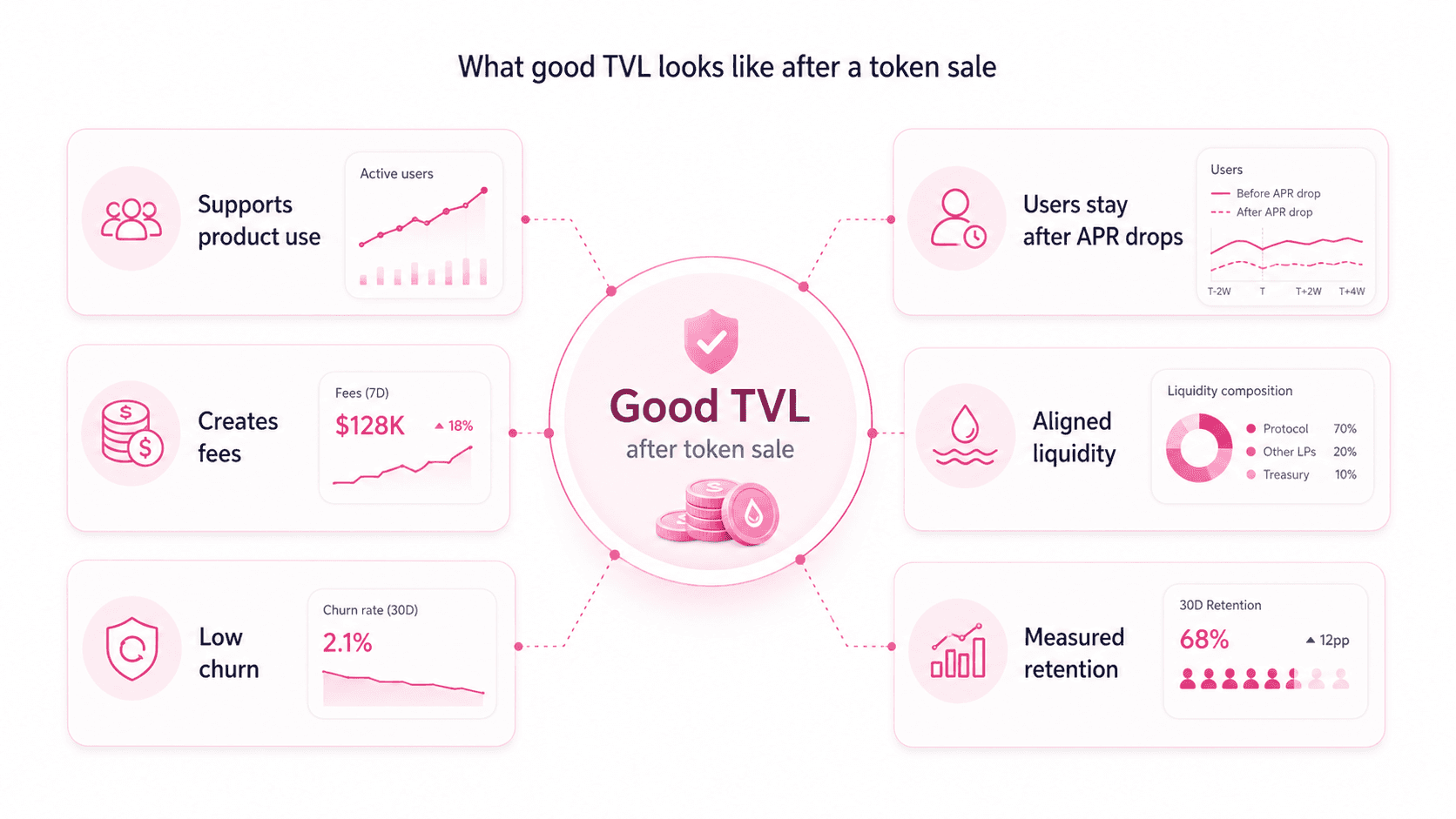
After a token sale, TVL becomes a post-launch credibility signal. Participants, partners, and exchanges may watch the number.  A stronger TVL program shows these signs:

  • Supplied liquidity supports trading, lending, staking, or settlement.

  • Capital creates fees or measurable product activity.

  • Users stay after APR declines.

  • Rewards target useful behavior, not passive capital.

  • Liquidity comes from aligned cohorts, not only reward farmers.

  • The team tracks retention, churn, and reward cost.

This makes TVL part of product design. Token projects have two goals after TGE. First, they need to hit their TVL target. Then, they need liquidity that supports product use after launch.

Read more: What is Token Generation Event (TGE)

Sustainable Liquidity vs Mercenary Liquidity in DeFi

Sustainable liquidity and mercenary liquidity can both increase TVL. The difference appears after rewards decline. 

Comparison Point

Sustainable Liquidity

Mercenary Liquidity

Main reason users join

Users need the product.

Users chase the highest APR.

Behavior after APR drops

Liquidity stays longer.

Capital moves somewhere else.

Product connection

Liquidity supports trading, lending, staking, or settlement.

Liquidity sits inside the protocol for rewards only.

Reward design

Rewards target useful behavior.

Rewards pay passive capital.

User quality

Capital comes from aligned cohorts.

Capital comes from short-term reward farmers.

Metrics to track

Retention, churn, fees, usage, reward cost.

Peak TVL and short-term inflow.

Main risk

Growth may take longer.

TVL can drop quickly after rewards decline.

This is why teams should not only ask how much TVL entered. If liquidity creates fees, supports activity, and stays after APR declines, the TVL program is healthier.

What Is APR, and When Does It Attract Mercenary Liquidity?

APR means annual percentage rate. In DeFi, APR shows the yearly reward rate for supplied capital. It is not the same as TVL. TVL measures how much capital sits inside the protocol. APR measures how much reward the protocol offers for that capital.

  • High APR means the protocol pays more rewards to attract capital.

  • Low APR means the protocol pays fewer rewards, so utility matters more.

Projects usually use APR to attract early liquidity after TGE. It can help liquidity pools, staking programs, or yield products grow faster.

The problem starts when APR becomes the main reason to participate. Users may join because rewards look high, not because they need the product. Once APR drops, they can move capital elsewhere.

This is how APR attracts mercenary liquidity.

Twin Finance explains this risk in liquidity flywheels. Native-token rewards can attract TVL, but weak token demand can reverse the cycle. That is why APR should reward useful behavior. It should not become the full TVL strategy.

Why High TVL Alone Does Not Prove Traction

TVL shows how much capital sits inside a protocol. But TVL does not prove users are active. It also does not prove retention, fee growth, or product demand.

DappRadar reported that DeFi reached $237 billion in TVL in Q3 2025. The same report said the dapp industry averaged 18.7 million active wallets per day, down 22.4% from the previous quarter. This shows why capital growth and user activity need separate checks.

A stronger TVL check asks:

  • Does liquidity support trading, lending, staking, or settlement?

  • Does the protocol create fees from that liquidity?

  • Do users stay after rewards decline?

  • Does capital come from useful cohorts?

  • Does TVL grow with active wallets and volume?

A lending protocol needs capital that supports loan demand. A DEX needs liquidity that improves execution. A staking product needs participation that connects to usage.

How Do Projects Bootstrap TVL Sustainably After TGE?

To bootstrap TVL means to build early TVL after launch. After TGE, many teams want TVL to grow fast. That is normal. The problem starts when teams reward capital before defining its purpose.

Early TVL should begin with product demand. Incentives should support actions that already matter to the protocol. Before setting APR, teams should answer these four checks:

Question

What It Checks

Better Direction

Which product action needs liquidity?

The real reason TVL is needed.

Support trading, lending, staking, or settlement.

Which user group benefits from it?

The cohort with product fit.

Prioritize users with real protocol usage.

Which reward supports useful behavior?

The link between incentive and action.

Reward liquidity that improves product function.

Which metric proves liquidity stayed?

The quality of post-TGE TVL.

Track retained TVL, churn, fees, and usage.

A sustainable TVL program should reward useful liquidity first. Reward budgets should also have a cap before launch.

For a deeper staking incentive framework, see: Which incentives actually bootstrap staking participation after TGE? (TM-15)

How to Reduce Mercenary Liquidity in DeFi

After teams understand TVL quality and APR risk, one question comes next. How can liquidity stay?

Sticky liquidity means capital stays because users need the product. Mercenary liquidity means capital leaves when another project offers higher rewards. To build sticky liquidity, a better TVL program separates users by behavior. Teams should check:

  • Who uses the product often?

  • Who keeps liquidity longer?

  • Who joins through trusted partners?

  • Who only appears when APR is high?

  • Who helps create trading, lending, or staking activity?

These user groups are called cohorts. After finding these cohorts, teams can design better rewards. Long-term users can receive rewards for staying. Active users can receive rewards for real product activity. Partner-sourced users can receive rewards when their liquidity supports the protocol.

How Do Projects Grow TVL After TGE Without Just Paying for It?
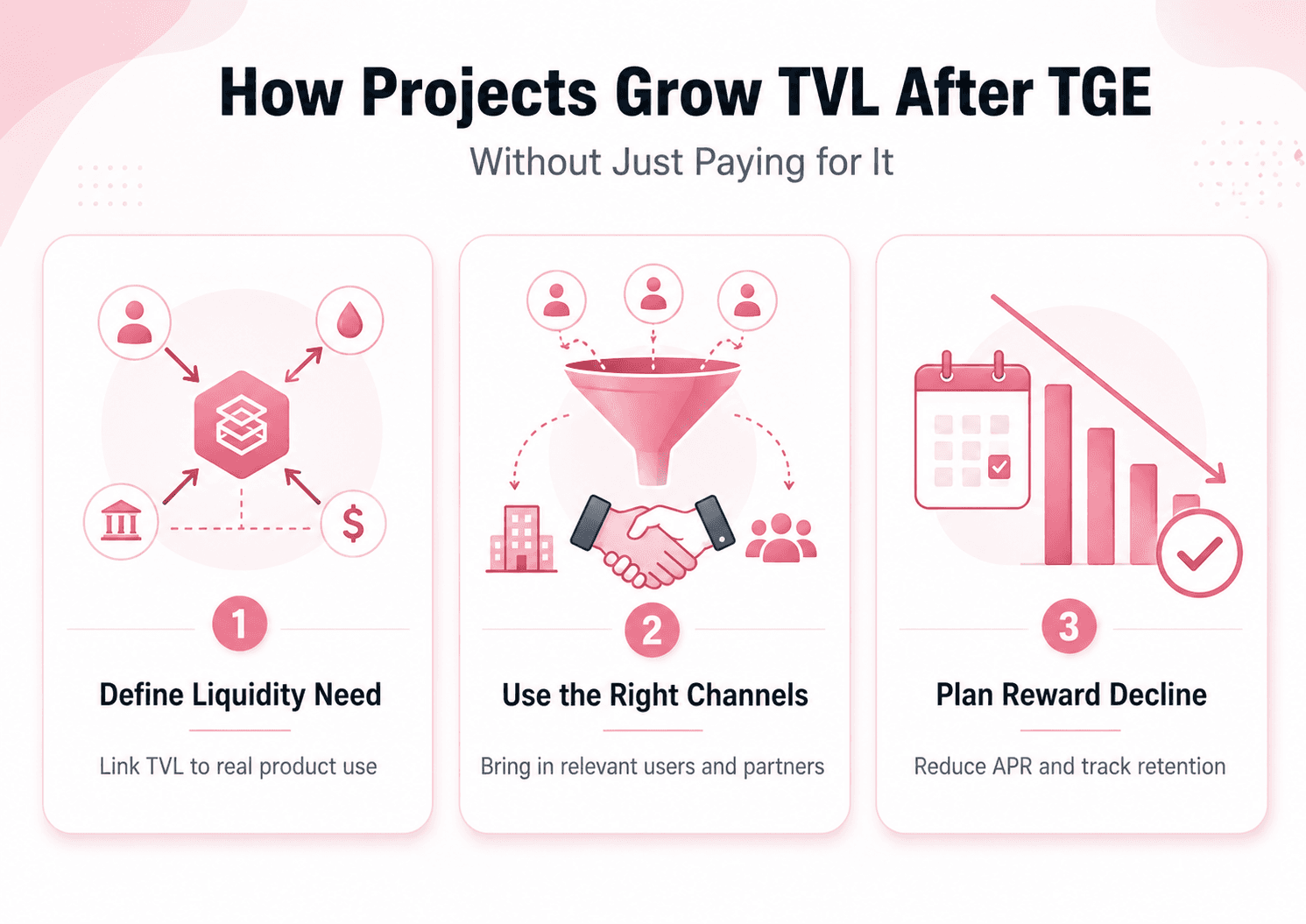
After TGE, projects need more than reward budgets. They need liquidity that connects to product use. A simple action plan has three parts:

1. Define Why Liquidity Is Needed

The team should link TVL to a real product action. Examples:

  • A DEX needs liquidity for better trade execution.

  • A lending protocol needs supplied assets with borrower demand.

  • A stablecoin product needs liquidity for payments or redemptions.

  • A staking product needs participation that supports access or governance.

This keeps TVL connected to real utility.

2. Bring Users Through the Right Channels

The team should choose partners that match the TVL goal.

A lending product can work with wallets, asset platforms, or borrower communities. A DEX can work with token projects that need deeper trading pairs. A stablecoin product can work with payment or treasury partners.

3. Reduce Rewards With a Retention Plan

Rewards should not stay high forever. But teams should not cut rewards without a plan. Before launch, the team should decide:

  • When APR will decline.

  • Which user groups should stay.

  • Which liquidity still supports product use.

  • Which rewards should continue.

  • Which rewards should stop.

This turns reward decay into a test.

If liquidity leaves after every APR drop, the project is still renting TVL. If users stay and activity continues, the program is building stronger TVL.

Teams that need the full post-launch incentive stack can read: How should liquidity, staking, and market-making incentives work together after launch? (TM-16)

Best TVL Metrics to Track After Token Launch

Teams should measure retained TVL, not only peak TVL. Peak TVL shows how much capital entered. Health metrics show whether that capital stayed, created activity, and supported the product.

Metric

What It Shows

Why It Matters

7, 30, and 90-day TVL retention

How much liquidity stays over time.

It shows whether TVL survives after launch hype.

Reward cost per retained dollar

How much emission creates lasting TVL.

It shows whether incentives are efficient.

Liquidity churn rate

How fast capital leaves the protocol.

High churn signals mercenary liquidity risk.

Active wallets using the product

Whether users actually engage.

TVL should grow with real usage.

Fees from supplied liquidity

Whether liquidity creates economic activity.

Fees show product demand, not only capital presence.

Revenue per liquidity cohort

Which user groups create value.

It helps teams reward better cohorts.

Repeat TVL from returning users

Whether users come back after rewards change.

Returning users signal stronger retention.

Partner-sourced TVL quality

Whether partner channels bring useful liquidity.

Not all partner traffic creates sticky TVL.

Reward emissions vs sell pressure

Whether rewards weaken the token market.

Emissions can hurt TVL if rewards get sold.

TVL concentration by top wallets

Whether TVL depends on a few large wallets.

High concentration can create sudden exit risk.

These metrics show whether liquidity behaves like capital or campaign traffic. The post-TGE team should review these metrics weekly. Fast changes matter because incentives affect markets quickly. Slow reviews can make emissions expensive.

For a deeper KPI framework, read: TVL vs active wallets vs volume vs retention: which KPI should founders prioritize? (TM-17)

Post-Sale TVL Design Checklist

A practical TVL plan should exist before incentives go live. Use this checklist during post-sale planning:

  • Define the product reason for TVL.

  • Segment users by liquidity behavior.

  • Set reward budgets before TGE.

  • Avoid one flat APR for every user.

  • Connect rewards to useful product actions.

  • Use locks only when utility supports them.

  • Build partner channels before campaign launch.

  • Track retained TVL, not only peak TVL.

  • Compare fees against reward costs.

  • Review sell pressure from emissions.

  • Reduce rewards through a planned schedule.

  • Prepare retention actions before rewards decline.

This checklist keeps the program grounded. It turns TVL growth into design work, not only campaign spend.

When Lock Mechanics Help TVL Retention

  • Locks work best when users receive real utility.

  • Locks can support governance, access, rewards, or fee sharing.

  • Locks should not trap users without product value.

  • Bad lock design can delay churn, not solve it.

  • Teams should compare locked TVL with active usage.

Common TVL Mistakes After a Token Sale

Many token projects repeat the same TVL mistakes after launch.

  • The first mistake is launching rewards before utility is clear. This makes APR the product. Users may deposit, farm, and leave.

  • The second mistake is treating peak TVL as traction. Peak TVL can reflect incentive timing. It does not always reflect demand.

  • The third mistake is paying every user the same rate. This rewards capital speed over capital quality.

  • The fourth mistake is ignoring reward sell pressure. Token emissions can weaken the same flywheel they were meant to support.

  • The fifth mistake is cutting rewards without a retention plan. Users need reasons to stay before APR declines.

These mistakes usually share one root cause. The team pays for liquidity before designing why liquidity should stay.

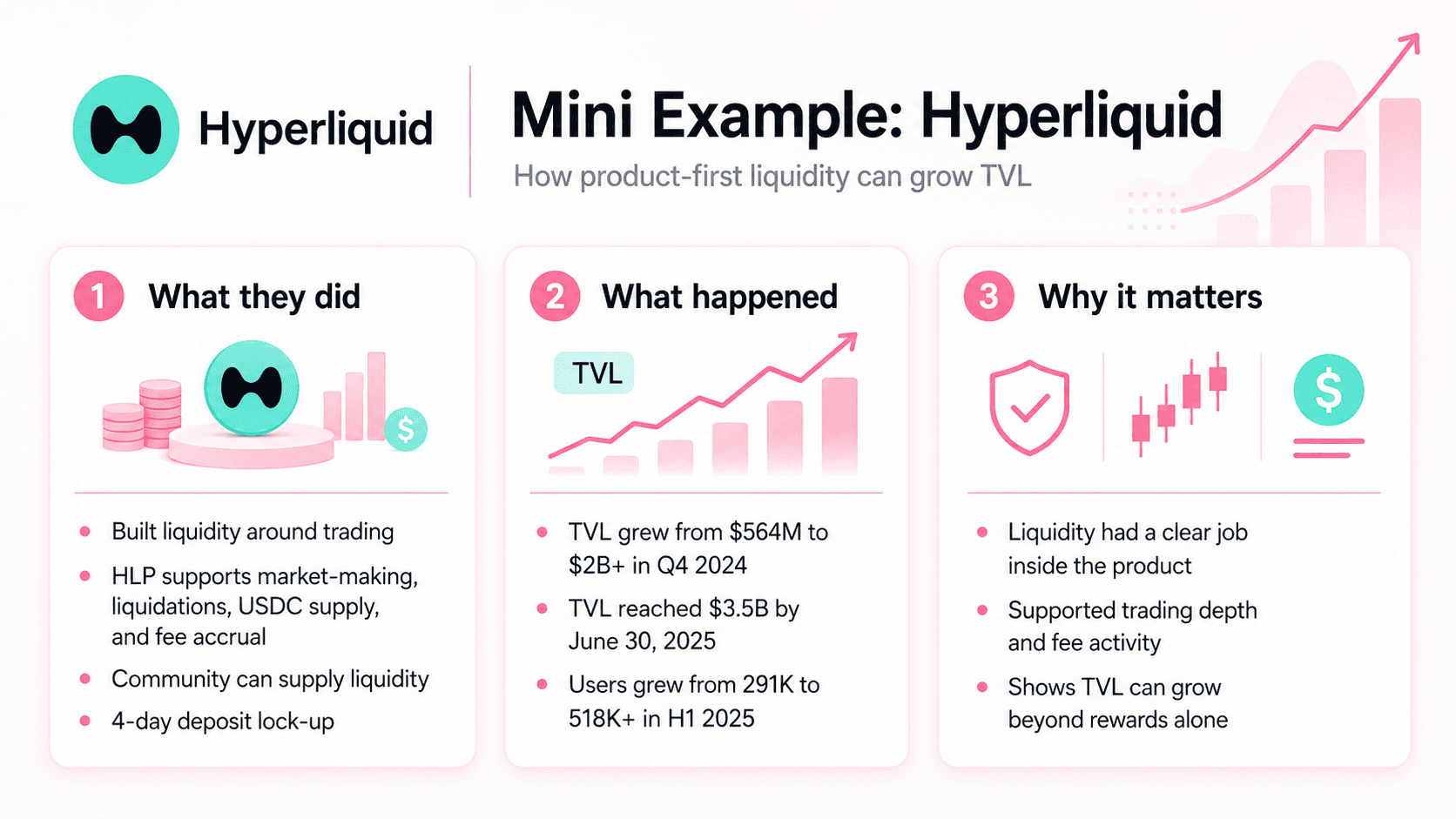
Mini Example: Hyperliquid

Hyperliquid shows how TVL can grow when liquidity supports product use.
What they did

What happened

Why it matters
Hyperliquid did not only attract capital with rewards. Its liquidity had a clear job inside the product.

It supported trading depth, market-making, liquidations, and fee activity. That makes it useful for this article’s point.

How TokenMinds Helps Design Sustainable TVL Programs

TokenMinds treats TVL growth as post-sale design work. That work connects tokenomics, incentives, product utility, partners, and retention metrics.

The process can support token sale teams across several areas including TVL program design and liquidity incentive planning.

This approach helps teams turn token sale momentum into durable liquidity. The program should not only fill dashboards. It should support product use and measurable activity.

Work with TokenMinds on a TVL growth design sprint before post-TGE incentives go live.

FAQs

  1. What is mercenary liquidity in crypto?

    Mercenary liquidity is capital that follows the highest rewards. It usually leaves when APR drops or better incentives appear elsewhere.

  2. Why does TVL drop after TGE?

    TVL often drops after TGE when rewards decline. Some users joined for incentives, not long-term product use.

  3. How do DeFi protocols retain liquidity?

    DeFi protocols retain liquidity through utility, user fit, lock benefits, partner channels, and measured rewards.

  4. Is high TVL bullish?

    High TVL can be positive, but it is not enough. Teams should also check retention, fees, volume, and active users.

  5. What is a liquidity flywheel?

    A liquidity flywheel is a growth loop. Product use attracts liquidity, liquidity improves the product, and better utility attracts more users.

  6. How do token emissions affect TVL?

    Token emissions can attract early TVL. But excessive emissions can create sell pressure when rewards get sold.


TL;DR
Sustainable TVL starts after the token sale, not during it. High APR can attract fast deposits, but weak utility can make that capital leave. Token projects need TVL that connects to product use, fees, revenue, and user retention. Mercenary liquidity follows rewards, not product value. Sticky liquidity stays because the protocol gives users a reason to stay. Teams should design rewards around cohorts, lock mechanics, partner channels, and post-TGE metrics. The goal is simple. Liquidity should support the product, not only decorate the dashboard.

What Is Sustainable TVL?

Sustainable TVL is liquidity that stays for a product reason. Users do not supply liquidity only because APR looks high. They stay because the protocol gives them utility, access, trading depth, lending demand, settlement value, or clear participation benefits.

TVL shows how much capital sits inside a protocol. It does not show whether that capital supports real product activity. A protocol can grow TVL while usage stays weak. Fees may stay low. Liquidity can also leave quickly when rewards decline.

Sustainable TVL needs one simple test. “Would the liquidity stay after rewards decline?” If not, the team has rented liquidity, not built a durable TVL.

What Sustainable TVL Looks Like After a Token Sale

After a token sale, TVL becomes a post-launch credibility signal. Participants, partners, and exchanges may watch the number.  A stronger TVL program shows these signs:

  • Supplied liquidity supports trading, lending, staking, or settlement.

  • Capital creates fees or measurable product activity.

  • Users stay after APR declines.

  • Rewards target useful behavior, not passive capital.

  • Liquidity comes from aligned cohorts, not only reward farmers.

  • The team tracks retention, churn, and reward cost.

This makes TVL part of product design. Token projects have two goals after TGE. First, they need to hit their TVL target. Then, they need liquidity that supports product use after launch.

Read more: What is Token Generation Event (TGE)

Sustainable Liquidity vs Mercenary Liquidity in DeFi

Sustainable liquidity and mercenary liquidity can both increase TVL. The difference appears after rewards decline. 

Comparison Point

Sustainable Liquidity

Mercenary Liquidity

Main reason users join

Users need the product.

Users chase the highest APR.

Behavior after APR drops

Liquidity stays longer.

Capital moves somewhere else.

Product connection

Liquidity supports trading, lending, staking, or settlement.

Liquidity sits inside the protocol for rewards only.

Reward design

Rewards target useful behavior.

Rewards pay passive capital.

User quality

Capital comes from aligned cohorts.

Capital comes from short-term reward farmers.

Metrics to track

Retention, churn, fees, usage, reward cost.

Peak TVL and short-term inflow.

Main risk

Growth may take longer.

TVL can drop quickly after rewards decline.

This is why teams should not only ask how much TVL entered. If liquidity creates fees, supports activity, and stays after APR declines, the TVL program is healthier.

What Is APR, and When Does It Attract Mercenary Liquidity?

APR means annual percentage rate. In DeFi, APR shows the yearly reward rate for supplied capital. It is not the same as TVL. TVL measures how much capital sits inside the protocol. APR measures how much reward the protocol offers for that capital.

  • High APR means the protocol pays more rewards to attract capital.

  • Low APR means the protocol pays fewer rewards, so utility matters more.

Projects usually use APR to attract early liquidity after TGE. It can help liquidity pools, staking programs, or yield products grow faster.

The problem starts when APR becomes the main reason to participate. Users may join because rewards look high, not because they need the product. Once APR drops, they can move capital elsewhere.

This is how APR attracts mercenary liquidity.

Twin Finance explains this risk in liquidity flywheels. Native-token rewards can attract TVL, but weak token demand can reverse the cycle. That is why APR should reward useful behavior. It should not become the full TVL strategy.

Why High TVL Alone Does Not Prove Traction

TVL shows how much capital sits inside a protocol. But TVL does not prove users are active. It also does not prove retention, fee growth, or product demand.

DappRadar reported that DeFi reached $237 billion in TVL in Q3 2025. The same report said the dapp industry averaged 18.7 million active wallets per day, down 22.4% from the previous quarter. This shows why capital growth and user activity need separate checks.

A stronger TVL check asks:

  • Does liquidity support trading, lending, staking, or settlement?

  • Does the protocol create fees from that liquidity?

  • Do users stay after rewards decline?

  • Does capital come from useful cohorts?

  • Does TVL grow with active wallets and volume?

A lending protocol needs capital that supports loan demand. A DEX needs liquidity that improves execution. A staking product needs participation that connects to usage.

How Do Projects Bootstrap TVL Sustainably After TGE?

To bootstrap TVL means to build early TVL after launch. After TGE, many teams want TVL to grow fast. That is normal. The problem starts when teams reward capital before defining its purpose.

Early TVL should begin with product demand. Incentives should support actions that already matter to the protocol. Before setting APR, teams should answer these four checks:

Question

What It Checks

Better Direction

Which product action needs liquidity?

The real reason TVL is needed.

Support trading, lending, staking, or settlement.

Which user group benefits from it?

The cohort with product fit.

Prioritize users with real protocol usage.

Which reward supports useful behavior?

The link between incentive and action.

Reward liquidity that improves product function.

Which metric proves liquidity stayed?

The quality of post-TGE TVL.

Track retained TVL, churn, fees, and usage.

A sustainable TVL program should reward useful liquidity first. Reward budgets should also have a cap before launch.

For a deeper staking incentive framework, see: Which incentives actually bootstrap staking participation after TGE? (TM-15)

How to Reduce Mercenary Liquidity in DeFi

After teams understand TVL quality and APR risk, one question comes next. How can liquidity stay?

Sticky liquidity means capital stays because users need the product. Mercenary liquidity means capital leaves when another project offers higher rewards. To build sticky liquidity, a better TVL program separates users by behavior. Teams should check:

  • Who uses the product often?

  • Who keeps liquidity longer?

  • Who joins through trusted partners?

  • Who only appears when APR is high?

  • Who helps create trading, lending, or staking activity?

These user groups are called cohorts. After finding these cohorts, teams can design better rewards. Long-term users can receive rewards for staying. Active users can receive rewards for real product activity. Partner-sourced users can receive rewards when their liquidity supports the protocol.

How Do Projects Grow TVL After TGE Without Just Paying for It?

After TGE, projects need more than reward budgets. They need liquidity that connects to product use. A simple action plan has three parts:

1. Define Why Liquidity Is Needed

The team should link TVL to a real product action. Examples:

  • A DEX needs liquidity for better trade execution.

  • A lending protocol needs supplied assets with borrower demand.

  • A stablecoin product needs liquidity for payments or redemptions.

  • A staking product needs participation that supports access or governance.

This keeps TVL connected to real utility.

2. Bring Users Through the Right Channels

The team should choose partners that match the TVL goal.

A lending product can work with wallets, asset platforms, or borrower communities. A DEX can work with token projects that need deeper trading pairs. A stablecoin product can work with payment or treasury partners.

3. Reduce Rewards With a Retention Plan

Rewards should not stay high forever. But teams should not cut rewards without a plan. Before launch, the team should decide:

  • When APR will decline.

  • Which user groups should stay.

  • Which liquidity still supports product use.

  • Which rewards should continue.

  • Which rewards should stop.

This turns reward decay into a test.

If liquidity leaves after every APR drop, the project is still renting TVL. If users stay and activity continues, the program is building stronger TVL.

Teams that need the full post-launch incentive stack can read: How should liquidity, staking, and market-making incentives work together after launch? (TM-16)

Best TVL Metrics to Track After Token Launch

Teams should measure retained TVL, not only peak TVL. Peak TVL shows how much capital entered. Health metrics show whether that capital stayed, created activity, and supported the product.

Metric

What It Shows

Why It Matters

7, 30, and 90-day TVL retention

How much liquidity stays over time.

It shows whether TVL survives after launch hype.

Reward cost per retained dollar

How much emission creates lasting TVL.

It shows whether incentives are efficient.

Liquidity churn rate

How fast capital leaves the protocol.

High churn signals mercenary liquidity risk.

Active wallets using the product

Whether users actually engage.

TVL should grow with real usage.

Fees from supplied liquidity

Whether liquidity creates economic activity.

Fees show product demand, not only capital presence.

Revenue per liquidity cohort

Which user groups create value.

It helps teams reward better cohorts.

Repeat TVL from returning users

Whether users come back after rewards change.

Returning users signal stronger retention.

Partner-sourced TVL quality

Whether partner channels bring useful liquidity.

Not all partner traffic creates sticky TVL.

Reward emissions vs sell pressure

Whether rewards weaken the token market.

Emissions can hurt TVL if rewards get sold.

TVL concentration by top wallets

Whether TVL depends on a few large wallets.

High concentration can create sudden exit risk.

These metrics show whether liquidity behaves like capital or campaign traffic. The post-TGE team should review these metrics weekly. Fast changes matter because incentives affect markets quickly. Slow reviews can make emissions expensive.

For a deeper KPI framework, read: TVL vs active wallets vs volume vs retention: which KPI should founders prioritize? (TM-17)

Post-Sale TVL Design Checklist

A practical TVL plan should exist before incentives go live. Use this checklist during post-sale planning:

  • Define the product reason for TVL.

  • Segment users by liquidity behavior.

  • Set reward budgets before TGE.

  • Avoid one flat APR for every user.

  • Connect rewards to useful product actions.

  • Use locks only when utility supports them.

  • Build partner channels before campaign launch.

  • Track retained TVL, not only peak TVL.

  • Compare fees against reward costs.

  • Review sell pressure from emissions.

  • Reduce rewards through a planned schedule.

  • Prepare retention actions before rewards decline.

This checklist keeps the program grounded. It turns TVL growth into design work, not only campaign spend.

When Lock Mechanics Help TVL Retention

  • Locks work best when users receive real utility.

  • Locks can support governance, access, rewards, or fee sharing.

  • Locks should not trap users without product value.

  • Bad lock design can delay churn, not solve it.

  • Teams should compare locked TVL with active usage.

Common TVL Mistakes After a Token Sale

Many token projects repeat the same TVL mistakes after launch.

  • The first mistake is launching rewards before utility is clear. This makes APR the product. Users may deposit, farm, and leave.

  • The second mistake is treating peak TVL as traction. Peak TVL can reflect incentive timing. It does not always reflect demand.

  • The third mistake is paying every user the same rate. This rewards capital speed over capital quality.

  • The fourth mistake is ignoring reward sell pressure. Token emissions can weaken the same flywheel they were meant to support.

  • The fifth mistake is cutting rewards without a retention plan. Users need reasons to stay before APR declines.

These mistakes usually share one root cause. The team pays for liquidity before designing why liquidity should stay.

Mini Example: Hyperliquid

Hyperliquid shows how TVL can grow when liquidity supports product use.

What they did

What happened

Why it matters
Hyperliquid did not only attract capital with rewards. Its liquidity had a clear job inside the product.

It supported trading depth, market-making, liquidations, and fee activity. That makes it useful for this article’s point.

How TokenMinds Helps Design Sustainable TVL Programs

TokenMinds treats TVL growth as post-sale design work. That work connects tokenomics, incentives, product utility, partners, and retention metrics.

The process can support token sale teams across several areas including TVL program design and liquidity incentive planning.

This approach helps teams turn token sale momentum into durable liquidity. The program should not only fill dashboards. It should support product use and measurable activity.

Work with TokenMinds on a TVL growth design sprint before post-TGE incentives go live.

FAQs

  1. What is mercenary liquidity in crypto?

    Mercenary liquidity is capital that follows the highest rewards. It usually leaves when APR drops or better incentives appear elsewhere.

  2. Why does TVL drop after TGE?

    TVL often drops after TGE when rewards decline. Some users joined for incentives, not long-term product use.

  3. How do DeFi protocols retain liquidity?

    DeFi protocols retain liquidity through utility, user fit, lock benefits, partner channels, and measured rewards.

  4. Is high TVL bullish?

    High TVL can be positive, but it is not enough. Teams should also check retention, fees, volume, and active users.

  5. What is a liquidity flywheel?

    A liquidity flywheel is a growth loop. Product use attracts liquidity, liquidity improves the product, and better utility attracts more users.

  6. How do token emissions affect TVL?

    Token emissions can attract early TVL. But excessive emissions can create sell pressure when rewards get sold.

GET SUCCESS IN WEB3

  • Trusted Web3 partner since 2017

  • Full-stack Web3 development team

  • Performance-driven Web3 marketing

Get A Free Consultation

Get A Free Consultation

MEET US AT

RECENT TRAININGS

Follow us

get web3 business updates

Email invalid

  • Access global liquidity for your RWA project with TMX Tokenize’s Canton Network integration

DISCOVER NOW

  • Access global liquidity for your RWA project with TMX Tokenize’s Canton Network integration

    JOIN NOW

DISCOVER

  • Access global liquidity for your RWA project with TMX Tokenize’s Canton Network integration