Web3 & AI

SOLUTIONS

Products

Services

Web3 & AI

SOLUTIONS

Services

Products

Industries

Become Our Client

About Us

Resources

Web3 & AI

SOLUTIONS

Services

Products

Industries

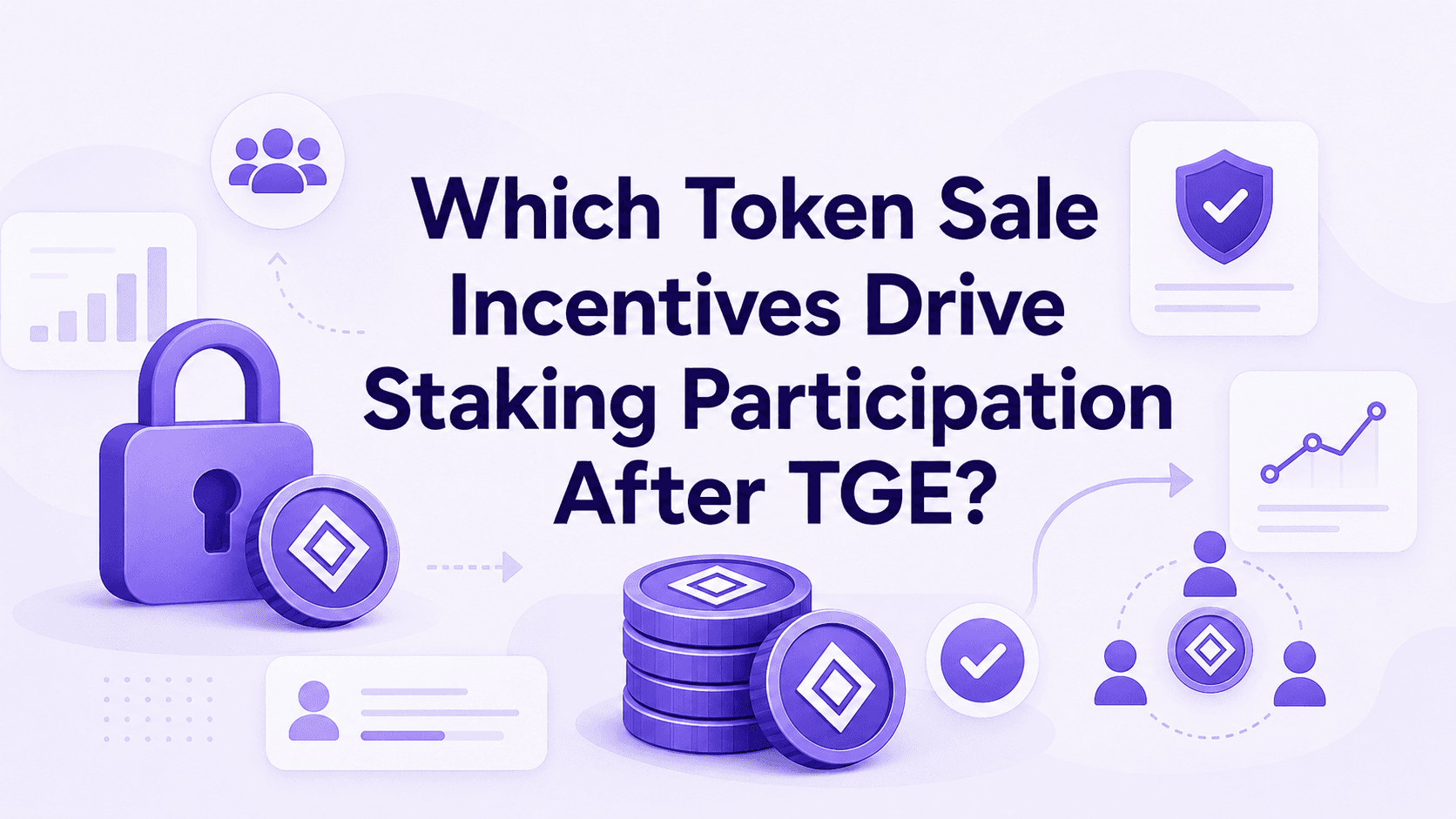
Which Token Sale Incentives Drive Staking Participation After TGE?

Which Token Sale Incentives Drive Staking Participation After TGE?

TL;DR
Staking can help token sale projects maintain active holders after the TGE, but only if incentives support real behavior. A high APR (Annual Percentage Rate) can attract quick deposits, but it can also attract opportunistic stakers who follow yield instead of the project. A better staking plan ensures rewards are linked to utility, access, governance rights, lock-ups, fee-backed rewards, and clear rules. The APR should follow the tokenomics plan, not market hype. Teams should review issuance, unlock times, float, and dashboard clarity before launch. Ethereum has also demonstrated that staking can function with lower yields when the role of staking is clear and beneficial.

What Is Staking?

In a crypto project, staking means holders commit tokens for a specific benefit. The project uses staking to turn token ownership into participation. That benefit can take several forms. Holders may receive token rewards, governance rights, platform access, fee-related rewards, or user status.

Staking works differently across projects. In Proof-of-Stake networks, staking can support validation and network security. In a token sale context, staking usually has a wider role. It helps holders stay active after tokens launch. They get another action besides holding or selling.

That is why staking design matters after token launch. It gives holders a clear action after they receive, buy, or earn tokens.

Why Does Staking Participation Matter After a Token Sale?

The job of a crypto project doesn't end once the money has been raised via a token sale. From there, the project must keep the activity going, the trust of the community and the usefulness of the tokens.

This can be aided by the creation of a clear crypto staking plan. Staking provides a motivation for token holders to remain engaged after the launch. They can be used to earn rewards, access, governance rights, or user status.

The flow is simple:

  1. The token sale brings holders into the project.

  2. The token launch provides them with liquidity.

  3. Others may choose to sell if there is no obvious role.

  4. Staking provides another action for holders other than selling.

  5. This is more effective if the token is actually useful.

This matters because early holder behavior can shape the market phase. A weak staking plan can attract short-term yield hunters. A stronger plan can support retention, participation, and supply discipline.

Staking can help token sale projects in three ways:

  1. Retention
    Holders have a reason to stay active.

  2. Participation
    Holders can access governance or platform benefits.

  3. Supply discipline
    Fewer tokens may enter immediate trading.

What Is APR in Staking?

APR stands for annual percentage rate. In staking, APR indicates the estimated annual reward before compounding. For token sale projects, APR helps token holders understand the reward offering. It's often the easiest figure to promote during launch.

However, APR doesn't reflect the overall quality of staking. It doesn't indicate whether the project can sustain the rewards earned during the token sale. This is crucial because staking rewards can come from various sources. Therefore, APR shouldn't stand alone. It must be linked to utility, lockup, emission, and clear reward rules.

Why High Staking APR Often Fails After TGE

High APR means the staking program offers a large estimated annual reward. It can attract fast participation after a token sale. But this does not always mean real commitment.
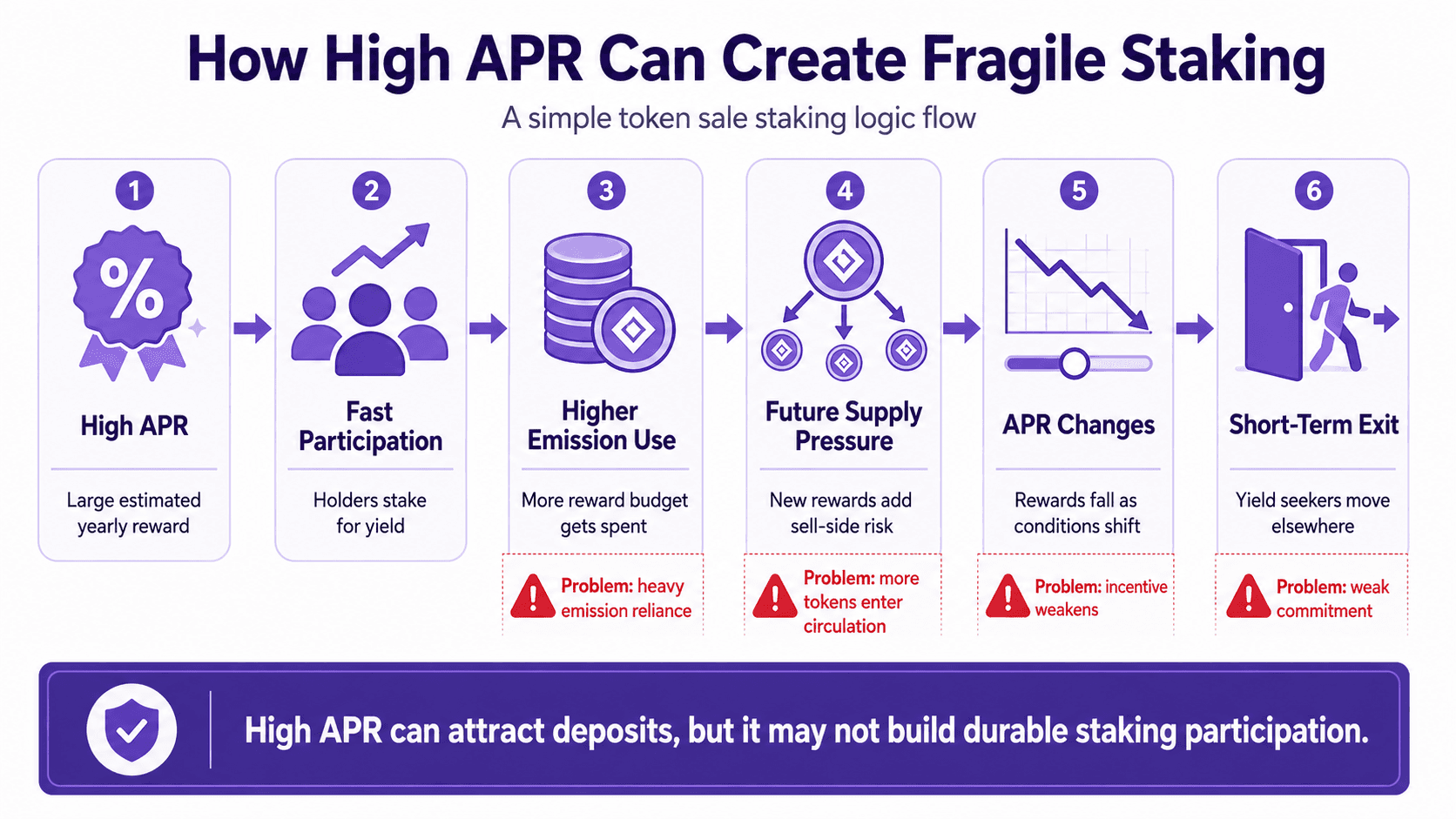
The logic works like this:

  1. Holders see a high APR.

  2. They stake tokens mainly for the reward.

  3. The project spends more on the emission budget.

  4. New rewards can increase future supply pressure.

  5. APR drops when the campaign changes.

  6. Short-term stakers move to another opportunity.

This is where mercenary behavior appears. The holder follows the reward, not the project. Speedrun Ethereum describes this as capital that enters for high APY, then leaves when another high-APY opportunity appears.

This pattern can also affect token sale liquidity. A deeper breakdown is covered in How to Build Sustainable TVL After a Token Sale Without Mercenary Liquidity TM-14.

Which Token Sale Incentives Drive Real Staking Participation?

The strongest staking incentives answer one practical question. Why should a holder commit tokens now?

The answer should include more than yield. It should connect staking with product role, user value, and commitment level. Below are the staking incentives that can drive participation, with the risk each one needs to manage.

Incentive type

How it drives participation

Main risk

Token utility

Gives holders a reason to stake

Utility may feel forced

Access perks

Links staking to product benefits

Perks may lack value

Governance rights

Turns holders into active participants

Governance may become symbolic

Lockup benefits

Rewards longer commitment

Users lose liquidity

Fee-backed rewards

Links rewards to protocol activity

Revenue may be too early

Reward clarity

Builds confidence through clear rules

Poor dashboards reduce trust

Token Utility

Token utility is the token’s actual role inside the project. It can include product access, fee discounts, governance actions, or ecosystem use.

It can help staking because holders need a reason to keep tokens. When the token has a clear role, staking feels connected to the product. This matters after a token sale. Holders should see why staking supports the project, not only rewards.

Access Perks

Access perks are benefits given to stakers. They can include feature access, priority access, discounts, or community status.

They can help staking because holders receive a product-related reason to participate. This makes the staking program feel more useful. Access perks work better when users already care about the product. If the product benefit feels weak, the perk may not matter.

Governance Rights

Governance rights let stakers join project decisions. They can vote on treasury use, ecosystem programs, product changes, or protocol rules.

They can help staking because holders become more involved. Staking becomes a way to join decision-making, not only earn rewards. This works only when governance has real impact. Symbolic voting can make the incentive feel empty.

Lockup Benefits

Lockup benefits reward holders for committing tokens longer. A longer lock can bring higher rewards, stronger voting power, or better access.

They can help staking because holders accept a clear tradeoff. They give up liquidity, then receive stronger benefits. This can support better post-launch discipline. Fewer unlocked tokens may enter immediate trading during the lock period.

Fee-Backed Rewards

Fee-backed rewards are staking rewards linked to protocol activity. They can come from platform fees, product usage, or other value flows.

They can help staking because rewards feel tied to actual project activity. This makes the reward source easier to understand. This model works better when the project already has real usage. Early projects should not overstate fee-backed rewards.

Reward Clarity

Reward clarity means the staking rules are easy to understand. Holders should know the APR, lock period, reward source, and withdrawal terms.

It can help staking because clear rules build trust. Holders are less likely to join when the program feels confusing. A simple dashboard can support this. It should show the key numbers without hiding tradeoffs.

This matters when APR changes, rewards unlock, or lockups end. Clear information helps holders understand what happens next.

What Staking APR Works Best After a Token Sale and TGE?

No universal APR fits every token launch.

According to CoinGecko, staking yields vary sharply across Proof-of-Stake blockchains. Its October 23, 2024 dataset lists ATOM at 18.5%, DOT at 11.5%, XTZ at 10%, ETH at 3%, and HBAR at 0.19%. CoinGecko also explains that staking yields depend on network design, token economics, staking ratio, and supply-demand factors.

This data shows one clear point. APR is not a number projects should copy. For a token sale project, APR should follow the tokenomics plan. The team needs to check emission budget, staking targets, unlock timing, and token utility.

For a token sale project, APR should follow a clear decision model:

  • Emission budget: how many tokens can the project spend on rewards?

  • Target staking ratio: how much circulating supply should staking attract?

  • Lock period: how long should holders commit their tokens?

  • Reward source: do rewards come from emissions, fees, or both?

  • Unlock timing: will rewards overlap with major token unlocks?

How Should Teams Design Staking Boosts Without Wrecking Float?

Staking boosts should reward a clear behavior. They should not only make APR look bigger. A boost can support stronger participation when it rewards:

  • Longer lockups, because holders accept less liquidity.

  • Governance activity, because holders join project decisions.

  • Product usage, because staking connects with real utility.

  • Ecosystem contribution, because rewards support useful actions.

According to Speedrun Ethereum, longer lockups can reduce sell pressure. They can also justify higher APY, stronger governance weight, or other benefits. The same source also warns that too much token creation can weaken value when supply grows faster than demand or utility.

This means staking boosts need supply control. A team should review each boost against float, emissions, and unlock timing.

Guardrail

How It Helps

Boost caps

Limits how large reward multipliers can become.

Campaign duration

Prevents temporary rewards from becoming permanent costs.

Claim schedules

Controls when rewards enter circulation.

Vesting alignment

Avoids reward payouts during major unlock pressure.

Reward decay

Reduces emission pressure as participation matures.

Anti-farming rules

Prevents users from joining only to extract rewards.

Dashboard clarity

Shows APR, lockups, rewards, and withdrawal rules clearly.

Read more to learn how liquidity, staking, and market-making incentives should work together after launch. (TM-16)

Staking Incentive Checklist Before Token Sale

A staking plan should be reviewed before launch pressure starts. The review should answer these questions.

  • What behavior should staking reward after TGE?

  • Which holder segment should the program attract?

  • What token utility supports the staking incentive?

  • Which rewards come from emissions?

  • Which rewards come from protocol value?

  • How long should lockups last?

  • What benefits apply to longer commitments?

  • How do rewards align with vesting and unlocks?

  • How does staking affect an effective float?

  • What dashboard metrics should users see?

This checklist keeps the program grounded. It also prevents random APR decisions.

Read more to learn which KPI founders should prioritize after launch, from TVL to active wallets, volume, and retention. (TM-17)

Case Study: Ethereum Staking

Ethereum is not a token sale project. This example is used only as a staking-role reference. Ethereum is a useful reference because its staking model does not rely on the highest yield. It connects staking with network security, validator responsibility, and long-term participation.

  • What is the staking strategy?
    Ethereum staking requires validators to commit ETH into the protocol. Validators receive rewards for proper participation. They can also face penalties when they fail duties or act dishonestly.

  • What is the yield context?
    CoinGecko’s October 23, 2024 dataset listed Ethereum staking yield at around 3.0%. This was far below Cosmos at 18.5%, Polkadot at 11.5%, and Tezos at 10.0%.

  • What is the result or benefit?
    Ethereum shows that staking can work with lower yield when the staking role is clear. The main benefit is not only the reward. The benefit also includes network security, validator participation, and stronger protocol alignment. Ethereum.org also describes home staking as a way to strengthen Ethereum’s robustness, decentralization, and security.

Lesson learned:

A token sale project should not copy Ethereum’s APR. The useful lesson is different. Staking works better when rewards connect with a clear role. For Ethereum, that role is network security. For a token sale project, that role may be product access, governance, utility, or longer-term holder participation.

How TokenMinds Reviews Staking Incentives Before TGE

Designing staking incentives before TGE requires balancing emissions, float, utility, and holder psychology. That review process is often overlooked during token sale planning.

TokenMinds reviews staking incentive design before TGE as part of token sale planning. The review checks whether rewards, lockups, emissions, vesting, and float support real holder behavior.

The goal is simple. Staking should give holders a clear reason to participate, not only chase APR.

Review staking incentives before TGE with TokenMinds. We can help align rewards, lockups, emissions, and float.


TL;DR
Staking can help token sale projects maintain active holders after the TGE, but only if incentives support real behavior. A high APR (Annual Percentage Rate) can attract quick deposits, but it can also attract opportunistic stakers who follow yield instead of the project. A better staking plan ensures rewards are linked to utility, access, governance rights, lock-ups, fee-backed rewards, and clear rules. The APR should follow the tokenomics plan, not market hype. Teams should review issuance, unlock times, float, and dashboard clarity before launch. Ethereum has also demonstrated that staking can function with lower yields when the role of staking is clear and beneficial.

What Is Staking?

In a crypto project, staking means holders commit tokens for a specific benefit. The project uses staking to turn token ownership into participation. That benefit can take several forms. Holders may receive token rewards, governance rights, platform access, fee-related rewards, or user status.

Staking works differently across projects. In Proof-of-Stake networks, staking can support validation and network security. In a token sale context, staking usually has a wider role. It helps holders stay active after tokens launch. They get another action besides holding or selling.

That is why staking design matters after token launch. It gives holders a clear action after they receive, buy, or earn tokens.

Why Does Staking Participation Matter After a Token Sale?

The job of a crypto project doesn't end once the money has been raised via a token sale. From there, the project must keep the activity going, the trust of the community and the usefulness of the tokens.

This can be aided by the creation of a clear crypto staking plan. Staking provides a motivation for token holders to remain engaged after the launch. They can be used to earn rewards, access, governance rights, or user status.

The flow is simple:

  1. The token sale brings holders into the project.

  2. The token launch provides them with liquidity.

  3. Others may choose to sell if there is no obvious role.

  4. Staking provides another action for holders other than selling.

  5. This is more effective if the token is actually useful.

This matters because early holder behavior can shape the market phase. A weak staking plan can attract short-term yield hunters. A stronger plan can support retention, participation, and supply discipline.

Staking can help token sale projects in three ways:

  1. Retention
    Holders have a reason to stay active.

  2. Participation
    Holders can access governance or platform benefits.

  3. Supply discipline
    Fewer tokens may enter immediate trading.

What Is APR in Staking?

APR stands for annual percentage rate. In staking, APR indicates the estimated annual reward before compounding. For token sale projects, APR helps token holders understand the reward offering. It's often the easiest figure to promote during launch.

However, APR doesn't reflect the overall quality of staking. It doesn't indicate whether the project can sustain the rewards earned during the token sale. This is crucial because staking rewards can come from various sources. Therefore, APR shouldn't stand alone. It must be linked to utility, lockup, emission, and clear reward rules.

Why High Staking APR Often Fails After TGE

High APR means the staking program offers a large estimated annual reward. It can attract fast participation after a token sale. But this does not always mean real commitment.

The logic works like this:

  1. Holders see a high APR.

  2. They stake tokens mainly for the reward.

  3. The project spends more on the emission budget.

  4. New rewards can increase future supply pressure.

  5. APR drops when the campaign changes.

  6. Short-term stakers move to another opportunity.

This is where mercenary behavior appears. The holder follows the reward, not the project. Speedrun Ethereum describes this as capital that enters for high APY, then leaves when another high-APY opportunity appears.

This pattern can also affect token sale liquidity. A deeper breakdown is covered in How to Build Sustainable TVL After a Token Sale Without Mercenary Liquidity TM-14.

Which Token Sale Incentives Drive Real Staking Participation?

The strongest staking incentives answer one practical question. Why should a holder commit tokens now?

The answer should include more than yield. It should connect staking with product role, user value, and commitment level. Below are the staking incentives that can drive participation, with the risk each one needs to manage.

Incentive type

How it drives participation

Main risk

Token utility

Gives holders a reason to stake

Utility may feel forced

Access perks

Links staking to product benefits

Perks may lack value

Governance rights

Turns holders into active participants

Governance may become symbolic

Lockup benefits

Rewards longer commitment

Users lose liquidity

Fee-backed rewards

Links rewards to protocol activity

Revenue may be too early

Reward clarity

Builds confidence through clear rules

Poor dashboards reduce trust

Token Utility

Token utility is the token’s actual role inside the project. It can include product access, fee discounts, governance actions, or ecosystem use.

It can help staking because holders need a reason to keep tokens. When the token has a clear role, staking feels connected to the product. This matters after a token sale. Holders should see why staking supports the project, not only rewards.

Access Perks

Access perks are benefits given to stakers. They can include feature access, priority access, discounts, or community status.

They can help staking because holders receive a product-related reason to participate. This makes the staking program feel more useful. Access perks work better when users already care about the product. If the product benefit feels weak, the perk may not matter.

Governance Rights

Governance rights let stakers join project decisions. They can vote on treasury use, ecosystem programs, product changes, or protocol rules.

They can help staking because holders become more involved. Staking becomes a way to join decision-making, not only earn rewards. This works only when governance has real impact. Symbolic voting can make the incentive feel empty.

Lockup Benefits

Lockup benefits reward holders for committing tokens longer. A longer lock can bring higher rewards, stronger voting power, or better access.

They can help staking because holders accept a clear tradeoff. They give up liquidity, then receive stronger benefits. This can support better post-launch discipline. Fewer unlocked tokens may enter immediate trading during the lock period.

Fee-Backed Rewards

Fee-backed rewards are staking rewards linked to protocol activity. They can come from platform fees, product usage, or other value flows.

They can help staking because rewards feel tied to actual project activity. This makes the reward source easier to understand. This model works better when the project already has real usage. Early projects should not overstate fee-backed rewards.

Reward Clarity

Reward clarity means the staking rules are easy to understand. Holders should know the APR, lock period, reward source, and withdrawal terms.

It can help staking because clear rules build trust. Holders are less likely to join when the program feels confusing. A simple dashboard can support this. It should show the key numbers without hiding tradeoffs.

This matters when APR changes, rewards unlock, or lockups end. Clear information helps holders understand what happens next.

What Staking APR Works Best After a Token Sale and TGE?

No universal APR fits every token launch.

According to CoinGecko, staking yields vary sharply across Proof-of-Stake blockchains. Its October 23, 2024 dataset lists ATOM at 18.5%, DOT at 11.5%, XTZ at 10%, ETH at 3%, and HBAR at 0.19%. CoinGecko also explains that staking yields depend on network design, token economics, staking ratio, and supply-demand factors.

This data shows one clear point. APR is not a number projects should copy. For a token sale project, APR should follow the tokenomics plan. The team needs to check emission budget, staking targets, unlock timing, and token utility.

For a token sale project, APR should follow a clear decision model:

  • Emission budget: how many tokens can the project spend on rewards?

  • Target staking ratio: how much circulating supply should staking attract?

  • Lock period: how long should holders commit their tokens?

  • Reward source: do rewards come from emissions, fees, or both?

  • Unlock timing: will rewards overlap with major token unlocks?

How Should Teams Design Staking Boosts Without Wrecking Float?

Staking boosts should reward a clear behavior. They should not only make APR look bigger. A boost can support stronger participation when it rewards:

  • Longer lockups, because holders accept less liquidity.

  • Governance activity, because holders join project decisions.

  • Product usage, because staking connects with real utility.

  • Ecosystem contribution, because rewards support useful actions.

According to Speedrun Ethereum, longer lockups can reduce sell pressure. They can also justify higher APY, stronger governance weight, or other benefits. The same source also warns that too much token creation can weaken value when supply grows faster than demand or utility.

This means staking boosts need supply control. A team should review each boost against float, emissions, and unlock timing.

Guardrail

How It Helps

Boost caps

Limits how large reward multipliers can become.

Campaign duration

Prevents temporary rewards from becoming permanent costs.

Claim schedules

Controls when rewards enter circulation.

Vesting alignment

Avoids reward payouts during major unlock pressure.

Reward decay

Reduces emission pressure as participation matures.

Anti-farming rules

Prevents users from joining only to extract rewards.

Dashboard clarity

Shows APR, lockups, rewards, and withdrawal rules clearly.

Read more to learn how liquidity, staking, and market-making incentives should work together after launch. (TM-16)

Staking Incentive Checklist Before Token Sale

A staking plan should be reviewed before launch pressure starts. The review should answer these questions.

  • What behavior should staking reward after TGE?

  • Which holder segment should the program attract?

  • What token utility supports the staking incentive?

  • Which rewards come from emissions?

  • Which rewards come from protocol value?

  • How long should lockups last?

  • What benefits apply to longer commitments?

  • How do rewards align with vesting and unlocks?

  • How does staking affect an effective float?

  • What dashboard metrics should users see?

This checklist keeps the program grounded. It also prevents random APR decisions.

Read more to learn which KPI founders should prioritize after launch, from TVL to active wallets, volume, and retention. (TM-17)

Case Study: Ethereum Staking

Ethereum is not a token sale project. This example is used only as a staking-role reference. Ethereum is a useful reference because its staking model does not rely on the highest yield. It connects staking with network security, validator responsibility, and long-term participation.

  • What is the staking strategy?
    Ethereum staking requires validators to commit ETH into the protocol. Validators receive rewards for proper participation. They can also face penalties when they fail duties or act dishonestly.

  • What is the yield context?
    CoinGecko’s October 23, 2024 dataset listed Ethereum staking yield at around 3.0%. This was far below Cosmos at 18.5%, Polkadot at 11.5%, and Tezos at 10.0%.

  • What is the result or benefit?
    Ethereum shows that staking can work with lower yield when the staking role is clear. The main benefit is not only the reward. The benefit also includes network security, validator participation, and stronger protocol alignment. Ethereum.org also describes home staking as a way to strengthen Ethereum’s robustness, decentralization, and security.

Lesson learned:

A token sale project should not copy Ethereum’s APR. The useful lesson is different. Staking works better when rewards connect with a clear role. For Ethereum, that role is network security. For a token sale project, that role may be product access, governance, utility, or longer-term holder participation.

How TokenMinds Reviews Staking Incentives Before TGE

Designing staking incentives before TGE requires balancing emissions, float, utility, and holder psychology. That review process is often overlooked during token sale planning.

TokenMinds reviews staking incentive design before TGE as part of token sale planning. The review checks whether rewards, lockups, emissions, vesting, and float support real holder behavior.

The goal is simple. Staking should give holders a clear reason to participate, not only chase APR.

Review staking incentives before TGE with TokenMinds. We can help align rewards, lockups, emissions, and float.

GET SUCCESS IN WEB3

  • Trusted Web3 partner since 2017

  • Full-stack Web3 development team

  • Performance-driven Web3 marketing

Get A Free Consultation

Get A Free Consultation

MEET US AT

RECENT TRAININGS

Follow us

get web3 business updates

Email invalid

  • Access global liquidity for your RWA project with TMX Tokenize’s Canton Network integration

DISCOVER NOW

  • Access global liquidity for your RWA project with TMX Tokenize’s Canton Network integration

    JOIN NOW

DISCOVER

  • Access global liquidity for your RWA project with TMX Tokenize’s Canton Network integration