Web3 & AI

SOLUTIONS

Products

Services

Web3 & AI

SOLUTIONS

Services

Products

Industries

Become Our Client

About Us

Resources

Web3 & AI

SOLUTIONS

Services

Products

Industries

How ERP, E-Invoicing, and Debtor Confirmation Feed Tokenized Receivables Collateral

How ERP, E-Invoicing, and Debtor Confirmation Feed Tokenized Receivables Collateral

TL;DR 

Tokenized receivables collateral depends on clean, verified data from upstream systems. This guide maps the full integration path. It covers how invoice records move from ERP and e-invoicing networks into the tokenization layer. It defines the debtor confirmation workflow, the event sequence from issuance to release, and the API checkpoints at each stage. It also addresses exception handling and off-chain reconciliation.

Why Integration Is the Real Implementation Challenge

Most tokenized receivables programs stall at the integration layer. The token format is not the hard part. Getting clean, verified invoice data from legacy systems into a collateral workflow is.

Chainlink identifies ERP data, debtor details, and payment terms as core inputs for tokenized invoices. Those inputs do not arrive automatically. They require deliberate integration design across three source systems: the seller's ERP, the e-invoicing network, and the debtor confirmation channel.

Each system has its own data format, validation rules and update frequency. The integration layer must reconcile all three into a single bank-grade collateral record.

Stage 1: Extract and Send Data from ERP Systems

The ERP system should provide invoice data as the source of truth. This includes the invoice ID, amount, currency, due date, payment terms, and underlying trade reference.

Banks cannot accept unstructured or manually entered invoice data for collateral purposes. The data must come directly from the ERP via a secure API connection. This removes human error from the origination step.

The extraction process has three steps. First, the ERP creates the invoice. Second, an API call sends the structured record. Third, the platform validates the record against field completeness and format rules.

At this point, any invoice that is not validated is rejected. It does not go into the collateral workflow. The rejection is logged with an error code and timestamp and remediated.

ERP Data Field

Validation Rule

Rejection Trigger

invoice_id

Unique, not previously submitted

Duplicate hash match

invoice_amount

Positive decimal, within policy limits

Zero or negative value

invoice_currency

Valid ISO 4217 code

Unrecognized currency code

due_date

Future date, within eligible maturity window

Past due or outside policy range

payment_terms_days

Integer, matches policy parameters

Outside eligible terms range

Stage 2: Integration of E-Invoicing Network 

E-invoicing networks offer an independent layer of invoice validation. They verify that the invoice has been registered in a government or network registry, outside the ERP record.

Across many markets, PEPPOL is widely used for structured e-invoice exchange, especially in Europe and parts of Asia-Pacific. In North America, EDI networks fulfill the same roles in trade corridors. Both transmit structured invoice data between buyer and seller systems with compliance logging built in.

For bank collateral purposes, e-invoicing network integration provides three things. First, it confirms the invoice was formally transmitted to the debtor. Second, it provides a network-level timestamp that supports the audit trail. Third, it enables cross-reference between the ERP record and the network record, which is a strong duplicate financing control.

Banks should require that invoices submitted for tokenization carry a network transmission reference where e-invoicing infrastructure exists in the relevant market. Invoices without a network reference are not automatically ineligible, but they require additional manual verification steps.

Read What Data Must Banks Verify Before Tokenizing Accounts Receivable? for the full verification checklist that e-invoicing data feeds into.

Stage 3: Debtor Confirmation Workflow

Debtor confirmation is the most operationally complex integration point. It requires a secure, documented acknowledgment from a third party outside the bank's direct control.
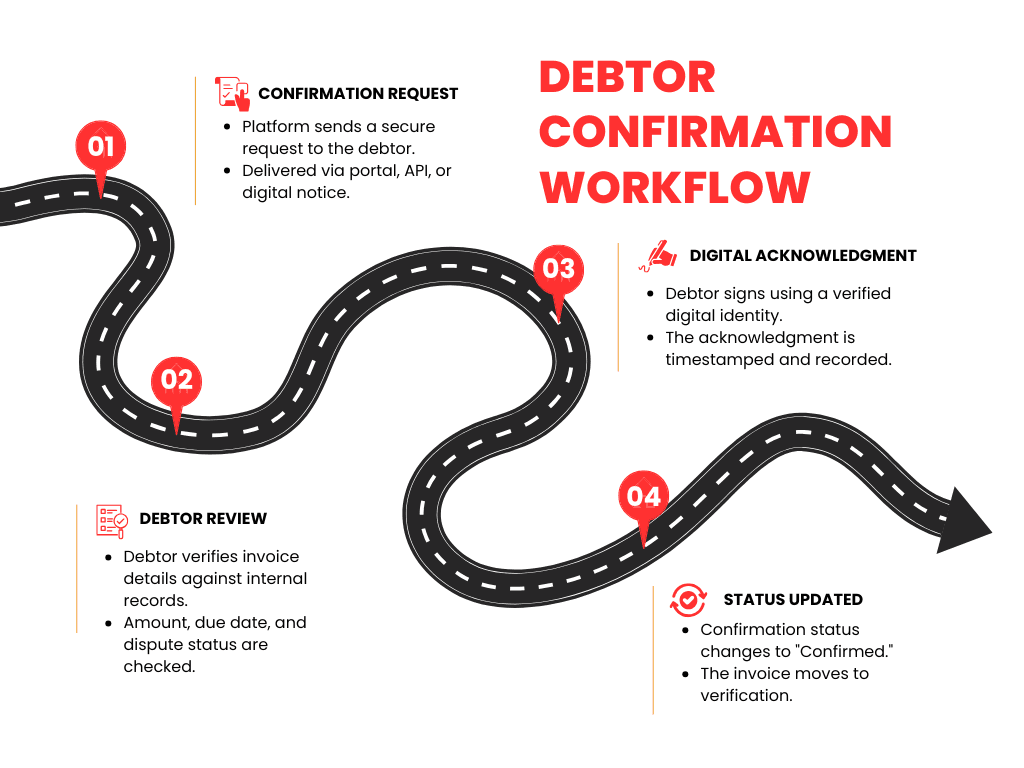
The confirmation workflow follows four steps:

  1. The bank sends a secure confirmation request to the debtor via API or portal.

  2. The debtor reviews invoice details, verifies amounts and due dates, and digitally acknowledges the obligation.

  3. The platform logs the cryptographic confirmation with a timestamp and links it to the token record.

  4. If the debtor rejects or disputes the invoice, it is flagged and removed from the eligible pool.

If the confirmation is not received in the time window, the invoice’s status is changed to Pending Timeout. Whether the timeout results in an automatic rejection or manual escalation is defined in the bank policy.

Stage 4: Event Sequencing from Issuance to Release

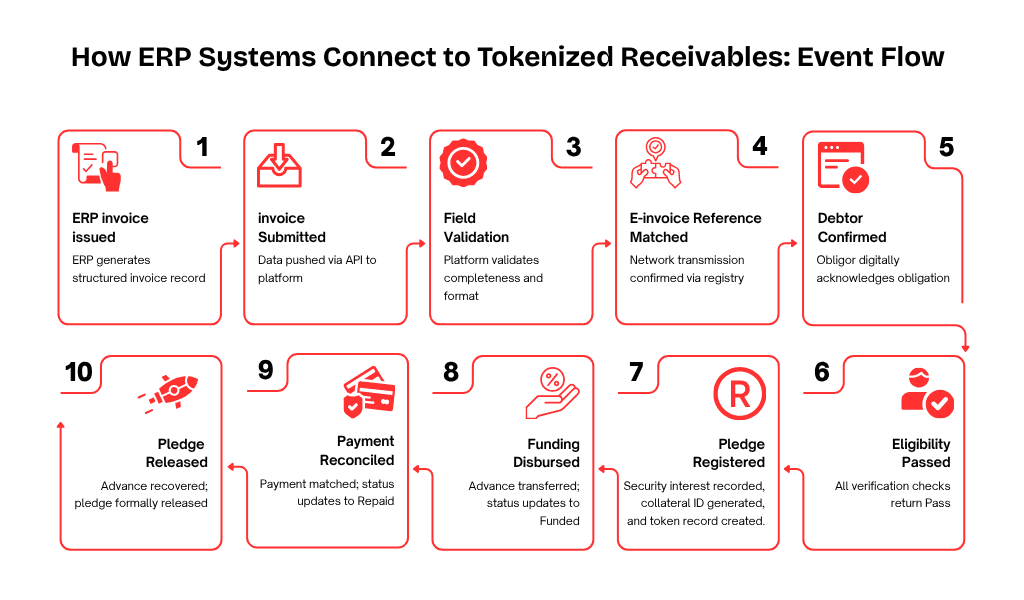
Every step in the collateral lifecycle is a logged event. The sequence is fixed. No stage can be skipped without triggering a system exception.
Event

Trigger

System Actor

Invoice Issued

ERP pushes invoice record to platform

ERP integration layer

Validation Passed

All required fields present and valid

Platform validation engine

E-Invoicing Reference Matched

Network transmission reference confirmed

E-invoicing connector

Debtor Confirmation Received

Cryptographic acknowledgment logged

Confirmation portal

Eligibility Check Passed

All verification events return Pass outcome

Verification engine

Pledge Registered

Security interest recorded in registry

Collateral operations

Funding Disbursed

Advance amount transferred to seller

Treasury system

Payment Received

Debtor payment confirmed and reconciled

Reconciliation engine

Pledge Released

Advance recovered, release authorized

Collateral operations

Each event record carries a timestamp, an actor ID, and a reference to the previous event. This creates an unbroken chain from origination to release.

Read Tokenized Invoice Data Model 2026: Fields Banks Need Before Collateral Approval for the full field-level specification behind each event record.

Stage 5: API Checklist for Bank Integration Teams

The integration architecture requires specific API endpoints at each stage. The table below defines the minimum API surface for a bank-grade tokenized receivables program.

Endpoint

Method

Purpose

/invoices/submit

POST

Push invoice record from ERP to platform

/invoices/{id}/status

GET

Retrieve current invoice and collateral status

/invoices/{id}/validate

POST

Trigger field validation and duplicate check

/confirmation/request

POST

Send confirmation request to debtor

/confirmation/{id}/status

GET

Check debtor confirmation status

/verification/run

POST

Trigger full verification event sequence

/pledge/register

POST

Register security interest and generate collateral ID

/funding/disburse

POST

Record advance disbursement against collateral

/payments/reconcile

POST

Match incoming payment to token record

/pledge/release

POST

Initiate pledge release after full repayment

/audit/events/{id}

GET

Retrieve full event log for a collateral position

These endpoints are complemented with webhook triggers. Payment events, confirmation updates and exception flags are pushed to the bank’s system in real time. The bank does not need to poll for status changes.

Bank API controls should include:

  • OAuth or signed API authentication

  • Idempotency keys for duplicate submission control

  • Webhook retry logic

  • Payload schema validation

  • API versioning

  • Immutable audit logs

Read Bank-Grade API Requirements for Tokenized Trade Collateral Platforms for the full API specification and security requirements.

Stage 6: Exception Handling

Four exception types require defined handling logic. Leaving them to manual resolution creates bottlenecks and audit gaps.

  1. Invoice amount difference. Invoice amount in ERP does not match invoice amount on e-invoicing network record. The invoice is on hold for manual review. Both source records are flagged for reconciliation prior to the verification stage proceeding.

  2. Rejected debtor confirmations. The debtor disputes the amount of the invoice, the due date or the underlying trade. The invoice will be excluded from the eligible pool. The seller will be informed about the reason for the rejection. A new invoice cannot be submitted for the same trade until the dispute is resolved.

  3. Duplicate submissions. There is a platform invoice with identical hash. The second submission is rejected immediately. The originator receives an error code with the reference ID of the existing record.

  4. Payment failures. The debtor payment is returned, reversed or only partially received and the shortfall is flagged by the reconciliation engine. The pledge is active and the bank collections workflow is triggered according to the default policy defined.

Stage 7: Reconciliation of Off-chain to On-chain

The token status must always match the real-world payment status. If a token shows Funded when the debtor has already paid, it results in a false collateral position.

Reconciliation is via payment event webhooks. The webhook fires when the debtor’s bank confirms a payment that matches the invoice reference, amount and currency. The reconciliation engine validates the match. The token status updates to Repaid. The pledge release process begins.

A payment can update the token status to Repaid only when:

  • The payment reference matches the invoice ID.

  • The payment amount covers the outstanding advance.

  • The payment currency matches the advance currency.

If any condition fails, the payment is logged as a partial match. The engine triggers a manual review flag. The token status does not change until the review is resolved.

Security and Access Controls

Cross-system data flows introduce data privacy and access control risks. Three controls apply across the full integration.

  1. Role-based permissions. Each system actor, ERP connector, confirmation portal, verification engine, collateral operations, and treasury, has defined read and write permissions. No actor can update records outside its scope of responsibility.

  2. All data in transit is encrypted. All API calls between source systems and the tokenization platform are encrypted with TLS 1.2 or higher. Invoice data, debtor details and payment records are encrypted end-to-end.

  3. Regulatory audit logging. Every API call is logged with a timestamp, actor ID, and payload hash. Logs are immutable. Regulators and internal auditors can retrieve a complete record of every data exchange for any collateral position.

Build an ERP-to-Collateral Integration Map With TokenMinds

Tokenized receivables programs need more than smart contracts. Banks need a clear integration path from ERP records, e-invoicing references, debtor confirmation, funding events, and repayment reconciliation.

TokenMinds helps banks and fintech teams design the API flow, collateral event model, and verification architecture needed for tokenized receivables collateral.

Book a call to map your ERP-to-collateral workflow. https://tokenminds.co/become-our-client/ 

Frequently Asked Questions

Q: How can banks confirm debtor acceptance before funding invoices?
A: Banks can send a secure confirmation request to the debtor through a portal, API, or digital notice. The debtor verifies the amount, due date, and dispute status. Funding should only proceed after the confirmation is recorded, timestamped, and linked to the invoice record.

Q: Does the ERP need to be changed to support this integration? 
A: Not always. Most modern ERP systems support API-based data export, without custom development. The integration layer is between the ERP and the tokenization platform. It does the translation and validation of the format. The ERP works as it should.

Q. What if the network is down when I submit? 
A. The platform queues the invoice and polls the network reference on a schedule. The invoice proceeds to the verification stage only when the network reference is complete. If the network does not come back online in the retry window, the invoice is flagged for manual review.

Q: Can a bank run this integration without a PEPPOL-connected e-invoicing network? 
A: Yes it can. PEPPOL connectivity adds an independent validation layer but is not a hard requirement in all markets. Where no e-invoicing network exists, the bank must apply additional manual verification steps to compensate. The verification checklist in CM-39 defines what those steps look like.

References

  1. Chainlink: "Invoice Tokenization in Trade Finance." Tokenized invoices are based on core inputs such as ERP data, debtor information and payment terms. https://chain.link/article/invoice-tokenization-trade-finance

  2. OpenPeppol: "PEPPOL Bis Billing 3.0 Specifications." Defines the standard for e-invoice exchange and network validation across European and APAC markets. https://docs.peppol.eu/poacc/billing/3.0/ 

  3. ISO: "ISO 4217 Currency Codes." Official standard for three-letter currency codes used in ERP and financial system integration. https://www.iso.org/iso-4217-currency-codes.html 

  4. NIST: "Transport Layer Security (TLS) Guidelines." Provides security standards for encrypting data in transit between ERP, banking, and tokenization platforms. https://csrc.nist.gov/news/2019/nist-publishes-sp-800-52-revision-2 

  5. ISO: "ISO 20022 Financial Services." Defines the global standard for electronic data interchange between financial institutions, including invoice and payment message formats. https://www.iso.org/standard/92561.html 

TL;DR 

Tokenized receivables collateral depends on clean, verified data from upstream systems. This guide maps the full integration path. It covers how invoice records move from ERP and e-invoicing networks into the tokenization layer. It defines the debtor confirmation workflow, the event sequence from issuance to release, and the API checkpoints at each stage. It also addresses exception handling and off-chain reconciliation.

Why Integration Is the Real Implementation Challenge

Most tokenized receivables programs stall at the integration layer. The token format is not the hard part. Getting clean, verified invoice data from legacy systems into a collateral workflow is.

Chainlink identifies ERP data, debtor details, and payment terms as core inputs for tokenized invoices. Those inputs do not arrive automatically. They require deliberate integration design across three source systems: the seller's ERP, the e-invoicing network, and the debtor confirmation channel.

Each system has its own data format, validation rules and update frequency. The integration layer must reconcile all three into a single bank-grade collateral record.

Stage 1: Extract and Send Data from ERP Systems

The ERP system should provide invoice data as the source of truth. This includes the invoice ID, amount, currency, due date, payment terms, and underlying trade reference.

Banks cannot accept unstructured or manually entered invoice data for collateral purposes. The data must come directly from the ERP via a secure API connection. This removes human error from the origination step.

The extraction process has three steps. First, the ERP creates the invoice. Second, an API call sends the structured record. Third, the platform validates the record against field completeness and format rules.

At this point, any invoice that is not validated is rejected. It does not go into the collateral workflow. The rejection is logged with an error code and timestamp and remediated.

ERP Data Field

Validation Rule

Rejection Trigger

invoice_id

Unique, not previously submitted

Duplicate hash match

invoice_amount

Positive decimal, within policy limits

Zero or negative value

invoice_currency

Valid ISO 4217 code

Unrecognized currency code

due_date

Future date, within eligible maturity window

Past due or outside policy range

payment_terms_days

Integer, matches policy parameters

Outside eligible terms range

Stage 2: Integration of E-Invoicing Network 

E-invoicing networks offer an independent layer of invoice validation. They verify that the invoice has been registered in a government or network registry, outside the ERP record.

Across many markets, PEPPOL is widely used for structured e-invoice exchange, especially in Europe and parts of Asia-Pacific. In North America, EDI networks fulfill the same roles in trade corridors. Both transmit structured invoice data between buyer and seller systems with compliance logging built in.

For bank collateral purposes, e-invoicing network integration provides three things. First, it confirms the invoice was formally transmitted to the debtor. Second, it provides a network-level timestamp that supports the audit trail. Third, it enables cross-reference between the ERP record and the network record, which is a strong duplicate financing control.

Banks should require that invoices submitted for tokenization carry a network transmission reference where e-invoicing infrastructure exists in the relevant market. Invoices without a network reference are not automatically ineligible, but they require additional manual verification steps.

Read What Data Must Banks Verify Before Tokenizing Accounts Receivable? for the full verification checklist that e-invoicing data feeds into.

Stage 3: Debtor Confirmation Workflow

Debtor confirmation is the most operationally complex integration point. It requires a secure, documented acknowledgment from a third party outside the bank's direct control.

The confirmation workflow follows four steps:

  1. The bank sends a secure confirmation request to the debtor via API or portal.

  2. The debtor reviews invoice details, verifies amounts and due dates, and digitally acknowledges the obligation.

  3. The platform logs the cryptographic confirmation with a timestamp and links it to the token record.

  4. If the debtor rejects or disputes the invoice, it is flagged and removed from the eligible pool.

If the confirmation is not received in the time window, the invoice’s status is changed to Pending Timeout. Whether the timeout results in an automatic rejection or manual escalation is defined in the bank policy.

Stage 4: Event Sequencing from Issuance to Release

Every step in the collateral lifecycle is a logged event. The sequence is fixed. No stage can be skipped without triggering a system exception.

Event

Trigger

System Actor

Invoice Issued

ERP pushes invoice record to platform

ERP integration layer

Validation Passed

All required fields present and valid

Platform validation engine

E-Invoicing Reference Matched

Network transmission reference confirmed

E-invoicing connector

Debtor Confirmation Received

Cryptographic acknowledgment logged

Confirmation portal

Eligibility Check Passed

All verification events return Pass outcome

Verification engine

Pledge Registered

Security interest recorded in registry

Collateral operations

Funding Disbursed

Advance amount transferred to seller

Treasury system

Payment Received

Debtor payment confirmed and reconciled

Reconciliation engine

Pledge Released

Advance recovered, release authorized

Collateral operations

Each event record carries a timestamp, an actor ID, and a reference to the previous event. This creates an unbroken chain from origination to release.

Read Tokenized Invoice Data Model 2026: Fields Banks Need Before Collateral Approval for the full field-level specification behind each event record.

Stage 5: API Checklist for Bank Integration Teams

The integration architecture requires specific API endpoints at each stage. The table below defines the minimum API surface for a bank-grade tokenized receivables program.

Endpoint

Method

Purpose

/invoices/submit

POST

Push invoice record from ERP to platform

/invoices/{id}/status

GET

Retrieve current invoice and collateral status

/invoices/{id}/validate

POST

Trigger field validation and duplicate check

/confirmation/request

POST

Send confirmation request to debtor

/confirmation/{id}/status

GET

Check debtor confirmation status

/verification/run

POST

Trigger full verification event sequence

/pledge/register

POST

Register security interest and generate collateral ID

/funding/disburse

POST

Record advance disbursement against collateral

/payments/reconcile

POST

Match incoming payment to token record

/pledge/release

POST

Initiate pledge release after full repayment

/audit/events/{id}

GET

Retrieve full event log for a collateral position

These endpoints are complemented with webhook triggers. Payment events, confirmation updates and exception flags are pushed to the bank’s system in real time. The bank does not need to poll for status changes.

Bank API controls should include:

  • OAuth or signed API authentication

  • Idempotency keys for duplicate submission control

  • Webhook retry logic

  • Payload schema validation

  • API versioning

  • Immutable audit logs

Read Bank-Grade API Requirements for Tokenized Trade Collateral Platforms for the full API specification and security requirements.

Stage 6: Exception Handling

Four exception types require defined handling logic. Leaving them to manual resolution creates bottlenecks and audit gaps.

  1. Invoice amount difference. Invoice amount in ERP does not match invoice amount on e-invoicing network record. The invoice is on hold for manual review. Both source records are flagged for reconciliation prior to the verification stage proceeding.

  2. Rejected debtor confirmations. The debtor disputes the amount of the invoice, the due date or the underlying trade. The invoice will be excluded from the eligible pool. The seller will be informed about the reason for the rejection. A new invoice cannot be submitted for the same trade until the dispute is resolved.

  3. Duplicate submissions. There is a platform invoice with identical hash. The second submission is rejected immediately. The originator receives an error code with the reference ID of the existing record.

  4. Payment failures. The debtor payment is returned, reversed or only partially received and the shortfall is flagged by the reconciliation engine. The pledge is active and the bank collections workflow is triggered according to the default policy defined.

Stage 7: Reconciliation of Off-chain to On-chain

The token status must always match the real-world payment status. If a token shows Funded when the debtor has already paid, it results in a false collateral position.

Reconciliation is via payment event webhooks. The webhook fires when the debtor’s bank confirms a payment that matches the invoice reference, amount and currency. The reconciliation engine validates the match. The token status updates to Repaid. The pledge release process begins.

A payment can update the token status to Repaid only when:

  • The payment reference matches the invoice ID.

  • The payment amount covers the outstanding advance.

  • The payment currency matches the advance currency.

If any condition fails, the payment is logged as a partial match. The engine triggers a manual review flag. The token status does not change until the review is resolved.

Security and Access Controls

Cross-system data flows introduce data privacy and access control risks. Three controls apply across the full integration.

  1. Role-based permissions. Each system actor, ERP connector, confirmation portal, verification engine, collateral operations, and treasury, has defined read and write permissions. No actor can update records outside its scope of responsibility.

  2. All data in transit is encrypted. All API calls between source systems and the tokenization platform are encrypted with TLS 1.2 or higher. Invoice data, debtor details and payment records are encrypted end-to-end.

  3. Regulatory audit logging. Every API call is logged with a timestamp, actor ID, and payload hash. Logs are immutable. Regulators and internal auditors can retrieve a complete record of every data exchange for any collateral position.

Build an ERP-to-Collateral Integration Map With TokenMinds

Tokenized receivables programs need more than smart contracts. Banks need a clear integration path from ERP records, e-invoicing references, debtor confirmation, funding events, and repayment reconciliation.

TokenMinds helps banks and fintech teams design the API flow, collateral event model, and verification architecture needed for tokenized receivables collateral.

Book a call to map your ERP-to-collateral workflow. https://tokenminds.co/become-our-client/ 

Frequently Asked Questions

Q: How can banks confirm debtor acceptance before funding invoices?
A: Banks can send a secure confirmation request to the debtor through a portal, API, or digital notice. The debtor verifies the amount, due date, and dispute status. Funding should only proceed after the confirmation is recorded, timestamped, and linked to the invoice record.

Q: Does the ERP need to be changed to support this integration? 
A: Not always. Most modern ERP systems support API-based data export, without custom development. The integration layer is between the ERP and the tokenization platform. It does the translation and validation of the format. The ERP works as it should.

Q. What if the network is down when I submit? 
A. The platform queues the invoice and polls the network reference on a schedule. The invoice proceeds to the verification stage only when the network reference is complete. If the network does not come back online in the retry window, the invoice is flagged for manual review.

Q: Can a bank run this integration without a PEPPOL-connected e-invoicing network? 
A: Yes it can. PEPPOL connectivity adds an independent validation layer but is not a hard requirement in all markets. Where no e-invoicing network exists, the bank must apply additional manual verification steps to compensate. The verification checklist in CM-39 defines what those steps look like.

References

  1. Chainlink: "Invoice Tokenization in Trade Finance." Tokenized invoices are based on core inputs such as ERP data, debtor information and payment terms. https://chain.link/article/invoice-tokenization-trade-finance

  2. OpenPeppol: "PEPPOL Bis Billing 3.0 Specifications." Defines the standard for e-invoice exchange and network validation across European and APAC markets. https://docs.peppol.eu/poacc/billing/3.0/ 

  3. ISO: "ISO 4217 Currency Codes." Official standard for three-letter currency codes used in ERP and financial system integration. https://www.iso.org/iso-4217-currency-codes.html 

  4. NIST: "Transport Layer Security (TLS) Guidelines." Provides security standards for encrypting data in transit between ERP, banking, and tokenization platforms. https://csrc.nist.gov/news/2019/nist-publishes-sp-800-52-revision-2 

  5. ISO: "ISO 20022 Financial Services." Defines the global standard for electronic data interchange between financial institutions, including invoice and payment message formats. https://www.iso.org/standard/92561.html 

GET SUCCESS IN WEB3

  • Trusted Web3 partner since 2017

  • Full-stack Web3 development team

  • Performance-driven Web3 marketing

Get A Free Consultation

Get A Free Consultation

MEET US AT

RECENT TRAININGS

Follow us

get web3 business updates

Email invalid

  • Access global liquidity for your RWA project with TMX Tokenize’s Canton Network integration

DISCOVER NOW

  • Access global liquidity for your RWA project with TMX Tokenize’s Canton Network integration

    JOIN NOW

DISCOVER

  • Access global liquidity for your RWA project with TMX Tokenize’s Canton Network integration