Web3 & AI

SOLUTIONS

Products

Services

Web3 & AI

SOLUTIONS

Services

Products

Industries

Become Our Client

About Us

Resources

Web3 & AI

SOLUTIONS

Services

Products

Industries

How To Get Institutional Liquidity Access for Tokenized Assets

How To Get Institutional Liquidity Access for Tokenized Assets

Written by:

Written by:

Feb 25, 2026

Feb 25, 2026

Key takeaways:

  • Institutional liquidity comes from connecting tokenized assets directly to regulated buyers with built-in compliance, not just issuing a token.

  • TMX Tokenize enables verify-once onboarding, automatic contract-level compliance, and atomic settlement on Canton, so institutions can trade immediately with faster capital turnover.

  • This shifts private assets from slow, illiquid holdings into instantly tradable institutional products, improving capital efficiency, reducing operational costs, and simplifying regulatory workflows.


Most real-world assets are illiquid. A property developer holds $50 million in commercial real estate. A fund manager holds a private credit portfolio. A commodity trader holds gold reserves. These assets have real value. But they cannot be easily divided, transferred, or sold to new investors.

The traditional path to liquidity is slow. It involves brokers, legal transfers, manual paperwork, and long settlement cycles. Minimum investment sizes are high. Cross-border participation is hard. And the process starts over every time ownership changes hands.

Tokenization solves part of this. It converts real-world assets into digital tokens on a blockchain. Each token represents ownership. Tokens can be divided, transferred, and traded. But most tokenization platforms stop there. They give you a token. They do not give you a market, a limitation addressed through this tokenize platform.

A token with no institutional buyers is still an illiquid asset. Just a digital one.

The real challenge is getting that token in front of regulated institutions that can buy it, trade it, and provide real liquidity. And doing that while keeping investor data private, enforcing compliance on every transaction, and not forcing every investor to re-verify their identity for every new asset they want to access.

TMX Tokenize fixes this. It gives issuers a direct path from asset setup to live institutional market. Assets connect to Canton Network the moment they go live. Regulated institutions that have been permissioned into the shared contract and are already operating on Canton can see and transact them immediately. Compliance is enforced automatically on every transaction.

What Is Tokenized Asset Liquidity?

Liquidity means how easily an asset can be bought or sold without moving its price. Cash is highly liquid. You can spend it instantly. Commercial real estate is not. Selling a building takes months of legal work, negotiation, and transfer processes.

When a real-world asset is tokenized, it becomes a digital token on a blockchain. That token can be divided into smaller units, transferred instantly, and traded on markets. But having a token does not automatically mean having liquidity. Liquidity requires buyers. It requires a market where those buyers can transact with confidence, a distinction addressed in this asset tokenization framework.

Tokenized asset liquidity is the ability of a token holder to find a buyer or seller quickly, at a fair price, without a long and expensive process. For institutions, this means access to a regulated market with enough participants and volume to support real trading activity.

This is the gap most tokenization platforms do not fill. They handle issuance. They do not handle market access. TMX Tokenize fills both.

What is TMX Tokenize
TMX Tokenize is an institution-grade, compliant asset tokenization platform built by TokenMinds. TokenMinds is an ISO 27001-certified Web3 and AI firm with eight-plus years of experience serving financial institutions globally.

It is not just a token issuance tool. It is a complete platform that takes a real-world asset from configuration to live institutional markets in one workflow. Issuance, compliance, investor verification, and settlement all happen inside one platform.

What makes TMX Tokenize different is that it connects issued assets directly to Canton Network the moment they go live. Canton is an institutional-grade blockchain with $6T+ in tokenized assets and $280B+ in daily US Treasury repo settlements. Institutions that have permissioned to the shared-contract and are already operating on Canton can access and transact TMX-issued assets, with compliance enforced automatically on every transaction and no repeated KYC checks across assets or issuers.

How Tokenized Assets Get Institutional Liquidity Through TMX Tokenize

The flow works from two sides at once. The issuer configures and publishes the asset on TMX Tokenize. The institutional investor verifies once and then accesses all eligible assets on the platform. TMX Tokenize connects both sides through a unified compliance and verification layer.

Once an issuer has issued a security on TMX Tokenize that security will be immediately available for purchase by all regulated and connected institutional investors using the Canton network.

Step 1: Issuer Publishes the Asset
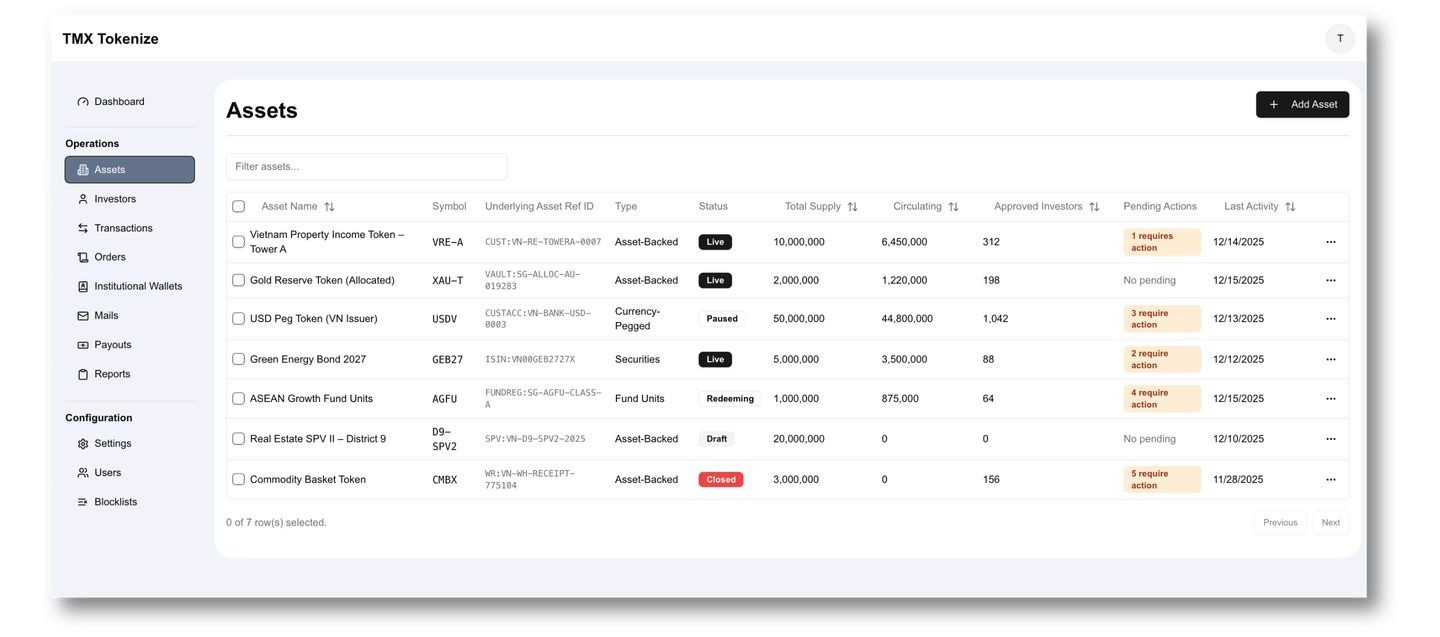
The issuer logs in to the TMX Tokenize portal and selects "Add Asset" from the top right corner of the screen.

Next, the issuer enters the asset information including the asset name, token symbol, total amount of tokens, number of decimal places, any applicable fees, whether the security is a tokenized stock, bond etc., and a short description.

Following this, the issuer defines the compliance requirements for the security. Compliance is defined as the rules governing which individuals or groups can acquire, hold or transfer the security. These could include geographical restrictions (e.g. where you live), the type of investor, their level of accredited investment status, or how long they have to keep the security before it can be transferred. These compliance rules are entered directly into the smart contract code. They are applied to each transaction made with the security.

Finally, the issuer reviews their setup and then selects "Issue Token".

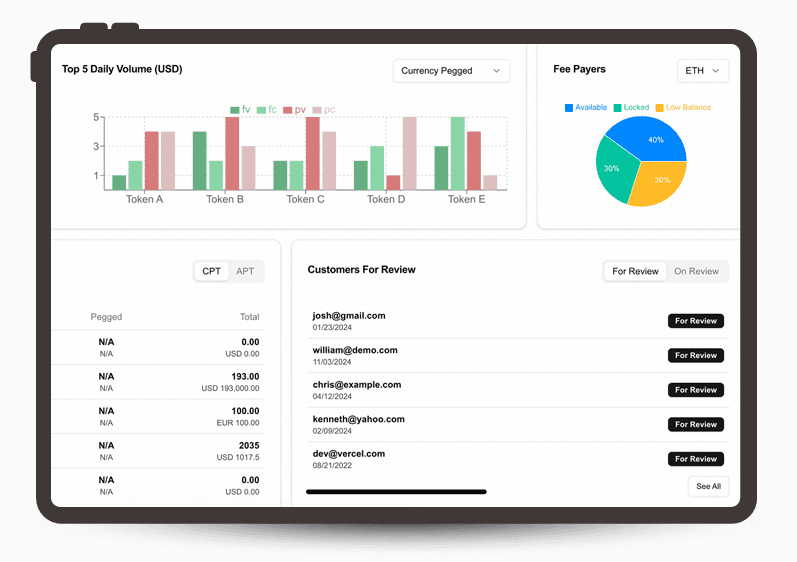
The asset is now live. It appears in the dashboard with real-time data such as supply, approved investors, and activity status. At this moment, it enters the Canton Network.

Step 2: Automatic Contract-Level Compliance
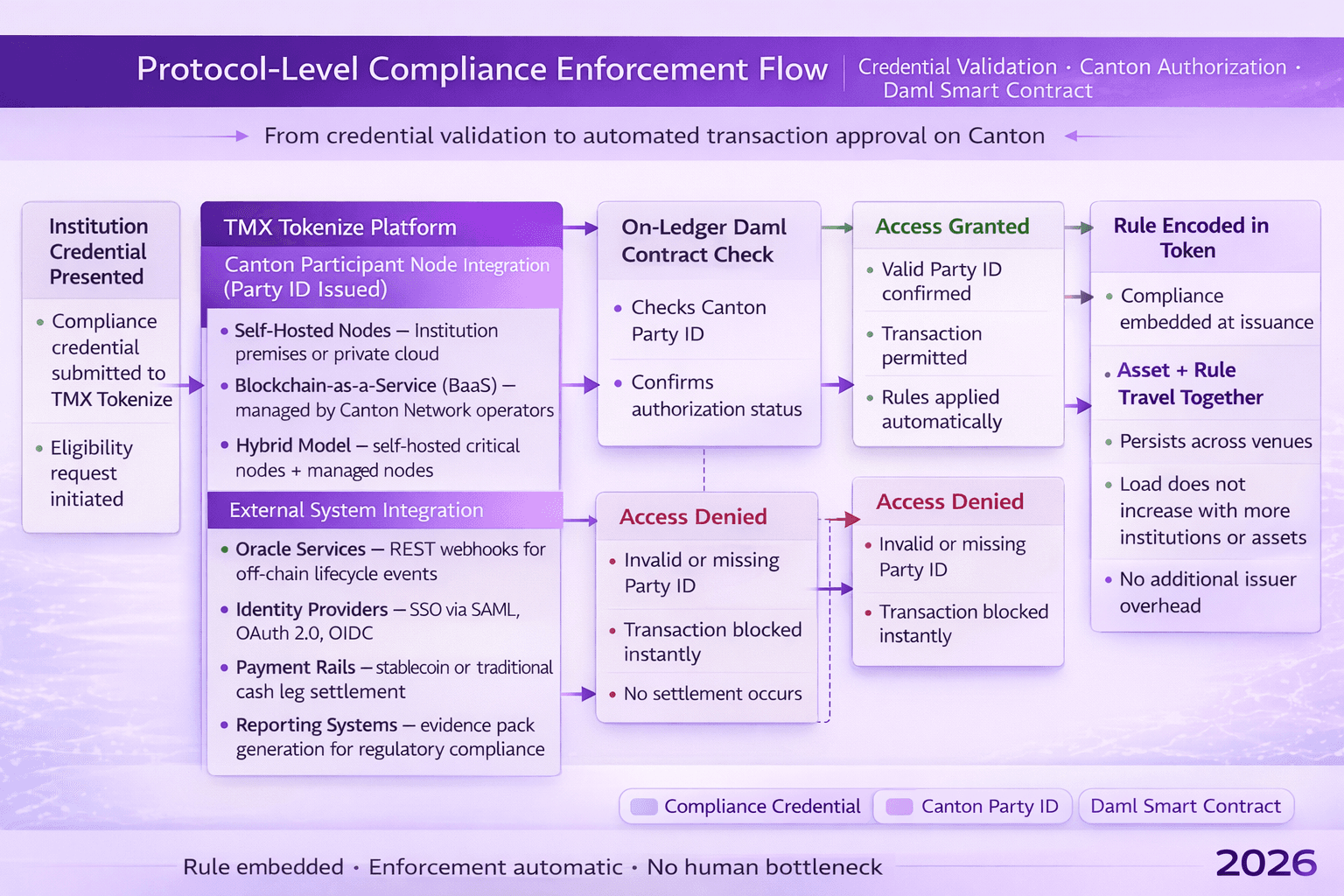
TMX provides a Party ID under hosted infrastructure: Self-hosted participant nodes, BaaS or Hybrid nodes on Canton network.

A DAML smart contract then checks this Party ID to determine whether to grant transaction access. If the ID is not valid, the transaction is blocked instantly.

  • No compliance officer reviews standard transactions. No manual approval queue exists for routine transfers. The contract enforces the issuer's rules on every transaction. 

  • This is the core technical advantage. Most platforms enforce compliance off-chain through document review or database checks. These steps introduce delay, human error, and inconsistency. TMX Tokenize encodes compliance directly into the token. 

  • The rule and the asset travel together and are inseparable regardless of where the asset transacts.

This means compliance scales automatically. As more institutions access more assets, the enforcement load does not grow. The contract handles every transaction without additional operational overhead on the issuer's side.

Step 3: Access to TMX-Issued Assets on Canton Network
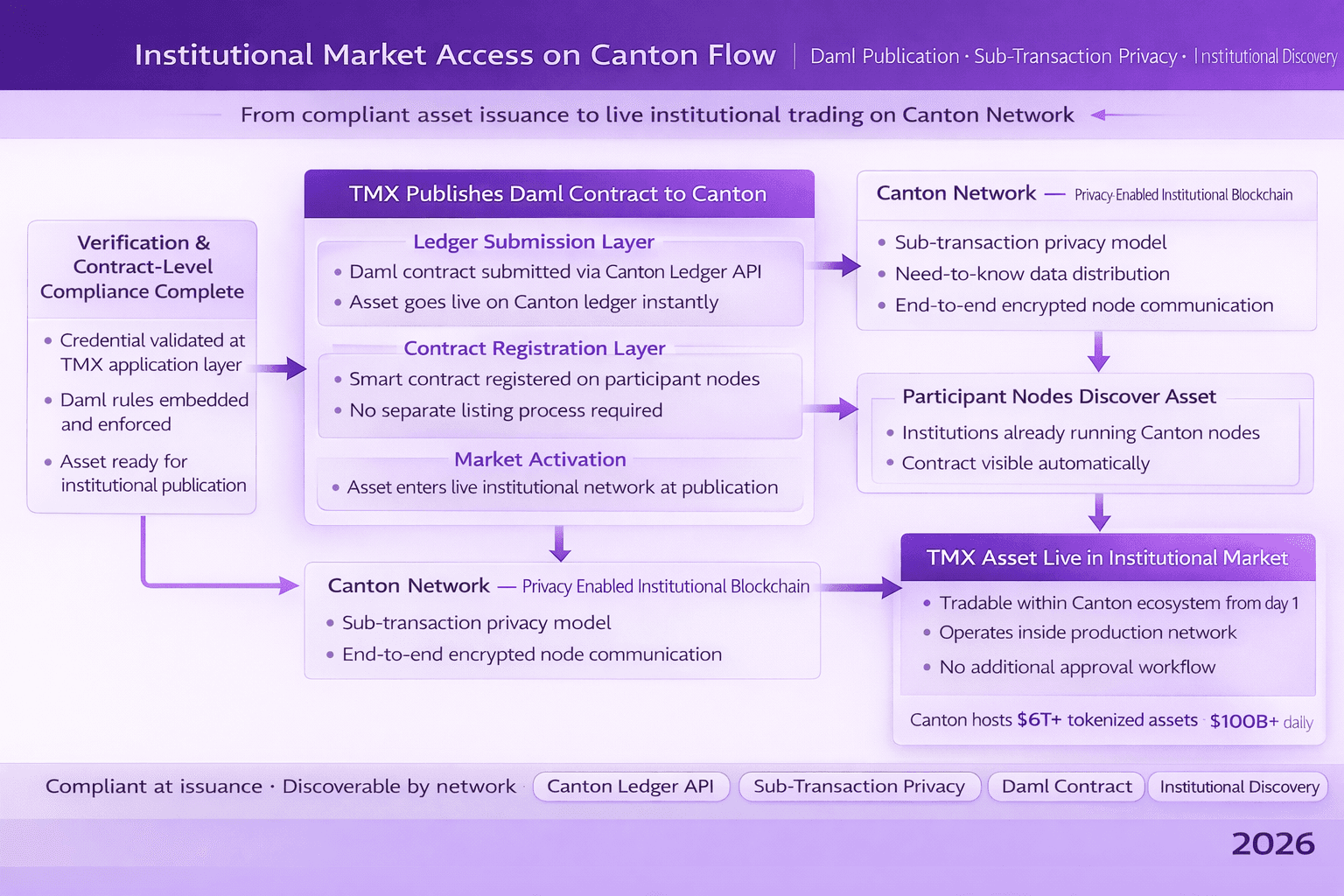
Now that verification has been confirmed and compliance has been enforced at the contract level, the institution may now use TMX-issued assets on Canton Network.

Canton Network is a privacy enabled institutional blockchain for regulated real-world assets. It provides privacy via sub-transaction privacy as well as a need-to-know data model in which each participant node receives only those parts of a transaction relevant to it. All data exchanged between nodes is end-to-end encrypted.

Goldman Sachs, HSBC, DTCC, and the European Investment Bank operate on it in production today.

  • TMX-issued assets enter this live institutional market the moment they go live on the platform. This works technically because TMX Tokenize submits a Daml contract to the Canton ledger via the Ledger API the moment an asset is published. Permitted institutions that already operate Canton participant nodes can immediately discover and interact with that contract without a separate listing or approval process.

  • The issuer does not need to find institutional buyers separately or negotiate individual relationships.

  • Regulated institutions already operating on Canton can see and transact TMX-issued assets directly within the network from day one, if permitted or invited.

Step 4: Institutional Transaction With Atomic Settlement
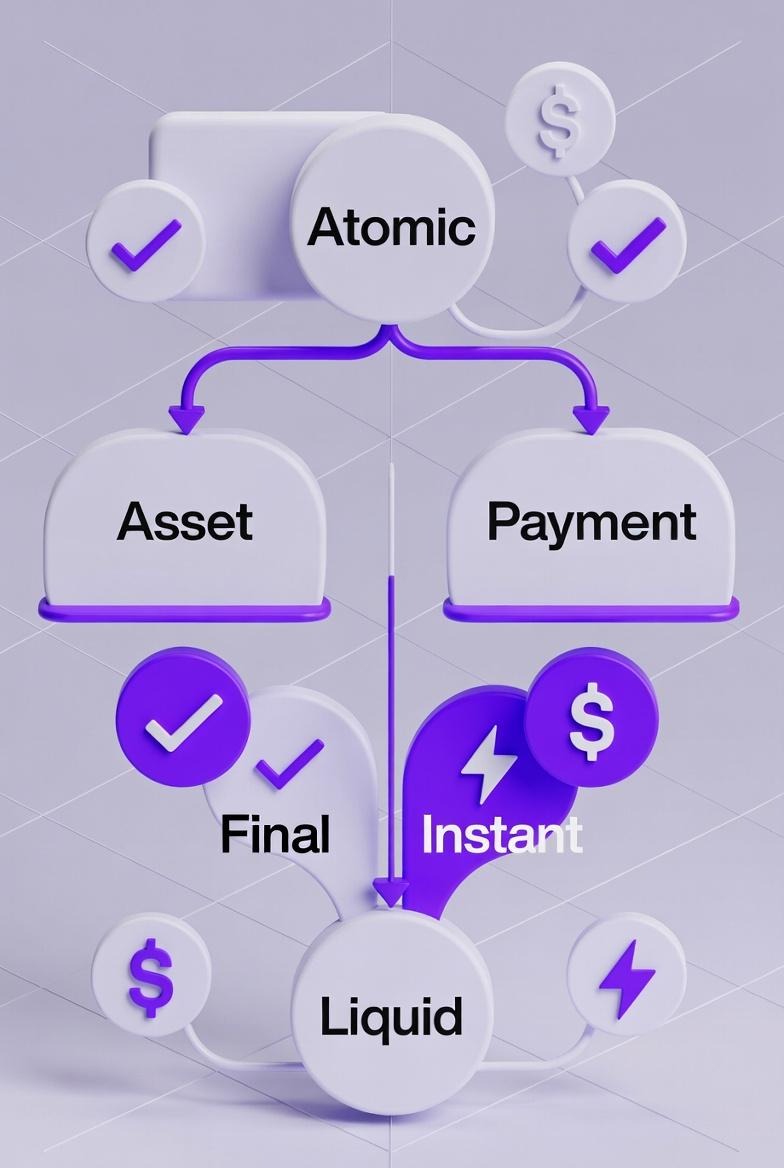
When an institution transacts a TMX-issued asset on Canton, atomic settlement ensures both sides of the transfer complete at exactly the same moment. There is no delivery window. There is no settlement risk between the asset moving and the payment arriving. Either the full transaction completes across all parties or nothing moves at all.

  • This removes the reconciliation burden that exists in traditional T+2 settlement cycles entirely. 

  • Collateral that used to take hours to mobilize during a margin call moves in a single atomic step. 

  • Capital that sat trapped waiting for settlement clears immediately and can be redeployed. 

  • For institutions managing large positions across multiple counterparties, this is a fundamental improvement in how capital flows.

Multiple institutions can access and transact the same TMX-issued asset simultaneously. The asset is not locked inside one institution's system. It circulates across all institutions that have been permissioned into the shared contract and are already operating on Canton, creating genuine market depth and real price discovery.


Table of comparison: Traditional Tokenization & TMX Tokenize
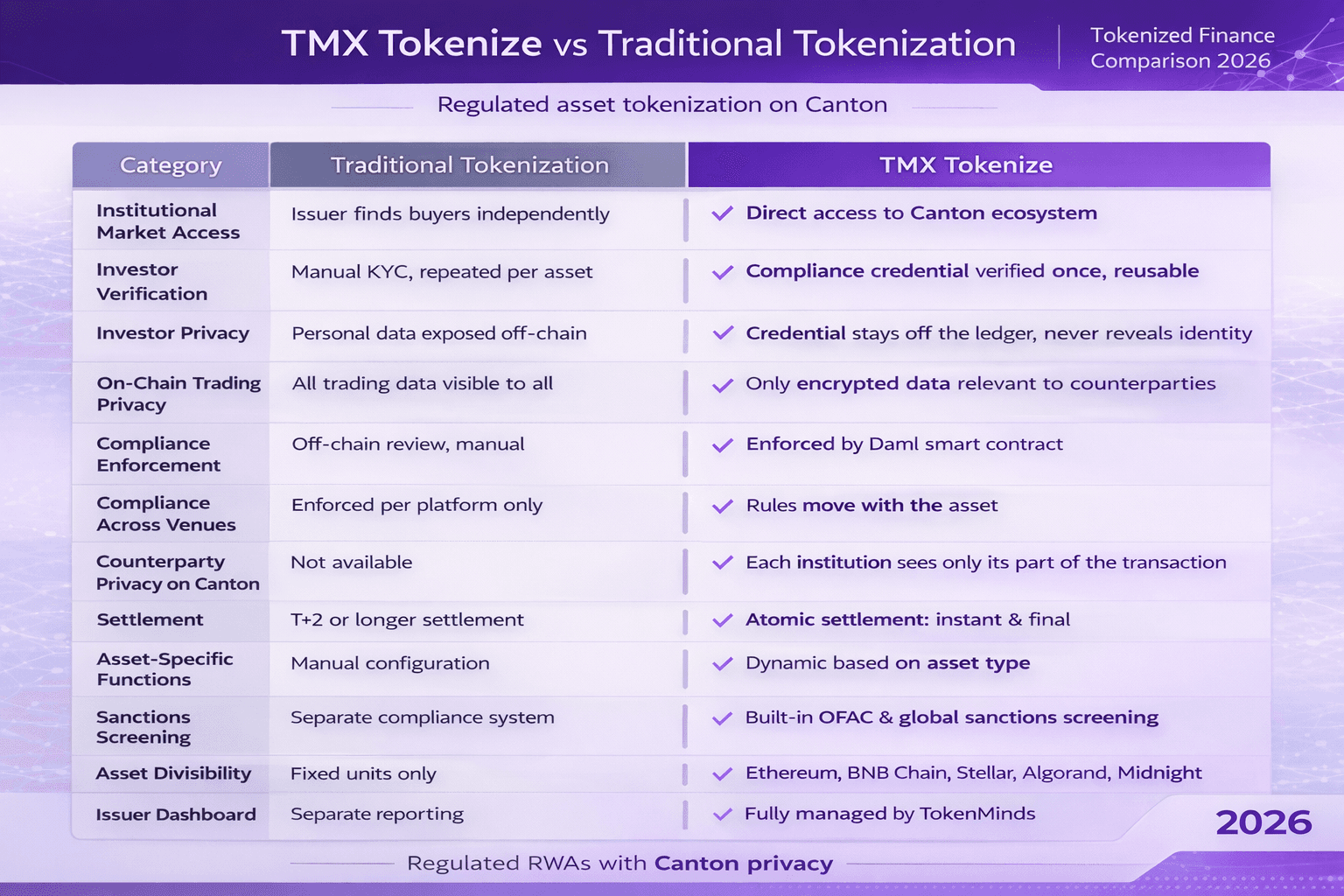
TMX Tokenize Supported Asset Types

TMX Tokenize supports five asset categories. Each has its own issuance rules, eligibility requirements, compliance policies, and functions.

Shares and Stocks

Public and private equity with fractional ownership. Tokens can be configured for dividends, stock payments, and capital calls on an automated schedule.

Real Estate

Commercial, residential, and fractional property. Tokens support revenue distributions and external custodian references. A single property can be split into thousands of tokens.

Tokens that are backed by commodities such as gold, silver, oil etc

These tokens will be able to reference an external custodian of the actual commodity to determine who owns what and when.

Private Credit

This includes loans, receivables and structured credit programs. The use of blockchain technology allows institutions to access private credit programs which they have previously had no way to access due to lack of transparency and regulatory issues. Private credit programs now also create a secondary market, which did not exist prior to this innovation.

Stable Coins and Digital Currencies

Fiat linked and asset backed digital currencies issued by banks, funds or enterprises. Stable coins are used as a means of exchange on our platform while their movement is independently tracked via the DeFi trading dashboard.

What Atomic Settlement Is Actually Worth

Atomic settlement has a real dollar value. Here is how to measure it.
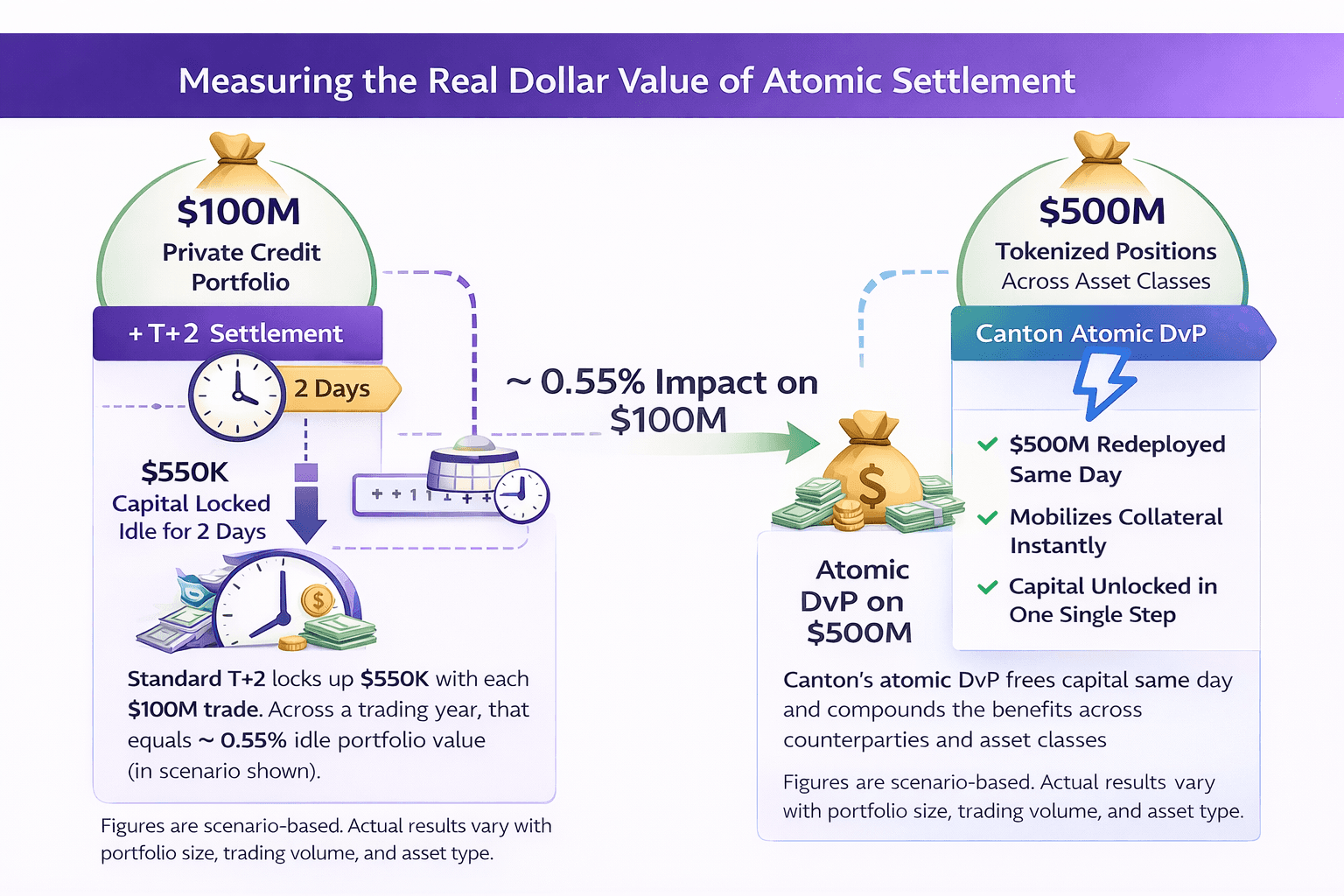
Collateral mobilization improves too. A traditional margin call can take hours to settle. On Canton, the collateral moves in one atomic step. That matters when markets move fast.

These figures are scenario-based. Actual results depend on portfolio size, trading volume, and asset type. But the direction is fixed. Every institution that replaces T+2 with atomic settlement frees capital that was previously locked by process.

Regulatory Compatibility

Compliance automation only works if it matches the rules institutions already follow. TMX Tokenize is built to align with three major regulatory frameworks.

Reg D / Reg S: US Private PlacementsUS issuers and issuers targeting US investors can configure assets under Regulation D (Rule 506(b) and 506(c)) or Regulation S. Transfer restrictions; including the 12-month holding period under Rule 144, are enforced by the smart contract. No manual transfer agent review is needed.

MiCA/European Union. The EU's Markets in Crypto-Assets Regulation sets specific rules for asset-referenced tokens and e-money tokens. TMX Tokenize supports MiCA-aligned token configuration. Issuers can set fields for white paper disclosures, reserve backing references, and eligibility restrictions for EU retail and professional investors.

FATF Travel Rule. The Travel Rule requires Virtual Asset Service Providers to pass originator and beneficiary data with transfers above set thresholds. TMX Tokenize supports Travel Rule data exchange between counterparty institutions. That data stays private from the broader network, consistent with Canton's ledger-level privacy model.

Issuers operating across multiple jurisdictions configure each regime independently within one asset. The smart contract applies the right rules to each investor based on their credential and jurisdiction. No separate token issuances. No parallel compliance workflows.

What Compliance Automation Saves Operationally

Atomic settlement frees capital. Contract-level compliance cuts operating costs. Both matter to institutional issuers.

Under a traditional model, a transfer agent reviews each transaction manually. TMX Tokenize replaces that with smart contract validation. The contract checks the investor's credential and either clears or blocks the transaction instantly. No queue. No reviewer. No delay.

Operation

Traditional Model

TMX Tokenize

Estimated Saving

Per-transaction review time

10–30 min (manual)

Instant (automated)

~60–80% cost reduction

Monthly review burden (200 tx)

33–100 hrs of back-office time

0 hrs

Full elimination

Counterparty onboarding

Manual, per-issuer

Verify once, reuse across all assets

~70% time reduction

Post-settlement reconciliation

Manual, T+2 cycle

Automated, atomic finality

Near zero

ATS compliance overhead

Separate checks per platform

Single on-chain layer

Consolidated into one workflow

Failure and Edge Case Scenarios

Institutional investors focus on risk first. TMX Tokenize is designed to handle problems in a clear and controlled way.

  • If a compliance credential expires, the asset stays in the investor’s wallet. It is not sold or taken away. Transfers are simply blocked until the credential is renewed. Once the investor completes verification and gets a new approval, transfer access turns back on automatically.

  • If regulations change, the issuer updates the rules in the dashboard. The new rules apply to future transactions right away. Existing holdings are not canceled. Investors who no longer qualify can keep their asset but cannot transfer it until they meet the new requirements or receive approval. The system enforces this automatically.

  • If a technical failure happens during atomic settlement, the transaction does not complete. No asset moves and no payment clears. Both sides return to their original position. When the system is stable again, the transaction can be submitted again from the start.

  • If an investor is added to a sanctions list after onboarding, the system detects it through live regulatory updates. Transfer access is blocked at the smart contract level. The investor still holds the asset on record, but cannot move it. The issuer is notified automatically.

Conclusion

What we learned after working with financial institutions and banks is that the core issue is not tokenization technology. It is institutional liquidity.

The institutions using TMX Tokenize do not have to create or manage any Blockchain Systems as they are able to tokenize their Real-World Assets through a platform that takes care of all aspects of the back end (i.e., creating an asset, enforce compliance with respect to the asset, linking to Canton Network, and settling transactions). All the issuer has to do is establish the asset, and specify the rules for the asset; the rest is automated by the system.

The result is a tokenized asset that goes live in an active institutional market from day one. It settles instantly instead of waiting for the usual T+2 process. It can be accessed by regulated institutions already on Canton Network, without needing a separate listing or extra market support. At the same time, all institutional activity stays private, investor identities remain confidential, and compliance rules are enforced automatically on every transaction.

Frequently Asked Questions

Who is TMX Tokenize built for?

This platform is designed to support two types of users. These include issuers (businesses, funds, and banks) who want to create tokens of real-world assets using this platform, automate compliance with their legal obligations, and access the liquidity in both institutional markets and decentralized finance (DeFi). 

The second group are institutional investors who are regulated and wish to buy compliant tokenized assets from a variety of sources once they have completed know-your-customer ("KYC") verification, and then be able to trade on multiple eligible assets as needed without having to complete KYC each time they make an investment in a different asset issued by a different entity.

What makes TMX Tokenize different from other tokenization platforms?

Three things. Privacy-preserving verification lets investors prove eligibility without revealing personal data. The verify-once model means one compliance check covers all eligible assets on the platform. And on-chain trading data is shielded even on public blockchains so compliant RWAs can trade on DeFi without breaking privacy or compliance.

What does tokenized asset liquidity mean?

It means how easily a tokenized real-world asset can be bought or sold without losing much value or waiting a long time.

How is institutional liquidity different from retail liquidity?

Retail investor's (individual) buying/selling of smaller size trades generate retail liquidity; institutional liquidity is generated through larger trade size investing from institutional investors, typically banks and investment funds, which are bound to greater regulation.

What are the common mechanisms for secondary market liquidity?

The most common way that liquidity can be generated includes but is not limited to, trading on licensed exchanges, using Market Makers, Private Secondary Deals and Liquidity Pools.

How do compliance systems affect liquidity?

Compliance systems check who can buy or sell. If they work smoothly, trading is faster and safer. If they are slow or unclear, they can reduce liquidity.

Can tokenized assets trade on DeFi?

Yes, some tokenized assets can trade on DeFi platforms, but they must follow legal and compliance rules built into the token.

What is atomic settlement and why does it matter for liquidity?

Atomic settlement means the asset and payment move at the same time. This reduces risk, builds trust, and makes trading faster.


Key takeaways:

  • Institutional liquidity comes from connecting tokenized assets directly to regulated buyers with built-in compliance, not just issuing a token.

  • TMX Tokenize enables verify-once onboarding, automatic contract-level compliance, and atomic settlement on Canton, so institutions can trade immediately with faster capital turnover.

  • This shifts private assets from slow, illiquid holdings into instantly tradable institutional products, improving capital efficiency, reducing operational costs, and simplifying regulatory workflows.


Most real-world assets are illiquid. A property developer holds $50 million in commercial real estate. A fund manager holds a private credit portfolio. A commodity trader holds gold reserves. These assets have real value. But they cannot be easily divided, transferred, or sold to new investors.

The traditional path to liquidity is slow. It involves brokers, legal transfers, manual paperwork, and long settlement cycles. Minimum investment sizes are high. Cross-border participation is hard. And the process starts over every time ownership changes hands.

Tokenization solves part of this. It converts real-world assets into digital tokens on a blockchain. Each token represents ownership. Tokens can be divided, transferred, and traded. But most tokenization platforms stop there. They give you a token. They do not give you a market, a limitation addressed through this tokenize platform.

A token with no institutional buyers is still an illiquid asset. Just a digital one.

The real challenge is getting that token in front of regulated institutions that can buy it, trade it, and provide real liquidity. And doing that while keeping investor data private, enforcing compliance on every transaction, and not forcing every investor to re-verify their identity for every new asset they want to access.

TMX Tokenize fixes this. It gives issuers a direct path from asset setup to live institutional market. Assets connect to Canton Network the moment they go live. Regulated institutions that have been permissioned into the shared contract and are already operating on Canton can see and transact them immediately. Compliance is enforced automatically on every transaction.

What Is Tokenized Asset Liquidity?

Liquidity means how easily an asset can be bought or sold without moving its price. Cash is highly liquid. You can spend it instantly. Commercial real estate is not. Selling a building takes months of legal work, negotiation, and transfer processes.

When a real-world asset is tokenized, it becomes a digital token on a blockchain. That token can be divided into smaller units, transferred instantly, and traded on markets. But having a token does not automatically mean having liquidity. Liquidity requires buyers. It requires a market where those buyers can transact with confidence, a distinction addressed in this asset tokenization framework.

Tokenized asset liquidity is the ability of a token holder to find a buyer or seller quickly, at a fair price, without a long and expensive process. For institutions, this means access to a regulated market with enough participants and volume to support real trading activity.

This is the gap most tokenization platforms do not fill. They handle issuance. They do not handle market access. TMX Tokenize fills both.

What is TMX Tokenize

TMX Tokenize is an institution-grade, compliant asset tokenization platform built by TokenMinds. TokenMinds is an ISO 27001-certified Web3 and AI firm with eight-plus years of experience serving financial institutions globally.

It is not just a token issuance tool. It is a complete platform that takes a real-world asset from configuration to live institutional markets in one workflow. Issuance, compliance, investor verification, and settlement all happen inside one platform.

What makes TMX Tokenize different is that it connects issued assets directly to Canton Network the moment they go live. Canton is an institutional-grade blockchain with $6T+ in tokenized assets and $280B+ in daily US Treasury repo settlements. Institutions that have permissioned to the shared-contract and are already operating on Canton can access and transact TMX-issued assets, with compliance enforced automatically on every transaction and no repeated KYC checks across assets or issuers.

How Tokenized Assets Get Institutional Liquidity Through TMX Tokenize

The flow works from two sides at once. The issuer configures and publishes the asset on TMX Tokenize. The institutional investor verifies once and then accesses all eligible assets on the platform. TMX Tokenize connects both sides through a unified compliance and verification layer.

Once an issuer has issued a security on TMX Tokenize that security will be immediately available for purchase by all regulated and connected institutional investors using the Canton network.

Step 1: Issuer Publishes the Asset

The issuer logs in to the TMX Tokenize portal and selects "Add Asset" from the top right corner of the screen.

Next, the issuer enters the asset information including the asset name, token symbol, total amount of tokens, number of decimal places, any applicable fees, whether the security is a tokenized stock, bond etc., and a short description.

Following this, the issuer defines the compliance requirements for the security. Compliance is defined as the rules governing which individuals or groups can acquire, hold or transfer the security. These could include geographical restrictions (e.g. where you live), the type of investor, their level of accredited investment status, or how long they have to keep the security before it can be transferred. These compliance rules are entered directly into the smart contract code. They are applied to each transaction made with the security.

Finally, the issuer reviews their setup and then selects "Issue Token".

The asset is now live. It appears in the dashboard with real-time data such as supply, approved investors, and activity status. At this moment, it enters the Canton Network.

Step 2: Automatic Contract-Level Compliance

TMX provides a Party ID under hosted infrastructure: Self-hosted participant nodes, BaaS or Hybrid nodes on Canton network.

A DAML smart contract then checks this Party ID to determine whether to grant transaction access. If the ID is not valid, the transaction is blocked instantly.

  • No compliance officer reviews standard transactions. No manual approval queue exists for routine transfers. The contract enforces the issuer's rules on every transaction. 

  • This is the core technical advantage. Most platforms enforce compliance off-chain through document review or database checks. These steps introduce delay, human error, and inconsistency. TMX Tokenize encodes compliance directly into the token. 

  • The rule and the asset travel together and are inseparable regardless of where the asset transacts.

This means compliance scales automatically. As more institutions access more assets, the enforcement load does not grow. The contract handles every transaction without additional operational overhead on the issuer's side.

Step 3: Access to TMX-Issued Assets on Canton Network

Now that verification has been confirmed and compliance has been enforced at the contract level, the institution may now use TMX-issued assets on Canton Network.

Canton Network is a privacy enabled institutional blockchain for regulated real-world assets. It provides privacy via sub-transaction privacy as well as a need-to-know data model in which each participant node receives only those parts of a transaction relevant to it. All data exchanged between nodes is end-to-end encrypted.

Goldman Sachs, HSBC, DTCC, and the European Investment Bank operate on it in production today.

  • TMX-issued assets enter this live institutional market the moment they go live on the platform. This works technically because TMX Tokenize submits a Daml contract to the Canton ledger via the Ledger API the moment an asset is published. Permitted institutions that already operate Canton participant nodes can immediately discover and interact with that contract without a separate listing or approval process.

  • The issuer does not need to find institutional buyers separately or negotiate individual relationships.

  • Regulated institutions already operating on Canton can see and transact TMX-issued assets directly within the network from day one, if permitted or invited.

Step 4: Institutional Transaction With Atomic Settlement

When an institution transacts a TMX-issued asset on Canton, atomic settlement ensures both sides of the transfer complete at exactly the same moment. There is no delivery window. There is no settlement risk between the asset moving and the payment arriving. Either the full transaction completes across all parties or nothing moves at all.

  • This removes the reconciliation burden that exists in traditional T+2 settlement cycles entirely. 

  • Collateral that used to take hours to mobilize during a margin call moves in a single atomic step. 

  • Capital that sat trapped waiting for settlement clears immediately and can be redeployed. 

  • For institutions managing large positions across multiple counterparties, this is a fundamental improvement in how capital flows.

Multiple institutions can access and transact the same TMX-issued asset simultaneously. The asset is not locked inside one institution's system. It circulates across all institutions that have been permissioned into the shared contract and are already operating on Canton, creating genuine market depth and real price discovery.


Table of comparison: Traditional Tokenization & TMX Tokenize

TMX Tokenize Supported Asset Types

TMX Tokenize supports five asset categories. Each has its own issuance rules, eligibility requirements, compliance policies, and functions.

Shares and Stocks

Public and private equity with fractional ownership. Tokens can be configured for dividends, stock payments, and capital calls on an automated schedule.

Real Estate

Commercial, residential, and fractional property. Tokens support revenue distributions and external custodian references. A single property can be split into thousands of tokens.

Tokens that are backed by commodities such as gold, silver, oil etc

These tokens will be able to reference an external custodian of the actual commodity to determine who owns what and when.

Private Credit

This includes loans, receivables and structured credit programs. The use of blockchain technology allows institutions to access private credit programs which they have previously had no way to access due to lack of transparency and regulatory issues. Private credit programs now also create a secondary market, which did not exist prior to this innovation.

Stable Coins and Digital Currencies

Fiat linked and asset backed digital currencies issued by banks, funds or enterprises. Stable coins are used as a means of exchange on our platform while their movement is independently tracked via the DeFi trading dashboard.

What Atomic Settlement Is Actually Worth

Atomic settlement has a real dollar value. Here is how to measure it.

Collateral mobilization improves too. A traditional margin call can take hours to settle. On Canton, the collateral moves in one atomic step. That matters when markets move fast.

These figures are scenario-based. Actual results depend on portfolio size, trading volume, and asset type. But the direction is fixed. Every institution that replaces T+2 with atomic settlement frees capital that was previously locked by process.

Regulatory Compatibility

Compliance automation only works if it matches the rules institutions already follow. TMX Tokenize is built to align with three major regulatory frameworks.

Reg D / Reg S: US Private PlacementsUS issuers and issuers targeting US investors can configure assets under Regulation D (Rule 506(b) and 506(c)) or Regulation S. Transfer restrictions; including the 12-month holding period under Rule 144, are enforced by the smart contract. No manual transfer agent review is needed.

MiCA/European Union. The EU's Markets in Crypto-Assets Regulation sets specific rules for asset-referenced tokens and e-money tokens. TMX Tokenize supports MiCA-aligned token configuration. Issuers can set fields for white paper disclosures, reserve backing references, and eligibility restrictions for EU retail and professional investors.

FATF Travel Rule. The Travel Rule requires Virtual Asset Service Providers to pass originator and beneficiary data with transfers above set thresholds. TMX Tokenize supports Travel Rule data exchange between counterparty institutions. That data stays private from the broader network, consistent with Canton's ledger-level privacy model.

Issuers operating across multiple jurisdictions configure each regime independently within one asset. The smart contract applies the right rules to each investor based on their credential and jurisdiction. No separate token issuances. No parallel compliance workflows.

What Compliance Automation Saves Operationally

Atomic settlement frees capital. Contract-level compliance cuts operating costs. Both matter to institutional issuers.

Under a traditional model, a transfer agent reviews each transaction manually. TMX Tokenize replaces that with smart contract validation. The contract checks the investor's credential and either clears or blocks the transaction instantly. No queue. No reviewer. No delay.

Operation

Traditional Model

TMX Tokenize

Estimated Saving

Per-transaction review time

10–30 min (manual)

Instant (automated)

~60–80% cost reduction

Monthly review burden (200 tx)

33–100 hrs of back-office time

0 hrs

Full elimination

Counterparty onboarding

Manual, per-issuer

Verify once, reuse across all assets

~70% time reduction

Post-settlement reconciliation

Manual, T+2 cycle

Automated, atomic finality

Near zero

ATS compliance overhead

Separate checks per platform

Single on-chain layer

Consolidated into one workflow

Failure and Edge Case Scenarios

Institutional investors focus on risk first. TMX Tokenize is designed to handle problems in a clear and controlled way.

  • If a compliance credential expires, the asset stays in the investor’s wallet. It is not sold or taken away. Transfers are simply blocked until the credential is renewed. Once the investor completes verification and gets a new approval, transfer access turns back on automatically.

  • If regulations change, the issuer updates the rules in the dashboard. The new rules apply to future transactions right away. Existing holdings are not canceled. Investors who no longer qualify can keep their asset but cannot transfer it until they meet the new requirements or receive approval. The system enforces this automatically.

  • If a technical failure happens during atomic settlement, the transaction does not complete. No asset moves and no payment clears. Both sides return to their original position. When the system is stable again, the transaction can be submitted again from the start.

  • If an investor is added to a sanctions list after onboarding, the system detects it through live regulatory updates. Transfer access is blocked at the smart contract level. The investor still holds the asset on record, but cannot move it. The issuer is notified automatically.

Conclusion

What we learned after working with financial institutions and banks is that the core issue is not tokenization technology. It is institutional liquidity.

The institutions using TMX Tokenize do not have to create or manage any Blockchain Systems as they are able to tokenize their Real-World Assets through a platform that takes care of all aspects of the back end (i.e., creating an asset, enforce compliance with respect to the asset, linking to Canton Network, and settling transactions). All the issuer has to do is establish the asset, and specify the rules for the asset; the rest is automated by the system.

The result is a tokenized asset that goes live in an active institutional market from day one. It settles instantly instead of waiting for the usual T+2 process. It can be accessed by regulated institutions already on Canton Network, without needing a separate listing or extra market support. At the same time, all institutional activity stays private, investor identities remain confidential, and compliance rules are enforced automatically on every transaction.

Frequently Asked Questions

Who is TMX Tokenize built for?

This platform is designed to support two types of users. These include issuers (businesses, funds, and banks) who want to create tokens of real-world assets using this platform, automate compliance with their legal obligations, and access the liquidity in both institutional markets and decentralized finance (DeFi). 

The second group are institutional investors who are regulated and wish to buy compliant tokenized assets from a variety of sources once they have completed know-your-customer ("KYC") verification, and then be able to trade on multiple eligible assets as needed without having to complete KYC each time they make an investment in a different asset issued by a different entity.

What makes TMX Tokenize different from other tokenization platforms?

Three things. Privacy-preserving verification lets investors prove eligibility without revealing personal data. The verify-once model means one compliance check covers all eligible assets on the platform. And on-chain trading data is shielded even on public blockchains so compliant RWAs can trade on DeFi without breaking privacy or compliance.

What does tokenized asset liquidity mean?

It means how easily a tokenized real-world asset can be bought or sold without losing much value or waiting a long time.

How is institutional liquidity different from retail liquidity?

Retail investor's (individual) buying/selling of smaller size trades generate retail liquidity; institutional liquidity is generated through larger trade size investing from institutional investors, typically banks and investment funds, which are bound to greater regulation.

What are the common mechanisms for secondary market liquidity?

The most common way that liquidity can be generated includes but is not limited to, trading on licensed exchanges, using Market Makers, Private Secondary Deals and Liquidity Pools.

How do compliance systems affect liquidity?

Compliance systems check who can buy or sell. If they work smoothly, trading is faster and safer. If they are slow or unclear, they can reduce liquidity.

Can tokenized assets trade on DeFi?

Yes, some tokenized assets can trade on DeFi platforms, but they must follow legal and compliance rules built into the token.

What is atomic settlement and why does it matter for liquidity?

Atomic settlement means the asset and payment move at the same time. This reduces risk, builds trust, and makes trading faster.
GET SUCCESS IN WEB3

  • Trusted Web3 partner since 2017

  • Full-stack Web3 development team

  • Performance-driven Web3 marketing

Get A Free Consultation

Get A Free Consultation

RECENT TRAININGS

Follow us

get web3 business updates

Email invalid

  • Access global liquidity for your RWA project with TMX Tokenize’s Canton Network integration

DISCOVER NOW

  • Access global liquidity for your RWA project with TMX Tokenize’s Canton Network integration

    JOIN NOW

DISCOVER

  • Access global liquidity for your RWA project with TMX Tokenize’s Canton Network integration