Web3 & AI

SOLUTIONS

Products

Services

Web3 & AI

SOLUTIONS

Services

Products

Industries

Become Our Client

About Us

Resources

Web3 & AI

SOLUTIONS

Services

Products

Industries

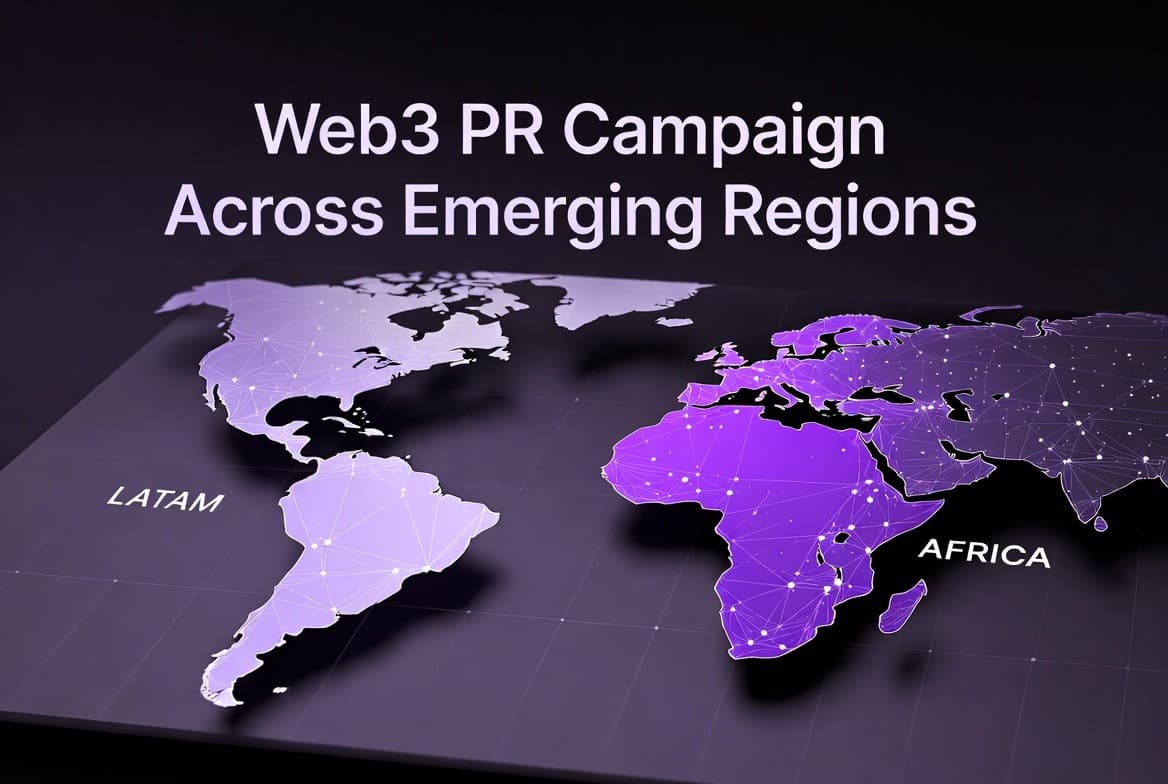
How To Launch Web3 PR Campaign Across Emerging Regions

How To Launch Web3 PR Campaign Across Emerging Regions

Written by:

Written by:

Feb 20, 2026

Feb 20, 2026

Key takeaways:

  • Build local credibility by partnering with Tier 2 regional crypto media like Portal do Bitcoin and Cripto Noticias, and collaborating with trusted local influencers (@andresgarzam, @bitcoin_chief), following the proven model behind Bitso’s expansion to over 9 million users across Latin America.

  • Activate communities (@bitso, @yellowcard_app) as primary growth engines in emerging markets, using localized engagement, education and trust-building to accelerate user acquisition.

  • Scale strategically with regional ad networks like Pulse Africa and Adintop only after media credibility and community traction are established, mirroring the structured expansion approach that helped Yellow Card grow to more than 1 million users across Africa.

Emerging markets are driving Web3 adoption. Latin America grew crypto ownership by 116.5% between 2023-2024. Africa recorded a 300% year-over-year increase in peer-to-peer crypto trading. Nigeria alone has 84% wallet ownership.

The Web3 market is worth several billion dollars globally. But adoption intent is much higher in emerging markets than developed ones. Latin America has 92 million wallet users. Africa has 75 million. MENA has 29 million active wallets.

This creates an opportunity. Web3 projects launching in emerging regions face unique challenges. Different languages. Different media landscapes. Different regulatory environments. Different user needs, a complexity navigated through this crypto PR approach.

Why Emerging Regions Matter for Web3

Emerging markets aren't secondary markets. They're often primary markets for Web3 adoption. The numbers prove it, a reality addressed in this revenue-focused Web3 acquisition framework.

Latin America: The Remittance and Inflation Hedge Market

Latin America represents 9.1% of global cryptocurrency value. The region received nearly $1.5 trillion in cryptocurrency transactions between July 2022 and June 2025.

Brazil leads with $91.1 billion in crypto value. Argentina follows with similar numbers. Both countries rank in the top 20 globally for crypto adoption.

Latin America has 92 million wallet users. Crypto ownership grew 116.5% between 2023 and 2024. The average national adoption rate sits at 15.2%.

Argentina leads stablecoin use. Over 61.8% of its transactions are stablecoins. Inflation drives this. People need dollars. Brazil grew 109.9% period-over-period. Mexico sends $61 billion in remittances every year, second highest in the world.

The reason is simple. Inflation destroys savings in Argentina and Venezuela. People buy USDC to protect their money. In Mexico and Brazil, sending money across borders is expensive through banks. Crypto makes it cheaper and faster.

Africa: The P2P Trading Hub

Africa reached 75 million wallet users in 2025. Having doubled over the past two years. The continent shows the highest 30-day retention globally.

Nigeria leads with 84% wallet ownership. South Africa follows with 66%. These aren't small markets. Nigeria alone accounts for 12.7% of all MetaMask users worldwide.

The reasons are practical. Most people have no bank account. Crypto fills that gap. Nigeria, Kenya, and Ghana depend heavily on remittances and traditional transfers are expensive. Currency instability pushes people toward USD stablecoins. The population is young and comfortable with mobile technology. Financial inclusion is not a marketing angle here. It is a real need.

MENA: The Regulatory-Forward Market

MENA recorded 29 million active wallets in 2025. The Middle East had 11.3% of adults holding digital assets. UAE leads with 31% adoption. Turkey follows with 19.3%.

The region has 29 million active wallets. 11.3% of adults hold digital assets. The UAE leads globally with 31% crypto adoption. Turkey sits at 19.3% adoption and 44% wallet ownership. 66% of all activity happens on centralized exchanges, the highest of any region in the world.

The reasons are clear. UAE and Bahrain have built progressive crypto regulations that give investors confidence. Smartphone penetration is high. The median age is under 30. People want alternative investments beyond traditional options. Governments are actively supporting blockchain, which makes crypto feel legitimate rather than risky.

The Core Challenge

Launching in emerging markets is not the same as launching in the West. The problems are different. So are the solutions.

Challenge 1: Fragmented Media

Every country runs on different media. Brazil's top crypto outlets mean nothing in Argentina. Nigeria's media landscape looks nothing like Kenya's or South Africa's. Language makes it harder. Portuguese in Brazil. Spanish across most of LATAM. English, French, Arabic, and hundreds of local languages across Africa and MENA. One press release does not work here, a reality managed in this PR marketing strategy.

Challenge 2: Different Adoption Drivers

Developed markets buy crypto to speculate. Emerging markets buy it to survive. In Argentina, people buy USDC to protect savings against 211% inflation. In Nigeria, crypto is cheaper than a bank transfer. In Venezuela, stablecoins are the only way to preserve wealth when the currency collapses. Messaging about decentralization misses the point. Messaging about protecting savings does not.

Challenge 3: Trust Gaps

Emerging markets have been burned. Exit scams. Rug pulls. Ponzi schemes dressed as Web3 projects. Trust is hard to earn and easy to lose. Regulatory compliance, government partnerships, and local credibility matter more here than anywhere else.

Challenge 4: Budget Misallocation

Most Web3 projects put 70-80% of PR spend into North America and Europe. Only 20-30% goes to emerging markets. Yet emerging markets drive more adoption. Projects are underspending in the exact markets growing fastest.

The Solution: Regional PR Framework

Launching a global Web3 PR campaign across emerging regions requires a structured approach. Each phase builds on the previous one.

Step 1: Multi-Tier Media Strategy

Emerging markets need a different media strategy. The three-tier approach works best.

Tier 1: International Crypto Media

These outlets have global credibility and local editions. Target Cointelegraph in Spanish, Portuguese, and Arabic. CoinDesk is growing its LATAM coverage. Bitcoin.com has strong emerging market reach. Decrypt is expanding into new regions.

Tier 2: Regional Crypto Media

These are the trusted local voices. They are essential for credibility.

In Latin America: Portal do Bitcoin, Livecoins, and CriptoFacil in Brazil. Ripio Learn and CriptoNoticias in Argentina. Cripto Tendencia in Mexico. Crypto Plaza and Colombia Fintech in Colombia.

In Africa: Nairametrics, Techpoint Africa, and Bitcoin Nigeria for Nigeria. BitHub Africa and Kenyan Wall Street for Kenya. CryptoSA and TechCentral for South Africa.

In MENA: Arabian Gazette and CryptoTimes for UAE. Koinmedya and Coin Turkey for Turkey. Youm7 Tech section for Egypt.

Tier 3: Mainstream Business Media

These reach audiences beyond crypto. They need economic angles, not crypto pitches.

In Latin America: Exame, InfoMoney, and NeoFeed in Brazil. Clarín, La Nación, and Ámbito Financiero in Argentina. El Economista and Expansión in Mexico.

In Africa: Business Day, The Guardian Nigeria, and Punch for Nigeria. Business Daily and The Star for Kenya. Business Day and Mail & Guardian for South Africa.

In MENA: The National, Gulf News, and Arabian Business for UAE. Hürriyet Daily News and Daily Sabah for Turkey. Ahram Online and Egypt Today for Egypt.

Securing coverage across these three tiers establishes the foundation of your media presence, but earned media alone won't move the needle in emerging markets. Trust in these regions is built peer-to-peer through communities, influencers, and local advocates who carry more weight than any headline. That's where Step 2 comes in.

Step 2: Community-Driven Amplification

Media coverage gets you visibility. Community gets you trust. In emerging markets, trust is the only currency that converts. People in Nigeria, Brazil, Turkey, and Egypt do not buy because they saw a headline. They buy because someone they follow said it was real. Your job is to find those people, build with them, and let them carry the message.

Community amplification is not about posting in groups. It is about showing up where your audience already is. Every market has its own platforms, its own voices, and its own rules for what earns trust. What works in São Paulo will not work in Lagos. What works in Lagos will not work in Dubai. Know the difference before you spend a dollar.

Latin America

  • Primary platforms: WhatsApp (Brazil 147M users, dominant entry point), Telegram (power users and serious crypto communities), Twitter/X (Argentina crypto debate and real-time inflation narrative), YouTube (Portuguese and Spanish long-form education, mandatory for Brazil and Mexico)

  • WhatsApp group admin partnerships (100 to 500 active groups) are the fastest community distribution shortcut in the region. Build this before your own official channel

  • Personal finance and inflation angles outperform pure crypto content across all LATAM markets. Lead with financial freedom and dollar access, not blockchain ideology

  • Active influencers:

  • @andresgarzam (Instagram, 2M followers: Andrés Garza, Mexico, personal finance and financial freedom

  • @morisdieck (Instagram 1M, TikTok 20.5M, podcast): Moris Dieck, Mexico, finance and investment education

  • @fernandoulrich (Twitter/X 262K, Instagram 275K, YouTube 822K):  Fernando Ulrich, Brazil, Bitcoin maximalist and Austrian economics educator

  • @primorico (YouTube, Instagram):  Thiago Nigro, Brazil, mainstream wealth building and crypto crossover, large non-crypto audience

Africa

  • Primary platforms: Twitter/X (Nigeria has one of the highest crypto Twitter engagement rates globally), WhatsApp (community coordination and support), Telegram (alpha and power user groups), YouTube (Kenya and South Africa long-form education)

  • Nigerian crypto Twitter runs on threads, alpha calls, and community debate. This is not optional for Nigeria entry. South Africa requires a more formal financial tone, closer to LinkedIn than Twitter

  • University-affiliated and policy-adjacent voices carry extra credibility in Kenya and South Africa. Community hype works in Nigeria; institutional credibility works everywhere else

  • Active influencers:

  • @damidefi (Twitter/X, 91.9K followers): Dami-Defi, Nigeria, alpha threads and whale wallet tracking

  • @bitcoinchief (Instagram 346K): Gaius Chibueze "Bitcoin Chief", South Africa, Bitcoin investor since 2011

  • @rumeaophi (Twitter/X, podcast, Channels TV):  Rume Ophi "Crypto Preacher", Nigeria, Blockchain Academy founder, trained 5,000+ Africans, featured on CoinTelegraph

  • @johnkaranja (Twitter/X):  John Karanja, Kenya, founder of BitHub Africa accelerator in Nairobi

MENA

Twitter/X dominates in Saudi Arabia, which ranks top 5 globally for usage per capita. YouTube is mandatory for Arabic-language education in Saudi Arabia and Egypt. Instagram drives the UAE and Gulf influencer market. Snapchat reaches Saudi youth and is consistently overlooked.

Arabic content is non-negotiable for Saudi Arabia and Egypt. English only works in Dubai and Abu Dhabi. Never run one unified MENA strategy across all markets.

Shariah compliance framing is mandatory for Saudi Arabia and conservative UAE segments. Audiences actively filter out content that conflicts with Islamic finance principles. This is not optional.

@coinbureau is the most credible English-language crypto education channel in the region. Guy Turner is UAE-based with 2.7 million YouTube subscribers, 944,000 on Twitter/X, and 220,000 on Instagram. Verified active as of December 2025.

@andreswifitv is Dubai-based with 1.5 million Instagram followers covering fintech and crypto. Trusted by Binance and OKX. Verified active.

Step 3. Paid Distribution (Yellow Card)

Paid ads amplify what already works. Run Steps 1 and 2 for at least 4 weeks before activating paid distribution. Ads without community or press credibility behind them convert poorly in emerging markets where trust is the primary purchase barrier.

Table: Format Priority by Region

Region

Primary Networks

Format Priority

Brazil

RevMob, Jampp, Mercado Libre Ads

Mobile video, native

Mexico / Colombia

Adsmovil, MGID

Mobile display, native

Nigeria

MTN Ads, NG Adverts, Alternative Adverts

Mobile video, push

Kenya / South Africa

Ad Dynamo, Jumia Ads

Mobile display, video

UAE / Saudi Arabia

AdinTop, DaartAds, Adfalcon

Arabic video, in-app

Key Implementation Steps:

  1. Set up separate ad accounts per country (not per region) before spending anything. One account for Brazil, one for Nigeria, one for UAE, not one for "LATAM" or "Africa"

  2. Create all creatives in local language first: Arabic for MENA, Portuguese for Brazil, Spanish for LATAM. English-only creatives are a budget waste in all three regions

  3. Start with a 2-week test budget (10% of paid allocation) split across 2-3 networks per region. Change underperformers at day 14, scale only what converts

  4. Set KPIs as active wallets created, KYC completions and first transactions only. Ignore impressions and CTR as primary metrics

  5. Run compliance check before launching in each country: Brazil (LGPD), Nigeria (NDPR), Saudi Arabia and UAE (financial ad restrictions and digital ad tax) all require local legal sign-off

  6. Retarget community members from Step 2 first before acquiring cold audiences. WhatsApp and Telegram community members who have not yet signed up are your highest-converting paid audience

Real Implementation: Bitso (Latin America) and Yellow Card (Africa)


Bitso launched in Mexico in 2014 when crypto had almost no public awareness in Latin America. They could not rely on organic demand because most people had never heard of Bitcoin, let alone trusted it with their savings. Local PR was their way of educating the market and building trust simultaneously, by getting their story told through outlets and voices people already trusted. Reaching 9M users and $3.3B remittances.

Yellow Card launched in Nigeria in 2019 in a market where crypto trust was almost zero. Their local PR focused on translating crypto into problems Africans already lived daily, currency devaluation, expensive remittances and dollar access. This built enough credibility to grow to 1 million users within months.

Step 1: Multi-Tier Media Strategy

Each tier serves a different job. Bitso feeds each one different content at different times.

Tier 1: International Media (TechCrunch, Bloomberg, Cointelegraph EN, Reuters)

You get into Tier 1 by creating a newsworthy event first. Bitso always used funding rounds as their entry point. When they closed their $250M Series C, they didn't send one press release. They sent three different angles to three different outlets:

  • TechCrunch got the startup growth story

  • Bloomberg and Reuters got the institutional investor angle (Tiger Global, Coatue)

  • Cointelegraph got the crypto and LATAM expansion story

To land these placements you need either a PR firm with existing reporter contacts or a founder who already knows the journalists. Cold pitching without a warm intro rarely works. The news you bring them needs to answer one question: why does this matter globally? The answers that work are a big funding number, a named investor, a regional first, or a verified market stat.

Tier 2: Regional Crypto Media (Cointelegraph ES, Portal do Bitcoin, CriptoNoticias)

These outlets are easier to access. The way Bitso built a weekly presence on Cointelegraph ES was simple: they made their CEO a go-to source for reporters, not just someone who appears when they have news. When a reporter covers a regulatory story or market trend, they call the people already in their contact list. Get on that list by offering your CEO as an expert source on topics beyond your own product.

A few other things that worked at this tier:

  • Give regional outlets exclusive first access to market-specific announcements. CriptoNoticias in Argentina always got Argentina news first

  • Use your own blog as a content base in the local language. Bitso's blog published in both Spanish and Portuguese, giving regional outlets something to reference and republish

Tier 3: Mainstream Business Media (El Economista, Exame, La Nación)

These outlets don't care about crypto. They care about money, savings, and economic problems their readers already worry about. Bitso never pitched technology. They pitched the local economic angle:

  • In Argentina it was peso devaluation and how people protect their savings

  • In Mexico it was the cost of sending money home to family

  • In Brazil it was financial access and the unbanked population

The easiest way in is an op-ed from your CEO tied to a macro trend, with exclusive data from your own platform to make it worth publishing.

Step 2: Community-Driven Amplification

Bitso's community strategy was the most documented and differentiated part of their growth; organized across social channels and a verified local influencer network.

Platforms by market:

  • WhatsApp: country-specific channels in Mexico, Argentina, Brazil, Colombia confirmed active. Used for customer support, product announcements, and educational content before any other channel

  • Telegram: active community channels per country, used for power users and product updates

  • Twitter/X: CEO Daniel Vogel active and cited across international and regional media consistently

Active influencers:

  • @andresgarzam (Instagram, 2M followers): Andrés Garza from Mexico. Featured at Bitso's ExpoCripto 2024 recording a live podcast on digital dollars with Bitso's Director of Product. Andres focus is Personal finance and financial freedom.

  • @lacasadesatoshi (Twitter/X): Santiago Varela from Mexico City. Co-hosted a meetup with Bitso's Director of Regulatory Affairs at ExpoCripto 2024. Grassroots Bitcoin community organizer, runs physical Bitcoin coworking space in CDMX. Real community-building, not paid reach.

Referral program:

Bitso's referral program gives 10% of trading fees to both the referrer and the referee. Every existing user becomes a motivated distributor.

In Argentina, Bitso never marketed USDC as crypto. They positioned it as inflation protection against peso devaluation. It worked. USDC became the largest purchased asset on Bitso across all of LATAM in 2024.

Bitso Onchain added a gamified XP leaderboard to keep existing users active and competing with each other.

Step 3: Paid Distribution via Strategic Partnerships

Yellow Card is Africa's largest licensed crypto exchange. They serve nearly 1.4 million users across the continent. Founded in Nigeria in 2019, they became Africa's most-funded crypto exchange with over $88 million raised.

They did not outsource their ads. Google and Snapchat campaigns were managed in-house. Snapchat videos showed young users how simple the app was to set up. Every ad led with cost, not crypto. Max 2% remittance fees versus the industry standard of 3-6% was the message that converted.

They never ran one campaign across all of Africa. Each country got its own campaign. That discipline cut cost per install by 30%.

The results were clear. App installs grew 74% quarter-on-quarter. They went from 200,000 to 1 million users in three months. In 2024 they processed over $3 billion in stablecoin transactions.

Here are the two sections, short and compact:

THE EMERGING MARKET WEB3 PR VELOCITY MODEL™

Most Web3 PR efforts fail because they treat media, community, and regulation as separate workstreams. They compound. Each layer feeds the next.

Layer 1: Regulatory Readiness

Know the rules before you publish. Map which countries require disclosure, which restrict promotions, and which are actively hostile. Comply more than required.

Layer 2:  Narrative Localization 

Dollar access in Argentina. Remittances in Mexico. P2P in Nigeria. Shariah framing in Saudi Arabia. Each market has one dominant entry narrative. Use it.

Layer 3: Media Penetration

Tier 2 regional outlets build credibility. Tier 1 amplifies it. Tier 3 mainstream press signals legitimacy to non-crypto audiences. Run in that order.

Layer 4: Community Liquidity Engine

WhatsApp admins, Telegram groups, and Twitter/X threads are distribution infrastructure. Media placements seed them. They amplify faster than any paid channel.

Layer 5: Institutional Anchoring 

Exchange listings, regulatory acknowledgment, and university partnerships convert attention into long-term trust. This is what makes growth defensible.

The flywheel: Media earns trust → Community distributes it → Partners validate it → Regulators tolerate it → Media covers it again. Each cycle compounds faster than the last.

MODELED GROWTH BENCHMARKS

These are directional projections based on regional campaign patterns, not guarantees. Use them for internal planning and expectation-setting.

Phase

Activity

Expected 90-Day Impact

Media

15 Tier-2 placements

+8–12% regional traffic

Community

20 WhatsApp groups activated

+25% referral acquisition

Community

Groups 1→50 (tipping point)

Organic sharing becomes self-sustaining

Partnership

1 exchange integration

+18% trust lift in conversion

Influencer

3 Tier-2 influencer activations

+15–20% social reach

Paid

Activated after 4 weeks organic

2–3x conversion vs. cold paid

How TokenMinds Executes Global Web3 PR Campaigns

What TokenMinds learned from executing Web3 PR campaigns across multiple regions is that most projects struggle not with visibility, but with building structured regional systems that convert PR into long-term growth. Through real case execution, TokenMinds helps Web3 companies implement scalable PR frameworks that turn exposure into trust and adoption.

In Southeast Asia, TokenMinds ran a structured PR and community campaign for MMAON. The rollout combined regional media placements with community amplification. It generated over 15 million clicks through PR distribution and grew 10,000+ community members in three months. Media exposure became measurable traction, not short-term noise.

Local Execution, Global Strategy:

We don't run campaigns from a single office. We have local teams in Brazil, Nigeria, UAE, and Mexico. They understand local media, local communities, local needs.

Research Before Creative:

Most agencies start with messaging. We start with research. We spend 3-4 weeks understanding your target market before writing a single press release.

Multi-Language Native Speakers:

We don't use Google Translate. Our Brazilian content is written by Brazilians. Our Arabic content is written by native Arabic speakers. Our Nigerian content is reviewed by Nigerians.

Community-First Approach:

We build community infrastructure before launching PR. WhatsApp channels, Telegram groups, local influencer networks. This amplifies every press release 10x.

Metrics That Matter:

We track media placements. But we also track user acquisition from each region. Telegram group growth. WhatsApp engagement. Community retention. PR that doesn't drive users is just vanity.

Conclusion

Emerging markets aren't secondary markets for Web3. They're now one of the primary markets. Latin America has 92 million wallet users. Africa has 75 million. MENA has 29 million. These regions are growing 100-300% year-over-year.

But launching in emerging regions requires different strategies. The projects that succeed do the work. Deep market research. Localized content. Community building. Strategic partnerships. Long-term commitment.

The rewards are significant. Market leadership in the world's fastest-growing Web3 regions. User acquisition at 1/10th the cost of developed markets. Brand recognition in markets hungry for financial inclusion.

FAQ

How long does it take to launch a successful campaign in emerging regions?

Minimum 6 months. Building trust in emerging markets takes longer than developed markets. Many users have been burned by scams. They're skeptical.

The best campaigns run 9-12 months. This allows time for:

  • 3-4 weeks research

  • 2-3 weeks infrastructure setup

  • 3-4 months initial campaign execution

  • 3-4 months optimization and scaling

Quick 1-2 month campaigns rarely work in emerging regions.

Should we launch in all three regions at once or sequentially?

Start with one region. Prove your model. Then expand.

Most successful projects start with either Latin America (if focused on remittances/inflation) or MENA (if focused on investment/institutions). Then expand to other regions.

Launching in all three regions simultaneously splits your resources too thin. You can't build deep communities or partnerships when spread across 30+ countries.

Our recommendation: Start with 2-3 countries in one region. Prove success. Then expand to 5-7 countries. Then move to the second region.

How much should we budget for a regional campaign?

A single country campaign runs $15,000 to $30,000 per month. A Brazil-only campaign is a good example. A single region across 3 to 4 countries like Mexico, Argentina, Brazil, and Colombia runs $30,000 to $60,000 per month. A multi-region campaign across 8 to 10 countries in LATAM, Africa, and MENA runs $75,000 to $150,000 per month.

That covers media relations, community management, content in multiple languages, partnership development, events, and performance tracking.

Do we need to have offices in these regions?

You do not need a local office to launch. Remote local teams, local contractors, and partnership structures all work. But if you are committing long term, physical presence matters. It builds trust. It makes hiring easier. It shows partners you are serious.

For LATAM, establish a presence in Brazil or Mexico. For Africa, Nigeria or South Africa. For MENA, UAE or Bahrain.

How important is regulatory compliance in emerging markets?

Extremely important. More important than in developed markets.

In developed markets, you can sometimes operate in gray areas. In emerging markets, this is risky:

  • Governments are watching crypto closely

  • Users have been burned by scams and are sensitive to legitimacy

  • Media won't cover unregulated projects

  • Exchanges won't list you

  • Partners won't work with you

Our advice:

  • Research regulations thoroughly before launching

  • Obtain required licenses where available

  • Work with local legal counsel

  • Be transparent about your regulatory status

  • Engage proactively with regulators

Compliance is a competitive advantage, not a cost.

What if regulations change after we launch?

Track regulatory developments every week. Build relationships with regulators before problems arise, not after. Do not hard-code assumptions about what is allowed. Know which countries you would prioritize if you had to exit one fast. When rules are unclear, comply more than required, not less.

The examples are real. Nigeria banned bank transfers to crypto exchanges in 2021. Exchanges with P2P infrastructure survived. Those without it left. Turkey proposed a crypto ban the same year. It did not pass. But exchanges that had engaged with the government early fared better than those that had not.

Key takeaways:

  • Build local credibility by partnering with Tier 2 regional crypto media like Portal do Bitcoin and Cripto Noticias, and collaborating with trusted local influencers (@andresgarzam, @bitcoin_chief), following the proven model behind Bitso’s expansion to over 9 million users across Latin America.

  • Activate communities (@bitso, @yellowcard_app) as primary growth engines in emerging markets, using localized engagement, education and trust-building to accelerate user acquisition.

  • Scale strategically with regional ad networks like Pulse Africa and Adintop only after media credibility and community traction are established, mirroring the structured expansion approach that helped Yellow Card grow to more than 1 million users across Africa.

Emerging markets are driving Web3 adoption. Latin America grew crypto ownership by 116.5% between 2023-2024. Africa recorded a 300% year-over-year increase in peer-to-peer crypto trading. Nigeria alone has 84% wallet ownership.

The Web3 market is worth several billion dollars globally. But adoption intent is much higher in emerging markets than developed ones. Latin America has 92 million wallet users. Africa has 75 million. MENA has 29 million active wallets.

This creates an opportunity. Web3 projects launching in emerging regions face unique challenges. Different languages. Different media landscapes. Different regulatory environments. Different user needs, a complexity navigated through this crypto PR approach.

Why Emerging Regions Matter for Web3

Emerging markets aren't secondary markets. They're often primary markets for Web3 adoption. The numbers prove it, a reality addressed in this revenue-focused Web3 acquisition framework.

Latin America: The Remittance and Inflation Hedge Market

Latin America represents 9.1% of global cryptocurrency value. The region received nearly $1.5 trillion in cryptocurrency transactions between July 2022 and June 2025.

Brazil leads with $91.1 billion in crypto value. Argentina follows with similar numbers. Both countries rank in the top 20 globally for crypto adoption.

Latin America has 92 million wallet users. Crypto ownership grew 116.5% between 2023 and 2024. The average national adoption rate sits at 15.2%.

Argentina leads stablecoin use. Over 61.8% of its transactions are stablecoins. Inflation drives this. People need dollars. Brazil grew 109.9% period-over-period. Mexico sends $61 billion in remittances every year, second highest in the world.

The reason is simple. Inflation destroys savings in Argentina and Venezuela. People buy USDC to protect their money. In Mexico and Brazil, sending money across borders is expensive through banks. Crypto makes it cheaper and faster.

Africa: The P2P Trading Hub

Africa reached 75 million wallet users in 2025. Having doubled over the past two years. The continent shows the highest 30-day retention globally.

Nigeria leads with 84% wallet ownership. South Africa follows with 66%. These aren't small markets. Nigeria alone accounts for 12.7% of all MetaMask users worldwide.

The reasons are practical. Most people have no bank account. Crypto fills that gap. Nigeria, Kenya, and Ghana depend heavily on remittances and traditional transfers are expensive. Currency instability pushes people toward USD stablecoins. The population is young and comfortable with mobile technology. Financial inclusion is not a marketing angle here. It is a real need.

MENA: The Regulatory-Forward Market

MENA recorded 29 million active wallets in 2025. The Middle East had 11.3% of adults holding digital assets. UAE leads with 31% adoption. Turkey follows with 19.3%.

The region has 29 million active wallets. 11.3% of adults hold digital assets. The UAE leads globally with 31% crypto adoption. Turkey sits at 19.3% adoption and 44% wallet ownership. 66% of all activity happens on centralized exchanges, the highest of any region in the world.

The reasons are clear. UAE and Bahrain have built progressive crypto regulations that give investors confidence. Smartphone penetration is high. The median age is under 30. People want alternative investments beyond traditional options. Governments are actively supporting blockchain, which makes crypto feel legitimate rather than risky.

The Core Challenge

Launching in emerging markets is not the same as launching in the West. The problems are different. So are the solutions.

Challenge 1: Fragmented Media

Every country runs on different media. Brazil's top crypto outlets mean nothing in Argentina. Nigeria's media landscape looks nothing like Kenya's or South Africa's. Language makes it harder. Portuguese in Brazil. Spanish across most of LATAM. English, French, Arabic, and hundreds of local languages across Africa and MENA. One press release does not work here, a reality managed in this PR marketing strategy.

Challenge 2: Different Adoption Drivers

Developed markets buy crypto to speculate. Emerging markets buy it to survive. In Argentina, people buy USDC to protect savings against 211% inflation. In Nigeria, crypto is cheaper than a bank transfer. In Venezuela, stablecoins are the only way to preserve wealth when the currency collapses. Messaging about decentralization misses the point. Messaging about protecting savings does not.

Challenge 3: Trust Gaps

Emerging markets have been burned. Exit scams. Rug pulls. Ponzi schemes dressed as Web3 projects. Trust is hard to earn and easy to lose. Regulatory compliance, government partnerships, and local credibility matter more here than anywhere else.

Challenge 4: Budget Misallocation

Most Web3 projects put 70-80% of PR spend into North America and Europe. Only 20-30% goes to emerging markets. Yet emerging markets drive more adoption. Projects are underspending in the exact markets growing fastest.

The Solution: Regional PR Framework

Launching a global Web3 PR campaign across emerging regions requires a structured approach. Each phase builds on the previous one.

Step 1: Multi-Tier Media Strategy

Emerging markets need a different media strategy. The three-tier approach works best.

Tier 1: International Crypto Media

These outlets have global credibility and local editions. Target Cointelegraph in Spanish, Portuguese, and Arabic. CoinDesk is growing its LATAM coverage. Bitcoin.com has strong emerging market reach. Decrypt is expanding into new regions.

Tier 2: Regional Crypto Media

These are the trusted local voices. They are essential for credibility.

In Latin America: Portal do Bitcoin, Livecoins, and CriptoFacil in Brazil. Ripio Learn and CriptoNoticias in Argentina. Cripto Tendencia in Mexico. Crypto Plaza and Colombia Fintech in Colombia.

In Africa: Nairametrics, Techpoint Africa, and Bitcoin Nigeria for Nigeria. BitHub Africa and Kenyan Wall Street for Kenya. CryptoSA and TechCentral for South Africa.

In MENA: Arabian Gazette and CryptoTimes for UAE. Koinmedya and Coin Turkey for Turkey. Youm7 Tech section for Egypt.

Tier 3: Mainstream Business Media

These reach audiences beyond crypto. They need economic angles, not crypto pitches.

In Latin America: Exame, InfoMoney, and NeoFeed in Brazil. Clarín, La Nación, and Ámbito Financiero in Argentina. El Economista and Expansión in Mexico.

In Africa: Business Day, The Guardian Nigeria, and Punch for Nigeria. Business Daily and The Star for Kenya. Business Day and Mail & Guardian for South Africa.

In MENA: The National, Gulf News, and Arabian Business for UAE. Hürriyet Daily News and Daily Sabah for Turkey. Ahram Online and Egypt Today for Egypt.

Securing coverage across these three tiers establishes the foundation of your media presence, but earned media alone won't move the needle in emerging markets. Trust in these regions is built peer-to-peer through communities, influencers, and local advocates who carry more weight than any headline. That's where Step 2 comes in.

Step 2: Community-Driven Amplification

Media coverage gets you visibility. Community gets you trust. In emerging markets, trust is the only currency that converts. People in Nigeria, Brazil, Turkey, and Egypt do not buy because they saw a headline. They buy because someone they follow said it was real. Your job is to find those people, build with them, and let them carry the message.

Community amplification is not about posting in groups. It is about showing up where your audience already is. Every market has its own platforms, its own voices, and its own rules for what earns trust. What works in São Paulo will not work in Lagos. What works in Lagos will not work in Dubai. Know the difference before you spend a dollar.

Latin America

  • Primary platforms: WhatsApp (Brazil 147M users, dominant entry point), Telegram (power users and serious crypto communities), Twitter/X (Argentina crypto debate and real-time inflation narrative), YouTube (Portuguese and Spanish long-form education, mandatory for Brazil and Mexico)

  • WhatsApp group admin partnerships (100 to 500 active groups) are the fastest community distribution shortcut in the region. Build this before your own official channel

  • Personal finance and inflation angles outperform pure crypto content across all LATAM markets. Lead with financial freedom and dollar access, not blockchain ideology

  • Active influencers:

  • @andresgarzam (Instagram, 2M followers: Andrés Garza, Mexico, personal finance and financial freedom

  • @morisdieck (Instagram 1M, TikTok 20.5M, podcast): Moris Dieck, Mexico, finance and investment education

  • @fernandoulrich (Twitter/X 262K, Instagram 275K, YouTube 822K):  Fernando Ulrich, Brazil, Bitcoin maximalist and Austrian economics educator

  • @primorico (YouTube, Instagram):  Thiago Nigro, Brazil, mainstream wealth building and crypto crossover, large non-crypto audience

Africa

  • Primary platforms: Twitter/X (Nigeria has one of the highest crypto Twitter engagement rates globally), WhatsApp (community coordination and support), Telegram (alpha and power user groups), YouTube (Kenya and South Africa long-form education)

  • Nigerian crypto Twitter runs on threads, alpha calls, and community debate. This is not optional for Nigeria entry. South Africa requires a more formal financial tone, closer to LinkedIn than Twitter

  • University-affiliated and policy-adjacent voices carry extra credibility in Kenya and South Africa. Community hype works in Nigeria; institutional credibility works everywhere else

  • Active influencers:

  • @damidefi (Twitter/X, 91.9K followers): Dami-Defi, Nigeria, alpha threads and whale wallet tracking

  • @bitcoinchief (Instagram 346K): Gaius Chibueze "Bitcoin Chief", South Africa, Bitcoin investor since 2011

  • @rumeaophi (Twitter/X, podcast, Channels TV):  Rume Ophi "Crypto Preacher", Nigeria, Blockchain Academy founder, trained 5,000+ Africans, featured on CoinTelegraph

  • @johnkaranja (Twitter/X):  John Karanja, Kenya, founder of BitHub Africa accelerator in Nairobi

MENA

Twitter/X dominates in Saudi Arabia, which ranks top 5 globally for usage per capita. YouTube is mandatory for Arabic-language education in Saudi Arabia and Egypt. Instagram drives the UAE and Gulf influencer market. Snapchat reaches Saudi youth and is consistently overlooked.

Arabic content is non-negotiable for Saudi Arabia and Egypt. English only works in Dubai and Abu Dhabi. Never run one unified MENA strategy across all markets.

Shariah compliance framing is mandatory for Saudi Arabia and conservative UAE segments. Audiences actively filter out content that conflicts with Islamic finance principles. This is not optional.

@coinbureau is the most credible English-language crypto education channel in the region. Guy Turner is UAE-based with 2.7 million YouTube subscribers, 944,000 on Twitter/X, and 220,000 on Instagram. Verified active as of December 2025.

@andreswifitv is Dubai-based with 1.5 million Instagram followers covering fintech and crypto. Trusted by Binance and OKX. Verified active.

Step 3. Paid Distribution (Yellow Card)

Paid ads amplify what already works. Run Steps 1 and 2 for at least 4 weeks before activating paid distribution. Ads without community or press credibility behind them convert poorly in emerging markets where trust is the primary purchase barrier.

Table: Format Priority by Region

Region

Primary Networks

Format Priority

Brazil

RevMob, Jampp, Mercado Libre Ads

Mobile video, native

Mexico / Colombia

Adsmovil, MGID

Mobile display, native

Nigeria

MTN Ads, NG Adverts, Alternative Adverts

Mobile video, push

Kenya / South Africa

Ad Dynamo, Jumia Ads

Mobile display, video

UAE / Saudi Arabia

AdinTop, DaartAds, Adfalcon

Arabic video, in-app

Key Implementation Steps:

  1. Set up separate ad accounts per country (not per region) before spending anything. One account for Brazil, one for Nigeria, one for UAE, not one for "LATAM" or "Africa"

  2. Create all creatives in local language first: Arabic for MENA, Portuguese for Brazil, Spanish for LATAM. English-only creatives are a budget waste in all three regions

  3. Start with a 2-week test budget (10% of paid allocation) split across 2-3 networks per region. Change underperformers at day 14, scale only what converts

  4. Set KPIs as active wallets created, KYC completions and first transactions only. Ignore impressions and CTR as primary metrics

  5. Run compliance check before launching in each country: Brazil (LGPD), Nigeria (NDPR), Saudi Arabia and UAE (financial ad restrictions and digital ad tax) all require local legal sign-off

  6. Retarget community members from Step 2 first before acquiring cold audiences. WhatsApp and Telegram community members who have not yet signed up are your highest-converting paid audience

Real Implementation: Bitso (Latin America) and Yellow Card (Africa)


Bitso launched in Mexico in 2014 when crypto had almost no public awareness in Latin America. They could not rely on organic demand because most people had never heard of Bitcoin, let alone trusted it with their savings. Local PR was their way of educating the market and building trust simultaneously, by getting their story told through outlets and voices people already trusted. Reaching 9M users and $3.3B remittances.

Yellow Card launched in Nigeria in 2019 in a market where crypto trust was almost zero. Their local PR focused on translating crypto into problems Africans already lived daily, currency devaluation, expensive remittances and dollar access. This built enough credibility to grow to 1 million users within months.

Step 1: Multi-Tier Media Strategy

Each tier serves a different job. Bitso feeds each one different content at different times.

Tier 1: International Media (TechCrunch, Bloomberg, Cointelegraph EN, Reuters)

You get into Tier 1 by creating a newsworthy event first. Bitso always used funding rounds as their entry point. When they closed their $250M Series C, they didn't send one press release. They sent three different angles to three different outlets:

  • TechCrunch got the startup growth story

  • Bloomberg and Reuters got the institutional investor angle (Tiger Global, Coatue)

  • Cointelegraph got the crypto and LATAM expansion story

To land these placements you need either a PR firm with existing reporter contacts or a founder who already knows the journalists. Cold pitching without a warm intro rarely works. The news you bring them needs to answer one question: why does this matter globally? The answers that work are a big funding number, a named investor, a regional first, or a verified market stat.

Tier 2: Regional Crypto Media (Cointelegraph ES, Portal do Bitcoin, CriptoNoticias)

These outlets are easier to access. The way Bitso built a weekly presence on Cointelegraph ES was simple: they made their CEO a go-to source for reporters, not just someone who appears when they have news. When a reporter covers a regulatory story or market trend, they call the people already in their contact list. Get on that list by offering your CEO as an expert source on topics beyond your own product.

A few other things that worked at this tier:

  • Give regional outlets exclusive first access to market-specific announcements. CriptoNoticias in Argentina always got Argentina news first

  • Use your own blog as a content base in the local language. Bitso's blog published in both Spanish and Portuguese, giving regional outlets something to reference and republish

Tier 3: Mainstream Business Media (El Economista, Exame, La Nación)

These outlets don't care about crypto. They care about money, savings, and economic problems their readers already worry about. Bitso never pitched technology. They pitched the local economic angle:

  • In Argentina it was peso devaluation and how people protect their savings

  • In Mexico it was the cost of sending money home to family

  • In Brazil it was financial access and the unbanked population

The easiest way in is an op-ed from your CEO tied to a macro trend, with exclusive data from your own platform to make it worth publishing.

Step 2: Community-Driven Amplification

Bitso's community strategy was the most documented and differentiated part of their growth; organized across social channels and a verified local influencer network.

Platforms by market:

  • WhatsApp: country-specific channels in Mexico, Argentina, Brazil, Colombia confirmed active. Used for customer support, product announcements, and educational content before any other channel

  • Telegram: active community channels per country, used for power users and product updates

  • Twitter/X: CEO Daniel Vogel active and cited across international and regional media consistently

Active influencers:

  • @andresgarzam (Instagram, 2M followers): Andrés Garza from Mexico. Featured at Bitso's ExpoCripto 2024 recording a live podcast on digital dollars with Bitso's Director of Product. Andres focus is Personal finance and financial freedom.

  • @lacasadesatoshi (Twitter/X): Santiago Varela from Mexico City. Co-hosted a meetup with Bitso's Director of Regulatory Affairs at ExpoCripto 2024. Grassroots Bitcoin community organizer, runs physical Bitcoin coworking space in CDMX. Real community-building, not paid reach.

Referral program:

Bitso's referral program gives 10% of trading fees to both the referrer and the referee. Every existing user becomes a motivated distributor.

In Argentina, Bitso never marketed USDC as crypto. They positioned it as inflation protection against peso devaluation. It worked. USDC became the largest purchased asset on Bitso across all of LATAM in 2024.

Bitso Onchain added a gamified XP leaderboard to keep existing users active and competing with each other.

Step 3: Paid Distribution via Strategic Partnerships

Yellow Card is Africa's largest licensed crypto exchange. They serve nearly 1.4 million users across the continent. Founded in Nigeria in 2019, they became Africa's most-funded crypto exchange with over $88 million raised.

They did not outsource their ads. Google and Snapchat campaigns were managed in-house. Snapchat videos showed young users how simple the app was to set up. Every ad led with cost, not crypto. Max 2% remittance fees versus the industry standard of 3-6% was the message that converted.

They never ran one campaign across all of Africa. Each country got its own campaign. That discipline cut cost per install by 30%.

The results were clear. App installs grew 74% quarter-on-quarter. They went from 200,000 to 1 million users in three months. In 2024 they processed over $3 billion in stablecoin transactions.

Here are the two sections, short and compact:

THE EMERGING MARKET WEB3 PR VELOCITY MODEL™

Most Web3 PR efforts fail because they treat media, community, and regulation as separate workstreams. They compound. Each layer feeds the next.

Layer 1: Regulatory Readiness

Know the rules before you publish. Map which countries require disclosure, which restrict promotions, and which are actively hostile. Comply more than required.

Layer 2:  Narrative Localization 

Dollar access in Argentina. Remittances in Mexico. P2P in Nigeria. Shariah framing in Saudi Arabia. Each market has one dominant entry narrative. Use it.

Layer 3: Media Penetration

Tier 2 regional outlets build credibility. Tier 1 amplifies it. Tier 3 mainstream press signals legitimacy to non-crypto audiences. Run in that order.

Layer 4: Community Liquidity Engine

WhatsApp admins, Telegram groups, and Twitter/X threads are distribution infrastructure. Media placements seed them. They amplify faster than any paid channel.

Layer 5: Institutional Anchoring 

Exchange listings, regulatory acknowledgment, and university partnerships convert attention into long-term trust. This is what makes growth defensible.

The flywheel: Media earns trust → Community distributes it → Partners validate it → Regulators tolerate it → Media covers it again. Each cycle compounds faster than the last.

MODELED GROWTH BENCHMARKS

These are directional projections based on regional campaign patterns, not guarantees. Use them for internal planning and expectation-setting.

Phase

Activity

Expected 90-Day Impact

Media

15 Tier-2 placements

+8–12% regional traffic

Community

20 WhatsApp groups activated

+25% referral acquisition

Community

Groups 1→50 (tipping point)

Organic sharing becomes self-sustaining

Partnership

1 exchange integration

+18% trust lift in conversion

Influencer

3 Tier-2 influencer activations

+15–20% social reach

Paid

Activated after 4 weeks organic

2–3x conversion vs. cold paid

How TokenMinds Executes Global Web3 PR Campaigns

What TokenMinds learned from executing Web3 PR campaigns across multiple regions is that most projects struggle not with visibility, but with building structured regional systems that convert PR into long-term growth. Through real case execution, TokenMinds helps Web3 companies implement scalable PR frameworks that turn exposure into trust and adoption.

In Southeast Asia, TokenMinds ran a structured PR and community campaign for MMAON. The rollout combined regional media placements with community amplification. It generated over 15 million clicks through PR distribution and grew 10,000+ community members in three months. Media exposure became measurable traction, not short-term noise.

Local Execution, Global Strategy:

We don't run campaigns from a single office. We have local teams in Brazil, Nigeria, UAE, and Mexico. They understand local media, local communities, local needs.

Research Before Creative:

Most agencies start with messaging. We start with research. We spend 3-4 weeks understanding your target market before writing a single press release.

Multi-Language Native Speakers:

We don't use Google Translate. Our Brazilian content is written by Brazilians. Our Arabic content is written by native Arabic speakers. Our Nigerian content is reviewed by Nigerians.

Community-First Approach:

We build community infrastructure before launching PR. WhatsApp channels, Telegram groups, local influencer networks. This amplifies every press release 10x.

Metrics That Matter:

We track media placements. But we also track user acquisition from each region. Telegram group growth. WhatsApp engagement. Community retention. PR that doesn't drive users is just vanity.

Conclusion

Emerging markets aren't secondary markets for Web3. They're now one of the primary markets. Latin America has 92 million wallet users. Africa has 75 million. MENA has 29 million. These regions are growing 100-300% year-over-year.

But launching in emerging regions requires different strategies. The projects that succeed do the work. Deep market research. Localized content. Community building. Strategic partnerships. Long-term commitment.

The rewards are significant. Market leadership in the world's fastest-growing Web3 regions. User acquisition at 1/10th the cost of developed markets. Brand recognition in markets hungry for financial inclusion.

FAQ

How long does it take to launch a successful campaign in emerging regions?

Minimum 6 months. Building trust in emerging markets takes longer than developed markets. Many users have been burned by scams. They're skeptical.

The best campaigns run 9-12 months. This allows time for:

  • 3-4 weeks research

  • 2-3 weeks infrastructure setup

  • 3-4 months initial campaign execution

  • 3-4 months optimization and scaling

Quick 1-2 month campaigns rarely work in emerging regions.

Should we launch in all three regions at once or sequentially?

Start with one region. Prove your model. Then expand.

Most successful projects start with either Latin America (if focused on remittances/inflation) or MENA (if focused on investment/institutions). Then expand to other regions.

Launching in all three regions simultaneously splits your resources too thin. You can't build deep communities or partnerships when spread across 30+ countries.

Our recommendation: Start with 2-3 countries in one region. Prove success. Then expand to 5-7 countries. Then move to the second region.

How much should we budget for a regional campaign?

A single country campaign runs $15,000 to $30,000 per month. A Brazil-only campaign is a good example. A single region across 3 to 4 countries like Mexico, Argentina, Brazil, and Colombia runs $30,000 to $60,000 per month. A multi-region campaign across 8 to 10 countries in LATAM, Africa, and MENA runs $75,000 to $150,000 per month.

That covers media relations, community management, content in multiple languages, partnership development, events, and performance tracking.

Do we need to have offices in these regions?

You do not need a local office to launch. Remote local teams, local contractors, and partnership structures all work. But if you are committing long term, physical presence matters. It builds trust. It makes hiring easier. It shows partners you are serious.

For LATAM, establish a presence in Brazil or Mexico. For Africa, Nigeria or South Africa. For MENA, UAE or Bahrain.

How important is regulatory compliance in emerging markets?

Extremely important. More important than in developed markets.

In developed markets, you can sometimes operate in gray areas. In emerging markets, this is risky:

  • Governments are watching crypto closely

  • Users have been burned by scams and are sensitive to legitimacy

  • Media won't cover unregulated projects

  • Exchanges won't list you

  • Partners won't work with you

Our advice:

  • Research regulations thoroughly before launching

  • Obtain required licenses where available

  • Work with local legal counsel

  • Be transparent about your regulatory status

  • Engage proactively with regulators

Compliance is a competitive advantage, not a cost.

What if regulations change after we launch?

Track regulatory developments every week. Build relationships with regulators before problems arise, not after. Do not hard-code assumptions about what is allowed. Know which countries you would prioritize if you had to exit one fast. When rules are unclear, comply more than required, not less.

The examples are real. Nigeria banned bank transfers to crypto exchanges in 2021. Exchanges with P2P infrastructure survived. Those without it left. Turkey proposed a crypto ban the same year. It did not pass. But exchanges that had engaged with the government early fared better than those that had not.

GET SUCCESS IN WEB3

  • Trusted Web3 partner since 2017

  • Full-stack Web3 development team

  • Performance-driven Web3 marketing

Get A Free Consultation

Get A Free Consultation

RECENT TRAININGS

Follow us

get web3 business updates

Email invalid

  • Limited Slot Available! Only 5 Clients Accepted Monthly for Guaranteed Web3 & AI Consulting. Book Your Spot Now!

JOIN NOW

  • Limited Slot Available! Only 5 Clients Accepted Monthly for Guaranteed Web3 & AI Consulting. Book Your Spot Now!

    JOIN NOW

JOIN NOW

  • Limited Slot Available! Only 5 Clients Accepted Monthly for Guaranteed Web3 & AI Consulting. Book Your Spot Now!