Web3 & AI

SOLUTIONS

Products

Services

Web3 & AI

SOLUTIONS

Services

Products

Industries

Become Our Client

About Us

Resources

Web3 & AI

SOLUTIONS

Services

Products

Industries

How to Structure a TGE Under the CLARITY Act Framework

How to Structure a TGE Under the CLARITY Act Framework

Written by:

Written by:

Mar 3, 2026

Mar 3, 2026

Key Takeaways:

  • Under the proposed CLARITY Act, a compliant TGE must begin with clear legal classification and proper company structure before any tokens are sold. A written legal opinion should confirm whether the token starts as an Investment Contract Asset or is designed to become a Digital Commodity.

  • The section 4(a)(8) exemption can support early token sales, but only if the $75M yearly cap, 10% buyer limit, and full KYC checks are enforced automatically by the platform, not tracked manually.

  • The Act’s 20% control rule determines when regulation moves from the SEC to the CFTC. Token distribution, vesting, and governance must be planned from the start to avoid excessive control by any single party.

Most token launches follow the same bad pattern. The team picks a supply. They set a price. They sell to private investors. Then they do a public sale. Then they list on an exchange. Legal review, if it happens at all, comes after everything is already decided, a sequencing flaw corrected through this TGE framework.

This is the wrong order. And it is costly when it breaks.

The U.S. crypto market has had no clear rules for years. The SEC said most tokens are securities. The CFTC said some are commodities. Nobody agreed. Projects that guessed wrong got hit with enforcement actions, lawsuits, and forced delistings.

That is changing. On July 17, 2025, the CLARITY Act passed the U.S. House with a vote of 294 to 134. It is now in the Senate. If enacted, every token offering in the U.S. market would need to fit inside a defined legal structure.

Projects that build for CLARITY Act compliance now will be ready. Projects that do not will face the same painful retrofit that has cost the crypto industry billions since 2017. Only this time the rules are being written into proposed law.

What is a TGE under CLARITY Act
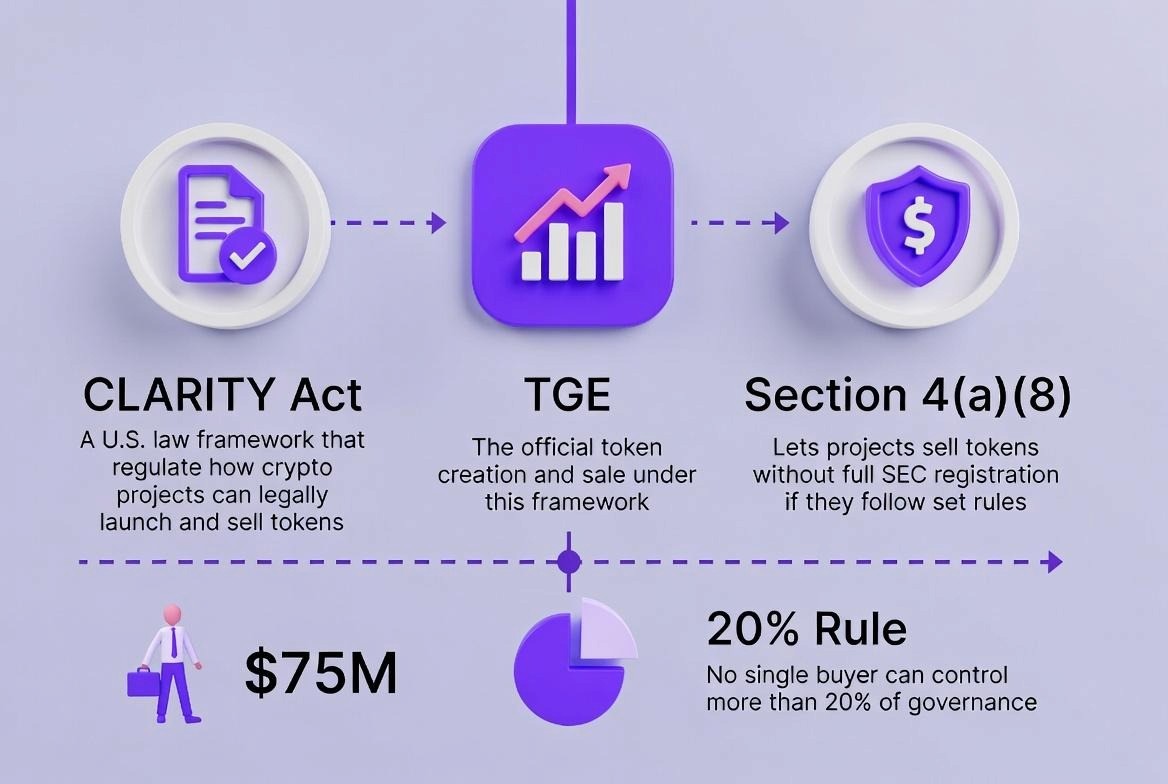
The CLARITY Act is a proposed U.S. law that aims to clearly define how digital assets like cryptocurrencies and tokens are regulated. It tries to separate which tokens are treated like securities and which are treated like commodities, so crypto companies know the rules before launching their projects.

The CLARITY Act does one key thing. It ends the SEC versus CFTC fight over digital assets. It does this by creating three clear categories that every token must fit into.

Digital Commodity

This is a token that gets its value from a decentralized blockchain. Bitcoin and Ethereum are the clearest examples. The CFTC regulates these. A token qualifies as a digital commodity when no single person or group controls 20% or more of the supply or voting power. Once a token hits that threshold, it can trade freely on CFTC-regulated exchanges.

Investment Contract Asset

This is where most TGEs start. When a founding team controls the network, the token supply, and the roadmap, the token is an investment contract asset. The SEC oversees it. This does not mean the token cannot be sold. It means the sale must follow SEC disclosure rules during the early phase.

Permitted Payment Stablecoin

Stablecoins are handled under a separate law called the GENIUS Act. If your TGE involves a stablecoin, that part follows a different path.

The Act also creates what it calls the mature blockchain system test. This is the test a token must pass to graduate from SEC oversight to CFTC oversight. The test is simple: no single entity can control 20% or more of the token supply or governance. Design your token distribution from day one with this threshold in mind. If you do not, your token may never qualify as a digital commodity, no matter how decentralized the tech is.

The Exemption Every TGE Founder Needs to Know

Most founding teams will not launch with a fully decentralized network. They will have a small core team, a product in development, and a need to raise money. The CLARITY Act has a specific exemption for this situation.

It is called the Section 4(a)(8) exemption. It allows a U.S.-organized issuer to sell tokens without full SEC registration. There are two hard limits. Total token sales cannot exceed $75 million in any 12-month period. And no single buyer can purchase more than 10% of the total token supply in one offering.

This exemption is the legal box most compliant TGEs will operate inside during the private and early public sale phases. Staying inside it while building toward network maturity is the main structural challenge of a CLARITY Act-compliant TGE, a transition phase managed through this real token sale demand system.

Three things determine whether you stay inside the exemption. The annual cap. The 10% single-buyer limit. And the requirement that the issuer is organized in the U.S. Break any one of these and you leave the exemption and enter full securities registration territory.

How to Prepare Your TGE for the CLARITY Act 

A CLARITY Act-ready TGE is not one event. It is a five-phase structure that moves the token from investment contract asset status toward digital commodity status as the network grows. The Act has not passed the Senate yet. But the requirements are already known. Founders who build toward them now will be ready the day it does. Founders who wait will spend their first year after passage fixing structure instead of growing.

Phase 1: Classify the Token and Set Up the Legal Entity
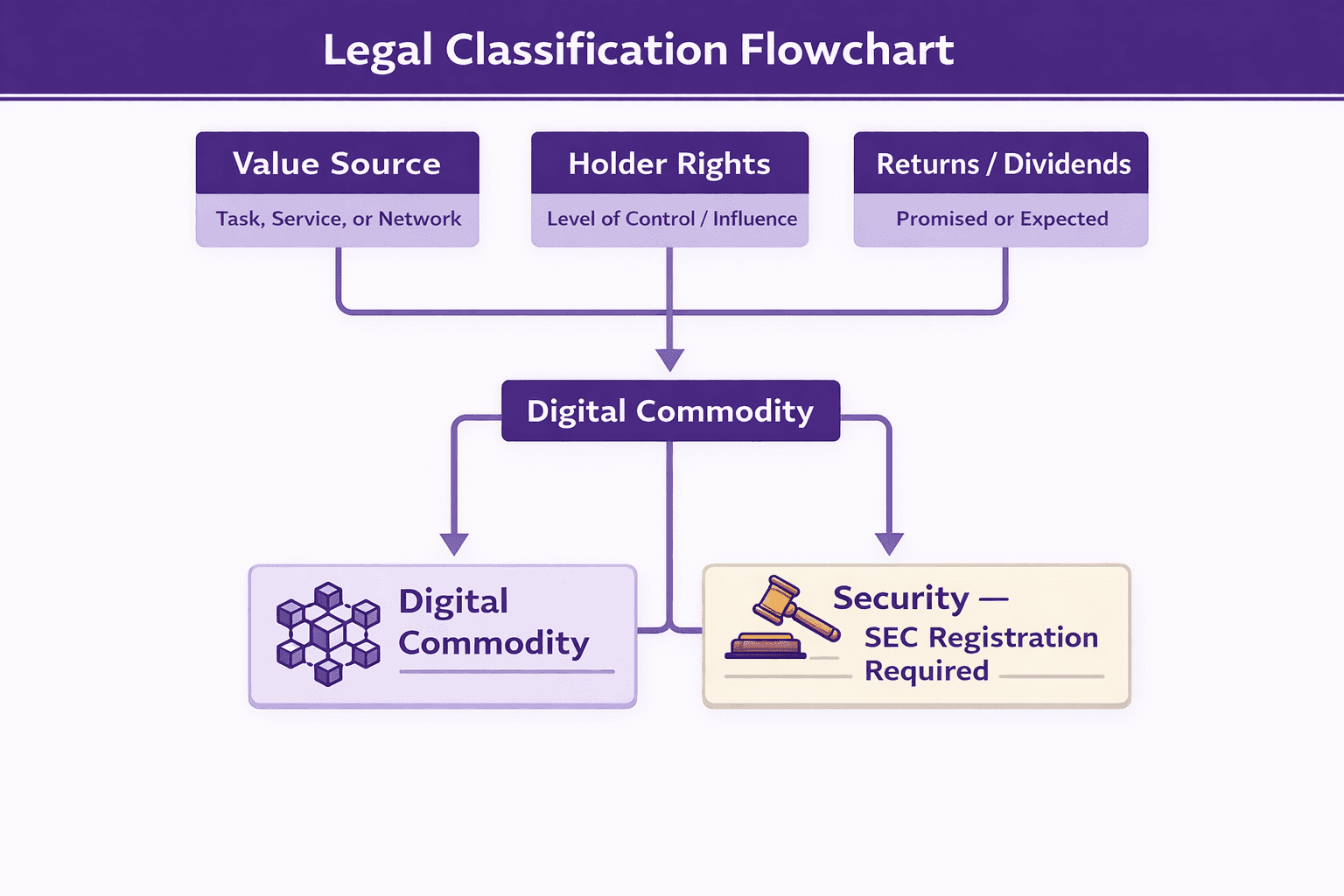
Nothing else happens until this is done. The founding team must answer three questions. Does the token get its value from the blockchain network, or from what the founding team does? What rights does the token give holders? Does the token pay returns, interest, or dividends?

The CLARITY Act is clear on one point. If a token gives the holder an ownership share in the issuer's revenues or profits, makes the holder a creditor, or pays interest, it will not qualify as a digital commodity. It will be treated as a security. It will need full SEC registration with no exemption available.

Start this now. Do not wait for the Act to pass. The classification question does not change while the law is still pending. The answer you get today will be the same answer regulators use when the Act takes effect. Getting a written legal opinion from qualified lawyers now gives you the foundation every other phase depends on.

Phase 2: Build the Private Sale Platform Before the Sale Opens
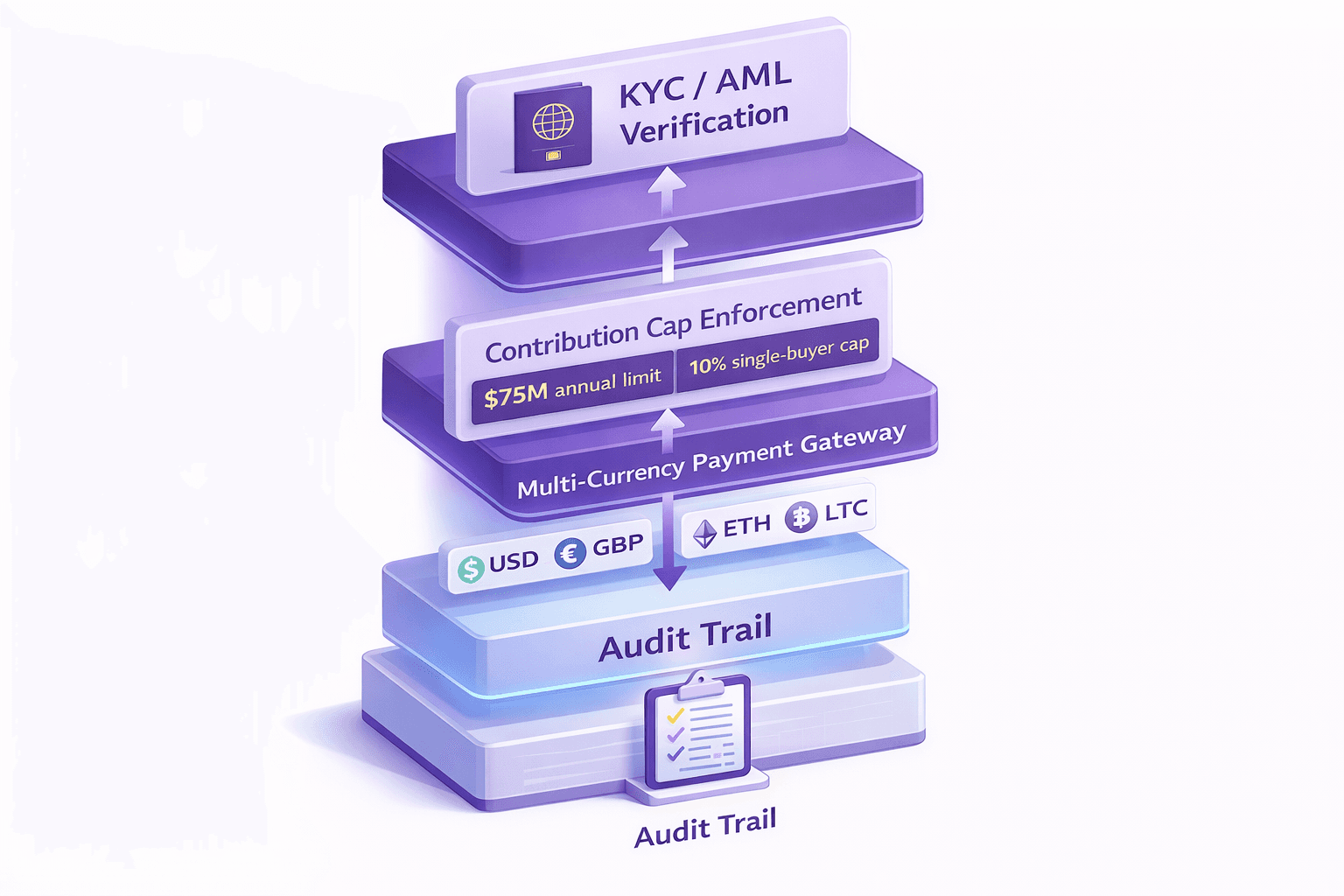
The CLARITY Act's Section 4(a)(8) exemption sets two hard limits. Total token sales cannot exceed $75 million in any 12-month period. No single buyer can purchase more than 10% of the total token supply in one offering.

These limits must be enforced by the platform automatically. Not tracked in a spreadsheet. Not reviewed at the end of the week. Enforced on every transaction before it goes through. A breach discovered after the fact does not fix the problem. It confirms it.

This is where most founding teams get stuck. Building a platform that enforces contribution caps, runs KYC at the transaction level, accepts multi-currency payments, and logs every entry with a full audit trail takes months of engineering work if you build it from scratch.

TMX TGE by TokenMinds is a ready-built token sale platform designed for exactly this. It enforces stage-level token caps and contribution limits automatically on every transaction. It integrates a KYC and AML module that verifies investor identity against government-issued documents before any purchase goes through. It accepts both fiat and crypto payments through one gateway. And it logs every transaction with a unique ID, timestamp, token amount, and USD value from day one.

Founders who deploy TMX TGE now are not just running a sale. They are building the compliance infrastructure that the CLARITY Act will require. When the Act passes, the platform already meets the standard. Nothing needs to be retrofitted.

Phase 3: Run Sale Stages With Automated Compliance
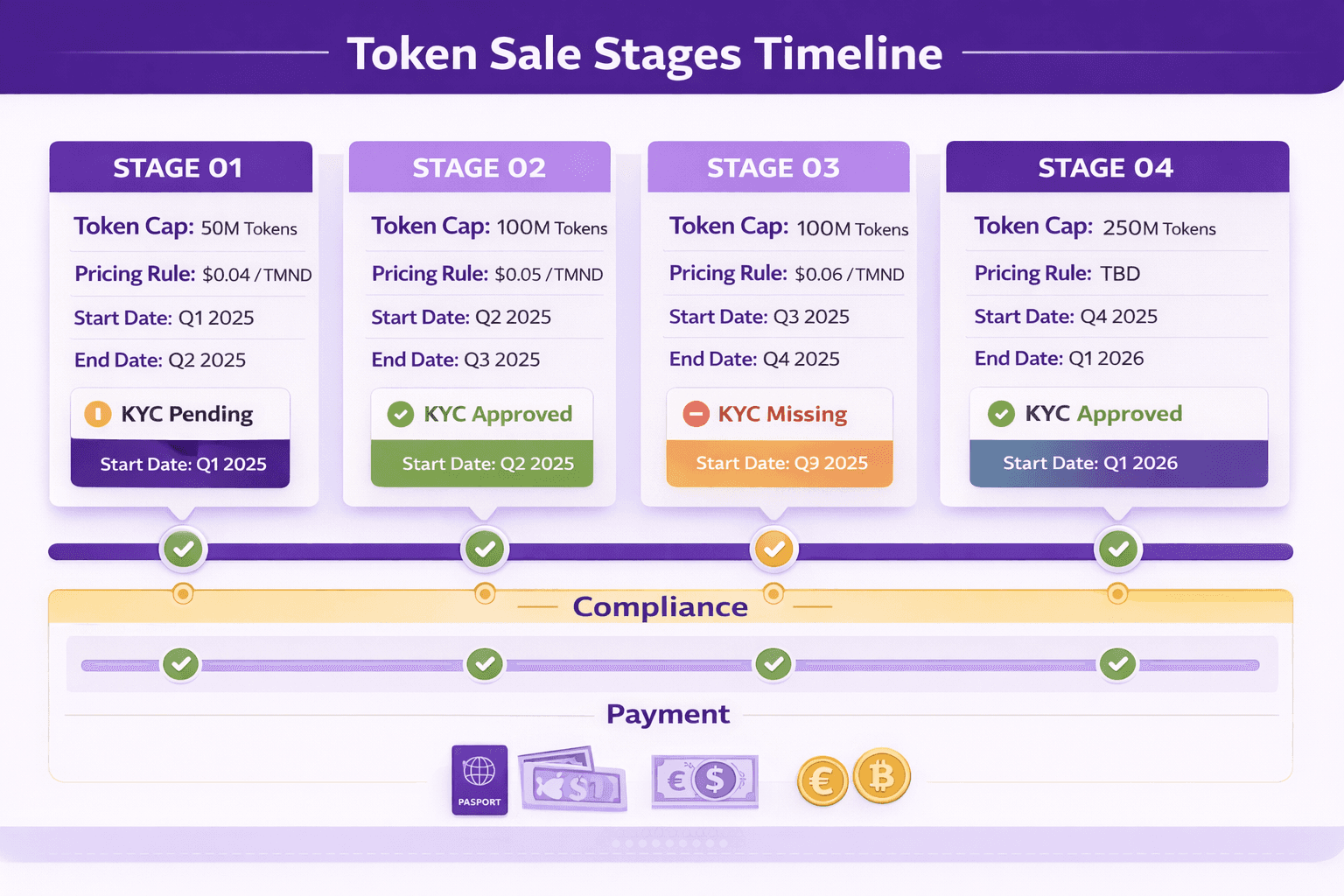
When the platform is live, the issuer runs sale stages with built-in compliance at every step. Each stage gets its own token cap, pricing rules, bonus structure, start date, and end date. Settings also cover website branding, referral programs, email communications, payment methods, private sale invitations, language options, and system status. All of it is configurable without touching code.

KYC and AML checks run in parallel with every purchase. TMX TGE supports document verification through Passport, National Card, and Driving License. No investor reaches the token purchase step without an Approved status. Every investor's identity is confirmed before funds are accepted. Investor statuses show as Pending, Missing, or Approved in real time inside the KYC List menu.

Payments come in through TMX TGE's multi-currency gateway. Fiat options include USD, EUR, and GBP. Crypto options include ETH, BTC, and LTC. Every transaction is logged automatically with a unique code, timestamp, token amount, and USD value. The platform tracks total contributions across all stages against the annual cap. No manual aggregation is needed at any point.

The Section 4(a)(8) exemption requires that identity be verified before funds are accepted and that contribution limits be tracked across the full sale period. TMX TGE enforces both as hard rules, not manual checks.

Phase 4: Give Investors and Admins Full Visibility
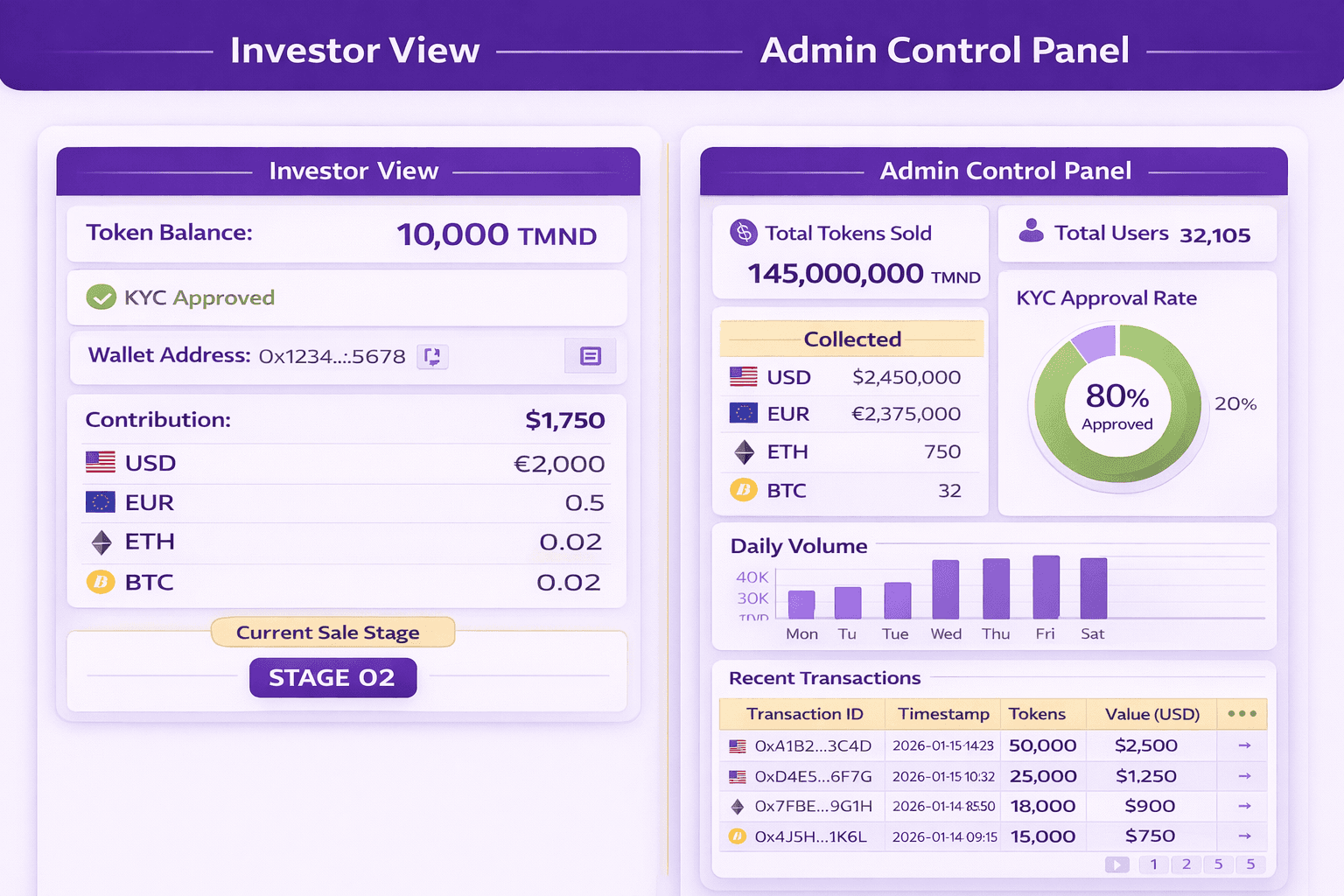
The CLARITY Act requires issuers to make ongoing disclosures to investors and to produce transaction records for regulators on demand. Neither requirement can be met without a proper audit trail built into the platform from day one.

Investors need a personal dashboard. TMX TGE gives every investor a clean view of their token balance, their contribution in multiple currencies, their KYC status, their wallet address, and the current stage of the sale. Transparency at the investor level is not a nice feature. Under the CLARITY Act, it is a disclosure requirement.

Admins need a unified control panel. TMX TGE covers total tokens sold, total users, KYC approval rates, amounts collected by currency, recent transactions with timestamps and USD values, and a volume graph by day. Every transaction has a unique ID, a timestamp, a token amount, and a USD value. All records are visible, auditable, and exportable in one place.

When the Act passes and a regulator asks for your transaction records, the answer should be ready in one click. TMX TGE makes that possible from the first day of the sale.

Phase 5: Design for Network Maturity From Day One
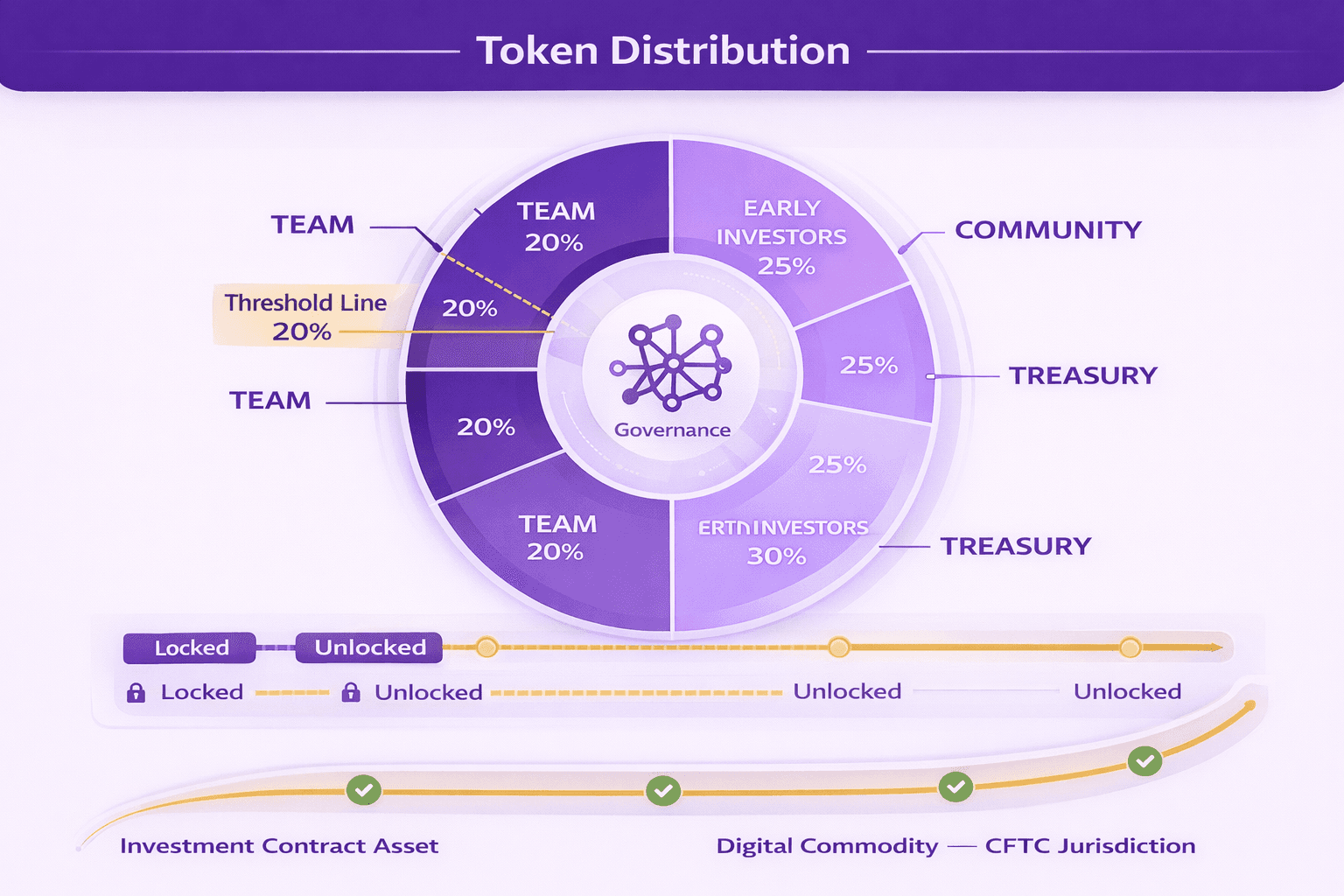
The CLARITY Act's most important long-term requirement is the 20% governance control threshold. When no single entity holds 20% or more of the token supply or voting power, the token qualifies as a digital commodity. The CFTC takes over from the SEC. The token can list on registered commodity exchanges. Institutional investors can hold it without legal risk.

This threshold cannot be fixed after the token is sold. If the founding team holds 25% of the supply, or if three investors each bought 15%, the network will never pass the maturity test. The tokenomics have to be designed for this from the first sale stage.

That means setting vesting schedules that prevent team concentration during the early phase. It means enforcing the 10% single-buyer cap on every purchase, which TMX TGE handles automatically at the transaction level. It means designing governance so that voting power spreads across a wide enough holder base from launch. Do this now and network maturity is a milestone you can plan toward. Do it after the fact and it may not be reachable at all.

The CLARITY Act TGE Compliance Matrix

Phase

Token Status

Regulator

Key Requirement

Limit

Pre-Sale

Investment Contract Asset

SEC

Legal opinion, entity structure

None, sets all future limits

Private Sale

Investment Contract Asset (Exempt)

SEC

Section 4(a)(8), KYC/AML, disclosures

$75M/year, 10% per buyer

Public Sale

Investment Contract Asset (Exempt)

SEC

Same exemption, public disclosures

Same caps

Maturity

Transition

SEC to CFTC

No single entity controls 20%+

20% control threshold

Secondary Market

Digital Commodity

CFTC

List on registered exchange

Exchange must be registered

How This Maps to CLARITY Act Compliance

Every Section 4(a)(8) requirement was met through the platform. The  cap was enforced through stage-level limits. The 10% single-buyer limit was set in stage configuration. KYC was completed before any investor could buy. Every transaction was logged with a unique ID, timestamp, currency, and amount. Distribution followed disclosed stage terms exactly. The multi-currency gateway recorded all contributions in a format ready for regulatory review.

VeriShip Protocol finished its private token sale with a compliant, fully auditable platform. Built and deployed by TokenMinds across four structured development stages from system setup to Solana mainnet launch.

The CLARITY Act TGE Readiness Index

Most founding teams do not know how ready their TGE is for CLARITY Act compliance. They know their token supply. They know their target. They do not know if their platform, legal structure, and distribution plan will hold up.

The CLARITY Act TGE Readiness Index scores projects across five areas. Each area is scored 1 to 4. A score of 1 means nothing is done. Score of 4 means fully built and compliant. Total out of 20.

Area

1 - Nothing Done

2 - Basic

3 - In Progress

4 - Fully Compliant

Token Classification

No legal opinion. Token type unknown.

The team has an internal view. No legal confirmation.

Lawyers engaged. Opinion in progress.

Written legal opinion confirms classification, exemption, and entity structure.

Exemption Compliance

No awareness of the caps.

Aware of limits but tracking by hand.

The platform tracks caps but does not enforce them automatically.

Platform blocks any transaction that would breach the $75M cap or 10% buyer limit.

KYC/AML

No KYC system. No investor verification.

Basic email form. No document check.

KYC integrated but approval is manual.

Automated module with real-time status tracking, document verification, and compliance reports.

Disclosure and Audit Trail

No disclosures. No transaction records.

Basic terms shared. No auditable log.

Disclosures made. Log exists but not structured for regulatory review.

Full disclosures on file. Real-time dashboard. Every transaction logged and ready for SEC or CFTC review.

Network Maturity Plan

No plan for the 20% threshold.

Token supply set but no governance plan.

Distribution planned. Governance structure being designed.

Tokenomics designed so no single entity crosses 20%. Governance spreads voting power. Maturity timeline is mapped.

Score guide:

5 to 8: You are fully exposed. If the CLARITY Act passes while your sale is running, you have no defense.

9 to 13: You are aware but not protected. You know what is needed but have not built the infrastructure to prove it.

14 to 17: You are structured for compliance. Platform, legal foundation, and distribution plan are in place.

18 to 20: You are audit-ready. Your sale can withstand SEC or CFTC review at any point.

Where most early-stage TGEs score:

Area

Score

Why

Token Classification

1

No legal opinion. Team calls it a utility token with no legal basis.

Exemption Compliance

1

No awareness of the caps. Tracking allocations in a spreadsheet.

KYC/AML

2

Email verification only. No document check. No AML screening.

Disclosure and Audit Trail

1

No formal disclosures. No auditable transaction log.

Network Maturity Plan

1

Tokenomics set by round economics. No governance plan.

Total

6/20

Fully exposed. No defensible structure.

Why Most CLARITY Act TGE Attempts Will Fail

Most founding teams that try to build a compliant TGE will fail. Not because the law is too hard. Because they copy the surface of each requirement without building the substance underneath it.

Email-only KYC

Email confirmation is not KYC under the CLARITY Act. Government-issued document verification is required. Real-time status tracking is required. A full audit trail is required. A spreadsheet of investor emails is not a defense under SEC review.

Manual cap tracking

The cap and the 10% buyer limit must be enforced at the moment of each transaction. A founder who checks allocations once a week and finds a breach has already violated the exemption. The platform has to stop the breach before it happens, not after.

Early token distribution

Distributing tokens before vesting conditions are met is a securities violation. It does not matter if the intention is goodwill. The disclosed terms are the legal terms. Changing them requires new disclosures and investor consent.

Ignoring maturity from day one

The 20% governance threshold cannot be fixed after the token is sold. If three investors hold 60% of the supply, the network will never pass the maturity test. Token distribution has to be designed for maturity certification from the first sale stage.

Skipping the legal opinion

The SEC does not accept a founder's view that their token is a utility token as a legal defense. A formal written opinion from qualified lawyers is the foundation the entire structure rests on. Without it, every other compliance step is built on nothing.

New Token Models Show How Projects Stay Under 20 Percent Control

Crypto legal experts are now sharing clearer token distribution models to help projects follow the 20 percent control rule under the CLARITY Act. Instead of only explaining the rule, they now show real numbers and structured plans.

Key example structure:

  • Team allocation: 18% with 4 year vesting

  • Private investors: Maximum 9.5% per wallet, hard coded into the system

  • Ecosystem incentives: 25% distributed through staking over 36 months

  • Public sale: Spread across many participants to avoid concentration

  • Treasury: Managed under governance rules with no single wallet control

These planned limits help make sure no single person or group can control more than 20% of the project.

Platforms Now Block Investors From Breaking Control Limits

New compliance systems also show what happens if someone tries to break the rules. Instead of reacting later, the platform stops the issue in real time.

Failure test example:

  • Investor already holds 9.6% of total token supply

  • Investor attempts a $9M purchase that would push ownership too high

  • Transaction is automatically rejected

  • Compliance log is generated and saved

  • Governance dashboard updates ownership records

This built in protection shows how projects can prevent violations before they happen, keeping the token launch legally safe from the start.

How TMX TGE Helps You Launch Under the CLARITY Act
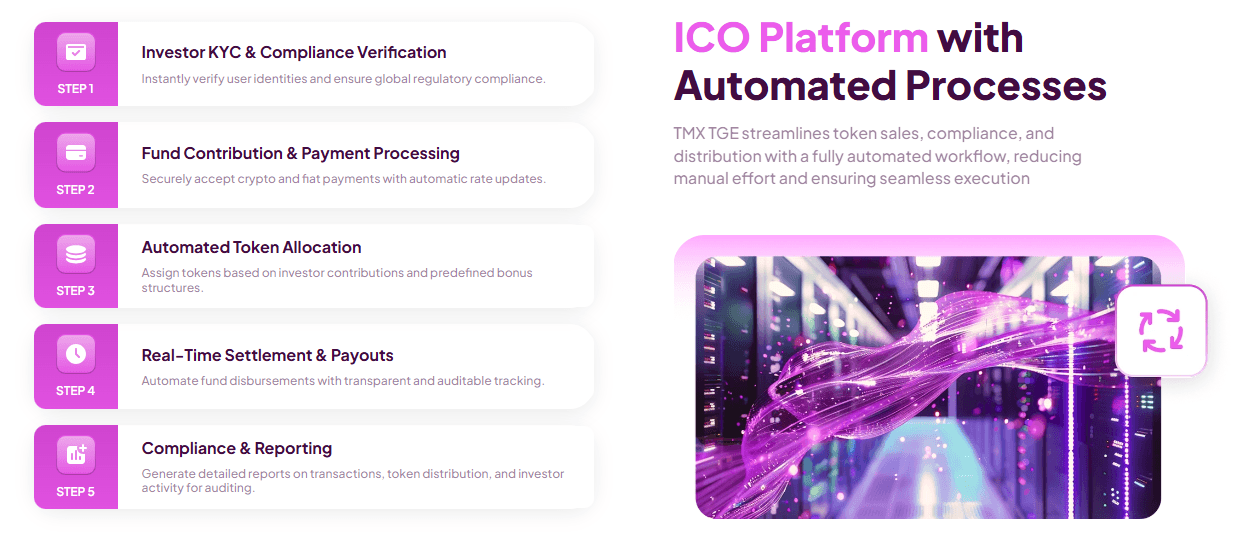
After helping VeriShip Protocol raise $506,783 across verified investors with a 97% KYC compliance rate using TMX TGE, TokenMinds learned that most founding teams know what the CLARITY Act requires. But they do not have the platform to prove they met it.

TMX TGE is TokenMinds' ready-built token sale platform. It handles the operational and compliance infrastructure that the Section 4(a)(8) exemption demands. You configure the rules. The platform enforces them on every transaction automatically.

Here is what TMX TGE covers for CLARITY Act-compliant launches.

  • Automated Exemption Enforcement

  • Document-Based KYC/AML

  • Multi-Currency Payment Gateway

  • Real-Time Investor and Admin Dashboards

  • Configurable Sale Stages

  • White-Label and Multi-Language

TMX TGE does not replace legal counsel. You still need a qualified lawyer to confirm your token classification and structure your entity under the CLARITY Act. But once that legal foundation is in place, TMX TGE gives you the platform infrastructure to run a compliant sale, produce the audit trail regulators require and scale to multiple sale stages without building everything from scratch.

Conclusion

Projects that build their TGE aligned with the proposed CLARITY Act framework today will be better positioned if and when the law takes effect. They have the legal classification confirmed. Their platform enforces the exemption limits on every transaction. Their KYC generates the audit trail regulators require. And their tokenomics are designed to reach network maturity on a real timeline.

Projects that skip this are running the same approach that has created billions in enforcement exposure since 2017. The difference now is that the proposed rules are written down, regulators are signaling clearer enforcement boundaries, and exchanges are preparing for registration. The gray zone is narrowing.

The token is the easy part. The structure is where TGEs succeed or fail. Build the structure before the sale opens. Everything else follows from there.

To get started, contact TokenMinds at info@tokenminds.co or visit tokenminds.co. TokenMinds provides the TMX TGE platform and strategic support for CLARITY Act-compliant token sales from private sale structure through network maturity certification.

FAQ

What is a TGE under the CLARITY Act?

A TGE, or Token Generation Event, under the CLARITY Act is when a crypto project officially creates and sells its tokens while following U.S. legal rules. The law explains how teams can sell tokens in a way that does not break securities laws.

What is the Section 4(a)(8) exemption?

The Section 4(a)(8) exemption is a special rule that lets crypto projects sell tokens without fully registering with the SEC, as long as they follow certain limits and requirements. It is meant to make legal token sales easier while still protecting investors.

What is the $75M annual cap?

The annual cap means a project can only raise up to 75 million dollars in one year using this exemption. If they want to raise more than that, they may need to follow stricter rules.

What is the 20% control threshold?

The 20% control threshold means no single buyer is allowed to control more than 20% of the project’s governance or decision-making power. This rule helps prevent one person or group from taking over the project.

When does SEC oversight end?

SEC oversight can end when the project becomes decentralized enough and no central team controls it anymore. At that point, the token may no longer be treated like a security.

Can foreign projects use the exemption?

Yes, foreign projects can use the exemption if they follow U.S. rules when selling tokens to U.S. investors. They must still meet the same requirements as U.S.-based projects.


Key Takeaways:

  • Under the proposed CLARITY Act, a compliant TGE must begin with clear legal classification and proper company structure before any tokens are sold. A written legal opinion should confirm whether the token starts as an Investment Contract Asset or is designed to become a Digital Commodity.

  • The section 4(a)(8) exemption can support early token sales, but only if the $75M yearly cap, 10% buyer limit, and full KYC checks are enforced automatically by the platform, not tracked manually.

  • The Act’s 20% control rule determines when regulation moves from the SEC to the CFTC. Token distribution, vesting, and governance must be planned from the start to avoid excessive control by any single party.

Most token launches follow the same bad pattern. The team picks a supply. They set a price. They sell to private investors. Then they do a public sale. Then they list on an exchange. Legal review, if it happens at all, comes after everything is already decided, a sequencing flaw corrected through this TGE framework.

This is the wrong order. And it is costly when it breaks.

The U.S. crypto market has had no clear rules for years. The SEC said most tokens are securities. The CFTC said some are commodities. Nobody agreed. Projects that guessed wrong got hit with enforcement actions, lawsuits, and forced delistings.

That is changing. On July 17, 2025, the CLARITY Act passed the U.S. House with a vote of 294 to 134. It is now in the Senate. If enacted, every token offering in the U.S. market would need to fit inside a defined legal structure.

Projects that build for CLARITY Act compliance now will be ready. Projects that do not will face the same painful retrofit that has cost the crypto industry billions since 2017. Only this time the rules are being written into proposed law.

What is a TGE under CLARITY Act

The CLARITY Act is a proposed U.S. law that aims to clearly define how digital assets like cryptocurrencies and tokens are regulated. It tries to separate which tokens are treated like securities and which are treated like commodities, so crypto companies know the rules before launching their projects.

The CLARITY Act does one key thing. It ends the SEC versus CFTC fight over digital assets. It does this by creating three clear categories that every token must fit into.

Digital Commodity

This is a token that gets its value from a decentralized blockchain. Bitcoin and Ethereum are the clearest examples. The CFTC regulates these. A token qualifies as a digital commodity when no single person or group controls 20% or more of the supply or voting power. Once a token hits that threshold, it can trade freely on CFTC-regulated exchanges.

Investment Contract Asset

This is where most TGEs start. When a founding team controls the network, the token supply, and the roadmap, the token is an investment contract asset. The SEC oversees it. This does not mean the token cannot be sold. It means the sale must follow SEC disclosure rules during the early phase.

Permitted Payment Stablecoin

Stablecoins are handled under a separate law called the GENIUS Act. If your TGE involves a stablecoin, that part follows a different path.

The Act also creates what it calls the mature blockchain system test. This is the test a token must pass to graduate from SEC oversight to CFTC oversight. The test is simple: no single entity can control 20% or more of the token supply or governance. Design your token distribution from day one with this threshold in mind. If you do not, your token may never qualify as a digital commodity, no matter how decentralized the tech is.

The Exemption Every TGE Founder Needs to Know

Most founding teams will not launch with a fully decentralized network. They will have a small core team, a product in development, and a need to raise money. The CLARITY Act has a specific exemption for this situation.

It is called the Section 4(a)(8) exemption. It allows a U.S.-organized issuer to sell tokens without full SEC registration. There are two hard limits. Total token sales cannot exceed $75 million in any 12-month period. And no single buyer can purchase more than 10% of the total token supply in one offering.

This exemption is the legal box most compliant TGEs will operate inside during the private and early public sale phases. Staying inside it while building toward network maturity is the main structural challenge of a CLARITY Act-compliant TGE, a transition phase managed through this real token sale demand system.

Three things determine whether you stay inside the exemption. The annual cap. The 10% single-buyer limit. And the requirement that the issuer is organized in the U.S. Break any one of these and you leave the exemption and enter full securities registration territory.

How to Prepare Your TGE for the CLARITY Act 

A CLARITY Act-ready TGE is not one event. It is a five-phase structure that moves the token from investment contract asset status toward digital commodity status as the network grows. The Act has not passed the Senate yet. But the requirements are already known. Founders who build toward them now will be ready the day it does. Founders who wait will spend their first year after passage fixing structure instead of growing.

Phase 1: Classify the Token and Set Up the Legal Entity

Nothing else happens until this is done. The founding team must answer three questions. Does the token get its value from the blockchain network, or from what the founding team does? What rights does the token give holders? Does the token pay returns, interest, or dividends?

The CLARITY Act is clear on one point. If a token gives the holder an ownership share in the issuer's revenues or profits, makes the holder a creditor, or pays interest, it will not qualify as a digital commodity. It will be treated as a security. It will need full SEC registration with no exemption available.

Start this now. Do not wait for the Act to pass. The classification question does not change while the law is still pending. The answer you get today will be the same answer regulators use when the Act takes effect. Getting a written legal opinion from qualified lawyers now gives you the foundation every other phase depends on.

Phase 2: Build the Private Sale Platform Before the Sale Opens

The CLARITY Act's Section 4(a)(8) exemption sets two hard limits. Total token sales cannot exceed $75 million in any 12-month period. No single buyer can purchase more than 10% of the total token supply in one offering.

These limits must be enforced by the platform automatically. Not tracked in a spreadsheet. Not reviewed at the end of the week. Enforced on every transaction before it goes through. A breach discovered after the fact does not fix the problem. It confirms it.

This is where most founding teams get stuck. Building a platform that enforces contribution caps, runs KYC at the transaction level, accepts multi-currency payments, and logs every entry with a full audit trail takes months of engineering work if you build it from scratch.

TMX TGE by TokenMinds is a ready-built token sale platform designed for exactly this. It enforces stage-level token caps and contribution limits automatically on every transaction. It integrates a KYC and AML module that verifies investor identity against government-issued documents before any purchase goes through. It accepts both fiat and crypto payments through one gateway. And it logs every transaction with a unique ID, timestamp, token amount, and USD value from day one.

Founders who deploy TMX TGE now are not just running a sale. They are building the compliance infrastructure that the CLARITY Act will require. When the Act passes, the platform already meets the standard. Nothing needs to be retrofitted.

Phase 3: Run Sale Stages With Automated Compliance

When the platform is live, the issuer runs sale stages with built-in compliance at every step. Each stage gets its own token cap, pricing rules, bonus structure, start date, and end date. Settings also cover website branding, referral programs, email communications, payment methods, private sale invitations, language options, and system status. All of it is configurable without touching code.

KYC and AML checks run in parallel with every purchase. TMX TGE supports document verification through Passport, National Card, and Driving License. No investor reaches the token purchase step without an Approved status. Every investor's identity is confirmed before funds are accepted. Investor statuses show as Pending, Missing, or Approved in real time inside the KYC List menu.

Payments come in through TMX TGE's multi-currency gateway. Fiat options include USD, EUR, and GBP. Crypto options include ETH, BTC, and LTC. Every transaction is logged automatically with a unique code, timestamp, token amount, and USD value. The platform tracks total contributions across all stages against the annual cap. No manual aggregation is needed at any point.

The Section 4(a)(8) exemption requires that identity be verified before funds are accepted and that contribution limits be tracked across the full sale period. TMX TGE enforces both as hard rules, not manual checks.

Phase 4: Give Investors and Admins Full Visibility

The CLARITY Act requires issuers to make ongoing disclosures to investors and to produce transaction records for regulators on demand. Neither requirement can be met without a proper audit trail built into the platform from day one.

Investors need a personal dashboard. TMX TGE gives every investor a clean view of their token balance, their contribution in multiple currencies, their KYC status, their wallet address, and the current stage of the sale. Transparency at the investor level is not a nice feature. Under the CLARITY Act, it is a disclosure requirement.

Admins need a unified control panel. TMX TGE covers total tokens sold, total users, KYC approval rates, amounts collected by currency, recent transactions with timestamps and USD values, and a volume graph by day. Every transaction has a unique ID, a timestamp, a token amount, and a USD value. All records are visible, auditable, and exportable in one place.

When the Act passes and a regulator asks for your transaction records, the answer should be ready in one click. TMX TGE makes that possible from the first day of the sale.

Phase 5: Design for Network Maturity From Day One

The CLARITY Act's most important long-term requirement is the 20% governance control threshold. When no single entity holds 20% or more of the token supply or voting power, the token qualifies as a digital commodity. The CFTC takes over from the SEC. The token can list on registered commodity exchanges. Institutional investors can hold it without legal risk.

This threshold cannot be fixed after the token is sold. If the founding team holds 25% of the supply, or if three investors each bought 15%, the network will never pass the maturity test. The tokenomics have to be designed for this from the first sale stage.

That means setting vesting schedules that prevent team concentration during the early phase. It means enforcing the 10% single-buyer cap on every purchase, which TMX TGE handles automatically at the transaction level. It means designing governance so that voting power spreads across a wide enough holder base from launch. Do this now and network maturity is a milestone you can plan toward. Do it after the fact and it may not be reachable at all.

The CLARITY Act TGE Compliance Matrix

Phase

Token Status

Regulator

Key Requirement

Limit

Pre-Sale

Investment Contract Asset

SEC

Legal opinion, entity structure

None, sets all future limits

Private Sale

Investment Contract Asset (Exempt)

SEC

Section 4(a)(8), KYC/AML, disclosures

$75M/year, 10% per buyer

Public Sale

Investment Contract Asset (Exempt)

SEC

Same exemption, public disclosures

Same caps

Maturity

Transition

SEC to CFTC

No single entity controls 20%+

20% control threshold

Secondary Market

Digital Commodity

CFTC

List on registered exchange

Exchange must be registered

How This Maps to CLARITY Act Compliance

Every Section 4(a)(8) requirement was met through the platform. The  cap was enforced through stage-level limits. The 10% single-buyer limit was set in stage configuration. KYC was completed before any investor could buy. Every transaction was logged with a unique ID, timestamp, currency, and amount. Distribution followed disclosed stage terms exactly. The multi-currency gateway recorded all contributions in a format ready for regulatory review.

VeriShip Protocol finished its private token sale with a compliant, fully auditable platform. Built and deployed by TokenMinds across four structured development stages from system setup to Solana mainnet launch.

The CLARITY Act TGE Readiness Index

Most founding teams do not know how ready their TGE is for CLARITY Act compliance. They know their token supply. They know their target. They do not know if their platform, legal structure, and distribution plan will hold up.

The CLARITY Act TGE Readiness Index scores projects across five areas. Each area is scored 1 to 4. A score of 1 means nothing is done. Score of 4 means fully built and compliant. Total out of 20.

Area

1 - Nothing Done

2 - Basic

3 - In Progress

4 - Fully Compliant

Token Classification

No legal opinion. Token type unknown.

The team has an internal view. No legal confirmation.

Lawyers engaged. Opinion in progress.

Written legal opinion confirms classification, exemption, and entity structure.

Exemption Compliance

No awareness of the caps.

Aware of limits but tracking by hand.

The platform tracks caps but does not enforce them automatically.

Platform blocks any transaction that would breach the $75M cap or 10% buyer limit.

KYC/AML

No KYC system. No investor verification.

Basic email form. No document check.

KYC integrated but approval is manual.

Automated module with real-time status tracking, document verification, and compliance reports.

Disclosure and Audit Trail

No disclosures. No transaction records.

Basic terms shared. No auditable log.

Disclosures made. Log exists but not structured for regulatory review.

Full disclosures on file. Real-time dashboard. Every transaction logged and ready for SEC or CFTC review.

Network Maturity Plan

No plan for the 20% threshold.

Token supply set but no governance plan.

Distribution planned. Governance structure being designed.

Tokenomics designed so no single entity crosses 20%. Governance spreads voting power. Maturity timeline is mapped.

Score guide:

5 to 8: You are fully exposed. If the CLARITY Act passes while your sale is running, you have no defense.

9 to 13: You are aware but not protected. You know what is needed but have not built the infrastructure to prove it.

14 to 17: You are structured for compliance. Platform, legal foundation, and distribution plan are in place.

18 to 20: You are audit-ready. Your sale can withstand SEC or CFTC review at any point.

Where most early-stage TGEs score:

Area

Score

Why

Token Classification

1

No legal opinion. Team calls it a utility token with no legal basis.

Exemption Compliance

1

No awareness of the caps. Tracking allocations in a spreadsheet.

KYC/AML

2

Email verification only. No document check. No AML screening.

Disclosure and Audit Trail

1

No formal disclosures. No auditable transaction log.

Network Maturity Plan

1

Tokenomics set by round economics. No governance plan.

Total

6/20

Fully exposed. No defensible structure.

Why Most CLARITY Act TGE Attempts Will Fail

Most founding teams that try to build a compliant TGE will fail. Not because the law is too hard. Because they copy the surface of each requirement without building the substance underneath it.

Email-only KYC

Email confirmation is not KYC under the CLARITY Act. Government-issued document verification is required. Real-time status tracking is required. A full audit trail is required. A spreadsheet of investor emails is not a defense under SEC review.

Manual cap tracking

The cap and the 10% buyer limit must be enforced at the moment of each transaction. A founder who checks allocations once a week and finds a breach has already violated the exemption. The platform has to stop the breach before it happens, not after.

Early token distribution

Distributing tokens before vesting conditions are met is a securities violation. It does not matter if the intention is goodwill. The disclosed terms are the legal terms. Changing them requires new disclosures and investor consent.

Ignoring maturity from day one

The 20% governance threshold cannot be fixed after the token is sold. If three investors hold 60% of the supply, the network will never pass the maturity test. Token distribution has to be designed for maturity certification from the first sale stage.

Skipping the legal opinion

The SEC does not accept a founder's view that their token is a utility token as a legal defense. A formal written opinion from qualified lawyers is the foundation the entire structure rests on. Without it, every other compliance step is built on nothing.

New Token Models Show How Projects Stay Under 20 Percent Control

Crypto legal experts are now sharing clearer token distribution models to help projects follow the 20 percent control rule under the CLARITY Act. Instead of only explaining the rule, they now show real numbers and structured plans.

Key example structure:

  • Team allocation: 18% with 4 year vesting

  • Private investors: Maximum 9.5% per wallet, hard coded into the system

  • Ecosystem incentives: 25% distributed through staking over 36 months

  • Public sale: Spread across many participants to avoid concentration

  • Treasury: Managed under governance rules with no single wallet control

These planned limits help make sure no single person or group can control more than 20% of the project.

Platforms Now Block Investors From Breaking Control Limits

New compliance systems also show what happens if someone tries to break the rules. Instead of reacting later, the platform stops the issue in real time.

Failure test example:

  • Investor already holds 9.6% of total token supply

  • Investor attempts a $9M purchase that would push ownership too high

  • Transaction is automatically rejected

  • Compliance log is generated and saved

  • Governance dashboard updates ownership records

This built in protection shows how projects can prevent violations before they happen, keeping the token launch legally safe from the start.

How TMX TGE Helps You Launch Under the CLARITY Act

After helping VeriShip Protocol raise $506,783 across verified investors with a 97% KYC compliance rate using TMX TGE, TokenMinds learned that most founding teams know what the CLARITY Act requires. But they do not have the platform to prove they met it.

TMX TGE is TokenMinds' ready-built token sale platform. It handles the operational and compliance infrastructure that the Section 4(a)(8) exemption demands. You configure the rules. The platform enforces them on every transaction automatically.

Here is what TMX TGE covers for CLARITY Act-compliant launches.

  • Automated Exemption Enforcement

  • Document-Based KYC/AML

  • Multi-Currency Payment Gateway

  • Real-Time Investor and Admin Dashboards

  • Configurable Sale Stages

  • White-Label and Multi-Language

TMX TGE does not replace legal counsel. You still need a qualified lawyer to confirm your token classification and structure your entity under the CLARITY Act. But once that legal foundation is in place, TMX TGE gives you the platform infrastructure to run a compliant sale, produce the audit trail regulators require and scale to multiple sale stages without building everything from scratch.

Conclusion

Projects that build their TGE aligned with the proposed CLARITY Act framework today will be better positioned if and when the law takes effect. They have the legal classification confirmed. Their platform enforces the exemption limits on every transaction. Their KYC generates the audit trail regulators require. And their tokenomics are designed to reach network maturity on a real timeline.

Projects that skip this are running the same approach that has created billions in enforcement exposure since 2017. The difference now is that the proposed rules are written down, regulators are signaling clearer enforcement boundaries, and exchanges are preparing for registration. The gray zone is narrowing.

The token is the easy part. The structure is where TGEs succeed or fail. Build the structure before the sale opens. Everything else follows from there.

To get started, contact TokenMinds at info@tokenminds.co or visit tokenminds.co. TokenMinds provides the TMX TGE platform and strategic support for CLARITY Act-compliant token sales from private sale structure through network maturity certification.

FAQ

What is a TGE under the CLARITY Act?

A TGE, or Token Generation Event, under the CLARITY Act is when a crypto project officially creates and sells its tokens while following U.S. legal rules. The law explains how teams can sell tokens in a way that does not break securities laws.

What is the Section 4(a)(8) exemption?

The Section 4(a)(8) exemption is a special rule that lets crypto projects sell tokens without fully registering with the SEC, as long as they follow certain limits and requirements. It is meant to make legal token sales easier while still protecting investors.

What is the $75M annual cap?

The annual cap means a project can only raise up to 75 million dollars in one year using this exemption. If they want to raise more than that, they may need to follow stricter rules.

What is the 20% control threshold?

The 20% control threshold means no single buyer is allowed to control more than 20% of the project’s governance or decision-making power. This rule helps prevent one person or group from taking over the project.

When does SEC oversight end?

SEC oversight can end when the project becomes decentralized enough and no central team controls it anymore. At that point, the token may no longer be treated like a security.

Can foreign projects use the exemption?

Yes, foreign projects can use the exemption if they follow U.S. rules when selling tokens to U.S. investors. They must still meet the same requirements as U.S.-based projects.

GET SUCCESS IN WEB3

  • Trusted Web3 partner since 2017

  • Full-stack Web3 development team

  • Performance-driven Web3 marketing

Get A Free Consultation

Get A Free Consultation

RECENT TRAININGS

Follow us

get web3 business updates

Email invalid

  • Access global liquidity for your RWA project with TMX Tokenize’s Canton Network integration

DISCOVER NOW

  • Access global liquidity for your RWA project with TMX Tokenize’s Canton Network integration

    JOIN NOW

DISCOVER

  • Access global liquidity for your RWA project with TMX Tokenize’s Canton Network integration