
Web3 & AI

SOLUTIONS

Products

Services

Web3 & AI

SOLUTIONS

Services

Products

Industries

Become Our Client

About Us

Resources

Web3 & AI

SOLUTIONS

Services

Products

Industries

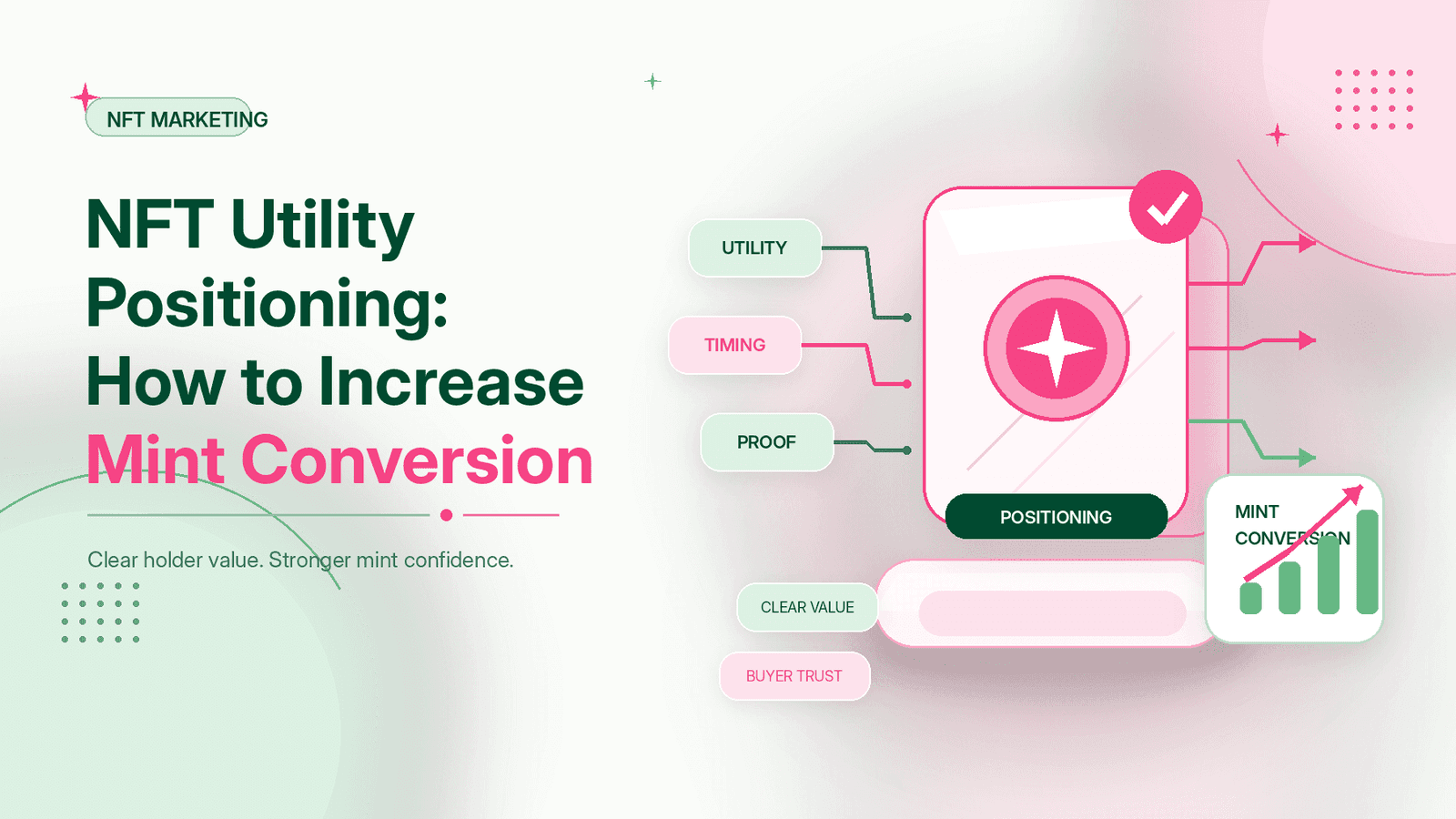
NFT Utility Positioning: How to Increase Mint Conversion

NFT Utility Positioning: How to Increase Mint Conversion

TL;DR
NFT mint conversion depends on how clearly the utility is positioned before launch. Most projects describe utility as roadmap ideas or feature lists, which creates confusion about benefits, timing, and ownership rights. Buyers do not struggle with interest. They struggle with interpretation. NFT utility positioning solves this by translating utility into clear outcomes, defined limits, and simple buyer-facing language. This reduces uncertainty and improves mint conversion without relying on hype-driven messaging.

Why NFT Mints Struggle When Utility Is Unclear

NFT mints usually struggle when buyers cannot understand utility fast enough. That problem matters more in the current NFT market. Nifty Gateway, an early NFT marketplace, announced a 2026 shutdown after years of weaker NFT activity. CoinDesk reported that the platform entered withdrawal-only mode before closing.

Market activity has not disappeared. It has become more selective. DappRadar reported a 158% rise in NFT sales between Q1 and Q3 2025. Wallets rose only 28.6% during the same period. DappRadar said this showed stronger activity from existing participants, not a large influx of new users.

This creates a harder mint environment. A project cannot rely only on art, roadmap energy, or community excitement. Buyers need a practical reason to mint, and they need it fast.

The main problems usually appear before mint:

  • Buyers cannot explain the holder benefit.

  • Activation timing feels unclear.

  • Rights and limits remain vague.

  • Roadmap promises look stronger than delivery proof.

  • Website, Discord, KOLs, and AMAs explain value differently.

That is why NFT utility clarity matters before mint. The issue is not always weak utility. The issue is weak interpretation.

A simple test helps. Can a new buyer explain the value in one sentence? If not, the project has a positioning problem. More promotion may increase reach, but it will not fix unclear value.

Why NFT Utility Clarity Matters Before Mint

NFT teams often assume utility is clear because the internal team understands it. Founders know the roadmap, marketers know the narrative, and community leads know the talking points. Buyers do not have that context when they reach the mint page.

That gap creates friction at the decision stage. A buyer may like the art, the community, or the founder story. Still, mint intent weakens when the practical value remains hard to explain.

The problem is usually not a lack of utility. It is a lack of positioning. Utility exists, but buyers cannot quickly understand what they receive, when it unlocks, and what rights apply.

What Makes NFT Utility Valuable?

NFT utility becomes valuable when it gives holders a clear reason to care. It should not exist only because the roadmap needs more features. It should solve a real holder problem or improve the holder experience.

A useful NFT utility usually passes four checks.

Utility Check

What It Means

Solves a holder problem

Gives holders a reason to join, hold, use, or participate

Easy to understand

Buyers can explain the benefit before mint

Redeemable

Holders know how to access or use the benefit

Sustainable

The project can support the utility after launch

If utility does not solve a holder problem, it becomes decoration. If it is not understandable, it becomes noise. If it is not redeemable, it creates frustration after mint.

Sustainability also matters. A utility promise may look strong during launch, but weak delivery can damage trust later. Projects should explain only what they can reasonably support.

This is where positioning becomes important. Valuable utility still needs clear explanation. Buyers must understand what the NFT gives them, why it matters, and how the value is delivered.

What is NFT Utility Positioning?

NFT utility positioning is the way a project explains utility in buyer language. Utility describes what the NFT can do. Positioning explains why that utility matters at the mint decision.

An NFT itself can represent a unique digital asset stored on a blockchain. DappRadar explains that NFTs can show ownership, authenticity, and scarcity through blockchain records. That technical layer matters, but buyers still need practical meaning.

Positioning connects technical value to buyer motivation. It turns “community access” into a clear access promise. It turns “future perks” into a defined benefit path with timing and limits.

Good positioning does not make bigger promises. It makes existing promises easier to understand. That is why it can improve mint conversion without adding hype.

NFT Utility Examples That Still Work in 2026

Once utility is positioned clearly, the next question becomes more practical. What types of utility still make sense in 2026, and how do buyers actually interpret them?

NFT utility still works when it gives buyers a clear and immediate reason to hold. That utility can be functional, social, experiential, or ownership-based. The key factor is not complexity. It is whether the buyer can understand the value before mint.

DappRadar describes NFT use cases across game items, real-world assets, phygital assets, domain names, access keys, and membership cards. It also notes that the market has moved beyond the 2021 hype cycle toward utility and integration.

Below is a simplified breakdown of utility types and what buyers actually need to understand before minting.

Utility type

What buyers need to understand

Access

Where access applies, and how long it lasts

Membership

What holders receive beyond joining a group

Rights

What usage rights exist, and what limits apply

Gaming

How the NFT works inside the game system

Phygital or RWA

How digital ownership connects to real assets

Dynamic utility

What changes over time, and why it changes

These categories are not automatically effective on their own. The category only creates the structure. The positioning determines whether it is understood correctly. That is why clarity still matters more than category selection. The best-performing utility is not always the most complex one. In most cases, it is the easiest one to understand at a glance. When utility is clear, hesitation drops before the buyer even reaches the mint button.

2026 NFT Utility Case Study: FIFA Collect Right-to-Ticket


Source: collect.fifa.com

FIFA Collect’s Right-to-Ticket digital collectibles give holders the right to claim an official ticket for a specified World Cup 2026 match and category. The collectible is not itself an entry ticket. Holders must complete FIFA’s conversion process before the applicable deadline.

  • Strategy
    Each collectible states the match, category, and conversion conditions. Holders can trade it before converting it through FIFA’s official process.

  • Positioning lesson
    The utility is specific, redeemable, time-bound, and verifiable. Buyers can understand the benefit and redemption process before purchase.

Common NFT Utility Positioning Mistakes

Even when NFT projects have real utility, positioning often breaks during communication. The issue is not the concept. It is how the concept is explained before mint.

Most problems appear in predictable patterns.

  1. Utility hidden inside roadmap
    Utility is often buried in roadmap slides or long-term plans. Buyers cannot quickly identify what they receive at mint stage. This creates uncertainty during decision-making.

  2. Undefined activation dates

    Many NFT projects describe benefits without timing. Buyers do not know when utility starts or becomes usable. This weakens trust at the mint moment.

  3. No proof mechanism

    Utility is presented without validation. There is no demo, partner confirmation, or system clarity. Buyers are forced to rely on assumptions.

  4. Rights not clearly explained

    Ownership rights are often vague. Buyers do not understand usage limits, commercial rights, or restrictions. This creates post-mint confusion risk.

  5. Overpromising future benefits

    Some messaging focuses heavily on future ecosystem growth. The issue is not ambition. The issue is lack of defined delivery structure.

These mistakes show a consistent pattern. Even strong utility can lose impact when its positioning is unclear. When explanation is unclear, even strong utility loses impact.

How to Explain NFT Utility before Mint

The previous section showed that NFT utility only works when buyers can understand it clearly. The problem is not utility itself. The problem is interpretation before mint.

To fix this, NFT utility explanation must follow a simple execution flow. Each step removes one layer of confusion before the mint decision.

Step 1: Start with buyer questions

Start with what the buyer needs to understand, not how the project was built. If buyer questions are unclear, everything else becomes unclear.

Step 2: Convert utility into outcomes

Internal utility must be translated into buyer outcomes. Technical language creates confusion, while outcomes create clarity.

Step 3: Define timing

Buyers need to know when value activates. Without timing, even strong utility feels uncertain.

Step 4: Define limits

Clear utility includes boundaries. Limits reduce expectation mismatch after mint.

Step 5: Add proof

Buyers need signals that utility is real. Proof reduces perceived risk before mint.

Step 6: Align all channels

Utility must be explained the same way everywhere. Inconsistency across channels breaks trust and slows conversion.

Why does this structure work?

This flow reduces interpretation step by step.

From confusion → clarity → decision readiness

Buyers do not need more information. They need less interpretation effort. When that happens, mint conversion becomes faster and more predictable.

Clear Utility vs Hype-driven Roadmap Messaging

Many NFT launches underperform even when utility exists because buyers interpret it differently. The same utility can feel either clear or speculative. The same utility can either feel clear or feel speculative.

Clear utility gives buyers a defined reason to mint. It explains the holder benefit, timing, proof, and limits. Buyers can understand what the NFT does without guessing.

Hype-driven messaging works differently. It turns utility into future potential, broad promises, or emotional claims. That may create attention, but it does not always create decision confidence.

This is why clarity of understanding matters. At the mint stage, buyers are not only asking if the idea sounds exciting. They are asking if the value is clear enough to act on.

Core difference in interpretation

The table below shows how the same utility idea can shift buyer perception.

Messaging Area

Hype-Driven Messaging

Clear Utility Positioning

Holder benefit

“Exclusive ecosystem access”

“Access to a gated holder portal after mint”

Timeline

“More perks coming soon”

“First benefit activates after mint”

Rights

“Own a piece of the brand”

“Commercial usage rights apply within defined limits”

Rewards

“Future holder rewards”

“Reward eligibility starts after the launch phase”

Community

“Join an elite community”

“Join a private holder group with scheduled sessions”

Proof

“Big partnerships ahead”

“Utility is supported by published partners or systems”

The difference is not only the wording. It changes how buyers evaluate risk. Hype asks buyers to believe. Clear positioning helps buyers understand.

What NFT teams should do instead

NFT teams should turn every utility claim into a checkable statement. Each claim should answer what holders receive, when it starts, and what limits apply. This makes the message easier to trust.

The best approach is not to remove excitement. It is to make excitement easier to verify. A strong mint message can still feel ambitious, but it should not depend on vague promises.

A useful test is simple. Can a new buyer explain the utility after reading it once? If not, the message still needs clearer positioning.

NFT Utility Examples by Campaign Type

Different NFT campaigns need different utility framing. A single template cannot cover every category. Each campaign type has a different buyer motivation.

Membership NFTs

Membership NFTs should focus on belonging and recurring value. Buyers need to understand what membership unlocks after mint. They also need to know whether benefits are one-time or ongoing.

Strong messaging explains the member experience clearly. It should define access, events, updates, and participation rights. Vague “exclusive community” language is usually too weak.

Event and access NFTs

Event NFTs depend on timing and entry rules. The buyer wants to know where access applies. They also need details on transferability, deadlines, and capacity.

This category needs operational clarity. Access utility fails when redemption feels uncertain. A clear process supports stronger mint confidence.

Gaming NFTs

Gaming NFTs should explain function inside the game world. Buyers need to know how the NFT affects play. Is it cosmetic, playable, tradable, upgradeable, or required.

Gaming utility also needs timeline clarity. If gameplay launches later, the message must separate live utility from planned utility. That prevents buyers from assuming too much.

Phygital and RWA-linked NFTs

Phygital NFTs connect digital ownership with physical value. RWA-linked NFTs connect the token to a real-world asset or entitlement. Both categories need redemption and verification clarity.

The message should explain how holders claim benefits. It should also define delivery timing, geographic limits, and support process. These details matter because the utility leaves the purely digital environment.

Community and status NFTs

Community NFTs often sell identity, belonging, and reputation. These benefits are softer than access or rights. They still need clear positioning.

The best approach defines what status means inside the ecosystem. It may involve roles, recognition, event access, or social identity. Without that definition, status becomes vague branding.

Mint Conversion Checklist for Utility Clarity

Utility positioning must appear across every launch surface. A buyer should hear the same core message on the mint page, X, Discord, AMAs, and KOL content. Consistency reduces confusion and improves decision speed.

Before mint, teams should check:

  • Does the website explain utility in one clear section?

  • Does the mint page show benefits, timing, and limits?

  • Does the FAQ answer repeated buyer questions?

  • Do Discord and Telegram moderators use the same wording?

  • Do KOL briefs explain utility without exaggeration?

  • Do AMA talking points define proof and boundaries?

  • Do PR angles match the actual holder benefits?

This checklist prevents messaging drift. Messaging drift happens when each channel interprets utility differently. Once that happens, buyers start trusting the least clear version.

When Teams Should Fix Utility Positioning Before Launch

Weak utility positioning shows up early. Communities ask the same questions repeatedly. KOLs describe benefits differently from the mint page.

These signals show that the project has attention, but not enough clarity. More promotion may increase reach. It will not fix weak interpretation.

Utility positioning should be corrected before heavy launch spending begins. For broader funnel planning, see NFT Sale Strategy in 2026: How to Build a Community-to-Mint Funnel. Utility positioning becomes the conversion layer inside that community-to-mint path.

Book an NFT Utility Messaging Workshop with TokenMinds

TokenMinds helps NFT teams turn utility into mint-ready messaging. The work connects buyer psychology, holder benefits, mint page copy, community FAQs, KOL briefs, AMA scripts, and launch assets.

This approach does not replace founder-owned strategy. It helps founders explain that strategy clearly before buyers decide. The goal is to reduce interpretation gaps, not add more promotional noise.

Need help turning NFT utility into clear mint messaging? TokenMinds can help refine the value narrative, holder benefits, FAQs, and launch assets before mint.

FAQs

What is NFT utility?
NFT utility refers to the practical benefits, access rights, ownership privileges, or experiences that holders receive from owning an NFT. It defines what the NFT enables for the holder beyond simple ownership of a digital asset.

How does NFT utility increase mint conversion?
Clear NFT utility increases mint conversion by reducing uncertainty. When buyers understand what they receive, when it activates, and how value is delivered, they can make faster and more confident mint decisions.

What NFT utility still works in 2026?
NFT utility that still performs in 2026 includes membership access, gaming assets, phygital experiences, tokenized real-world assets, and dynamic NFTs. These models work best when they are clearly defined and easy to understand before mint.

How do you explain NFT utility before mint?
Explain what holders receive, when the benefit activates, how they access it, what rights apply, and what limits exist. Support important claims with demos, partners, systems, or published delivery details.

How do you market NFTs without hype?
Use specific holder benefits, activation timelines, proof points, redemption rules, and clear limits. Keep the same core explanation across the mint page, community, KOL content, AMAs, and PR.

TL;DR
NFT mint conversion depends on how clearly the utility is positioned before launch. Most projects describe utility as roadmap ideas or feature lists, which creates confusion about benefits, timing, and ownership rights. Buyers do not struggle with interest. They struggle with interpretation. NFT utility positioning solves this by translating utility into clear outcomes, defined limits, and simple buyer-facing language. This reduces uncertainty and improves mint conversion without relying on hype-driven messaging.

Why NFT Mints Struggle When Utility Is Unclear

NFT mints usually struggle when buyers cannot understand utility fast enough. That problem matters more in the current NFT market. Nifty Gateway, an early NFT marketplace, announced a 2026 shutdown after years of weaker NFT activity. CoinDesk reported that the platform entered withdrawal-only mode before closing.

Market activity has not disappeared. It has become more selective. DappRadar reported a 158% rise in NFT sales between Q1 and Q3 2025. Wallets rose only 28.6% during the same period. DappRadar said this showed stronger activity from existing participants, not a large influx of new users.

This creates a harder mint environment. A project cannot rely only on art, roadmap energy, or community excitement. Buyers need a practical reason to mint, and they need it fast.

The main problems usually appear before mint:

  • Buyers cannot explain the holder benefit.

  • Activation timing feels unclear.

  • Rights and limits remain vague.

  • Roadmap promises look stronger than delivery proof.

  • Website, Discord, KOLs, and AMAs explain value differently.

That is why NFT utility clarity matters before mint. The issue is not always weak utility. The issue is weak interpretation.

A simple test helps. Can a new buyer explain the value in one sentence? If not, the project has a positioning problem. More promotion may increase reach, but it will not fix unclear value.

Why NFT Utility Clarity Matters Before Mint

NFT teams often assume utility is clear because the internal team understands it. Founders know the roadmap, marketers know the narrative, and community leads know the talking points. Buyers do not have that context when they reach the mint page.

That gap creates friction at the decision stage. A buyer may like the art, the community, or the founder story. Still, mint intent weakens when the practical value remains hard to explain.

The problem is usually not a lack of utility. It is a lack of positioning. Utility exists, but buyers cannot quickly understand what they receive, when it unlocks, and what rights apply.

What Makes NFT Utility Valuable?

NFT utility becomes valuable when it gives holders a clear reason to care. It should not exist only because the roadmap needs more features. It should solve a real holder problem or improve the holder experience.

A useful NFT utility usually passes four checks.

Utility Check

What It Means

Solves a holder problem

Gives holders a reason to join, hold, use, or participate

Easy to understand

Buyers can explain the benefit before mint

Redeemable

Holders know how to access or use the benefit

Sustainable

The project can support the utility after launch

If utility does not solve a holder problem, it becomes decoration. If it is not understandable, it becomes noise. If it is not redeemable, it creates frustration after mint.

Sustainability also matters. A utility promise may look strong during launch, but weak delivery can damage trust later. Projects should explain only what they can reasonably support.

This is where positioning becomes important. Valuable utility still needs clear explanation. Buyers must understand what the NFT gives them, why it matters, and how the value is delivered.

What is NFT Utility Positioning?

NFT utility positioning is the way a project explains utility in buyer language. Utility describes what the NFT can do. Positioning explains why that utility matters at the mint decision.

An NFT itself can represent a unique digital asset stored on a blockchain. DappRadar explains that NFTs can show ownership, authenticity, and scarcity through blockchain records. That technical layer matters, but buyers still need practical meaning.

Positioning connects technical value to buyer motivation. It turns “community access” into a clear access promise. It turns “future perks” into a defined benefit path with timing and limits.

Good positioning does not make bigger promises. It makes existing promises easier to understand. That is why it can improve mint conversion without adding hype.

NFT Utility Examples That Still Work in 2026

Once utility is positioned clearly, the next question becomes more practical. What types of utility still make sense in 2026, and how do buyers actually interpret them?

NFT utility still works when it gives buyers a clear and immediate reason to hold. That utility can be functional, social, experiential, or ownership-based. The key factor is not complexity. It is whether the buyer can understand the value before mint.

DappRadar describes NFT use cases across game items, real-world assets, phygital assets, domain names, access keys, and membership cards. It also notes that the market has moved beyond the 2021 hype cycle toward utility and integration.

Below is a simplified breakdown of utility types and what buyers actually need to understand before minting.

Utility type

What buyers need to understand

Access

Where access applies, and how long it lasts

Membership

What holders receive beyond joining a group

Rights

What usage rights exist, and what limits apply

Gaming

How the NFT works inside the game system

Phygital or RWA

How digital ownership connects to real assets

Dynamic utility

What changes over time, and why it changes

These categories are not automatically effective on their own. The category only creates the structure. The positioning determines whether it is understood correctly. That is why clarity still matters more than category selection. The best-performing utility is not always the most complex one. In most cases, it is the easiest one to understand at a glance. When utility is clear, hesitation drops before the buyer even reaches the mint button.

2026 NFT Utility Case Study: FIFA Collect Right-to-Ticket


Source: collect.fifa.com

FIFA Collect’s Right-to-Ticket digital collectibles give holders the right to claim an official ticket for a specified World Cup 2026 match and category. The collectible is not itself an entry ticket. Holders must complete FIFA’s conversion process before the applicable deadline.

  • Strategy
    Each collectible states the match, category, and conversion conditions. Holders can trade it before converting it through FIFA’s official process.

  • Positioning lesson
    The utility is specific, redeemable, time-bound, and verifiable. Buyers can understand the benefit and redemption process before purchase.

Common NFT Utility Positioning Mistakes

Even when NFT projects have real utility, positioning often breaks during communication. The issue is not the concept. It is how the concept is explained before mint.

Most problems appear in predictable patterns.

  1. Utility hidden inside roadmap
    Utility is often buried in roadmap slides or long-term plans. Buyers cannot quickly identify what they receive at mint stage. This creates uncertainty during decision-making.

  2. Undefined activation dates

    Many NFT projects describe benefits without timing. Buyers do not know when utility starts or becomes usable. This weakens trust at the mint moment.

  3. No proof mechanism

    Utility is presented without validation. There is no demo, partner confirmation, or system clarity. Buyers are forced to rely on assumptions.

  4. Rights not clearly explained

    Ownership rights are often vague. Buyers do not understand usage limits, commercial rights, or restrictions. This creates post-mint confusion risk.

  5. Overpromising future benefits

    Some messaging focuses heavily on future ecosystem growth. The issue is not ambition. The issue is lack of defined delivery structure.

These mistakes show a consistent pattern. Even strong utility can lose impact when its positioning is unclear. When explanation is unclear, even strong utility loses impact.

How to Explain NFT Utility before Mint

The previous section showed that NFT utility only works when buyers can understand it clearly. The problem is not utility itself. The problem is interpretation before mint.

To fix this, NFT utility explanation must follow a simple execution flow. Each step removes one layer of confusion before the mint decision.

Step 1: Start with buyer questions

Start with what the buyer needs to understand, not how the project was built. If buyer questions are unclear, everything else becomes unclear.

Step 2: Convert utility into outcomes

Internal utility must be translated into buyer outcomes. Technical language creates confusion, while outcomes create clarity.

Step 3: Define timing

Buyers need to know when value activates. Without timing, even strong utility feels uncertain.

Step 4: Define limits

Clear utility includes boundaries. Limits reduce expectation mismatch after mint.

Step 5: Add proof

Buyers need signals that utility is real. Proof reduces perceived risk before mint.

Step 6: Align all channels

Utility must be explained the same way everywhere. Inconsistency across channels breaks trust and slows conversion.

Why does this structure work?

This flow reduces interpretation step by step.

From confusion → clarity → decision readiness

Buyers do not need more information. They need less interpretation effort. When that happens, mint conversion becomes faster and more predictable.

Clear Utility vs Hype-driven Roadmap Messaging

Many NFT launches underperform even when utility exists because buyers interpret it differently. The same utility can feel either clear or speculative. The same utility can either feel clear or feel speculative.

Clear utility gives buyers a defined reason to mint. It explains the holder benefit, timing, proof, and limits. Buyers can understand what the NFT does without guessing.

Hype-driven messaging works differently. It turns utility into future potential, broad promises, or emotional claims. That may create attention, but it does not always create decision confidence.

This is why clarity of understanding matters. At the mint stage, buyers are not only asking if the idea sounds exciting. They are asking if the value is clear enough to act on.

Core difference in interpretation

The table below shows how the same utility idea can shift buyer perception.

Messaging Area

Hype-Driven Messaging

Clear Utility Positioning

Holder benefit

“Exclusive ecosystem access”

“Access to a gated holder portal after mint”

Timeline

“More perks coming soon”

“First benefit activates after mint”

Rights

“Own a piece of the brand”

“Commercial usage rights apply within defined limits”

Rewards

“Future holder rewards”

“Reward eligibility starts after the launch phase”

Community

“Join an elite community”

“Join a private holder group with scheduled sessions”

Proof

“Big partnerships ahead”

“Utility is supported by published partners or systems”

The difference is not only the wording. It changes how buyers evaluate risk. Hype asks buyers to believe. Clear positioning helps buyers understand.

What NFT teams should do instead

NFT teams should turn every utility claim into a checkable statement. Each claim should answer what holders receive, when it starts, and what limits apply. This makes the message easier to trust.

The best approach is not to remove excitement. It is to make excitement easier to verify. A strong mint message can still feel ambitious, but it should not depend on vague promises.

A useful test is simple. Can a new buyer explain the utility after reading it once? If not, the message still needs clearer positioning.

NFT Utility Examples by Campaign Type

Different NFT campaigns need different utility framing. A single template cannot cover every category. Each campaign type has a different buyer motivation.

Membership NFTs

Membership NFTs should focus on belonging and recurring value. Buyers need to understand what membership unlocks after mint. They also need to know whether benefits are one-time or ongoing.

Strong messaging explains the member experience clearly. It should define access, events, updates, and participation rights. Vague “exclusive community” language is usually too weak.

Event and access NFTs

Event NFTs depend on timing and entry rules. The buyer wants to know where access applies. They also need details on transferability, deadlines, and capacity.

This category needs operational clarity. Access utility fails when redemption feels uncertain. A clear process supports stronger mint confidence.

Gaming NFTs

Gaming NFTs should explain function inside the game world. Buyers need to know how the NFT affects play. Is it cosmetic, playable, tradable, upgradeable, or required.

Gaming utility also needs timeline clarity. If gameplay launches later, the message must separate live utility from planned utility. That prevents buyers from assuming too much.

Phygital and RWA-linked NFTs

Phygital NFTs connect digital ownership with physical value. RWA-linked NFTs connect the token to a real-world asset or entitlement. Both categories need redemption and verification clarity.

The message should explain how holders claim benefits. It should also define delivery timing, geographic limits, and support process. These details matter because the utility leaves the purely digital environment.

Community and status NFTs

Community NFTs often sell identity, belonging, and reputation. These benefits are softer than access or rights. They still need clear positioning.

The best approach defines what status means inside the ecosystem. It may involve roles, recognition, event access, or social identity. Without that definition, status becomes vague branding.

Mint Conversion Checklist for Utility Clarity

Utility positioning must appear across every launch surface. A buyer should hear the same core message on the mint page, X, Discord, AMAs, and KOL content. Consistency reduces confusion and improves decision speed.

Before mint, teams should check:

  • Does the website explain utility in one clear section?

  • Does the mint page show benefits, timing, and limits?

  • Does the FAQ answer repeated buyer questions?

  • Do Discord and Telegram moderators use the same wording?

  • Do KOL briefs explain utility without exaggeration?

  • Do AMA talking points define proof and boundaries?

  • Do PR angles match the actual holder benefits?

This checklist prevents messaging drift. Messaging drift happens when each channel interprets utility differently. Once that happens, buyers start trusting the least clear version.

When Teams Should Fix Utility Positioning Before Launch

Weak utility positioning shows up early. Communities ask the same questions repeatedly. KOLs describe benefits differently from the mint page.

These signals show that the project has attention, but not enough clarity. More promotion may increase reach. It will not fix weak interpretation.

Utility positioning should be corrected before heavy launch spending begins. For broader funnel planning, see NFT Sale Strategy in 2026: How to Build a Community-to-Mint Funnel. Utility positioning becomes the conversion layer inside that community-to-mint path.

Book an NFT Utility Messaging Workshop with TokenMinds

TokenMinds helps NFT teams turn utility into mint-ready messaging. The work connects buyer psychology, holder benefits, mint page copy, community FAQs, KOL briefs, AMA scripts, and launch assets.

This approach does not replace founder-owned strategy. It helps founders explain that strategy clearly before buyers decide. The goal is to reduce interpretation gaps, not add more promotional noise.

Need help turning NFT utility into clear mint messaging? TokenMinds can help refine the value narrative, holder benefits, FAQs, and launch assets before mint.

FAQs

What is NFT utility?
NFT utility refers to the practical benefits, access rights, ownership privileges, or experiences that holders receive from owning an NFT. It defines what the NFT enables for the holder beyond simple ownership of a digital asset.

How does NFT utility increase mint conversion?
Clear NFT utility increases mint conversion by reducing uncertainty. When buyers understand what they receive, when it activates, and how value is delivered, they can make faster and more confident mint decisions.

What NFT utility still works in 2026?
NFT utility that still performs in 2026 includes membership access, gaming assets, phygital experiences, tokenized real-world assets, and dynamic NFTs. These models work best when they are clearly defined and easy to understand before mint.

How do you explain NFT utility before mint?
Explain what holders receive, when the benefit activates, how they access it, what rights apply, and what limits exist. Support important claims with demos, partners, systems, or published delivery details.

How do you market NFTs without hype?
Use specific holder benefits, activation timelines, proof points, redemption rules, and clear limits. Keep the same core explanation across the mint page, community, KOL content, AMAs, and PR.

GET SUCCESS IN WEB3

  • Trusted Web3 partner since 2017

  • Full-stack Web3 development team

  • Performance-driven Web3 marketing

Get A Free Consultation

Get A Free Consultation

MEET US AT

RECENT TRAININGS

Follow us

get web3 business updates

Email invalid

  • Access global liquidity for your RWA project with TMX Tokenize’s Canton Network integration

DISCOVER NOW

  • Access global liquidity for your RWA project with TMX Tokenize’s Canton Network integration

    JOIN NOW

DISCOVER

  • Access global liquidity for your RWA project with TMX Tokenize’s Canton Network integration