Web3 & AI

SOLUTIONS

Products

Services

Web3 & AI

SOLUTIONS

Services

Products

Industries

Become Our Client

About Us

Resources

Web3 & AI

SOLUTIONS

Services

Products

Industries

How Can Distributed Ledger Repo Improve Intraday Funding and Collateral Mobility?

How Can Distributed Ledger Repo Improve Intraday Funding and Collateral Mobility?

TL;DR

Intraday repo funding often fails after trade agreement. The problem sits in collateral movement, custody confirmation, eligibility checks, and settlement timing. Distributed ledger repo infrastructure can reduce these delays by giving counterparties a shared settlement record, faster substitution workflows, and clearer intraday collateral visibility. Broadridge DLR shows live institutional traction at scale. DTCC and ECB initiatives also show growing market focus on collateral mobility and central bank money settlement. Institutions should now assess whether current repo workflows can support same-session funding, substitution, reconciliation, and collateral reuse.

Why Intraday Collateral Efficiency Has Become a Strategic Priority

Global repo market daily exposures exceed $12 trillion in the United States alone, with outstanding size estimates surpassing $15 trillion globally, according to Federal Reserve OFR and ICMA reporting. Collateral sits fragmented across dozens of custodians. Basel III liquidity rules can increase the cost of delayed funding and collateral movement. Key banking rules, such as NSFR and LCR, amplify the operational impact of settlement lags. Operational teams spend hours each day chasing collateral substitutions. Funding windows close before confirmations arrive.

Collateral trapped in fragmented custody systems increases funding inefficiency. Firms are prioritizing the speed of asset movement over the total volume of their collateral pools. For a dealer managing an $8 billion daily repo book, asset substitution times can drop from 95 minutes to 12 minutes. This releases $240 million in extra intraday liquidity capacity. (Note: This represents an illustrative operational model calculated by applying a standard 2.5 percent intraday liquidity buffer reduction to the book size when substitution delays are minimized.) The operational case now drives adoption more than the technology case.

Where Repo Workflows Break Down

Execution speed is not the core problem. Most repo desks agree to a trade in seconds. The problem occurs after the agreement. Settlement infrastructure relies on batch cycles and manual custody workflows. These systems cannot match intraday liquidity demands.

A collateral call arrives mid-morning. The typical response requires checking inventory across many custodians. Teams confirm eligibility. They request a transfer. They wait for confirmation before proceeding. Each handoff adds delay. Stable markets absorb these delays. Stressed conditions turn delays into funding gaps.

Three specific failure modes repeat across institutions.

Common Intraday Funding and Collateral Failure Modes

Failure Mode

Operational Impact

Settlement cycle mismatch across custodians

Collateral confirmed in one leg before the other is ready, creating intraday exposure

Manual substitution workflows

Repo desks wait for back-office sign-off on substitution requests, losing funding windows

Fragmented inventory visibility

When assets are held by different banks, they cannot be grouped or moved fast enough to meet settlement obligations.

Fails caused by cutoff timing

Late-day trades often miss deadline windows. This pushes the debt to the next day and drives up funding costs.

Reconciliation delays

Internal position records do not match custodian statements until the next day. This mismatch stops firms from reusing those assets immediately.

These failures are not edge cases. They represent recurring operational costs. The current infrastructure model embeds these costs. Fixing them requires changes at the settlement and custody layer. Trading desk changes alone will not solve the problem.

Legacy Versus Modern Collateral Workflow Comparison

Workflow Element

Legacy Approach

Modern Infrastructure Model

Inventory visibility

Aggregated from custodian reports, often T+1

Real-time or near-real-time across linked custody accounts

Substitution execution

Manual request via back-office, hours to complete

Automated substitution within pre-agreed parameters, minutes

Settlement finality

End-of-day batch netting with intraday exposure

Atomic or near-atomic settlement, reducing intraday counterparty risk

Collateral eligibility

Static schedules reviewed periodically

Dynamic eligibility checks against live parameters

Reconciliation

Overnight or next-day confirmation against custodian records

Continuous or same-session reconciliation on shared ledger

Funding window responsiveness

Reactive, constrained by operational cutoffs

Proactive, responsive within the trading session

The gap between these models is not just technological. It is also a process and governance gap. Successful institutions redesign their operating model first. They select infrastructure to match the new model.

How Distributed Ledger Repo Changes Funding Windows

Distributed ledger repo platforms use a shared infrastructure layer. They record trades, collateral transfer instructions, and settlement confirmations on this layer. All participants see the same state simultaneously. This reduces dependency on bilateral message handoffs between separate systems.

This architecture change produces direct operational effects. Substitution executes without a back-office relay. Settlement achieves finality within the same session. Inventory checks against a live shared record. Teams no longer rely on delayed reports.
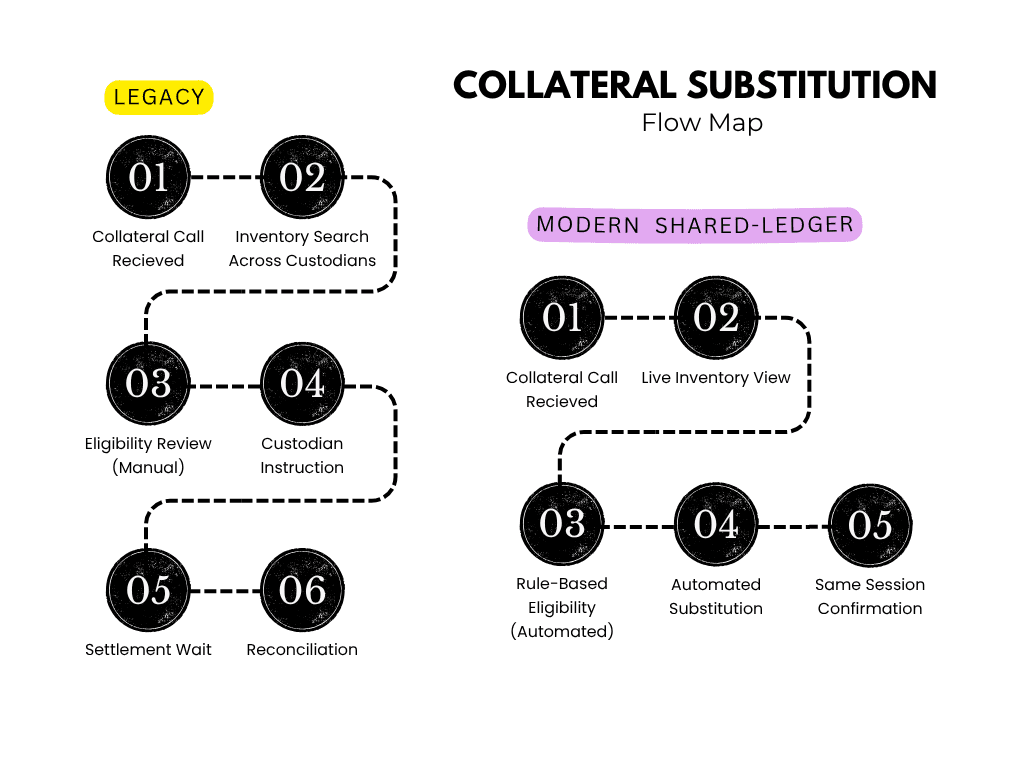
At each stage, a different system or team controls the next action. Inventory checks run against static or delayed feeds. Eligibility decisions require a human review when the substituting asset is not on a pre-approved schedule. Transfer instructions route through custodian portals that operate on fixed-cycle settlement. By the time confirmation arrives, the funding window that triggered the original call may have closed.

Tri-party repo arrangements improve some of this process. They automate collateral selection within a defined pool. Even tri-party systems face challenges when collateral needs to move outside the pool. They also face challenges when the trade structure involves multiple counterparties in different custody arrangements.

Why Interoperability Matters

Shared ledger fragmentation creates new operational risks. A bank may connect to five different DLT platforms. Each platform uses different messaging standards. Each platform maintains separate custody records. Without interoperability, the bank faces higher complexity, not lower complexity.

SWIFT research highlights the need for unified messaging standards to bridge traditional rails and distributed ledgers. Market infrastructure providers emphasize integration with legacy custody systems. Central bank money settlement must coexist with DLT settlement. The ECB Pontes initiative bridges DLT platforms and TARGET services. This allows firms to settle digital securities in central bank money without replacing their old systems. The ECB describes Pontes as a Eurosystem DLT solution linking market platforms and TARGET Services, with a pilot planned by the end of Q3 2026.

Interoperability requires three layers:

  1. Messaging standards that translate between DLT platforms and traditional systems

  2. Custody integration that maintains a unified view across ledgers

  3. Settlement finality that coordinates across different rails

CM-10 explains how distributed ledger settlement interacts with central bank money rails. That article covers interoperability models that allow DLT settlement to coexist with existing central bank and custodian infrastructure.

What Live Market Activity Shows

DTCC announced an AppChain-based tokenized collateral platform in 2025. The platform focuses on real-time collateral management and mobility. BIS frames tokenized government bonds as a core part of a broader tokenized financial system. These programs focus on making collateral easier to move and trade, rather than focusing on crypto tokens.

Composability allows collateral to move across books without re-verification. Shared network rules allow a digital bond from one platform to work as collateral on a different network. Eligibility automation checks collateral quality in real time against predefined parameters. The system can reject ineligible assets before execution when rules are predefined.

For more on how tokenized collateral delivers operational gains in securities financing, see [CM-02: Tokenized collateral for securities financing: where do the real operational gains come from] 

The Broadridge Distributed Ledger Repo platform shows current operational scale. In February 2026, it processed an average of $362 billion in daily transactions. Monthly volumes reached $6.9 trillion. This represents a 457 percent increase over February 2025. The Broadridge March 2026 press release confirms these figures. The growth is not experimental. It reflects live institutional trading at scale. Major banks and financial intermediaries take part as counterparties. This sustained volume growth indicates growing institutional adoption.

Horacio Barakat, Global Head of Digital Innovation at Broadridge, noted the platform focus. Development will extend into intraday funding. It will also strengthen collateral mobility. These areas present the strongest operational case for shared infrastructure.

Institutions evaluating this space must ask practical questions. Technology function is not the primary concern. Teams must determine if funding window improvements are measurable. They must assess if substitution processes can support faster execution. They must verify if custody and legal frameworks can accommodate shared settlement infrastructure.

Collateral Mobility Evaluation Checklist

Evaluation Criterion

Current State Assessment

Intraday inventory visibility

Can collateral positions be viewed in real time across all custodians?

Substitution execution speed

Can substitution requests be executed and confirmed within the same trading session?

Settlement finality timing

Does settlement achieve intraday finality or rely on end-of-day batch?

Reconciliation frequency

Is reconciliation continuous or limited to overnight processing?

Collateral re-use capacity

Can collateral be re-used intraday following settlement of the initial leg?

Infrastructure interoperability

Can old custody and settlement systems link to a shared ledger without being completely replaced?

Legal and regulatory framework

Are collateral agreements and netting opinions compatible with distributed ledger-settled trades?

For a detailed review of how to scope a tokenized collateral or repo pilot, see [CM-19: What should a bank include in a tokenized collateral or repo pilot?]

A collateral mobility assessment can identify trapped collateral, delayed substitution steps, and settlement windows that create intraday funding pressure. TokenMinds can map the current workflow and identify where shared-ledger infrastructure may improve operational efficiency. Contact TokenMinds to request a collateral mobility assessment: https://tokenminds.co/become-our-client/

Frequently Asked Questions

Q: What is distributed ledger repo, and how does it differ from standard repo?
A: Distributed ledger repo platforms handle the trade, move the collateral, and confirm the settlement all on one shared ledger. Standard repo uses bilateral messaging between separate systems. The underlying instrument can be a conventional security. The difference lies in the settlement infrastructure. Both parties see the same record simultaneously. This reduces bilateral reconciliation and supports same-session confirmation. It allows intraday settlement finality that batch-cycle systems cannot provide.

Q: Does adopting distributed ledger repo require holding digital assets?
A: No. Platforms such as Broadridge DLR settle conventional securities. These include government bonds. The institution does not need to hold or trade crypto assets. Conventional securities can be represented or settled through DLT rails without requiring full tokenization.

Q: What operational gains are institutions reporting from distributed ledger collateral infrastructure?
A: Institutions report gains in substitution speed. They also report gains in intraday settlement finality and cross-custodian inventory visibility. Platforms like Broadridge DLR process high volumes of daily repo transactions. They achieve intraday settlement capability. Broadridge’s trading volume grew by 457 percent in February 2026. This sustained growth indicates growing institutional adoption at scale.

References:

  1. Broadridge Financial Solutions: Primary source confirming DLR platform processed $362 billion average daily repo volume and $6.9 trillion monthly volume in February 2026, with 457 percent year-over-year growth. Also source of survey data on institutional distributed ledger adoption attitudes. https://www.broadridge.com/press-release/2026/broadridges-dlr-platform-achieves-457-percent-year-over-year-growth-in-february

  2. DTCC: Tokenized collateral platform announcement and real-time collateral management capabilities. https://www.dtcc.com/news/2025/april/02/dtcc-announces-new-platform-for-tokenized-real-time-collateral-management

  3. BIS: Annual Economic Report 2025 discussion of tokenized government bonds and wholesale finance infrastructure. https://www.bis.org/publ/arpdf/ar2025e3.htm

  4. ECB: Pontes initiative bridging DLT platforms and TARGET services for central bank money settlement. https://www.ecb.europa.eu/press/pr/date/2025/html/ecb.pr250701~f4a98dd9dc.en.html

  5. Federal Reserve OFR & ICMA: Reporting on U.S. repo market daily exposures and global outstanding size estimates. https://www.newyorkfed.org/markets/reference-rates/sofr; https://www.icmagroup.org/repo-and-collateral-markets/

  1. SWIFT Institute: Research on unified messaging standards for bridging traditional rails and distributed ledger settlement. https://www.swift.com/swift-resource/252290/download


TL;DR

Intraday repo funding often fails after trade agreement. The problem sits in collateral movement, custody confirmation, eligibility checks, and settlement timing. Distributed ledger repo infrastructure can reduce these delays by giving counterparties a shared settlement record, faster substitution workflows, and clearer intraday collateral visibility. Broadridge DLR shows live institutional traction at scale. DTCC and ECB initiatives also show growing market focus on collateral mobility and central bank money settlement. Institutions should now assess whether current repo workflows can support same-session funding, substitution, reconciliation, and collateral reuse.

Why Intraday Collateral Efficiency Has Become a Strategic Priority

Global repo market daily exposures exceed $12 trillion in the United States alone, with outstanding size estimates surpassing $15 trillion globally, according to Federal Reserve OFR and ICMA reporting. Collateral sits fragmented across dozens of custodians. Basel III liquidity rules can increase the cost of delayed funding and collateral movement. Key banking rules, such as NSFR and LCR, amplify the operational impact of settlement lags. Operational teams spend hours each day chasing collateral substitutions. Funding windows close before confirmations arrive.

Collateral trapped in fragmented custody systems increases funding inefficiency. Firms are prioritizing the speed of asset movement over the total volume of their collateral pools. For a dealer managing an $8 billion daily repo book, asset substitution times can drop from 95 minutes to 12 minutes. This releases $240 million in extra intraday liquidity capacity. (Note: This represents an illustrative operational model calculated by applying a standard 2.5 percent intraday liquidity buffer reduction to the book size when substitution delays are minimized.) The operational case now drives adoption more than the technology case.

Where Repo Workflows Break Down

Execution speed is not the core problem. Most repo desks agree to a trade in seconds. The problem occurs after the agreement. Settlement infrastructure relies on batch cycles and manual custody workflows. These systems cannot match intraday liquidity demands.

A collateral call arrives mid-morning. The typical response requires checking inventory across many custodians. Teams confirm eligibility. They request a transfer. They wait for confirmation before proceeding. Each handoff adds delay. Stable markets absorb these delays. Stressed conditions turn delays into funding gaps.

Three specific failure modes repeat across institutions.

Common Intraday Funding and Collateral Failure Modes

Failure Mode

Operational Impact

Settlement cycle mismatch across custodians

Collateral confirmed in one leg before the other is ready, creating intraday exposure

Manual substitution workflows

Repo desks wait for back-office sign-off on substitution requests, losing funding windows

Fragmented inventory visibility

When assets are held by different banks, they cannot be grouped or moved fast enough to meet settlement obligations.

Fails caused by cutoff timing

Late-day trades often miss deadline windows. This pushes the debt to the next day and drives up funding costs.

Reconciliation delays

Internal position records do not match custodian statements until the next day. This mismatch stops firms from reusing those assets immediately.

These failures are not edge cases. They represent recurring operational costs. The current infrastructure model embeds these costs. Fixing them requires changes at the settlement and custody layer. Trading desk changes alone will not solve the problem.

Legacy Versus Modern Collateral Workflow Comparison

Workflow Element

Legacy Approach

Modern Infrastructure Model

Inventory visibility

Aggregated from custodian reports, often T+1

Real-time or near-real-time across linked custody accounts

Substitution execution

Manual request via back-office, hours to complete

Automated substitution within pre-agreed parameters, minutes

Settlement finality

End-of-day batch netting with intraday exposure

Atomic or near-atomic settlement, reducing intraday counterparty risk

Collateral eligibility

Static schedules reviewed periodically

Dynamic eligibility checks against live parameters

Reconciliation

Overnight or next-day confirmation against custodian records

Continuous or same-session reconciliation on shared ledger

Funding window responsiveness

Reactive, constrained by operational cutoffs

Proactive, responsive within the trading session

The gap between these models is not just technological. It is also a process and governance gap. Successful institutions redesign their operating model first. They select infrastructure to match the new model.

How Distributed Ledger Repo Changes Funding Windows

Distributed ledger repo platforms use a shared infrastructure layer. They record trades, collateral transfer instructions, and settlement confirmations on this layer. All participants see the same state simultaneously. This reduces dependency on bilateral message handoffs between separate systems.

This architecture change produces direct operational effects. Substitution executes without a back-office relay. Settlement achieves finality within the same session. Inventory checks against a live shared record. Teams no longer rely on delayed reports.

At each stage, a different system or team controls the next action. Inventory checks run against static or delayed feeds. Eligibility decisions require a human review when the substituting asset is not on a pre-approved schedule. Transfer instructions route through custodian portals that operate on fixed-cycle settlement. By the time confirmation arrives, the funding window that triggered the original call may have closed.

Tri-party repo arrangements improve some of this process. They automate collateral selection within a defined pool. Even tri-party systems face challenges when collateral needs to move outside the pool. They also face challenges when the trade structure involves multiple counterparties in different custody arrangements.

Why Interoperability Matters

Shared ledger fragmentation creates new operational risks. A bank may connect to five different DLT platforms. Each platform uses different messaging standards. Each platform maintains separate custody records. Without interoperability, the bank faces higher complexity, not lower complexity.

SWIFT research highlights the need for unified messaging standards to bridge traditional rails and distributed ledgers. Market infrastructure providers emphasize integration with legacy custody systems. Central bank money settlement must coexist with DLT settlement. The ECB Pontes initiative bridges DLT platforms and TARGET services. This allows firms to settle digital securities in central bank money without replacing their old systems. The ECB describes Pontes as a Eurosystem DLT solution linking market platforms and TARGET Services, with a pilot planned by the end of Q3 2026.

Interoperability requires three layers:

  1. Messaging standards that translate between DLT platforms and traditional systems

  2. Custody integration that maintains a unified view across ledgers

  3. Settlement finality that coordinates across different rails

CM-10 explains how distributed ledger settlement interacts with central bank money rails. That article covers interoperability models that allow DLT settlement to coexist with existing central bank and custodian infrastructure.

What Live Market Activity Shows

DTCC announced an AppChain-based tokenized collateral platform in 2025. The platform focuses on real-time collateral management and mobility. BIS frames tokenized government bonds as a core part of a broader tokenized financial system. These programs focus on making collateral easier to move and trade, rather than focusing on crypto tokens.

Composability allows collateral to move across books without re-verification. Shared network rules allow a digital bond from one platform to work as collateral on a different network. Eligibility automation checks collateral quality in real time against predefined parameters. The system can reject ineligible assets before execution when rules are predefined.

For more on how tokenized collateral delivers operational gains in securities financing, see [CM-02: Tokenized collateral for securities financing: where do the real operational gains come from] 

The Broadridge Distributed Ledger Repo platform shows current operational scale. In February 2026, it processed an average of $362 billion in daily transactions. Monthly volumes reached $6.9 trillion. This represents a 457 percent increase over February 2025. The Broadridge March 2026 press release confirms these figures. The growth is not experimental. It reflects live institutional trading at scale. Major banks and financial intermediaries take part as counterparties. This sustained volume growth indicates growing institutional adoption.

Horacio Barakat, Global Head of Digital Innovation at Broadridge, noted the platform focus. Development will extend into intraday funding. It will also strengthen collateral mobility. These areas present the strongest operational case for shared infrastructure.

Institutions evaluating this space must ask practical questions. Technology function is not the primary concern. Teams must determine if funding window improvements are measurable. They must assess if substitution processes can support faster execution. They must verify if custody and legal frameworks can accommodate shared settlement infrastructure.

Collateral Mobility Evaluation Checklist

Evaluation Criterion

Current State Assessment

Intraday inventory visibility

Can collateral positions be viewed in real time across all custodians?

Substitution execution speed

Can substitution requests be executed and confirmed within the same trading session?

Settlement finality timing

Does settlement achieve intraday finality or rely on end-of-day batch?

Reconciliation frequency

Is reconciliation continuous or limited to overnight processing?

Collateral re-use capacity

Can collateral be re-used intraday following settlement of the initial leg?

Infrastructure interoperability

Can old custody and settlement systems link to a shared ledger without being completely replaced?

Legal and regulatory framework

Are collateral agreements and netting opinions compatible with distributed ledger-settled trades?

For a detailed review of how to scope a tokenized collateral or repo pilot, see [CM-19: What should a bank include in a tokenized collateral or repo pilot?]

A collateral mobility assessment can identify trapped collateral, delayed substitution steps, and settlement windows that create intraday funding pressure. TokenMinds can map the current workflow and identify where shared-ledger infrastructure may improve operational efficiency. Contact TokenMinds to request a collateral mobility assessment: https://tokenminds.co/become-our-client/

Frequently Asked Questions

Q: What is distributed ledger repo, and how does it differ from standard repo?
A: Distributed ledger repo platforms handle the trade, move the collateral, and confirm the settlement all on one shared ledger. Standard repo uses bilateral messaging between separate systems. The underlying instrument can be a conventional security. The difference lies in the settlement infrastructure. Both parties see the same record simultaneously. This reduces bilateral reconciliation and supports same-session confirmation. It allows intraday settlement finality that batch-cycle systems cannot provide.

Q: Does adopting distributed ledger repo require holding digital assets?
A: No. Platforms such as Broadridge DLR settle conventional securities. These include government bonds. The institution does not need to hold or trade crypto assets. Conventional securities can be represented or settled through DLT rails without requiring full tokenization.

Q: What operational gains are institutions reporting from distributed ledger collateral infrastructure?
A: Institutions report gains in substitution speed. They also report gains in intraday settlement finality and cross-custodian inventory visibility. Platforms like Broadridge DLR process high volumes of daily repo transactions. They achieve intraday settlement capability. Broadridge’s trading volume grew by 457 percent in February 2026. This sustained growth indicates growing institutional adoption at scale.

References:

  1. Broadridge Financial Solutions: Primary source confirming DLR platform processed $362 billion average daily repo volume and $6.9 trillion monthly volume in February 2026, with 457 percent year-over-year growth. Also source of survey data on institutional distributed ledger adoption attitudes. https://www.broadridge.com/press-release/2026/broadridges-dlr-platform-achieves-457-percent-year-over-year-growth-in-february

  2. DTCC: Tokenized collateral platform announcement and real-time collateral management capabilities. https://www.dtcc.com/news/2025/april/02/dtcc-announces-new-platform-for-tokenized-real-time-collateral-management

  3. BIS: Annual Economic Report 2025 discussion of tokenized government bonds and wholesale finance infrastructure. https://www.bis.org/publ/arpdf/ar2025e3.htm

  4. ECB: Pontes initiative bridging DLT platforms and TARGET services for central bank money settlement. https://www.ecb.europa.eu/press/pr/date/2025/html/ecb.pr250701~f4a98dd9dc.en.html

  5. Federal Reserve OFR & ICMA: Reporting on U.S. repo market daily exposures and global outstanding size estimates. https://www.newyorkfed.org/markets/reference-rates/sofr; https://www.icmagroup.org/repo-and-collateral-markets/

  1. SWIFT Institute: Research on unified messaging standards for bridging traditional rails and distributed ledger settlement. https://www.swift.com/swift-resource/252290/download

GET SUCCESS IN WEB3

  • Trusted Web3 partner since 2017

  • Full-stack Web3 development team

  • Performance-driven Web3 marketing

Get A Free Consultation

Get A Free Consultation

MEET US AT

RECENT TRAININGS

Follow us

get web3 business updates

Email invalid

  • Access global liquidity for your RWA project with TMX Tokenize’s Canton Network integration

DISCOVER NOW

  • Access global liquidity for your RWA project with TMX Tokenize’s Canton Network integration

    JOIN NOW

DISCOVER

  • Access global liquidity for your RWA project with TMX Tokenize’s Canton Network integration