
TL;DR
A post token sale marketing plan keeps holder confidence alive after TGE and listing. The first 72 hours should reduce confusion around claims, exchange access, official links, and support. The next 30-90 days should explain utility, report progress, continue creator activity, and prepare updates around liquidity, unlocks, and supply. The goal is not more hype. The goal is a repeatable retention system.
Why Post Token Sale Marketing Matters
A token sale does not end when the token goes live. That moment creates attention. It also creates pressure. Holders start judging the project by execution, not only by promise.
The market has become less forgiving here. AP Collective cites 2025 launch data showing that 84.7% of token launches traded below their TGE valuation. The same data showed a median FDV decline of 71%.
That does not mean marketing can control price. It means holders need stronger reasons to stay informed, active, and patient. A project must show that launch was the start of execution, not the end of the campaign.
Post token sale marketing answers basic holder questions:
What should holders do next?
Where are the official links?
How can holders claim, trade, or stake?
What utility is available now?
What updates will come next?
How will unlocks and supply changes be explained?
These questions may sound simple. But they shape trust quickly. A strong post token sale marketing plan gives holders clarity. It explains what changed after TGE. It gives the community a weekly rhythm. It also shows that the team is still building.
Post-TGE Problems
Post-TGE problems usually come from weak operating systems. Many teams have a launch plan. Fewer teams have a retention plan. This creates gaps once the token goes live. The most common gaps are operational:
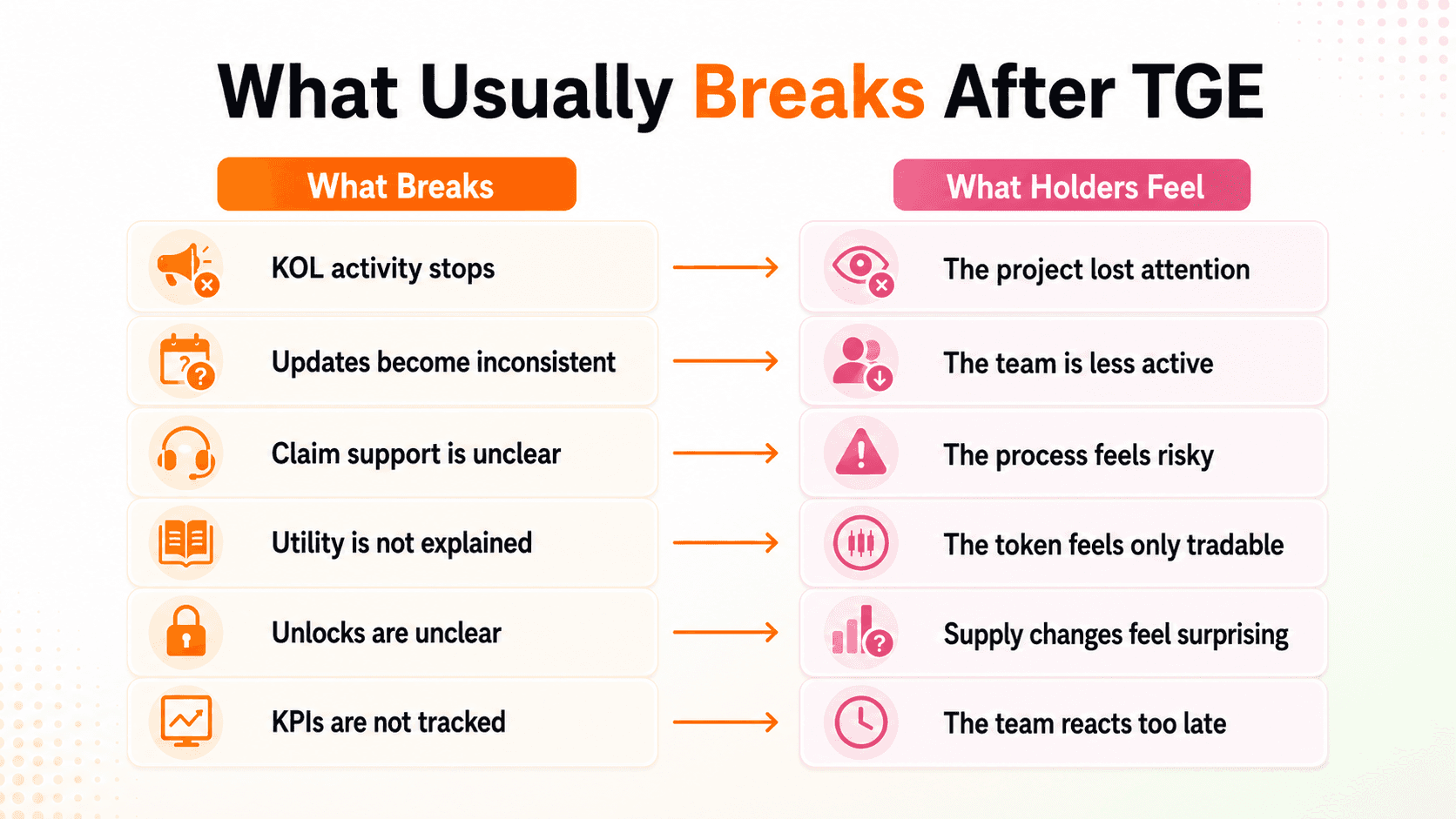
Each gap makes holders question the project’s control. Post token sale marketing fixes this with clear owners, weekly schedules, support scripts, creator follow-ups, and simple reporting.
These systems should be planned before TGE. Waiting until momentum drops makes the work harder.
Critical Timing After TGE: The First 72 Hours
The first 72 hours shape holder confidence. Attention is high. Questions also come fast. Holders want official links, claim steps, exchange access, and clear support.
AP Collective also treats this window as important. It highlights announcement timing, KOL activation, community coordination, exchange updates, and live communication during the TGE window.
The goal is simple. Reduce confusion before it spreads. Projects should focus on three jobs:
Access:
Share official links, claim steps, exchange access, contract details, and staking links.Support:
Prepare moderator answers, scam warnings, wallet guidance, and escalation paths.Confidence:
Publish a short recap, explain what went live, and share the next update schedule.
The same information should appear across the website, X, Telegram, Discord, exchange posts, and pinned messages.
A simple 72-hour plan can look like this:
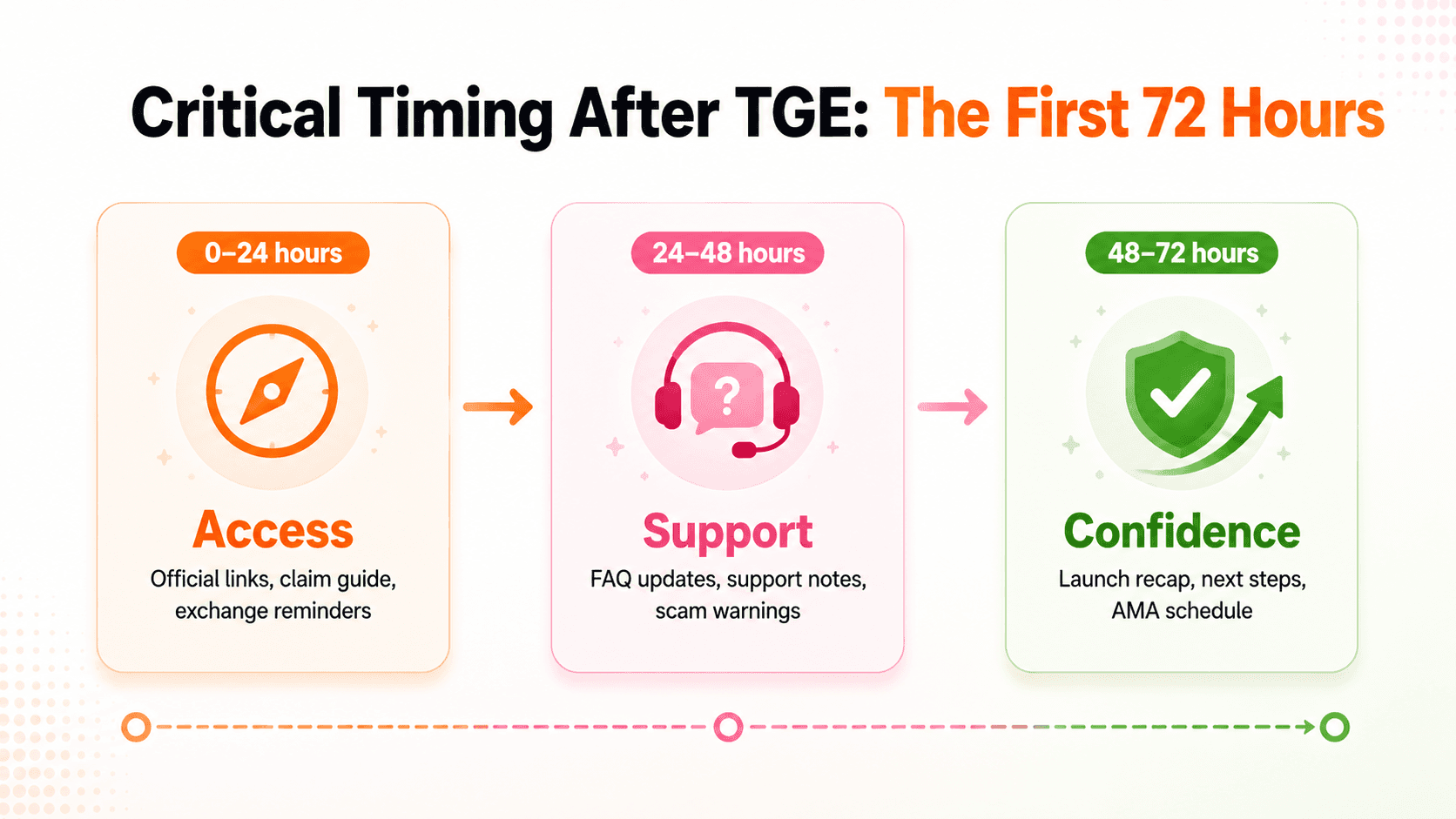
This turns launch attention into a controlled handoff.
The project is no longer only announcing the token. It is showing holders where to go, what to do, and what comes next.
The 30-60-90 Day Holder Retention Plan
The first 30-90 days need a clear retention plan. Launch attention fades fast. KOL content slows down. The media moves to the next token. Community questions also become more practical.
AP Collective says this period is where many launches fail without a deliberate post-TGE program. It also connects retention with narrative continuation, community deepening, and continued KOL engagement.
A practical plan can be split into three stages.
Period | Owner | Cadence | Output |
First 72 hours | Community + Ops | Daily | Claim support, scam warnings, pinned links |
First 30 days | Marketing + Product | Weekly | Progress update, AMA, utility guide |
Days 31-60 | Growth + Community | Weekly | Staking education, governance tasks |
Days 61-90 | Founder + Marketing | Biweekly | Roadmap report, creator refresh, unlock reminders |
The plan should move through three stages:
First 30 days: stabilize confidence.
The project should fix launch friction first. Holders need clear claim support, official links, exchange access, weekly updates, and simple utility education.Days 31-60: turn holders into participants.
The project should give holders something useful to do. This can include staking education, governance explainers, product walkthroughs, ecosystem tasks, or community programs.
Staking and liquidity programs should be explained before promotion. Holders need the basic rules first:
Who can join
When the program starts
How lock terms work
How rewards are calculated
What risks holders should understand
Where support questions should go
The goal is participation clarity, not yield hype. These programs should help holders understand how to take part. They should not sound like guaranteed return opportunities.
Days 61-90: keep momentum visible.
The project should show that progress continues. This can include milestone reports, creator refresh campaigns, partner updates, listing updates, and early unlock communication.
This plan should be ready before TGE. Once activity drops, every update feels late. A planned rhythm helps the team stay ahead of holder questions.
The Retention Flywheel: Why Post-TGE Work Compounds
Holder retention is not built by one update. It grows when each activity supports the next one. A clear update builds trust. Trust makes holders more willing to participate. Participation creates social proof. Social proof attracts new holders and observers. New holders can strengthen the community and liquidity base.
The loop is simple:
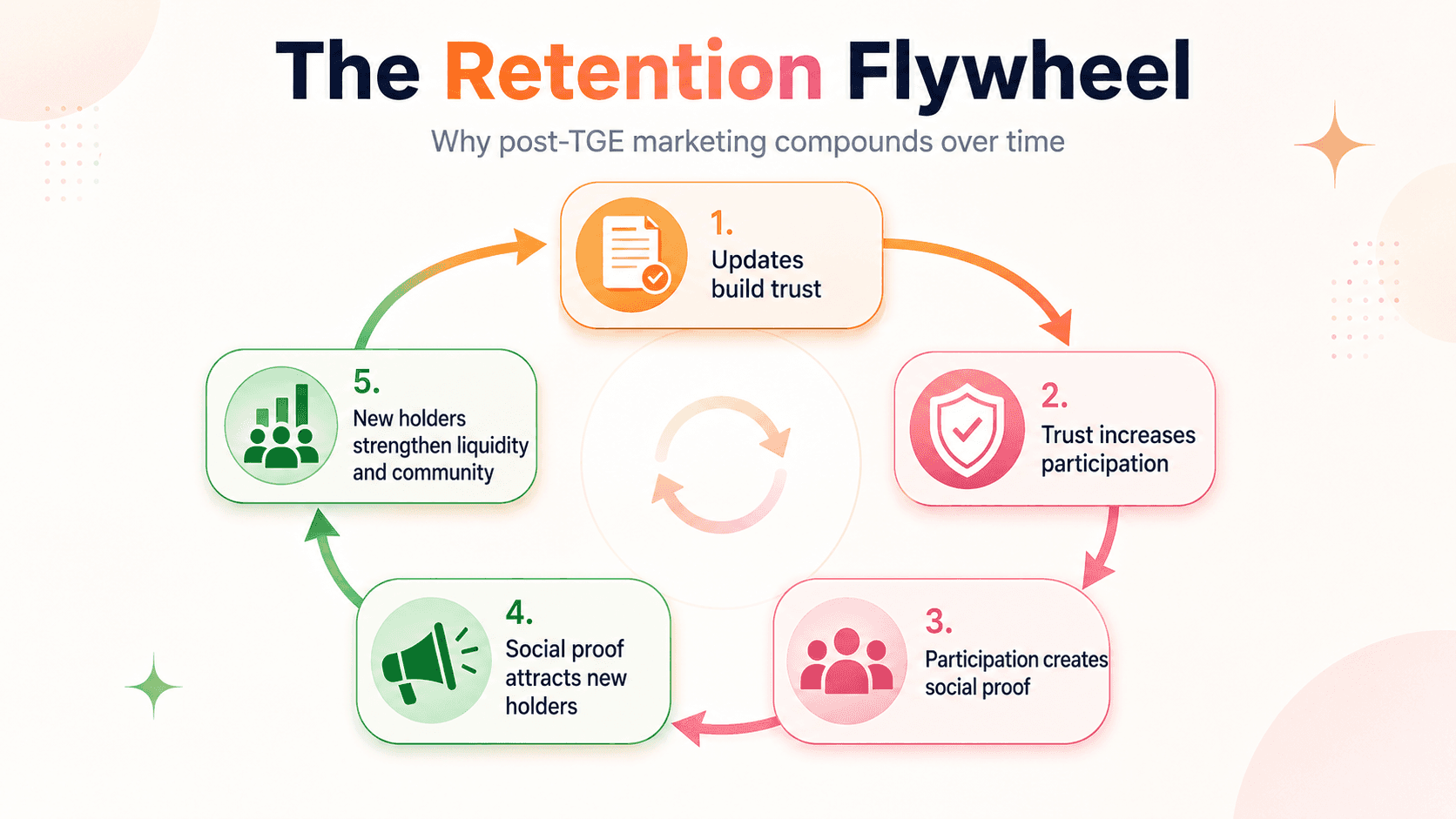
This is why post token sale marketing needs rhythm. A weekly update can support an AMA. An AMA can produce better holder questions. Those questions can become new education content. That content helps new holders understand the project faster.
Common Post-TGE Marketing Mistakes
Post-TGE marketing fails when teams treat retention as casual posting. The most common mistakes are simple:
Going silent after TGE
Posting only price or trading updates
Delaying unlock communication
Ending KOL relationships after launch week
Sharing roadmap updates without a clear schedule
Ignoring support tickets and repeated questions
These mistakes weaken the retention flywheel.
How to Keep Token Holders Informed and Active After TGE
Holder activity depends on information quality. A noisy community is not always a strong community. A quiet but informed holder base can be healthier than a chat full of short-term reactions. The goal is useful repetition, not constant posting.
1. Explain utility in plain language
Token utility needs repeated explanation after TGE. Holders should understand what the token does inside the product or ecosystem. They should also know what is available now, what comes later, and what claims should be avoided.
The action points are simple:
Explain what holders can do with the token now.
Separate live utility from future utility.
Show staking, governance, or product steps clearly.
Avoid price, yield, or return promises.
Repeat important instructions across all main channels.
Turn complex token mechanics into short guides.
This helps holders see the token as more than a tradable asset.
Teams should separate live utility from planned utility. Live utility should show what holders can use now. Planned utility should show what is still being built, when it may arrive, and what must happen first. This prevents holders from confusing future roadmap items with current product access.
For incentive planning, read TokenMinds’ guide to designing liquidity, staking, and market-making incentives after launch.
2. Report progress weekly
Weekly updates give holders a rhythm. The update does not need to be long. It should show that the team is still active and organized.
A useful weekly update can include:
Product progress
Community highlights
Support issues fixed
Upcoming milestones
Exchange or liquidity reminders
Staking or governance updates
Key questions from the community
Next actions for holders
The tone should feel like an operator note.
It should not read like a press release. Holders need clear progress, not polished announcements only.
Teams should also check whether holders understand the updates. Good signs include better questions, fewer repeated support issues, stronger program participation, and clearer community discussion.
TokenMinds covers this deeper in its guide on how to measure community quality in a token sale campaign.
How to Continue KOL, PR, and Creator Activity After Launch
Post-launch creator work should not copy launch-week hype. Before listing, creators can educate the market about the launch. After listing, they should explain progress, product use, community programs, exchange access, and early lessons.
AP Collective describes continued KOL engagement as a core post-TGE component. It needs consistency, not launch-week scale.
Channel | Post-launch role |
KOLs | Explain utility, progress, and participation |
PR | Cover milestones, partnerships, and product updates |
Founders | Give direct context and execution signals |
Community | Turn updates into discussion and feedback |
Short-form content | Repeat support, utility, and safety messages |
This keeps discovery alive without forcing artificial urgency. It also gives new holders a path to understand the project after the sale window closes.
How to Communicate Exchange, Liquidity, Unlock, and Supply Updates
Some post-listing updates carry more trust risk than others.
Exchange, liquidity, unlock, and supply updates need extra care. Poor wording can create false expectations. Late wording can create panic. Vague wording can create speculation.
Exchange communication should focus on access and official links. It should explain where the token is available, what users should verify, and which channels provide support.
Liquidity communication should stay factual. Teams can explain market access, trading venues, and operational updates. They should avoid language that implies price support.
Unlock and vesting communication should happen before sensitive dates. Holders should know what unlocks, when it unlocks, and where to check the schedule.
A useful checklist includes official links, contract verification, claim guides, liquidity context, vesting schedules, support channels, and FAQ updates.
The principle is simple. Holders do not need perfect market conditions. They need clear information before sensitive events happen.
How to Respond When Price Drops After Listing
Price drops can create panic if the team reacts late. The team should stay factual, calm, and consistent. Marketing should not promise recovery or discuss price targets.
Do | Avoid |
Confirm official channels | Blaming holders |
Share product and roadmap updates | Promising price recovery |
Explain known supply events | Giving price targets |
Increase support coverage | Posting emotional responses |
Keep weekly updates active | Going silent |
The goal is to protect trust. Holders may not expect perfect market conditions. They do expect clear information from the team.
Simple Post-TGE Communication Templates
Post-TGE updates should follow one rule. Say what happened, where holders should verify it, and what happens next.
Use these simple formats:
Claim issue
Focus on the official link, known issue, and support path.
Example: “Some holders are facing claim issues. The team is reviewing the issue. Use only the official claim link. Support is available through [support channel]. The next update will be posted at [time].”Exchange update
Focus on the venue, access steps, and verification reminder.
Example: “The token is now available on [exchange]. Holders should verify the trading pair, contract details, and official links before taking action.”Utility update
Focus on what is live, who can use it, and the next step.
Example: “[Feature] is now live for eligible holders. Holders can access it through [official link]. The next utility update will cover [next feature].”Unlock reminder
Focus on date, amount, source, and verification link.
Example: “The next scheduled unlock is on [date]. It covers [amount/source]. Holders can check the full schedule through [official link].”Price volatility
Focus on facts, roadmap, and support links.
Example: “Market volatility is being monitored. The team will continue sharing roadmap updates, support links, and official information. No price guidance is provided.”
This keeps communication clear without making promises. It also gives community teams approved wording before pressure starts.
Post-TGE Marketing KPIs to Measure Holder Retention
Post token sale marketing needs measurement. Without measurement, teams overreact to price, sentiment, or Telegram noise. Those signals matter, but they are not enough. A retention plan should track whether holders remain informed, active, and able to participate.
The TokenMinds guide on token sale growth metrics before and after TGE gives a broader metric view across the launch lifecycle.
Timeframe | KPI Area | What It Shows | Warning Sign | Action |
First 72 hours | Support tickets, claim issues, access questions | Launch friction | Claim questions stay high | Update FAQs and support scripts |
First 30 days | Holder count, active wallets, community activity | Early retention | Utility questions repeat | Publish clearer product guides |
Days 31-60 | Staking, governance, product usage | Participation depth | Participation stays low | Refresh staking or community programs |
Days 61-90 | Repeat engagement, creator performance, new holder growth | Sustained momentum | Engagement drops | Restart founder and creator updates |
Ongoing | Unlock questions, sentiment, support volume | Trust risk | Unlock questions increase | Publish clearer supply reminders |
These KPIs should guide weekly decisions. If claim issues stay high, support content needs work. If utility questions repeat, education is unclear. If engagement drops after creator activity ends, the project may need a stronger content rhythm.
The goal is not to track everything. The goal is to see where confidence weakens first.
Build a Post-TGE Retention Sprint With TokenMinds
Post-TGE marketing should not start after momentum drops. The first 30-90 days need a clear operating rhythm before listing happens.
TokenMinds helps token teams plan holder education, weekly updates, KOL continuation, exchange communication, unlock messaging, and retention KPIs.
The goal is simple: keep holders informed, reduce confusion, and turn launch attention into sustained participation.
Book a call with TokenMinds to plan a post-TGE retention sprint.
FAQs
What happens after a token sale?
After a token sale, the project enters its post-TGE phase. Holders need claim support, official links, exchange access, utility education, and regular updates. The team should shift from launch promotion to holder retention.
How long should post-TGE marketing continue?
Post-TGE marketing should run for at least 30-90 days. The first 72 hours reduce confusion. The next 30-90 days should focus on updates, utility, community reporting, creator activity, and unlock communication.
How do projects retain token holders?
Projects retain token holders by staying clear and active. They should explain utility, publish weekly updates, answer support questions, continue KOL activity, and give holders useful ways to participate.
Why do most token launches lose momentum?
Most token launches lose momentum because the team prepares for launch, but not retention. Updates slow down, KOL activity stops, utility stays unclear, and holders lose reasons to stay involved.