TL;DR
TokenMinds and SoluLab both provide blockchain development services. However, their focus and expertise differ significantly. SoluLab builds blockchain and AI applications specifically for startups and digital products. TokenMinds, on the other hand, focuses on enterprise blockchain systems and financial infrastructure. The company develops and supports the integration of blockchain technology into companies and institutions. They focus heavily on tokenization frameworks and regulated digital asset systems. This article compares the two companies based on their services, architecture, and compliance readiness. This helps executives evaluate the right blockchain development partner for their strategy.
Understanding the Difference Between SoluLab and TokenMinds
Different companies prioritize different blockchain deployment models. Some companies focus on Web3 platforms and decentralized product development. Others focus on enterprise blockchain solutions for financial institutions.
Category | SoluLab | TokenMinds |
Company Type | Technology development company | Blockchain development company |
Primary Focus | Web3 platforms and digital product ecosystems | Enterprise blockchain development |
Technology Scope | Blockchain applications and AI systems | Enterprise blockchain solutions and AI integration |
Target Clients | Startups and Web3 product teams | Financial institutions (banks, payment providers, etc) and enterprises |
Infrastructure Model | Public blockchain platforms | Public and private blockchain systems |
What is SoluLab?
SoluLab is a company that operates as a technology development provider. They deliver blockchain and AI applications. Many projects involve decentralized platforms or digital product ecosystems.
What is TokenMinds?
TokenMinds is a blockchain development company that focuses on enterprise blockchain development. Especially for regulated digital asset infrastructure. The company builds enterprise blockchain solutions for finance and institutional environments.
SoluLab vs TokenMinds: Company Snapshot
The following table summarizes key differences between both blockchain development companies.
Category | SoluLab | TokenMinds |
Headquarters | India | Singapore |
Minimum Project Size | $25,000+ | $10,000+ |
Company Size | ~50 employees | ~30 employees |
SoluLab operates from India and provides global blockchain development services. The company often delivers full product development and large technology platforms. Many projects involve complete application builds rather than early prototypes. Because of this scope, SoluLab projects often start around $25,000.
TokenMinds operates from Singapore as a specialized blockchain development company. Its team is smaller but focused on enterprise blockchain development. This structure allows TokenMinds to support projects starting from lower budgets. Many enterprise blockchain solutions begin with pilot implementations or early prototypes. TokenMinds supports these early stages before full enterprise system deployment.
Technology Stack and Blockchain Network Support
Blockchain development companies support different blockchain network ecosystems. Public networks support decentralized applications and token ecosystems. Enterprise blockchain solutions may require permissioned infrastructure.
The table below compares typical network support:
Blockchain Network | SoluLab | TokenMinds |
Ethereum | ✓ | ✓ |
Solana | ✓ | ✓ |
BNB Chain | ✓ | ✓ |
Polygon | ✓ | ✓ |
Avalanche | ✓ | ✓ |
Hyperledger | Limited | ✓ |
Canton Network | Limited | ✓ |
SoluLab primarily develops applications on public blockchain networks. Many of its clients involve development for Web3 platforms, crypto tokens, and DApps. These systems typically operate on open blockchain networks. Therefore, public networks are suitable for many similar crypto startup products.
Unlike SoluLab, TokenMinds supports public blockchain networks. The company frequently develops enterprise blockchain solutions. These systems often require private or permissioned blockchain architectures. Examples include financial infrastructure, asset tokenization platforms, and digital asset systems.
However, TokenMinds also supports startups building applications on public blockchain ecosystems. This flexibility allows projects to start small before expanding into enterprise systems.
What Types of Blockchain Projects Do They Support
Blockchain development companies often specialize in specific project categories. Project type usually determines architecture complexity and compliance requirements.
SoluLab Project Focus
SoluLab provides blockchain development services for digital products and Web3 platforms.
Common project categories include:
Decentralized applications and Web3 platforms
NFT marketplaces and digital asset ecosystems
Smart contract systems on public blockchain networks
Decentralized finance applications
AI integrated blockchain platforms
Many projects support startups building decentralized platforms or digital services. Public blockchain networks often support these deployments.
TokenMinds Project Focus
TokenMinds focuses on enterprise blockchain development and financial infrastructure systems.
Common project categories include:
Enterprise blockchain solutions for financial institutions
Asset tokenization infrastructure
Private or permissioned blockchain networks
AI enabled payment infrastructure
Regulated digital asset platforms
These enterprise blockchain solutions support institutions operating in regulated environments. Financial institutions often require governance controls and compliance ready system architecture.
Core Blockchain Development Services Comparison
Both companies provide blockchain development services across multiple industries. However, their specialization differs based on project type and deployment model.
Service Category | SoluLab | TokenMinds |
Token Development and Launch | ✅ Token creation and launch infrastructure | ✅ Structured token design for regulated environments |
Smart Contract Development | ✅ Smart contracts for public blockchain applications | ✅ Finance-grade contracts with governance controls |
dApp Development | ✅ Decentralized applications and Web3 platforms | ✅ dApps integrated with enterprise blockchain systems |
Enterprise Blockchain Development | ⚠️ Available but not primary focus | ✅ Core specialization for enterprise blockchain solutions |
Private Blockchain Systems | ⚠️ Custom private networks available | ✅ Hyperledger and enterprise blockchain architectures |
RWA and Asset Tokenization | ⚠️ Tokenization platforms and blockchain integrations | ✅ Structured tokenization frameworks for finance |
AI and Blockchain Integration | ✅ AI-powered blockchain applications | ✅ AI-driven financial automation systems |
DeFi Platform Development | ✅ DeFi applications and token ecosystems | ✅ DeFi systems tailored for institutional use |
Key Blockchain Development Service Differences
Three major differences appear when comparing both blockchain development companies. These differences relate to:
Enterprise blockchain development
Private blockchain systems
Asset tokenization infrastructure
Each company prioritizes different deployment environments and client industries. The gap relates to specialization rather than basic blockchain development services.
Enterprise Readiness and Compliance Considerations
Regulatory requirements influence enterprise blockchain development decisions. Financial institutions require governance controls and compliance ready architecture. SoluLab primarily delivers blockchain development services for Web3 product platforms. Compliance features depend on the specific application requirements. Some projects may include identity verification or token restrictions.
However regulatory infrastructure is not always the main focus. TokenMinds prioritizes enterprise blockchain development for regulated financial systems. Enterprise blockchain solutions may include:
KYC identity verification layers
Jurisdiction based token transfer restrictions
Permission based governance controls
Integration with regulatory reporting frameworks
These capabilities support financial institutions adopting blockchain infrastructure. Regulated digital asset systems often require this level of compliance readiness.
Enterprise Blockchain Architecture Comparison
The comparison below outlines how SoluLab’s typical development stack differs from TokenMinds. Particularly in areas such as system integration, identity frameworks, and regulatory compliance.
Layer | SoluLab Typical Stack | TokenMinds Enterprise Stack |
Application Layer | Web3 dApps | Enterprise financial systems |
Middleware | Web3 APIs | Banking integration middleware |
Blockchain Layer | Ethereum / Solana | Hyperledger / Canton |
Identity | Wallet-based auth | KYC identity frameworks |
Compliance | Optional | Built-in regulatory layers |
Enterprise Blockchain Adoption Maturity Model
Companies adopt blockchain at different maturity levels. Each stage requires different blockchain development services.
The table below illustrates how project needs evolve over time. It also clarifies where SoluLab and TokenMinds typically operate.
Stage | Project Focus | Typical Needs | Best Fit Partner |
1️⃣ Experimentation Stage | Early Web3 validation | Token launchesDeFi integrationsPublic dApps | SoluLab |
2️⃣ Platform Growth Stage | Ecosystem expansion | dApp scalingWeb3 integrationsCross-chain support | SoluLab |
3️⃣ Enterprise Integration Stage | Operational alignment | Banking integrationsCompliance controlsGovernance frameworks | TokenMinds |
4️⃣ Institutional Infrastructure Stage | Regulated infrastructure | Asset tokenization platformsPermissioned blockchain networksInstitutional custody systems | TokenMinds |
Case Studies: Sample From SoluLab & TokenMinds
Real project examples show how each company applies its blockchain development services. The cases below highlight different use cases, technology focus, and outcomes.
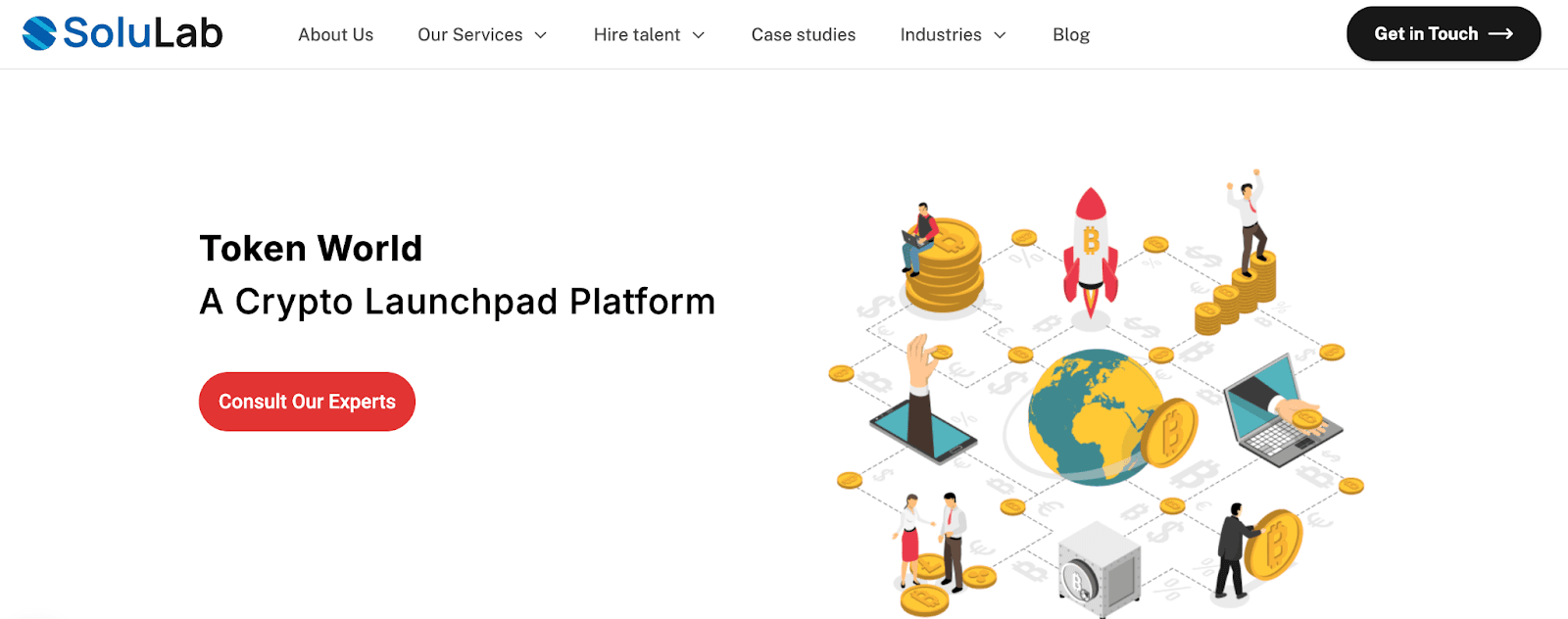
SoluLab: Crypto Launchpad Platform Development
SoluLab helped Token World build a crypto launchpad for token sales. The platform supports creators, investors, and admin review workflows.
Solutions include:
Smart contract audits and rigorous testing for vulnerability reduction.
Compliance guidance covering KYC/AML procedures and securities considerations.
Scalable cloud architecture with load balancing and performance optimization.
Results:
Stronger smart contract security posture through audits and testing processes.
Clearer compliance approach through tailored frameworks and regulatory guidance.
Better peak-period scalability through cloud scaling and performance optimization.
Read the case study HERE
TokenMinds: AI-Powered E-commerce Platform With Tokenized Payments
TokenMinds helped a client build AI commerce with private tokenized payments. The platform uses a permissioned blockchain for confidential transactions.
Solutions include:
Permissioned blockchain payments using Hyperledger Fabric.
AI recommendation engine using transaction data for personalization.
Custodial wallet system for token balances and loyalty points.
System Architecture:
Hyperledger Fabric permissioned blockchain
Custodial wallet infrastructure
AI recommendation engine pipeline
Tokenized payment rails
Results:
30% boost in user engagement from personalized recommendations.
20% improved conversion rate from streamlined AI-driven shopping.
40% increase in operational efficiency from automation and integration.
Read the case study HERE
Why Companies Sometimes Look Beyond SoluLab
Many startups begin with decentralized applications on public blockchain networks. Public blockchain development works well during early product experimentation. However, project requirements often evolve as platforms scale and mature. Some organizations later require enterprise blockchain development capabilities.
Common reasons include:
Requirements for private or permissioned blockchain infrastructure.
Governance and regulatory compliance.
Need for integration with banking systems and financial infrastructure.
Digital asset custodianship and security frameworks.
Regulated financial environments. Tokenization of structured assets.
Architectural complexity tends to increase as blockchain platforms evolve. The requirements of all enterprise operations may not be supported by public blockchain systems. Enterprise blockchain solutions are often considered in such cases. TokenMinds assists such organizations in the transition to enterprise blockchain infrastructure. The company creates blockchain architectures for financial institutions and regulated markets. These systems include private networks, tokenization systems, and governance architecture.
Conclusion
The two firms offer blockchain development services in various blockchain environments. The selection is based on the complexity of the project, compliance and the industry environment. Enterprise blockchain development may be organised in the form of projects aimed at finance of enterprises. Projects focusing on the Web3 can have a preference on decentralized applications and token ecosystems. The knowledge of these distinctions guides the executives to select an appropriate blockchain development partner.
Want to learn more about TokenMinds’ blockchain development services for the financial industry? Visit our development page today. Or schedule a free consultation with our expert here.
FAQs
What are the blockchain development services that SoluLab offers?
SoluLab is a company that offers blockchain web development services to Web3 and decentralized application development. The company as well produces AI-based blockchain platforms.
Can SoluLab develop an enterprise blockchain solutions?
SoluLab primarily concentrates on Web3 applications and decentralized developing products. Blockchain software at an enterprise level might demand dedicated infrastructure vendors.
How long does enterprise blockchain development take?
Enterprise blockchain development schedules are based on the compliance and architecture needs. It can take a number of months to develop a complex system.
What is the comparison between SoluLab and TokenMinds?
SoluLab specializes in the development of custom blockchain and AI in various spheres. Both healthcare and finance, as well as enterprise software. TokenMinds pays more attention to Web3-solutions. It incorporates tokenization platforms and token launches, and blockchain infrastructure. They also merged with marketing services for crypto and Web3 projects.
What industries does SoluLab serve?
SoluLab works with clients across several industries. Those include healthcare, finance, supply chain, and retail. Their services typically focus on blockchain development, AI solutions, and digital transformation projects. Especially for businesses looking to implement emerging technologies.