
TL;DR: Token launch liquidity communication builds trust when it stays away from price. Founders can explain venue readiness, market maker roles, liquidity pool mechanics, and slippage risk in plain language. They should never promise price support or stability, because regulators treat public statements as evidence of what a project promised. This guide sets out the safe language, the red lines, and a launch-week checklist teams can run before trading opens.
Every token listing triggers the same questions. Community members want to know about liquidity, market makers, and price. Founders then face an uncomfortable choice. Silence looks evasive, while overpromising creates legal exposure and broken trust. Token launch liquidity communication resolves this tension with one rule. Explain the mechanics, never the price.
Why Liquidity Communication Is Part of Token Launch Trust
Buyers read liquidity communication as a signal of competence. A team that explains its liquidity setup clearly shows it has one. A team that dodges the question invites speculation and fear. The credibility built during a token sale carries into the listing, and one vague liquidity answer can undo it.
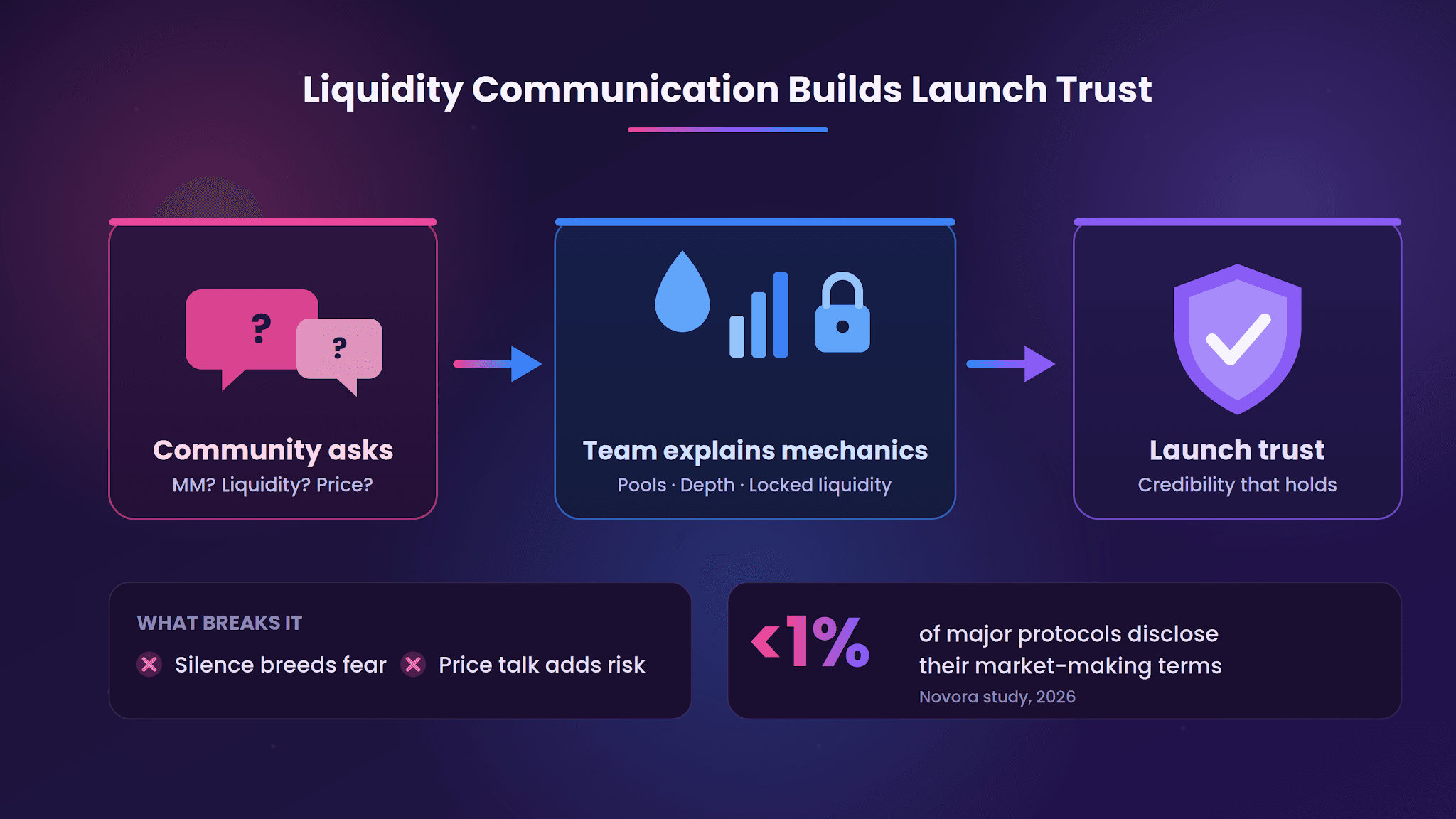
The Movement Labs market maker scandal shows how fast that happens. Binance offboarded the market maker behind the MOVE token after it sold off tokens for a $38 million profit. The terms of the arrangement were never disclosed to the community, and the token crashed along with the project's credibility.
Most of the industry still hides these arrangements. Novora, a governance transparency firm, audited more than 150 major protocols in April 2026. Only one disclosed its market maker terms, and only 8% publish token holder reports at all. Novora's founder Connor King called market maker opacity "the single most consequential transparency gap in the industry."
That gap is an opening for prepared founders. Teams that communicate liquidity clearly stand out on day one. The question is what clear communication looks like for each topic, starting with the most sensitive one.
What Founders Can Safely Say About Market Makers
Founders can safely share three things about a market maker. They can explain what it does, confirm one is engaged, and announce venue readiness. A market maker places buy and sell quotes so trading stays orderly. Explaining that role educates the community without touching price.
The safe version sounds like this. "The project works with a professional market maker to support orderly trading at launch." The numbers behind the deal stay private.
Founders can go one step further without touching price. They can state whether the project supplies the inventory the market maker trades or the firm commits its own capital, and whether any tokens have been loaned. MHC Digital Group's market-making guide calls these designated and principal market making, and notes that reputable firms do not guarantee price appreciation. Fees, spreads, and option terms stay confidential either way.
Structure-level disclosure is where the market is heading. Only one protocol in Novora's audit does this today, so a team that explains its structure stands out immediately. The Blockworks Token Transparency Framework now asks projects to disclose market maker identities and terms.
The table below shows where the line sits:
Item | Status | What it looks like |
Market maker's role | Safe | "A market maker quotes buy and sell orders to keep trading orderly." |
Engagement exists | Safe | "The project works with a professional market maker." |
Engagement model | Safe | "The market maker uses its own capital," or "The market maker trades a token loan from the treasury, listed in the token report." |
Venue readiness | Safe | "Trading opens on these confirmed venues, pairs, and times." |
Deal terms and fees | Private | Loan size, option strikes, and fees stay confidential |
Spreads and targets | Private | No numbers on spreads, depth commitments, or uptime. |
Price commitments | Never | No version of "the market maker will defend the price." |
The private and never rows exist because public statements outlive the launch. Regulators read them as a record of what the project led buyers to expect. a16z Crypto's token launch guidance warns that a single errant statement by a CEO can put an entire project at risk. Communication that stays on mechanics creates no record of promised appreciation.
Market-making guides written for issuers list price stability and lower slippage as benefits of the service. Those are a vendor's claims about its own product. A founder who repeats them to buyers turns a service description into a price promise.
Venue readiness is the better story to tell. Teams can announce which venues are confirmed, when trading opens, and which pairs go live. The MOVE offboarding above shows exchanges act on this, and venues can also delist tokens over conduct that crosses the line. Working through a token listing readiness checklist shows which facts are solid enough to publish. The next question is how to explain the venues themselves, especially on a DEX.
How to Explain LP Mechanics and DEX Liquidity in Plain Language
Most tokens start trading on a decentralized exchange, or DEX. Uniswap and Raydium are common launch venues. A DEX has no company running the market and no order book behind it. Trading happens against a liquidity pool instead.
Think of the pool as a shared pot holding two assets. One side holds the project token, the other holds a stablecoin like USDC. Traders swap one for the other, and every swap moves the price a little. This matters for founders because the team usually creates and funds that pool. Buyers cannot check a team's intentions, but they can check its pool on-chain. Explaining the pool clearly is therefore the DEX version of venue readiness.
Three facts belong in every pool announcement:
The trading pair. Name the exact pool, such as TOKEN/USDC, so buyers trade in the right place and avoid fakes.
The depth. Say how much value sits in the pool at launch. A deeper pool handles bigger trades with less price movement.
Locked liquidity. Confirm whether the pool is locked. Locking means the team cannot pull the funds out early, which is the community's biggest fear.
Each item is a fact users can verify on-chain, and that is what makes the list safe to publish. Some teams seed the pool through structured initial liquidity offerings rather than funding it alone, and that choice is worth explaining too.
Venue choice deserves the same openness. The trade-offs between CEX and DEX listings are legitimate, factual content. So is the design of liquidity, staking, and market making incentives that reward long-term participation. Mechanics are safe ground. The moment mechanics become forecasts, the ground disappears, and slippage is where that slide usually starts.
Talking About Slippage and Volatility Without Predicting Price
Most buyers meet slippage in their very first swap. Slippage is the gap between the price a user expects and the price the trade actually executes at. Picture a buyer who expects to pay $1.00 per token. The trade fills at $1.05, so slippage cost them five percent.
The cause connects back to the pool. Every trade moves the pool's price, and big trades in a shallow pool move it a lot. Launch days make this worse because many people trade at once. Those rapid swings in both directions are volatility.
Founders should present both as user-protection topics, not market forecasts. Teams can explain slippage with a simple example before trading opens. They can show users how to set slippage tolerance in their wallet and suggest smaller trades during the first hours.
The line between protecting and predicting looks like this:
Do | Don't |
Explain slippage with a simple example before trading opens. | Promise low slippage or smooth trading. |
Show users how to set slippage tolerance in their wallet. | Present one "safe" number as a guarantee. |
Warn that the first hours are usually volatile. | Frame volatility as a dip before a rise. |
Suggest smaller trade sizes early on. | Quote expected price ranges for launch day. |
Every safe action on that list shares one trait. It prepares users for volatility instead of predicting it away. Warning buyers about rough trading protects them and the project. Promising smooth trading protects no one. That difference defines the red lines that come next.
The Red Lines: Statements That Put a Token Launch at Risk
Once a project knows how to explain market makers, pools, and slippage, one skill remains. The team must know which statements can never be said at all. Safe explanations and forbidden claims often sit one sentence apart, and crossing that line is what turns communication into liability.
Four types of statement should never appear in launch communication, based on a16z's guidance:
First, price talk of any kind, including targets, floors, and expectations.
Second, descriptions of mechanisms meant to make the token appreciate.
Third, commitments that the team will fund or guarantee ongoing token support.
Fourth, promises such as "the market maker will defend the price."
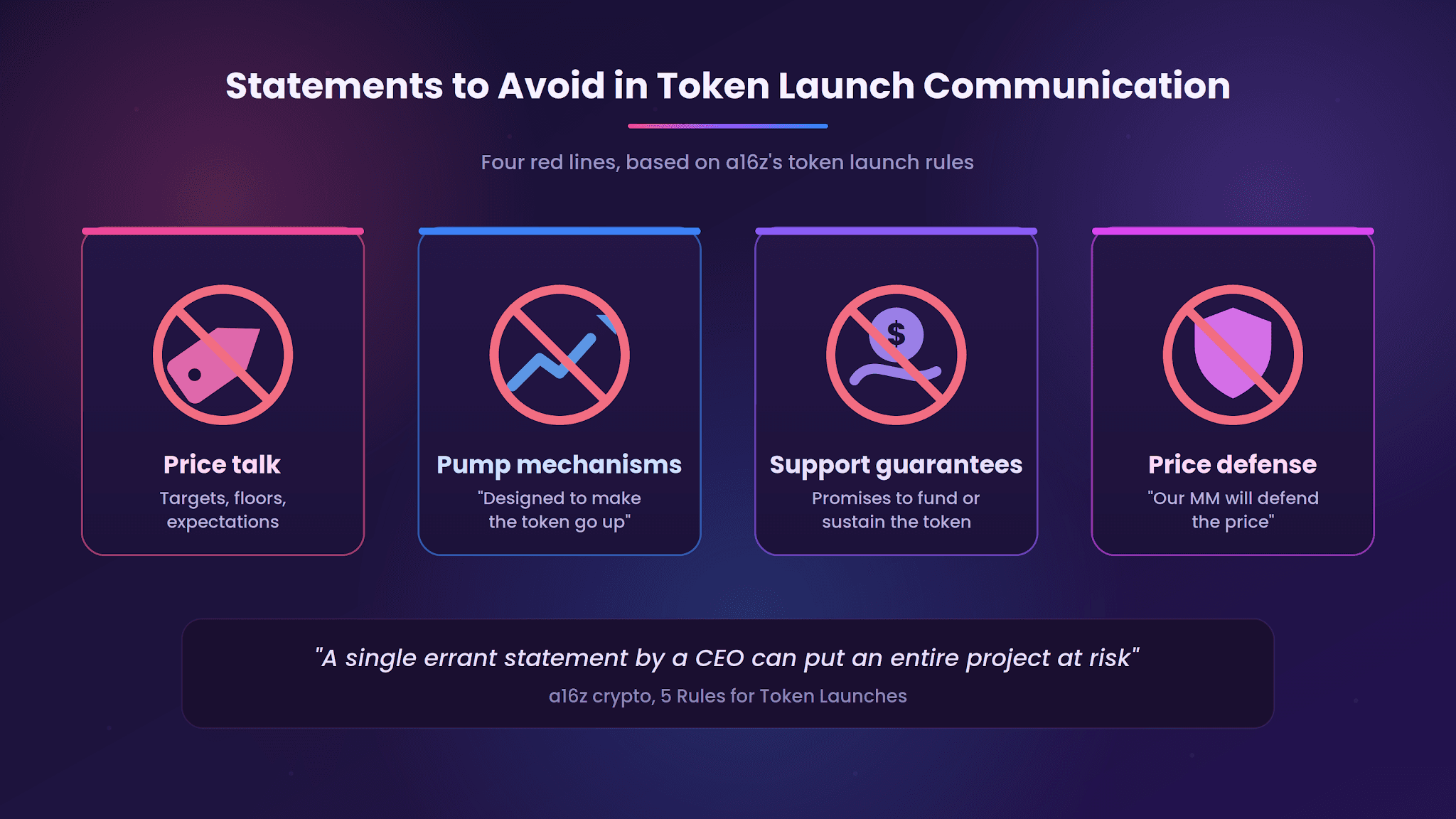
These lines are not cosmetic, and the exposure spans every channel. A price promise on Twitter counts. So does a casual mention of market maker support in a Discord AMA, or an investor email hinting at ongoing funding. Improvisation on a launch-day livestream can undo months of careful preparation.
The exposure is concrete. In the US, statements that lead buyers to expect profit from the team's efforts feed the Howey analysis. In the EU, MiCA requires marketing communications to be fair, clear, and not misleading, and its market abuse rules cover false or misleading statements about a token's price, supply, or demand.
Discipline does not mean silence. It means knowing in advance which sentences are safe. The table below makes that split concrete for listing week.
Safe vs. Risky Liquidity Language for Listing Week
Topic | Safe to say | Risky to say |
Market maker | "A professional market maker supports orderly trading." | "Our MM will defend the price." |
Liquidity pool | "The official pool is TOKEN/USDC with locked liquidity." | "The pool guarantees price stability." |
Price | Nothing. Price stays out of every statement. | Any target, floor, or prediction. |
Listings | "Trading opens on these confirmed venues." | "More top exchanges are coming soon." |
The pattern holds across every row. Safe statements describe systems and actions users can verify. Risky statements describe outcomes nobody can guarantee. Teams that internalize this pattern can answer unexpected questions without a script. The table shows the split line by line. One announcement shows it in practice.
What a Strong Liquidity Announcement Looks Like
The difference between risky and safe communication fits in one announcement. Here is the version many projects post:
"We have partnered with a leading market maker ahead of launch. More exchange news coming soon."
Every part of it invites trouble. The partnership claim is vague, so the community fills the gap with price expectations. The exchange teaser is a forward promise the team may not keep. Nothing in it can be verified.
Here is the same announcement rewritten with structure-level disclosure and the safe-language table:
"Trading opens June 12 at 14:00 UTC on Uniswap, pair TOKEN/USDC, seeded with $500,000 and locked for 12 months. A professional market maker supports orderly trading under a token loan from the treasury, listed in the token report. Verify the contract address in the official links post before trading."
Every sentence states a fact users can check, and none touches price. Meteora shows this standard is realistic. It was the only protocol in Novora's audit that publishes its market maker terms, and it tops Novora's investor relations scorecard. One more topic completes the picture, which is protecting users from scams.
Official Links, Scam Warnings, and Support Channels for a Token Launch
Safe language protects the project from regulators. A token launch also needs protection from thieves. Scammers copy everything in launch week: the token's name, the logo, the website, and even the liquidity pool. A buyer who clicks the wrong link sends money straight to a criminal.
Publish One Verified List of Official Links
The best practice is a single official-links post that every channel points to. It lives on the project website, stays pinned in Telegram and Discord, and sits in the X profile bio. The list carries the token's contract address, the official pool, and every genuine community channel.
Timing matters as much as content. Publish the list before trading opens, not after the first scam appears. Repeat it in every launch announcement and state plainly that nothing outside the list is real. Teach buyers to verify tokens by contract address, never by name or logo, because scammers can copy everything except the address.
Warn About Scams Before They Happen
Impersonation is the most common launch-week attack. Scammers pose as admins and offer help in private messages, then ask for a wallet connection or a seed phrase. One published rule stops most of it. Staff never send direct messages first.
Strong teams go further. They switch off admin direct messages where the platform allows it, name the real admins in a pinned post, and warn that any airdrop or migration link outside official channels is fake. A short scam alert posted at TGE costs nothing and saves users real money.
Staff Support Channels for the First 72 Hours
New users hit failed transactions, wrong-network transfers, and slippage errors in the first hours. The best practice is one dedicated support channel with named staff, announced before launch and covered around the clock for the first 72 hours. A pinned FAQ answering the five most common errors resolves most questions before a ticket is opened.
This investment pays back in trust. A staffed channel turns problems into resolved tickets instead of public accusations. Handled well, launch-week incidents become proof that the team is present, which is the trust this article started with.
Token Launch-Week Liquidity Communication Checklist
The phase plan below matches how teams actually run the week:
Phase | Actions |
Before TGE | Publish the verified links list with the contract address and official pool. Announce confirmed venues, pairs, and the exact start time. Post the pool explainer and slippage guidance. Brief every spokesperson on the red lines. |
At TGE | Repost the official links with a scam alert. Confirm trading is live using verifiable facts only. Remind users to check the contract address before trading. |
First 72 hours | Staff the support channel around the clock and log every issue. Watch for impersonators and fake pools. If price swings, restate the verified facts and say nothing about price. |
Post-launch | Publish an update covering venue status, resolved issues, and lessons learned. Keep the market maker structure disclosure current in the token report. |
Every action is verifiable and none touches price. That is the standard the whole launch should meet.
Get a Token Launch Liquidity Communication Review With TokenMinds
Liquidity communication decides how listing week ends. Clear messaging builds trust that lasts past launch. Careless messaging invites regulators and scammers instead. The difference is preparation, not luck.
TokenMinds reviews venue announcements, market maker and pool language, and red-line risk in a single pass before TGE. Teams walk away with safe-language templates, a briefed spokesperson guide, the official-links kit and scam warnings, and a launch-week communication plan.
Book a liquidity communication review call with TokenMinds.
FAQs
How should a team explain liquidity before a token listing?
Teams should explain mechanics, not outcomes. That means confirming venues, trading pairs, pool depth, and locked liquidity in plain language. It also means publishing official links and slippage guidance. Price expectations stay out of every statement.
What should founders say about market makers and liquidity pools?
Founders can confirm that a market maker engagement exists, describe its role in orderly trading, and state the structure, such as whether it trades a token loan from the treasury. They can name the official pool, its pair, its depth, and whether liquidity is locked. Loan size, fees, spreads, and any price commitment stay out of public statements.
How can teams discuss LP and slippage without promising price stability?
Frame both as user protection. Explain how pools price trades, why shallow pools increase slippage, and how to set slippage tolerance. Warn that early trading is volatile. A warning about volatility is safe, while a promise against it is not.
What should a team brief spokespeople on before launch week?
Every spokesperson needs the safe-language table, the red-lines list, and a copy of the official-links post. A dry-run Q&A should cover market maker questions, pool mechanics, and what happens if price drops. The briefing takes an hour. Skipping it is what creates launch-day risk.
What should a team say if the token price drops on launch day?
Nothing about price. The team can restate the facts users can verify: the official pool is unchanged and locked, the market maker continues to quote on the confirmed venues, and the support channel is staffed. It can repeat the slippage guidance and point to the official links. Any comment on where the price should go, or when it might recover, crosses the red lines.