
TL;DR
A strong token sale KOL strategy does more than create reach. It helps teams find creators with real audience trust, clear disclosure habits, and healthier buyer quality. Teams should review audience fit, past launch outcomes, claim discipline, payment terms, attribution data, and post-TGE retention. The goal is not louder hype. The goal is informed participation that does not damage trust after listing.
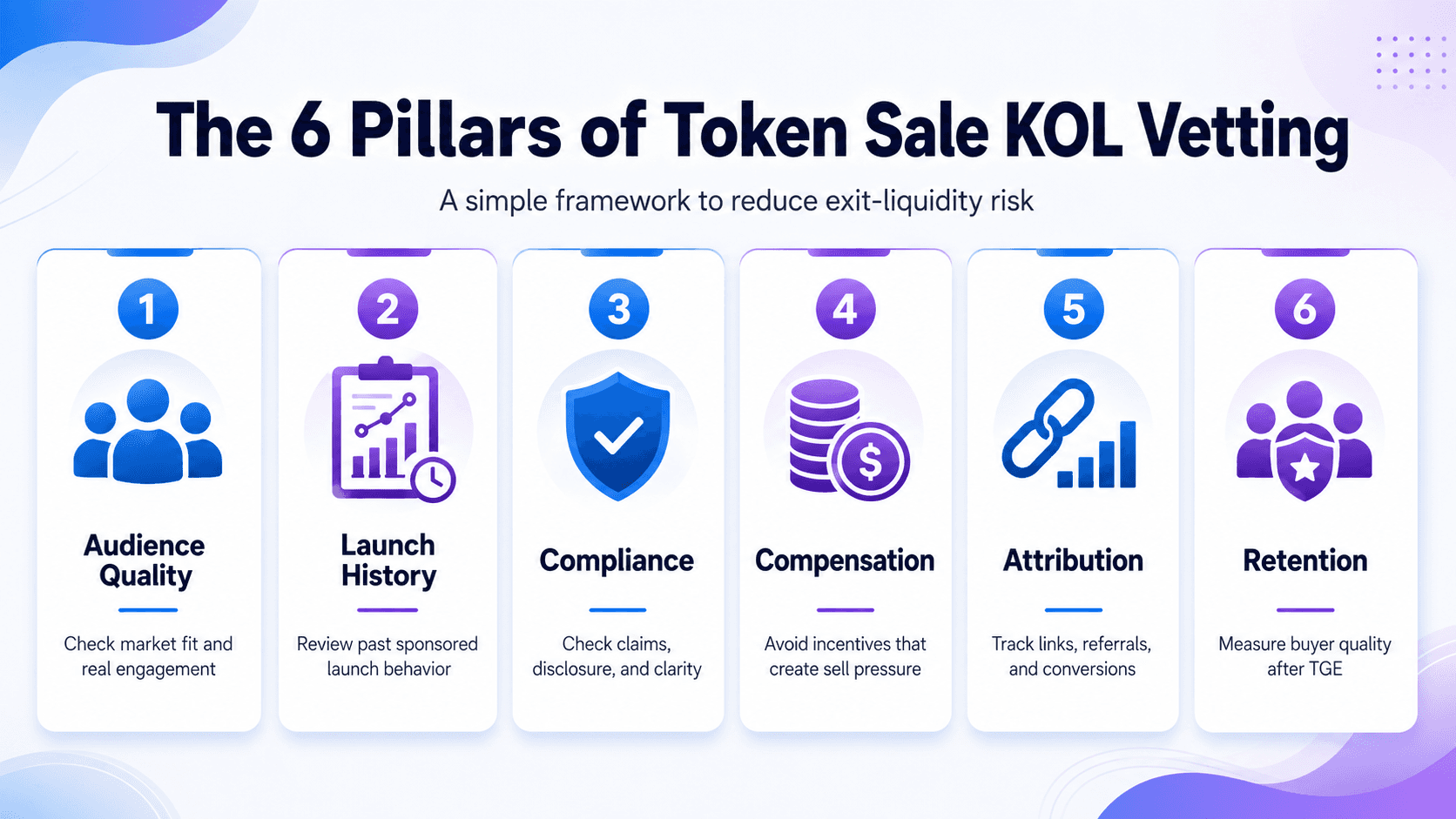
The 6 Pillars of Token Sale KOL Vetting
A token sale KOL strategy should not start with a creator list. It should start with a vetting framework. Teams need creators who can bring the right buyers, explain the sale clearly, and avoid incentives that damage trust after TGE.
The six pillars are:
Audience quality
Previous launch history
Claim and disclosure discipline
Compensation risk
Attribution readiness
Retention quality
The 2026 KOL Marketing Landscape for Token Sales
KOL marketing still plays a major role in token sales. Many buyers first hear about a sale through creators, not project channels. A creator can explain the offer, share social proof, and push traffic into the sale funnel.
This also creates risk. A token sale is not a normal product launch. Every KOL post can influence whitelist sign-ups, KYC starts, wallet connections, and first buyer behavior. If the message is unclear or too hype-driven, trust can break before TGE.
The 2026 environment makes this harder to ignore. In April 2026, the FCA led international action against illegal influencers, with 17 regulators involved. The FCA also made 120 account takedown requests linked to illegal financial promotions. IOSCO’s influencer report also explains the wider issue. It flags risks such as misleading information, hidden incentives, and promotion of higher-risk products, including crypto assets.
For token sale teams, the lesson is simple. KOL selection cannot start with follower count. It needs to start with audience quality, claims, compensation, disclosure, and buyer retention.
Why KOL Strategy Matters Before a Token Sale
This stricter landscape matters because KOLs often touch the sale funnel before buyers commit. A single creator post can influence how people understand the project, join the community, start KYC, or connect a wallet.
A token sale needs trust before conversion. Buyers need to understand several points before they participate:
what the token does
who can join the sale
how the sale process works
what lockups or claim rules apply
what risks buyers should consider
where official links and support channels are
KOLs can help explain these points. They can also bring regional reach that project-owned channels may not have.
This is why KOL planning needs a clear sequence. Awareness, education, and conversion should not happen randomly. For broader launch sequencing, read How Founders Should Sequence Partnerships, KOLs, PR, and Community Before a Token Sale.
Why Token Sale KOLs Need Different Vetting Than Traditional Influencers
Token sale KOLs are not the same as traditional influencers. A normal influencer campaign may push product awareness, sign-ups, or app installs. A token sale campaign can influence financial decisions before a liquidity event.
Token sale teams need stronger vetting because:
Blockchain actions can be hard to reverse. Buyers may connect wallets, send funds, or claim tokens based on creator content.
The asset is speculative. KOL wording can shape buyer expectations around price, access, and upside.
Regulatory scrutiny is higher. Paid promotion, disclosure, and risky claims need tighter review.
Audiences can be pseudonymous. Engagement may look strong, but buyer quality can be hard to verify.
Liquidity events create timing pressure. TGE, exchange listing, unlocks, and claim windows can affect buyer behavior.
Post-listing trust matters. A poor campaign can damage the community after the sale ends.
This is why token sale KOL vetting should go beyond brand fit.
What Exit-Liquidity Risk Means in a Token Sale
The previous section shows why KOLs need clear control before a sale opens. The next risk is buyer perception. In a token sale, exit-liquidity risk means buyers may feel they entered too late, with too little information, while earlier holders, paid promoters, or short-term traders had better positioning.
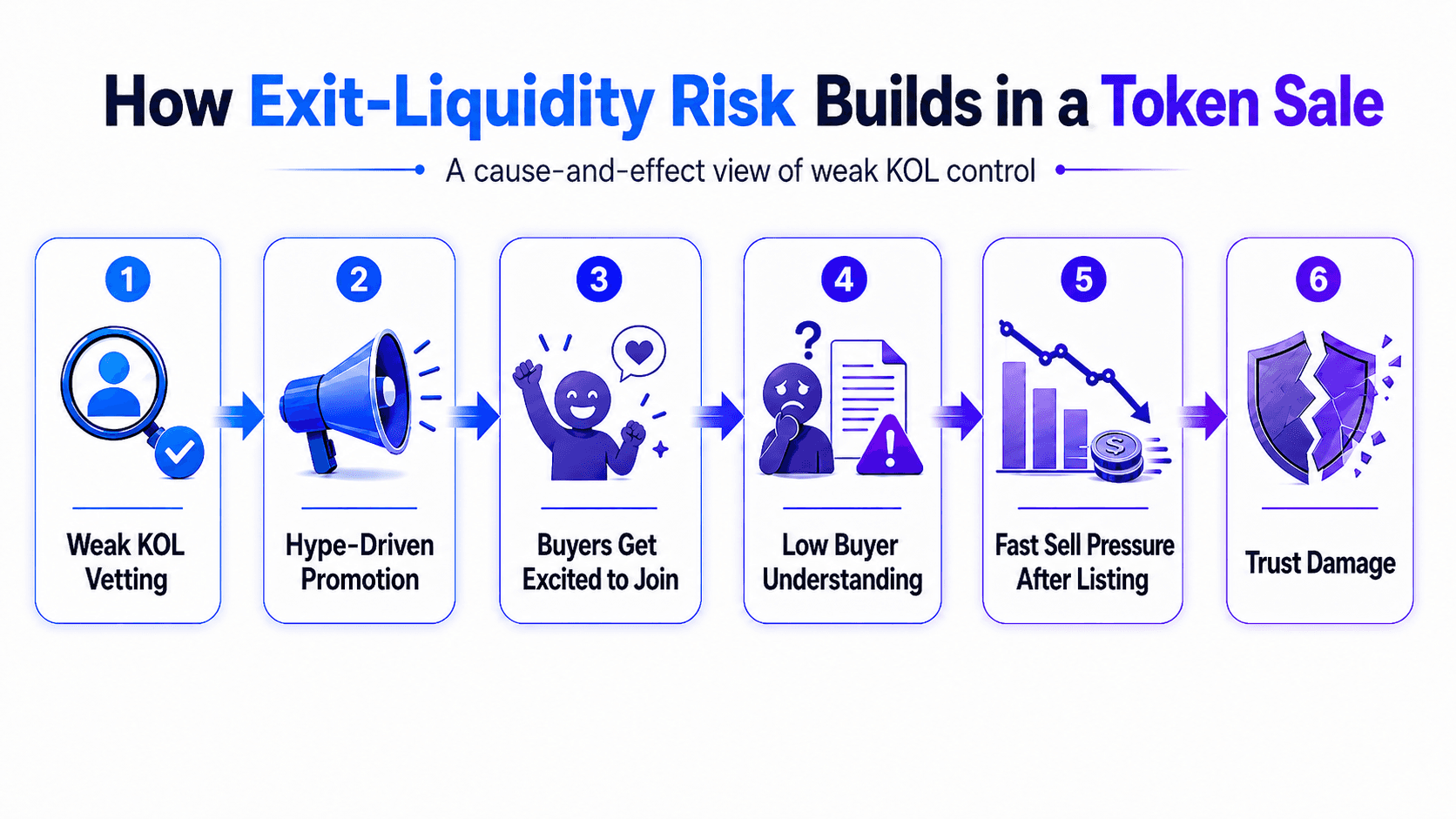
This does not mean every KOL campaign creates that risk. The risk appears when promotion moves faster than buyer understanding. It can happen when KOL posts focus only on upside. It can also happen when paid promotion is unclear, sale terms are missing, or token payments create pressure to sell after listing.
The result is usually the same. The community starts asking who benefited from the campaign. That conversation can quickly damage trust.
This concern is not only regulatory. Founders and communities increasingly question campaigns where KOL posts create short-term attention, but launch charts weaken after listing. The concern becomes stronger when wallet flows are unclear, paid promotion is not disclosed, or token-paid promoters receive unlocked supply. This is why KOL vetting should include prior launch outcomes, payment terms, attribution setup, and post-TGE buyer behavior before contracts are signed.
Token Sale KOL Vetting Strategies to Reduce Exit-Liquidity Risk
The best KOL process starts before outreach. It defines good participation first. Then it checks whether each creator can support that result. The process has six steps.
1. Start With Audience Quality, Not Follower Count
Follower count is only a surface signal. It shows reach, but it does not show buyer fit. Audience quality shows who may actually enter the token sale funnel. Teams should check the creator’s region, language, comment quality, wallet maturity, and past response to sponsored posts.
A creator with a smaller but relevant audience can outperform a larger account with passive reach. The goal is not to buy the biggest audience. The goal is to reach buyers who understand the sale and are more likely to stay after TGE.
Below are the main audience checks teams should review before shortlisting a KOL:
Vetting Area | What to Check | Why It Matters |
Audience fit | Region, language, buyer type | Reduces wasted reach |
Engagement quality | Real comments and replies | Filters fake attention |
Content depth | Explainers, AMAs, threads | Supports buyer education |
Paid post response | Sponsored post comments | Shows trust under promotion |
2. Review Previous Launch Signals Before Signing a KOL
Audience quality shows who the KOL reaches. The next check is what usually happens after the KOL promotes a project. Teams can review available signals. Useful signals include past sponsored posts, launch threads, AMAs, referral campaigns, and post-TGE updates. The goal is to see how the creator behaves before and after promotion.
A team should check at least these three areas:
Did the creator explain the project clearly?
Did the post focus only on price or urgency?
Did the creator continue educating after the campaign?
Still, repeated patterns matter. If a creator often drives fast attention with weak follow-up, the campaign may bring shallow buyers. If sponsored posts often attract confused comments, the audience may not understand the offer. A strong KOL supports buyer understanding before and after TGE.
3. Check Claim Discipline and Disclosure Habits
After reviewing past campaign signals, the next check is message control. A strong KOL should bring attention without turning the sale into a return promise.
Token sale content should be clear, balanced, and easy to verify. It should help buyers understand the offer, not push them with hype.
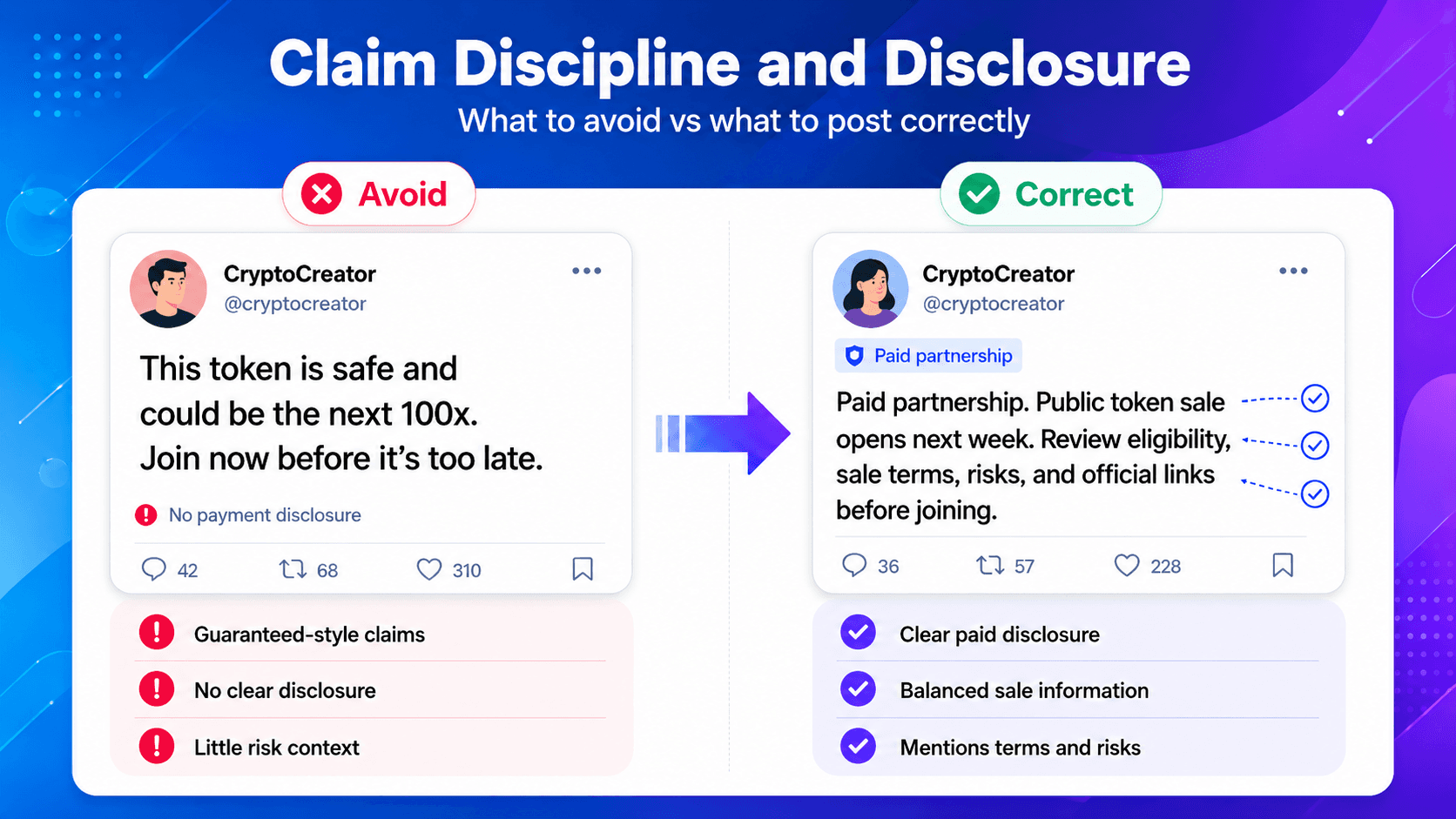
Teams should check whether the KOL does the following:
avoids risky words such as “safe,” “risk-free,” “guaranteed,” or “next 100x”
explains the sale terms, eligibility, steps, risks, and official links clearly
discloses paid promotion in a way that is easy to see
follows approved messaging instead of adding unsupported claims
gives enough context for buyers to make an informed decision
This matters because disclosure is part of trust. The SEC has warned against paid crypto promotion without proper compensation disclosure. The Kim Kardashian EMAX case showed the same issue in practice. The FTC also expects influencers to make paid relationships clear. FCA guidance adds a similar standard. Promotions should be fair, clear, and not misleading.
4. Structure KOL Compensation Without Creating Sell Pressure
The way a KOL is compensated can affect how the campaign behaves. Some payment models can push creators toward hype-heavy posts, weak disclosure, or fast token selling after listing.
This does not mean token sale teams should underpay creators. It means the payment model should not create incentives that hurt buyer trust.
Below are common payment models, the risks they can create, and controls teams can use before signing:
Fully unlocked token payment
Risk: the creator can sell immediately after listing.
Control: use vesting, staged unlocks, or partial non-token payment.Pay-per-post only
Risk: the creator may focus on posting volume, not buyer quality.
Control: define deliverables, review content, and track funnel quality.Bonus for hype metrics
Risk: the creator may chase views with aggressive claims.
Control: reward verified funnel actions, not only impressions.No wallet visibility
Risk: token movement may be hard to review after payment.
Control: use wallet tagging where possible.
Compensation Red Flag | Why It Creates Risk | Safer Control |
100% unlocked token payment at TGE | KOL can sell immediately after listing | Use vesting or staged unlocks |
Payment based only on impressions | Rewards hype, not buyer quality | Tie part of payment to approved deliverables and reporting |
No disclosure requirement | Creates trust and compliance risk | Require visible paid promotion disclosure |
No post approval process | KOL may add unsupported claims | Use approved scripts and review rights |
No attribution setup | Team cannot track buyer quality | Use links, referral codes, and wallet/funnel tracking |
No post-TGE follow-up | KOL disappears after conversion | Add follow-up education or recap content |
The goal is simple. KOL compensation should support clear promotion, fair incentives, and stronger buyer trust. For budget planning, read Token Launch Marketing Budget 2026: KOLs, PR, Community, Listings, and Post-TGE.
5. Use Wallet, Referral, and Attribution Data
The final strategy check is data. KOL marketing should not rely only on screenshots, views, or engagement reports. Teams need three layers of tracking:
Wallet data shows what buyers do after interest starts. It can help track wallet connections, contributions, claim behavior, and post-TGE holding patterns where possible.
Referral data shows which creator sent the user. Teams can use unique links, UTM tags, referral codes, or campaign landing pages for each KOL.
Attribution data connects the full path. It links the KOL source to clicks, KYC starts, wallet connections, sale participation, and retention.
6. On-Chain KOL Due Diligence Checks
Before signing a KOL, teams should review available cohort signals where possible. The goal is not to identify every buyer personally. The goal is to understand whether the KOL brings informed participants or short-term extractive traffic.
Useful checks may include:
wallet-connect quality from past campaigns
contribution concentration from referred wallets
suspicious repeat-wallet patterns
same-day sell behavior after TGE
percentage of referred buyers still holding after listing
claim behavior during the first post-TGE window
These checks should be used carefully. They are signals, not final proof. A team should use them to compare source quality, spot risk patterns, and improve KOL selection.
Token Sale KOL Red Flags Before Signing
After the tracking setup, teams still need one final filter. Some issues should pause the deal before any brief, payment, or post goes live. These red flags usually point to weak campaign control:
No clear paid promotion disclosure.
Fake, repeated, or empty comments.
Sudden follower growth without a clear reason.
Too many sponsored token posts in a short period.
Refusal to submit content for review.
Price promises or “guaranteed allocation” language.
Requests for large unlocked token payments.
No examples from past campaigns.
Weak understanding of the project or sale terms.
Heavy FOMO language with little buyer education.
Poor follow-up after past launches.
One red flag may not always disqualify a creator. But several red flags together should trigger deeper review. The bigger issue is accountability. A KOL should not get promotion rights without clear rules, approved messaging, and measurable reporting.
Some teams may also compare KOLs with quests or ambassador programs. For deciding whether KOLs, quests, or ambassador programs should come first, read Quest Campaigns, Ambassador Programs, or KOLs: What Should Come First?
What Good KOL Success Looks Like
Red flags help teams avoid weak creators.A good KOL campaign should show whether it brought buyers who understood the sale and stayed engaged after TGE. Strong KOL outcomes may include:
Long-term holders who do not leave right after listing.
Community members who ask informed questions.
Buyers who follow claim rules and official updates.
Repeat buyers in later campaigns or ecosystem launches.
Governance participation where governance is active.
Ecosystem engagement through product use, quests, referrals, or staking.
Lower confusion in support channels after the campaign.
This gives teams a better standard. A KOL is not only successful because the post reached many people. A KOL is successful when the audience understands the offer, joins through the right path, and stays useful after the sale.
Token Sale KOL Vetting Checklist
A checklist helps teams avoid emotional creator selection.
Vetting Area | Question to Ask |
Audience fit | Does the audience match the sale market? |
Engagement quality | Are comments real and relevant? |
Past launches | What happened after previous promotions? |
Claim discipline | Does the KOL avoid risky language? |
Disclosure | Are paid posts clearly marked? |
Compensation | Could payment create sell pressure? |
Attribution | Can links, wallets, and conversions be tracked? |
Retention | Do referred users stay after TGE? |
Review control | Are posts approved before publishing? |
This checklist should sit before contract signing. It should also guide reporting after launch.
Weighted KOL Scorecard for Token Sale Teams
A token sale team should not shortlist KOLs by follower count alone. A weighted scorecard gives founders a more consistent way to compare creator quality.
The weights below are a starting model. Teams can adjust them based on market, sale structure, compliance needs, and campaign goals.
Vetting Area | Weight | What to Review |
Audience quality | 25% | Market fit, real engagement, buyer type, comment quality |
Launch history | 20% | Past sponsored posts, launch behavior, post-TGE follow-up |
Claim and disclosure discipline | 15% | Paid disclosure, risky claims, approved messaging |
Compensation risk | 15% | Token payment terms, unlocks, incentive structure |
Attribution readiness | 10% | Unique links, referral setup, wallet and funnel tracking |
Retention quality | 15% | Holder behavior, community activity, repeat engagement |
Teams can score each area from 1 to 5, then multiply it by the weight. A creator with strong reach but weak disclosure or poor retention should not pass automatically.
How to Measure Token Sale KOL Performance After TGE
Impressions show reach. They do not show buyer quality. A KOL campaign should be judged across the full sale path. That includes clicks, KYC starts, wallet connections, contributions, and holder behavior.
KPI | What It Shows |
Impressions | Reach |
CTR | Initial interest |
KYC completion | Serious intent |
Wallet connection | Funnel progress |
Sale participation | Conversion |
7-day holder rate | Early quality |
30-day holder rate | Retention |
Community activity | Trust and education |
Sell pressure by source | Campaign risk |
This approach gives founders a clearer decision. Scale creators who bring informed participants. Stop creators who bring shallow traffic.
Post-TGE KOL Review Template
After TGE, KOL reporting should not stop at reach. Each creator should be reviewed as a traffic source, funnel source, and holder-quality source.
Teams can use this review after the first 7 days. They can repeat it after 30 days.
Review Area | What to Measure | Decision Rule |
Traffic quality | CTR, bounce rate, landing page actions | Continue only if traffic moves beyond clicks |
Funnel quality | KYC starts, wallet connects, sale participation | Scale sources with serious buyer actions |
Buyer quality | 7-day and 30-day holder rate | Reduce sources with fast sell pressure |
Community quality | Support questions, repeat engagement | Keep KOLs that educate buyers |
Risk signals | Same-day selling, confused buyers, complaints | Pause or remove risky KOLs |
This template turns campaign reporting into a decision process. The goal is not to reward the loudest source. The goal is to keep KOLs that bring informed buyers and reduce sources that create trust risk.
Illustrative Case Study: Bigger Reach vs Better Buyer Quality
Follower count can make one creator look stronger at first. But source quality can tell a different story. The example below is illustrative. Teams should replace these numbers with actual campaign data.
Signal | Creator A | Creator B |
Followers | 500,000 | 80,000 |
Click-through rate | 0.8% | 3.7% |
Early buyer behavior | 65% sold within 7 days | Stronger holding behavior |
30-day retention | Weak retention signal | 82% retained after 30 days |
Main takeaway | Large reach, weaker buyer quality | Smaller reach, stronger buyer fit |
Creator A looks stronger before the campaign because the account is larger. But the campaign quality looks weaker if many referred buyers sell quickly.
Creator B has a smaller audience. Still, the higher click-through rate and stronger holder retention suggest better buyer fit.
This is why token sale teams should not judge KOLs by reach alone. A good KOL brings buyers who understand the sale and stay active after TGE.
Plan a KOL Vetting and Attribution Audit With TokenMinds
Token launch KOL campaigns should not be managed as a last-minute creator list. They need audience checks, approved claims, disclosure controls, compensation safeguards, referral setup, wallet tracking, and post-TGE source-quality review.
TokenMinds helps token sale teams vet creators before promotion goes live, structure safer KOL campaigns, and measure which sources bring informed buyers instead of short-term attention.
Book a call to plan a KOL vetting and attribution audit.
People Also Ask
How do we choose KOLs for a token launch?
Choose KOLs using a weighted framework that reviews audience quality, previous launch behavior, claim discipline, compensation structure, attribution readiness, and post-TGE retention. Follower count should be a secondary filter.
How do we avoid paid influencers dumping tokens?
Avoid unlocked token-only compensation. Use staged unlocks, mixed cash and token payments, post-campaign holdbacks, disclosure requirements, approved messaging, and reporting windows that track whether referred buyers stay after TGE.
How should we vet crypto KOLs before TGE?
Review the KOL’s past sponsored posts, launch outcomes, disclosure habits, audience comments, referral setup, wallet and funnel data, payment expectations, and willingness to follow approved sale messaging.
Should crypto influencers receive tokens?
Crypto influencers can receive tokens, but the structure matters. Large unlocked token payments can create sell-pressure risk. Staged unlocks, vesting, or mixed payment models give better control.
How do you track token sale attribution?
Teams can track attribution through unique links, UTM tags, referral codes, campaign landing pages, wallet connections, KYC starts, sale participation, and post-TGE retention.
What makes a high-quality crypto KOL?
A high-quality crypto KOL has a relevant audience, real engagement, clear disclosure habits, strong content discipline, and a record of explaining projects beyond hype.
What disclosure rules apply to crypto influencers?
Crypto influencers should clearly disclose paid relationships. Promotion should also avoid misleading claims, unclear incentives, and guaranteed-return language. Token sale teams should review local rules before campaigns go live.