
TL;DR
Token sale marketing compliance starts before promotion. Teams need one approved source of truth. Every claim, disclosure, KYC message, and influencer post should match it. The checklist is practical. Confirm the whitepaper and sale terms, remove price or ROI claims, make risks visible, explain eligibility before signup, and give influencers strict claim rules.
Why Token Sale Marketing Compliance Matters Before Launch
Token sale marketing is not only about reach. It also shapes what buyers believe before they join. A strong campaign can create attention. But unclear messaging can create confusion, complaints, or trust issues.
Before joining a token sale, buyers usually ask simple questions:
Is this project real?
What does the token actually do?
Can buyers join from their country?
What happens during KYC?
What risks should buyers understand?
What did the team actually promise?
These questions appear across many places. They show up on the landing page, X posts, Telegram replies, influencer content, FAQs, and support tickets. That is where compliance becomes practical. Every public message should follow the same rules.
Recent enforcement shows why this matters. In February 2026, the UK FCA began legal proceedings against HTX for allegedly promoting cryptoasset services illegally to UK consumers. The FCA said crypto firms must follow rules that protect consumers from unfair and misleading marketing. It also said HTX continued to publish promotions on its website and social platforms, including TikTok, X, Facebook, Instagram, and YouTube.
Token Sale Marketing Compliance Starts With One Source of Truth
Token sale marketing compliance should not start with ad copy. It should start with approved facts. This makes the work easier for every team. Marketing can write clearer copy. Legal can review faster. Community teams can answer questions better. Influencers can promote without adding unsafe claims.
The useful question is simple: which approved document proves this line? Every public asset should answer that question. Below are the source items each campaign should lock before promotion:
Source item | How marketing uses it |
Whitepaper | Token utility, risks, issuer details |
Sale terms | Price, allocation, refund, claim rules |
Tokenomics | Supply, allocation, vesting, lockups |
Eligibility policy | Jurisdiction limits and KYC rules |
Security review | Audit status and audit scope |
Approved claims | Landing page, PR, KOLs, ads |
Each channel should use these approved items. This is the main control point. If a claim cannot be traced to an approved source, it should not go live. Once the source of truth is clear, the next step is claim review. This is where teams decide what marketing can say, and what it must avoid.
For broader launch planning, TokenMinds’ token sale GTM model guide explains how strategy, community, KOLs, PR, and conversion flows connect before TGE.
What Claims Should Token Sale Marketing Avoid?
Once the source of truth is clear, the next step is claim review. A claim is any public statement about the token, sale, team, roadmap, listing, utility, access, risk, or expected outcome. It can appear on a landing page, pitch deck, X post, AMA, ad, email, or influencer script. This is where many campaigns create risk.
Risky Wording and Safer Direction
Below are common claim types token sale marketing should avoid. These lines can make buyers expect profit, certainty, listing access, or low risk.
Safer wording keeps the message factual. It also helps teams explain the sale without making promises that source documents cannot support.
Risky wording | Why it creates risk | Safer direction |
“Guaranteed profit after TGE” | It promises financial return | Explain token utility and sale terms |
“Listing confirmed soon” | It may lack public proof | Mention only confirmed listing details |
“Risk-free token sale” | It removes real buyer risk | Use clear risk language |
“Last chance before it pumps” | It adds price pressure | Use factual deadline language |
“Major partners support us” | It may be too vague | Name only confirmed public partners |
Why Transaction Context Matters in US-Facing Token Sale Marketing
For US-facing campaigns, wording matters. The SEC’s 2026 interpretation covers how federal securities laws apply to certain crypto assets and transactions involving crypto assets. It also says the interpretation does not replace the Howey test.
For marketing teams, the practical rule is simple. Avoid framing the token as a profit opportunity from the team’s future work. Use factual language about utility, sale terms, eligibility, risks, and official documents instead. If a claim sounds like a promise of future upside, it should get legal review before publication.
Read more: How Do We Position a Token Around Utility and Ecosystem Value Instead Of Hype?
What Should Token Sale Disclosures Include?
After claim review, the sale page should also show the details buyers need before they act. Claims explain what the project says. Disclosures explain what buyers should verify. This includes the whitepaper, risks, eligibility rules, tokenomics, vesting, lockups, refund terms, and audit status. These details should be easy to find before wallet connection, signup, or KYC.
MiCA Article 29 gives a useful baseline for EU-related campaigns under its scope. It says marketing for asset-referenced tokens must be clear, fair, not misleading, and consistent with the white paper. It also requires an issuer website and contact details.
Below are the key disclosure items token sale pages should include:
Disclosure item | Where it should appear |
Whitepaper link | Landing page, sale page, footer |
Issuer contact | Footer, whitepaper, legal section |
Risk language | Landing page, FAQ, sale flow |
Sale eligibility | Before signup or wallet connection |
Jurisdiction limits | Signup page and FAQ |
Token utility | Landing page and whitepaper |
Tokenomics | Landing page and whitepaper |
Vesting and lockups | Sale page and FAQ |
Refund terms | FAQ and sale terms |
Audit status | Security section and docs page |
Paid ads, sponsored posts, influencer content, advertorials, and community promotions should be clearly identifiable as marketing. They should not look like neutral research, organic investment advice, or independent endorsement.
Token Sale Jurisdiction Checklist Before Marketing Starts
Jurisdiction rules should be clear before traffic starts. It helps the team avoid ads, influencer posts, and landing pages that reach restricted markets.
Before public marketing starts, token sale teams should check:
Which countries can join?
The team should define eligible countries before launch. This should match the sale terms and KYC rules.Which countries are restricted?
Restricted countries should appear clearly on the sale page, FAQ, and signup flow.Are the US, UK, EU, and sanctioned jurisdictions handled separately?
These markets may need different reviews. Sanctioned jurisdictions should follow the project’s compliance policy.Does the landing page show eligibility before signup?
Users should see basic access rules before they connect a wallet or start KYC.Are paid ads geo-restricted?
Ad settings should match the published eligibility rules. A restricted user should not see an ad inviting them to join.Are influencers told which regions they cannot target?
KOL briefs should include restricted regions, approved links, and banned targeting language.Does the KYC flow match the published eligibility rules?
The page should not say one thing while the KYC system applies another rule.Has local counsel reviewed high-risk markets?
Legal review matters when the campaign targets complex or high-risk regions.
Explain KYC and Eligibility Before Users Join
After the sale page, users meet the onboarding flow. This is where KYC messaging matters. It should not feel like a surprise. It should explain access rules before users spend time in the funnel.
KYC and eligibility copy should explain when KYC happens, what users must provide, restricted jurisdictions, sanctions screening, source-of-funds checks when needed, data privacy, and failed-KYC handling.
FATF’s customer due diligence standards include identifying and verifying customers, understanding the business relationship, and conducting ongoing due diligence. FATF also notes that source-of-funds checks may apply where necessary. Its virtual asset service provider definition includes financial services related to an issuer’s offer or sale of a virtual asset.
For marketing teams, the goal is not to write legal policy. The goal is to make the user journey clear.
Simple KYC Flow
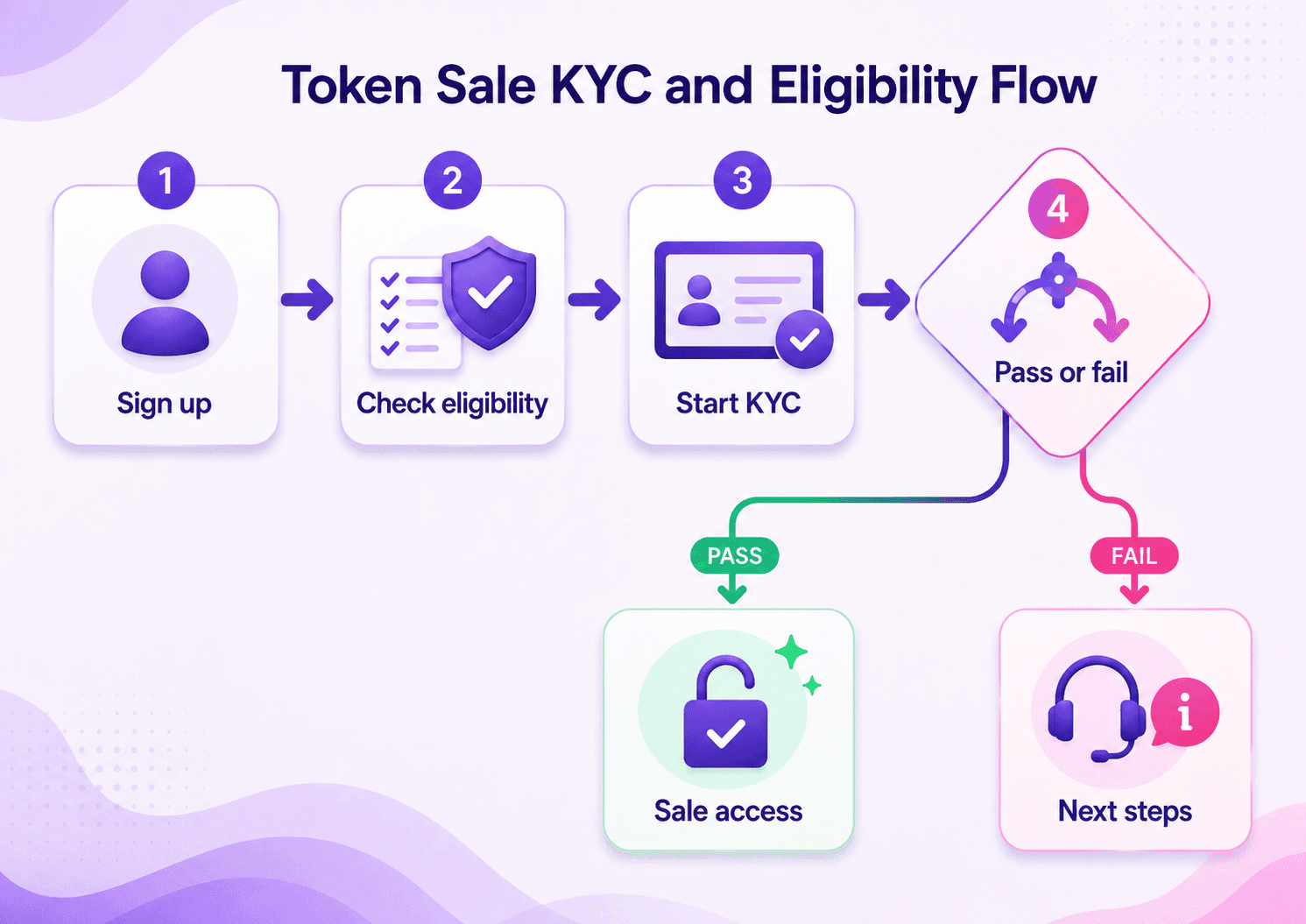
The failed-KYC step deserves attention. Users need to know whether they can appeal, resubmit, receive support, or access future updates. That message should match the actual policy.
Keep Influencer Promotion Within Approved Claims
Once KYC and eligibility rules are clear, the next risk point is promotion. Influencers can expand reach quickly. They can also create message risk quickly. But one influencer post can add a new claim. That claim may spread faster than the official sale page.
That is why influencer marketing needs a controlled brief. It should not only be a media booking.
Each influencer should receive:
Approved claims
Banned phrases
Required disclosure wording
Official links
Jurisdiction limits
Visual rules
Post archive requirements
Correction instructions
The FTC says influencers should disclose material connections, including financial, employment, personal, or family relationships. It also says disclosures should be easy to see and understand, and placed with the endorsement message itself.
Paid promotion should look like paid promotion. It should not look like organic financial conviction.
Risky Influencer Lines to Avoid
Influencer content needs the same claim rules as the official sale page. This matters because buyers may treat influencer posts as project guidance. A short post can sound casual, but still create a strong expectation. That is why every KOL script should remove lines that suggest profit, certainty, low risk, or confirmed listings.
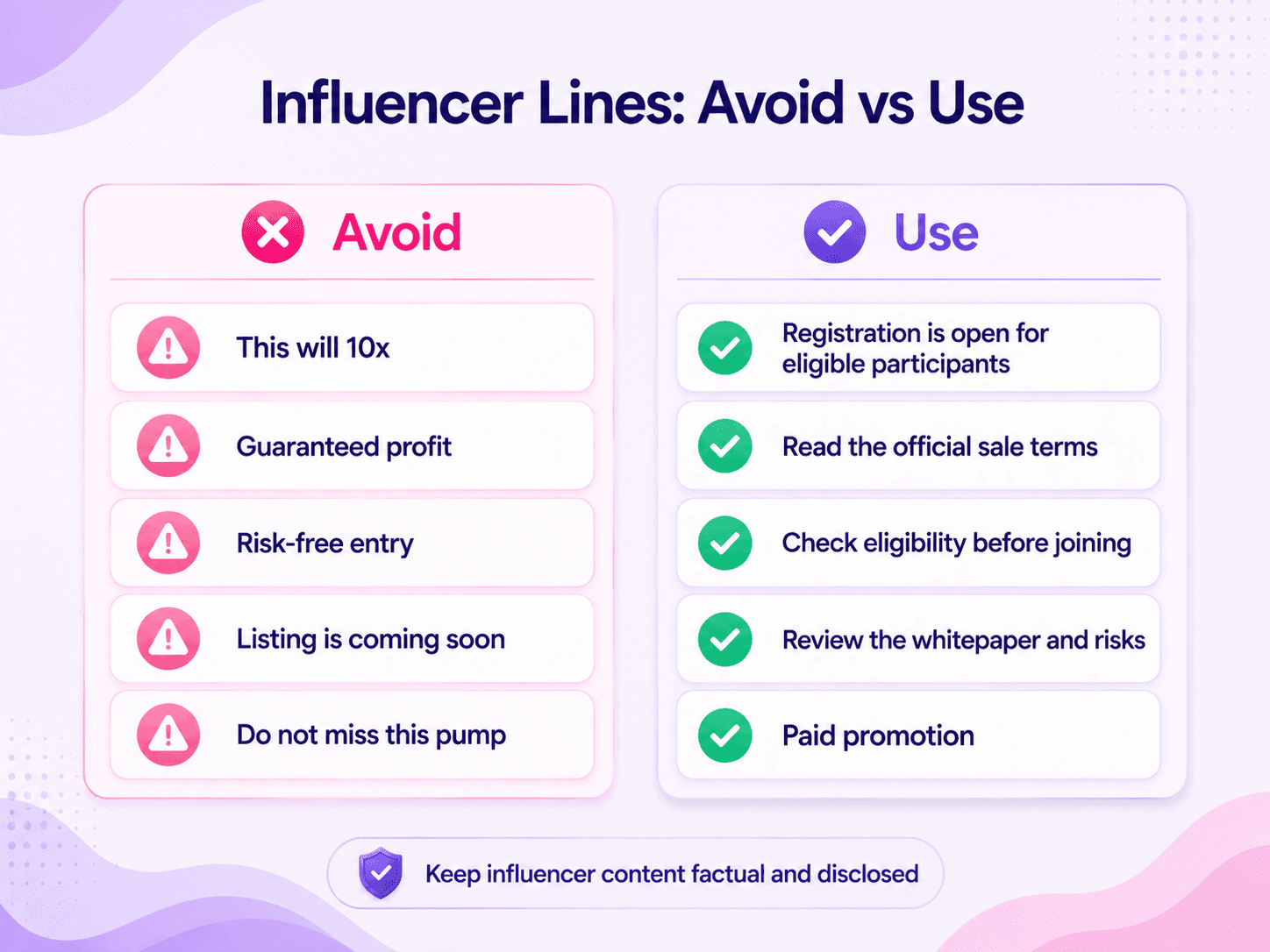
Influencer scripts should also avoid risky lines, such as:
“This will 10x”
“Guaranteed profit”
“Risk-free entry”
“Listing is coming soon”
“Do not miss this pump”
These lines create expectations that the project may not support.
A safer message stays factual. For example, “registration is open for eligible participants” is clearer than “last chance before launch.”
This keeps influencer content aligned with the same claim rules used on the landing page, FAQ, and sale materials.
7 Common Token Sale Marketing Mistakes Before Launch
After claims, disclosures, KYC, and influencer rules are reviewed, teams should check for common launch mistakes. These mistakes often look small. But they can confuse buyers before the sale starts. They can also create trust issues across landing pages, KOL posts, FAQs, and community replies.
Common mistakes include:
Inconsistent token utility.
The landing page explains one use case. The whitepaper explains another. The team should use one approved utility statement across all assets.Hidden vesting terms.
Buyers may miss lockups, release limits, or claim timing. Vesting should appear clearly on the sale page and FAQ.Influencer exaggeration.
KOLs may add hype, price talk, or urgency. Influencer content should follow approved scripts and banned phrase rules.Outdated whitepaper references.
Marketing may link to old project details. The team should review the latest whitepaper before promotion starts.Missing jurisdiction warning.
Restricted users may enter the funnel too early. Eligibility rules should appear before signup, wallet connection, or KYC.Unclear refund policy.
Buyers may not know what happens after a failed contribution or sale change. Refund rules should be easy to find in the FAQ and sale terms.Unsupported partnership claims.
Vague partner language can mislead buyers. The campaign should mention only confirmed public partners.
Build an Approval Workflow Before Posts Go Live
Compliance cannot rely on memory. It needs a workflow. The team should decide how each asset moves from draft to approval. This includes landing pages, ads, PR quotes, email sequences, KOL scripts, AMA points, FAQ pages, community posts, and support macros.
# | Workflow step | Owner | Output |
1 | Source review | Legal and founders | Approved source documents |
2 | Claim review | Legal and marketing | Approved claim library |
3 | Landing page review | Growth and legal | Final page copy |
4 | KYC copy review | Product and compliance | Clear onboarding copy |
5 | Influencer review | Marketing and legal | Approved KOL brief |
6 | Monitoring | Community and marketing | Issue log and corrections |
This workflow should start before public promotion.
That matters because token sale campaigns move quickly. A team may publish website updates, KOL posts, AMA clips, community replies, and partner announcements in the same week. Without version control, different channels may say different things.
Read more: How to Handle FUD, Scam Claims, and Fake Screenshots Before TGE to see what the monitoring step should do when the claims come from outside the team.
The TokenMinds guide on token sale GTM briefs and agency RFPs shows how founders can define campaign inputs before outside partners execute. That same logic applies here. Compliance inputs should be clear before agencies, KOLs, and PR partners publish anything.
Prepare a Pre-Launch Compliance Asset Pack
A token sale compliance checklist works best when it becomes launch material. The team should not only review risks. It should prepare assets that make safe execution easier across marketing, KYC, community, and influencer channels.
Before public promotion starts, prepare this compliance asset pack:
Asset | What it should include |
Source-of-truth folder | Whitepaper, sale terms, tokenomics, vesting, eligibility rules, audit status |
Approved claim library | Claims the team can prove from official documents |
Banned phrase list | No ROI promises, price predictions, risk-free language, or false urgency |
Disclosure checklist | Whitepaper link, issuer contact, risks, eligibility, tokenomics, refunds, audit status |
Landing page review notes | Final copy checks before ads, PR, or KOL traffic starts |
FAQ review | Clear answers on utility, KYC, vesting, lockups, refunds, and restrictions |
KYC copy guide | When KYC happens, what users provide, and what happens after pass or fail |
Influencer script template | Approved talking points, required disclosures, and official links |
Post archive folder | Screenshots, live links, captions, dates, and influencer records |
Correction workflow | Steps to remove, edit, or correct unsafe content quickly |
This pack gives the team one working system. This article is general marketing guidance. It is not legal advice. Token sale teams should confirm campaign rules with qualified counsel in each target jurisdiction.
How TokenMinds Supports Token Sale Compliance Readiness
TokenMinds helps token sale teams review campaign assets before public promotion starts. The review can cover:
Token sale messaging
Whitepaper consistency
Risk and disclosure gaps
KYC and eligibility copy
Influencer briefs
Approved claim rules
Pre-launch review workflow
The goal is not to replace founder-owned strategy. The goal is to make token sale marketing clearer, safer, and easier to execute before traffic arrives.
FAQs
Can you advertise a token sale?
Yes, after proper review. Token sale ads should avoid price promises, ROI claims, risk-free wording, and unsupported listing claims.
Does MiCA regulate token marketing?
Yes, when the campaign falls under MiCA. Marketing should be clear, identifiable, not misleading, and consistent with the whitepaper.
Are influencers allowed to promote token sales?
Yes, if they follow campaign rules. They should disclose paid relationships and avoid price predictions, profit claims, and hidden compensation.
What disclosures should a token sale include?
A token sale should show the whitepaper, issuer contact, risks, eligibility rules, jurisdiction limits, tokenomics, vesting, refund terms, and audit status.