
TL;DR
Bonding curve launches use formula-based pricing instead of fixed sale prices. Pump.fun mints the full token supply when each token is created. Part enters a virtual constant-product AMM. Real SOL accumulates as buyers and sellers trade. At graduation, the accumulated SOL and reserved tokens move into PumpSwap. Pump.fun popularized this model without presales or initial team allocations. Founders still need clear supply, vesting, graduation, and disclosure rules. The model exchanges allocation control for fast access and built-in liquidity.
Why Bonding Curve Token Launches Matter for Founders Now
Traditional token sales need a lot of upfront work: fundraising, allocation planning, then listing. A bonding curve launch flips that order. Why? It comes down to liquidity, virality, and early trading. Pump.fun demonstrated that a standardized bonding curve can attract launch activity at scale.
What Changed Between 2024 and 2026
Back in 2024, founders had one practical door for a bonding curve launch. Pump.fun launched in January 2024 and reduced token creation to filling out a simple web form, with no presale and no coding required. Solana became the dominant early venue for this model.
Solana's fast, low-cost transactions made it the default home for bonding curve launches. Its tokens follow the SPL standard, while Ethereum, Base, and BNB Chain use ERC-20. Tokens must comply with the chain’s fungible-token standard. Some curve designs mint and burn during trades. Pump.fun instead trades against a pre-minted token supply.
Now in 2026, things have changed. Competing platforms captured real share: Bonk.fun alone captured over 55% of Solana's token issuances by mid-2025. By 2026, Pump.fun was no longer the only serious option. Competing launchpads brought similar models to other chains. In May 2026, Pump.fun added multichain trading access for Ethereum, Base, BNB Chain, and other networks. Its core bonding-curve token creation flow remains associated with Solana.
This shows that lower switching costs benefit both founders and competing platforms. They also increase launch volume and failure risk. Easier entry for founders also brought more failed launches. Founders must now prove their curve parameters, deployer wallets, and post-graduation liquidity plans are sound before they launch. Even teams that pick a different launch model study bonding curves, since buyers expect them to explain why.
Liquidity and Early Trading as the Product Experience
The changes above explain where founders can launch. But why do so many founders still pick this model? The answer sits in the design itself.
A traditional launch assumes the product exists before the token trades. Users come for the product, and the token follows. The curve model reverses this. At launch there is usually no app to use yet. The token is the thing people interact with. Buying is the sign-up. Watching the price move is the engagement. Sharing the chart is the referral loop.
Liquidity is what makes this work. The curve's reserve lets anyone buy or sell from the first minute. No one waits for an exchange listing or a market maker. That instant tradability turns a new token into an experience instead of a promise.
Early trading can create visible momentum and a referral loop. Every purchase raises the price for the next buyer. That creates urgency and social proof at the same time. Founders who ignore this dynamic misread the model. Founders who understand it can decide whether it serves their project or harms it.
What Is a Bonding Curve Token Launch?
Bonding curve launches use smart contracts to adjust prices through reserve rules. Some designs mint and burn supply during trades. Pump.fun works differently.
Pump.fun mints the token supply when the token is created. Part enters a virtual constant-product AMM. Traders use synthetic reserve variables while real SOL accumulates. Price changes as those virtual reserve balances move.
How Pricing Works Along the Curve
Curve shape determines token price behavior. Two shapes dominate.
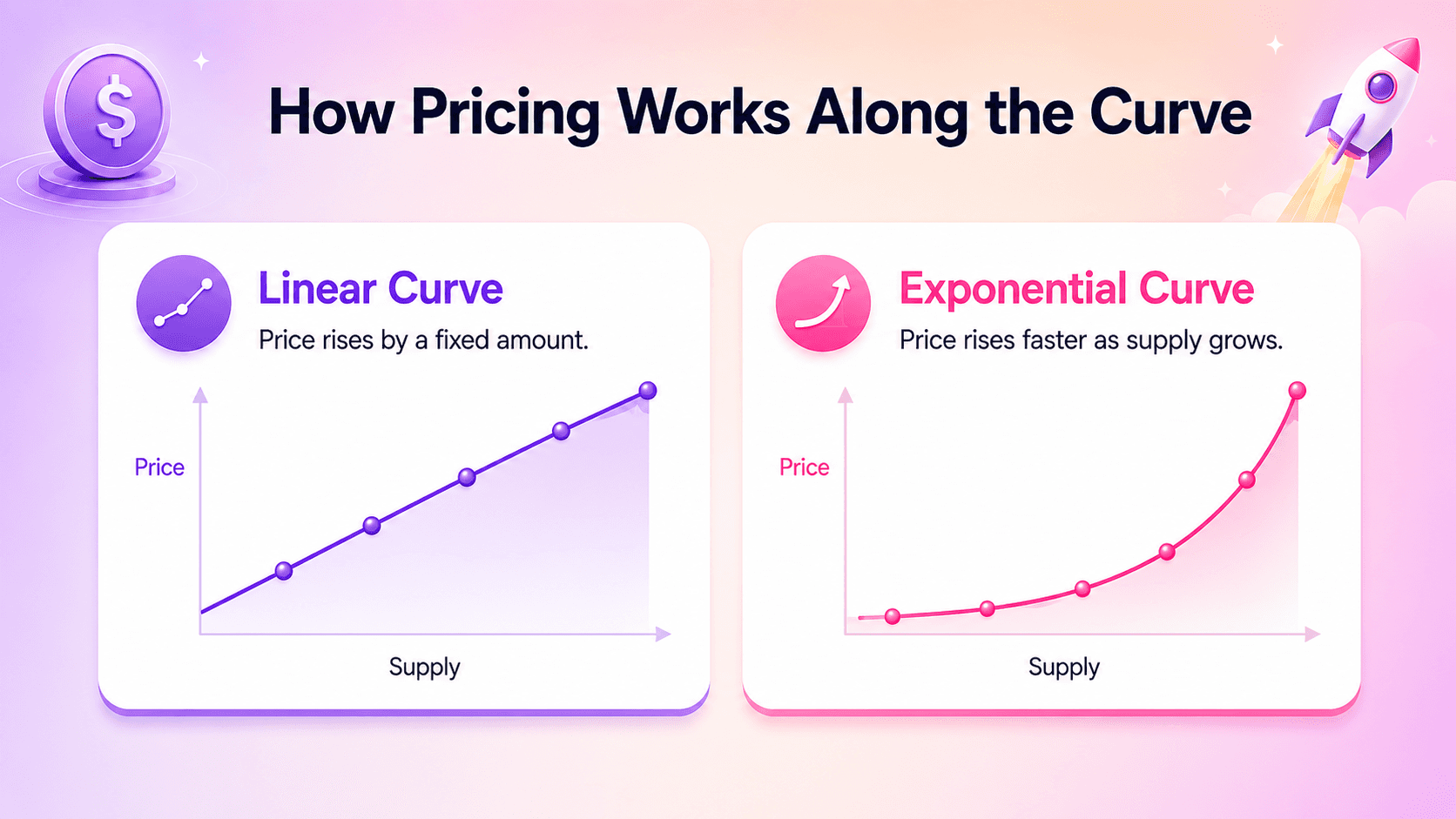
Note: These charts show generic bonding curve designs. Pump.fun uses a virtual constant-product curve instead.
Linear curves raise the price by a fixed amount per token minted. Growth is steady and predictable.
Exponential curves raise the price faster as supply grows. Early buyers gain a larger advantage, which fuels urgency.
Linear and exponential curves explain common formula-based designs. However, Pump.fun does not use either shape directly. In Pump.fun, buyers add real SOL to the launch contract. Sellers receive SOL from those accumulated reserves. Synthetic reserve balances determine each trade’s price. This creates immediate two-way trading before graduation.
Bonding Curves vs. Traditional Token Sale Models
A bonding curve token launch is best compared with a presale or IDO, since both end with the token trading on a decentralized exchange. A traditional presale or IDO separates two decisions: who gets tokens (allocation) and when those tokens reach the market (distribution). Teams negotiate allocation first, then release supply on a vesting schedule that can run months or years after the sale closes. A bonding curve collapses that sequence. In a pure fair launch, there may be no private allocation to negotiate. Every buyer trades against the same public formula at the curve’s current price. Distribution happens instantly and continuously, one transaction at a time, instead of on a schedule set in advance.
Projects still weighing which launch model fits best can read TokenMinds' guide to ICO vs. IDO vs. IEO.
Bonding curves replace most of that structure with a formula. The table below shows the contrast.
Dimension | Bonding Curve Launch | Presale / IDO |
Pricing | Formula-based, changes per trade | Fixed or tiered sale price |
Liquidity | Automatic, held in contract reserve | Seeded manually after listing |
Team allocation | Often zero | Typically 15–25% with vesting |
Investor rounds | None required | Private and public sales with lockups |
Access | Permissionless, open to anyone | Whitelists, KYC, or allocations |
Speed to market | Minutes | Weeks to months |
The Pump.fun Model Explained
The table above shows the contrast in the abstract. Pump.fun turned it into a working fair-launch template. No presale. There is no preset team allocation. However, creators and related wallets can still buy from the public curve, making self-buys and wallet concentration important disclosure points.
When a token reaches its protocol-defined reserve or curve-completion threshold, it graduates. Platforms often express this as an implied market capitalization. The contract moves reserve liquidity to a decentralized exchange and locks it. Trading then continues on the open market. Graduation is the model's key checkpoint, and most tokens never reach it.
A later 2026 study, “Pump.fun Graduation Regime Windows: Survival Analysis of 832,941 Token Launches and the Social-Presence Effect,” examined 832,941 launches. It found a pooled 24-hour graduation rate of 0.198%, or approximately two graduations per thousand launches. This was 3.18 times lower than the 0.63% rate reported for September 2025.

What Pump.fun Research Shows About Graduation
A 2026 arXiv study analyzed 655,770 Pump.fun tokens launched during September 2025. Only 4,338 graduated, equal to about 0.63%. This provides clear evidence that reaching the end of the curve is rare, even when launch activity appears high.
The strongest predictor was liquidity velocity. Historically successful traders provided modest and inconsistent predictive value, making their participation an unreliable standalone graduation signal.
Bot-like activity correlated with lower graduation probabilities beyond intermediate curve stages. Historically successful traders offered only modest and inconsistent predictive value. Participation by historically successful traders was not a reliable standalone signal of graduation.
The study identified structural incentives for creators to sell before graduation. More importantly, graduation only marked the end of the launchpad phase. It did not prove lasting demand or project quality.
Virtual Bonding Curve AMM vs. Post-Graduation AMM
Pump.fun mints the token supply when a token is created. Part of that supply enters a virtual constant-product AMM. Buyers and sellers trade against synthetic reserve variables. Real SOL from purchases accumulates inside the launch contract.
At graduation, accumulated SOL and reserved tokens move into PumpSwap. They form a real liquidity pool for open-market trading. The launch therefore uses two sequential AMM environments. The first is virtual. The second contains real post-graduation liquidity.
This distinction matters for founders. Pump.fun does not move from a curve into an AMM. Its launch curve is already a virtual AMM.
How to Plan and Execute a Bonding Curve Token Launch
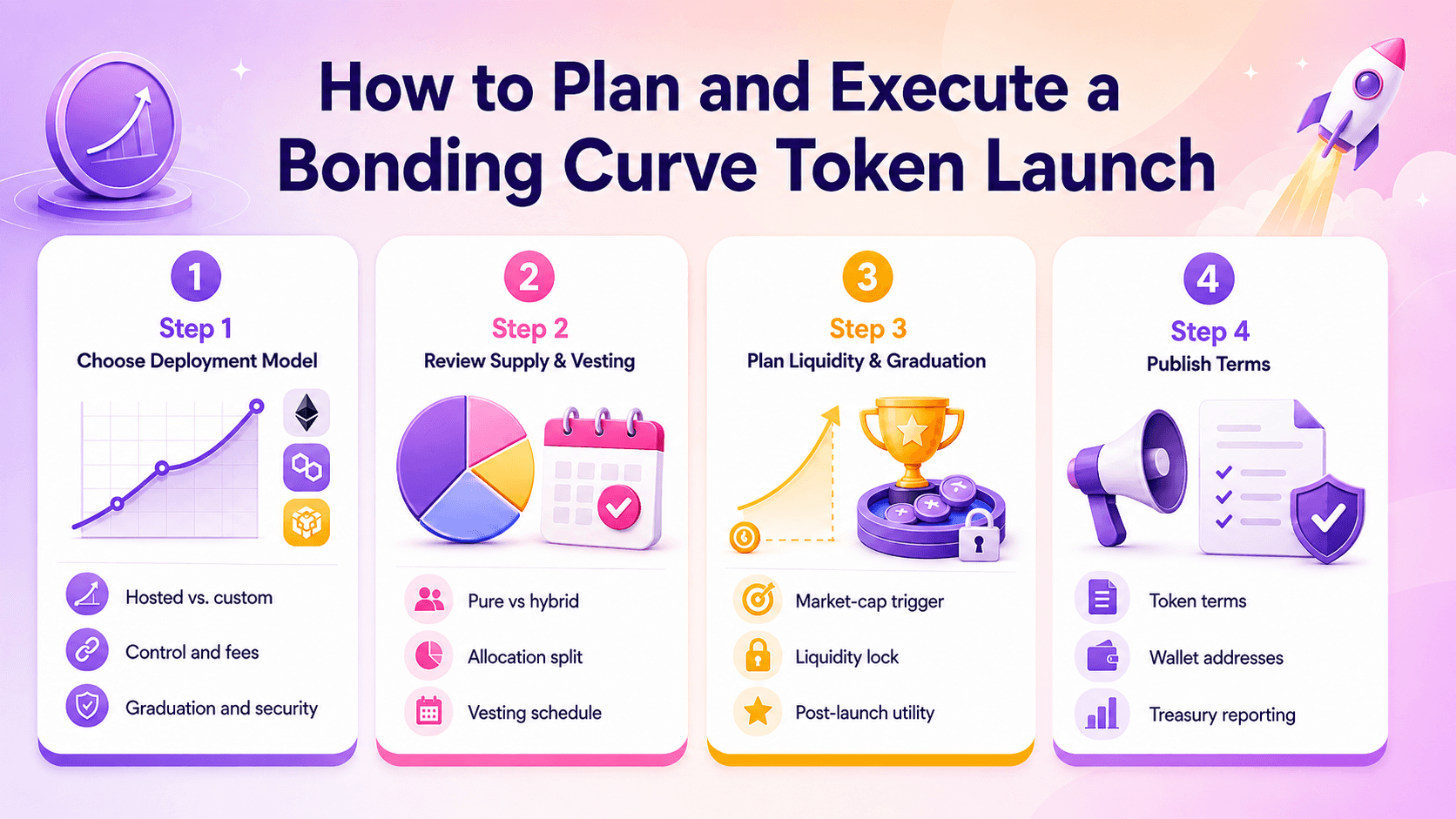
The sections above explain the base mechanics of the model. With that foundation in place, projects can now plan their own launch. The steps below apply to hosted launchpads and custom curves. However, the level of control differs. Hosted platforms simplify deployment but often fix key parameters. Custom curves offer more control but add technical and security responsibilities.
Step 1: Choose a Hosted Launchpad or Custom Curve
Start by choosing the deployment model. This determines which parameters the project can control. Hosted launchpads use standardized contracts and preset rules. They may fix the curve, supply, fees, graduation threshold, and migration destination.
Custom curves offer greater control over pricing, reserves, graduation, and liquidity. However, they also require development, economic design, audits, and security management.
Compare both options across five factors:
Control: Which parameters can the project change?
Chain: Who can participate, and what fees apply?
Fees: Review creation, trading, graduation, and migration costs.
Graduation: Confirm the trigger and liquidity destination.
Security: Check audits, contract history, and admin controls.
Active platform options in 2026 include the following.
Pump.fun. A Solana-based launchpad using a virtual constant-product curve. Its multichain feature supports trading access across other networks. The core token-creation flow remains Solana-based. Graduated liquidity moves into PumpSwap.
Jupiter Studio. A Solana launchpad from the team behind the Jupiter exchange. Access is wallet-based, and graduated tokens move to a Meteora pool.
Bonk.fun. A Solana launchpad that took majority creator share from Pump.fun in mid-2025.
Four.Meme. A launchpad on BNB Chain that runs a Pump.fun-style curve for BEP-20 tokens, the BNB Chain variant of the ERC-20 standard. Graduated tokens move to PancakeSwap's automated market maker pools.
Clanker. A token launch tool on Base, the Ethereum layer-2 network built by Coinbase. Tokens deploy as ERC-20 contracts, and graduated liquidity typically settles into an AMM pool on Base.
SunPump. A launchpad on the Tron chain, where tokens follow the TRC-20 standard, Tron's fungible token specification. Graduated tokens move to SunSwap, Tron's native AMM.
Platform details verified in July 2026
Platform | Launch chain | Hosted model | Graduation destination |
Pump.fun | Solana | Standardized | PumpSwap |
Jupiter Studio | Solana | Standardized | Verified destination |
Bonk.fun | Solana | Standardized | Verified destination |
Four.Meme | BNB Chain | Standardized | Verified destination |
Clanker | Base | Standardized | Verified destination |
SunPump | Tron | Standardized | Verified destination |
Step 2: Review Supply, Allocation, and Vesting Rules
A pure Pump.fun-style launch places the launch-phase tradable supply on the curve and reserves another portion for post-graduation liquidity. It does not create a preset team allocation. It still fixes total supply and a graduation reserve upfront. A hybrid launch holds part of the supply back for the team, treasury, or contributors, and sells the rest on the curve.
In practice, the choice follows the project type. A pure launch suits community experiments where the token itself is the product. A project with a roadmap may need a hybrid structure. A pure fair launch does not guarantee a treasury allocation. Development funding must come from disclosed creator fees, separate financing, retained exposure, or another funding mechanism.
If the team retains supply, established benchmarks apply. According to Liquifi, successful launches typically show teams holding 15–25%, communities 30–40%, investors 20–30%, and treasuries 10–20%. Retained supply needs a disclosed vesting schedule. Vesting limits immediate circulation and makes future unlocks more predictable. Cliff vesting releases nothing until a set date, then unlocks gradually. Linear vesting releases steadily over time. Many teams combine the two. The Liquifi allocation benchmarks show most vesting schedules run 12–48 months. Large insider allocations without vesting can weaken buyer confidence and increase near-term sell-pressure risk.
Step 3: Review or Set Liquidity and Graduation Parameters
Hosted launchpads usually define the graduation and migration rules. Custom deployments allow teams to set these parameters directly. In both cases, founders must understand how the transition works. Two parameters matter here:
The first is the protocol-defined reserve or curve-completion threshold. Platforms often communicate this as an implied market capitalization.
The second is the liquidity lock, which decides what happens to the reserve after migration. Unlocked post-graduation liquidity can increase rug-pull concerns.
Here is how the liquidity actually gets set. As people buy, the curve collects their payments inside the contract as a reserve. At graduation, the contract moves that reserve and a reserved share of tokens into a DEX pool. Pump.fun, for example, then burns the pool's LP tokens. That locks the liquidity for good. Teams that deploy a custom curve set each value themselves. They choose the trigger, the token share reserved for the pool, and the lock method.
Treat graduation as the start of retention work, not the finish line. Most curve tokens lose momentum after migration. The curve's built-in urgency disappears once open-market trading begins. Plan utility, staking, or community programs for the post-graduation phase before launch day.
Step 4: Communicate Terms Before Launch
Steps 1 through 3 set the launch parameters. This step makes them public before anyone buys. Transparency is the main defense against distrust.
The work itself is simple. Write the full token terms into one public document. Cover total supply, the allocation split, vesting schedules, the graduation trigger, and the liquidity lock method. Publish it where people will actually look, such as the project site and the launch platform profile. Publish the allocation even if it is zero for the team. TokenMinds' public token sale terms checklist covers the full set of terms to publish.
Then disclose the wallets. List the deployer wallet and any team or treasury wallets by address. This lets anyone verify the holdings on-chain instead of taking the team's word for it.
If a treasury exists, commit to a reporting schedule before launch. Best practice for DAO treasury reporting is quarterly disclosures covering token usage, reserves, and liquidity decisions. That level of disclosure strengthens governance credibility and buyer confidence. Missing token terms create avoidable trust and verification gaps.
Decision Framework: Is a Bonding Curve Right for Your Token?
The four steps above show how to run a bonding curve launch. Whether a project should run one is a separate question. The launch mechanism should follow the project's goals, not the trend. The comparison below maps common goals to launch models.
Project Goal | Best Fit | Why |
Fair-launch positioning, community-first brand | Bonding curve | No preset private allocation to defend |
Fast market test with low upfront capital | Bonding curve | No fundraising round required |
Funding a multi-year product roadmap | Structured allocation | Investor rounds with lockups provide capital |
Token-based employee compensation | Structured allocation | Requires reserved supply and vesting |
Governance-weighted distribution | Structured allocation or hybrid | Voting power needs planned distribution |
When a Bonding Curve Fits
The model suits community-first projects that want fair-launch credibility. It suits teams with low upfront capital needs. It also suits experiments where the market itself validates demand before further investment.
How to Judge Community Quality After a Bonding Curve Launch
A bonding curve launch recruits its community through trading. Every early member arrives as a buyer, and the long-term community case depends on whether early buyers remain after graduation. That makes community quality a launch metric, not a soft extra. Holder count alone misleads. Founders should track four signals instead.
Holder retention after graduation. Do wallets stay once curve urgency ends?
Wallet concentration. A few large wallets can create severe price impact through one sale.
Flipper-to-holder ratio. High turnover can indicate short-term participation rather than durable holder interest.
Organic versus incentivized activity. Discussion that survives without rewards indicates real interest.
These metrics connect back to Step 4. Publishing these metrics helps teams demonstrate whether activity remains distributed and organic.
When to Use a Structured Allocation Instead
Some projects need what a curve cannot provide. Investor rounds require reserved supply and staged unlocks to manage circulating supply and align investor timelines. Employee token compensation needs planned grants, and many models reserve 10–15% of supply for them. Governance-heavy projects need designed distribution, the way Uniswap reserved 60% of UNI's genesis supply for its community. These outcomes require an allocation plan, not a curve.
Risks, Trade-Offs, and Common Founder Mistakes
Bonding curves carry four main risks.
Structural volatility. The formula amplifies momentum in both directions.
Sniping bots. Bots buy within seconds of deployment and sell into early demand.
Rug-pull perception. Anonymous deployers and unlocked liquidity read as risk, even when intent is honest.
Regulatory uncertainty. Treatment varies across jurisdictions.
Common Founder Mistakes
Most failures in this category trace back to five avoidable decisions.
Launching without publishing token terms, wallets, and lock methods.
Holding a large, concentrated share with no vesting, on the curve or off it.
Treating graduation as the finish line, with no retention plan for after migration.
Picking a platform without checking fees, graduation rules, and audit status.
Deferring legal review until after deployment.
Why Creator Selling Matters Before Graduation
The 2026 Pump.fun study identified an incentive for creators to sell before graduation. Migration replaces the virtual launch environment with a real pool that has lower effective liquidity. Creators holding large early positions may therefore prefer to exit before the transition.
Founders should disclose creator purchases, linked wallets, and concentration levels. Graduation should not be treated as proof that creator incentives remain aligned with later holders.
Governance and Compliance Considerations
Concentrated holdings centralize governance if the token carries voting rights, which damages credibility with communities and investors alike. Whether a curve-launched token is a security depends on facts and local law. Legal review should precede deployment, not follow the first regulator inquiry.
This article is for educational purposes only and does not constitute financial or legal advice.
Choose the Right Token Launch Model With TokenMinds
Bonding curves can create instant trading, rapid market feedback, and permissionless distribution. They can also amplify bot activity, concentrated ownership, and pre-graduation selling.
The right model depends on funding needs, distribution goals, compliance requirements, product maturity, and post-launch retention plans.
TokenMinds helps teams compare bonding curves, fair launches, IDOs, and structured token sales. Its launch model research briefing reviews curve mechanics, supply design, graduation rules, liquidity migration, wallet risks, and community-quality requirements before deployment.
Schedule a launch model research briefing with TokenMinds.
Frequently Asked Questions
How do bonding curve token launches work?
Bonding curve launches use reserve rules to change prices during trades. Pump.fun mints its token supply upfront. Part enters a virtual constant-product AMM. Synthetic reserves determine prices while real SOL accumulates. At graduation, the SOL and reserved tokens move into PumpSwap. Trading then continues through a real liquidity pool.
What can founders learn from Pump.fun-style launches?
Three lessons stand out. Momentum mechanics matter, since the curve turns early buying into the onboarding funnel itself. Manipulation risk is real, since bots and concentrated wallets exploit thin early supply. Graduation is a beginning, not an ending, so retention planning must exist before launch. The community-quality signals above show how to separate holders from flippers.
Should our project use a bonding curve or a structured allocation?
Match the mechanism to the goal. Choose a curve for fair-launch positioning, fast validation, and low capital needs. Choose a structured allocation when the project needs investor rounds, employee token compensation, or governance-weighted distribution. Hybrid approaches exist, but they require the transparency discipline described in Step 4.
Is a bonding curve token launch legal?
Legal status depends on facts and local law, not on the launch mechanism itself. A token sold through a bonding curve can still meet the legal definition of a security in some jurisdictions. Legal review should happen before deployment, not after a regulator inquiry.
How much does a bonding curve token launch cost?
Costs vary by platform and chain. Most launchpads charge a small percentage on each trade and a fee at graduation. Custom curve contracts add audit and development costs on top of gas fees. Founders should compare fee structures across platforms before choosing one.
What is the difference between a bonding curve launch and a fair launch?
A fair launch means no presale and no insider allocation before public trading opens. A bonding curve is one mechanism for running a fair launch, but not the only one. A project can run a fair launch without a curve, and a curve launch can still include a team allocation, which breaks the fair-launch label.
What happens if a bonding curve token never graduates?
Most tokens launched on a curve never reach the protocol-defined reserve or curve-completion threshold. Trading simply continues on the curve, or activity stops and the reserve sits unused. There is no forced deadline on most platforms, so an ungraduated token is not automatically a failure, but it also never reaches open-market liquidity.