Web3 & AI

SOLUTIONS

Products

Services

Web3 & AI

SOLUTIONS

Services

Products

Industries

Become Our Client

About Us

Resources

Web3 & AI

SOLUTIONS

Services

Products

Industries

Public Token Sale Terms Checklist: Allocation Caps, Vesting, Refunds, and Buyer Protection

Public Token Sale Terms Checklist: Allocation Caps, Vesting, Refunds, and Buyer Protection

TL;DR
Before marketing a public token sale, teams should approve one set of sale terms covering price, allocation, purchase limits, vesting, refunds, eligibility, claim timing, disclosures, and buyer support. Every landing page, FAQ, and influencer script should trace back to those approved terms. This checklist gives buyers and teams a structured way to review sale terms, spot red flags, and reduce disputes tied to unclear allocation, vesting, or refund conditions.

Why Token Sale Terms Review Matters for Projects

Token sale disputes often trace back to one problem. Token sale disputes often begin with incomplete or inconsistent terms. Buyers may misunderstand refunds, unlocks, eligibility, or claim timing.

Take refund terms as an example. A project may publish a refund policy but never state when it applies. Buyers only discover the gap after a sale fails, when they can't tell if their case qualifies. Vesting creates a similar problem. A team may promise a vesting schedule but skip the actual unlock date, so buyers can't plan around it. Eligibility works differently. A sale that skips jurisdiction disclosures exposes the team to legal risk once regulators or courts get involved.

Regulators are paying closer attention to this gap, and the sharper lesson is jurisdictional: the same sale terms can be compliant in one region and illegal in another.

  • EU (MiCA): Offerors of covered crypto-assets generally must prepare, notify, and publish a crypto-asset white paper. For ordinary crypto-assets, this is a notify-and-publish regime, not a prior-approval regime; approval requirements apply differently to asset-referenced and e-money tokens. MiCA gives certain retail holders a 14-day withdrawal right, subject to Article 13 conditions and exceptions.

  • Singapore (MAS): treatment depends on several factors: whether the token qualifies as a capital-markets product under the Securities and Futures Act, whether digital payment token services are involved, how the sale is structured, and which regulated activities occur. This is a different framework from MiCA’s white-paper regime for covered public offers, and the two should not be compared as simply 'broader' or 'narrower' without legal review of the specific sale structure.

  • Cross-region risk: A single global sale terms document can create compliance gaps. Language prepared for US investment-contract analysis may not satisfy MiCA’s white-paper notification, disclosure, and withdrawal-right requirements. Singapore may apply separate securities and digital-token-service rules. Projects should map every sale term to each target jurisdiction before promotion begins

Terms also vary by launch structure. If a project wants to understand how sale terms differ across models, this guide on ICO vs. IDO vs. IEO breaks down the differences.

For projects, the risk is trust. A sale page that can't answer basic buyer questions invites complaints and scrutiny.

Token Sale Terms Checklist: What to Verify First

For projects preparing a public sale, it's important to confirm these terms before promotion starts. Below are the terms projects should define before public promotion:

  • Allocation caps: hard cap, soft cap, and per-wallet limits.

  • Vesting schedules: cliff length, release curve, and unlock dates.

  • Refund policies: trigger conditions, processing timeline, and method of return.

  • Eligibility rules: jurisdiction restrictions, KYC steps, and accreditation requirements.

  • Team and advisor verification: identity confirmation, public track record, and credential checks.

Before going deep, it helps to understand what these items actually cover.

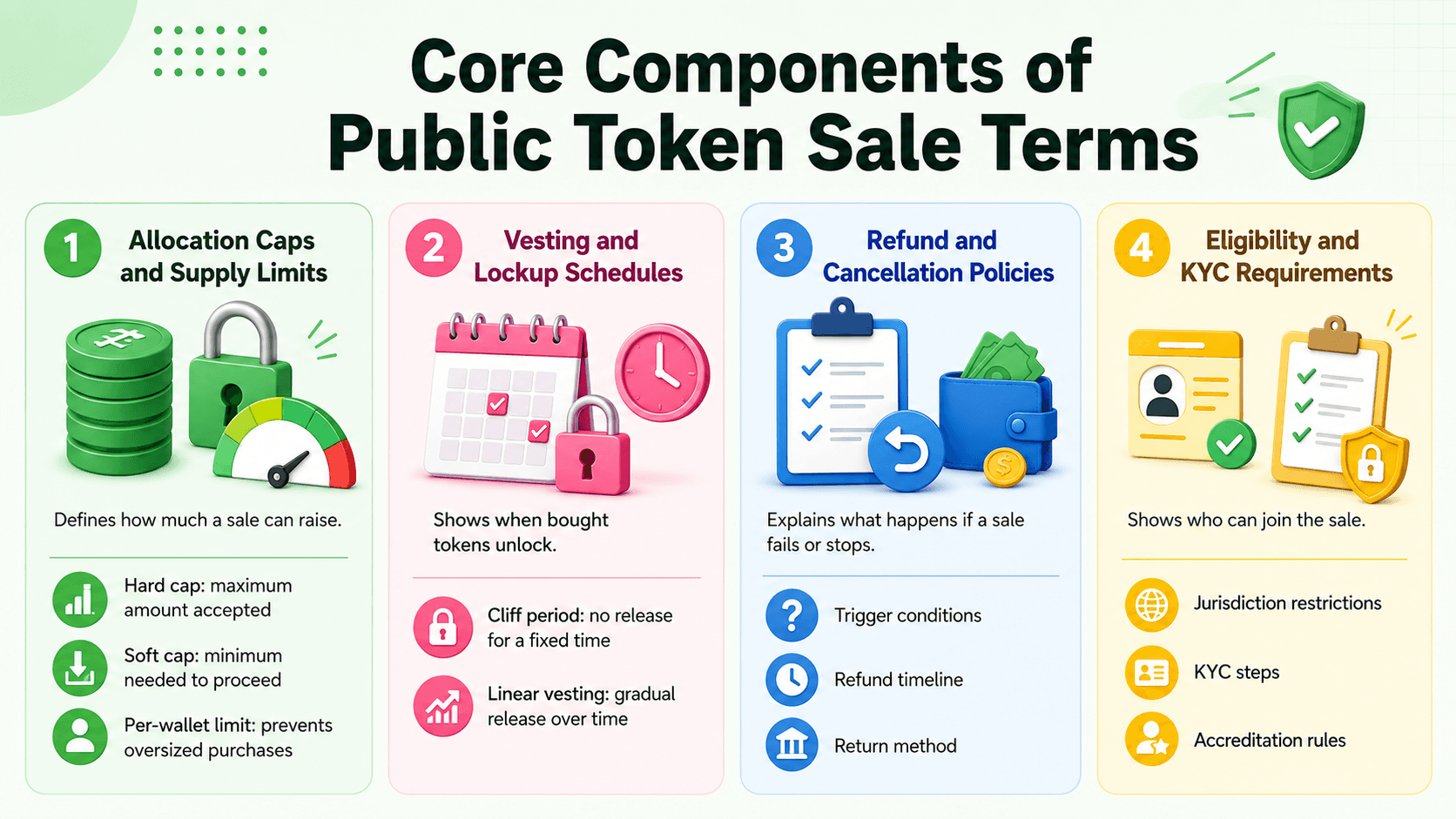
Core Components of Public Token Sale Terms

As shown above, unclear terms create risk for projects. Below are the core components every public sale must explain clearly to buyers before launch.
ChatGPT Image Jul 21, 2026, 10_29_07 AM.png

1. Allocation Caps and Supply Limits

Allocation caps are often treated as one concept, but they cover five distinct terms:

  • Sale allocation: the number or percentage of tokens offered.

  • Hard cap: the maximum amount the sale can raise or accept.

  • Soft cap: a minimum funding threshold, where applicable.

  • Per-buyer cap: the maximum allocation for each approved participant.

  • Oversubscription method: how allocations are reduced when demand exceeds supply.

A sale terms document that uses these words interchangeably makes it harder to know what's actually capped.

Not every sale uses a conventional hard-cap structure. Fixed token allocations, auctions, and platform-managed request systems use different mechanics. Coinbase's token sale platform is one example: it runs a finite request window, then allocates tokens through an algorithm designed to limit concentration among large purchasers, filling smaller requests first before larger ones. The platform frames this as equitable access with clear disclosures and transparent terms.

The red flag is not the absence of the specific term "hard cap." The stronger concern is a sale terms document with no stated maximum raise, supply limit, or allocation mechanic at all. Buyers should confirm whatever mechanic the sale actually uses before committing funds.

2. Vesting and Lockup Schedules

Vesting controls when purchased tokens become transferable. This applies to every allocation group, not only public-sale buyers. Public sale terms should show the TGE unlock, cliff, release frequency, first unlock date, and final unlock date for each allocation group. Buyers should be able to compare public-sale vesting with private, team, and advisor schedules, including:

  • Public-sale TGE unlock and private-sale unlocks.

  • Team and founder cliffs.

  • Advisor vesting.

  • Treasury and ecosystem releases.

Many schedules combine a TGE unlock, a cliff period, and then monthly, quarterly, or milestone-based releases, rather than a single cliff-or-linear structure. A shorter or laxer schedule for insiders than for public buyers signals uneven treatment and raises sell-pressure risk after launch.

If a project wants to understand how to structure vesting, unlocks, and float after a sale, this guide on designing vesting, unlocks, emissions, and float covers the mechanics.

3. Refund and Cancellation Policies

Refund terms explain what happens if a sale fails, gets cancelled, or misses its soft cap. These conditions should be explicit, not implied. Buyers should confirm three things before joining:

  • Trigger conditions: what exactly counts as a failed or cancelled sale, including sale cancellation, failure to meet a minimum threshold, rejected KYC, oversubscription, duplicate or excess payments, failed transactions, technical errors, buyer withdrawal rights where applicable, gas fees and exchange-rate differences, and refunds after terms change.

  • Processing timeline: how long a refund takes to arrive.

  • Method of return: how funds are sent back, and in what asset.

Sale terms must clearly state whether purchases are refundable. Some sales explicitly state that completed purchases are final and non-refundable, except where mandatory law applies. That is not buyer-friendly, but it is still a defined policy. Where refunds are available, the terms should define each trigger, processing timeline, return asset, network fees, and the party responsible for processing.

Beyond refund language, most sale terms documents include standard legal clauses that buyers should locate and read directly, not skim. These clauses shift real legal exposure onto the buyer:

  • Indemnification clause: the buyer covers the issuer's legal costs for breaches or misrepresented eligibility.

  • Jurisdiction clause: names which country's courts resolve disputes.

  • Class-action waiver: blocks buyers from joining a group lawsuit against the issuer, in some documents.

Some sales use a smart contract escrow instead of a team-controlled wallet. Escrow holds funds until the soft cap is met or a deadline passes, and can release refunds automatically if the sale fails. Buyers should check whether the escrow contract is named and its address is publicly verifiable on-chain.

4. Eligibility and KYC Requirements

Eligibility rules define who can legally participate. This includes:

  • Jurisdiction restrictions: which countries or regions are excluded.

  • KYC verification steps: what identity checks are required and when.

  • Accreditation requirements: whether some buyers must qualify as accredited investors.

These rules should appear before signup, not after payment. A sale that collects funds first and asks eligibility questions later is poorly structured.

AML, or anti-money laundering compliance, is separate from KYC. KYC verifies who a buyer is. AML monitors where funds come from and flags suspicious transaction patterns, such as structuring or use of mixing services. A sale terms document should state whether the project screens wallet addresses or transaction history, not only identity documents.

If a project wants to understand how to filter real buyers from bots and Sybil signups during whitelist collection, this guide on building a token sale whitelist that filters real users covers the mechanics.

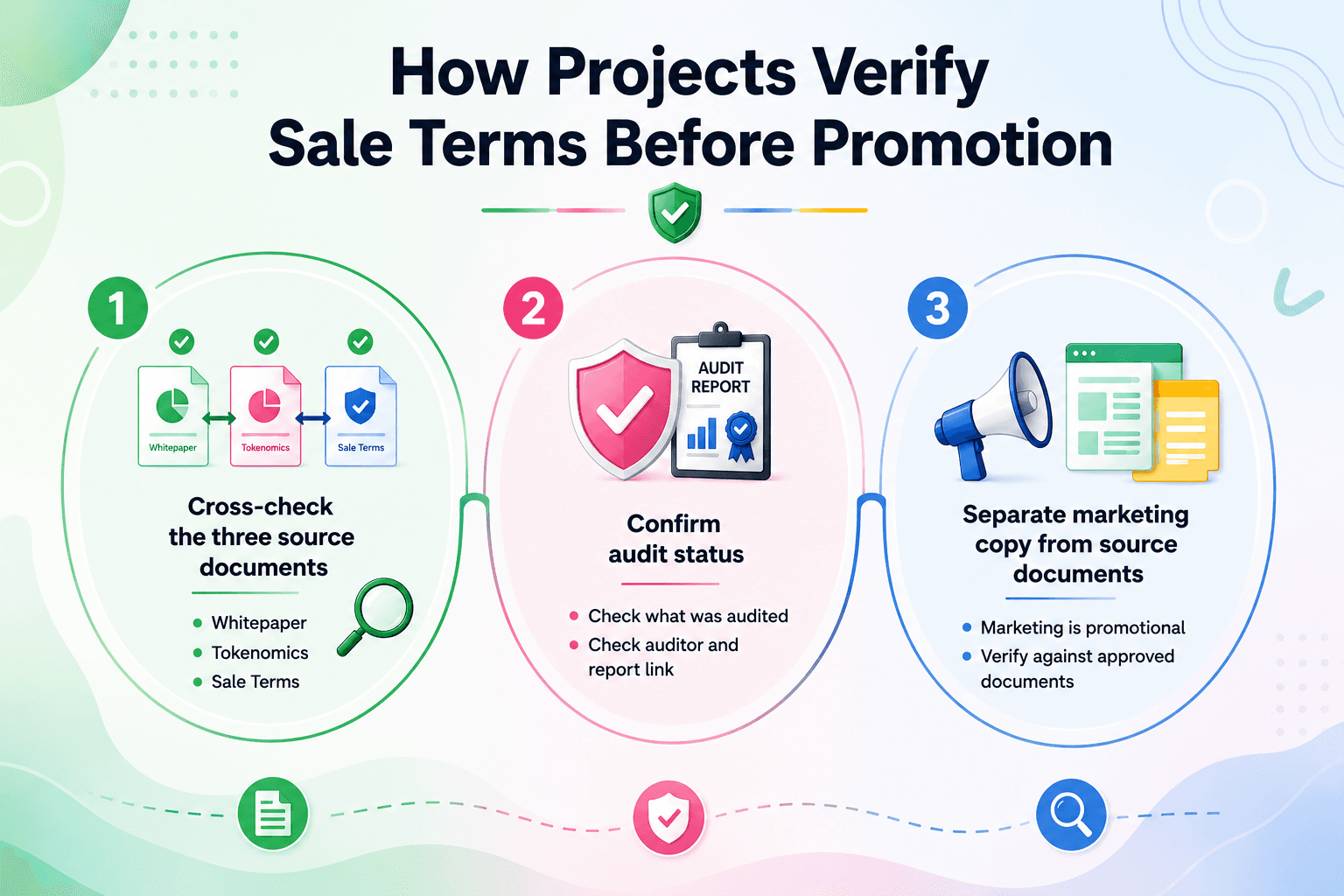
How to Verify Token Sale Terms Before Public Promotion

Verification is a matching exercise. Every public claim should trace back to an approved document, and gaps between documents create the same kind of inconsistency that hurts both buyer trust and search visibility.
ChatGPT Image Jul 21, 2026, 02_43_43 PM.png
  1. Cross-check the three source documents.
    Start with the whitepaper for token utility, issuer details, and risk factors. Then check the tokenomics document for supply figures, allocation breakdowns, and vesting details. Finally, review the sale terms document for price, refund, and claim rules. These three sources should agree. If the whitepaper states one supply figure and the sale terms state another, that inconsistency needs explanation before any funds move.

  2. Confirm audit status.
    A completed security review should specify what was audited and by whom. A vague reference to "audited" with no report link is not sufficient confirmation.

  3. Separate marketing copy from source documents.
    Landing pages, X posts, and influencer scripts are promotional material. They should reflect the approved documents, not replace them. If a claim on a landing page can't be traced to the whitepaper, tokenomics, or sale terms, treat it as unverified.

Public Token Sale Terms Checklist

The table below organizes the verification steps into a scannable format. Use this checklist before publishing the sale page, opening the whitelist, or briefing promoters.

Illustrative Public Sale Readiness Score

Beyond a pass/fail checklist, teams can score a sale numerically. Rate each category from 1 (weak) to 10 (strong), then apply the weight to get a total out of 100.

Use these anchors to keep scoring consistent across categories:

  • 1-3: missing or unverifiable.

  • 4-6: partially disclosed.

  • 7-8: clear but incomplete.

  • 9-10: complete, consistent, and publicly verifiable.

Category

Weight

What to Score

Scoring Guide

Allocation & vesting clarity

25%

Are caps, cliffs, and unlock dates fully stated?

1-3 missing, 4-6 partial, 7-8 clear but incomplete, 9-10 fully verifiable

Refund terms

20%

Are trigger conditions, timeline, and method explicit?

1-3 missing, 4-6 partial, 7-8 clear but incomplete, 9-10 fully verifiable

Eligibility & KYC

15%

Are jurisdiction and accreditation rules shown before payment?

1-3 missing, 4-6 partial, 7-8 clear but incomplete, 9-10 fully verifiable

Audit status

15%

Is there a named auditor and a linked report?

1-3 missing, 4-6 partial, 7-8 clear but incomplete, 9-10 fully verifiable

Team & advisor transparency

15%

Are team identities and advisor credentials verifiable?

1-3 missing, 4-6 partial, 7-8 clear but incomplete, 9-10 fully verifiable

Marketing-to-document consistency

10%

Do landing pages and influencer claims match the source documents?

1-3 missing, 4-6 partial, 7-8 clear but incomplete, 9-10 fully verifiable

This is an internal readiness and clarity tool, not a legal-risk score, and it does not replace legal review. It gives growth and risk teams a shared way to report readiness to leadership.

Buyer Protection Checklist Table

Term Category

What to Verify

Where to Find It

Red Flag Signs

Allocation caps

Hard cap, soft cap, per-wallet limit

Sale terms document

No maximum raise, supply limit, or allocation method

Vesting schedule

Cliff length, release curve, unlock dates

Tokenomics document

No TGE unlock or dated release schedule

Refund policy

Trigger conditions, timeline, method

Sale terms document

No stated refund or final-sale policy

Eligibility rules

Jurisdiction limits, KYC steps, accreditation

Eligibility policy page

Eligibility shown only after payment

Audit status

Auditor name, scope, report link

Security review page

"Audited" claim with no linked report

Marketing claims

Cross-check against source documents

Whitepaper, sale terms, tokenomics

Claims of guaranteed returns or listing certainty

Common Mistakes and Risks in Reviewing Token Sale Terms

At this point, buyers and teams should know how to verify sale terms against source documents. But verification does not always catch every gap in practice. Below are the common mistakes and risks that repeat across disputed sales.

  • Skipping vesting details: buyers assume tokens are liquid immediately, then get confused when tokens remain locked for months after purchase.

  • Ignoring refund conditions: buyers overlook refund terms until a sale fails. By then, it's too late to negotiate terms that should have been checked in advance.

  • Trusting unverifiable partner claims: a sale page listing "major partners" without public confirmation offers no real assurance. Vague partner claims should name only confirmed public partners, not implied ones.

  • Relying on influencer content: promotional posts sometimes go further than the approved sale terms, adding profit language or listing promises that the source documents don't support. Buyers who rely on influencer claims instead of official documents take on unverified information as fact.

If a project wants to understand how to control marketing claims and influencer scripts before launch, this token sale marketing compliance checklist covers the full process.

The SEC's 2026 interpretation on crypto asset transactions reinforces this point. It clarifies how federal securities laws apply to certain crypto assets, without replacing the Howey test. The Howey test comes from a 1946 US Supreme Court case. It defines an investment contract as an investment of money in a common enterprise with an expectation of profit derived from the efforts of others. Regulators use it to assess whether a token sale involves a security.

This way, projects can understand and avoid the mistakes that most often lead to disputes and regulatory scrutiny.

Fraud Red Flags in Public Token Sales

Some patterns in a sale terms page signal fraud risk rather than a drafting gap. Buyers should treat these as stop signs, not negotiation points.

  • Guaranteed returns: guaranteed high returns with little or no stated risk are a major warning sign. Any language implying guaranteed upside contradicts standard risk disclosures.

  • Unsolicited offers: a sale pitch arriving through an unrequested message or DM carries higher fraud risk than one a buyer sought out directly.

  • Urgency pressure: countdown timers or "final allocation" messaging designed to rush a decision reduce the time available to verify claims against source documents.

  • Unlicensed sellers: if a sale involves securities, the individuals or firms selling them may need registration. Buyers should check registration status before committing funds.

  • No net worth or income questions: exemption-based sales that never ask about accreditation status skip a check that legitimate exempt offerings normally require.

These patterns mirror longstanding guidance from the SEC's Investor Bulletin on Initial Coin Offerings. Any one of these signs on its own is not conclusive. Any warning sign requires further verification. Multiple unresolved warning signs should stop participation until the project provides verifiable answers.

Case Study: Disclosure Lesson From the Open Props SAFT Dispute

Open Props ran a 2017 ICO under sale terms governed by a SAFT. In 2023, a New York court dismissed an investor's fraud claims against the project, finding that the issuer's public risk disclosures undercut the investor's claim of reliance on prior statements.

The case shows that documented risk disclosures can affect how courts evaluate reliance-based claims. Disclosures do not eliminate liability or replace compliant sale terms.

Review Public Token Sale Terms With TokenMinds

Public sale terms should be approved before promotion starts. They should cover allocation, purchase limits, vesting, refunds, eligibility, claims, disclosures, and buyer support.

TokenMinds helps projects review sale mechanics, align public documents, prepare public sale FAQs and buyer support paths, and check marketing claims against approved terms.

Book a public sale terms review with TokenMinds.

Educational content only. This article does not provide financial or legal advice.

FAQs

What is an allocation cap in a token sale?

An allocation cap is the maximum amount of tokens or funds a sale will accept, sometimes paired with a per-wallet limit. Buyers should confirm both the total cap and any individual purchase limit before joining. A sale without a stated cap offers no predictability on final supply distribution.

How does vesting affect when I can sell tokens?

Vesting delays when purchased tokens become transferable. A cliff period holds all tokens until a set date, and linear vesting then releases them gradually. Buyers should check both the cliff length and the release curve to understand actual liquidity timing.

Can I get a refund if a token sale is canceled?

Refund eligibility depends entirely on the sale terms document. Typical triggers include missing the soft cap or the project cancelling before token distribution. Buyers should request the specific trigger conditions, processing timeline, and refund method in writing before participating.

What eligibility rules commonly restrict token sale participation?

Common restrictions include jurisdiction bans, mandatory KYC verification, and sometimes accreditation requirements for certain buyer classes. These rules should be visible before signup begins. If eligibility is only checked after payment, treat that as a structural red flag.

Where should I find official public token sale terms?

The whitepaper, sale terms document, and tokenomics document are the primary sources. These should be internally consistent and publicly accessible before wallet connection. Marketing pages and social posts should reflect these documents, not substitute for them.

What should a public token sale terms checklist include?

A public token sale should define price, payment methods, allocation, purchase limits, vesting, refunds, eligibility, restricted regions, claim timing, disclosures, term changes, and buyer support. Projects should verify these terms across the whitepaper, tokenomics, sale terms, landing pages, FAQs, and promoter materials.

What terms should a public token sale include?

A public token sale should include price, allocation caps, vesting schedules, refund policies, and eligibility rules. These terms should appear in the sale terms and tokenomics documents.

How do allocation caps and vesting affect token sale trust?

Allocation caps limit concentration risk. Vesting schedules limit early sell pressure. Clear, consistent terms across all buyer groups signal a well-planned sale.

What token sale terms protect retail buyers?

Refund policies, eligibility disclosures, and audit status protect retail buyers most. These terms should be stated in writing before a buyer commits funds.



TL;DR
Before marketing a public token sale, teams should approve one set of sale terms covering price, allocation, purchase limits, vesting, refunds, eligibility, claim timing, disclosures, and buyer support. Every landing page, FAQ, and influencer script should trace back to those approved terms. This checklist gives buyers and teams a structured way to review sale terms, spot red flags, and reduce disputes tied to unclear allocation, vesting, or refund conditions.

Why Token Sale Terms Review Matters for Projects

Token sale disputes often trace back to one problem. Token sale disputes often begin with incomplete or inconsistent terms. Buyers may misunderstand refunds, unlocks, eligibility, or claim timing.

Take refund terms as an example. A project may publish a refund policy but never state when it applies. Buyers only discover the gap after a sale fails, when they can't tell if their case qualifies. Vesting creates a similar problem. A team may promise a vesting schedule but skip the actual unlock date, so buyers can't plan around it. Eligibility works differently. A sale that skips jurisdiction disclosures exposes the team to legal risk once regulators or courts get involved.

Regulators are paying closer attention to this gap, and the sharper lesson is jurisdictional: the same sale terms can be compliant in one region and illegal in another.

  • EU (MiCA): Offerors of covered crypto-assets generally must prepare, notify, and publish a crypto-asset white paper. For ordinary crypto-assets, this is a notify-and-publish regime, not a prior-approval regime; approval requirements apply differently to asset-referenced and e-money tokens. MiCA gives certain retail holders a 14-day withdrawal right, subject to Article 13 conditions and exceptions.

  • Singapore (MAS): treatment depends on several factors: whether the token qualifies as a capital-markets product under the Securities and Futures Act, whether digital payment token services are involved, how the sale is structured, and which regulated activities occur. This is a different framework from MiCA’s white-paper regime for covered public offers, and the two should not be compared as simply 'broader' or 'narrower' without legal review of the specific sale structure.

  • Cross-region risk: A single global sale terms document can create compliance gaps. Language prepared for US investment-contract analysis may not satisfy MiCA’s white-paper notification, disclosure, and withdrawal-right requirements. Singapore may apply separate securities and digital-token-service rules. Projects should map every sale term to each target jurisdiction before promotion begins

Terms also vary by launch structure. If a project wants to understand how sale terms differ across models, this guide on ICO vs. IDO vs. IEO breaks down the differences.

For projects, the risk is trust. A sale page that can't answer basic buyer questions invites complaints and scrutiny.

Token Sale Terms Checklist: What to Verify First

For projects preparing a public sale, it's important to confirm these terms before promotion starts. Below are the terms projects should define before public promotion:

  • Allocation caps: hard cap, soft cap, and per-wallet limits.

  • Vesting schedules: cliff length, release curve, and unlock dates.

  • Refund policies: trigger conditions, processing timeline, and method of return.

  • Eligibility rules: jurisdiction restrictions, KYC steps, and accreditation requirements.

  • Team and advisor verification: identity confirmation, public track record, and credential checks.

Before going deep, it helps to understand what these items actually cover.

Core Components of Public Token Sale Terms

As shown above, unclear terms create risk for projects. Below are the core components every public sale must explain clearly to buyers before launch.

ChatGPT Image Jul 21, 2026, 10_29_07 AM.png

1. Allocation Caps and Supply Limits

Allocation caps are often treated as one concept, but they cover five distinct terms:

  • Sale allocation: the number or percentage of tokens offered.

  • Hard cap: the maximum amount the sale can raise or accept.

  • Soft cap: a minimum funding threshold, where applicable.

  • Per-buyer cap: the maximum allocation for each approved participant.

  • Oversubscription method: how allocations are reduced when demand exceeds supply.

A sale terms document that uses these words interchangeably makes it harder to know what's actually capped.

Not every sale uses a conventional hard-cap structure. Fixed token allocations, auctions, and platform-managed request systems use different mechanics. Coinbase's token sale platform is one example: it runs a finite request window, then allocates tokens through an algorithm designed to limit concentration among large purchasers, filling smaller requests first before larger ones. The platform frames this as equitable access with clear disclosures and transparent terms.

The red flag is not the absence of the specific term "hard cap." The stronger concern is a sale terms document with no stated maximum raise, supply limit, or allocation mechanic at all. Buyers should confirm whatever mechanic the sale actually uses before committing funds.

2. Vesting and Lockup Schedules

Vesting controls when purchased tokens become transferable. This applies to every allocation group, not only public-sale buyers. Public sale terms should show the TGE unlock, cliff, release frequency, first unlock date, and final unlock date for each allocation group. Buyers should be able to compare public-sale vesting with private, team, and advisor schedules, including:

  • Public-sale TGE unlock and private-sale unlocks.

  • Team and founder cliffs.

  • Advisor vesting.

  • Treasury and ecosystem releases.

Many schedules combine a TGE unlock, a cliff period, and then monthly, quarterly, or milestone-based releases, rather than a single cliff-or-linear structure. A shorter or laxer schedule for insiders than for public buyers signals uneven treatment and raises sell-pressure risk after launch.

If a project wants to understand how to structure vesting, unlocks, and float after a sale, this guide on designing vesting, unlocks, emissions, and float covers the mechanics.

3. Refund and Cancellation Policies

Refund terms explain what happens if a sale fails, gets cancelled, or misses its soft cap. These conditions should be explicit, not implied. Buyers should confirm three things before joining:

  • Trigger conditions: what exactly counts as a failed or cancelled sale, including sale cancellation, failure to meet a minimum threshold, rejected KYC, oversubscription, duplicate or excess payments, failed transactions, technical errors, buyer withdrawal rights where applicable, gas fees and exchange-rate differences, and refunds after terms change.

  • Processing timeline: how long a refund takes to arrive.

  • Method of return: how funds are sent back, and in what asset.

Sale terms must clearly state whether purchases are refundable. Some sales explicitly state that completed purchases are final and non-refundable, except where mandatory law applies. That is not buyer-friendly, but it is still a defined policy. Where refunds are available, the terms should define each trigger, processing timeline, return asset, network fees, and the party responsible for processing.

Beyond refund language, most sale terms documents include standard legal clauses that buyers should locate and read directly, not skim. These clauses shift real legal exposure onto the buyer:

  • Indemnification clause: the buyer covers the issuer's legal costs for breaches or misrepresented eligibility.

  • Jurisdiction clause: names which country's courts resolve disputes.

  • Class-action waiver: blocks buyers from joining a group lawsuit against the issuer, in some documents.

Some sales use a smart contract escrow instead of a team-controlled wallet. Escrow holds funds until the soft cap is met or a deadline passes, and can release refunds automatically if the sale fails. Buyers should check whether the escrow contract is named and its address is publicly verifiable on-chain.

4. Eligibility and KYC Requirements

Eligibility rules define who can legally participate. This includes:

  • Jurisdiction restrictions: which countries or regions are excluded.

  • KYC verification steps: what identity checks are required and when.

  • Accreditation requirements: whether some buyers must qualify as accredited investors.

These rules should appear before signup, not after payment. A sale that collects funds first and asks eligibility questions later is poorly structured.

AML, or anti-money laundering compliance, is separate from KYC. KYC verifies who a buyer is. AML monitors where funds come from and flags suspicious transaction patterns, such as structuring or use of mixing services. A sale terms document should state whether the project screens wallet addresses or transaction history, not only identity documents.

If a project wants to understand how to filter real buyers from bots and Sybil signups during whitelist collection, this guide on building a token sale whitelist that filters real users covers the mechanics.

How to Verify Token Sale Terms Before Public Promotion

Verification is a matching exercise. Every public claim should trace back to an approved document, and gaps between documents create the same kind of inconsistency that hurts both buyer trust and search visibility.

ChatGPT Image Jul 21, 2026, 02_43_43 PM.png
  1. Cross-check the three source documents.
    Start with the whitepaper for token utility, issuer details, and risk factors. Then check the tokenomics document for supply figures, allocation breakdowns, and vesting details. Finally, review the sale terms document for price, refund, and claim rules. These three sources should agree. If the whitepaper states one supply figure and the sale terms state another, that inconsistency needs explanation before any funds move.

  2. Confirm audit status.
    A completed security review should specify what was audited and by whom. A vague reference to "audited" with no report link is not sufficient confirmation.

  3. Separate marketing copy from source documents.
    Landing pages, X posts, and influencer scripts are promotional material. They should reflect the approved documents, not replace them. If a claim on a landing page can't be traced to the whitepaper, tokenomics, or sale terms, treat it as unverified.

Public Token Sale Terms Checklist

The table below organizes the verification steps into a scannable format. Use this checklist before publishing the sale page, opening the whitelist, or briefing promoters.

Illustrative Public Sale Readiness Score

Beyond a pass/fail checklist, teams can score a sale numerically. Rate each category from 1 (weak) to 10 (strong), then apply the weight to get a total out of 100.

Use these anchors to keep scoring consistent across categories:

  • 1-3: missing or unverifiable.

  • 4-6: partially disclosed.

  • 7-8: clear but incomplete.

  • 9-10: complete, consistent, and publicly verifiable.

Category

Weight

What to Score

Scoring Guide

Allocation & vesting clarity

25%

Are caps, cliffs, and unlock dates fully stated?

1-3 missing, 4-6 partial, 7-8 clear but incomplete, 9-10 fully verifiable

Refund terms

20%

Are trigger conditions, timeline, and method explicit?

1-3 missing, 4-6 partial, 7-8 clear but incomplete, 9-10 fully verifiable

Eligibility & KYC

15%

Are jurisdiction and accreditation rules shown before payment?

1-3 missing, 4-6 partial, 7-8 clear but incomplete, 9-10 fully verifiable

Audit status

15%

Is there a named auditor and a linked report?

1-3 missing, 4-6 partial, 7-8 clear but incomplete, 9-10 fully verifiable

Team & advisor transparency

15%

Are team identities and advisor credentials verifiable?

1-3 missing, 4-6 partial, 7-8 clear but incomplete, 9-10 fully verifiable

Marketing-to-document consistency

10%

Do landing pages and influencer claims match the source documents?

1-3 missing, 4-6 partial, 7-8 clear but incomplete, 9-10 fully verifiable

This is an internal readiness and clarity tool, not a legal-risk score, and it does not replace legal review. It gives growth and risk teams a shared way to report readiness to leadership.

Buyer Protection Checklist Table

Term Category

What to Verify

Where to Find It

Red Flag Signs

Allocation caps

Hard cap, soft cap, per-wallet limit

Sale terms document

No maximum raise, supply limit, or allocation method

Vesting schedule

Cliff length, release curve, unlock dates

Tokenomics document

No TGE unlock or dated release schedule

Refund policy

Trigger conditions, timeline, method

Sale terms document

No stated refund or final-sale policy

Eligibility rules

Jurisdiction limits, KYC steps, accreditation

Eligibility policy page

Eligibility shown only after payment

Audit status

Auditor name, scope, report link

Security review page

"Audited" claim with no linked report

Marketing claims

Cross-check against source documents

Whitepaper, sale terms, tokenomics

Claims of guaranteed returns or listing certainty

Common Mistakes and Risks in Reviewing Token Sale Terms

At this point, buyers and teams should know how to verify sale terms against source documents. But verification does not always catch every gap in practice. Below are the common mistakes and risks that repeat across disputed sales.

  • Skipping vesting details: buyers assume tokens are liquid immediately, then get confused when tokens remain locked for months after purchase.

  • Ignoring refund conditions: buyers overlook refund terms until a sale fails. By then, it's too late to negotiate terms that should have been checked in advance.

  • Trusting unverifiable partner claims: a sale page listing "major partners" without public confirmation offers no real assurance. Vague partner claims should name only confirmed public partners, not implied ones.

  • Relying on influencer content: promotional posts sometimes go further than the approved sale terms, adding profit language or listing promises that the source documents don't support. Buyers who rely on influencer claims instead of official documents take on unverified information as fact.

If a project wants to understand how to control marketing claims and influencer scripts before launch, this token sale marketing compliance checklist covers the full process.

The SEC's 2026 interpretation on crypto asset transactions reinforces this point. It clarifies how federal securities laws apply to certain crypto assets, without replacing the Howey test. The Howey test comes from a 1946 US Supreme Court case. It defines an investment contract as an investment of money in a common enterprise with an expectation of profit derived from the efforts of others. Regulators use it to assess whether a token sale involves a security.

This way, projects can understand and avoid the mistakes that most often lead to disputes and regulatory scrutiny.

Fraud Red Flags in Public Token Sales

Some patterns in a sale terms page signal fraud risk rather than a drafting gap. Buyers should treat these as stop signs, not negotiation points.

  • Guaranteed returns: guaranteed high returns with little or no stated risk are a major warning sign. Any language implying guaranteed upside contradicts standard risk disclosures.

  • Unsolicited offers: a sale pitch arriving through an unrequested message or DM carries higher fraud risk than one a buyer sought out directly.

  • Urgency pressure: countdown timers or "final allocation" messaging designed to rush a decision reduce the time available to verify claims against source documents.

  • Unlicensed sellers: if a sale involves securities, the individuals or firms selling them may need registration. Buyers should check registration status before committing funds.

  • No net worth or income questions: exemption-based sales that never ask about accreditation status skip a check that legitimate exempt offerings normally require.

These patterns mirror longstanding guidance from the SEC's Investor Bulletin on Initial Coin Offerings. Any one of these signs on its own is not conclusive. Any warning sign requires further verification. Multiple unresolved warning signs should stop participation until the project provides verifiable answers.

Case Study: Disclosure Lesson From the Open Props SAFT Dispute

Open Props ran a 2017 ICO under sale terms governed by a SAFT. In 2023, a New York court dismissed an investor's fraud claims against the project, finding that the issuer's public risk disclosures undercut the investor's claim of reliance on prior statements.

The case shows that documented risk disclosures can affect how courts evaluate reliance-based claims. Disclosures do not eliminate liability or replace compliant sale terms.

Review Public Token Sale Terms With TokenMinds

Public sale terms should be approved before promotion starts. They should cover allocation, purchase limits, vesting, refunds, eligibility, claims, disclosures, and buyer support.

TokenMinds helps projects review sale mechanics, align public documents, prepare public sale FAQs and buyer support paths, and check marketing claims against approved terms.

Book a public sale terms review with TokenMinds.

Educational content only. This article does not provide financial or legal advice.

FAQs

What is an allocation cap in a token sale?

An allocation cap is the maximum amount of tokens or funds a sale will accept, sometimes paired with a per-wallet limit. Buyers should confirm both the total cap and any individual purchase limit before joining. A sale without a stated cap offers no predictability on final supply distribution.

How does vesting affect when I can sell tokens?

Vesting delays when purchased tokens become transferable. A cliff period holds all tokens until a set date, and linear vesting then releases them gradually. Buyers should check both the cliff length and the release curve to understand actual liquidity timing.

Can I get a refund if a token sale is canceled?

Refund eligibility depends entirely on the sale terms document. Typical triggers include missing the soft cap or the project cancelling before token distribution. Buyers should request the specific trigger conditions, processing timeline, and refund method in writing before participating.

What eligibility rules commonly restrict token sale participation?

Common restrictions include jurisdiction bans, mandatory KYC verification, and sometimes accreditation requirements for certain buyer classes. These rules should be visible before signup begins. If eligibility is only checked after payment, treat that as a structural red flag.

Where should I find official public token sale terms?

The whitepaper, sale terms document, and tokenomics document are the primary sources. These should be internally consistent and publicly accessible before wallet connection. Marketing pages and social posts should reflect these documents, not substitute for them.

What should a public token sale terms checklist include?

A public token sale should define price, payment methods, allocation, purchase limits, vesting, refunds, eligibility, restricted regions, claim timing, disclosures, term changes, and buyer support. Projects should verify these terms across the whitepaper, tokenomics, sale terms, landing pages, FAQs, and promoter materials.

What terms should a public token sale include?

A public token sale should include price, allocation caps, vesting schedules, refund policies, and eligibility rules. These terms should appear in the sale terms and tokenomics documents.

How do allocation caps and vesting affect token sale trust?

Allocation caps limit concentration risk. Vesting schedules limit early sell pressure. Clear, consistent terms across all buyer groups signal a well-planned sale.

What token sale terms protect retail buyers?

Refund policies, eligibility disclosures, and audit status protect retail buyers most. These terms should be stated in writing before a buyer commits funds.


GET SUCCESS IN WEB3

  • Trusted Web3 partner since 2017

  • Full-stack Web3 development team

  • Performance-driven Web3 marketing

Get A Free Consultation

Get A Free Consultation

MEET US AT

RECENT TRAININGS

Follow us

get web3 business updates

Email invalid

  • Access global liquidity for your RWA project with TMX Tokenize’s Canton Network integration

DISCOVER NOW

  • Access global liquidity for your RWA project with TMX Tokenize’s Canton Network integration

    JOIN NOW

DISCOVER

  • Access global liquidity for your RWA project with TMX Tokenize’s Canton Network integration