Web3 & AI

SOLUTIONS

Products

Services

Web3 & AI

SOLUTIONS

Services

Products

Industries

Become Our Client

About Us

Resources

Web3 & AI

SOLUTIONS

Services

Products

Industries

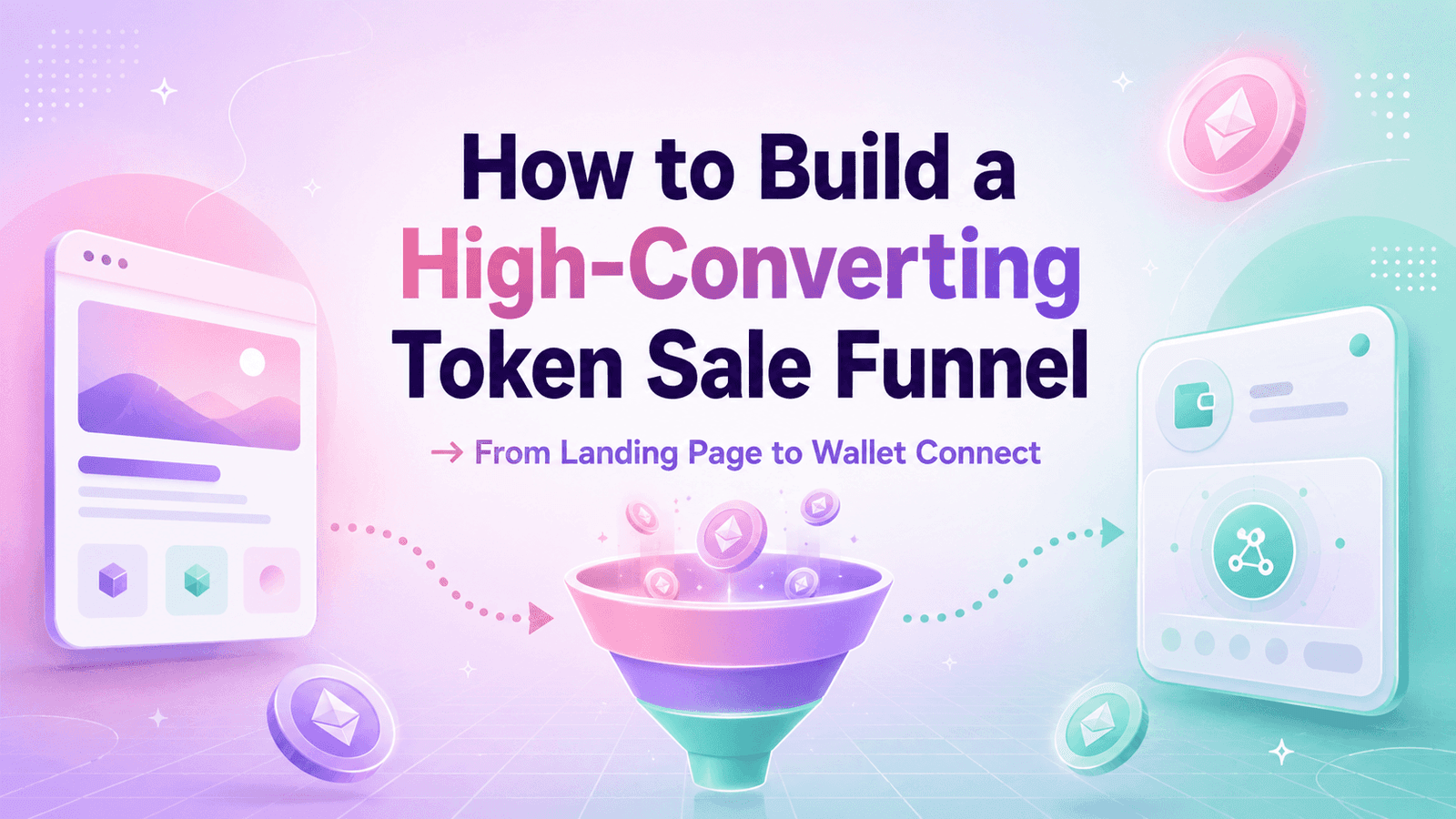
How to Build a High-Converting Token Sale Funnel From Landing Page to Wallet Connect

How to Build a High-Converting Token Sale Funnel From Landing Page to Wallet Connect

TL;DR
A high-converting token sale funnel guides users from first visit to wallet readiness. It should explain the project, token utility, proof, eligibility, sale rules, KYC, wallet setup, and funding steps. Each stage should answer one buyer question before friction appears. This reduces user confusion before wallet connection. Teams also need reminder flows and funnel tracking across visits, CTAs, KYC, wallet connection, purchases, and first on-chain actions.

Token Sale Funnel Objective and Buyer Journey

A token sale funnel is the conversion path from first visit to wallet readiness. It guides users through project context, token utility, eligibility, KYC, wallet setup, and funding. The objective of this funnel is not traffic alone. The objective is to create qualified buyers who can complete the next on-chain step. This means each user understands the project, passes required checks, prepares funds, and reaches wallet connection with fewer blockers.

A strong funnel should answer each buyer question in sequence. The user first needs context. Then the user needs utility, proof, eligibility, and sale rules. After that, the user needs wallet and funding guidance.

CoinList notes that token launches require planning across community, token economics, legal, custody, and security considerations. This supports the need for a structured funnel before launch.

Funnel stage

Buyer question

Funnel output

Landing page

What is this project?

Clear sale context

Utility

Why does the token matter?

Token role explanation

Proof

Can this project be trusted?

Credibility signals

Eligibility

Can this user join?

Participation clarity

KYC

What approval is needed?

Verification readiness

Wallet setup

Which wallet works?

Technical readiness

Funding

What asset is needed?

Purchase readiness

Wallet connection

Can the user proceed?

Onchain entry point

This buyer journey gives the funnel a clear structure. It also helps teams find where users drop before purchase. 

Required Pages and Sections for a Token Sale Funnel

A token sale funnel needs more than one sale page. The structure depends on compliance, region, and sale type. Most funnels still need the same core sections. 

A practical token sale funnel should include:

  1. Landing Page
    The project needs a landing page that explains the sale clearly. This page should introduce the project, token purpose, and main CTA. It should also guide visitors toward signup, whitelist, or eligibility checks.

  2. Token Utility Section
    The project needs a section that explains why the token exists. This section should show the token’s role in the product or ecosystem. It should help buyers understand the token before reviewing sale mechanics.

  3. Proof Section
    The project must first present a proof section before users are asked to take action. It should demonstrate product progress, team background, audits, traction or partners. It aids to lower hesitation prior to signup or KYC.

  4. Eligibility Page

There should be an eligibility page describing who is eligible for the project. Supported areas, restricted areas, user types and rules of participation should be covered on this page. It helps to avoid user restrictions at a late stage.

  1. KYC Page
    The project requires a KYC page with a description of the verification process. This page should display documents required, review time and approval status. It helps users prepare before the sale window.

  2. Sale Mechanics Page
    A page on the project should be created to describe how the sale works. This page should include token price, allocation, caps, deadlines and accepted currency. It helps buyers understand the rules prior to funding a wallet.

  3. Wallet Setup Guide
    The project needs a wallet guide before wallet connection. This guide should explain supported wallets, networks, and gas requirements. It reduces failed attempts during the technical step.

  4. Funding Guide
    The project needs a funding guide before the sale opens. This guide should explain accepted assets, funding routes, and balance preparation. It helps approved buyers prepare before purchase.

  5. FAQ Page
    The project needs an FAQ page for common blockers. This page should answer questions about eligibility, KYC, wallets, funding, deadlines, and transactions. It also reduces repeated support requests.

  6. Confirmation Page
    The project needs a confirmation page after signup or whitelist submission. This page should show the user’s next action clearly. It can direct users to KYC, wallet setup, funding, or reminders.

These sections can live on one page. They can also work as separate pages. The structure matters more than the format.

Recommended Token Launch Funnel Structure

A token launch funnel should follow the buyer decision path. It should not start with price, countdowns, and allocation only. A practical structure follows this order:

Landing page visit → Problem framing → Token utility → Proof and trust signals →Eligibility review → Sale mechanics → Signup or whitelist → KYC walkthrough → Wallet setup → Funding preparation → Wallet connection → Transaction readiness → Reminder and drop-off recovery.

This structure answers one question at each step. The buyer first understands the project. Then the buyer checks utility and proof. After that, the buyer reviews eligibility and mechanics. Wallet connection comes after preparation. This order prevents avoidable technical drop-off.

Landing Page Message Hierarchy

The landing page is one of the main touchpoints in a token sale funnel. It should turn first interest into a clear next step. It should not repeat every funnel page or replace the full sale documentation.

A strong landing page should present messages in this order:

  • Hero message
    State the token sale, project purpose, and primary CTA. The CTA should match the buyer stage, such as “Join whitelist,” “Check eligibility,” or “Prepare wallet.”

  • Problem context
    Explain why the project exists. This section helps buyers understand the need before reviewing token details.

  • Token role
    Explain what the token does in the product or ecosystem. This section should connect the token to real product usage.

  • Proof signals
    Show credibility before asking for signup or KYC. This can include product progress, audit status, team background, partners, or traction.

  • Sale summary
    Present the key sale details briefly. Include price, allocation, dates, limits, and accepted currency. Detailed mechanics can link to the sale details page.

  • Eligibility prompt
    Show who can participate at a high level. This section should push users toward the full eligibility or KYC page.

  • Wallet readiness prompt
    Prepare approved users for the next technical step. This can link to wallet setup, funding guidance, or transaction instructions.

How to Build Buyer Confidence Before Signup

A token sale funnel should build buyer confidence before signup. This stage explains why the project deserves attention. Without it, the sale can feel like a price page. The funnel should answer one core question first. “Why should this project matter to the buyer?”

This stage should explain the project context, token role, and trust signals. It should help buyers understand the sale before KYC or wallet connection. A strong confidence layer should include:

  • Problem framing
    Explain the problem the project addresses. This gives buyers context before token details appear.

  • Token utility
    Explain what the token does inside the product or ecosystem. Buyers should understand the token role before sale mechanics.

  • Product proof
    Show demo access, screenshots, roadmap progress, or working product signals.

  • Technical proof
    Show audit status, contract notes, or security preparation.

  • Team and market proof
    Show founder background, partner signals, traction, or community progress.

This section should not overpromise future demand. It should help buyers understand why the token exists. Then buyers can decide whether the sale deserves the next step.

How to Clarify Participation Rules Before Wallet Connection

A token sale funnel should clarify participation rules before wallet connection. This stage prevents users from discovering blockers too late. The funnel should answer one core question after buyer confidence; “Can this user actually participate?”

This section should explain the sale rules before the technical step. Late restrictions can create drop-off, support tickets, and user frustration. A clear participation layer should cover:

  • Eligibility rules
    Explain supported regions, restricted regions, user types, and participation requirements.

  • KYC process
    Explain required documents, review timing, and approval status.

  • Sale mechanics
    Explain sale type, token price, accepted currency, allocation, and caps.

  • Deadlines
    Show registration, KYC, funding, sale opening, and sale closing dates.

  • User status
    Show whether the user is pending, approved, rejected, waitlisted, or action required.

This section prepares users before wallet connection. It also helps teams reduce avoidable drop-off before purchase.

Common Token Sale Funnel Drop-Off Points

A token sale funnel should diagnose friction before purchase. Most drop-off appears when users understand the sale but cannot move through the next step. Each stage should show what happened and why the user may have stopped.

Drop-off point

What happens

Likely friction

Landing page to signup

Visitors leave before signup.

The CTA is unclear, the offer lacks proof, or eligibility is unclear.

Signup to KYC

Users register but do not start verification.

The document requirements, review time, or privacy process feels unclear.

KYC start to approval

Users start KYC but do not reach approval.

Documents fail, regions are restricted, or status updates are missing.

Approval to wallet setup

Approved users do not prepare wallets.

Wallet, network, and next-step instructions are missing.

Wallet setup to wallet connection

Users fail before wallet connection.

Wallet compatibility, browser, mobile, or permission issues appear.

Wallet connection to funding

Connected wallets remain unfunded.

Users have the wrong asset, wrong network, or no gas.

Funding to transaction

Funded users do not complete the transaction.

Approval prompts, gas prompts, or sale instructions create hesitation.

Transaction to confirmation

Users do not see a clear success state.

Confirmation, receipt, or next-step messaging is unclear.

Read next: How to Reduce Wallet Onboarding Drop-Off Before a Token Sale or Mint

How to Improve Token Sale Conversion From Site to Wallet Connection

Site-to-wallet conversion improves when the funnel removes uncertainty early. The page should not wait until launch day to explain technical steps. 

  1. The first improvement is stage-based CTA logic. Visitors should get education and eligibility checks. Signed-up users should get KYC instructions. Approved users should get wallet and funding guidance.

  2. The second improvement is visible progress. Users should know their status at each step. Useful progress states include:

  • Signup complete

  • KYC submitted

  • KYC approved

  • Wallet ready

  • Funds ready

  • Sale open

  • Transaction complete

  1. The third improvement is error prevention. The funnel should explain wallet compatibility, network selection, accepted assets, and gas.

  2. The fourth improvement is reminder timing. Users often stop after signup or KYC approval. Reminder flows should move them back into the journey.

How to Recover Token Sale Drop-Off After Signup

A token sale funnel does not stop after signup. Many buyers still need KYC approval, wallet setup, funding, and sale timing reminders. Post-signup nurture keeps these users moving toward wallet readiness.

Some users stop before KYC. Others complete KYC but forget to prepare funds. Others prepare funds but miss the sale window. Each case needs a targeted reminder, not a generic campaign update. A practical nurture flow should include:

  • Incomplete signup reminder: This reminder brings users back to finish registration.

  • Unfinished KYC reminder: This message explains the next verification step.

  • Pending approval update: This update tells users their review status.

  • Approved participation notice: This message confirms sale access and next steps.

  • Wallet setup reminder: This reminder directs users to wallet preparation.

  • Funding preparation reminder: This message explains accepted assets and gas.

  • Sale opening alert: This alert brings approved users back on time.

  • Sale closing reminder: This reminder reduces missed participation windows.

  • Failed transaction follow-up: This message helps users resolve technical issues.

Read more: Which Wallet Onboarding Model Works Best Before a Token Sale?

Token Sale Funnel Tracking From Visits to First On-chain Actions

Final purchases are too late for funnel diagnosis. Teams need to see where users stop before purchase.

Crypto funnel tracking should connect off-chain touchpoints with on-chain actions. Formo identifies website actions, wallet connections, approvals, and first transactions as key funnel events. It also frames wallet connection as the bridge between discovery and on-chain identity.

Funnel point

Metric

Ratio

KPI

Success signal

Benchmark or baseline

Landing page

Visits, source, scroll depth

Engaged visits ÷ total visits

Qualified visit rate

Visitors reach key sections

Compare by source and campaign

CTA

Signup clicks, whitelist clicks

CTA clicks ÷ page visits

CTA click-through rate

Users take the next step

Compare hero CTA versions

Signup

Form starts and completions

Completed signups ÷ form starts

Signup completion rate

Users finish registration

Compare by country and device

KYC

Starts, approvals, rejections

Approved users ÷ KYC starts

KYC approval rate

Users pass verification

Compare by KYC flow and region

Wallet connection

Starts and successful connections

Successful connects ÷ connection starts

Wallet connection success rate

Users connect without errors

Compare by wallet and browser

Funding

Funded wallets, asset readiness

Funded wallets ÷ approved users

Funded wallet rate

Users prepare funds before launch

Compare before each reminder

Approval

Approval attempts and failures

Successful approvals ÷ approval attempts

Approval success rate

Users pass contract approval

Compare by wallet and network

Purchase

Attempts and completions

Completed purchases ÷ purchase attempts

Purchase completion rate

Users finish the sale action

Compare by launch window

Onchain action

First transaction or purchase

First actions ÷ connected wallets

Activation rate

Wallets complete first onchain action

Compare by channel and cohort

This tracking view gives teams clearer diagnosis. CTA drop-off needs message review. KYC drop-off needs process review. Wallet drop-off needs technical review. Teams should also segment the data. Useful segments include country, device, source, wallet, KYC status, and funding status.

Tools for Tracking Token Sale Funnels

A token sale funnel needs tools that track both website behavior and onchain actions.

Tool layer

Example tools

Best use in a token sale funnel

Web3 funnel analytics

Formo

Track page visits, wallet connections, transactions, and funnel paths.

Website analytics

Google Analytics 4

Track traffic sources, landing pages, CTAs, and key events.

Product analytics

Mixpanel, Amplitude

Analyze signup, KYC, wallet setup, and drop-off paths.

Event pipeline

Segment, RudderStack

Route funnel events into analytics, CRM, or data warehouse tools.

Onchain analytics

Dune, Flipside

Track purchases, contract events, transfers, and post-sale activity.

Map a Token Sale Funnel Wireframe with TokenMinds

TokenMinds helps teams map the token sale funnel before launch traffic starts. The sprint reviews landing page structure, eligibility, KYC, wallet readiness, reminders, and tracking. Schedule a free consultation to review the funnel from first visit to wallet connection.

Request a Token Sale Funnel Wireframe Sprint.

FAQs

  1. What is a token sale funnel?

    A token sale funnel guides users from first visit to wallet readiness. It covers context, utility, proof, eligibility, KYC, funding, and wallet connection.

  2. Why do users drop off before wallet connection?

    Users drop off when the next step feels unclear. Common blockers include weak proof, unclear eligibility, KYC friction, funding issues, and wallet confusion.

  3. What metrics should teams track in a token sale funnel?

    Teams should track visits, CTA clicks, signups, KYC status, wallet connections, approvals, purchases, and first onchain actions.

  4. How do teams improve wallet connection conversion?

    Teams improve conversion by preparing users before the wallet step. Clear wallet rules, network guidance, funding instructions, and reminders reduce friction.

  5. What happens after KYC approval?

    Approved users should receive wallet setup and funding guidance. They also need sale timing, accepted assets, gas details, and transaction instructions.

  6. Which wallets should token sales support?

    Token sales should support wallets that match the target users and chain. Teams should prioritize common wallet types across desktop and mobile.

TL;DR
A high-converting token sale funnel guides users from first visit to wallet readiness. It should explain the project, token utility, proof, eligibility, sale rules, KYC, wallet setup, and funding steps. Each stage should answer one buyer question before friction appears. This reduces user confusion before wallet connection. Teams also need reminder flows and funnel tracking across visits, CTAs, KYC, wallet connection, purchases, and first on-chain actions.

Token Sale Funnel Objective and Buyer Journey

A token sale funnel is the conversion path from first visit to wallet readiness. It guides users through project context, token utility, eligibility, KYC, wallet setup, and funding. The objective of this funnel is not traffic alone. The objective is to create qualified buyers who can complete the next on-chain step. This means each user understands the project, passes required checks, prepares funds, and reaches wallet connection with fewer blockers.

A strong funnel should answer each buyer question in sequence. The user first needs context. Then the user needs utility, proof, eligibility, and sale rules. After that, the user needs wallet and funding guidance.

CoinList notes that token launches require planning across community, token economics, legal, custody, and security considerations. This supports the need for a structured funnel before launch.

Funnel stage

Buyer question

Funnel output

Landing page

What is this project?

Clear sale context

Utility

Why does the token matter?

Token role explanation

Proof

Can this project be trusted?

Credibility signals

Eligibility

Can this user join?

Participation clarity

KYC

What approval is needed?

Verification readiness

Wallet setup

Which wallet works?

Technical readiness

Funding

What asset is needed?

Purchase readiness

Wallet connection

Can the user proceed?

Onchain entry point

This buyer journey gives the funnel a clear structure. It also helps teams find where users drop before purchase. 

Required Pages and Sections for a Token Sale Funnel

A token sale funnel needs more than one sale page. The structure depends on compliance, region, and sale type. Most funnels still need the same core sections. 

A practical token sale funnel should include:

  1. Landing Page
    The project needs a landing page that explains the sale clearly. This page should introduce the project, token purpose, and main CTA. It should also guide visitors toward signup, whitelist, or eligibility checks.

  2. Token Utility Section
    The project needs a section that explains why the token exists. This section should show the token’s role in the product or ecosystem. It should help buyers understand the token before reviewing sale mechanics.

  3. Proof Section
    The project must first present a proof section before users are asked to take action. It should demonstrate product progress, team background, audits, traction or partners. It aids to lower hesitation prior to signup or KYC.

  4. Eligibility Page

There should be an eligibility page describing who is eligible for the project. Supported areas, restricted areas, user types and rules of participation should be covered on this page. It helps to avoid user restrictions at a late stage.

  1. KYC Page
    The project requires a KYC page with a description of the verification process. This page should display documents required, review time and approval status. It helps users prepare before the sale window.

  2. Sale Mechanics Page
    A page on the project should be created to describe how the sale works. This page should include token price, allocation, caps, deadlines and accepted currency. It helps buyers understand the rules prior to funding a wallet.

  3. Wallet Setup Guide
    The project needs a wallet guide before wallet connection. This guide should explain supported wallets, networks, and gas requirements. It reduces failed attempts during the technical step.

  4. Funding Guide
    The project needs a funding guide before the sale opens. This guide should explain accepted assets, funding routes, and balance preparation. It helps approved buyers prepare before purchase.

  5. FAQ Page
    The project needs an FAQ page for common blockers. This page should answer questions about eligibility, KYC, wallets, funding, deadlines, and transactions. It also reduces repeated support requests.

  6. Confirmation Page
    The project needs a confirmation page after signup or whitelist submission. This page should show the user’s next action clearly. It can direct users to KYC, wallet setup, funding, or reminders.

These sections can live on one page. They can also work as separate pages. The structure matters more than the format.

Recommended Token Launch Funnel Structure

A token launch funnel should follow the buyer decision path. It should not start with price, countdowns, and allocation only. A practical structure follows this order:

Landing page visit → Problem framing → Token utility → Proof and trust signals →Eligibility review → Sale mechanics → Signup or whitelist → KYC walkthrough → Wallet setup → Funding preparation → Wallet connection → Transaction readiness → Reminder and drop-off recovery.

This structure answers one question at each step. The buyer first understands the project. Then the buyer checks utility and proof. After that, the buyer reviews eligibility and mechanics. Wallet connection comes after preparation. This order prevents avoidable technical drop-off.

Landing Page Message Hierarchy

The landing page is one of the main touchpoints in a token sale funnel. It should turn first interest into a clear next step. It should not repeat every funnel page or replace the full sale documentation.

A strong landing page should present messages in this order:

  • Hero message
    State the token sale, project purpose, and primary CTA. The CTA should match the buyer stage, such as “Join whitelist,” “Check eligibility,” or “Prepare wallet.”

  • Problem context
    Explain why the project exists. This section helps buyers understand the need before reviewing token details.

  • Token role
    Explain what the token does in the product or ecosystem. This section should connect the token to real product usage.

  • Proof signals
    Show credibility before asking for signup or KYC. This can include product progress, audit status, team background, partners, or traction.

  • Sale summary
    Present the key sale details briefly. Include price, allocation, dates, limits, and accepted currency. Detailed mechanics can link to the sale details page.

  • Eligibility prompt
    Show who can participate at a high level. This section should push users toward the full eligibility or KYC page.

  • Wallet readiness prompt
    Prepare approved users for the next technical step. This can link to wallet setup, funding guidance, or transaction instructions.

How to Build Buyer Confidence Before Signup

A token sale funnel should build buyer confidence before signup. This stage explains why the project deserves attention. Without it, the sale can feel like a price page. The funnel should answer one core question first. “Why should this project matter to the buyer?”

This stage should explain the project context, token role, and trust signals. It should help buyers understand the sale before KYC or wallet connection. A strong confidence layer should include:

  • Problem framing
    Explain the problem the project addresses. This gives buyers context before token details appear.

  • Token utility
    Explain what the token does inside the product or ecosystem. Buyers should understand the token role before sale mechanics.

  • Product proof
    Show demo access, screenshots, roadmap progress, or working product signals.

  • Technical proof
    Show audit status, contract notes, or security preparation.

  • Team and market proof
    Show founder background, partner signals, traction, or community progress.

This section should not overpromise future demand. It should help buyers understand why the token exists. Then buyers can decide whether the sale deserves the next step.

How to Clarify Participation Rules Before Wallet Connection

A token sale funnel should clarify participation rules before wallet connection. This stage prevents users from discovering blockers too late. The funnel should answer one core question after buyer confidence; “Can this user actually participate?”

This section should explain the sale rules before the technical step. Late restrictions can create drop-off, support tickets, and user frustration. A clear participation layer should cover:

  • Eligibility rules
    Explain supported regions, restricted regions, user types, and participation requirements.

  • KYC process
    Explain required documents, review timing, and approval status.

  • Sale mechanics
    Explain sale type, token price, accepted currency, allocation, and caps.

  • Deadlines
    Show registration, KYC, funding, sale opening, and sale closing dates.

  • User status
    Show whether the user is pending, approved, rejected, waitlisted, or action required.

This section prepares users before wallet connection. It also helps teams reduce avoidable drop-off before purchase.

Common Token Sale Funnel Drop-Off Points

A token sale funnel should diagnose friction before purchase. Most drop-off appears when users understand the sale but cannot move through the next step. Each stage should show what happened and why the user may have stopped.

Drop-off point

What happens

Likely friction

Landing page to signup

Visitors leave before signup.

The CTA is unclear, the offer lacks proof, or eligibility is unclear.

Signup to KYC

Users register but do not start verification.

The document requirements, review time, or privacy process feels unclear.

KYC start to approval

Users start KYC but do not reach approval.

Documents fail, regions are restricted, or status updates are missing.

Approval to wallet setup

Approved users do not prepare wallets.

Wallet, network, and next-step instructions are missing.

Wallet setup to wallet connection

Users fail before wallet connection.

Wallet compatibility, browser, mobile, or permission issues appear.

Wallet connection to funding

Connected wallets remain unfunded.

Users have the wrong asset, wrong network, or no gas.

Funding to transaction

Funded users do not complete the transaction.

Approval prompts, gas prompts, or sale instructions create hesitation.

Transaction to confirmation

Users do not see a clear success state.

Confirmation, receipt, or next-step messaging is unclear.

Read next: How to Reduce Wallet Onboarding Drop-Off Before a Token Sale or Mint

How to Improve Token Sale Conversion From Site to Wallet Connection

Site-to-wallet conversion improves when the funnel removes uncertainty early. The page should not wait until launch day to explain technical steps. 

  1. The first improvement is stage-based CTA logic. Visitors should get education and eligibility checks. Signed-up users should get KYC instructions. Approved users should get wallet and funding guidance.

  2. The second improvement is visible progress. Users should know their status at each step. Useful progress states include:

  • Signup complete

  • KYC submitted

  • KYC approved

  • Wallet ready

  • Funds ready

  • Sale open

  • Transaction complete

  1. The third improvement is error prevention. The funnel should explain wallet compatibility, network selection, accepted assets, and gas.

  2. The fourth improvement is reminder timing. Users often stop after signup or KYC approval. Reminder flows should move them back into the journey.

How to Recover Token Sale Drop-Off After Signup

A token sale funnel does not stop after signup. Many buyers still need KYC approval, wallet setup, funding, and sale timing reminders. Post-signup nurture keeps these users moving toward wallet readiness.

Some users stop before KYC. Others complete KYC but forget to prepare funds. Others prepare funds but miss the sale window. Each case needs a targeted reminder, not a generic campaign update. A practical nurture flow should include:

  • Incomplete signup reminder: This reminder brings users back to finish registration.

  • Unfinished KYC reminder: This message explains the next verification step.

  • Pending approval update: This update tells users their review status.

  • Approved participation notice: This message confirms sale access and next steps.

  • Wallet setup reminder: This reminder directs users to wallet preparation.

  • Funding preparation reminder: This message explains accepted assets and gas.

  • Sale opening alert: This alert brings approved users back on time.

  • Sale closing reminder: This reminder reduces missed participation windows.

  • Failed transaction follow-up: This message helps users resolve technical issues.

Read more: Which Wallet Onboarding Model Works Best Before a Token Sale?

Token Sale Funnel Tracking From Visits to First On-chain Actions

Final purchases are too late for funnel diagnosis. Teams need to see where users stop before purchase.

Crypto funnel tracking should connect off-chain touchpoints with on-chain actions. Formo identifies website actions, wallet connections, approvals, and first transactions as key funnel events. It also frames wallet connection as the bridge between discovery and on-chain identity.

Funnel point

Metric

Ratio

KPI

Success signal

Benchmark or baseline

Landing page

Visits, source, scroll depth

Engaged visits ÷ total visits

Qualified visit rate

Visitors reach key sections

Compare by source and campaign

CTA

Signup clicks, whitelist clicks

CTA clicks ÷ page visits

CTA click-through rate

Users take the next step

Compare hero CTA versions

Signup

Form starts and completions

Completed signups ÷ form starts

Signup completion rate

Users finish registration

Compare by country and device

KYC

Starts, approvals, rejections

Approved users ÷ KYC starts

KYC approval rate

Users pass verification

Compare by KYC flow and region

Wallet connection

Starts and successful connections

Successful connects ÷ connection starts

Wallet connection success rate

Users connect without errors

Compare by wallet and browser

Funding

Funded wallets, asset readiness

Funded wallets ÷ approved users

Funded wallet rate

Users prepare funds before launch

Compare before each reminder

Approval

Approval attempts and failures

Successful approvals ÷ approval attempts

Approval success rate

Users pass contract approval

Compare by wallet and network

Purchase

Attempts and completions

Completed purchases ÷ purchase attempts

Purchase completion rate

Users finish the sale action

Compare by launch window

Onchain action

First transaction or purchase

First actions ÷ connected wallets

Activation rate

Wallets complete first onchain action

Compare by channel and cohort

This tracking view gives teams clearer diagnosis. CTA drop-off needs message review. KYC drop-off needs process review. Wallet drop-off needs technical review. Teams should also segment the data. Useful segments include country, device, source, wallet, KYC status, and funding status.

Tools for Tracking Token Sale Funnels

A token sale funnel needs tools that track both website behavior and onchain actions.

Tool layer

Example tools

Best use in a token sale funnel

Web3 funnel analytics

Formo

Track page visits, wallet connections, transactions, and funnel paths.

Website analytics

Google Analytics 4

Track traffic sources, landing pages, CTAs, and key events.

Product analytics

Mixpanel, Amplitude

Analyze signup, KYC, wallet setup, and drop-off paths.

Event pipeline

Segment, RudderStack

Route funnel events into analytics, CRM, or data warehouse tools.

Onchain analytics

Dune, Flipside

Track purchases, contract events, transfers, and post-sale activity.

Map a Token Sale Funnel Wireframe with TokenMinds

TokenMinds helps teams map the token sale funnel before launch traffic starts. The sprint reviews landing page structure, eligibility, KYC, wallet readiness, reminders, and tracking. Schedule a free consultation to review the funnel from first visit to wallet connection.

Request a Token Sale Funnel Wireframe Sprint.

FAQs

  1. What is a token sale funnel?

    A token sale funnel guides users from first visit to wallet readiness. It covers context, utility, proof, eligibility, KYC, funding, and wallet connection.

  2. Why do users drop off before wallet connection?

    Users drop off when the next step feels unclear. Common blockers include weak proof, unclear eligibility, KYC friction, funding issues, and wallet confusion.

  3. What metrics should teams track in a token sale funnel?

    Teams should track visits, CTA clicks, signups, KYC status, wallet connections, approvals, purchases, and first onchain actions.

  4. How do teams improve wallet connection conversion?

    Teams improve conversion by preparing users before the wallet step. Clear wallet rules, network guidance, funding instructions, and reminders reduce friction.

  5. What happens after KYC approval?

    Approved users should receive wallet setup and funding guidance. They also need sale timing, accepted assets, gas details, and transaction instructions.

  6. Which wallets should token sales support?

    Token sales should support wallets that match the target users and chain. Teams should prioritize common wallet types across desktop and mobile.

GET SUCCESS IN WEB3

  • Trusted Web3 partner since 2017

  • Full-stack Web3 development team

  • Performance-driven Web3 marketing

Get A Free Consultation

Get A Free Consultation

MEET US AT

RECENT TRAININGS

Follow us

get web3 business updates

Email invalid

  • Access global liquidity for your RWA project with TMX Tokenize’s Canton Network integration

DISCOVER NOW

  • Access global liquidity for your RWA project with TMX Tokenize’s Canton Network integration

    JOIN NOW

DISCOVER

  • Access global liquidity for your RWA project with TMX Tokenize’s Canton Network integration