

How to Reduce Wallet Onboarding Drop-Off Before a Token Sale or Mint (2026 Guide)
Written by: TokenMinds Team
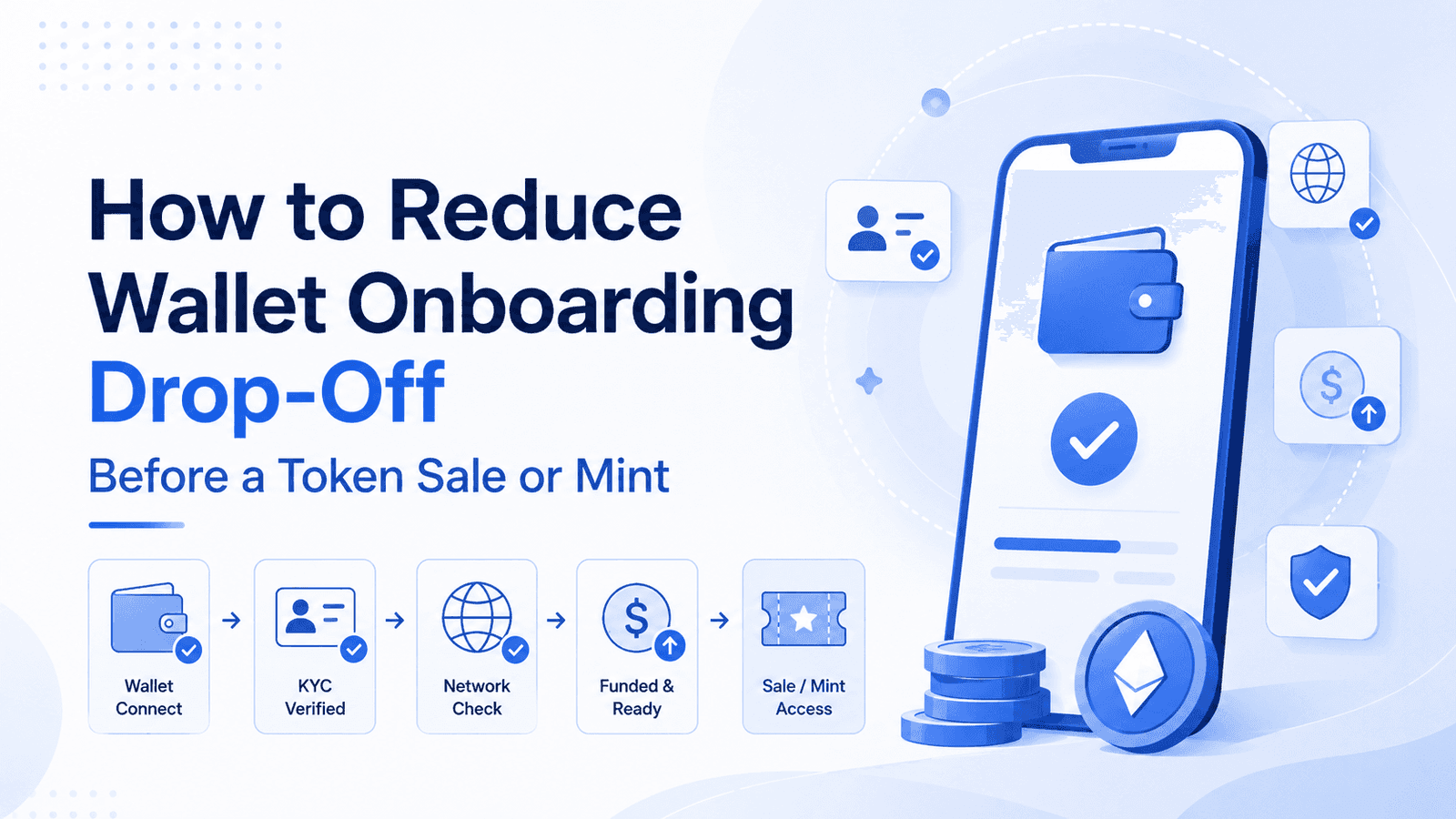
What Wallet Onboarding Drop-Off Means
Wallet onboarding drop-off happens when interested buyers leave before they become sale-ready. They may visit the sale page, join the allowlist, or start registration. But they fail to complete the steps needed to participate.
Most pre-sale drop-off does not happen at the purchase button. It happens earlier, when interested buyers cannot create an account, connect the right wallet, pass KYC, choose the correct network, or fund the wallet in time.
A clear “Connect wallet” button does not guarantee progress. The buyer may not know which wallet to use, which chain to select, what token to hold, or what permissions are being requested. For first-time buyers, the button can create uncertainty instead of readiness.
That is why wallet onboarding should be treated as part of the token sale funnel or structure. The goal is not just to connect a wallet. The goal is to help qualified buyers become ready to buy before the sale opens.
Where the Pre-Sale Funnel Loses Buyers

Wallet onboarding usually breaks before the token sale page. The buyer may show interest, but one unclear step stops progress. Industry benchmarks show how early this loss can happen. Blockchain-Ads reports a 15% landing-page-to-wallet-connect rate for DeFi apps. It also reports a 45% wallet-connect-to-first-transaction rate. Token sale teams should treat these as directional benchmarks, not fixed targets.
Why Do Users Drop at Wallet Connect?
The most common drop-off points are:
Drop-off point | Why buyers leave |
|---|---|
Wallet creation | First-time buyers may not know which wallet to use or how to set it up. |
Wallet connect | The buyer may face wallet options, permission prompts, or unclear security language. |
KYC | Verification may appear too late, take too long, or interrupt the sale flow. |
Network check | The wallet may be connected to the wrong chain, with no clear fix. |
Funding | The buyer may not hold the right token, gas, or minimum purchase amount. |
Verification friction is a deep enough problem to deserve its own playbook. The TokenMinds guide to token sale KYC and eligibility UX covers how to cut that drop-off without weakening compliance.
Read more: What does a high-converting token sale funnel look like from landing page to wallet connection.
How Do We Reduce Onboarding Friction Before a Token Sale or Mint?
As the funnel shows, buyers often drop before the sale page because one required step feels unclear, risky, or hard to complete. The fix is to reduce friction before those technical steps appear. A stronger flow starts with familiar actions, then guides buyers through wallet setup, KYC, network checks, and funding in the right order.
1. Start With Progressive Authentication
Progressive authentication lowers the first barrier. Users can begin with email, social login, or a light account. Wallet connection can come later, when it becomes necessary.
Read more: Social login, embedded wallets, or native wallet connect, what converts best for Web3 launches.
This approach helps teams capture demand early. It also gives users time to understand the process. A buyer can join the waitlist, receive sale updates, and review requirements before connecting a wallet.
This does not remove wallet steps. It places them at the right moment. The user first learns what the sale requires. Then the platform asks for wallet action.
Read more: How to Structure a Token Sale Whitelist.
2. Make Wallet Setup Feel Familiar
Wallet setup should feel closer to normal account creation. This matters when buyers do not use crypto every day. Teams can offer familiar login methods and embedded wallets. They can also explain wallet setup in plain language. But the interface should not assume the user knows seed phrases, gas, RPC errors, or network switching.
Wallet onboarding works better when account creation is simple, steps are clear, security language is plain, and help appears inside the flow. The same principle applies to a token sale. Each wallet step should explain what is happening and why. The user should not need to search for a help center.
3. Show Clear Wallet States
Users need to know their current status. A connected wallet is not always sale-ready. A token sale interface should show clear wallet states:
- Not connected
- Connected
- Wrong network
- KYC pending
- KYC approved
- Funding incomplete
- Gas missing
- Sale-ready
These states reduce uncertainty. They tell the buyer what is complete and what remains. They also prevent a common mistake. Many users think connection means they are ready to buy.
4. Fix Wallet Connect UX

Wallet connect should be simple and guided. One primary CTA should lead the user forward. Secondary options should not compete for attention.
The flow should detect errors early. Wrong-network errors should not appear as technical alerts. They should explain the issue and give a fix.
For example:
“Your wallet is connected, but it is on the wrong network. Switch to the required network to continue.”
This is clearer than “RPC error” or “transaction failed.”
The same logic applies to wallet choice. If multiple wallets are supported, the interface should guide selection. Desktop users may need browser wallet support. Mobile users may need deep links into wallet apps.
A good wallet-connect flow also gives retry paths. Users should not restart the full process after one failed action.
5. Make Mobile Wallet Flows Easier
Mobile flow quality matters because users do not always return after friction. AppsFlyer notes that average app retention across 31 mobile app categories is about 25% on day one retention, about 6% by day 30. Finance app retention is also low, with day-one retention around 17% on Android and 22% on iOS. A broken wallet handoff can therefore cost more than one session.
Mobile wallet friction can break the pre-sale journey. Many users browse from mobile devices. Yet wallet apps often open in a separate screen.
The flow should support mobile wallet deep links. It should also return users to the correct step after wallet action. If the wallet app does not open, the user needs a fallback path.
Mobile screens also need shorter copies. Each screen should tell the user what to do now.
How to Prepare Buyers Before the Token Sale or Mints Opens

1. Explain Funding Requirements Early
A connected wallet is not a funded wallet. A funded wallet is not always ready.
Token sale teams should explain funding requirements before the sale opens. Users need to know the required chain, accepted purchase token, minimum amount, and gas needs. They also need to know how long transfers may take.
This guidance should appear before the final sale page. A readiness screen can show what is missing. For example, KYC may be approved, but the wallet may have no gas.
Fiat onramps can also reduce funding friction. Not every buyer already holds the right asset. If onramps are supported, the sale flow should explain timing, fees, and limits.
2. Give Users a Sale-Readiness Checklist
A sale-readiness checklist turns uncertainty into action. It should show the user what is complete and what remains.
The checklist can include:
- Account created
- Allowlist status confirmed
- KYC approved
- Wallet connected
- Correct network selected
- Purchase token available
- Gas available
- Sale opening time confirmed
This checklist helps buyers act before the sale window. It also helps the team segment reminders.
3. Send Pre-Sale Reminders
Reminder sequences should follow user status. Generic reminders are less useful. A token sale team can send different reminders for KYC, wallet connection, funding, and sale timing. This keeps communication relevant. It also reduces support load near launch. Reminders should state the missing action, deadline, and next step.
How to Reduce First Transaction Anxiety During a Token Sale or Mint
Wallet connection does not remove buyer hesitation. The first on-chain action can still feel risky, especially when the wallet asks for a signature, approval, or purchase confirmation. The sale flow should explain each action before the wallet prompt appears.
Clear UX copy can reduce uncertainty:
- “This signature verifies wallet ownership. It does not move funds.”
- “This approval allows the sale contract to use the selected purchase token.”
- “This purchase transaction submits the token sale order.”
- “Estimated gas will appear before confirmation.”
The flow also needs recovery paths. If a signature expires, approval fails, or gas changes, the buyer should see the next step. They should not restart the full sale flow.
How to Measure Wallet Onboarding Drop-Off
Final purchase conversion is too late. Token sale teams need to measure each step before the buyer reaches the purchase screen.
External benchmarks should be used as directional context, not fixed token sale targets. Signicat found that financial services onboarding abandonment reached 68% in 2022. These figures show why teams need step-level measurement before launch.
Metric | Benchmark or reference point | What to watch |
|---|---|---|
Landing page to signup rate | Internal baseline | Low signup may show unclear sale requirements or weak next steps. |
Landing page to wallet connect | 15% DeFi benchmark | A low rate may show weak intent, poor wallet guidance, or early technical friction. |
Signup to wallet-connect start | Internal baseline | A drop here may mean wallet connection appears too early. |
Wallet-connect start to success | Internal baseline | Segment by wallet type, device, browser, and country. |
KYC start to approval | 68% financial onboarding abandonment risk | Slow or unclear KYC can block qualified buyers before sale access. |
Correct network selected | Internal baseline | High wrong-network rates point to weak prompts or unclear wallet states. |
Funded wallet rate | Internal baseline | Track the right token, gas balance, chain, and fiat onramp usage. |
Wallet connect to first transaction | 45% DeFi benchmark | A low rate may show transaction anxiety, unclear gas costs, or weak recovery paths. |
Sale-readiness conversion | Internal baseline | Track account, KYC, wallet, network, funding, gas, and reminder status. |
Purchase completion rate | Internal baseline | Low completion may point to failed transactions or unclear confirmation states. |
*Note: Internal baseline means the project’s own starting conversion rate. Some token sale metrics do not have reliable public benchmarks, so teams should compare later improvements against their own pre-sale funnel data.
Pre-Sale or Pre-Mint Wallet Onboarding Checklist
Before launch, token sale teams should review these questions:
- Can users register before connecting a wallet?
- Is there one clear CTA per step?
- Are wallet states visible and easy to understand?
- Are wrong-network errors easy to fix?
- Does the mobile wallet flow return users correctly?
- Are KYC steps explained before users start?
- Are funding and gas requirements clear?
- Are fiat onramp options explained, if available?
- Are reminder sequences based on user status?
- Is drop-off tracked at every onboarding step?
This checklist should involve marketing, product, engineering, compliance, and support. Wallet onboarding touches the full pre-sale funnel.
Audit the Onchain Funnel Before the Token Sale Starts
Wallet onboarding issues are easier to fix before the sale goes live. After launch, every unclear wallet state, failed network switch, delayed KYC check, or funding gap can become lost demand.
A pre-sale funnel audit helps identify where qualified buyers may drop before they can participate. It reviews registration, allowlist flow, wallet connection, KYC, chain selection, funding, mobile UX, support paths, and funnel analytics.
Before opening the sale, TokenMinds can do the on-chain funnel audit to identify where wallet setup, funding, KYC, or mobile UX may cause qualified buyers to drop. Request an Onchain Funnel Audit before your token sale or mint opens and schedule a free call now.
FAQ
- Why do users abandon wallet onboarding before a token sale?Users abandon wallet onboarding when the next step feels unclear, risky, or too technical. Common causes include early wallet pressure, confusing wallet choices, KYC friction, wrong-network errors, missing gas, and weak mobile wallet flows.
- What is the biggest source of wallet onboarding friction?The biggest friction point is unclear readiness. A buyer may connect a wallet but still lack KYC approval, the right network, the purchase token, or gas. The interface should show what is complete and what remains.
- Should KYC happen before or after wallet connection?KYC should be explained before the buyer starts the flow. In most token sale funnels, KYC should be completed before sale access. Wallet connection can happen after signup, once the buyer understands the sale requirements.
- How do embedded wallets improve token sale conversion?Embedded wallets reduce the need for first-time buyers to manage complex wallet setup. They make onboarding feel closer to normal account creation, while still allowing the sale flow to prepare users for onchain participation.
- Why do mobile wallet flows fail?Mobile wallet flows often fail during app handoffs. A buyer may start in a browser, open a wallet app, and lose the original step. Deep links, return paths, and short status messages help reduce this drop-off.
- What metrics should token sale teams track before launch?Token sale teams should track signup, wallet connection, KYC status, network status, funding status, gas readiness, device, browser, wallet type, and sale-readiness conversion. Final purchase conversion alone is too late.