
TL;DR
A crypto presale marketing strategy should prove trust before driving traffic. Founders need a clear narrative, visible tokenomics, sale terms, audit status, official links, and tested wallet flow. PR, KOLs, community, SEO, and AI search should repeat one message. The project is legitimate, the sale is clear, and the buyer journey is safe. Campaigns should track wallet starts, KYC, contributions, source quality, and post-sale engagement.
The Crypto Presale Trust Gap in 2026
Crypto presale buyers are becoming more cautious in 2026. Many of them are wary of fake projects, phishing links, suspicious teams, and unfulfilled token promises. As a result, they no longer trust presale sites simply because they have high traffic, KOL posts, or an attractive website.
Chainalysis estimated that crypto scams received at least $14 billion on-chain in 2025. They also predict that the final figure could exceed $17 billion as more rogue wallets are identified. Security risks are also influencing buyer behavior. CertiK reported Web3 losses of $3.35 billion in 2025, up about 37% from 2024.
This doesn’t mean every presale is suspicious. It simply means buyers are now doing their due diligence before taking action. This creates a real challenge for presales. Traffic can drive people to a sales page, but trust is what determines whether they’ll stay, connect their wallets, and contribute.
The Objective of a Public Token Sale
A public token sale has one direct goal: raise capital. But it also gives the market a first real test. It shows whether people understand the project well enough to join the sale.
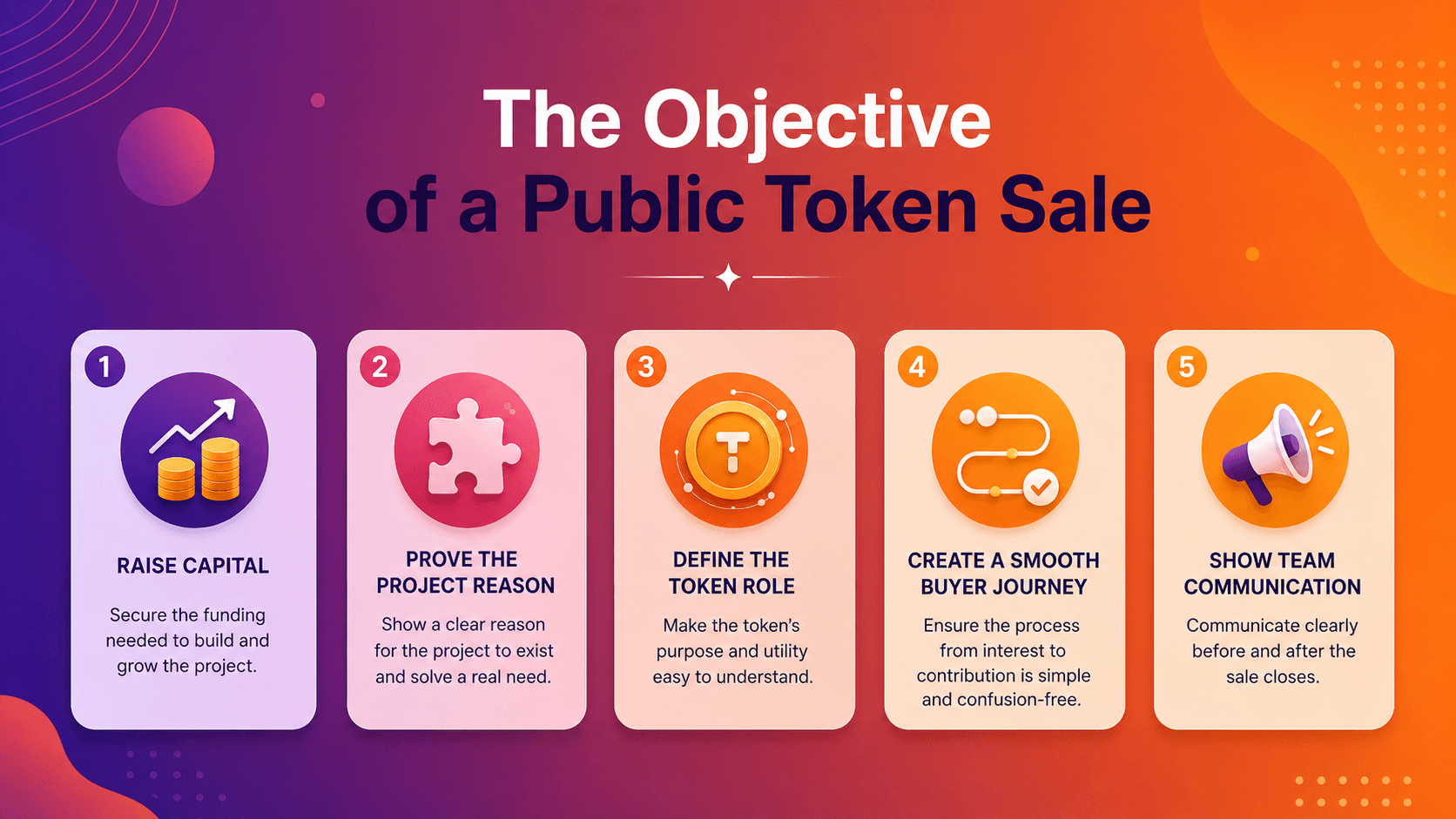
For founders, the main objectives are:
Raise capital for product, liquidity, market entry, and growth.
Prove the project has a clear reason to exist.
Explain why the token is needed.
Make the sale terms easy to understand.
Move buyers from interest to contribution safely.
Build confidence that continues after the sale closes.
These objectives are connected. A project cannot raise quality capital if buyers do not understand the token, the sale terms, or the next step. Even one unclear part, such as vesting, can slow the decision.
This is why the sale needs a trust layer before heavy promotion. The work is not only about getting attention. It is about making the project clear enough for buyers to verify and complete the sale journey.
Crypto Presale Marketing Strategy: Trust Layers to Prepare Before Promotion
A public token sale needs more than attention. It needs a clear trust system before promotion scales. The following strategy layers help founders make the sale easier to understand, verify, and complete.
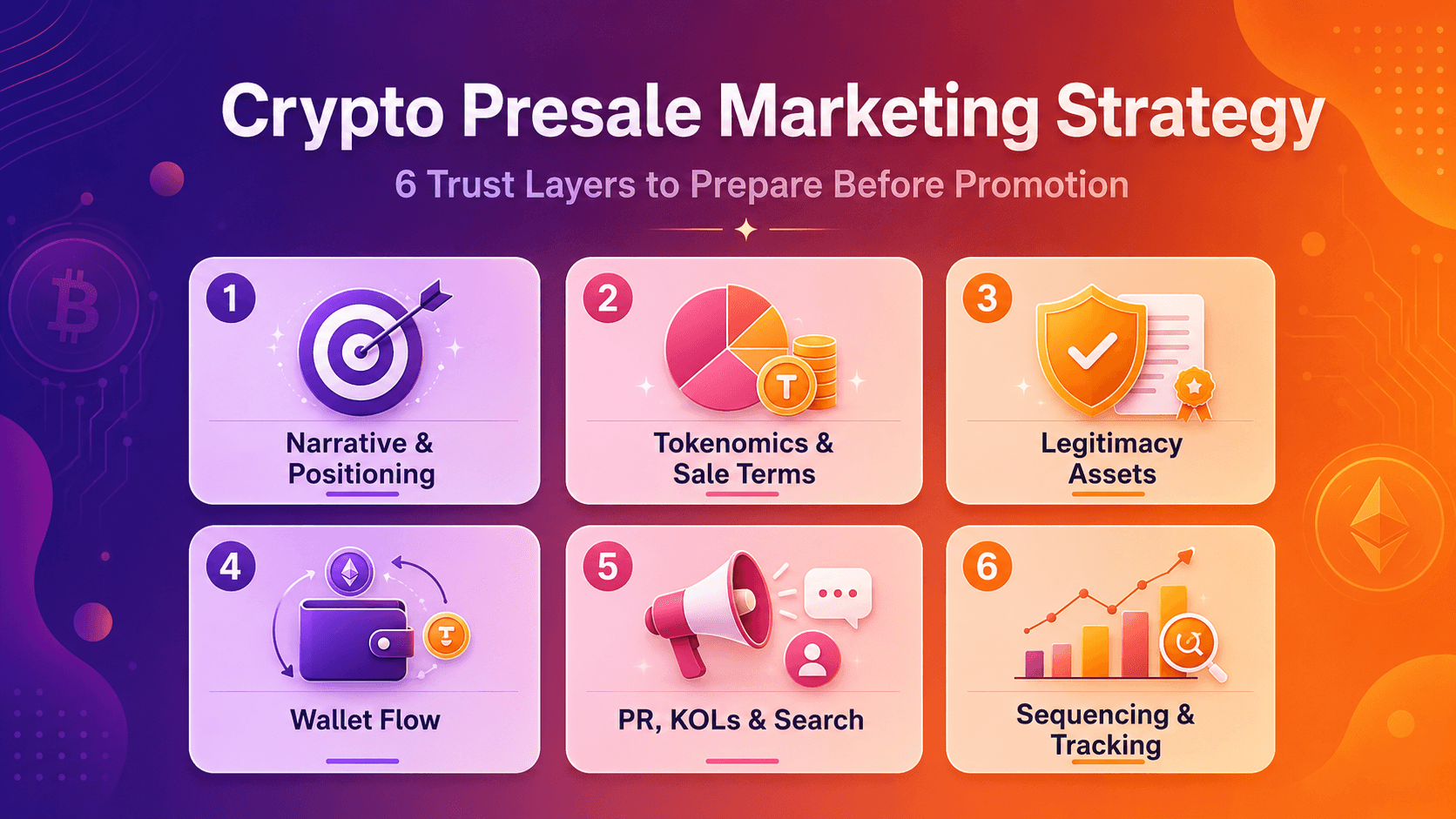
1. Build the Presale Narrative and Buyer Positioning
After the sale objective is clear, the first strategy layer is buyer understanding. A presale cannot build trust if buyers cannot explain what the project does, who it serves, and why the token exists.
A presale narrative is the plain-language story behind the sale. It should connect the product, token role, market need, and buyer profile. This is not just branding. It helps every channel explain the same reason to care.
The table below shows simple narrative examples. It compares vague messages with clearer presale positioning.
Narrative Area | Weak Message | Stronger Presale Narrative |
Project problem | “A new Web3 ecosystem” | “A payment tool for freelancers who need faster crypto settlement” |
Product role | “Users join the platform” | “Users can create invoices, receive crypto payments, and track settlement” |
Token role | “The token powers the ecosystem” | “The token gives access to lower fees, rewards, and governance rights” |
Buyer profile | “Built for everyone” | “Built for crypto-native freelancers, agencies, and payment users” |
Timing | “Presale is now live” | “The presale supports liquidity, beta access, and market entry before launch” |
The simple test is clear. Can a new buyer explain the project in one sentence before connecting a wallet? If the answer is no, the campaign needs clearer positioning before promotion scales. PR, KOLs, and community channels can only amplify the story already prepared.
For a deeper breakdown, read TokenMinds’ guide on crypto narratives.
2. Clarify Tokenomics, Sale Terms, and Eligibility
Once the narrative is clear, buyers need the sale details. A strong story can create interest, but clear tokenomics helps buyers decide whether the sale feels credible.
Tokenomics explains how the token works. Sale terms explain how the presale works. Eligibility explains who can join. These three areas should be easy to find before promotion starts. A presale page should clearly show:
Token allocation
Vesting and unlock schedule
Presale price
Hard cap or sale allocation
Accepted payment assets
Claim timing
KYC requirements
Restricted regions
Minimum or maximum contribution rules
Wallet and network requirements
These details reduce confusion. They help buyers understand what they are buying, when tokens unlock, and whether they can join the sale. They also help KOLs, PR teams, and community managers explain the campaign without guessing.
This matters because presale trust often breaks on simple questions. If buyers need to search Telegram for vesting, claim timing, or eligibility rules, the sale is not ready for heavy promotion. For a deeper breakdown of token design, supply, utility, and distribution, read TokenMinds’ guide to tokenomics strategy.
3. Prepare Legitimacy Assets Before Promotion
Presale marketing should send traffic to assets that can handle scrutiny. A campaign becomes fragile when buyers land on an unfinished site.
Legitimacy assets include the sale page, litepaper, audit status, roadmap, team information, legal notes, FAQs, official links, and partner proof. These assets should be clear, current, and easy to verify.
The table below maps common buyer questions to the trust assets that should answer them:
Buyer Question | Trust Asset Needed |
Is this project real? | Team page, roadmap, partner proof, and official links |
What does the token do? | Token utility section and tokenomics page |
Can I join the sale? | KYC, region, wallet, and eligibility rules |
When do tokens unlock? | Vesting and claim schedule |
Is the contract safe? | Audit status and security notes |
Is this the official link? | Verified sale page and pinned community links |
What happens after the sale? | Claim plan, support channel, and roadmap update |
Audit status, team visibility, and verified links need clear wording. A completed audit, active audit, and planned audit are not the same. Where possible, show key product, security, and operations roles. Official sale, wallet, claim, and support links should stay consistent across channels.
4. Fix the Wallet Flow and Contribution Journey
A presale funnel can fail at the wallet step. The buyer may understand the narrative and still abandon the sale.
The contribution journey should be mapped before traffic starts. It should cover registration, whitelist, KYC, wallet connection, network selection, payment confirmation, receipt, and claim instructions.
TokenMinds covers this operational layer in its guide to building a token sale funnel from landing page to wallet connection. That funnel view is important because presale marketing does not end at awareness. It must carry users into a safe contribution flow.
Journey Step | Main Trust Risk | Preparation Needed |
Registration | Users do not know if they qualify | Clear eligibility page |
KYC | Users abandon the process | Simple instructions |
Wallet connection | Users fear phishing | Verified links |
Network choice | Users pick the wrong chain | Network guide |
Payment | Users miss confirmation | Transaction guidance |
Claim | Users expect instant tokens | Claim schedule |
This journey should be tested by non-core team members. If they cannot complete the flow, the market will struggle too.
5. Use PR, KOLs, Community, SEO, and AI Search
After the sale assets are ready, channel work can start. The goal is not to make noise. The goal is to help buyers find proof, understand the sale, and verify official information.
ICODA analyzed active presale campaigns in 2026 and found patterns around exchange reprints, local Telegram, KOLs, PR, and AI-search visibility. These patterns show why presale campaigns need both visibility and verification.
a. PR and Exchange Reprints Build Searchable Proof
PR gives the project a public explanation outside its own website. Buyers can search the project name and find third-party coverage.
Exchange reprints can add more visibility when available. They help the project appear in places buyers already associate with crypto research.
b. KOLs and Community Explain the Sale
KOLs help explain the presale to the right audience. The best KOL is not always the biggest account. The better fit is the account with the most relevant audience.
Community keeps the message clear after attention arrives. Telegram, Discord, and X should answer buyer questions with the same core explanation.
c. SEO and AI Search Support Buyer Research
SEO helps buyers find the project before they join. AI search matters because buyers now ask tools for summaries, comparisons, and risk checks.
Presale content should use structured information. Pages should explain the project, token role, sale terms, FAQs, and official links clearly.
6. Sequence the Campaign and Track Conversion Quality
A presale campaign needs sequence. Launching every channel at once creates noise without control.
A better sequence starts with readiness. Narrative, tokenomics, sale page, wallet flow, FAQs, and tracking should come first. Then PR and SEO create a searchable base. KOLs and community activation can follow once the conversion path works.
Stage | Main Goal | Marketing Focus |
Before presale | Build trust | Narrative, tokenomics, sale page, PR |
Launch window | Convert demand | KOLs, community, wallet guidance |
During presale | Reduce friction | FAQs, reminders, support |
After presale | Maintain confidence | Updates, claim details, roadmap |
Budget should follow this sequence. TokenMinds explains channel planning and spend control in its token launch marketing budget guide. That budget view helps founders avoid spreading spend across channels before the foundation is ready.
Tracking should measure conversion quality, not only reach. Useful signals include UTM source, referral source, KOL source, wallet starts, KYC starts, KYC completions, contributions, support tickets, and post-sale activity.
Crypto Presale KPIs to Track Across the Funnel
Once the campaign is sequenced, teams need the right metrics. Reach alone does not show buyer trust. The table below maps each funnel stage to practical crypto presale KPIs.
Funnel Stage | KPI to Track | Why It Matters |
Awareness | PR views, KOL reach, search impressions | Shows demand creation |
Research | Website visits, FAQ views, litepaper clicks | Shows buyer intent |
Onboarding | Wallet starts, KYC starts, whitelist signups | Shows conversion readiness |
Contribution | KYC completions, deposits, contribution value | Shows sale performance |
Support | Ticket volume, repeated questions, failed transactions | Shows friction |
Post-sale | Claim readiness, update engagement, community retention | Shows trust continuity |
These KPIs help founders see where buyers drop off. They also show which channels bring qualified interest, not only attention.
Common Reasons Crypto Presales Fail
Crypto presales usually fail when promotion moves faster than trust. The problem is not always low traffic. Often, buyers reach the sale page and find too many unanswered questions.
Common failure points include:
Unclear token utility
Weak or inactive community
Poor communication during the sale
Broken or unrealistic roadmap
Phishing links or fake support channels
Delayed claims without clear updates
These issues reduce buyer confidence. They also make PR, KOLs, and the community work harder to defend the campaign. A strong presale strategy should find these gaps before public promotion starts.
Post-Sale Communication Keeps Presale Trust Alive
Trust does not end when the sale closes. Buyers still need claim dates, listing updates, roadmap progress, support access, and security reminders.
Projects should publish clear updates after each major milestone. These updates should explain what happened, what comes next, and where buyers can verify official links.
Weak post-sale communication creates avoidable pressure. It can increase support tickets, community doubt, and refund concerns. Strong communication keeps buyers informed before the token claim or listing phase begins.
Crypto Presale Marketing Checklist
A strong crypto presale marketing strategy should pass a basic readiness check before public promotion scales. The checklist below turns the trust layers above into practical review points.
Readiness Area | What to Confirm Before Promotion |
Narrative | The project, token role, buyer profile, and sale reason are clear. |
Tokenomics | Allocation, vesting, price, unlocks, and token utility are visible. |
Sale terms | Dates, hard cap, accepted assets, and claim timing are easy to find. |
Eligibility | KYC rules, restricted regions, and wallet requirements are clear. |
Legitimacy assets | Audit status, docs, roadmap, team details, and official links are ready. |
Wallet flow | Registration, KYC, wallet connection, payment, and claim steps are tested. |
Channels | PR, KOLs, community, SEO, and AI-search content support one message. |
Tracking | UTM links, referral sources, KYC starts, wallet starts, and contributions are tracked. |
Post-sale updates | Claim guidance, support channels, and next steps are prepared. |
This checklist should not be treated as a final approval form. It is a quick way to find weak points before the campaign attracts buyers. If several items are unclear, the project needs more preparation before pushing traffic to the sale page.
How TokenMinds Supports Crypto Presale Campaign Readiness
TokenMinds helps token projects prepare presale campaigns before public promotion starts.
The work combines token sale strategy, KOL and PR execution, community growth, launch readiness, conversion tracking, and post-sale communication. The goal is not isolated promotion. The goal is a trust-building campaign system.
This matters for founders who already own the project strategy. TokenMinds supports execution around that strategy. It helps turn narrative, sale terms, channel plans, wallet flow, and reporting into one coordinated campaign.
Buyers do not trust one channel alone. They trust the combined signal across search, media, KOLs, community, and the sale experience.
FAQs
How do you market a crypto presale?
Successful crypto presale marketing starts with trust. Founders should prepare a clear narrative, transparent tokenomics, verified sale details, PR coverage, community activity, SEO content, and wallet guidance before scaling promotion.
When should crypto presale marketing begin?
Crypto presale marketing should begin several weeks before the public sale. Projects should first finalize the litepaper, tokenomics, roadmap, FAQs, audit status, sale terms, and wallet flow. PR, KOL campaigns, and community promotions should follow after those trust assets are ready.
What marketing channels work best for crypto presales?
The strongest campaigns combine crypto PR, KOL marketing, community management, SEO, AI-search optimization, email marketing, and referral programs. These channels work best when they repeat the same project narrative, sale details, and trust signals.
How do you make a crypto presale look legitimate?
A crypto presale looks more legitimate when buyers can verify the project, token role, sale terms, audit status, official links, team roles, wallet flow, and post-sale plan. These assets should be visible before PR, KOL, or community promotion starts.