Key takeaways:
Glamsterdam addresses four institutional pain points at the protocol level: unpredictable gas fees, slow sequential settlement, MEV-driven transaction reordering, and the inability to run private compliance on a public chain.
Parallel execution and increased block gas limits make settlement timing faster and more consistent, reducing the risk premium institutions currently price into every tokenized asset deal.
Protocol improvements alone do not connect tokenized assets to institutional buyers; institutions still need a compliance-ready infrastructure layer that links issuance directly to regulated liquidity networks to fully capture what Glamsterdam enables.
Ethereum is the top blockchain for institutional use. JPMorgan, Janus Henderson, and Apollo have all launched funds on it. The network holds over $12 billion in tokenized assets today.
But Ethereum has real problems. Gas fees are hard to predict. They spike without warning. Settlement is slower than it should be. And the way blocks are built creates risks that most compliance teams do not fully understand.
These problems are being fixed. The Glamsterdam hard fork is scheduled for the first half of 2026. It targets three things: stronger decentralization, faster execution, and better protection against censorship.
For financial institutions, this is not a tech story. It is a change in the cost, speed, and reliability of the infrastructure their assets run on, an infrastructure layer increasingly connected with this tokenization platform.
What Glamsterdam Hard Fork Actually Does
Glamsterdam is a bundle of upgrades. Four of them matter most to financial institutions.
Gas fees drop
Early research simulations suggest gas fees could drop by up to 78.6%, depending on final implementation and network conditions, as mentioned by Ethereum Research discussion on execution efficiency improvements
Every smart contract call gets cheaper. Dividend payments, capital calls, and yield distributions all fire as smart contracts on-chain. After Glamsterdam, these cost far less to run. They become routine costs, like a wire transfer fee.
Transactions run faster
Today, Ethereum executes transactions sequentially within each block, which ensures deterministic state updates but limits how efficiently nodes can use multi-core processors. Glamsterdam changes this. The upgrade introduces parallel execution for independent transactions and increases the block gas limit to around 200 million, allowing more operations per block. Nodes can now handle many transactions at the same time as long as they do not conflict. For institutions settling many asset transfers, this means faster finality and fewer delays.
Block production becomes fairer
Today, block builders can choose which transactions to include or exclude. They can reorder them to their own benefit. This is called MEV, or maximal extractable value. Glamsterdam introduces enshrined Proposer-Builder Separation (ePBS), which restructures how blocks are built and proposed in order to reduce MEV-related transaction ordering risks. The protocol itself now enforces the rules between block builders and validators. This improves transaction ordering transparency and execution integrity, reducing the ability for block builders to reorder transactions for extractable value. Institutions can trust that their transactions will not be cut or reordered.
ZK proofs move on-chain
A zero-knowledge proof lets someone prove a fact is true without showing the data behind it. An investor can prove they passed KYC without revealing who they are. A transaction can prove it cleared sanctions screening without showing the parties involved. Glamsterdam moves this technology to the base layer of Ethereum. This paves the way for 10,000 transactions per second and makes private compliance possible at scale.
Why This Ethereum Upgrade Matters for Tokenized Assets
Each Glamsterdam change solves a real problem institutions face today.
Gas fees make asset functions costly
Every dividend, yield payment, and capital call fires a smart contract. At current gas prices this adds up. After up to 78.6% fee cut, these become cheap and predictable.
Slow settlement creates risk. Institutions price that risk into every deal
Faster, more reliable settlement shrinks that risk premium. Glamsterdam's parallel execution makes settlement timing more consistent.
Hidden block ordering breaks compliance
If a builder can reorder transactions, a compliance team cannot prove the exact sequence of a settlement. Glamsterdam enforces the rules at the protocol level. The order becomes predictable and verifiable.
Public chains expose sensitive data
Many institutions will not hold tokenized assets on a public chain because competitors could see their positions and trade sizes. ZK proofs let institutions keep compliance records on-chain without revealing private data.
How TMX Tokenize Helps Institutions Capture These Benefits
Knowing Ethereum is improving is not enough. Institutions need a platform already built for what Glamsterdam creates. That means smart contract compliance, automatic asset functions, and institutional liquidity access that works now and scales after the upgrade.
TMX Tokenize is a flexible tokenization platform. This lets enterprises issue, manage, and transfer tokenized assets across multiple blockchain networks. It also delivers built-in privacy controls, compliance, and DeFi-ready connectivity.
1. Lower gas costs improve asset economics
TMX Tokenize runs dividends, capital calls, yield distributions, and corporate actions as smart contracts on-chain. When Glamsterdam cuts gas fees up to 78.6%, every one of these calls costs less. Issuers already using TMX Tokenize will capture that saving on the day the upgrade goes live.
2. Programmable settlement matches faster execution
TMX Tokenize enforces settlement at the contract level. A transfer either completes fully or it does not happen at all. No T+2 wait. No partial transfers that leave one side exposed. As Glamsterdam speeds up block processing, TMX Tokenize settlement becomes faster and more reliable at the same time.
3. Verify-once compliance scales with the upgrade
TMX Tokenize uses a ZK-proof layer that lets investors verify their identity once and use that across many assets. Compliance runs automatically at the contract level. When Glamsterdam brings ZK proof validation to the base layer, this becomes cheaper to run and more tightly tied to the protocol.
4. Canton Network brings institutional liquidity from day one
TMX Tokenize connects assets directly to the Canton Network. Canton carries over $6 trillion in assets under management and more than $300 billion in daily transaction volume. Goldman Sachs, HSBC, DTCC, and the European Investment Bank all participate. As Glamsterdam makes Ethereum more predictable, institutions on Canton gain more confidence in settlement finality. That means deeper liquidity for issuers.
5. White-label compliance works across many counterparties
TMX Tokenize lets institutions embed a branded KYC verification layer in their own onboarding flow. Verify an investor once. That verification works across every asset on the platform. Glamsterdam's censorship resistance makes it harder to block verified transactions at the protocol level.
The Ethereum’s Glamsterdam Readiness Index
Most institutions do not know how ready their setup is to benefit from Glamsterdam. This index scores issuers across five areas. Each area is scored 1 to 4. Score of 1 means nothing is done. Score of 4 means fully ready. Total out of 20.
Area | 1 - Not Started | 2 - Basic | 3 - In Progress | 4 - Fully Ready |
Gas Cost Management | No plan. Paying full gas on every call. | Aware of fees. No changes made yet. | Some functions grouped to cut calls. | Asset functions built to use less gas. Ready to save from day one. |
Settlement Architecture | Manual settlement. No smart contracts. | Basic token transfer. No rules. | Programmable settlement for some assets. | Smart contracts handle timing, rules, and distributions automatically. |
Compliance Infrastructure | No on-chain compliance. KYC is off-chain only. | Basic wallet screening. No on-chain checks. | KYC integrated but not private. | ZK-proof compliance in place. Verify once, use across many assets. |
Block Production Risk | No awareness of MEV risk. | Aware of MEV but no action taken. | Using private mempools to reduce exposure. | Settlement built for ePBS. Transaction order is predictable without outside help. |
Institutional Liquidity | Token exists but no institutional access. | Listed on one or two exchanges. | Institutional buyers onboarded manually. | Institutional liquidity layer connected. Compliance runs at the contract level. |
Score guide:
5 to 8: Your setup will not benefit from Glamsterdam without major changes.
9 to 13: You will see some gains but gaps will limit how much you capture.
14 to 17: You are well-placed. Glamsterdam will cut your costs and improve settlement.
18 to 20: Fully ready. Every Glamsterdam change makes your assets perform better.
Institution Example:
Asset Manager Example
A tokenized fund distributing dividends to thousands of wallets benefits from lower gas fees and programmable settlement.Bank Token Platform Example
A bank issuing tokenized bonds requires deterministic settlement ordering and compliance automation.DeFi Native Issuer Example
A DeFi protocol issuing tokenized real-world assets benefits from faster execution and reusable compliance credentials.
Where most institutions start:
Area | Score | Why |
Gas Cost Management | 2 | Fees paid but not optimized. No grouping strategy. |
Settlement Architecture | 1 | Manual processes. No smart contract settlement. |
Compliance Infrastructure | 1 | KYC is off-chain only. No on-chain layer. |
Block Production Risk | 1 | No awareness of MEV risk in settlement. |
Institutional Liquidity | 2 | Token exists but only on retail exchanges. |
Total | 7/20 | Glamsterdam benefits will be limited without changes. |
Operational Impact for Financial Institutions
Lower gas fees are important, but institutions care about real operational savings. A simple example helps show the impact.
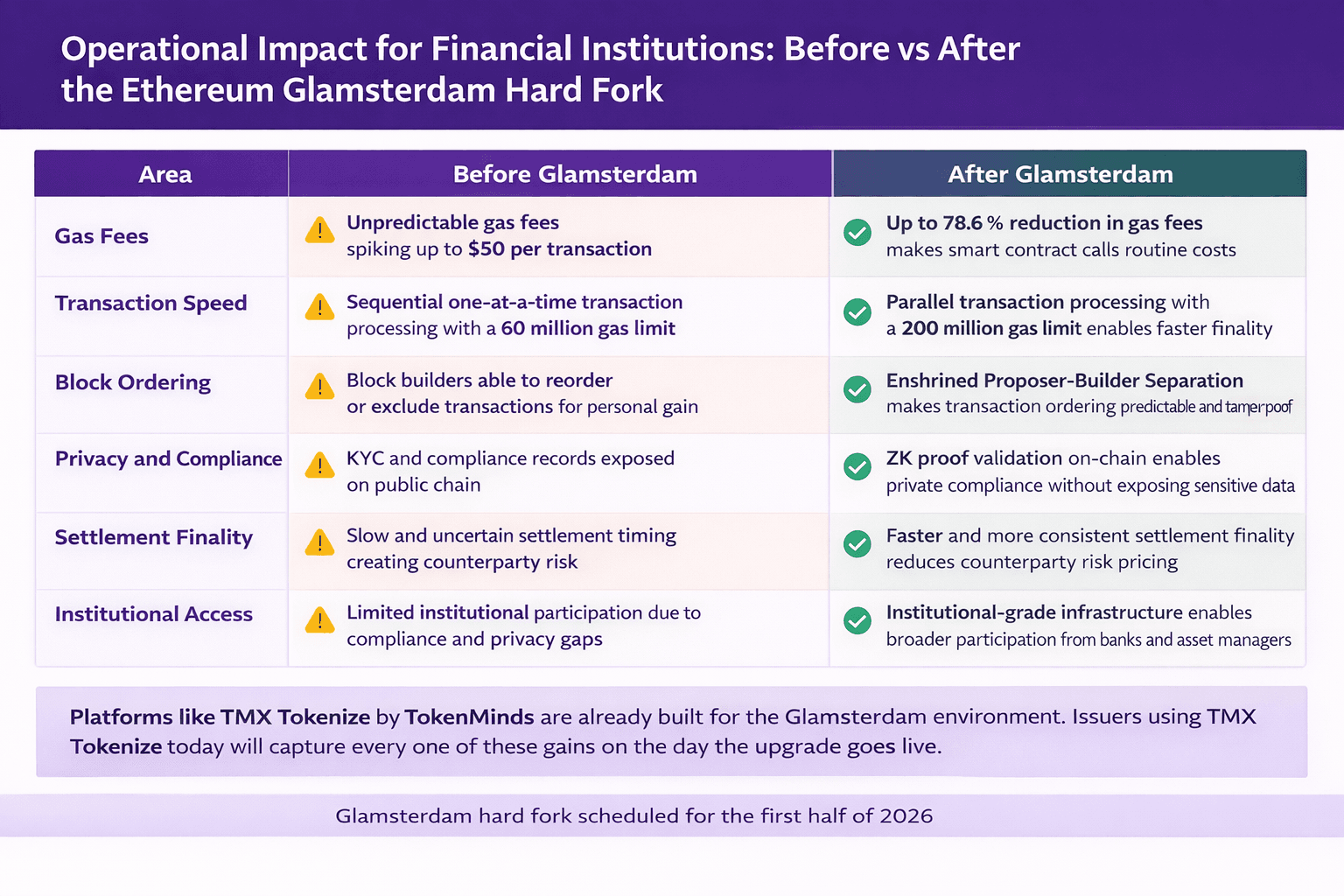
For example, a fund distributing dividends to 10,000 investor wallets could spend hundreds of thousands of dollars per year in transaction fees depending on gas prices. If gas costs drop by about 78.6 percent, as suggested in early Ethereum protocol research simulations, that annual cost could fall to roughly $50,000.
This means the fund saves close to $190,000 per year. For asset managers running frequent payouts, capital calls, or redemptions, this can significantly reduce fund administration costs.
Table: Operational Impact (Before and After)
Institutional Settlement Flow with TMX Tokenize
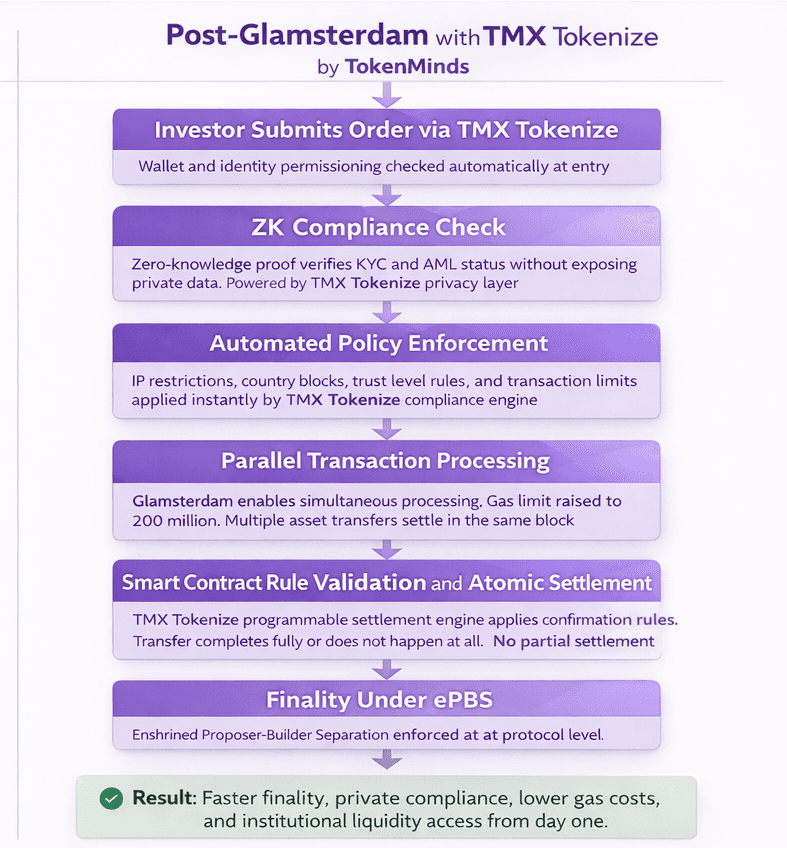
The upgrade also improves how institutional transactions move through the system. Using TMX Tokenize, the settlement process can follow a clear automated workflow.
Investor submits order
→ Zero knowledge compliance check verifies KYC and sanctions rules
→ Smart contract validates asset and investor permissions
→ Atomic settlement executes payment and asset transfer
→ Transaction finality is secured through Ethereum block confirmation
This step-by-step process helps institutions run compliant and automated settlements on-chain.
Confirmed Upgrades vs Expected Performance
Some improvements in the upgrade are confirmed protocol changes, while others are projected performance targets.
For example, early research suggests gas fees could drop by up to 78.6 percent. Some projections also estimate that Ethereum throughput could reach around 10,000 transactions per second at the base layer in the future.
However, these numbers depend on final testing and implementation. Actual results may vary based on client software, validator adoption, and real network conditions.
Because of this, performance estimates should be viewed as projections and remain subject to final testnet validation and client benchmark results.
Conclusion
Glamsterdam is not hype. It cuts gas fees. It speeds up settlement. It makes block production fair. It brings private compliance to the base layer.
For institutions that tokenize real-world assets, each of these changes lowers costs and reduces risk. The institutions that gain the most will be the ones already running on the right infrastructure when the upgrade goes live.
Glamsterdam activates in the first half of 2026. The platform to capture it is available now.
FAQ
What is an Ethereum hard fork?
An Ethereum hard fork is a major software update to the Ethereum network. It changes the rules of how the blockchain works. Everyone who runs Ethereum software must upgrade to the new version, or they will stay on the old chain.
When is the next Ethereum hard fork scheduled?
The next Ethereum hard fork is expected in 2026. The exact date depends on testing and developer readiness. Ethereum upgrades usually happen after months of testing to make sure everything runs safely.
Will the 2026 Ethereum hard fork reduce gas fees?
The 2026 hard fork is expected to help improve how transactions are processed. This can make gas fees more stable and easier to predict. However, fees may still change depending on network demand.
What is ePBS in Ethereum?
ePBS stands for enshrined Proposer Builder Separation. It is a system that separates the role of building blocks from proposing them. This helps make Ethereum more secure and reduces the risk of unfair block ordering.
How do zero-knowledge proofs work on Ethereum?
Zero-knowledge proofs let someone prove something is true without sharing all the details. On Ethereum, this helps make transactions faster and more private. It also allows scaling solutions to process more transactions at lower cost.
Do institutions need to upgrade for a hard fork?
Yes. If an institution runs its own Ethereum node, it must upgrade the software before the hard fork. If it uses a third-party provider, the provider usually handles the upgrade, but institutions should still confirm everything is ready.