TL;DR
Waitlists, quests, and allowlists indicate interest, but do not ensure purchases or mints. There are four conditions for conversion: qualification, allocation, wallet readiness and timing. Waitlists can be used to identify who is on the list, quests can be used to score intent, and allowlists can be used to guide approved users. By monitoring indicators such as verified user percentage, quest completion quality, wallet ready percentage, and completed purchases or mints, teams can identify areas of improvement and optimize their funnel. This article explains how teams convert early engagement into purchases or mints.
Definition of Waitlists, Quests, and Allowlists in a Token Sale Context
Token sale teams use waitlists, quests, and allowlists for different jobs. Each mechanism supports acquisition. Each mechanism also needs a conversion role.
Waitlist
A waitlist is a list of users who want early access. It collects interest before a token sale or mint opens. However, a waitlist does not prove purchase intent.Quest:
A quest is a task that users complete before access. It can test product interest, community activity, or wallet readiness. A strong quest shows more than basic campaign participation.Allowlist:
An allowlist is a selected group approved for access. It controls who can buy or mint during the sale window. It should also explain eligibility, allocation, wallet rules, and timing.
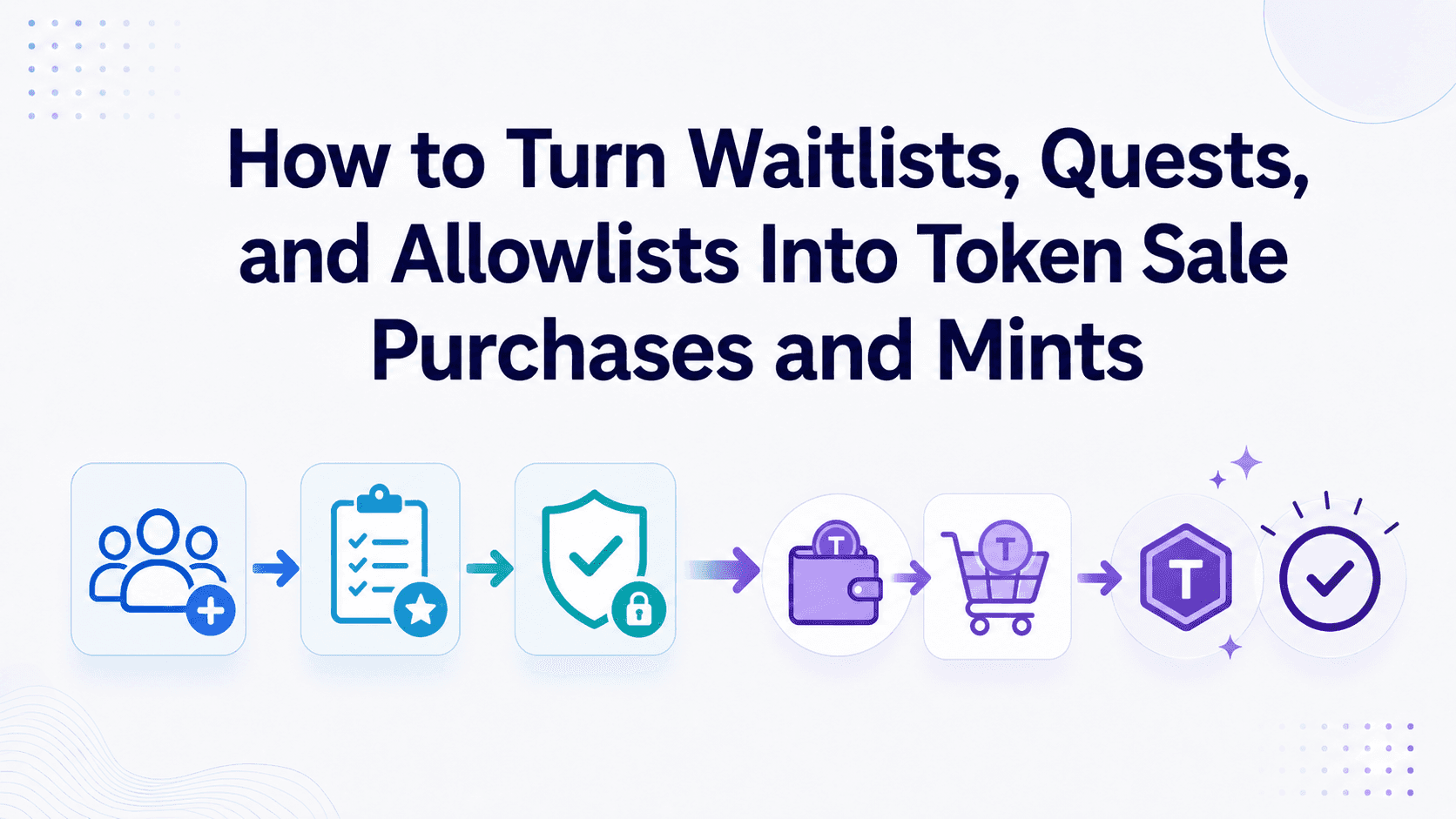
These three tools shape the token sale conversion path. Waitlists collect demand. Quests help teams qualify that demand. Allowlists turn qualified users into approved participants. Conversion starts when approved users understand their allocation, prepare their wallet, and act inside the purchase or mint window.
Why Waitlists, Quests, and Allowlists Often Fail to Convert
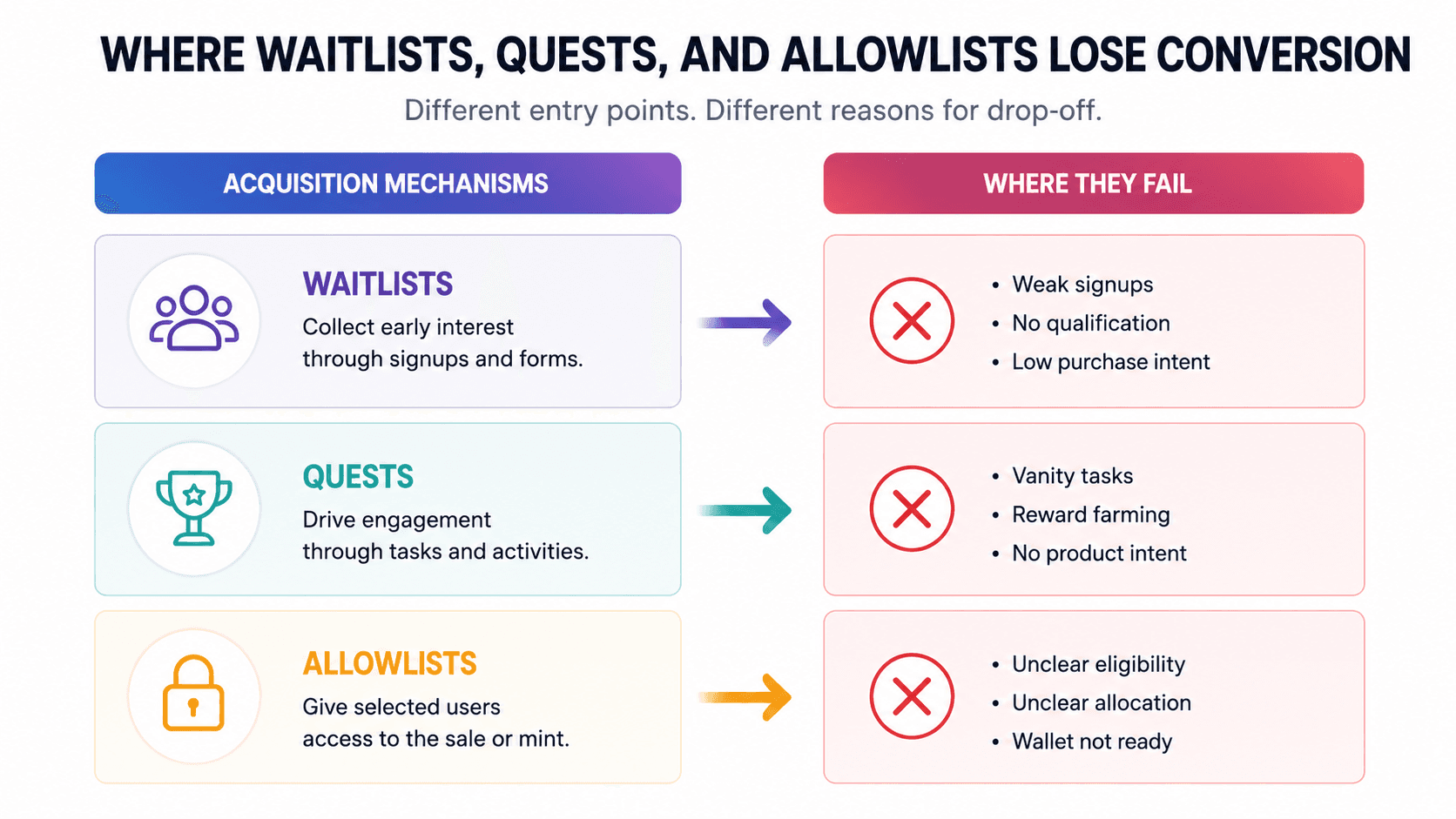
Waitlists, quests, and allowlists are key acquisition mechanisms. They capture interest and participation, but they do not guarantee purchases or mints. Users often drop off before completing a token sale because next steps are unclear. For wallet-specific drop-off issues, read the guide on reducing onboarding friction before a token sale.
Diagnosis of The Causes of Token Sale Conversion Failures
Waitlists Fail When Signups Stay Unqualified
A waitlist is only the first contact point for a token sale. It shows who wants access, not who is ready to buy. Common gaps include:
Weak signups
Users often join with minimal effort or just out of curiosity.No qualification
For a token sale, teams need signals to identify serious users.Low purchase intent
Users may want updates or early access but not plan to act.
Quests Fail When Activity Becomes Vanity Engagement
Quests are designed to test engagement, but they fail when activity does not correlate with purchase intent:
Vanity tasks
Low-effort actions, like follows or likes, do not indicate readiness.Reward farming
Users chase rewards rather than completing meaningful product actions.No product intent
Participation does not demonstrate wallet readiness or token interest.
Allowlists Fail When Access Does Not Lead to Action
Allowlists give permission to participate but do not enforce conversion:
Unclear eligibility
Users may not understand which tokens or mints they can access.Unclear allocation
Users may not know their limits or tiers.Wallet not ready
Incorrect wallets, insufficient funds, or network issues can block participation.
CoinList notes that whitelist size affects conversion. A loosely defined whitelist may convert only 5 to 10%. A smaller selective whitelist may reach 50 to 70% participation. This point matters for token sale teams. Bigger lists can look stronger in reports. Smaller qualified lists can perform better during purchase or mint windows.
Conversion Friction Moments in a Token Sale Funnel
Even when the campaign structure looks correct, conversion can still break at several points. These friction moments help teams map where drop-offs happen and see where users hesitate or fail to act.
1. Signup friction
Users can join a waitlist with very little effort. That makes early demand easy to inflate. It also means many signups may have low commitment from the start.
2. Quest friction
Users may not understand why a task matters. If the quest feels random or too promotional, it becomes harder to connect activity with real token sale intent.
3. Allowlist friction
Users may not understand whether they are approved, what they can access, or how much they can buy or mint. Confusion at this stage often weakens action.
4. Wallet friction
A user may qualify but still fail to complete the transaction. Common issues include wrong wallet connection, missing gas, insufficient funds, or network mismatch.
5. Timing friction
Users can miss the purchase or mint window. This often happens when reminders are weak or deadlines are not communicated clearly.
6. Trust friction
Some users hesitate even when they are ready. They may worry about scams, fake links, failed transactions, or unclear sale instructions.
This friction map gives teams a clearer operating view. It shows not only what the funnel includes, but also where conversion starts to weaken.
How Education Turns Waitlist Interest Into Sale Readiness
Token sale conversion often breaks when users lack clear education. Teams should explain rules, allocation, wallet setup, funding, deadlines, and scam risks. This guidance turns early interest into sale-ready action.
Below are the key educational items that need to be prepared:
Sale rules
Sale rules enable users to understand participation requirements. This way, users know who can participate.Allocation explanation
Explaining allocation enables users to understand limits and tiers. This ensures expectations are clear before the sale or mint.Wallet setup guide
Wallet setup guidance ensures users prepare the correct wallet. This prevents errors during purchase or mint.Funding instructions
Providing funding instructions helps users avoid failed transactions due to insufficient funds or gas.Deadline reminders
Timing reminders ensure users act inside the sale or mint window, reducing drop-offs.Scam warnings
Educating users about scams prevents engagement with fake links or phishing attempts.
How Teams Turn Waitlists, Quests, and Allowlists Into Token Sale Purchases and Mints
This section outlines the steps teams need for a practical conversion path. We utilize these three mechanisms in sequence. Teams should guide users from interest to final action with clear operational steps.
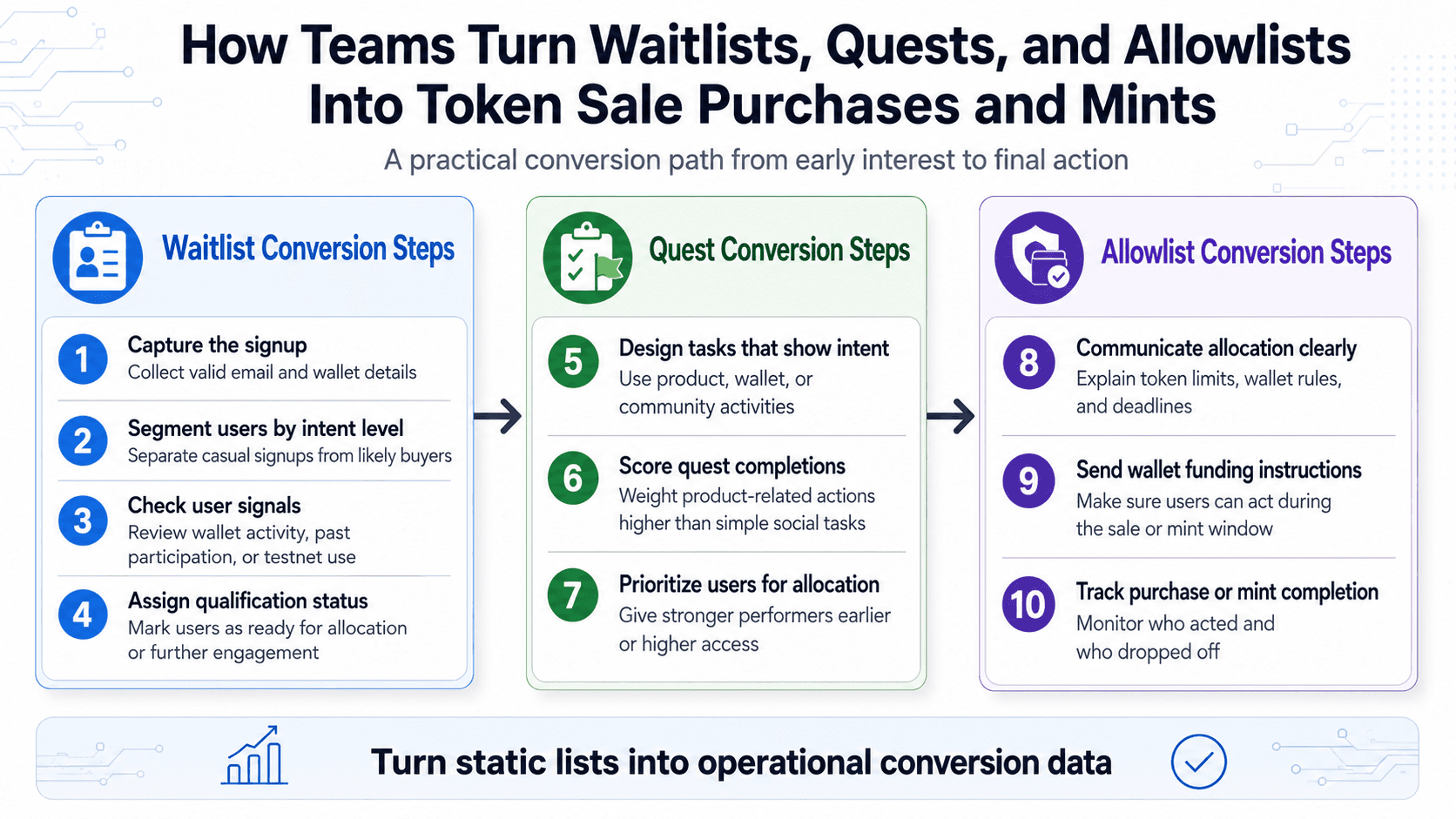
Waitlist Conversion Steps
Capture the signup: Collect valid email and wallet information.
Segment users by intent level: Separate casual signups from likely buyers.
Check user signals: Review wallet activity, past participation, or testnet use.
Assign qualification status: Mark users as ready for allocation or further engagement.
Quest Conversion Steps
Design tasks that show intent: Product, wallet, or community activities.
Score quest completions: Weight product-related actions higher than simple social tasks.
Prioritize users for allocation: Stronger performers receive early or higher access.
Allowlist Conversion Steps
Communicate allocation clearly: Explain token limits, wallet rules, and deadlines.
Send wallet funding instructions: Ensure users can act during the sale or mint window.
Track purchase or mint completion: Monitor who acted and who dropped off.
Following these steps, token sale teams can turn static lists into operational data. The team can see who joined, qualified, prepared, and completed the purchase or mint. It also provides clarity on where users may need reminders or support
Teams should also filter for bots and Sybil users before allocation to maintain whitelist quality and improve conversion. Read the guide about operational methods for verifying real users in token sales not bots and Sybil here.
How Lifecycle Reminders Increase Token Sale Conversion
Token sale teams can use reminders to reduce drop-offs and guide users toward purchase or mint completion. A lifecycle reminder strategy operationalizes follow-up at every critical point.
Timing | Reminder | Example Action |
72 hours before | Wallet funding reminder | Prompt users to prepare funds and gas for the sale/mint |
24 hours before | Allocation confirmation | Notify users of approved allocation and sale window |
Sale open | Direct purchase link | Provide easy access to the token or NFT purchase page |
Failed transaction | Retry guidance | Inform users of errors and provide instructions to retry |
Post-mint | Confirmation | Send a summary of completed purchase or mint |
How Teams Build Allocation Criteria From Real User Signals
Once a user is prepared to purchase or mint, the next step is allocation. Turning interest into action is only part of the story. Teams must decide how much each user can access and when, based on signals that indicate real intent and readiness.
Allocation should not depend solely on signup order. It should reflect user quality and campaign goals.
CoinList notes that builders may identify loyal users through on-chain activity, transaction history, transaction size, testnet participation, and community engagement across multiple touchpoints. These signals help teams separate stronger users from casual signups.
Signal | Weak signal | Stronger signal |
Wallet activity | Empty new wallet | Relevant on-chain activity |
Testnet use | No product action | Completed testnet flow |
Community role | Passive member | Helpful contributor |
Quest activity | One social task | Product-related completion |
Verification | Unverified signup | Verified wallet and email |
The goal is better allocation quality. A first-time user may still deserve access. That user should show clear intent through education, verification, and wallet readiness.
How Quests Turn Into Mint or Token Sale Participation
Quests become meaningful conversion signals when teams design them to qualify users, not just inflate engagement numbers. Low-effort tasks, like a social follow, can support awareness but do not indicate readiness to purchase or mint.
Stronger quests guide users to learn, test, verify, or prepare. These actions help teams identify serious participants and help users understand the sale or mint process.
User type | Quest behavior | Allocation treatment |
Passive signup | Joins waitlist only | Low priority |
Social participant | Completes basic tasks | Basic access |
Product tester | Completes product tasks | Higher priority |
Verified contributor | Shows repeated useful activity | Stronger allocation |
Best practice: Each quest should clearly connect to eligibility or allocation. Users should understand how their participation influences access or priority in the token sale.
How Allowlists Should Support Token Sale Purchase and Mint Conversion
An allowlist gives qualified users permission to act, but teams must guide them clearly. An effective allowlist answers five key questions:
Who is eligible?
What can each user purchase or mint?
Which wallet must be used?
When does access open?
What happens if a user misses the window?
CoinList data shows whitelist quality affects conversion: a broad whitelist may convert only 5–10% of users, while a smaller selective whitelist can reach 50–70% participation.
Key points for teams:
A larger allowlist may look good in reports but underperform during the actual sale.
A tighter allowlist improves focus, reminders, and allocation clarity.
Avoid arbitrary exclusion. Allocation should match campaign goals, user intent, and readiness.
Takeaway: Quests help qualify users, allowlists give approved access, and both ensure users can act efficiently during the token sale or mint window.
Token Sale and Mint Conversion Path From Signup to Completion
A token sale team should guide users through every stage of the conversion funnel. Each step connects waitlists, quests, and allowlists to actual purchases or mints.
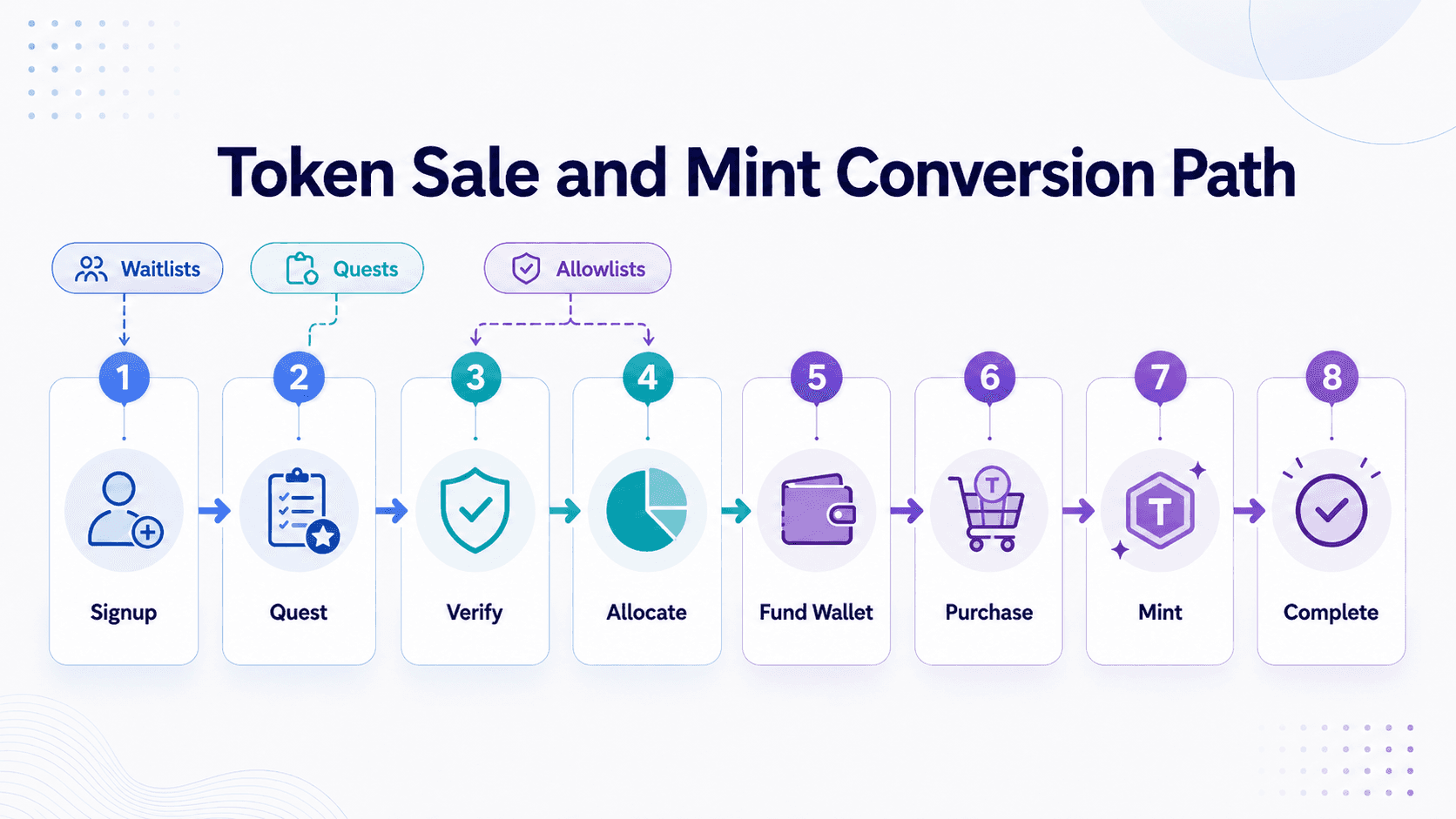
Signup: Capture Early Interest
Users join the waitlist. Teams collect clean email and wallet data to verify participants and prepare for follow-up.Quest Completion: Assess Engagement
Users complete quests. Teams score task quality to determine intent. Product- or wallet-related tasks indicate higher readiness for allocation.Verification: Confirm User Identity and Wallet
Users verify their wallet and email. Teams remove weak or duplicate entries to ensure only qualified users proceed.Allocation: Assign Access and Limits
Teams approve users for purchase or mint access. Clear instructions include token or NFT allocation, wallet requirements, and timing.Readiness: Ensure Wallet Funding
Users prepare their wallets with sufficient funds or gas. Teams send clear guidance to prevent transaction errors.Purchase: Execute Token Sale
Users initiate purchases. Teams track successful transactions and monitor for failed attempts.Mint: Complete Token or NFT Acquisition
Users mint the token or NFT. Teams track completion and ensure proper recording in the system.Completion: Confirm and Follow Up
Users confirm their transaction. Teams send next-step communications or reminders for additional steps, if any.
What Token Sale Teams Should Track From Waitlist to Purchase or Mint
Token sale teams should track conversion, not just activity, to find real bottlenecks in the funnel.
Metric | Description | Benchmark / Insight |
Waitlist signup rate | Number of users joining the waitlist | Operational metric; varies by campaign |
Verified user rate | Users with verified wallet and email | Operational metric; ensures quality of potential participants |
Quest completion quality | Weighted score of tasks completed | Operational metric; indicates user engagement and intent |
Allowlist conversion | Percentage of allowlisted users who complete purchase or mint | 5–10% for broad lists, 50–70% for selective lists (CoinList) |
Wallet-ready rate | Users with funded and ready wallets | Operational metric; ensures technical readiness |
Purchase attempt rate | Users initiating a purchase | Operational metric; shows engagement and action intent |
Failed transaction rate | Transactions that did not complete | Operational metric; indicates UX, wallet, or network friction |
Completed purchase / mint rate | Users who successfully purchased or minted | Operational metric; final conversion outcome |
Plan a Waitlist-to-Conversion Sprint with TokenMinds
TokenMinds helps token sale teams review qualification rules, quest scoring, allowlist criteria, wallet readiness, lifecycle reminders, and purchase flow.
Plan a Waitlist-to-Conversion Sprint with TokenMinds. The sprint identifies where users drop off before the sale or mint window. It also gives teams a clearer action plan for improving completed purchases or mints.
FAQs
Why do allowlist users fail to convert?
Users may not understand allocation, miss deadlines, or have unprepared wallets. Clear instructions and reminders improve conversion.How do token sale teams improve mint participation?
Teams should qualify users, provide allocation clarity, ensure wallet readiness, send reminders, and monitor for drop-offs.What makes a high-quality token sale waitlist?
Verified users, strong engagement signals, wallet readiness, and meaningful participation in quests indicate high-quality waitlists.How do quests qualify users for token sales?
Quests show intent through product actions, wallet preparation, and community engagement. Task quality helps prioritize allocation.How can teams reduce failed mint transactions?
Ensure wallet readiness, sufficient funds and gas, clear instructions, retries for errors, and timely reminders during the mint window.