Web3 & AI

SOLUTIONS

Products

Services

Web3 & AI

SOLUTIONS

Services

Products

Industries

Become Our Client

About Us

Resources

Web3 & AI

SOLUTIONS

Services

Products

Industries

How to Grow Your Web3 User Base with GEO

How to Grow Your Web3 User Base with GEO

Written by:

Written by:

Feb 27, 2026

Feb 27, 2026

Key Takeaways

  • AI engines like ChatGPT, Perplexity and Gemini each pull from different sources; Reddit, Wikipedia and brand-owned content, this makes multi-platform authority strategy essential.

  • Content structured with direct answers in the first two sentences is more likely to be cited by AI, making answer-first formatting important for GEO visibility.

  • AI-cited content is 25% fresher than traditional ranked content, which means outdated pages and documentation reduce your chances of being recommended.

Paid ads, KOLs, and community campaigns are still important for Web3 growth. They help create awareness and bring in new users. But the way people discover projects is changing. More users now rely on AI tools to find answers and compare options.

GEO adds a long term discovery layer on top of your existing marketing. It does not replace ads or KOLs. It makes sure your project continues to be found, even when campaigns slow down, a shift executed in this GEO visibility strategy.

Short-term spikes usually do not lead to long term token growth. Strong token value comes from real network effects like: real users, real use cases and steady discovery over time. If your user base doesn’t keep growing consistently, then demand for your token will never grow either.

There is a second problem most projects miss completely. The way people discover Web3 projects is changing. People used to Google things. Now they ask AI. They type into ChatGPT. They search on Perplexity. They ask Claude. They get an answer right there. They do not click through ten links. They trust the answer they get.

Insightland report shows 58% of users have already replaced traditional search engines with AI-driven tools for product and service discovery. AI platforms generated 1.13 billion referral visits in June 2025, a 357% increase from June 2024.

If someone asks ChatGPT "what is the best Web3 project for tokenized real estate" and your project is not in that answer, you do not exist to that person. It does not matter how good your Discord is. It does not matter how many Twitter followers you have.

This is the discovery gap. And most Web3 communities are falling into it without knowing it. GEO implementation fixes this.

What Is GEO?
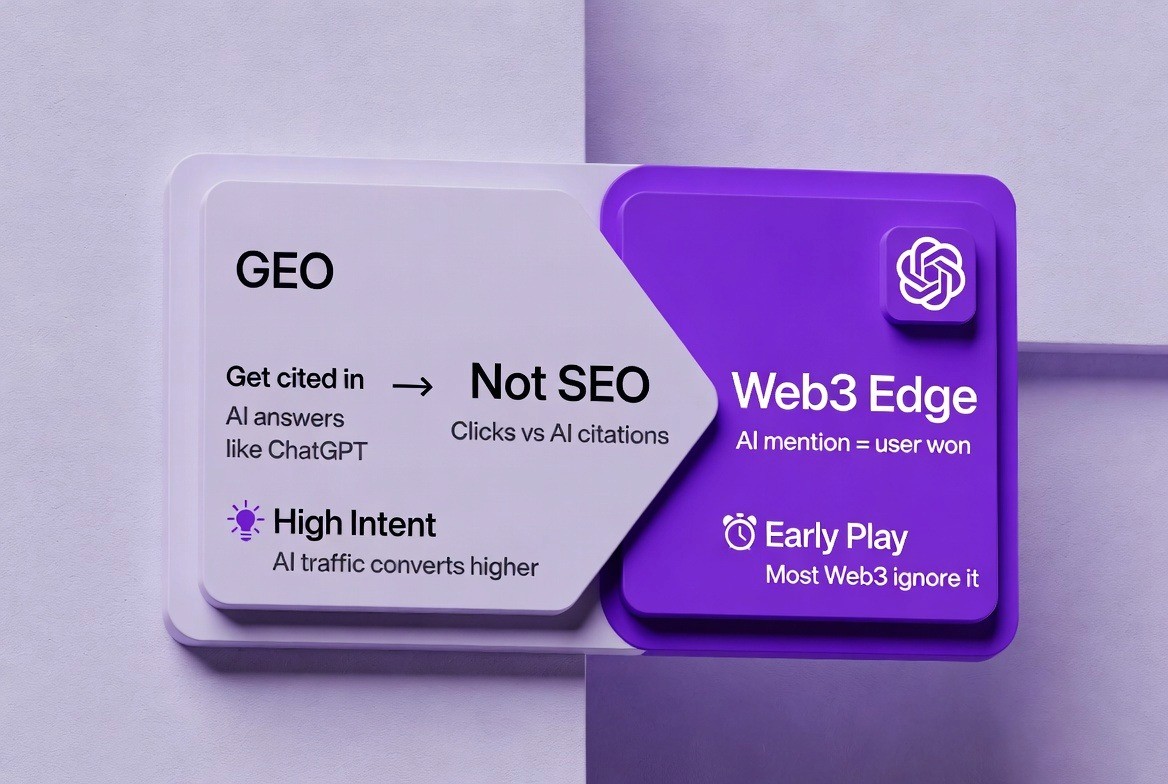
GEO stands for Generative Engine Optimization. It is the practice of structuring digital content and managing online presence to improve visibility in responses generated by generative AI systems. Based on Princeton University research, GEO focuses on influencing the way large language models such as ChatGPT, Google Gemini, Claude, and Perplexity retrieve, summarize, and present information in response to user queries.

Think of it this way. Traditional SEO tries to get you to the top of Google. GEO tries to get you into the answer AI gives before Google even shows up, a competitive edge developed in this crypto GEO model.

SEO fights for clicks. GEO competes for citations by AI that answers on behalf of the user. The user asks a question, and the AI provides a ready answer, often without visiting any website. 

For Web3 projects, this is the difference between being discovered and being invisible. When someone asks an AI tool about DeFi protocols, tokenized assets, Layer 2 networks, or crypto wallets, the projects that show up in that answer get the community member. The ones that do not show up get nothing.

AI traffic drives 12.1% more signups, despite making only 0.5% of all visitors. LLM traffic converts at higher rates than organic traffic, with ChatGPT at 15.9% and Perplexity at 10.5%. 

This is the highest-quality discovery traffic available today. And almost no Web3 project is optimizing for it.

The GEO Strategy to Grow Web3 User base

GEO is not one tactic. It is a framework of five strategies that work together. Each one builds on the last. Together they turn your project into the answer AI gives when people search for what you do.

Strategy 1: Become the Answer, Not the Link
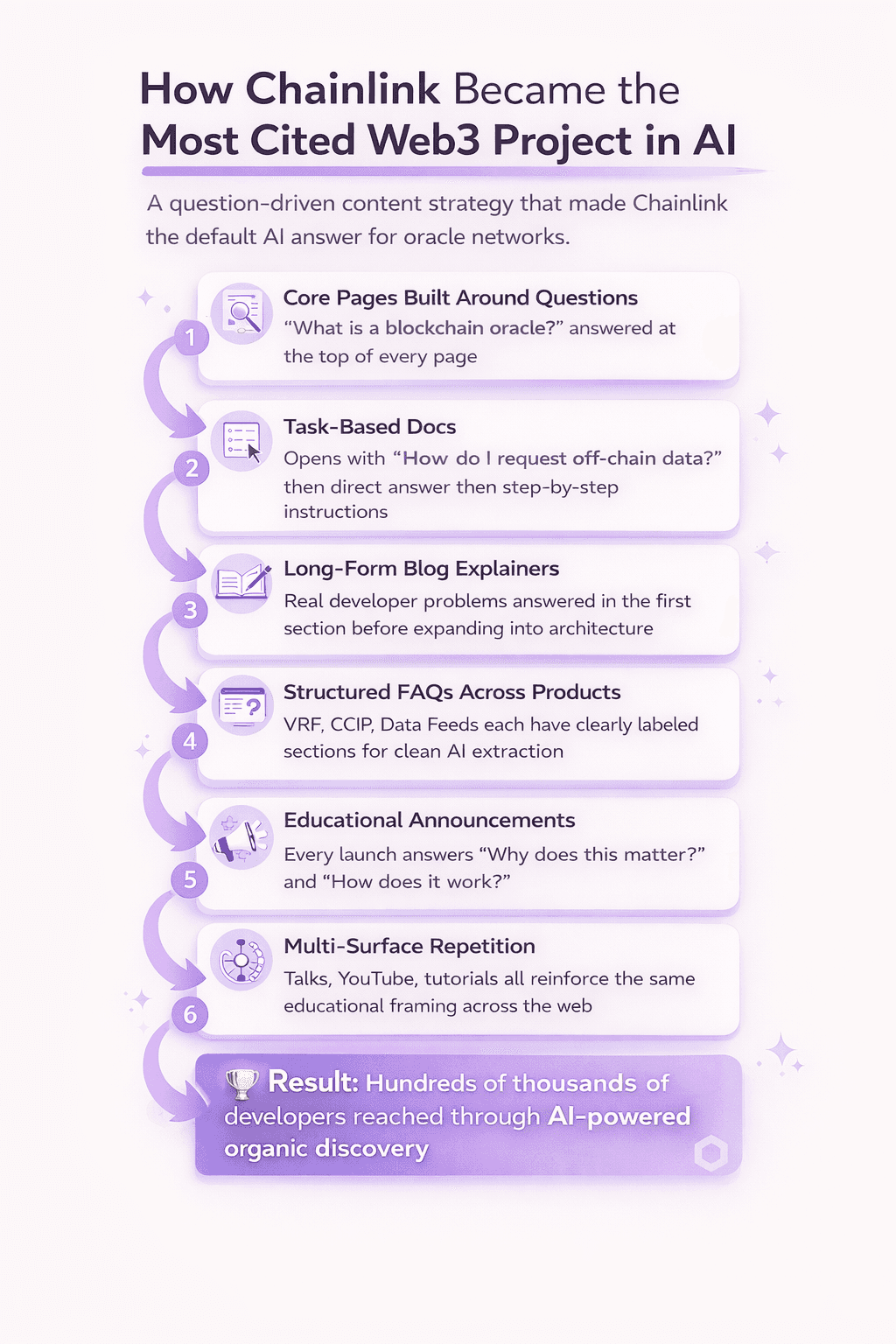
Most Web3 content is written to rank on Google. It targets keywords. It stuffs headers. It chases backlinks. This does not work on AI engines. AI engines do not care about keyword density. They care about whether your content directly answers a real question.

  • Content with clear questions and direct answers is 40% more likely to be rephrased by AI tools like ChatGPT. 

  • Structured content such as headings, lists, and FAQ is the most effective format in AI search.

  • 44.2% of all LLM citations come from the first 30% of text. 

For Web3 projects, this means rewriting your core content around the questions your potential users are actually asking. 

  • Not "Layer 2 scaling solution" but "How do I send ETH without paying high gas fees?" 

  • Not "tokenized real estate protocol" but "How do I invest in real estate using crypto?" 

  • Not "decentralized oracle network" but "How does a smart contract know the price of Bitcoin?"

Every major section of your website, your documentation, your blog, and your social content should be built around a real question and a direct answer. The answer should be in the first two sentences. This is how AI engines extract and cite your content.

Strategy 2: Build Authority Where AI Looks
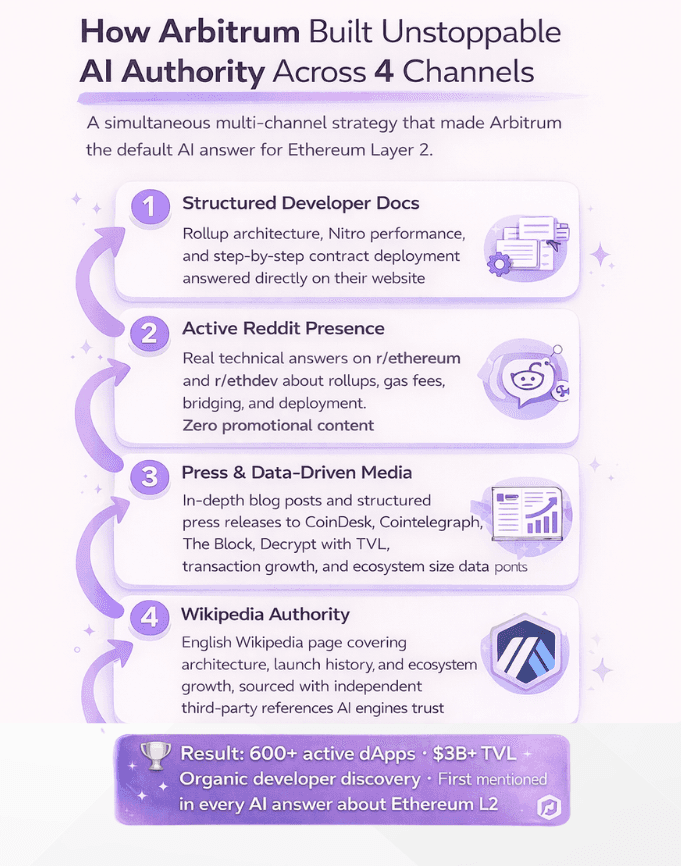
AI engines do not cite every website equally. They have strong preferences for where they pull information from. 

  • Wikipedia is the most cited source in ChatGPT at 7.8% of citations, followed by Reddit at 1.8%. 

  • Wikipedia and Reddit are among the most frequently cited domains across AI Overviews, AI Mode, and ChatGPT. 

  • Perplexity shows a strong preference for Reddit, which dominates its citations at a significant share of top sources.

This tells Web3 projects exactly where to build authority. It is not just your website. It is the platforms AI engines trust most.

There are four places that matter most for Web3 GEO authority.

  1. Reddit

Your project needs active, helpful presence on relevant subreddits. Not promotional posts. Real answers to real questions from users  who genuinely know what they are talking about. When a Redditor asks "what is the best protocol for tokenizing real estate" and a knowledgeable member gives a detailed, honest answer that mentions your project, Perplexity reads that. It gets cited. That answer becomes part of how AI thinks about your project.

  1. Wikipedia

If your project is significant enough, a Wikipedia page is one of the most powerful GEO assets you can have. ChatGPT cites Wikipedia in nearly 1 in 13 responses. A clear, factual, well-sourced Wikipedia page about your protocol, your technology, or the problem you solve puts you directly in the pool of sources AI reaches for most often.

  1. Your own documentation and blog

Detailed, well-structured technical documentation is one of the most cited content types in AI responses to developer questions. If your docs are comprehensive, clearly organized, and answer specific questions, AI engines pull from them constantly.

  1. Third-party coverage

A Princeton study shows that AI engines strongly favor earned media, authoritative third-party sources, over brand-owned content. Press coverage on CoinDesk, Cointelegraph, The Block, Decrypt, and mainstream outlets like Forbes gives AI engines independent verification that your project is real and credible.

Strategy 3: Earn Citations Through Community Expertise
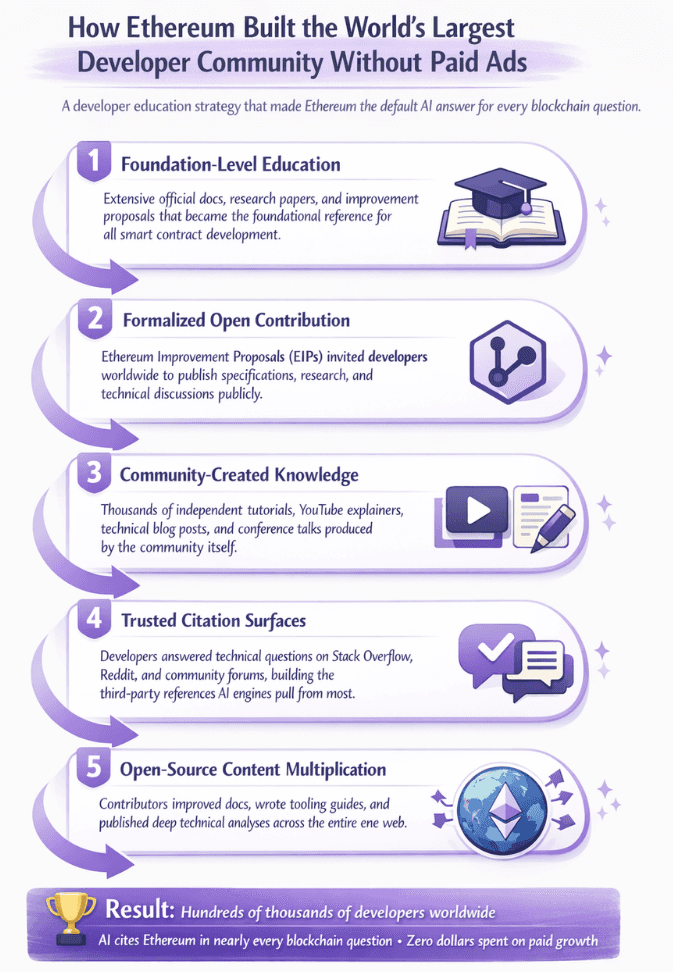
The fastest way to get AI engines to cite your project is to have real users  creating real, expert content about it. This is not paid content. It is not an influencer post. It is genuine expertise from people who use and build your protocol.

  • Coverage from credible third-party outlets may increase the likelihood of being cited in AI-generated responses. 

  • The same is true for community-generated content on platforms AI trusts. When your developers write deep technical threads on X, post detailed tutorials on Medium, answer questions on Stack Exchange, and contribute to Reddit discussions, they are creating the citation surface that AI engines draw from.

This is why the quality of your users matters more than the size. A community of 500 serious developers who write technical content, answer questions, and contribute to forums will generate more AI citations than a community of 50,000 passive Discord members who joined for a giveaway.

For Web3 projects, the strategy is to actively support and amplify community expertise. Create a program that rewards members for writing tutorials, answering forum questions, creating explainer content, and contributing to documentation. These contributions directly build your GEO footprint.

There is another powerful lever here: YouTube. YouTube dominates AI search citations and shows up disproportionately in AI answers across platforms.

Strategy 4: Stay Fresh and Stay Up-to-Date
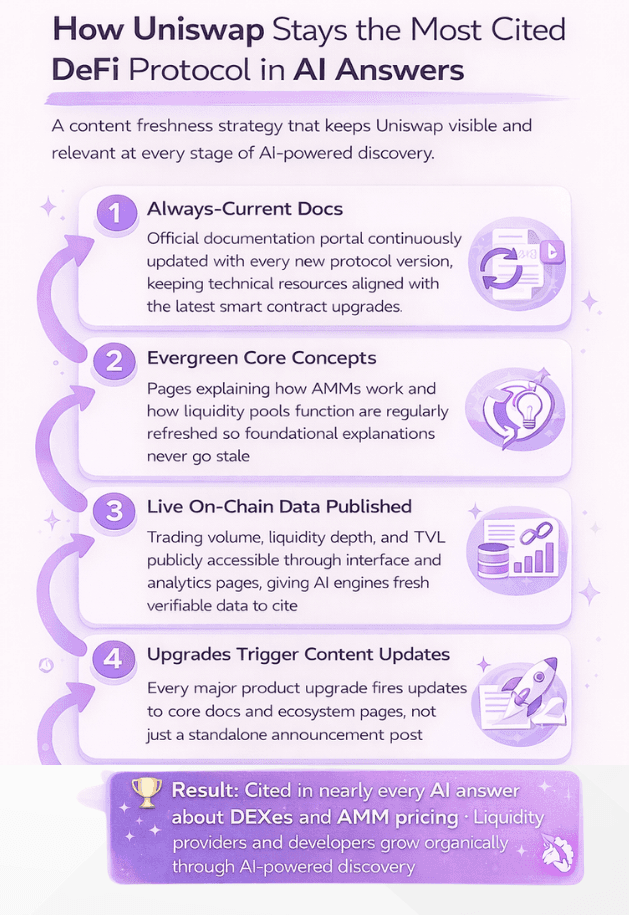
AI engines heavily favor recent content. Ahrefs analyzed 17 million citations across AI platforms and found that AI-cited content is 25.7% fresher than traditionally ranked content. Content updated within the last 30 to 90 days is cited significantly more often than older pages.

For Web3 projects, this means stale content is actively working against you. A blog post about your protocol from 18 months ago with no updates is not helping your GEO. It may be hurting it. AI engines interpret outdated content as less reliable.

The GEO strategy here is to treat your core content as living documents. 

  • Your main protocol explanation page should be updated regularly. Your documentation should reflect the current version. Your FAQ should include questions people are asking right now. Every major product update should generate a content update on your core pages, not just an announcement post.

  • There is a specific tactic that works especially well for Web3 projects: data pages. If your protocol publishes regular on-chain data, transaction volumes, TVL figures, or network statistics, turn those into regularly updated pages. AI engines love current data because it is the kind of factual, verifiable content they prefer to cite. A page that updates your network metrics monthly is an AI citation magnet.

Strategy 5: Shape the AI's Understanding of Your Category
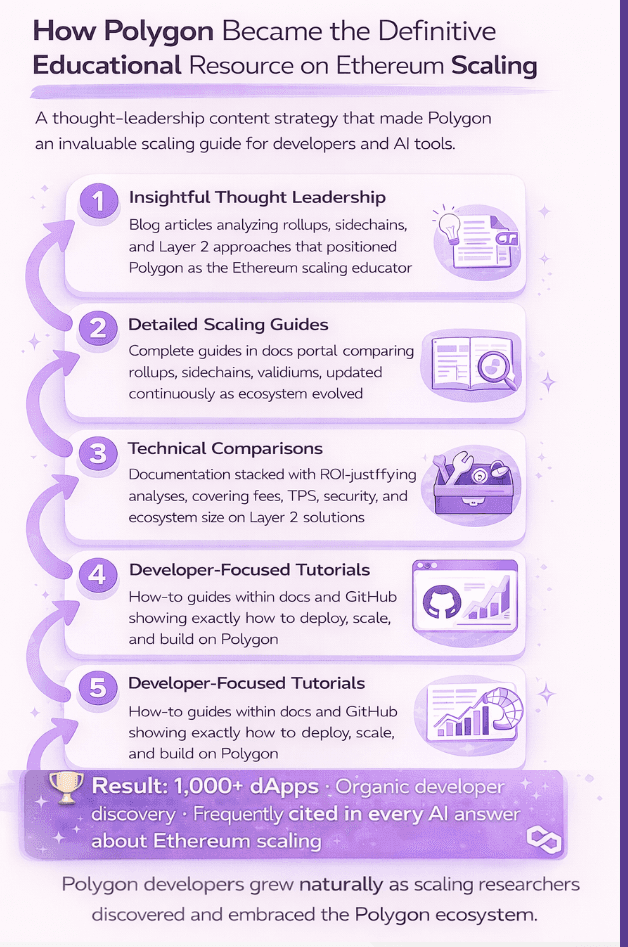
The most advanced GEO strategy is not just getting cited. It is defining how AI engines understand the category you operate in. This is where the biggest Web3 communities are built. Not by being mentioned in an answer. By being the frame through which the answer is given.

This works through what GEO researchers call authority clustering. You publish content that does not just explain your project. It explains the entire problem space your project operates in. You become the reference point for the category itself.

For example, if your project does real-world asset tokenization, you should not only have content about your own platform. You should have the most comprehensive, most cited content on the web about what asset tokenization is, how it works, what problems it solves, what regulations apply, and how institutions are approaching it. When AI engines learn about this category, they learn it through your content. Your project becomes inseparable from the category in AI's understanding.

Original research, proprietary data, and expert commentary attract citations. If you publish something no one else has, a benchmark study, a unique dataset, or a framework built from your experience, AI engines have a reason to cite you over a dozen lookalike alternatives.

  • For Web3 projects, this means publishing original research about your ecosystem. 

  • State of the network reports. Developer surveys. On-chain data analysis. 

  • Market size estimates for the problem you solve. 

These become reference documents that AI engines pull from constantly because no one else has the data.

How to Measure GEO Progress for Your Web3 User Base

GEO success is not measured by website traffic alone. A project can gain thousands of new users from AI citations without ever seeing a spike in traditional traffic metrics. You need different signals.

There are four things to track.

  1. AI citation frequency: Run weekly manual checks on ChatGPT, Perplexity, and Google's AI Overviews using the questions your potential users would ask. Log whether your project appears, which content is cited, and which competitors show up instead. This is your baseline and your weekly scoreboard.

  2. Community source tracking: Ask new Discord and Telegram members how they found the project. Add this as a standard onboarding question. When members say they found you through ChatGPT or Perplexity or "just Googling and an AI answered," those are GEO conversions. Track them.

  3. Referral traffic from AI platforms: In GA4, create a custom AI/LLM traffic channel grouping that buckets referrals from chatgpt.com and perplexity.ai. This traffic is small today but converts significantly better than standard organic search traffic. Even a small number of AI referral visitors joining your community represents high-quality, high-intent members.

  4. Brand search volume: When AI engines mention your project in answers, people who have never heard of you start searching for your name directly. Rising branded search volume is a strong signal that AI visibility is converting into community awareness.

The GEO Community Growth Stack

Here is the complete stack in practical terms. These are the things a Web3 project needs to have in place to execute GEO-driven community growth.

A question-first content library covering the twenty most common questions people ask about the problem your project solves. Each piece is written for AI extraction. Direct answers first, detail second, project mention woven in naturally.

Active Reddit presence on the three to five most relevant subreddits. Not promotional. Expert answers from real users that reference your project honestly when it is genuinely the right answer.

A structured Wikipedia page covering your protocol, your technology category, and the problem you solve. Factual, sourced, and maintained.

Documentation that answers developer questions directly. Structured with clear headings, step-by-step instructions, and code examples that AI engines can extract as standalone answers.

A community content program that rewards members for creating tutorials, YouTube explainers, forum answers, and written guides. Every piece of community content expands your citation surface.

Original research published at least twice a year. On-chain data analysis, state of the network reports, developer surveys. Something no one else has that AI engines will cite because it is the only source.

Regular content refreshes. Core pages updated at least monthly. Protocol stats kept current. Documentation version-matched to the live protocol.

What Each AI Engine Favors: The Web3 Citation Cheat Sheet

Not all AI engines pull from the same sources. Optimizing for one and ignoring the others means leaving users on the table. These models aren't just different tools. Their distinct citation behaviors reveal different approaches to trust and authority. Broadly speaking: Gemini trusts what your brand says. ChatGPT trusts what the internet agrees on. Perplexity trusts industry experts and real-time sources.

Here is what that means in practice for Web3 projects.

AI Engine

Primary Trust Signal

Top Citation Sources

What Web3 Projects Should Do

ChatGPT

What the internet agrees on at scale

Wikipedia, mainstream press, broadly linked domains

Build a Wikipedia page. Get covered by CoinDesk, Cointelegraph, Forbes, The Block. Make sure your project appears consistently across many independent sources.

Perplexity

Fresh, expert, real-time sources

Reddit, niche industry directories, recently updated pages

Post expert answers on r/ethereum, r/defi, r/web3. Update core pages monthly. Perplexity pulls 21+ citations per answer vs ChatGPT's 8, so comprehensive content has more surface area to win.

Google AI Overviews

Traditional Google signals plus YouTube

YouTube, Google-indexed pages, local and structured content

Create YouTube explainers and tutorials. Optimize for featured snippets. Every answer capsule on your site is a candidate for AI Overview inclusion.

Gemini

Brand-owned structured content

Your own website with schema markup, consistent subdomains, local landing pages

52.15% of Gemini citations come from brand-owned websites. Add schema markup to every core page. Keep your domain and subdomains consistent and structured.

Claude

Depth, methodology, primary sources

Long-form technical content, original research, structured analysis

Claude consistently stands out in B2B and technical content. Its ability to parse long-form content and prioritize subject-matter authority makes it the most reliable engine for strategy-led articles and technical deep dives. Publish in-depth protocol analyses and original research reports.

The Web3 GEO Maturity Index

Most Web3 projects do not know where they stand on GEO. They know their Twitter follower count. They know their Discord member count. They do not know whether ChatGPT cites them when someone asks about their category.

The Web3 GEO Maturity Index scores projects across five dimensions. Each dimension is scored from 1 to 4. A score of 1 means nothing is in place. A score of 4 means the dimension is fully built and actively maintained. Total score out of 20.

Dimension

1 - Not Started

2 - Basic

3 - Active

4 - Optimized

Answer Structuring

No answer capsules. Content written for humans, not AI extraction.

A few pages have direct answers at the top.

Most core pages have answer capsules. FAQ pages exist.

Every core page leads with a 50-60 word answer capsule. FAQ updated monthly with real community questions.

Citation Surface

No Reddit presence. No Wikipedia page. No third-party coverage.

Occasional Reddit posts. Mentioned in one or two articles.

Active Reddit presence in 3+ subreddits. Coverage in crypto media.

Wikipedia page live. Consistent Reddit authority. Coverage in mainstream and crypto press. YouTube tutorials published.

Authority Signals

No third-party validation. No original data.

Some press mentions. Basic on-chain stats published.

Regular media coverage. Quarterly data reports published.

Original research cited by other projects. State of the Network report published quarterly. Referenced as category authority.

Freshness Cadence

Core pages not updated in 6+ months.

Updates happen occasionally, no schedule.

Core pages updated monthly. New content published regularly.

Core pages updated every 30 days. Monthly FAQ additions. Documentation version-matched to live protocol.

Category Ownership

Project described only in relation to itself.

Some educational content about the broader category.

Publishes content defining the problem space. Appears in category-level AI answers.

Definitive resource for the category. AI engines use project content as the frame of reference for the entire topic.

How to read your score:

A score of 5 to 8 means you are invisible to AI engines right now. Community growth depends entirely on paid and social channels.

A score of 9 to 13 means you have a foundation but AI engines are inconsistently citing you. Competitors with stronger GEO are capturing your potential users.

A score of 14 to 17 means GEO is working. You appear in AI answers for your core topics. Users are finding you through AI discovery.

A score of 18 to 20 means you own your category in AI search. Your project is the reference point AI engines use when anyone asks about what you do.

Sample score for a hypothetical Layer 2 project at launch:

Dimension

Score

Why

Answer Structuring

1

Website explains features but no answer capsules. No FAQ.

Citation Surface

1

No Reddit presence. No Wikipedia. No press coverage yet.

Authority Signals

2

On-chain stats visible on dashboard but not published as a citable document.

Freshness Cadence

1

Site launched two months ago. No update schedule in place.

Category Ownership

1

All content is about the project. Nothing explains the category.

Total

6/20

Invisible to AI engines. All discovery is paid or social.

This is where most Web3 projects start. The five tactics in this article move each dimension from 1 toward 4. The order matters. Answer Structuring and Citation Surface give you the fastest gains. Category Ownership takes the longest but creates the most durable community growth.

Before and After: 90-Day GEO Intervention for a Web3 Project
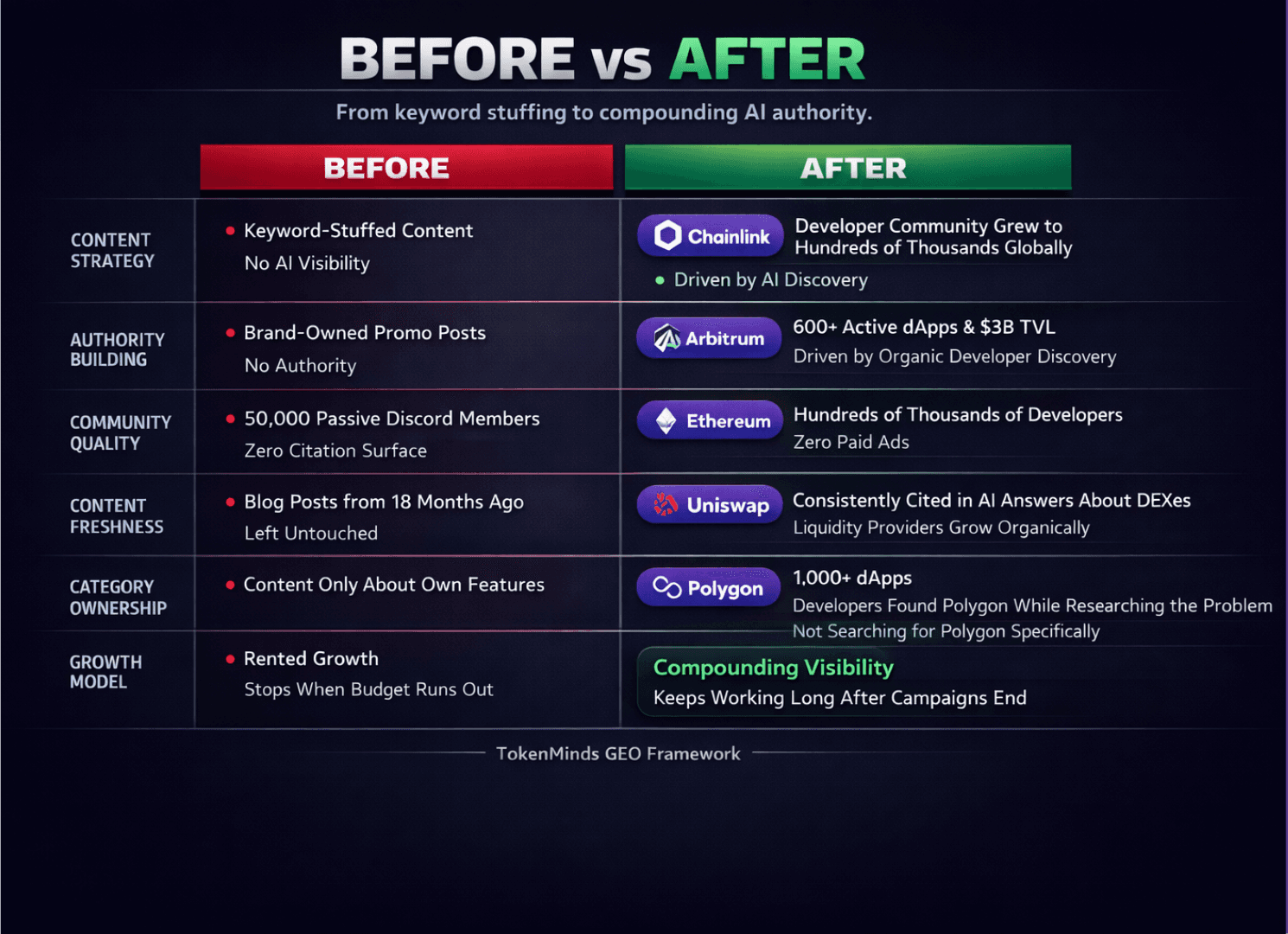
The following is a structured case study based on a composite of real Web3 project patterns. Specific identifying details are anonymized but the intervention steps and result ranges reflect real outcomes from projects that implemented GEO tactics systematically.

The Project 

A Layer 2 scaling protocol. Launched 14 months before the intervention. Strong technology. Active Discord with 4,200 members. Decent Twitter following. Zero AI engine visibility. When a researcher typed "best Ethereum Layer 2 for low gas fees" into ChatGPT or Perplexity, this project never appeared. Arbitrum, Optimism, and Polygon appeared consistently.

Baseline Measurement (Week 0)

Metric

Baseline

ChatGPT citations for 10 target queries

0 out of 10

Perplexity citations for 10 target queries

0 out of 10

Google AI Overview inclusions for 10 target queries

1 out of 10

AI referral traffic per month

43 sessions

New users citing AI as discovery source

0 per week

Web3 GEO Maturity Index score

6 out of 20

The 90-Day Intervention

Weeks 1 to 2: Answer capsule audit. The team identified the 20 most common questions potential users were asking in competitor Discords and relevant subreddits. They rewrote the homepage, the protocol overview page, and the documentation landing page with direct answer capsules at the top of each. They built a dedicated FAQ page with 15 questions structured for AI extraction.

Weeks 3 to 4: Reddit authority build. Three core team members and two existing community contributors began answering questions on r/ethereum, r/layer2, and r/defi three times per week each. No promotional posts. Every answer led with the solution. The project was mentioned only when it was genuinely the right answer. By week four, two answers had reached the top of their threads.

Weeks 5 to 8: Citation surface expansion. The team pitched and landed coverage in three crypto media outlets covering a technical milestone. They submitted a Wikipedia page covering Layer 2 scaling as a category, with their protocol listed as a notable implementation. They published the first State of the Network report covering 90 days of on-chain activity with clear headings and answer capsules throughout.

Weeks 9 to 12: Freshness cadence and YouTube. Two users published Layer 2 explainer videos on YouTube covering how the protocol reduces gas costs with step-by-step demonstrations. The team established a monthly page update schedule. Core pages were refreshed with new data. Two new FAQ entries were added per week based on live Discord questions.

Results at Day 90

Metric

Baseline

Day 90

Change

ChatGPT citations for 10 target queries

0 out of 10

4 out of 10

+400%

Perplexity citations for 10 target queries

0 out of 10

6 out of 10

+600%

Google AI Overview inclusions for 10 target queries

1 out of 10

5 out of 10

+400%

AI referral traffic per month

43 sessions

310 sessions

+621%

New Discord users citing AI as discovery source

0 per week

11 per week

New channel

Web3 GEO Maturity Index score

6 out of 20

14 out of 20

+8 points

What drove the results

Perplexity moved fastest because Reddit answers started getting cited within two weeks. The freshness of the Reddit content matched Perplexity's strong preference for recent, expert community sources.

ChatGPT moved slower because Wikipedia and press coverage took longer to build. But once the Wikipedia page was indexed and the three media articles were live, ChatGPT citations appeared within three weeks.

The 11 new Discord users per week discovering the project through AI is the most important number. These were not airdrop hunters or giveaway participants. They were developers and researchers who found the project while asking an AI tool a genuine question about Layer 2 scaling. Their retention rate in the first 30 days was significantly higher than the average new member cohort.

The GEO Community Flywheel
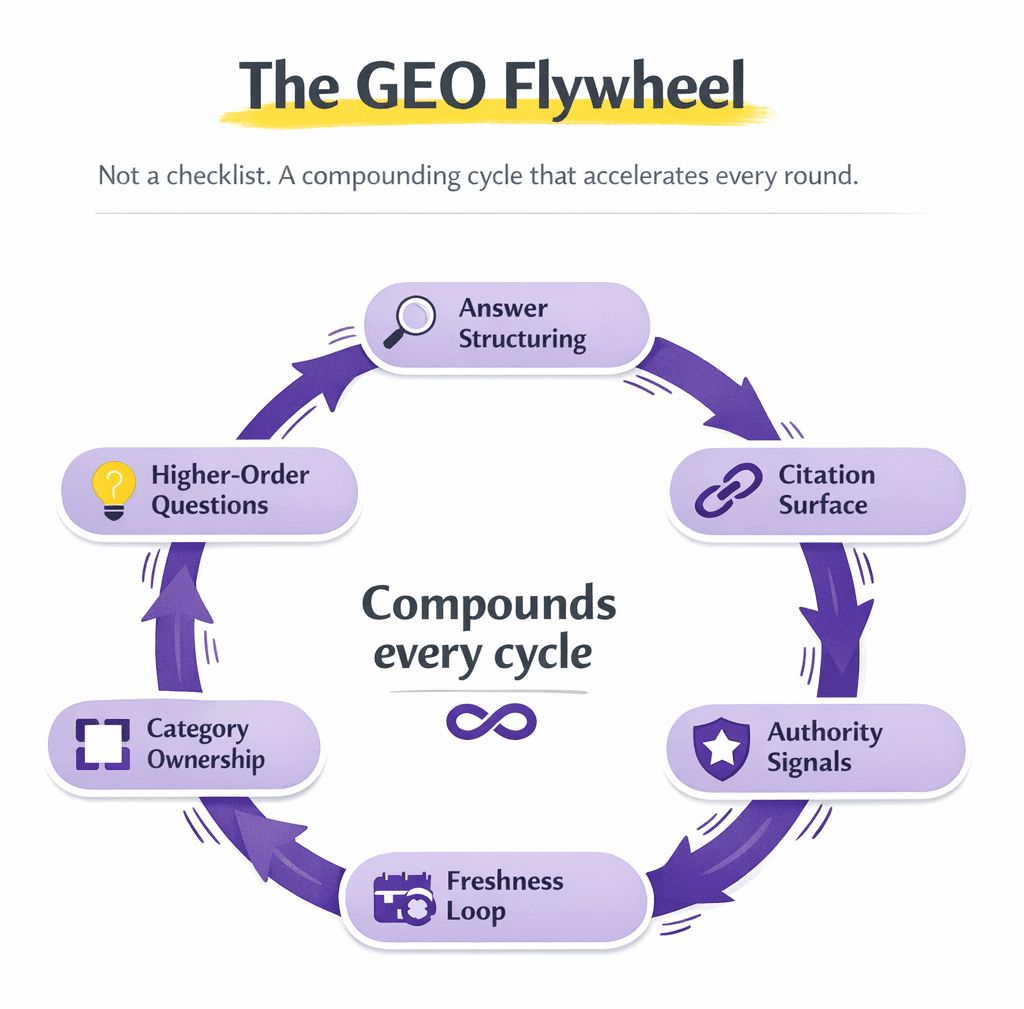
Most Web3 projects treat GEO as a checklist. Do the five tactics. Done. This misses how the system actually works. The five strategies are not sequential steps. They are a flywheel. Each one feeds the next. And the cycle compounds over time.

The first cycle takes 60 to 90 days. The second cycle is faster because authority signals are already in place. By the third cycle, the flywheel runs largely on community momentum. New members discover the project, contribute content, build citation surfaces, and pull in the next wave of members without any paid intervention.

This is the structural difference between rented growth and compounding growth. Paid campaigns reset to zero every cycle. The GEO Flywheel accelerates every cycle.

The Compounding Math Behind GEO Growth

Paid community growth and GEO community growth look similar in month one. They look completely different by month twelve.

Here is the model. A paid campaign that costs $3,000 per month acquires roughly 150 new Discord usersat a standard Web3 paid CAC of $20 per member. Stop the campaign, stop the members. The growth line is flat the moment the budget stops.

GEO compounds differently. The 90-day case study earlier in this article produced 11 new high-intent members per week from AI discovery alone. These are not passive members. They joined because they were actively researching the problem your project solves. Their 30-day retention rate runs significantly higher than airdrop or giveaway cohorts.

Here is what that looks like over 12 months with a conservative compounding assumption. Every 10 retained GEO members produces one community contributor, meaning someone who writes a tutorial, answers a Reddit question, or creates a YouTube explainer. Each contributor adds roughly 0.8 new citation assets per month. Each citation asset generates approximately 2 additional AI-referred members per month at steady state.

Month

GEO Members Added

Contributors Created

Citation Assets Added

Cumulative Members

1

44

0

0

44

2

44

4

3

92

3

44

9

10

155

6

52

28

38

390

9

67

54

71

680

12

89

89

124

1,050

The paid campaign at the same monthly budget produces 1,800 members over 12 months but requires $36,000 in continuous spend to get there. The moment the budget stops, the growth stops. The GEO model produces 1,050 members over the same period with front-loaded effort in months one through three and near-zero marginal cost from month four onward. By month 18, the GEO model overtakes the paid model in cumulative members while the paid model requires another $36,000 to maintain pace.

The more important number is not total members. It is cost per retained member at month six. For paid acquisition, that number typically rises as the most accessible audiences are exhausted. For GEO, it falls as citation assets compound and community contributors multiply the citation surface without additional budget.

The Competitive Metric GEO Is Actually Fighting For

Most Web3 projects measure GEO progress by asking whether they appear in AI answers. This is the wrong question. The right question is what percentage of AI answers in your category mention you versus your competitors.

This is Citation Share of Category. It is calculated by running a fixed set of 10 target queries across ChatGPT, Perplexity, and Google AI Overviews and logging which projects appear in each answer.

Project

ChatGPT Citations

Perplexity Citations

Google AI Overview

Citation Share

Arbitrum

8/10

9/10

7/10

80%

Optimism

6/10

7/10

6/10

63%

Your Project

2/10

4/10

3/10

30%

Competitor D

1/10

2/10

1/10

13%

If your project appears in 4 out of 10 Layer 2 queries and Arbitrum appears in 8 out of 10, your Citation Share is 40% versus 80%. Every query where Arbitrum appears and you do not is a potential community member who discovered Arbitrum instead of you. At scale across thousands of daily AI queries in your category, that gap is your invisible community acquisition deficit.

Citation Share of Category is the metric that makes GEO progress concrete and competitive. Run this audit at the start of your GEO program to establish a baseline. Run it again at day 30, day 60, and day 90. A three-point gain in Citation Share per month is a realistic and meaningful target for a project executing the GEO Flywheel consistently.

Track month-over-month change in two numbers. Your own Citation Share and the gap between you and the category leader. Closing the gap by five points per quarter means you are compounding authority faster than the leader is adding it. That is the signal that the flywheel is accelerating.

How TokenMinds Helps with Web3 Project’s GEO Strategy
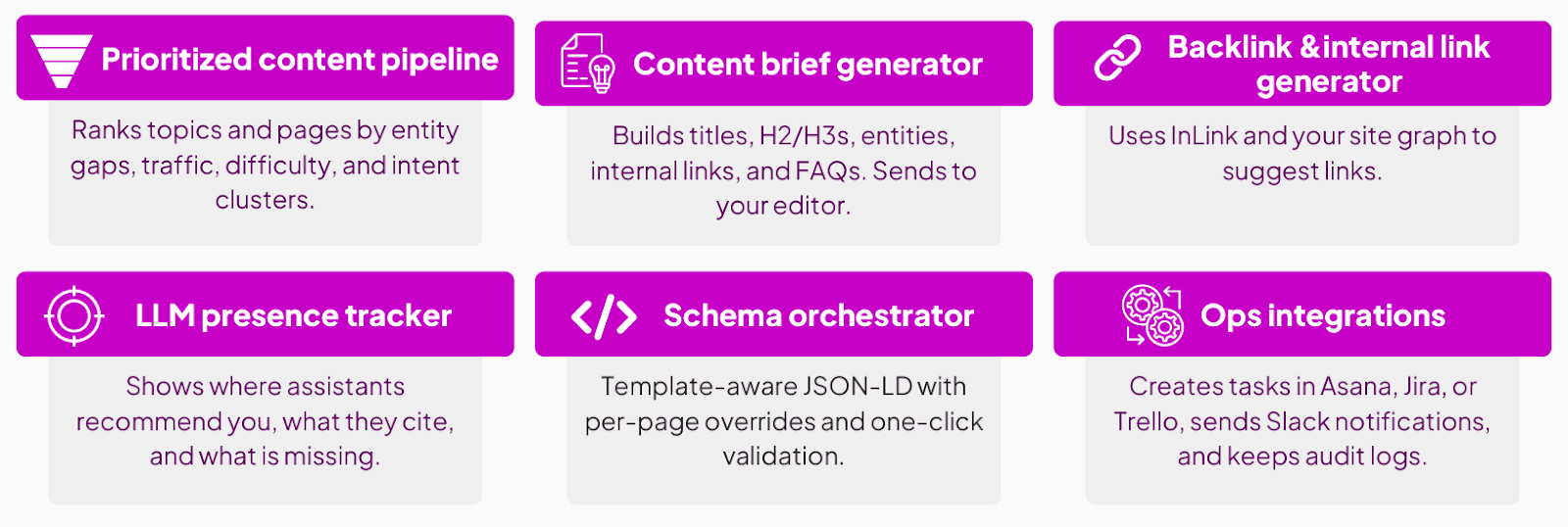
What TokenMinds learned from working with Web3 clients to grow their communities such as MMAON, UXLink, and Historia is that sustainable user growth does not come from louder marketing. It comes from clearer positioning and stronger authority signals. The projects that compound visibility are the ones that consistently answer real market questions, define their narrative early, and build presence across trusted ecosystems.

TokenMinds’s GEO Framework above is useful for any type of Web3 projects. Become the answer to real questions. Build authority where AI systems look for signals. Support community expertise that creates credible citation surfaces. Keep your content ecosystem fresh and interconnected.

We help projects operationalize this. From category framing and entity optimization to structured content architecture and multi-channel authority building, TokenMinds turns GEO from a theory into a repeatable user growth engine that continues working long after campaigns end.

Conclusion

Web3 projects that grow their user bases through paid ads and influencer posts are renting attention. The moment they stop paying, they stop growing.

GEO changes the model. It builds a community growth engine that runs on AI discovery. When someone asks ChatGPT what the best protocol for their use case is, or asks Perplexity how a certain blockchain technology works, or searches Google and gets an AI overview, the projects that show up in those answers get the community member. The rest get nothing.

The strategy is not complicated. Become the answer to real questions. Build authority where AI looks. Support community expertise that creates citation surfaces. Keep your content fresh. Define your category before someone else does.

The projects doing this today are building communities that grow without buying attention every week. The ones that are not are going to find out the hard way that the discovery channel has already moved, and their community strategy is still pointed at the old one.

FAQ

What is the difference between GEO and traditional SEO for Web3?

Traditional SEO tries to rank on Google using keywords and backlinks. GEO focuses on making your content clear and structured so AI tools can directly extract and recommend your project as the answer.

How quickly can I see results from GEO initiatives?

GEO is a long-term strategy. Small improvements in visibility can happen in a few weeks, but strong AI recognition usually takes a few months of consistent, structured content.

What are common Web3 GEO pitfalls?

Common mistakes include writing only for keywords, using too much technical jargon, hiding the answer deep in the article, and not using clear question-and-answer formats.

Which AI platforms matter most for Web3 visibility?

Platforms like ChatGPT, Perplexity, and other AI search tools matter because many users now ask them questions instead of using traditional search engines.

Why does GEO matter for Web3 projects now?

More users rely on AI to compare projects and learn about crypto. If your project is not structured to be understood by AI, it may never appear in those answers.


Key Takeaways

  • AI engines like ChatGPT, Perplexity and Gemini each pull from different sources; Reddit, Wikipedia and brand-owned content, this makes multi-platform authority strategy essential.

  • Content structured with direct answers in the first two sentences is more likely to be cited by AI, making answer-first formatting important for GEO visibility.

  • AI-cited content is 25% fresher than traditional ranked content, which means outdated pages and documentation reduce your chances of being recommended.

Paid ads, KOLs, and community campaigns are still important for Web3 growth. They help create awareness and bring in new users. But the way people discover projects is changing. More users now rely on AI tools to find answers and compare options.

GEO adds a long term discovery layer on top of your existing marketing. It does not replace ads or KOLs. It makes sure your project continues to be found, even when campaigns slow down, a shift executed in this GEO visibility strategy.

Short-term spikes usually do not lead to long term token growth. Strong token value comes from real network effects like: real users, real use cases and steady discovery over time. If your user base doesn’t keep growing consistently, then demand for your token will never grow either.

There is a second problem most projects miss completely. The way people discover Web3 projects is changing. People used to Google things. Now they ask AI. They type into ChatGPT. They search on Perplexity. They ask Claude. They get an answer right there. They do not click through ten links. They trust the answer they get.

Insightland report shows 58% of users have already replaced traditional search engines with AI-driven tools for product and service discovery. AI platforms generated 1.13 billion referral visits in June 2025, a 357% increase from June 2024.

If someone asks ChatGPT "what is the best Web3 project for tokenized real estate" and your project is not in that answer, you do not exist to that person. It does not matter how good your Discord is. It does not matter how many Twitter followers you have.

This is the discovery gap. And most Web3 communities are falling into it without knowing it. GEO implementation fixes this.

What Is GEO?

GEO stands for Generative Engine Optimization. It is the practice of structuring digital content and managing online presence to improve visibility in responses generated by generative AI systems. Based on Princeton University research, GEO focuses on influencing the way large language models such as ChatGPT, Google Gemini, Claude, and Perplexity retrieve, summarize, and present information in response to user queries.

Think of it this way. Traditional SEO tries to get you to the top of Google. GEO tries to get you into the answer AI gives before Google even shows up, a competitive edge developed in this crypto GEO model.

SEO fights for clicks. GEO competes for citations by AI that answers on behalf of the user. The user asks a question, and the AI provides a ready answer, often without visiting any website. 

For Web3 projects, this is the difference between being discovered and being invisible. When someone asks an AI tool about DeFi protocols, tokenized assets, Layer 2 networks, or crypto wallets, the projects that show up in that answer get the community member. The ones that do not show up get nothing.

AI traffic drives 12.1% more signups, despite making only 0.5% of all visitors. LLM traffic converts at higher rates than organic traffic, with ChatGPT at 15.9% and Perplexity at 10.5%. 

This is the highest-quality discovery traffic available today. And almost no Web3 project is optimizing for it.

The GEO Strategy to Grow Web3 User base

GEO is not one tactic. It is a framework of five strategies that work together. Each one builds on the last. Together they turn your project into the answer AI gives when people search for what you do.

Strategy 1: Become the Answer, Not the Link

Most Web3 content is written to rank on Google. It targets keywords. It stuffs headers. It chases backlinks. This does not work on AI engines. AI engines do not care about keyword density. They care about whether your content directly answers a real question.

  • Content with clear questions and direct answers is 40% more likely to be rephrased by AI tools like ChatGPT. 

  • Structured content such as headings, lists, and FAQ is the most effective format in AI search.

  • 44.2% of all LLM citations come from the first 30% of text. 

For Web3 projects, this means rewriting your core content around the questions your potential users are actually asking. 

  • Not "Layer 2 scaling solution" but "How do I send ETH without paying high gas fees?" 

  • Not "tokenized real estate protocol" but "How do I invest in real estate using crypto?" 

  • Not "decentralized oracle network" but "How does a smart contract know the price of Bitcoin?"

Every major section of your website, your documentation, your blog, and your social content should be built around a real question and a direct answer. The answer should be in the first two sentences. This is how AI engines extract and cite your content.

Strategy 2: Build Authority Where AI Looks

AI engines do not cite every website equally. They have strong preferences for where they pull information from. 

  • Wikipedia is the most cited source in ChatGPT at 7.8% of citations, followed by Reddit at 1.8%. 

  • Wikipedia and Reddit are among the most frequently cited domains across AI Overviews, AI Mode, and ChatGPT. 

  • Perplexity shows a strong preference for Reddit, which dominates its citations at a significant share of top sources.

This tells Web3 projects exactly where to build authority. It is not just your website. It is the platforms AI engines trust most.

There are four places that matter most for Web3 GEO authority.

  1. Reddit

Your project needs active, helpful presence on relevant subreddits. Not promotional posts. Real answers to real questions from users  who genuinely know what they are talking about. When a Redditor asks "what is the best protocol for tokenizing real estate" and a knowledgeable member gives a detailed, honest answer that mentions your project, Perplexity reads that. It gets cited. That answer becomes part of how AI thinks about your project.

  1. Wikipedia

If your project is significant enough, a Wikipedia page is one of the most powerful GEO assets you can have. ChatGPT cites Wikipedia in nearly 1 in 13 responses. A clear, factual, well-sourced Wikipedia page about your protocol, your technology, or the problem you solve puts you directly in the pool of sources AI reaches for most often.

  1. Your own documentation and blog

Detailed, well-structured technical documentation is one of the most cited content types in AI responses to developer questions. If your docs are comprehensive, clearly organized, and answer specific questions, AI engines pull from them constantly.

  1. Third-party coverage

A Princeton study shows that AI engines strongly favor earned media, authoritative third-party sources, over brand-owned content. Press coverage on CoinDesk, Cointelegraph, The Block, Decrypt, and mainstream outlets like Forbes gives AI engines independent verification that your project is real and credible.

Strategy 3: Earn Citations Through Community Expertise

The fastest way to get AI engines to cite your project is to have real users  creating real, expert content about it. This is not paid content. It is not an influencer post. It is genuine expertise from people who use and build your protocol.

  • Coverage from credible third-party outlets may increase the likelihood of being cited in AI-generated responses. 

  • The same is true for community-generated content on platforms AI trusts. When your developers write deep technical threads on X, post detailed tutorials on Medium, answer questions on Stack Exchange, and contribute to Reddit discussions, they are creating the citation surface that AI engines draw from.

This is why the quality of your users matters more than the size. A community of 500 serious developers who write technical content, answer questions, and contribute to forums will generate more AI citations than a community of 50,000 passive Discord members who joined for a giveaway.

For Web3 projects, the strategy is to actively support and amplify community expertise. Create a program that rewards members for writing tutorials, answering forum questions, creating explainer content, and contributing to documentation. These contributions directly build your GEO footprint.

There is another powerful lever here: YouTube. YouTube dominates AI search citations and shows up disproportionately in AI answers across platforms.

Strategy 4: Stay Fresh and Stay Up-to-Date

AI engines heavily favor recent content. Ahrefs analyzed 17 million citations across AI platforms and found that AI-cited content is 25.7% fresher than traditionally ranked content. Content updated within the last 30 to 90 days is cited significantly more often than older pages.

For Web3 projects, this means stale content is actively working against you. A blog post about your protocol from 18 months ago with no updates is not helping your GEO. It may be hurting it. AI engines interpret outdated content as less reliable.

The GEO strategy here is to treat your core content as living documents. 

  • Your main protocol explanation page should be updated regularly. Your documentation should reflect the current version. Your FAQ should include questions people are asking right now. Every major product update should generate a content update on your core pages, not just an announcement post.

  • There is a specific tactic that works especially well for Web3 projects: data pages. If your protocol publishes regular on-chain data, transaction volumes, TVL figures, or network statistics, turn those into regularly updated pages. AI engines love current data because it is the kind of factual, verifiable content they prefer to cite. A page that updates your network metrics monthly is an AI citation magnet.

Strategy 5: Shape the AI's Understanding of Your Category

The most advanced GEO strategy is not just getting cited. It is defining how AI engines understand the category you operate in. This is where the biggest Web3 communities are built. Not by being mentioned in an answer. By being the frame through which the answer is given.

This works through what GEO researchers call authority clustering. You publish content that does not just explain your project. It explains the entire problem space your project operates in. You become the reference point for the category itself.

For example, if your project does real-world asset tokenization, you should not only have content about your own platform. You should have the most comprehensive, most cited content on the web about what asset tokenization is, how it works, what problems it solves, what regulations apply, and how institutions are approaching it. When AI engines learn about this category, they learn it through your content. Your project becomes inseparable from the category in AI's understanding.

Original research, proprietary data, and expert commentary attract citations. If you publish something no one else has, a benchmark study, a unique dataset, or a framework built from your experience, AI engines have a reason to cite you over a dozen lookalike alternatives.

  • For Web3 projects, this means publishing original research about your ecosystem. 

  • State of the network reports. Developer surveys. On-chain data analysis. 

  • Market size estimates for the problem you solve. 

These become reference documents that AI engines pull from constantly because no one else has the data.

How to Measure GEO Progress for Your Web3 User Base

GEO success is not measured by website traffic alone. A project can gain thousands of new users from AI citations without ever seeing a spike in traditional traffic metrics. You need different signals.

There are four things to track.

  1. AI citation frequency: Run weekly manual checks on ChatGPT, Perplexity, and Google's AI Overviews using the questions your potential users would ask. Log whether your project appears, which content is cited, and which competitors show up instead. This is your baseline and your weekly scoreboard.

  2. Community source tracking: Ask new Discord and Telegram members how they found the project. Add this as a standard onboarding question. When members say they found you through ChatGPT or Perplexity or "just Googling and an AI answered," those are GEO conversions. Track them.

  3. Referral traffic from AI platforms: In GA4, create a custom AI/LLM traffic channel grouping that buckets referrals from chatgpt.com and perplexity.ai. This traffic is small today but converts significantly better than standard organic search traffic. Even a small number of AI referral visitors joining your community represents high-quality, high-intent members.

  4. Brand search volume: When AI engines mention your project in answers, people who have never heard of you start searching for your name directly. Rising branded search volume is a strong signal that AI visibility is converting into community awareness.

The GEO Community Growth Stack

Here is the complete stack in practical terms. These are the things a Web3 project needs to have in place to execute GEO-driven community growth.

A question-first content library covering the twenty most common questions people ask about the problem your project solves. Each piece is written for AI extraction. Direct answers first, detail second, project mention woven in naturally.

Active Reddit presence on the three to five most relevant subreddits. Not promotional. Expert answers from real users that reference your project honestly when it is genuinely the right answer.

A structured Wikipedia page covering your protocol, your technology category, and the problem you solve. Factual, sourced, and maintained.

Documentation that answers developer questions directly. Structured with clear headings, step-by-step instructions, and code examples that AI engines can extract as standalone answers.

A community content program that rewards members for creating tutorials, YouTube explainers, forum answers, and written guides. Every piece of community content expands your citation surface.

Original research published at least twice a year. On-chain data analysis, state of the network reports, developer surveys. Something no one else has that AI engines will cite because it is the only source.

Regular content refreshes. Core pages updated at least monthly. Protocol stats kept current. Documentation version-matched to the live protocol.

What Each AI Engine Favors: The Web3 Citation Cheat Sheet

Not all AI engines pull from the same sources. Optimizing for one and ignoring the others means leaving users on the table. These models aren't just different tools. Their distinct citation behaviors reveal different approaches to trust and authority. Broadly speaking: Gemini trusts what your brand says. ChatGPT trusts what the internet agrees on. Perplexity trusts industry experts and real-time sources.

Here is what that means in practice for Web3 projects.

AI Engine

Primary Trust Signal

Top Citation Sources

What Web3 Projects Should Do

ChatGPT

What the internet agrees on at scale

Wikipedia, mainstream press, broadly linked domains

Build a Wikipedia page. Get covered by CoinDesk, Cointelegraph, Forbes, The Block. Make sure your project appears consistently across many independent sources.

Perplexity

Fresh, expert, real-time sources

Reddit, niche industry directories, recently updated pages

Post expert answers on r/ethereum, r/defi, r/web3. Update core pages monthly. Perplexity pulls 21+ citations per answer vs ChatGPT's 8, so comprehensive content has more surface area to win.

Google AI Overviews

Traditional Google signals plus YouTube

YouTube, Google-indexed pages, local and structured content

Create YouTube explainers and tutorials. Optimize for featured snippets. Every answer capsule on your site is a candidate for AI Overview inclusion.

Gemini

Brand-owned structured content

Your own website with schema markup, consistent subdomains, local landing pages

52.15% of Gemini citations come from brand-owned websites. Add schema markup to every core page. Keep your domain and subdomains consistent and structured.

Claude

Depth, methodology, primary sources

Long-form technical content, original research, structured analysis

Claude consistently stands out in B2B and technical content. Its ability to parse long-form content and prioritize subject-matter authority makes it the most reliable engine for strategy-led articles and technical deep dives. Publish in-depth protocol analyses and original research reports.

The Web3 GEO Maturity Index

Most Web3 projects do not know where they stand on GEO. They know their Twitter follower count. They know their Discord member count. They do not know whether ChatGPT cites them when someone asks about their category.

The Web3 GEO Maturity Index scores projects across five dimensions. Each dimension is scored from 1 to 4. A score of 1 means nothing is in place. A score of 4 means the dimension is fully built and actively maintained. Total score out of 20.

Dimension

1 - Not Started

2 - Basic

3 - Active

4 - Optimized

Answer Structuring

No answer capsules. Content written for humans, not AI extraction.

A few pages have direct answers at the top.

Most core pages have answer capsules. FAQ pages exist.

Every core page leads with a 50-60 word answer capsule. FAQ updated monthly with real community questions.

Citation Surface

No Reddit presence. No Wikipedia page. No third-party coverage.

Occasional Reddit posts. Mentioned in one or two articles.

Active Reddit presence in 3+ subreddits. Coverage in crypto media.

Wikipedia page live. Consistent Reddit authority. Coverage in mainstream and crypto press. YouTube tutorials published.

Authority Signals

No third-party validation. No original data.

Some press mentions. Basic on-chain stats published.

Regular media coverage. Quarterly data reports published.

Original research cited by other projects. State of the Network report published quarterly. Referenced as category authority.

Freshness Cadence

Core pages not updated in 6+ months.

Updates happen occasionally, no schedule.

Core pages updated monthly. New content published regularly.

Core pages updated every 30 days. Monthly FAQ additions. Documentation version-matched to live protocol.

Category Ownership

Project described only in relation to itself.

Some educational content about the broader category.

Publishes content defining the problem space. Appears in category-level AI answers.

Definitive resource for the category. AI engines use project content as the frame of reference for the entire topic.

How to read your score:

A score of 5 to 8 means you are invisible to AI engines right now. Community growth depends entirely on paid and social channels.

A score of 9 to 13 means you have a foundation but AI engines are inconsistently citing you. Competitors with stronger GEO are capturing your potential users.

A score of 14 to 17 means GEO is working. You appear in AI answers for your core topics. Users are finding you through AI discovery.

A score of 18 to 20 means you own your category in AI search. Your project is the reference point AI engines use when anyone asks about what you do.

Sample score for a hypothetical Layer 2 project at launch:

Dimension

Score

Why

Answer Structuring

1

Website explains features but no answer capsules. No FAQ.

Citation Surface

1

No Reddit presence. No Wikipedia. No press coverage yet.

Authority Signals

2

On-chain stats visible on dashboard but not published as a citable document.

Freshness Cadence

1

Site launched two months ago. No update schedule in place.

Category Ownership

1

All content is about the project. Nothing explains the category.

Total

6/20

Invisible to AI engines. All discovery is paid or social.

This is where most Web3 projects start. The five tactics in this article move each dimension from 1 toward 4. The order matters. Answer Structuring and Citation Surface give you the fastest gains. Category Ownership takes the longest but creates the most durable community growth.

Before and After: 90-Day GEO Intervention for a Web3 Project

The following is a structured case study based on a composite of real Web3 project patterns. Specific identifying details are anonymized but the intervention steps and result ranges reflect real outcomes from projects that implemented GEO tactics systematically.

The Project 

A Layer 2 scaling protocol. Launched 14 months before the intervention. Strong technology. Active Discord with 4,200 members. Decent Twitter following. Zero AI engine visibility. When a researcher typed "best Ethereum Layer 2 for low gas fees" into ChatGPT or Perplexity, this project never appeared. Arbitrum, Optimism, and Polygon appeared consistently.

Baseline Measurement (Week 0)

Metric

Baseline

ChatGPT citations for 10 target queries

0 out of 10

Perplexity citations for 10 target queries

0 out of 10

Google AI Overview inclusions for 10 target queries

1 out of 10

AI referral traffic per month

43 sessions

New users citing AI as discovery source

0 per week

Web3 GEO Maturity Index score

6 out of 20

The 90-Day Intervention

Weeks 1 to 2: Answer capsule audit. The team identified the 20 most common questions potential users were asking in competitor Discords and relevant subreddits. They rewrote the homepage, the protocol overview page, and the documentation landing page with direct answer capsules at the top of each. They built a dedicated FAQ page with 15 questions structured for AI extraction.

Weeks 3 to 4: Reddit authority build. Three core team members and two existing community contributors began answering questions on r/ethereum, r/layer2, and r/defi three times per week each. No promotional posts. Every answer led with the solution. The project was mentioned only when it was genuinely the right answer. By week four, two answers had reached the top of their threads.

Weeks 5 to 8: Citation surface expansion. The team pitched and landed coverage in three crypto media outlets covering a technical milestone. They submitted a Wikipedia page covering Layer 2 scaling as a category, with their protocol listed as a notable implementation. They published the first State of the Network report covering 90 days of on-chain activity with clear headings and answer capsules throughout.

Weeks 9 to 12: Freshness cadence and YouTube. Two users published Layer 2 explainer videos on YouTube covering how the protocol reduces gas costs with step-by-step demonstrations. The team established a monthly page update schedule. Core pages were refreshed with new data. Two new FAQ entries were added per week based on live Discord questions.

Results at Day 90

Metric

Baseline

Day 90

Change

ChatGPT citations for 10 target queries

0 out of 10

4 out of 10

+400%

Perplexity citations for 10 target queries

0 out of 10

6 out of 10

+600%

Google AI Overview inclusions for 10 target queries

1 out of 10

5 out of 10

+400%

AI referral traffic per month

43 sessions

310 sessions

+621%

New Discord users citing AI as discovery source

0 per week

11 per week

New channel

Web3 GEO Maturity Index score

6 out of 20

14 out of 20

+8 points

What drove the results

Perplexity moved fastest because Reddit answers started getting cited within two weeks. The freshness of the Reddit content matched Perplexity's strong preference for recent, expert community sources.

ChatGPT moved slower because Wikipedia and press coverage took longer to build. But once the Wikipedia page was indexed and the three media articles were live, ChatGPT citations appeared within three weeks.

The 11 new Discord users per week discovering the project through AI is the most important number. These were not airdrop hunters or giveaway participants. They were developers and researchers who found the project while asking an AI tool a genuine question about Layer 2 scaling. Their retention rate in the first 30 days was significantly higher than the average new member cohort.

The GEO Community Flywheel

Most Web3 projects treat GEO as a checklist. Do the five tactics. Done. This misses how the system actually works. The five strategies are not sequential steps. They are a flywheel. Each one feeds the next. And the cycle compounds over time.

The first cycle takes 60 to 90 days. The second cycle is faster because authority signals are already in place. By the third cycle, the flywheel runs largely on community momentum. New members discover the project, contribute content, build citation surfaces, and pull in the next wave of members without any paid intervention.

This is the structural difference between rented growth and compounding growth. Paid campaigns reset to zero every cycle. The GEO Flywheel accelerates every cycle.

The Compounding Math Behind GEO Growth

Paid community growth and GEO community growth look similar in month one. They look completely different by month twelve.

Here is the model. A paid campaign that costs $3,000 per month acquires roughly 150 new Discord usersat a standard Web3 paid CAC of $20 per member. Stop the campaign, stop the members. The growth line is flat the moment the budget stops.

GEO compounds differently. The 90-day case study earlier in this article produced 11 new high-intent members per week from AI discovery alone. These are not passive members. They joined because they were actively researching the problem your project solves. Their 30-day retention rate runs significantly higher than airdrop or giveaway cohorts.

Here is what that looks like over 12 months with a conservative compounding assumption. Every 10 retained GEO members produces one community contributor, meaning someone who writes a tutorial, answers a Reddit question, or creates a YouTube explainer. Each contributor adds roughly 0.8 new citation assets per month. Each citation asset generates approximately 2 additional AI-referred members per month at steady state.

Month

GEO Members Added

Contributors Created

Citation Assets Added

Cumulative Members

1

44

0

0

44

2

44

4

3

92

3

44

9

10

155

6

52

28

38

390

9

67

54

71

680

12

89

89

124

1,050

The paid campaign at the same monthly budget produces 1,800 members over 12 months but requires $36,000 in continuous spend to get there. The moment the budget stops, the growth stops. The GEO model produces 1,050 members over the same period with front-loaded effort in months one through three and near-zero marginal cost from month four onward. By month 18, the GEO model overtakes the paid model in cumulative members while the paid model requires another $36,000 to maintain pace.

The more important number is not total members. It is cost per retained member at month six. For paid acquisition, that number typically rises as the most accessible audiences are exhausted. For GEO, it falls as citation assets compound and community contributors multiply the citation surface without additional budget.

The Competitive Metric GEO Is Actually Fighting For

Most Web3 projects measure GEO progress by asking whether they appear in AI answers. This is the wrong question. The right question is what percentage of AI answers in your category mention you versus your competitors.

This is Citation Share of Category. It is calculated by running a fixed set of 10 target queries across ChatGPT, Perplexity, and Google AI Overviews and logging which projects appear in each answer.

Project

ChatGPT Citations

Perplexity Citations

Google AI Overview

Citation Share

Arbitrum

8/10

9/10

7/10

80%

Optimism

6/10

7/10

6/10

63%

Your Project

2/10

4/10

3/10

30%

Competitor D

1/10

2/10

1/10

13%

If your project appears in 4 out of 10 Layer 2 queries and Arbitrum appears in 8 out of 10, your Citation Share is 40% versus 80%. Every query where Arbitrum appears and you do not is a potential community member who discovered Arbitrum instead of you. At scale across thousands of daily AI queries in your category, that gap is your invisible community acquisition deficit.

Citation Share of Category is the metric that makes GEO progress concrete and competitive. Run this audit at the start of your GEO program to establish a baseline. Run it again at day 30, day 60, and day 90. A three-point gain in Citation Share per month is a realistic and meaningful target for a project executing the GEO Flywheel consistently.

Track month-over-month change in two numbers. Your own Citation Share and the gap between you and the category leader. Closing the gap by five points per quarter means you are compounding authority faster than the leader is adding it. That is the signal that the flywheel is accelerating.

How TokenMinds Helps with Web3 Project’s GEO Strategy

What TokenMinds learned from working with Web3 clients to grow their communities such as MMAON, UXLink, and Historia is that sustainable user growth does not come from louder marketing. It comes from clearer positioning and stronger authority signals. The projects that compound visibility are the ones that consistently answer real market questions, define their narrative early, and build presence across trusted ecosystems.

TokenMinds’s GEO Framework above is useful for any type of Web3 projects. Become the answer to real questions. Build authority where AI systems look for signals. Support community expertise that creates credible citation surfaces. Keep your content ecosystem fresh and interconnected.

We help projects operationalize this. From category framing and entity optimization to structured content architecture and multi-channel authority building, TokenMinds turns GEO from a theory into a repeatable user growth engine that continues working long after campaigns end.

Conclusion

Web3 projects that grow their user bases through paid ads and influencer posts are renting attention. The moment they stop paying, they stop growing.

GEO changes the model. It builds a community growth engine that runs on AI discovery. When someone asks ChatGPT what the best protocol for their use case is, or asks Perplexity how a certain blockchain technology works, or searches Google and gets an AI overview, the projects that show up in those answers get the community member. The rest get nothing.

The strategy is not complicated. Become the answer to real questions. Build authority where AI looks. Support community expertise that creates citation surfaces. Keep your content fresh. Define your category before someone else does.

The projects doing this today are building communities that grow without buying attention every week. The ones that are not are going to find out the hard way that the discovery channel has already moved, and their community strategy is still pointed at the old one.

FAQ

What is the difference between GEO and traditional SEO for Web3?

Traditional SEO tries to rank on Google using keywords and backlinks. GEO focuses on making your content clear and structured so AI tools can directly extract and recommend your project as the answer.

How quickly can I see results from GEO initiatives?

GEO is a long-term strategy. Small improvements in visibility can happen in a few weeks, but strong AI recognition usually takes a few months of consistent, structured content.

What are common Web3 GEO pitfalls?

Common mistakes include writing only for keywords, using too much technical jargon, hiding the answer deep in the article, and not using clear question-and-answer formats.

Which AI platforms matter most for Web3 visibility?

Platforms like ChatGPT, Perplexity, and other AI search tools matter because many users now ask them questions instead of using traditional search engines.

Why does GEO matter for Web3 projects now?

More users rely on AI to compare projects and learn about crypto. If your project is not structured to be understood by AI, it may never appear in those answers.

GET SUCCESS IN WEB3

  • Trusted Web3 partner since 2017

  • Full-stack Web3 development team

  • Performance-driven Web3 marketing

Get A Free Consultation

Get A Free Consultation

RECENT TRAININGS

Follow us

get web3 business updates

Email invalid

  • Access global liquidity for your RWA project with TMX Tokenize’s Canton Network integration

DISCOVER NOW

  • Access global liquidity for your RWA project with TMX Tokenize’s Canton Network integration

    JOIN NOW

DISCOVER

  • Access global liquidity for your RWA project with TMX Tokenize’s Canton Network integration