Web3 & AI

SOLUTIONS

Products

Services

Web3 & AI

SOLUTIONS

Services

Products

Industries

Become Our Client

About Us

Resources

Web3 & AI

SOLUTIONS

Services

Products

Industries

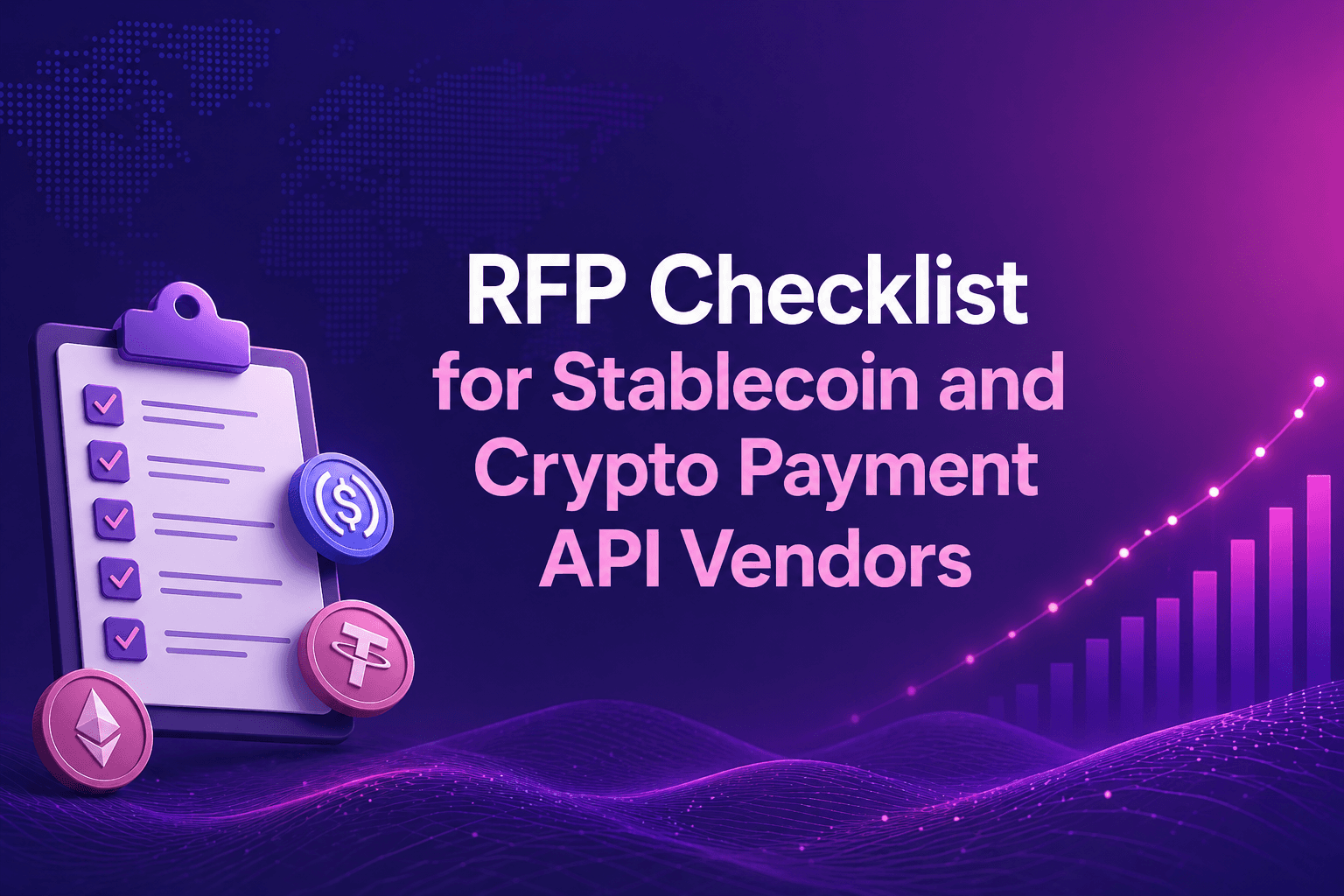
RFP Checklist for Stablecoin and Crypto Payment API Vendors

RFP Checklist for Stablecoin and Crypto Payment API Vendors

Featured answer: Banks evaluating stablecoin payment API vendors should use a four-stage procurement framework covering licensing, Travel Rule compliance, custody, technical fit, contract terms, and implementation support. Hard minimums apply to licensing, Travel Rule, and custody model; all other criteria should be scored 1–3 with required evidence documented.

EXECUTIVE SUMMARY:

EY-Parthenon surveyed 350 decision-makers, including 100 financial institutions; among FIs, 79% plan to use partnerships or hybrid vendor models to support stablecoin services. That creates a large volume of vendor decisions under commercial pressure, in a market where due diligence standards are still inconsistent. A common failure mode in this space is asking the right questions too late. This guide gives procurement leads, payments product heads, and digital asset CTOs a structured four-stage framework to evaluate vendors, from the first conversation to contract signing.

RFP Questions for Stablecoin Payment API Vendors

Many banks and financial institutions are about to make a significant vendor decision in a market where infrastructure is real, regulation is still settling, and the cost of choosing wrong is high. The vendor landscape has grown quickly. According to Bessemer, citing Stripe data, real-world stablecoin payments volume doubled in 2025 to $400 billion. More than 300 payment companies live on the Fireblocks Network alone, processing over $200 billion in monthly flows according to Fireblocks-reported data. There is no shortage of providers. There is, however, a serious shortage of structured frameworks for choosing between them.

Fireblocks frames the buyer pain explicitly: institutions struggle to identify providers with the right mix of liquidity, compliance credentials, licensing, and acceptable risk profiles. That is why a structured RFP checklist matters — it turns fragmented vetting into a repeatable, defensible process.

This guide offers one. Four stages, each calibrated to a different phase of the procurement process. Work through them in sequence and each stage filters the vendor pool before you invest time in the next. Score vendors 1 to 3 per criterion based on the specificity of their answers. Gaps are as informative as the answers themselves.

For the complete seven-category vendor taxonomy that underpins this checklist, see Crypto Payment Integration for Banks: Vendor Landscape and Decision Framework.

Crypto Payment Vendor Checklist for Banks

Use this checklist to score vendors. Copy the table below into your RFP document or vendor evaluation spreadsheet.

Hard Disqualifiers (Apply at Stage 1)

Any vendor that cannot document (1) valid licensing in your operating jurisdictions, (2) Travel Rule compliance with named provider or native capability, or (3) a bank-grade custody model with asset segregation is disqualified regardless of performance in other areas.

How to Use This Checklist

Use Stage 1 to eliminate vendors that cannot document licensing, Travel Rule readiness, or jurisdictional operating authority. Use Stage 2 to test operational fit across assets, chains, corridors, custody, liquidity, compliance controls, and API reliability. Use Stage 3 to identify contractual risk in SLAs, refunds, pricing, security, and liability. Use Stage 4 to validate whether the vendor can support implementation, reconciliation, and post-launch operations.

Note: Vendor-provided claims are not evidence unless backed by certificates, audit reports, regulator correspondence, architecture diagrams, sample files, or contractual terms.

Stage 1: Before First Meeting

Category

Key questions to ask

Required evidence

Vendor response

Score (1-3)

Owner

Disqualifier

Licensing

Are you licensed in our operating jurisdictions, and under which regulatory frameworks? What is your contingency if a license lapses or is under review? For EU corridors, are you operating under a MiCA authorization, a national-law transitional regime, or a partner/license reliance model? Provide the relevant authorization, regulator correspondence, or transition-period basis by jurisdiction.

License certificates, regulatory correspondence, legal opinion


Compliance

Yes

Supported assets & chains

Which stablecoins and blockchains do you support today? What is your roadmap for new assets, and who controls prioritization?

Asset support matrix, chain documentation, roadmap timeline


Product

No

Travel Rule compliance

Which Travel Rule solution do you use? How do you handle unhosted wallets, and what happens when a counterparty VASP is non-compliant?

Travel Rule provider contract, workflow documentation, test results


Compliance

Yes

Stage 2: Technical Evaluation

Category

Key questions to ask

Required evidence

Vendor response

Score (1-3)

Owner

Disqualifier

Fiat rails & corridors

Which fiat currencies and corridors do you support? What are the actual settlement windows per corridor, not best-case estimates?

Corridor matrix, settlement SLA documentation, performance reports


Treasury

No

Custody model

Who holds the private keys? What is the asset segregation model, and how are client assets protected in an insolvency scenario?

Custody architecture diagram, legal segregation opinion, insurance certificates


Risk

Yes

AML / KYT

Is your compliance solution native to the platform or third-party? What is your false positive rate, and how is it managed?

KYT provider documentation, false-positive metrics, tuning process


Compliance

No

API reliability 


What uptime is guaranteed? What retry, idempotency, rate-limit, and failover logic exists?

Uptime reports, retry policy, rate-limit docs, incident history


Engineering

No

Webhooks & event streaming

Which events are emitted for payment initiation, compliance review, settlement, refund, failed transaction, reversal, and reconciliation? Are webhook signatures, replay protection, ordering guarantees, retries, and event IDs supported?

Webhook schema, sample payloads, event catalog, signing specification, replay/retry documentation, event ID documentation, ordering guarantee documentation


Engineering

No

Liquidity, FX & slippage

Which liquidity providers, market makers, or banking partners support each corridor? What FX spread, slippage, and failed-liquidity fallback rules apply under normal and stressed conditions?

Liquidity partner list, corridor-level FX spread data, fallback playbook, settlement failure reports


Treasury

No

Stage 3: Contract Scrutiny

Category

Key questions to ask

Required evidence

Vendor response

Score (1-3)

Owner

Disqualifier

SLAs & incident response

What contractual uptime guarantees apply, and what exclusions exist? What is the escalation path and compensation mechanism for SLA breaches?

Draft SLA, incident response playbook, escalation matrix


Legal

No

Refunds & disputes

How are refunds processed on-chain? Who bears network fee costs during refund processing, and what is the dispute resolution timeline?

Refund workflow documentation, fee policy, dispute SLA


Ops

No

Security audits

What independent audits have been completed in the last 12 months? Do you hold SOC 2 Type II? What is your penetration testing cadence? Can you share audit reports under NDA?

SOC 2 Type II report, pen-test summary, vulnerability disclosure policy, incident history


Security

No

Pricing & TCO transparency

What fees apply: FX spreads, gas/network fees, custody fees, support fees, implementation fees, minimums, refund costs, and SLA credits?

Fee schedule, TCO model, sample invoice


Procurement

No

Stage 4: Implementation

Category

Key questions to ask

Required evidence

Vendor response

Score (1-3)

Owner

Disqualifier

Implementation & onboarding

What does a realistic integration timeline look like for our size? Is dedicated technical support included or charged separately?

Do you provide sandbox access, solution architecture support, an implementation manager, a testing plan, migration support, and post-launch hypercare?

Project plan, resource allocation, sandbox credentials, testing checklist


PMO

No

Reconciliation & reporting

Which reconciliation formats and webhook payloads do you support? How does transaction data integrate with existing treasury and finance systems? Can you provide sample export files, webhook payload examples, transaction ID mapping, fee field definitions, settlement reports, and ERP/TMS integration options?

Sample reconciliation file, webhook payload schema, integration guide


Finance/Ops

No

*Scoring guide: 1 = vague or incomplete answer | 2 = partial answer with gaps | 3 = specific, documented, verifiable. Hard minimum score of 3 required on licensing, Travel Rule, and custody model.

**Weighting model suggestion: Licensing (25%), Travel Rule (20%), Custody (20%), Technical fit (15%), Contract terms (10%), Implementation support (10%). Adjust weights based on institutional priorities.

***Scoring flow note: Use Stage 1 to eliminate vendors that fail licensing or Travel Rule requirements. Do not advance any vendor to final shortlist unless it also scores 3 on custody model during Stage 2.

Minimum Evidence Pack Request

Ask vendors to provide these documents before Stage 2 evaluation begins:

  1. Current licenses/registrations in your operating jurisdictions

  2. SOC 2 Type II report (or equivalent security certification)

  3. Penetration test summary (last 12 months)

  4. Travel Rule provider documentation and workflow diagram

  5. Supported corridors matrix with settlement windows

  6. Custody architecture diagram with key management model

  7. Sample SLA with exclusions and compensation terms

  8. Sample webhook payload and retry logic specification

  9. Sample reconciliation file format and field definitions

  10. Incident response policy and escalation contacts

  11. Business continuity / disaster recovery policy

  12. Data retention and privacy policy for Travel Rule data

  13. Subprocessor / partner list

  14. Chain outage / depeg playbook

  15. Sample incident notice template

Stage 1: Before the First Meeting

These are table-stakes questions. Licensing and regulatory status come first, because a vendor's licensing position determines whether they can legally operate in your jurisdiction at all, and what happens to your assets if their license lapses or comes under review. For US corridors, ask the vendor to map its role under the GENIUS Act and implementing rules: issuer, foreign issuer, digital asset service provider, custodian/safekeeping provider, or non-issuing API/orchestration provider. Require the vendor to identify the regulated affiliate responsible for each role, the approvals or licenses applicable to that role, and how the model will adapt once final implementing rules are effective. In the EU, MiCA is already live for stablecoin issuers: ART and EMT provisions have applied since June 2024, while most CASP provisions have applied since December 2024; note that transitional periods may apply in some Member States for firms that provided crypto-asset services before December 30, 2024. Any serious vendor should be able to document their preparation under both frameworks without hesitation.

Asset and chain coverage questions belong here too, before you invest time in a deeper evaluation. Gaps in supported stablecoins or blockchains create operational blind spots that surface only after go-live. And Travel Rule compliance deserves specific scrutiny at this stage. Vendor responses here vary enormously, from fully embedded solutions with named compliance partners to vague commitments about work in progress. For any regulated institution, vagueness is a disqualifier. The Fireblocks Network, for reference, handles Travel Rule through in-house capabilities and named integrations with Notabene, Elliptic, and Chainalysis. That level of specificity is what a credible answer looks like. For a deep dive on control frameworks, third-party risk, and jurisdictional perimeter due diligence, see Compliance Checklist for Bank Crypto Payment Integrations.

Stage 2: Technical Evaluation

This is where you pressure-test whether the product actually fits your operational reality, not just whether it performs well in a controlled demo.

Fiat rails and corridor coverage matter more than they appear in a pitch. Stablecoin settlement is only as useful as the fiat off-ramp at the other end, and settlement windows per corridor can vary significantly from best-case figures. Ask for actuals, not estimates. For a neutral comparison of specific rails including Circle CPN, Fireblocks Network, Ripple Payments, BVNK, and Bridge, see Stablecoin Payment Rails Compared: Circle CPN, Fireblocks Network, Ripple Payments, BVNK, and Bridge. Custody model questions belong here as well. The architecture determines not just day-to-day security but what happens to client assets in an insolvency scenario, a question that gets asked far too rarely before a market event forces it.

AML and KYT integration deserves careful attention. Native compliance is fundamentally different from bolted-on third-party compliance. The difference is invisible during a sales demo and clearly visible during regulatory scrutiny. Finally, API reliability under volume is not a detail, it is the product. Payment infrastructure that degrades under load is one of the most costly integration failures in this space. Ask for independent reliability data, not internal metrics, and ask how failed transactions are retried. Explicitly verify webhook and event-streaming capabilities: real-time status notifications for settlement, compliance flags, and refund initiation are essential for automated reconciliation and exception handling.

Stage 3: Contract Scrutiny

This is where most institutions lose ground. Vendors bury risk in contract language that only becomes visible under operational stress, by which point renegotiation is difficult.

SLA language deserves the closest reading. Exclusions for blockchain network downtime or force majeure events can leave an institution with no contractual recourse during exactly the moments they need it most. Read the exclusions as carefully as the guarantees. Refund and dispute resolution clauses are often underdeveloped in crypto payment contracts because the on-chain mechanics are newer than the template language. Who bears network fee costs during a refund? What is the dispute timeline? These gaps matter operationally.

Security audit credentials round out Stage 3. Self-reported credentials carry limited weight. What matters is whether independent third parties have tested and verified what the vendor claims. SOC 2 Type II certification and a clearly documented penetration testing cadence are the minimum bar. Anything less should require an explanation.

Stage 4: Implementation Reality Check

The last mile, and the most underweighted stage in most vendor evaluations.

Implementation timelines that seem unrealistically fast are a red flag, not a feature. Vendors who overpromise on speed tend to underdeliver on support once the contract is signed. Ask for a realistic timeline based on your institution's specific complexity. Ask whether dedicated technical support is included or charged separately. And ask who your named point of contact will be throughout the process, not just during the sales cycle.

Reconciliation capability deserves direct attention before any contract is signed. Data that does not flow cleanly into existing treasury and finance systems creates manual overhead that compounds every day. Vague answers about reconciliation formats and webhook payload structures are a reliable predictor of operational pain post go-live.

What the Red Flags Have in Common

Across vendor evaluations that go wrong, a few patterns appear consistently. Licensing questions answered with jurisdiction-level vagueness. Travel Rule responses that describe future plans rather than current operations. No independent security audit in the last 12 months. SLA exclusions that cover the exact scenarios institutions worry about most. Implementation timelines that seem calibrated to win the contract rather than reflect reality.

Except for licensing, Travel Rule, and custody model, individual red flags are not always disqualifying on their own. Together, they tell a consistent story about how a vendor handles accountability under pressure.

One Hard Rule on Scoring

Three categories carry hard minimums: licensing status, Travel Rule compliance, and custody model. Any vendor that does not score 3 on all three is disqualified regardless of performance in other areas. Use Stage 1 to eliminate vendors that fail licensing or Travel Rule requirements. Do not advance any vendor to final shortlist unless it also scores 3 on custody model during Stage 2. The vendor that answers every question clearly, completely, and without hesitation is telling you something important about how they will perform under operational pressure.

Download the Crypto Payment RFP Checklist

Get a procurement-ready scorecard for stablecoin and crypto payment API vendors, including required evidence, owner assignments, disqualifier rules, and weighted scoring across licensing, Travel Rule compliance, custody, technical fit, contract terms, and implementation support.

https://tokenminds.co/tmx-payments

Frequently Asked Questions 

Q: What RFP questions should banks ask crypto payment API vendors?

Banks should evaluate vendors across four procurement stages: licensing & regulatory status, technical capability (assets, corridors, custody, API reliability), contract terms (SLAs, refunds, security audits), and implementation reality (timelines, reconciliation, support). Hard minimums apply to licensing, Travel Rule compliance, and custody architecture.

Q: How do we compare crypto payment gateway providers for a financial institution?

Use a weighted scoring model (1–3 per criterion) with non-negotiable thresholds for regulatory status, compliance embedding, and asset segregation. Compare actual settlement windows per corridor, independent audit credentials, and SLA exclusions—not demo performance. Validate webhook reliability and reconciliation data formats before technical sign-off.

Q: What compliance credentials should a stablecoin payment vendor have?

Vendors must document Travel Rule implementation (native or verified third-party), real-time sanctions/AML screening, SOC 2 Type II or equivalent security certification, and clear jurisdictional licensing. Vague or roadmap-only compliance claims are disqualifiers for regulated institutions.

References:

  1. EY-Parthenon Stablecoin Survey 2025 https://www.ey.com/content/dam/ey-unified-site/ey-com/en-us/insights/financial-services/documents/cs-eyp-stablecoin-survey.pdf

  2. Fireblocks — The Fireblocks Network for Payments (September 2025) https://www.fireblocks.com/blog/the-fireblocks-network-for-payments-is-here

  3. Bessemer Venture Partners — Stablecoins: from DeFi primitive to global financial infrastructure, April 22, 2026 https://www.bvp.com/atlas/stablecoins-from-defi-primitive-to-global-financial-infrastructure

  4. GENIUS Act — S. 1582 / Public Law 119-27 https://www.congress.gov/bill/119th-congress/senate-bill/1582

  5. Federal Register / OCC — Implementing the GENIUS Act for the Issuance of Stablecoins by OCC-Supervised Entities, March 2, 2026 https://www.federalregister.gov/documents/2026/03/02/2026-04089/

  6. European Banking Authority — MiCA: Asset-Referenced Tokens and E-Money Tokens Timeline https://www.eba.europa.eu/regulation-and-policy/markets-crypto-assets-regulation-mica

  7. European Securities and Markets Authority — Markets in Crypto-Assets Regulation (MiCA) Overview https://www.esma.europa.eu/esmas-activities/digital-finance-and-innovation/markets-crypto-assets-regulation-mica


Featured answer: Banks evaluating stablecoin payment API vendors should use a four-stage procurement framework covering licensing, Travel Rule compliance, custody, technical fit, contract terms, and implementation support. Hard minimums apply to licensing, Travel Rule, and custody model; all other criteria should be scored 1–3 with required evidence documented.

EXECUTIVE SUMMARY:

EY-Parthenon surveyed 350 decision-makers, including 100 financial institutions; among FIs, 79% plan to use partnerships or hybrid vendor models to support stablecoin services. That creates a large volume of vendor decisions under commercial pressure, in a market where due diligence standards are still inconsistent. A common failure mode in this space is asking the right questions too late. This guide gives procurement leads, payments product heads, and digital asset CTOs a structured four-stage framework to evaluate vendors, from the first conversation to contract signing.

RFP Questions for Stablecoin Payment API Vendors

Many banks and financial institutions are about to make a significant vendor decision in a market where infrastructure is real, regulation is still settling, and the cost of choosing wrong is high. The vendor landscape has grown quickly. According to Bessemer, citing Stripe data, real-world stablecoin payments volume doubled in 2025 to $400 billion. More than 300 payment companies live on the Fireblocks Network alone, processing over $200 billion in monthly flows according to Fireblocks-reported data. There is no shortage of providers. There is, however, a serious shortage of structured frameworks for choosing between them.

Fireblocks frames the buyer pain explicitly: institutions struggle to identify providers with the right mix of liquidity, compliance credentials, licensing, and acceptable risk profiles. That is why a structured RFP checklist matters — it turns fragmented vetting into a repeatable, defensible process.

This guide offers one. Four stages, each calibrated to a different phase of the procurement process. Work through them in sequence and each stage filters the vendor pool before you invest time in the next. Score vendors 1 to 3 per criterion based on the specificity of their answers. Gaps are as informative as the answers themselves.

For the complete seven-category vendor taxonomy that underpins this checklist, see Crypto Payment Integration for Banks: Vendor Landscape and Decision Framework.

Crypto Payment Vendor Checklist for Banks

Use this checklist to score vendors. Copy the table below into your RFP document or vendor evaluation spreadsheet.

Hard Disqualifiers (Apply at Stage 1)

Any vendor that cannot document (1) valid licensing in your operating jurisdictions, (2) Travel Rule compliance with named provider or native capability, or (3) a bank-grade custody model with asset segregation is disqualified regardless of performance in other areas.

How to Use This Checklist

Use Stage 1 to eliminate vendors that cannot document licensing, Travel Rule readiness, or jurisdictional operating authority. Use Stage 2 to test operational fit across assets, chains, corridors, custody, liquidity, compliance controls, and API reliability. Use Stage 3 to identify contractual risk in SLAs, refunds, pricing, security, and liability. Use Stage 4 to validate whether the vendor can support implementation, reconciliation, and post-launch operations.

Note: Vendor-provided claims are not evidence unless backed by certificates, audit reports, regulator correspondence, architecture diagrams, sample files, or contractual terms.

Stage 1: Before First Meeting

Category

Key questions to ask

Required evidence

Vendor response

Score (1-3)

Owner

Disqualifier

Licensing

Are you licensed in our operating jurisdictions, and under which regulatory frameworks? What is your contingency if a license lapses or is under review? For EU corridors, are you operating under a MiCA authorization, a national-law transitional regime, or a partner/license reliance model? Provide the relevant authorization, regulator correspondence, or transition-period basis by jurisdiction.

License certificates, regulatory correspondence, legal opinion


Compliance

Yes

Supported assets & chains

Which stablecoins and blockchains do you support today? What is your roadmap for new assets, and who controls prioritization?

Asset support matrix, chain documentation, roadmap timeline


Product

No

Travel Rule compliance

Which Travel Rule solution do you use? How do you handle unhosted wallets, and what happens when a counterparty VASP is non-compliant?

Travel Rule provider contract, workflow documentation, test results


Compliance

Yes

Stage 2: Technical Evaluation

Category

Key questions to ask

Required evidence

Vendor response

Score (1-3)

Owner

Disqualifier

Fiat rails & corridors

Which fiat currencies and corridors do you support? What are the actual settlement windows per corridor, not best-case estimates?

Corridor matrix, settlement SLA documentation, performance reports


Treasury

No

Custody model

Who holds the private keys? What is the asset segregation model, and how are client assets protected in an insolvency scenario?

Custody architecture diagram, legal segregation opinion, insurance certificates


Risk

Yes

AML / KYT

Is your compliance solution native to the platform or third-party? What is your false positive rate, and how is it managed?

KYT provider documentation, false-positive metrics, tuning process


Compliance

No

API reliability 


What uptime is guaranteed? What retry, idempotency, rate-limit, and failover logic exists?

Uptime reports, retry policy, rate-limit docs, incident history


Engineering

No

Webhooks & event streaming

Which events are emitted for payment initiation, compliance review, settlement, refund, failed transaction, reversal, and reconciliation? Are webhook signatures, replay protection, ordering guarantees, retries, and event IDs supported?

Webhook schema, sample payloads, event catalog, signing specification, replay/retry documentation, event ID documentation, ordering guarantee documentation


Engineering

No

Liquidity, FX & slippage

Which liquidity providers, market makers, or banking partners support each corridor? What FX spread, slippage, and failed-liquidity fallback rules apply under normal and stressed conditions?

Liquidity partner list, corridor-level FX spread data, fallback playbook, settlement failure reports


Treasury

No

Stage 3: Contract Scrutiny

Category

Key questions to ask

Required evidence

Vendor response

Score (1-3)

Owner

Disqualifier

SLAs & incident response

What contractual uptime guarantees apply, and what exclusions exist? What is the escalation path and compensation mechanism for SLA breaches?

Draft SLA, incident response playbook, escalation matrix


Legal

No

Refunds & disputes

How are refunds processed on-chain? Who bears network fee costs during refund processing, and what is the dispute resolution timeline?

Refund workflow documentation, fee policy, dispute SLA


Ops

No

Security audits

What independent audits have been completed in the last 12 months? Do you hold SOC 2 Type II? What is your penetration testing cadence? Can you share audit reports under NDA?

SOC 2 Type II report, pen-test summary, vulnerability disclosure policy, incident history


Security

No

Pricing & TCO transparency

What fees apply: FX spreads, gas/network fees, custody fees, support fees, implementation fees, minimums, refund costs, and SLA credits?

Fee schedule, TCO model, sample invoice


Procurement

No

Stage 4: Implementation

Category

Key questions to ask

Required evidence

Vendor response

Score (1-3)

Owner

Disqualifier

Implementation & onboarding

What does a realistic integration timeline look like for our size? Is dedicated technical support included or charged separately?

Do you provide sandbox access, solution architecture support, an implementation manager, a testing plan, migration support, and post-launch hypercare?

Project plan, resource allocation, sandbox credentials, testing checklist


PMO

No

Reconciliation & reporting

Which reconciliation formats and webhook payloads do you support? How does transaction data integrate with existing treasury and finance systems? Can you provide sample export files, webhook payload examples, transaction ID mapping, fee field definitions, settlement reports, and ERP/TMS integration options?

Sample reconciliation file, webhook payload schema, integration guide


Finance/Ops

No

*Scoring guide: 1 = vague or incomplete answer | 2 = partial answer with gaps | 3 = specific, documented, verifiable. Hard minimum score of 3 required on licensing, Travel Rule, and custody model.

**Weighting model suggestion: Licensing (25%), Travel Rule (20%), Custody (20%), Technical fit (15%), Contract terms (10%), Implementation support (10%). Adjust weights based on institutional priorities.

***Scoring flow note: Use Stage 1 to eliminate vendors that fail licensing or Travel Rule requirements. Do not advance any vendor to final shortlist unless it also scores 3 on custody model during Stage 2.

Minimum Evidence Pack Request

Ask vendors to provide these documents before Stage 2 evaluation begins:

  1. Current licenses/registrations in your operating jurisdictions

  2. SOC 2 Type II report (or equivalent security certification)

  3. Penetration test summary (last 12 months)

  4. Travel Rule provider documentation and workflow diagram

  5. Supported corridors matrix with settlement windows

  6. Custody architecture diagram with key management model

  7. Sample SLA with exclusions and compensation terms

  8. Sample webhook payload and retry logic specification

  9. Sample reconciliation file format and field definitions

  10. Incident response policy and escalation contacts

  11. Business continuity / disaster recovery policy

  12. Data retention and privacy policy for Travel Rule data

  13. Subprocessor / partner list

  14. Chain outage / depeg playbook

  15. Sample incident notice template

Stage 1: Before the First Meeting

These are table-stakes questions. Licensing and regulatory status come first, because a vendor's licensing position determines whether they can legally operate in your jurisdiction at all, and what happens to your assets if their license lapses or comes under review. For US corridors, ask the vendor to map its role under the GENIUS Act and implementing rules: issuer, foreign issuer, digital asset service provider, custodian/safekeeping provider, or non-issuing API/orchestration provider. Require the vendor to identify the regulated affiliate responsible for each role, the approvals or licenses applicable to that role, and how the model will adapt once final implementing rules are effective. In the EU, MiCA is already live for stablecoin issuers: ART and EMT provisions have applied since June 2024, while most CASP provisions have applied since December 2024; note that transitional periods may apply in some Member States for firms that provided crypto-asset services before December 30, 2024. Any serious vendor should be able to document their preparation under both frameworks without hesitation.

Asset and chain coverage questions belong here too, before you invest time in a deeper evaluation. Gaps in supported stablecoins or blockchains create operational blind spots that surface only after go-live. And Travel Rule compliance deserves specific scrutiny at this stage. Vendor responses here vary enormously, from fully embedded solutions with named compliance partners to vague commitments about work in progress. For any regulated institution, vagueness is a disqualifier. The Fireblocks Network, for reference, handles Travel Rule through in-house capabilities and named integrations with Notabene, Elliptic, and Chainalysis. That level of specificity is what a credible answer looks like. For a deep dive on control frameworks, third-party risk, and jurisdictional perimeter due diligence, see Compliance Checklist for Bank Crypto Payment Integrations.

Stage 2: Technical Evaluation

This is where you pressure-test whether the product actually fits your operational reality, not just whether it performs well in a controlled demo.

Fiat rails and corridor coverage matter more than they appear in a pitch. Stablecoin settlement is only as useful as the fiat off-ramp at the other end, and settlement windows per corridor can vary significantly from best-case figures. Ask for actuals, not estimates. For a neutral comparison of specific rails including Circle CPN, Fireblocks Network, Ripple Payments, BVNK, and Bridge, see Stablecoin Payment Rails Compared: Circle CPN, Fireblocks Network, Ripple Payments, BVNK, and Bridge. Custody model questions belong here as well. The architecture determines not just day-to-day security but what happens to client assets in an insolvency scenario, a question that gets asked far too rarely before a market event forces it.

AML and KYT integration deserves careful attention. Native compliance is fundamentally different from bolted-on third-party compliance. The difference is invisible during a sales demo and clearly visible during regulatory scrutiny. Finally, API reliability under volume is not a detail, it is the product. Payment infrastructure that degrades under load is one of the most costly integration failures in this space. Ask for independent reliability data, not internal metrics, and ask how failed transactions are retried. Explicitly verify webhook and event-streaming capabilities: real-time status notifications for settlement, compliance flags, and refund initiation are essential for automated reconciliation and exception handling.

Stage 3: Contract Scrutiny

This is where most institutions lose ground. Vendors bury risk in contract language that only becomes visible under operational stress, by which point renegotiation is difficult.

SLA language deserves the closest reading. Exclusions for blockchain network downtime or force majeure events can leave an institution with no contractual recourse during exactly the moments they need it most. Read the exclusions as carefully as the guarantees. Refund and dispute resolution clauses are often underdeveloped in crypto payment contracts because the on-chain mechanics are newer than the template language. Who bears network fee costs during a refund? What is the dispute timeline? These gaps matter operationally.

Security audit credentials round out Stage 3. Self-reported credentials carry limited weight. What matters is whether independent third parties have tested and verified what the vendor claims. SOC 2 Type II certification and a clearly documented penetration testing cadence are the minimum bar. Anything less should require an explanation.

Stage 4: Implementation Reality Check

The last mile, and the most underweighted stage in most vendor evaluations.

Implementation timelines that seem unrealistically fast are a red flag, not a feature. Vendors who overpromise on speed tend to underdeliver on support once the contract is signed. Ask for a realistic timeline based on your institution's specific complexity. Ask whether dedicated technical support is included or charged separately. And ask who your named point of contact will be throughout the process, not just during the sales cycle.

Reconciliation capability deserves direct attention before any contract is signed. Data that does not flow cleanly into existing treasury and finance systems creates manual overhead that compounds every day. Vague answers about reconciliation formats and webhook payload structures are a reliable predictor of operational pain post go-live.

What the Red Flags Have in Common

Across vendor evaluations that go wrong, a few patterns appear consistently. Licensing questions answered with jurisdiction-level vagueness. Travel Rule responses that describe future plans rather than current operations. No independent security audit in the last 12 months. SLA exclusions that cover the exact scenarios institutions worry about most. Implementation timelines that seem calibrated to win the contract rather than reflect reality.

Except for licensing, Travel Rule, and custody model, individual red flags are not always disqualifying on their own. Together, they tell a consistent story about how a vendor handles accountability under pressure.

One Hard Rule on Scoring

Three categories carry hard minimums: licensing status, Travel Rule compliance, and custody model. Any vendor that does not score 3 on all three is disqualified regardless of performance in other areas. Use Stage 1 to eliminate vendors that fail licensing or Travel Rule requirements. Do not advance any vendor to final shortlist unless it also scores 3 on custody model during Stage 2. The vendor that answers every question clearly, completely, and without hesitation is telling you something important about how they will perform under operational pressure.

Download the Crypto Payment RFP Checklist

Get a procurement-ready scorecard for stablecoin and crypto payment API vendors, including required evidence, owner assignments, disqualifier rules, and weighted scoring across licensing, Travel Rule compliance, custody, technical fit, contract terms, and implementation support.

https://tokenminds.co/tmx-payments

Frequently Asked Questions 

Q: What RFP questions should banks ask crypto payment API vendors?

Banks should evaluate vendors across four procurement stages: licensing & regulatory status, technical capability (assets, corridors, custody, API reliability), contract terms (SLAs, refunds, security audits), and implementation reality (timelines, reconciliation, support). Hard minimums apply to licensing, Travel Rule compliance, and custody architecture.

Q: How do we compare crypto payment gateway providers for a financial institution?

Use a weighted scoring model (1–3 per criterion) with non-negotiable thresholds for regulatory status, compliance embedding, and asset segregation. Compare actual settlement windows per corridor, independent audit credentials, and SLA exclusions—not demo performance. Validate webhook reliability and reconciliation data formats before technical sign-off.

Q: What compliance credentials should a stablecoin payment vendor have?

Vendors must document Travel Rule implementation (native or verified third-party), real-time sanctions/AML screening, SOC 2 Type II or equivalent security certification, and clear jurisdictional licensing. Vague or roadmap-only compliance claims are disqualifiers for regulated institutions.

References:

  1. EY-Parthenon Stablecoin Survey 2025 https://www.ey.com/content/dam/ey-unified-site/ey-com/en-us/insights/financial-services/documents/cs-eyp-stablecoin-survey.pdf

  2. Fireblocks — The Fireblocks Network for Payments (September 2025) https://www.fireblocks.com/blog/the-fireblocks-network-for-payments-is-here

  3. Bessemer Venture Partners — Stablecoins: from DeFi primitive to global financial infrastructure, April 22, 2026 https://www.bvp.com/atlas/stablecoins-from-defi-primitive-to-global-financial-infrastructure

  4. GENIUS Act — S. 1582 / Public Law 119-27 https://www.congress.gov/bill/119th-congress/senate-bill/1582

  5. Federal Register / OCC — Implementing the GENIUS Act for the Issuance of Stablecoins by OCC-Supervised Entities, March 2, 2026 https://www.federalregister.gov/documents/2026/03/02/2026-04089/

  6. European Banking Authority — MiCA: Asset-Referenced Tokens and E-Money Tokens Timeline https://www.eba.europa.eu/regulation-and-policy/markets-crypto-assets-regulation-mica

  7. European Securities and Markets Authority — Markets in Crypto-Assets Regulation (MiCA) Overview https://www.esma.europa.eu/esmas-activities/digital-finance-and-innovation/markets-crypto-assets-regulation-mica

GET SUCCESS IN WEB3

  • Trusted Web3 partner since 2017

  • Full-stack Web3 development team

  • Performance-driven Web3 marketing

Get A Free Consultation

Get A Free Consultation

MEET US AT

RECENT TRAININGS

Follow us

get web3 business updates

Email invalid

  • Access global liquidity for your RWA project with TMX Tokenize’s Canton Network integration

DISCOVER NOW

  • Access global liquidity for your RWA project with TMX Tokenize’s Canton Network integration

    JOIN NOW

DISCOVER

  • Access global liquidity for your RWA project with TMX Tokenize’s Canton Network integration