Web3 & AI

SOLUTIONS

Products

Services

Web3 & AI

SOLUTIONS

Services

Products

Industries

Become Our Client

About Us

Resources

Web3 & AI

SOLUTIONS

Services

Products

Industries

Token Launch Timeline 2026: What to Do 90, 60, 30, and 7 Days Before TGE

Token Launch Timeline 2026: What to Do 90, 60, 30, and 7 Days Before TGE

TL;DR

Token launches in 2026 leave little room for rushed planning. Teams should set the TGE date first, then work backward. A 90-day window provides a practical planning baseline for many token launches. Each phase should cover clear tasks, owners, deadlines, and approval points. At 90 days, teams lock the launch foundations. At 60 days, audience and participant work begins. At 30 days, promotion expands and full testing starts. The final week focuses on launch control and final checks. Go/no-go checkpoints should guide each stage. Planning should also cover post-TGE support, claims, communications, and reporting. 

The 2026 Token Launch Planning Landscape

Token launches entered 2026 in a more selective market. CoinGecko reported a 20.4% market decline during Q1. Centralized exchange spot volume also fell 39.1%. Weak market momentum leaves less room for rushed launch decisions.

Recent token sale performance reflects that pressure. Decasonic reviewed 45 tokens launched from February through April 2026. Only 40% traded above their TGE closing price after 30 days. After 60 days, that share fell to 28%. This is not a universal launch success rate. However, it shows why valuation, distribution, liquidity, messaging, and timing must align before TGE.

The token launch timeline below turns those dependencies into one operating plan.

What Does a Token Launch Timeline Look Like?

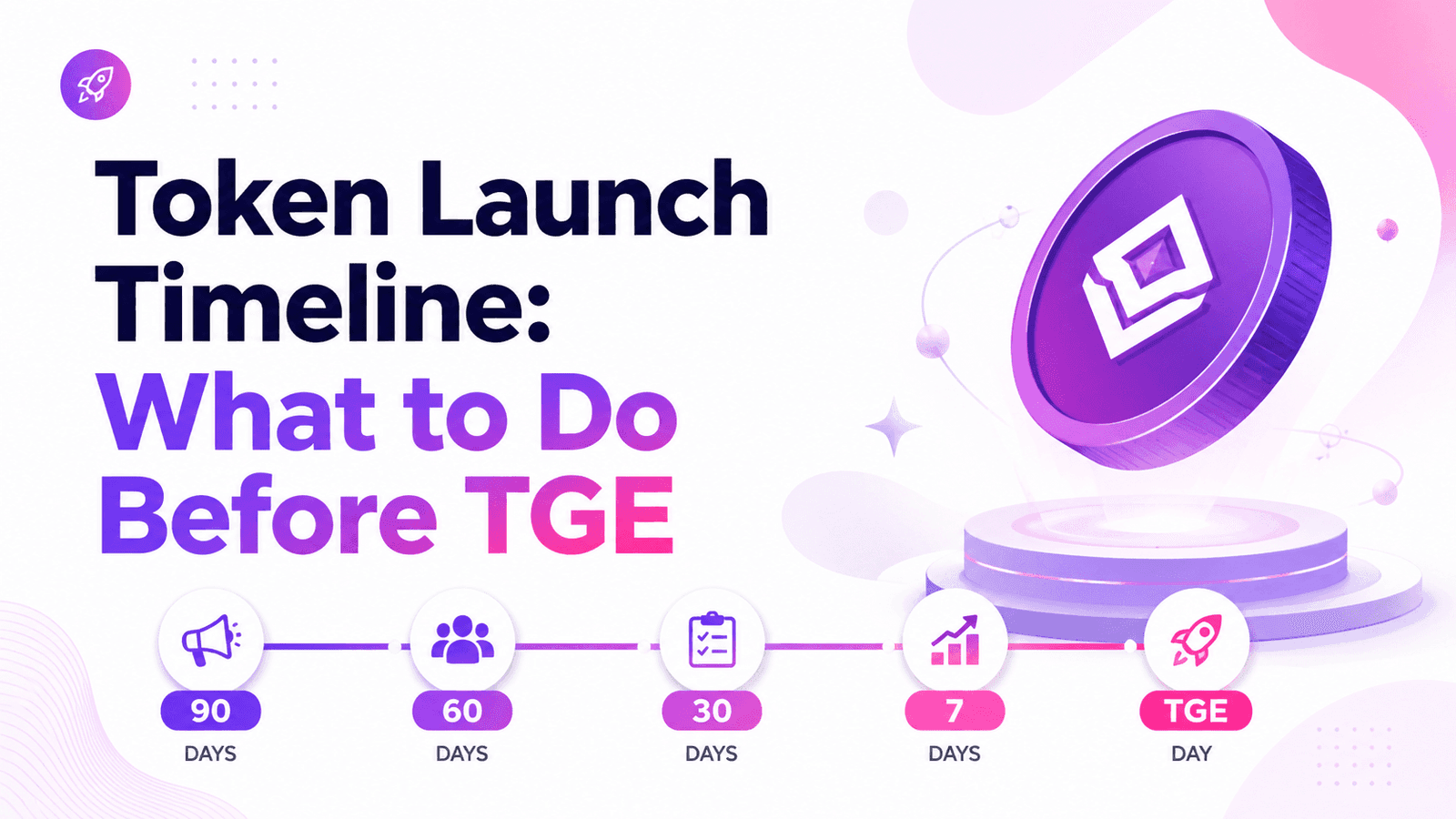
Token launch planning should be divided into clear phases. One broad launch phase makes priorities and deadlines harder to track. Teams should separate the work into 90, 60, 30, and 7-day stages. Each stage has its own tasks, owners, and readiness checks.

The table below shows how the work should progress around TGE.

Timing

Objective

Required assets

Owner

Readiness KPI

Decision gate

90 days

Approve the launch foundations

Tokenomics, narrative brief, target-market plan, budget, partner shortlist

Founder, COO, tokenomics lead, legal lead, marketing lead

0 unowned critical blockers; 100% of public token facts aligned.

Continue only after legal, security, tokenomics, and budget approval.

60 days

Build the audience and participant setup

Content calendar, community plan, KOL and PR briefs, regional plan, wallet, KYC, claim, and tracking flows

Marketing lead, community lead, growth lead, product lead, compliance lead

100% of partner briefs approved; every participant step testable.

Start wider promotion only when messaging and participant flows are ready.

30 days

Sequence promotion and complete testing

Campaign calendar, partner confirmations, exchange plan, market-maker plan, test report, support routes

Growth lead, partnerships lead, product lead, market-making lead, support lead

100% of partner confirmations documented; 0 unresolved critical test failures.

Enter the final week only after integrations and critical fixes are complete.

7 days

Freeze changes and prepare launch operations

Final links and contracts, launch runbook, announcement plan, FAQs, moderation roster, dashboards, contingency plans

COO, product lead, security lead, marketing lead, community lead

100% of launch roles staffed; 0 open critical issues.

Proceed to TGE only when no critical issue remains open.

TGE onward

Run support and post-launch communication

Support plan, issue log, reporting dashboard, follow-up schedule

Product lead, support lead, community lead, marketing lead, analytics lead

100% of incidents assigned within the agreed escalation time.

Complete the handoff once post-launch owners are active.

As the table shows, each phase prepares the next one. The first stage sets the launch foundations. The second builds the audience and supporting systems. The final month focuses on promotion, testing, and launch control.

Teams should set the TGE date first, then work backward. Each workstream needs a clear owner, deadline, output, and approval point. AP Collective uses 90 days as a practical starting point. Launches across several regions or with complex integrations may need longer. Projects pursuing complex exchange integrations may need to begin partner coordination several months earlier.

How to Reverse-Plan a Token Launch From a Fixed TGE Date

Teams should confirm the target TGE date first. They can then divide the launch into separate workstreams. These include tokenomics, narrative, community, KOLs, PR, exchanges, wallet, KYC, analytics, and support.

Each workstream needs an owner, deadline, dependency, expected output, and approval point. Teams then place each output at its latest safe completion date.

The timeline table above shows what should be ready at each milestone. Reverse-planning shows how every team reaches those milestones on time. It also reveals which delays may affect the wider launch.

90 Days Before TGE: Lock the Launch Foundations

The 90-day mark starts the main planning phase. At this stage, projects must confirm whether the launch is ready. The token model, markets, budget, and partner plans need approval. These decisions should be clear before wider promotion begins. The work falls into three main areas:

1. Confirm the Project Is Ready for TGE

Teams should first confirm whether the planned TGE remains feasible. All functions that may cause delays to launch should be included in the review.

  • Assess product, legal, security, treasury, governance and support preparedness.

  • Identify an owner and timeline for each critical gap.

  • Prioritize launch blockers from lower priority improvements.

  • Establish escalation procedures for delayed approvals and partner dependencies.

  • When there are significant risks that have not been addressed, reconsider the TGE date.

A structured token launch readiness review helps identify these gaps early.

2. Finalize Token Utility, Tokenomics, and Narrative

Prior to KOL and PR activities, the token model should be stable. It provides campaigns, partners and communities with one source of truth.

  • Verify the token’s purpose, target users, and role within the product.

  • Complete supply, allocation, vesting, unlocks and distribution.

  • Align token information across partner documents and public channels.

  • Write a single story for the founders, KOLs, media and communities.

  • Confirm that the token’s purpose remains clear without discussing price.

Late changes can create inconsistencies across exchange documents, website copy, campaign briefs, and community channels.

3. Confirm Markets, Budget, Partners, and Community Setup

After finalizing the token model, teams can prepare each target market for launch. Local content, support and access needs are added to each target market.

  • Choose target markets that are commercially relevant and operationally feasible.

  • Create budgets for content, KOLs, PR, community and localization.

  • Integrate analytics and launch support in the core budget.

  • Keep listing fees and other direct costs separate from the marketing budget.

  • Start exchange or launchpad applications and prepare the required documents.

  • Start wallet, KYC, analytics and market making coordination.

  • Develop moderation procedures, FAQs, reporting processes, and escalation contacts.

These foundations should be approved by day 60. All open issues should have an owner and a time frame.

60 Days Before TGE: Build the Audience and Participant Flows

The 60-day stage begins audience building and campaign setup. Projects now turn approved plans into public content and community activity. KOLs, PR partners, and regional teams also begin their work. At the same time, teams build and test the participant journey. The work covers three main areas.

1. Start Content and Community Education

Owned channels should explain the project before wider promotion begins. The website, documentation, founder content, and community answers need consistent messaging.

  • Publish content about the market problem and product.

  • Explain token utility after the product context is clear.

  • Prepare participation details for later campaign stages.

  • Set a regular schedule for community education.

  • Give moderators approved answers and escalation contacts.

  • Track repeated questions that may reveal unclear messaging.

Community growth alone does not show launch readiness. Members should understand the product, token role, and next steps.

2. Brief KOLs, PR Partners, and Regional Teams

KOL and PR planning should begin once the narrative is approved. Each partner needs a clear role within the campaign.

  • Select KOLs based on audience fit, region, and credibility.

  • Use early creator content for education and awareness.

  • Save action-focused content for later campaign stages.

  • Prepare one brief with approved messages and key facts.

  • Build PR plans around audits, partnerships, and product progress.

  • Assign local creators, media, and moderators to priority regions.

The token sale channel sequencing framework explains how these channels should support each other. Narrative and community work come first. Wider KOL and PR activity follows.

3. Build and Test the Participant Journey

The full participant flow should now be connected. Product, growth, and community teams should review it together.

  • Build the landing page and wallet connection flow.

  • Connect KYC and eligibility checks where required.

  • Prepare purchase, claim, and vesting views.

  • Track activity from the first campaign visit.

  • Record where participants leave or face errors.

  • Prepare support steps for wallet, KYC, and claim issues.

  • Test the flow with someone outside the build team.

A technically working flow may still confuse new participants. Testing should cover both system errors and unclear instructions.

By day 30, audience activity should be running. KOL and PR plans should be approved. The full participant journey should also be ready for end-to-end testing.

30 Days Before TGE: Sequence Marketing and Test Conversion

The final month brings more visibility without adding more confusion. Campaign activity now follows the audience’s information needs.

How Should Marketing Be Sequenced Before Token Listing?

A practical sequence moves through three stages.

  1. Education explains the market, product, and problem.

  2. Understanding covers utility, tokenomics, and ecosystem roles.

  3. Action explains access, timing, eligibility, and next steps.

KOLs, PR, founder content, and community activity follow this order. Each message prepares the audience for the next one. Broad promotion works better after the story is clear. Action content works better after enough context exists.

Confirm Exchange and Market-Maker Coordination

By the 30-day mark, partner plans should be confirmed in writing. Each partner needs clear deadlines, deliverables, communication rules, and escalation contacts.

Listing claims should remain private until the exchange approves them. Campaign timing must also follow technical and contractual milestones. Marketing should not run ahead of an unfinished integration.

Market-making plans need the same level of detail. Funding, launch timing, reporting, and incident response should each have a named owner. This prevents operational questions from moving between teams during launch week.

Test the Journey From First Click to Final Status

The team should now test the full participant journey. The test starts from a live campaign link and ends with a clear status.

Can a new participant complete every step without private support? Someone outside the build team should run at least one test. Internal teams often miss unclear steps because they already know the process.

Testing should cover devices, browsers, wallets, regions, and common errors. Support routing also needs review. Wallet, KYC, and claim issues may need different owners. Each case should still reach the correct team quickly.

7 Days Before TGE: Freeze, Verify, and Staff the Launch

The final week is for control. Large changes now create more risk than value. Critical pages, token details, contracts, and access flows need formal change control. Necessary fixes may continue, but every fix needs a reviewer and rollback plan.

A full rehearsal includes leadership, product, marketing, community, and support. Partners join where their actions affect timing.

Area

Final check

Contracts and links

Addresses, domains, wallets, and claim pages match

Announcements

Timing, wording, and partner approvals are final

Community

FAQs, shifts, and escalation contacts are ready

Dashboards

Traffic, KYC, wallets, claims, and support remain visible

Contingencies

Delays, outages, misinformation, and impersonation have owners

Announcements follow a controlled schedule. Listing news, token details, and access instructions need separate moments.

Moderation coverage also needs enough depth. Launch week often brings repeated questions, scams, and false links. Approved answers and rapid escalation reduce that pressure.

The final decision remains practical. Critical systems must pass testing, public information needs approval, and partners must confirm readiness.

Go / No-Go Checkpoints Before TGE

After the four planning phases, teams should confirm whether the launch can move forward. Each checkpoint should cover the work completed during the previous phase.

Checkpoint

Go when

No-go when

By day 60

Tokenomics, narrative, target markets, and budget are approved. Partner preparation and community setup have started.

Major token, legal, budget, or ownership issues remain open.

By day 30

Content and community activity are live. KOL, PR, and regional plans are approved. The participant flow is fully testable.

Promotion starts before messaging, partners, or participant flows are ready.

By day 7

Exchange and market-maker roles are confirmed. The full participant journey has passed testing. Critical launch details are final.

Partner approval, testing, or important launch details remain unresolved.

Final TGE approval

Contracts, links, announcements, moderation shifts, dashboards, and contingency owners are confirmed.

Any critical security, legal, access, or operational issue remains open.

A no-go decision does not always require a long delay. However, the responsible owner must resolve the issue before launch continues.

TGE Day and the First 72 Hours

TGE does not end the launch process. It shifts execution into live operations. Teams must move from planning into real-time monitoring, support, and incident handling during the first 72 hours.

In the first three phases after TGE:

  • TGE to 24 hours: Monitor wallet, KYC, purchase, claim, exchange, market-maker, support, and scam activity.

  • Within 24 hours: Review system performance, support demand, partner status, and unresolved incidents.

  • Within 72 hours: Produce a performance and incident report with owners, deadlines, and next actions.

This ensures launch execution stays controlled during the most sensitive period. It also keeps ownership clear while the system transitions from planning into live operations.

Turn Your TGE Date Into a 90-Day Operating Plan

A token launch needs one shared plan across every workstream. Tokenomics, narrative, community, KOLs, PR, and partner work must stay aligned. Wallet, KYC, analytics, and post-launch support follow the same schedule.

TokenMinds helps teams turn a target TGE date into that operating plan. Founders keep control of product, token, and business decisions. TokenMinds supports the planning, coordination, and execution around them.

Need to turn a target TGE date into an executable roadmap? Book a 90-day TGE planning sprint with TokenMinds.

FAQs

How long before TGE should token launch planning start?
Most teams should start at least 90 days before TGE. Larger or multi-region launches may need six months.

What should be ready 30 days before a token launch?
Content and community activity should be live. Partner plans should be approved, and participant flows should be fully testable.

What happens in the final 7 days before TGE?
Teams freeze critical changes and run final checks. Links, contracts, moderation shifts, dashboards, and contingency owners should be confirmed.

What should a project do 90 days before TGE?
Teams should confirm launch feasibility, finalize tokenomics and narrative, approve target markets and budgets, begin exchange applications, and assign owners to every critical blocker.

What does a token launch timeline look like?
A practical token launch timeline moves through launch foundations at 90 days, audience and infrastructure development at 60 days, promotion and testing at 30 days, and final launch control during the last seven days.

How should marketing be sequenced before token listing?
Marketing should move from education to understanding and then action. Product and market education should come first, followed by token utility and ecosystem content. Participation instructions and conversion campaigns should appear closer to TGE.

TL;DR

Token launches in 2026 leave little room for rushed planning. Teams should set the TGE date first, then work backward. A 90-day window provides a practical planning baseline for many token launches. Each phase should cover clear tasks, owners, deadlines, and approval points. At 90 days, teams lock the launch foundations. At 60 days, audience and participant work begins. At 30 days, promotion expands and full testing starts. The final week focuses on launch control and final checks. Go/no-go checkpoints should guide each stage. Planning should also cover post-TGE support, claims, communications, and reporting. 

The 2026 Token Launch Planning Landscape

Token launches entered 2026 in a more selective market. CoinGecko reported a 20.4% market decline during Q1. Centralized exchange spot volume also fell 39.1%. Weak market momentum leaves less room for rushed launch decisions.

Recent token sale performance reflects that pressure. Decasonic reviewed 45 tokens launched from February through April 2026. Only 40% traded above their TGE closing price after 30 days. After 60 days, that share fell to 28%. This is not a universal launch success rate. However, it shows why valuation, distribution, liquidity, messaging, and timing must align before TGE.

The token launch timeline below turns those dependencies into one operating plan.

What Does a Token Launch Timeline Look Like?

Token launch planning should be divided into clear phases. One broad launch phase makes priorities and deadlines harder to track. Teams should separate the work into 90, 60, 30, and 7-day stages. Each stage has its own tasks, owners, and readiness checks.

The table below shows how the work should progress around TGE.

Timing

Objective

Required assets

Owner

Readiness KPI

Decision gate

90 days

Approve the launch foundations

Tokenomics, narrative brief, target-market plan, budget, partner shortlist

Founder, COO, tokenomics lead, legal lead, marketing lead

0 unowned critical blockers; 100% of public token facts aligned.

Continue only after legal, security, tokenomics, and budget approval.

60 days

Build the audience and participant setup

Content calendar, community plan, KOL and PR briefs, regional plan, wallet, KYC, claim, and tracking flows

Marketing lead, community lead, growth lead, product lead, compliance lead

100% of partner briefs approved; every participant step testable.

Start wider promotion only when messaging and participant flows are ready.

30 days

Sequence promotion and complete testing

Campaign calendar, partner confirmations, exchange plan, market-maker plan, test report, support routes

Growth lead, partnerships lead, product lead, market-making lead, support lead

100% of partner confirmations documented; 0 unresolved critical test failures.

Enter the final week only after integrations and critical fixes are complete.

7 days

Freeze changes and prepare launch operations

Final links and contracts, launch runbook, announcement plan, FAQs, moderation roster, dashboards, contingency plans

COO, product lead, security lead, marketing lead, community lead

100% of launch roles staffed; 0 open critical issues.

Proceed to TGE only when no critical issue remains open.

TGE onward

Run support and post-launch communication

Support plan, issue log, reporting dashboard, follow-up schedule

Product lead, support lead, community lead, marketing lead, analytics lead

100% of incidents assigned within the agreed escalation time.

Complete the handoff once post-launch owners are active.

As the table shows, each phase prepares the next one. The first stage sets the launch foundations. The second builds the audience and supporting systems. The final month focuses on promotion, testing, and launch control.

Teams should set the TGE date first, then work backward. Each workstream needs a clear owner, deadline, output, and approval point. AP Collective uses 90 days as a practical starting point. Launches across several regions or with complex integrations may need longer. Projects pursuing complex exchange integrations may need to begin partner coordination several months earlier.

How to Reverse-Plan a Token Launch From a Fixed TGE Date

Teams should confirm the target TGE date first. They can then divide the launch into separate workstreams. These include tokenomics, narrative, community, KOLs, PR, exchanges, wallet, KYC, analytics, and support.

Each workstream needs an owner, deadline, dependency, expected output, and approval point. Teams then place each output at its latest safe completion date.

The timeline table above shows what should be ready at each milestone. Reverse-planning shows how every team reaches those milestones on time. It also reveals which delays may affect the wider launch.

90 Days Before TGE: Lock the Launch Foundations

The 90-day mark starts the main planning phase. At this stage, projects must confirm whether the launch is ready. The token model, markets, budget, and partner plans need approval. These decisions should be clear before wider promotion begins. The work falls into three main areas:

1. Confirm the Project Is Ready for TGE

Teams should first confirm whether the planned TGE remains feasible. All functions that may cause delays to launch should be included in the review.

  • Assess product, legal, security, treasury, governance and support preparedness.

  • Identify an owner and timeline for each critical gap.

  • Prioritize launch blockers from lower priority improvements.

  • Establish escalation procedures for delayed approvals and partner dependencies.

  • When there are significant risks that have not been addressed, reconsider the TGE date.

A structured token launch readiness review helps identify these gaps early.

2. Finalize Token Utility, Tokenomics, and Narrative

Prior to KOL and PR activities, the token model should be stable. It provides campaigns, partners and communities with one source of truth.

  • Verify the token’s purpose, target users, and role within the product.

  • Complete supply, allocation, vesting, unlocks and distribution.

  • Align token information across partner documents and public channels.

  • Write a single story for the founders, KOLs, media and communities.

  • Confirm that the token’s purpose remains clear without discussing price.

Late changes can create inconsistencies across exchange documents, website copy, campaign briefs, and community channels.

3. Confirm Markets, Budget, Partners, and Community Setup

After finalizing the token model, teams can prepare each target market for launch. Local content, support and access needs are added to each target market.

  • Choose target markets that are commercially relevant and operationally feasible.

  • Create budgets for content, KOLs, PR, community and localization.

  • Integrate analytics and launch support in the core budget.

  • Keep listing fees and other direct costs separate from the marketing budget.

  • Start exchange or launchpad applications and prepare the required documents.

  • Start wallet, KYC, analytics and market making coordination.

  • Develop moderation procedures, FAQs, reporting processes, and escalation contacts.

These foundations should be approved by day 60. All open issues should have an owner and a time frame.

60 Days Before TGE: Build the Audience and Participant Flows

The 60-day stage begins audience building and campaign setup. Projects now turn approved plans into public content and community activity. KOLs, PR partners, and regional teams also begin their work. At the same time, teams build and test the participant journey. The work covers three main areas.

1. Start Content and Community Education

Owned channels should explain the project before wider promotion begins. The website, documentation, founder content, and community answers need consistent messaging.

  • Publish content about the market problem and product.

  • Explain token utility after the product context is clear.

  • Prepare participation details for later campaign stages.

  • Set a regular schedule for community education.

  • Give moderators approved answers and escalation contacts.

  • Track repeated questions that may reveal unclear messaging.

Community growth alone does not show launch readiness. Members should understand the product, token role, and next steps.

2. Brief KOLs, PR Partners, and Regional Teams

KOL and PR planning should begin once the narrative is approved. Each partner needs a clear role within the campaign.

  • Select KOLs based on audience fit, region, and credibility.

  • Use early creator content for education and awareness.

  • Save action-focused content for later campaign stages.

  • Prepare one brief with approved messages and key facts.

  • Build PR plans around audits, partnerships, and product progress.

  • Assign local creators, media, and moderators to priority regions.

The token sale channel sequencing framework explains how these channels should support each other. Narrative and community work come first. Wider KOL and PR activity follows.

3. Build and Test the Participant Journey

The full participant flow should now be connected. Product, growth, and community teams should review it together.

  • Build the landing page and wallet connection flow.

  • Connect KYC and eligibility checks where required.

  • Prepare purchase, claim, and vesting views.

  • Track activity from the first campaign visit.

  • Record where participants leave or face errors.

  • Prepare support steps for wallet, KYC, and claim issues.

  • Test the flow with someone outside the build team.

A technically working flow may still confuse new participants. Testing should cover both system errors and unclear instructions.

By day 30, audience activity should be running. KOL and PR plans should be approved. The full participant journey should also be ready for end-to-end testing.

30 Days Before TGE: Sequence Marketing and Test Conversion

The final month brings more visibility without adding more confusion. Campaign activity now follows the audience’s information needs.

How Should Marketing Be Sequenced Before Token Listing?

A practical sequence moves through three stages.

  1. Education explains the market, product, and problem.

  2. Understanding covers utility, tokenomics, and ecosystem roles.

  3. Action explains access, timing, eligibility, and next steps.

KOLs, PR, founder content, and community activity follow this order. Each message prepares the audience for the next one. Broad promotion works better after the story is clear. Action content works better after enough context exists.

Confirm Exchange and Market-Maker Coordination

By the 30-day mark, partner plans should be confirmed in writing. Each partner needs clear deadlines, deliverables, communication rules, and escalation contacts.

Listing claims should remain private until the exchange approves them. Campaign timing must also follow technical and contractual milestones. Marketing should not run ahead of an unfinished integration.

Market-making plans need the same level of detail. Funding, launch timing, reporting, and incident response should each have a named owner. This prevents operational questions from moving between teams during launch week.

Test the Journey From First Click to Final Status

The team should now test the full participant journey. The test starts from a live campaign link and ends with a clear status.

Can a new participant complete every step without private support? Someone outside the build team should run at least one test. Internal teams often miss unclear steps because they already know the process.

Testing should cover devices, browsers, wallets, regions, and common errors. Support routing also needs review. Wallet, KYC, and claim issues may need different owners. Each case should still reach the correct team quickly.

7 Days Before TGE: Freeze, Verify, and Staff the Launch

The final week is for control. Large changes now create more risk than value. Critical pages, token details, contracts, and access flows need formal change control. Necessary fixes may continue, but every fix needs a reviewer and rollback plan.

A full rehearsal includes leadership, product, marketing, community, and support. Partners join where their actions affect timing.

Area

Final check

Contracts and links

Addresses, domains, wallets, and claim pages match

Announcements

Timing, wording, and partner approvals are final

Community

FAQs, shifts, and escalation contacts are ready

Dashboards

Traffic, KYC, wallets, claims, and support remain visible

Contingencies

Delays, outages, misinformation, and impersonation have owners

Announcements follow a controlled schedule. Listing news, token details, and access instructions need separate moments.

Moderation coverage also needs enough depth. Launch week often brings repeated questions, scams, and false links. Approved answers and rapid escalation reduce that pressure.

The final decision remains practical. Critical systems must pass testing, public information needs approval, and partners must confirm readiness.

Go / No-Go Checkpoints Before TGE

After the four planning phases, teams should confirm whether the launch can move forward. Each checkpoint should cover the work completed during the previous phase.

Checkpoint

Go when

No-go when

By day 60

Tokenomics, narrative, target markets, and budget are approved. Partner preparation and community setup have started.

Major token, legal, budget, or ownership issues remain open.

By day 30

Content and community activity are live. KOL, PR, and regional plans are approved. The participant flow is fully testable.

Promotion starts before messaging, partners, or participant flows are ready.

By day 7

Exchange and market-maker roles are confirmed. The full participant journey has passed testing. Critical launch details are final.

Partner approval, testing, or important launch details remain unresolved.

Final TGE approval

Contracts, links, announcements, moderation shifts, dashboards, and contingency owners are confirmed.

Any critical security, legal, access, or operational issue remains open.

A no-go decision does not always require a long delay. However, the responsible owner must resolve the issue before launch continues.

TGE Day and the First 72 Hours

TGE does not end the launch process. It shifts execution into live operations. Teams must move from planning into real-time monitoring, support, and incident handling during the first 72 hours.

In the first three phases after TGE:

  • TGE to 24 hours: Monitor wallet, KYC, purchase, claim, exchange, market-maker, support, and scam activity.

  • Within 24 hours: Review system performance, support demand, partner status, and unresolved incidents.

  • Within 72 hours: Produce a performance and incident report with owners, deadlines, and next actions.

This ensures launch execution stays controlled during the most sensitive period. It also keeps ownership clear while the system transitions from planning into live operations.

Turn Your TGE Date Into a 90-Day Operating Plan

A token launch needs one shared plan across every workstream. Tokenomics, narrative, community, KOLs, PR, and partner work must stay aligned. Wallet, KYC, analytics, and post-launch support follow the same schedule.

TokenMinds helps teams turn a target TGE date into that operating plan. Founders keep control of product, token, and business decisions. TokenMinds supports the planning, coordination, and execution around them.

Need to turn a target TGE date into an executable roadmap? Book a 90-day TGE planning sprint with TokenMinds.

FAQs

How long before TGE should token launch planning start?
Most teams should start at least 90 days before TGE. Larger or multi-region launches may need six months.

What should be ready 30 days before a token launch?
Content and community activity should be live. Partner plans should be approved, and participant flows should be fully testable.

What happens in the final 7 days before TGE?
Teams freeze critical changes and run final checks. Links, contracts, moderation shifts, dashboards, and contingency owners should be confirmed.

What should a project do 90 days before TGE?
Teams should confirm launch feasibility, finalize tokenomics and narrative, approve target markets and budgets, begin exchange applications, and assign owners to every critical blocker.

What does a token launch timeline look like?
A practical token launch timeline moves through launch foundations at 90 days, audience and infrastructure development at 60 days, promotion and testing at 30 days, and final launch control during the last seven days.

How should marketing be sequenced before token listing?
Marketing should move from education to understanding and then action. Product and market education should come first, followed by token utility and ecosystem content. Participation instructions and conversion campaigns should appear closer to TGE.

GET SUCCESS IN WEB3

  • Trusted Web3 partner since 2017

  • Full-stack Web3 development team

  • Performance-driven Web3 marketing

Get A Free Consultation

Get A Free Consultation

MEET US AT

RECENT TRAININGS

Follow us

get web3 business updates

Email invalid

  • Access global liquidity for your RWA project with TMX Tokenize’s Canton Network integration

DISCOVER NOW

  • Access global liquidity for your RWA project with TMX Tokenize’s Canton Network integration

    JOIN NOW

DISCOVER

  • Access global liquidity for your RWA project with TMX Tokenize’s Canton Network integration