Web3 & AI

SOLUTIONS

Products

Services

Web3 & AI

SOLUTIONS

Services

Products

Industries

Become Our Client

About Us

Resources

Web3 & AI

SOLUTIONS

Services

Products

Industries

How to Launch a Token: Complete 2026 Guide

How to Launch a Token: Complete 2026 Guide

How to Launch a Token

TL;DR: Launching a token in 2026 takes eight steps, from setting the goal and auditing the contract to running the sale, listing, and activating governance. Compliance shapes every step, with the SEC's new token taxonomy in the US and MiCA fully in force in the EU. Most public sales now run through curated launchpads like Coinbase Token Sales and Legion, which reward projects that build a community early. A lean launch costs under $100,000, and the full process usually takes six to nine months.

Launching a token is now a structured business process. In the early days, Initial Coin Offerings (ICOs) went live with little planning or compliance. Today, founders and executives must treat a token launch as a multi-stage project. It involves regulation, tokenomics, security, and marketing. Learn how leading Web3 projects plan successful token launches in our article: “Crypto IPO Guide for Founders & Executives”.

This guide explains how to launch a token in 2026. It covers planning, compliance, funding, and promotion. Each step helps ensure the launch is credible and sustainable. Explore our Token Launch Checklist to streamline your process.

Why Launch a Token?

Tokens serve more than fundraising goals. They create new ways for businesses to build ownership and liquidity. A well-designed token can:

  • Raise capital through a token sale

  • Motivate community action

  • Give rights of governance to the users

  • Facilitate liquidity in the digital markets

Types of tokens include:

  • Utility tokens: Give access to services or features

  • Governance tokens: Provide voting rights in protocols or DAOs

  • Security tokens: Represent regulated, asset-backed offerings

  • Hybrid tokens: Combine features such as utility and governance

The decision to launch must support the company’s strategy, not just raise funds.

Investors are drawn to tokens because they provide early access to upside, transparent governance rights, and participation in fast-growing digital ecosystems. For many backers, liquidity potential is as important as the long-term vision.

Also read our article: “Token Sale Complete Guide for Web3 Firms” to learn how token sales fuel Web3 growth. Explore structures, compliance steps, and launch strategies for founders and executives.

Key Pre-Launch Considerations

Regulatory Compliance

Compliance comes first because it decides what kind of token a project can sell, to whom, and how. The rules changed a lot in 2025 and 2026, and the three main markets now look like this.

  • United States
    On March 17, 2026, the SEC issued an interpretive release that sorts crypto assets into five groups: digital commodities, digital collectibles, digital tools, stablecoins, and digital securities. Only digital securities are securities by default. A utility or governance token can still fall under securities law if it is sold with promises that the team's work will raise its value, so the wording of the sale matters as much as the token design. Stablecoins now have their own federal law, the GENIUS Act, signed in July 2025. The wider market structure bill, the CLARITY Act, passed the House in July 2025 and is scheduled for a Senate vote in September 2026. It is still pending, not law.

  • European Union
    MiCA is now fully in force. Its transitional period ended on July 1, 2026, so any exchange or launchpad operating in the EU must hold a MiCA licence. A project offering a utility token to the EU public must publish a crypto-asset white paper and notify a national regulator before the sale opens.

  • Other regions
    Singapore, Switzerland, Dubai, and Hong Kong have clear token rules and remain common bases for launches. All still apply KYC and AML checks to buyers, and most exchanges ask for a legal opinion on the token's status before listing.

Because these rules shape tokenomics and sale design, a project should bring in a crypto lawyer before the token is finalised, not after. Working with an ICO development company that knows these markets reduces risk, and a crypto advisory partner can help connect the team with exchanges and launchpads.

Tokenomics Design

Sound economics protect the token and its holders. Executives should plan:

  • Allocation between team, investors, and community

  • Vesting schedules that prevent early dumps

  • Liquidity pools to support exchange trading

Website and Branding

Secure the domain and build the project website early. A clear site builds trust, gives buyers one official source of information, and makes phishing copies easier to spot. Apply basic SEO so the project appears in search, and keep the site updated as the main hub for investor and community communication.

Token Allocation and Vesting Example
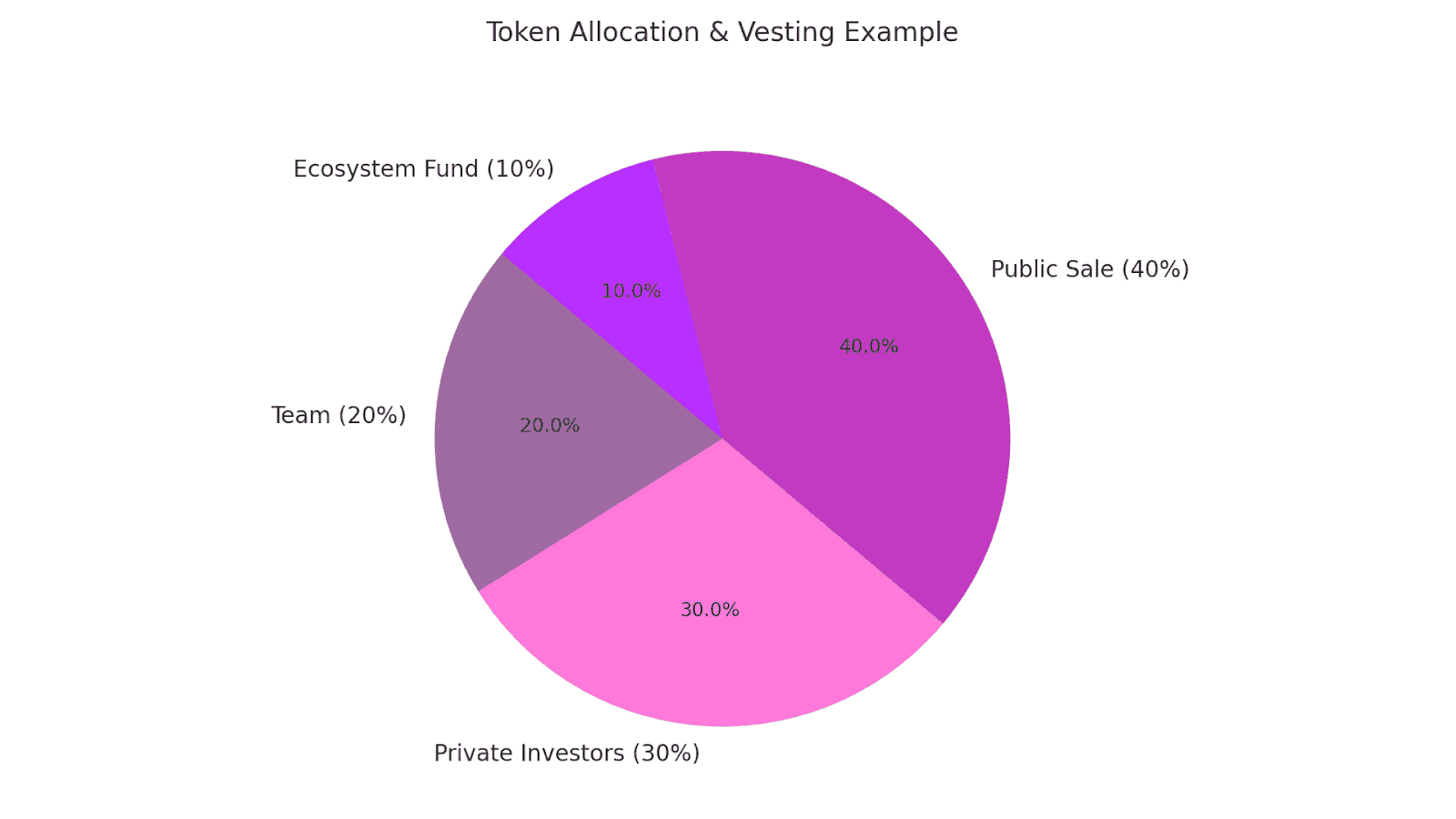
Token Allocation vs Vesting Example

This chart shows how tokens can be divided between the team, investors, the public sale, and the ecosystem fund. Fair allocation and vesting protect long-term value.

Technology Stack

The technical setup defines performance:

  • Blockchain: Ethereum offers liquidity, BNB Chain offers lower fees, Solana offers high speed.

  • Smart contracts: Must pass audits.

  • Interoperability: Needed if tokens will move across chains.

Next — explore the major token sale models in detail. Read our article: “The 4 Stages of a Token Sale for Modern Businesses”.

Token Sale Models Explained

Most launches include a sale. Common models are:

  • ICO (Initial Coin Offering): The project sells directly 

  • IDO (Initial DEX Offering): Sold on decentralized exchanges to get quick liquidity

  • IEO (Initial Exchange Offering): Sold on centralized exchanges, with the advantages of trust and user access

Rounds may be private (strategic investors) or public (retail). Vesting should apply to both.

If public demand may exceed the tokens on offer, read this article titled Token Sale Oversubscription Strategy: How to Allocate Tokens Fairly When Demand Exceeds Supply. It explains how to set allocation rules, buyer caps, priority tiers, and refunds before the sale opens.

Executives can review token sale structure before choosing a model. Tailored ICO development helps avoid mistakes.

ICO vs IDO vs IEO

Model

Access

Compliance

Liquidity

Cost

ICO

Direct

Moderate

Low until listing

Lower setup

IDO

DEX users

Lower

High at launch

Mid-range

IEO

Exchange users

Higher

Exchange-provided

Higher fees

Investor engagement is critical regardless of model. Early backers, exchange partners, and advisors drive token adoption early on. A clear investor communication strategy should be built alongside tokenomics.

Exchange Strategy Tip: Ttrade at launchpads and exchanges earlier in order to have your liquidity and marketing afterward. It has become a routine best practice to negotiate with exchanges prior to the public sale. Want to learn how to negotiate with exchanges and secure liquidity? Dive into our article: “Top Token Launchpads in 2026” for expert strategies and best practices!

Where Token Sales Happen in 2026, and What a Launch Costs

Most public sales now run through a new generation of launchpads, platforms that verify buyers, collect funds, and deliver tokens. Older launchpads sold to whoever paid first. The new ones select buyers by reputation and activity, so a project must arrive with a real community.

Platform

How buyers get allocation

What the project must bring

Coinbase Token Sales

Small orders fill first, early sellers lose future access

Many real users, not a few large wallets

Legion

Reputation score from wallet history, GitHub, and social reach

Builders and credible voices in the community

Buidlpad

Staked capital plus a leaderboard for content and promotion

Active promoters before the sale opens

Kaito Launchpad

Allocation for people driving real discussion on X

A story worth talking about for weeks

Slots are limited. Coinbase runs about one sale per month, and Legion's Yield Basis sale was oversubscribed 98 times in under a day. The capital is there, with public sales raising $1.42 billion from January to July 2026, but it goes to projects that prepared early.

That preparation is where the budget goes. The main cost lines in 2026:

Cost line

Typical range

Source

Smart contract audit

$10,000 to $60,000

Sherlock, 2026 token launch playbook

Legal opinion and compliance

$5,000 to $20,000

Sherlock

Marketing and community

$25,000 to $60,000 lean, $80,000 to $180,000 standard

RGray, crypto marketing cost 2026

Centralized exchange listing

$10,000 to over $1,000,000

Sherlock

Marketing is usually the largest line, and the step-by-step process below shows where each cost lands in the sequence.

Step-by-Step Process: How to Launch a Token

A token launch works best as a sequence. Each step below builds on the one before it, and skipping ahead usually costs more later.

1. Set the goal
Decide what the token is for before anything else. It might raise capital, give access to a product, or let holders vote on decisions. This choice shapes the token type, the legal path, and the sale model, so write it down in one sentence and test every later decision against it.

2. Build the legal and technical team
Bring in a lawyer who knows crypto rules in your target markets, and a developer team that has shipped tokens before. Do this early, since legal advice changes how the token is designed. Many founders also add an advisor with exchange or launchpad contacts at this stage.

3. Build and audit the smart contract
The smart contract is the code that creates and controls the token. Keep it simple, use a proven standard such as ERC-20 or SPL, and send it to an independent audit firm before launch. An audit typically costs $10,000 to $60,000 and takes two to four weeks, and buyers and launchpads will ask to see the report.

4. Design the tokenomics and write the whitepaper
Tokenomics
is the plan for how many tokens exist, who gets them, and when they unlock. Most projects give 15 to 20% to the team, 15 to 25% to investors, and 30 to 50% to the community and ecosystem, with team tokens locked for at least 12 months. Put this plan in a short whitepaper that explains the product, the token's use, and the numbers in plain language.

5. Run the private and presale rounds
Early rounds sell tokens to strategic investors and committed community members before the public sale. They bring in first capital and partners who will support the launch. Keep prices, discounts, and vesting terms clear, because public buyers will compare them later.

6. Run the public sale
The public sale is where most projects now use a launchpad. Platforms like Coinbase Token Sales, Legion, and Buidlpad handle buyer checks, payments, and token delivery, but they select projects carefully. Apply early, meet their requirements, and have your community ready before the sale opens.

7. List on exchanges and support liquidity
After the sale, the token needs a place to trade. Most projects start with a decentralized exchange pool, then add a centralized exchange listing. Set aside a liquidity budget and, for larger launches, a market maker, so early trading stays stable.

8. Activate governance and long-term use
A token that does nothing after launch loses holders fast. Turn on the utility you promised, whether that is product access, staking, or voting. Share regular updates and let the community take part in decisions, because that is what keeps the token alive after the launch buzz fades.

Token Sale Timeline

The full sequence usually runs six to nine months. The private sale takes two to three months, the presale four to six weeks, and the public sale one to two weeks. Listing follows within days of the public sale, and governance starts in the first three months after that.

Private sale → Pre-sale → Public sale → Listing → Governance.

Executives can study token launch strategies for deeper insights.

ICO Marketing and Community Growth

Marketing is as important as development. Community trust determines token demand. Key actions include:

  • Open channels: Telegram, X, Discord, LinkedIn

  • Educate users: FAQs, AMAs, and explainers

  • Secure media: Publish press releases and insights

  • Reward supporters: Run ambassador or referral programs

A structured ICO marketing plan builds visibility. Share regular updates with investors, and work with launchpad and exchange partners to add credibility.

Risks and Challenges in Token Launches

Launching a token is complex. Common risks include:

  • Regulation: Ambiguous rules in some markets

  • Volatility: Sudden price swings damage trust

  • Security: Hacks or contract flaws

  • Reputation: Poor communication or broken promises

Working with a professional ICO development company reduces these risks. Multisig wallets, smart contract insurance, and regulated custody add further protection and reassure both retail and institutional investors.

Choosing that partner is its own decision, since every agency covers a different slice of the launch. Our comparison of the best token launch agencies ranks 10 firms by how much of the lifecycle they handle, so you can match one to your gap.

Best Practices for Token Success

  1. Communicate transparently with the community.

  2. Use staged unlocks to prevent sell-offs.

  3. Partner with exchanges to build liquidity.

  4. Ensure real-world token utility.

  5. Audit every contract and campaign.

These steps keep the launch credible and sustainable.

TokenMinds leads in ICO development with compliant, end-to-end services globally. This approach makes sure every stage of a launch meets regulations and drives market adoption.

Conclusion

Launching a token is no longer about quick fundraising. It requires discipline across regulation, tokenomics, technology, and marketing. Executives must treat it like a global product launch.

Investor trust, clear governance, smart exchange plans, and risk control make launches succeed. Amplify governance and investor confidence with expert PR. Read our article: “Web3 PR Agency Guide for Web3 Leaders.”

Ready to launch your token with confidence?

TokenMinds provides ICO development, strategy, and compliance services. Book a free consultation with TokenMinds today to plan your token sale and build long-term value.

FAQs

How long does it take to launch a token?
Six to nine months for a full launch. The private sale takes two to three months, the presale four to six weeks, and the public sale one to two weeks. Listing follows within days, and governance starts in the first three months after that.

How much does it cost to launch a token in 2026?
A smart contract audit costs $10,000 to $60,000, a legal opinion $5,000 to $20,000, and marketing $25,000 to $60,000 for a lean launch or $80,000 to $180,000 for a standard one. Centralized exchange listings range from $10,000 to over $1 million depending on the tier.

Is a token a security in the US?
It depends on the category. The SEC's March 2026 interpretive release treats digital commodities, collectibles, tools, and stablecoins as non-securities by default. Only digital securities are securities. A utility token can still be treated as one if it is sold with promises that the team's work will raise its value.

What is the difference between an ICO, IDO, and IEO?
An ICO is a sale run directly by the project. An IDO runs on a decentralized exchange or launchpad. An IEO runs on a centralized exchange, which brings trust and users but higher fees. In 2026 most public sales use curated launchpads, so all three now depend on getting accepted and building demand first.

Which launchpads should a project consider in 2026?
Coinbase Token Sales, Legion, Buidlpad, and Kaito Launchpad are the main ones. Each selects buyers differently, so a project should build its community around the platform's rules before applying.

What is the biggest mistake in a token launch?
Treating launch day as the finish line. Tokens with no utility, no communication, and large unlocks in the first months lose holders fast. Governance, regular updates, and staged unlocks keep the token alive after the launch buzz fades.


TL;DR: Launching a token in 2026 takes eight steps, from setting the goal and auditing the contract to running the sale, listing, and activating governance. Compliance shapes every step, with the SEC's new token taxonomy in the US and MiCA fully in force in the EU. Most public sales now run through curated launchpads like Coinbase Token Sales and Legion, which reward projects that build a community early. A lean launch costs under $100,000, and the full process usually takes six to nine months.

Launching a token is now a structured business process. In the early days, Initial Coin Offerings (ICOs) went live with little planning or compliance. Today, founders and executives must treat a token launch as a multi-stage project. It involves regulation, tokenomics, security, and marketing. Learn how leading Web3 projects plan successful token launches in our article: “Crypto IPO Guide for Founders & Executives”.

This guide explains how to launch a token in 2026. It covers planning, compliance, funding, and promotion. Each step helps ensure the launch is credible and sustainable. Explore our Token Launch Checklist to streamline your process.

Why Launch a Token?

Tokens serve more than fundraising goals. They create new ways for businesses to build ownership and liquidity. A well-designed token can:

  • Raise capital through a token sale

  • Motivate community action

  • Give rights of governance to the users

  • Facilitate liquidity in the digital markets

Types of tokens include:

  • Utility tokens: Give access to services or features

  • Governance tokens: Provide voting rights in protocols or DAOs

  • Security tokens: Represent regulated, asset-backed offerings

  • Hybrid tokens: Combine features such as utility and governance

The decision to launch must support the company’s strategy, not just raise funds.

Investors are drawn to tokens because they provide early access to upside, transparent governance rights, and participation in fast-growing digital ecosystems. For many backers, liquidity potential is as important as the long-term vision.

Also read our article: “Token Sale Complete Guide for Web3 Firms” to learn how token sales fuel Web3 growth. Explore structures, compliance steps, and launch strategies for founders and executives.

Key Pre-Launch Considerations

Regulatory Compliance

Compliance comes first because it decides what kind of token a project can sell, to whom, and how. The rules changed a lot in 2025 and 2026, and the three main markets now look like this.

  • United States
    On March 17, 2026, the SEC issued an interpretive release that sorts crypto assets into five groups: digital commodities, digital collectibles, digital tools, stablecoins, and digital securities. Only digital securities are securities by default. A utility or governance token can still fall under securities law if it is sold with promises that the team's work will raise its value, so the wording of the sale matters as much as the token design. Stablecoins now have their own federal law, the GENIUS Act, signed in July 2025. The wider market structure bill, the CLARITY Act, passed the House in July 2025 and is scheduled for a Senate vote in September 2026. It is still pending, not law.

  • European Union
    MiCA is now fully in force. Its transitional period ended on July 1, 2026, so any exchange or launchpad operating in the EU must hold a MiCA licence. A project offering a utility token to the EU public must publish a crypto-asset white paper and notify a national regulator before the sale opens.

  • Other regions
    Singapore, Switzerland, Dubai, and Hong Kong have clear token rules and remain common bases for launches. All still apply KYC and AML checks to buyers, and most exchanges ask for a legal opinion on the token's status before listing.

Because these rules shape tokenomics and sale design, a project should bring in a crypto lawyer before the token is finalised, not after. Working with an ICO development company that knows these markets reduces risk, and a crypto advisory partner can help connect the team with exchanges and launchpads.

Tokenomics Design

Sound economics protect the token and its holders. Executives should plan:

  • Allocation between team, investors, and community

  • Vesting schedules that prevent early dumps

  • Liquidity pools to support exchange trading

Website and Branding

Secure the domain and build the project website early. A clear site builds trust, gives buyers one official source of information, and makes phishing copies easier to spot. Apply basic SEO so the project appears in search, and keep the site updated as the main hub for investor and community communication.

Token Allocation and Vesting Example

Token Allocation vs Vesting Example

This chart shows how tokens can be divided between the team, investors, the public sale, and the ecosystem fund. Fair allocation and vesting protect long-term value.

Technology Stack

The technical setup defines performance:

  • Blockchain: Ethereum offers liquidity, BNB Chain offers lower fees, Solana offers high speed.

  • Smart contracts: Must pass audits.

  • Interoperability: Needed if tokens will move across chains.

Next — explore the major token sale models in detail. Read our article: “The 4 Stages of a Token Sale for Modern Businesses”.

Token Sale Models Explained

Most launches include a sale. Common models are:

  • ICO (Initial Coin Offering): The project sells directly 

  • IDO (Initial DEX Offering): Sold on decentralized exchanges to get quick liquidity

  • IEO (Initial Exchange Offering): Sold on centralized exchanges, with the advantages of trust and user access

Rounds may be private (strategic investors) or public (retail). Vesting should apply to both.

If public demand may exceed the tokens on offer, read this article titled Token Sale Oversubscription Strategy: How to Allocate Tokens Fairly When Demand Exceeds Supply. It explains how to set allocation rules, buyer caps, priority tiers, and refunds before the sale opens.

Executives can review token sale structure before choosing a model. Tailored ICO development helps avoid mistakes.

ICO vs IDO vs IEO

Model

Access

Compliance

Liquidity

Cost

ICO

Direct

Moderate

Low until listing

Lower setup

IDO

DEX users

Lower

High at launch

Mid-range

IEO

Exchange users

Higher

Exchange-provided

Higher fees

Investor engagement is critical regardless of model. Early backers, exchange partners, and advisors drive token adoption early on. A clear investor communication strategy should be built alongside tokenomics.

Exchange Strategy Tip: Ttrade at launchpads and exchanges earlier in order to have your liquidity and marketing afterward. It has become a routine best practice to negotiate with exchanges prior to the public sale. Want to learn how to negotiate with exchanges and secure liquidity? Dive into our article: “Top Token Launchpads in 2026” for expert strategies and best practices!

Where Token Sales Happen in 2026, and What a Launch Costs

Most public sales now run through a new generation of launchpads, platforms that verify buyers, collect funds, and deliver tokens. Older launchpads sold to whoever paid first. The new ones select buyers by reputation and activity, so a project must arrive with a real community.

Platform

How buyers get allocation

What the project must bring

Coinbase Token Sales

Small orders fill first, early sellers lose future access

Many real users, not a few large wallets

Legion

Reputation score from wallet history, GitHub, and social reach

Builders and credible voices in the community

Buidlpad

Staked capital plus a leaderboard for content and promotion

Active promoters before the sale opens

Kaito Launchpad

Allocation for people driving real discussion on X

A story worth talking about for weeks

Slots are limited. Coinbase runs about one sale per month, and Legion's Yield Basis sale was oversubscribed 98 times in under a day. The capital is there, with public sales raising $1.42 billion from January to July 2026, but it goes to projects that prepared early.

That preparation is where the budget goes. The main cost lines in 2026:

Cost line

Typical range

Source

Smart contract audit

$10,000 to $60,000

Sherlock, 2026 token launch playbook

Legal opinion and compliance

$5,000 to $20,000

Sherlock

Marketing and community

$25,000 to $60,000 lean, $80,000 to $180,000 standard

RGray, crypto marketing cost 2026

Centralized exchange listing

$10,000 to over $1,000,000

Sherlock

Marketing is usually the largest line, and the step-by-step process below shows where each cost lands in the sequence.

Step-by-Step Process: How to Launch a Token

A token launch works best as a sequence. Each step below builds on the one before it, and skipping ahead usually costs more later.

1. Set the goal
Decide what the token is for before anything else. It might raise capital, give access to a product, or let holders vote on decisions. This choice shapes the token type, the legal path, and the sale model, so write it down in one sentence and test every later decision against it.

2. Build the legal and technical team
Bring in a lawyer who knows crypto rules in your target markets, and a developer team that has shipped tokens before. Do this early, since legal advice changes how the token is designed. Many founders also add an advisor with exchange or launchpad contacts at this stage.

3. Build and audit the smart contract
The smart contract is the code that creates and controls the token. Keep it simple, use a proven standard such as ERC-20 or SPL, and send it to an independent audit firm before launch. An audit typically costs $10,000 to $60,000 and takes two to four weeks, and buyers and launchpads will ask to see the report.

4. Design the tokenomics and write the whitepaper
Tokenomics
is the plan for how many tokens exist, who gets them, and when they unlock. Most projects give 15 to 20% to the team, 15 to 25% to investors, and 30 to 50% to the community and ecosystem, with team tokens locked for at least 12 months. Put this plan in a short whitepaper that explains the product, the token's use, and the numbers in plain language.

5. Run the private and presale rounds
Early rounds sell tokens to strategic investors and committed community members before the public sale. They bring in first capital and partners who will support the launch. Keep prices, discounts, and vesting terms clear, because public buyers will compare them later.

6. Run the public sale
The public sale is where most projects now use a launchpad. Platforms like Coinbase Token Sales, Legion, and Buidlpad handle buyer checks, payments, and token delivery, but they select projects carefully. Apply early, meet their requirements, and have your community ready before the sale opens.

7. List on exchanges and support liquidity
After the sale, the token needs a place to trade. Most projects start with a decentralized exchange pool, then add a centralized exchange listing. Set aside a liquidity budget and, for larger launches, a market maker, so early trading stays stable.

8. Activate governance and long-term use
A token that does nothing after launch loses holders fast. Turn on the utility you promised, whether that is product access, staking, or voting. Share regular updates and let the community take part in decisions, because that is what keeps the token alive after the launch buzz fades.

Token Sale Timeline

The full sequence usually runs six to nine months. The private sale takes two to three months, the presale four to six weeks, and the public sale one to two weeks. Listing follows within days of the public sale, and governance starts in the first three months after that.

Private sale → Pre-sale → Public sale → Listing → Governance.

Executives can study token launch strategies for deeper insights.

ICO Marketing and Community Growth

Marketing is as important as development. Community trust determines token demand. Key actions include:

  • Open channels: Telegram, X, Discord, LinkedIn

  • Educate users: FAQs, AMAs, and explainers

  • Secure media: Publish press releases and insights

  • Reward supporters: Run ambassador or referral programs

A structured ICO marketing plan builds visibility. Share regular updates with investors, and work with launchpad and exchange partners to add credibility.

Risks and Challenges in Token Launches

Launching a token is complex. Common risks include:

  • Regulation: Ambiguous rules in some markets

  • Volatility: Sudden price swings damage trust

  • Security: Hacks or contract flaws

  • Reputation: Poor communication or broken promises

Working with a professional ICO development company reduces these risks. Multisig wallets, smart contract insurance, and regulated custody add further protection and reassure both retail and institutional investors.

Choosing that partner is its own decision, since every agency covers a different slice of the launch. Our comparison of the best token launch agencies ranks 10 firms by how much of the lifecycle they handle, so you can match one to your gap.

Best Practices for Token Success

  1. Communicate transparently with the community.

  2. Use staged unlocks to prevent sell-offs.

  3. Partner with exchanges to build liquidity.

  4. Ensure real-world token utility.

  5. Audit every contract and campaign.

These steps keep the launch credible and sustainable.

TokenMinds leads in ICO development with compliant, end-to-end services globally. This approach makes sure every stage of a launch meets regulations and drives market adoption.

Conclusion

Launching a token is no longer about quick fundraising. It requires discipline across regulation, tokenomics, technology, and marketing. Executives must treat it like a global product launch.

Investor trust, clear governance, smart exchange plans, and risk control make launches succeed. Amplify governance and investor confidence with expert PR. Read our article: “Web3 PR Agency Guide for Web3 Leaders.”

Ready to launch your token with confidence?

TokenMinds provides ICO development, strategy, and compliance services. Book a free consultation with TokenMinds today to plan your token sale and build long-term value.

FAQs

How long does it take to launch a token?
Six to nine months for a full launch. The private sale takes two to three months, the presale four to six weeks, and the public sale one to two weeks. Listing follows within days, and governance starts in the first three months after that.

How much does it cost to launch a token in 2026?
A smart contract audit costs $10,000 to $60,000, a legal opinion $5,000 to $20,000, and marketing $25,000 to $60,000 for a lean launch or $80,000 to $180,000 for a standard one. Centralized exchange listings range from $10,000 to over $1 million depending on the tier.

Is a token a security in the US?
It depends on the category. The SEC's March 2026 interpretive release treats digital commodities, collectibles, tools, and stablecoins as non-securities by default. Only digital securities are securities. A utility token can still be treated as one if it is sold with promises that the team's work will raise its value.

What is the difference between an ICO, IDO, and IEO?
An ICO is a sale run directly by the project. An IDO runs on a decentralized exchange or launchpad. An IEO runs on a centralized exchange, which brings trust and users but higher fees. In 2026 most public sales use curated launchpads, so all three now depend on getting accepted and building demand first.

Which launchpads should a project consider in 2026?
Coinbase Token Sales, Legion, Buidlpad, and Kaito Launchpad are the main ones. Each selects buyers differently, so a project should build its community around the platform's rules before applying.

What is the biggest mistake in a token launch?
Treating launch day as the finish line. Tokens with no utility, no communication, and large unlocks in the first months lose holders fast. Governance, regular updates, and staged unlocks keep the token alive after the launch buzz fades.
GET SUCCESS IN WEB3

  • Trusted Web3 partner since 2017

  • Full-stack Web3 development team

  • Performance-driven Web3 marketing

Get A Free Consultation

Get A Free Consultation

MEET US AT

RECENT TRAININGS

Follow us

get web3 business updates

Email invalid

  • Access global liquidity for your RWA project with TMX Tokenize’s Canton Network integration

DISCOVER NOW

  • Access global liquidity for your RWA project with TMX Tokenize’s Canton Network integration

    JOIN NOW

DISCOVER

  • Access global liquidity for your RWA project with TMX Tokenize’s Canton Network integration