
Web3 & AI

SOLUTIONS

Products

Services

Web3 & AI

SOLUTIONS

Services

Products

Industries

Become Our Client

About Us

Resources

Web3 & AI

SOLUTIONS

Services

Products

Industries

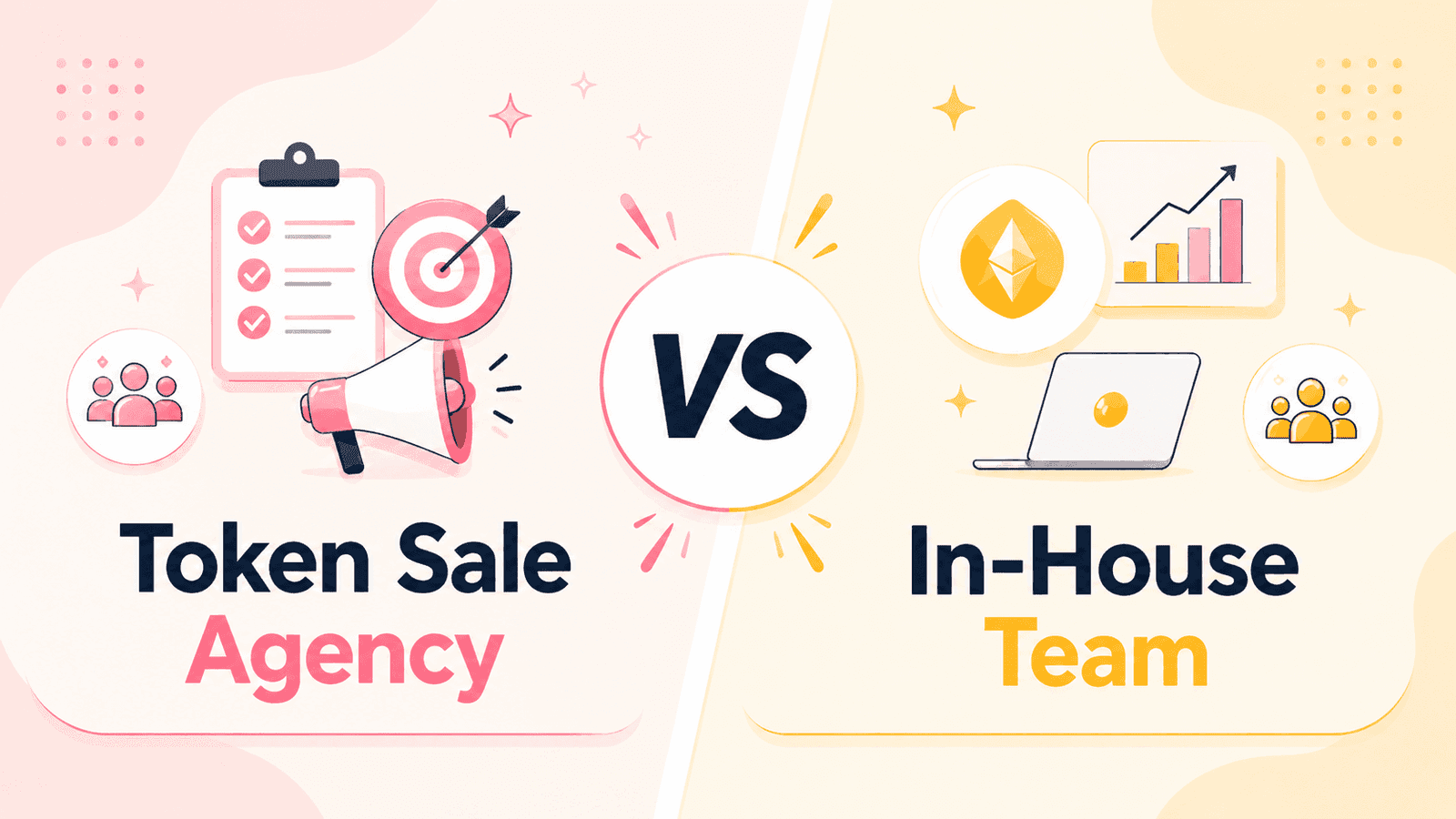
Token Sale Agency vs In-House Team: What Should Founders Choose for GTM, Tokenomics, UX, and Community Growth

Token Sale Agency vs In-House Team: What Should Founders Choose for GTM, Tokenomics, UX, and Community Growth

TL;DR
A token sale agency should not replace founder ownership. Founders still need to control strategy, positioning, approvals, product direction, and final launch decisions. An in-house team works when the project already has crypto GTM experience, enough bandwidth, and existing community capacity. Agency support works when execution speed, specialist workflows, ecosystem access, coordination, and reporting exceed internal capacity. The strongest model is often hybrid. Founders keep the core direction. External partners help execute the parts that slow the launch, especially across GTM, tokenomics, UX, and community growth.

Why Token Sale Execution Needs Clear Workstream Ownership

Token sale planning often breaks without clear owners for each workstream. In this article, ownership means accountability for decisions and execution. It does not mean ownership of the project or token.

A token sale usually involves GTM, tokenomics, UX, and community growth. Each area needs one internal decision owner. That person keeps context, approves changes, and coordinates outside support.

When workstream owners are unclear, execution becomes reactive. Content moves without tokenomics context. UX gets reviewed too late. Community work starts after campaign momentum slows. The real issue is cross-functional coordination. These workstreams affect each other.

This is why the model choice matters early. Should the company build in-house, hire a token sale agency, or use both? The answer starts with an ownership map. Founders decide which decisions stay internal. Then they can decide which execution tasks external partners can support.

The Three Token Sale Execution Models

The choice is not only agency or internal hiring. Most projects choose one of three models. Each model works under different conditions.

Model

Best fit

Main risk

In-house team

Crypto GTM experience and enough bandwidth

Execution slows when specialists are missing

Token sale agency

Tight timelines, workflow gaps, and partner needs

Results weaken when ownership is unclear

Hybrid model

Clear strategy with limited execution capacity

Scope drifts without clear reporting

The hybrid model often fits token launches better. It gives founders control over strategic choices. It also adds execution capacity when the launch clock keeps moving.

Why Token Sale GTM Needs Different Skills Than Traditional Marketing

Token sale GTM is not only campaign planning. It connects marketing, product, token design, wallet flow, community, and ecosystem work. This is where many teams misjudge the hiring plan. A traditional marketer may understand messaging and channels. A token sale team also needs crypto-native context.

a16z explains that crypto BD and growth cannot simply copy Web2 hiring playbooks. Token design, onchain distribution, wallets, airdrops, quests, governance, and open-source ecosystems change the GTM work. These factors also shape the skills and metrics a team needs.

For a token sale, that usually means the team needs skills across:

  • Tokenomics communication: Explaining utility, allocation, vesting, and sale logic clearly.

  • Wallet onboarding: Reducing friction across wallet connection and contribution steps.

  • Community-driven growth: Building trust before conversion starts.

  • Ecosystem partnerships: Coordinating partners, integrations, listings, or launch channels.

  • Governance participation: Preparing for community input where governance matters.

  • TGE-driven timelines: Managing campaign pressure before and after launch milestones.

What Should Stay In-House During a Token Launch?

After the ownership map, the next question becomes practical. Which decisions should stay inside the company?

The project team should own decisions that define the token sale. These decisions shape market trust. They also explain why the sale matters. Strategic ownership should stay in-house across five areas:

  • Strategy: Launch purpose, audience, timing, and campaign direction.

  • Positioning: The core market reason behind the token sale.

  • Approvals: Final messaging, claims, partner references, and campaign materials.

  • Product direction: UX trade-offs, contribution flow, and product decisions.

  • Final ownership: Accountability for reputation after the sale.

Token sale agencies can support these areas with review, execution, and coordination. They should not decide the project’s core direction alone.

What Workstreams Can a Token Sale Agency Support?

After the in-house line is clear, the next step is execution scope. A token sale agency can support the workstreams that need speed, structure, and specialist help.

The token sale agency should not control the project’s core direction. It should support defined execution areas. This keeps founders in charge while giving the launch team more capacity.

GTM Execution

A token sale needs clear campaign sequencing. Awareness, education, community activation, and conversion should not move randomly. Token sale agency support can cover:

  • Building the token sale GTM timeline.

  • Mapping launch stages before and after TGE.

  • Planning awareness, education, and conversion campaigns.

  • Coordinating content across social, PR, KOLs, and community.

  • Aligning campaign timing with product and token sale milestones.

  • Tracking which channels move users toward action.

Founders can also review the token sale channel sequencing guide when planning channel order.

Tokenomics Coordination

Tokenomics should stay connected to market communication. The agency does not need to own token design. It can help explain tokenomics in clearer public language. Token sale agency support can cover:

  • Turning tokenomics inputs into clear public messaging.

  • Checking whether sale terms are easy to understand.

  • Aligning token utility with campaign narratives.

  • Supporting FAQ content around vesting, allocation, and utility.

  • Flagging confusing token language before publication.

  • Coordinating tokenomics updates with content and community teams.

This matters because unclear token language creates friction. Founders may understand the model. New participants may not.

UX Conversion Review

A token sale can lose users before contribution. The issue may sit inside the landing page, wallet flow, form, or checkout path. Token sale agency support can cover:

  • Reviewing the token sale landing page.

  • Checking CTA clarity and page structure.

  • Finding friction in wallet connection flows.

  • Reviewing contribution steps from a user view.

  • Checking whether trust cues appear before conversion.

  • Flagging unclear handoffs between content and product.

This does not replace the product team. It gives the product team outside conversion feedback.

Community Growth

Community work should not start after campaign momentum peaks. It needs structure before TGE. Agency support can cover:

  • Setting a community content cadence.

  • Planning Telegram, Discord, or X activation.

  • Creating education threads and campaign prompts.

  • Supporting moderation structure and response flows.

  • Running engagement campaigns before major launch moments.

  • Turning repeated questions into community FAQ content.

The internal team should still have its own community tone. The agency can support activation and consistency.

Reporting

Reporting helps founders see what is working. It also shows where execution is stuck. Agency reporting should cover campaign progress, channel performance, community movement, and conversion signals.

Founders can pair this with token sale growth metrics before and after TGE. That helps connect agency reporting with internal decisions.

Token Sale Agency vs In-House Team by Function

Each function needs a different ownership split. The table below shows a practical comparison.

Function

In-house team

Token sale agency

GTM

Owns positioning, timing, and launch priorities

Supports campaign setup and rollout

Tokenomics

Owns model logic and final approval

Supports messaging and coordination

UX

Owns product decisions and technical changes

Reviews conversion friction and journey gaps

Community growth

Owns tone, standards, and long-term trust

Supports activation, campaigns, and moderation systems

Reporting

Owns decisions from the data

Structures updates and execution visibility

This comparison shows the real pattern. In-house teams own direction. Agencies support movement. The two roles should not compete.

When Is an In-House Team Better for a Token Sale?

Agency support helps when execution gaps are clear. Internal execution works better when the team already has core capacity.

An in-house team fits better when the project has:

  • Enough bandwidth for daily execution.

  • A clear launch plan and timeline.

  • An experienced crypto GTM lead.

  • Existing community managers and content capacity.

  • Reporting discipline across campaign channels.

  • Clear owners for GTM, tokenomics, UX, and community.

This model works because the team already holds product context. It can connect launch messaging with tokenomics, product, and community decisions. That matters when every update needs fast internal approval.

This is also why hiring matters. Crypto GTM needs people who understand token mechanics, wallets, quests, governance, and community-led growth, not only traditional campaign execution.

Why Many Token Sales Use a Hybrid Execution Model

Many token sales do not fit one model cleanly. The team may understand the product, token logic, and market. The same team may still lack execution bandwidth before TGE.

A hybrid model keeps strategic control inside the company. It adds agency support where speed, structure, and specialist execution are needed.

Hybrid layer

Accountable side

Practical role

Founder-owned strategy

Founder team

Owns positioning, audience, timing, and final decisions.

Internal product ownership

Product team

Owns UX changes, technical trade-offs, and product flow.

Agency-led execution

Agency support

Supports GTM, content, community, and campaign rollout.

Weekly reporting structure

Shared

Reviews progress, blockers, weak channels, and next steps.

Escalation framework

Internal lead

Moves urgent issues to the right decision owner.

This setup keeps the project’s direction inside the company. It also gives the launch team more execution support before momentum slows.

When Should Founders Hire a Token Sale Agency for TGE?

A token sale agency makes more sense when the launch has more work than the team can absorb. This often happens before TGE, when timelines compress and decisions stack up.

  • The first signal is a tight timeline. A team may know what it wants. It may still lack time to build workflows, produce content, coordinate partners, and run community programs.

  • The second signal is limited team capacity. A founder may have product, fundraising, legal, and partnership work already. Adding full launch execution creates risk.

  • The third signal is an unclear execution process. The team may have a strategy deck but no campaign operating system. That creates a gap between planning and movement.

Weak community traction is another signal. If the community does not understand the project, the sale message weakens. Agency support can help create cadence, education, and activation. Missing partner access also matters. Token launches often need ecosystem coordination. An agency can help expand reach when the internal network is still thin.

Decision Table: Which Model Fits the Token Sale?

The right model depends on stage, capacity, and launch pressure. This table gives founders a fast filter.

Situation

Recommended model

Strong internal team, clear plan, enough time

In-house

Clear strategy but weak execution capacity

Hybrid

Tight timeline and limited launch experience

Agency support

Weak community traction before launch

Hybrid or agency support

Strong product team but weak GTM team

Agency support

Strong community but weak reporting

Hybrid

Unclear positioning and unclear audience

In-house strategy first, then agency support

Missing partner access

Agency support

Good traction but scattered workflows

Hybrid

The table should not replace judgment. It should expose the real constraint. The question is “Is the main problem strategy, bandwidth, skills, access, or reporting?”

Scoping Checklist Before Hiring a Token Sale Agency

Founders should scope the engagement before choosing a partner. A vague brief creates vague execution. A clear brief creates better accountability.

Use this checklist before agency conversations:

  • What launch stage is the project in?

  • What must stay under founder control?

  • What GTM work is already complete?

  • What tokenomics inputs need coordination?

  • Where does the UX lose users?

  • What community channels already exist?

  • What partner access is missing?

  • What reports should the agency provide?

  • Who approves final messaging?

  • What timeline must the agency follow?

This checklist should become the first filter. It helps founders avoid hiring for a vague problem. It also helps agencies propose a realistic scope.

This connects with the next internal guide: What should a founder include in a token launch GTM brief or agency RFP? 

5 Common Token Sale Execution Mistakes Founders Make

The agency versus in-house decision can look simple. Most problems start when the scope is unclear. Founders are not only choosing a vendor. They are choosing how the launch gets executed before TGE.

  1. Hiring senior strategists without enough executors

    Senior strategy helps the launch plan. It does not replace daily execution. Token sale teams still need people who can ship content, manage channels, support the community, and track progress.

  2. Outsourcing positioning entirely

    Agencies can refine messaging. They should not define the project’s core direction alone. Founders should own positioning because it reflects the product, token logic, and market focus.

  3. Starting community growth too late

    Community growth needs time before conversion starts. It should not begin when the sale page goes live. Late community work creates weak context. Users may see the campaign, but trust is still low.

  4. Treating tokenomics as separate from GTM

    Tokenomics shapes how the sale gets explained. It affects landing pages, FAQs, community answers, and campaign content. When tokenomics and GTM move separately, the market gets fragmented explanations.

  5. Launching without reporting ownership

    Reporting needs a clear owner before campaigns start. Otherwise, teams only see activity. A reporting owner helps founders track weak channels, community signals, and stalled workstreams.

Scope Token Sale Execution With TokenMinds

Token sale execution needs a clear operating model. Founders should know what stays internal. They should also know where external execution support can help.

TokenMinds helps founders scope the right model across token sale GTM, tokenomics coordination, UX conversion, and community growth. The goal is not full outsourcing by default. The goal is clear ownership and stronger execution.

Need help deciding what to keep in-house and what to outsource? Book a token sale scoping call with TokenMinds. We will help map your launch stage, internal capacity, GTM gaps, community needs, UX blockers, and agency execution scope.

FAQs

  1. Should founders hire a token sale agency before TGE?

    Founders should consider a token sale agency before TGE when execution demands exceed internal bandwidth. Agency support can help accelerate GTM, community growth, reporting, and launch coordination. Founders should still keep strategy, positioning, approvals, and final decisions in-house.

  2. What should stay in-house during a token sale?

    Strategy, positioning, approvals, product direction, and final launch accountability should stay in-house. These areas define the project’s direction and reputation. External partners can support execution, but the core decisions should remain internal.

  3. Is a hybrid model better than fully outsourcing a token sale?

    For many projects, yes. A hybrid model lets founders keep strategic ownership while external specialists support execution. This works best when the project has clear direction but needs more capacity across GTM, community, UX, and reporting.

  4. What should a token sale agency own during a token launch?
    A token sale agency should own defined execution workstreams, not the project’s core direction. This can include GTM rollout, content coordination, community activation, UX conversion review, reporting, and partner coordination.

    Founders should still own strategy, positioning, approvals, product direction, and final launch decisions. The cleaner setup is simple: founders own direction, while the agency supports execution.

TL;DR
A token sale agency should not replace founder ownership. Founders still need to control strategy, positioning, approvals, product direction, and final launch decisions. An in-house team works when the project already has crypto GTM experience, enough bandwidth, and existing community capacity. Agency support works when execution speed, specialist workflows, ecosystem access, coordination, and reporting exceed internal capacity. The strongest model is often hybrid. Founders keep the core direction. External partners help execute the parts that slow the launch, especially across GTM, tokenomics, UX, and community growth.

Why Token Sale Execution Needs Clear Workstream Ownership

Token sale planning often breaks without clear owners for each workstream. In this article, ownership means accountability for decisions and execution. It does not mean ownership of the project or token.

A token sale usually involves GTM, tokenomics, UX, and community growth. Each area needs one internal decision owner. That person keeps context, approves changes, and coordinates outside support.

When workstream owners are unclear, execution becomes reactive. Content moves without tokenomics context. UX gets reviewed too late. Community work starts after campaign momentum slows. The real issue is cross-functional coordination. These workstreams affect each other.

This is why the model choice matters early. Should the company build in-house, hire a token sale agency, or use both? The answer starts with an ownership map. Founders decide which decisions stay internal. Then they can decide which execution tasks external partners can support.

The Three Token Sale Execution Models

The choice is not only agency or internal hiring. Most projects choose one of three models. Each model works under different conditions.

Model

Best fit

Main risk

In-house team

Crypto GTM experience and enough bandwidth

Execution slows when specialists are missing

Token sale agency

Tight timelines, workflow gaps, and partner needs

Results weaken when ownership is unclear

Hybrid model

Clear strategy with limited execution capacity

Scope drifts without clear reporting

The hybrid model often fits token launches better. It gives founders control over strategic choices. It also adds execution capacity when the launch clock keeps moving.

Why Token Sale GTM Needs Different Skills Than Traditional Marketing

Token sale GTM is not only campaign planning. It connects marketing, product, token design, wallet flow, community, and ecosystem work. This is where many teams misjudge the hiring plan. A traditional marketer may understand messaging and channels. A token sale team also needs crypto-native context.

a16z explains that crypto BD and growth cannot simply copy Web2 hiring playbooks. Token design, onchain distribution, wallets, airdrops, quests, governance, and open-source ecosystems change the GTM work. These factors also shape the skills and metrics a team needs.

For a token sale, that usually means the team needs skills across:

  • Tokenomics communication: Explaining utility, allocation, vesting, and sale logic clearly.

  • Wallet onboarding: Reducing friction across wallet connection and contribution steps.

  • Community-driven growth: Building trust before conversion starts.

  • Ecosystem partnerships: Coordinating partners, integrations, listings, or launch channels.

  • Governance participation: Preparing for community input where governance matters.

  • TGE-driven timelines: Managing campaign pressure before and after launch milestones.

What Should Stay In-House During a Token Launch?

After the ownership map, the next question becomes practical. Which decisions should stay inside the company?

The project team should own decisions that define the token sale. These decisions shape market trust. They also explain why the sale matters. Strategic ownership should stay in-house across five areas:

  • Strategy: Launch purpose, audience, timing, and campaign direction.

  • Positioning: The core market reason behind the token sale.

  • Approvals: Final messaging, claims, partner references, and campaign materials.

  • Product direction: UX trade-offs, contribution flow, and product decisions.

  • Final ownership: Accountability for reputation after the sale.

Token sale agencies can support these areas with review, execution, and coordination. They should not decide the project’s core direction alone.

What Workstreams Can a Token Sale Agency Support?

After the in-house line is clear, the next step is execution scope. A token sale agency can support the workstreams that need speed, structure, and specialist help.

The token sale agency should not control the project’s core direction. It should support defined execution areas. This keeps founders in charge while giving the launch team more capacity.

GTM Execution

A token sale needs clear campaign sequencing. Awareness, education, community activation, and conversion should not move randomly. Token sale agency support can cover:

  • Building the token sale GTM timeline.

  • Mapping launch stages before and after TGE.

  • Planning awareness, education, and conversion campaigns.

  • Coordinating content across social, PR, KOLs, and community.

  • Aligning campaign timing with product and token sale milestones.

  • Tracking which channels move users toward action.

Founders can also review the token sale channel sequencing guide when planning channel order.

Tokenomics Coordination

Tokenomics should stay connected to market communication. The agency does not need to own token design. It can help explain tokenomics in clearer public language. Token sale agency support can cover:

  • Turning tokenomics inputs into clear public messaging.

  • Checking whether sale terms are easy to understand.

  • Aligning token utility with campaign narratives.

  • Supporting FAQ content around vesting, allocation, and utility.

  • Flagging confusing token language before publication.

  • Coordinating tokenomics updates with content and community teams.

This matters because unclear token language creates friction. Founders may understand the model. New participants may not.

UX Conversion Review

A token sale can lose users before contribution. The issue may sit inside the landing page, wallet flow, form, or checkout path. Token sale agency support can cover:

  • Reviewing the token sale landing page.

  • Checking CTA clarity and page structure.

  • Finding friction in wallet connection flows.

  • Reviewing contribution steps from a user view.

  • Checking whether trust cues appear before conversion.

  • Flagging unclear handoffs between content and product.

This does not replace the product team. It gives the product team outside conversion feedback.

Community Growth

Community work should not start after campaign momentum peaks. It needs structure before TGE. Agency support can cover:

  • Setting a community content cadence.

  • Planning Telegram, Discord, or X activation.

  • Creating education threads and campaign prompts.

  • Supporting moderation structure and response flows.

  • Running engagement campaigns before major launch moments.

  • Turning repeated questions into community FAQ content.

The internal team should still have its own community tone. The agency can support activation and consistency.

Reporting

Reporting helps founders see what is working. It also shows where execution is stuck. Agency reporting should cover campaign progress, channel performance, community movement, and conversion signals.

Founders can pair this with token sale growth metrics before and after TGE. That helps connect agency reporting with internal decisions.

Token Sale Agency vs In-House Team by Function

Each function needs a different ownership split. The table below shows a practical comparison.

Function

In-house team

Token sale agency

GTM

Owns positioning, timing, and launch priorities

Supports campaign setup and rollout

Tokenomics

Owns model logic and final approval

Supports messaging and coordination

UX

Owns product decisions and technical changes

Reviews conversion friction and journey gaps

Community growth

Owns tone, standards, and long-term trust

Supports activation, campaigns, and moderation systems

Reporting

Owns decisions from the data

Structures updates and execution visibility

This comparison shows the real pattern. In-house teams own direction. Agencies support movement. The two roles should not compete.

When Is an In-House Team Better for a Token Sale?

Agency support helps when execution gaps are clear. Internal execution works better when the team already has core capacity.

An in-house team fits better when the project has:

  • Enough bandwidth for daily execution.

  • A clear launch plan and timeline.

  • An experienced crypto GTM lead.

  • Existing community managers and content capacity.

  • Reporting discipline across campaign channels.

  • Clear owners for GTM, tokenomics, UX, and community.

This model works because the team already holds product context. It can connect launch messaging with tokenomics, product, and community decisions. That matters when every update needs fast internal approval.

This is also why hiring matters. Crypto GTM needs people who understand token mechanics, wallets, quests, governance, and community-led growth, not only traditional campaign execution.

Why Many Token Sales Use a Hybrid Execution Model

Many token sales do not fit one model cleanly. The team may understand the product, token logic, and market. The same team may still lack execution bandwidth before TGE.

A hybrid model keeps strategic control inside the company. It adds agency support where speed, structure, and specialist execution are needed.

Hybrid layer

Accountable side

Practical role

Founder-owned strategy

Founder team

Owns positioning, audience, timing, and final decisions.

Internal product ownership

Product team

Owns UX changes, technical trade-offs, and product flow.

Agency-led execution

Agency support

Supports GTM, content, community, and campaign rollout.

Weekly reporting structure

Shared

Reviews progress, blockers, weak channels, and next steps.

Escalation framework

Internal lead

Moves urgent issues to the right decision owner.

This setup keeps the project’s direction inside the company. It also gives the launch team more execution support before momentum slows.

When Should Founders Hire a Token Sale Agency for TGE?

A token sale agency makes more sense when the launch has more work than the team can absorb. This often happens before TGE, when timelines compress and decisions stack up.

  • The first signal is a tight timeline. A team may know what it wants. It may still lack time to build workflows, produce content, coordinate partners, and run community programs.

  • The second signal is limited team capacity. A founder may have product, fundraising, legal, and partnership work already. Adding full launch execution creates risk.

  • The third signal is an unclear execution process. The team may have a strategy deck but no campaign operating system. That creates a gap between planning and movement.

Weak community traction is another signal. If the community does not understand the project, the sale message weakens. Agency support can help create cadence, education, and activation. Missing partner access also matters. Token launches often need ecosystem coordination. An agency can help expand reach when the internal network is still thin.

Decision Table: Which Model Fits the Token Sale?

The right model depends on stage, capacity, and launch pressure. This table gives founders a fast filter.

Situation

Recommended model

Strong internal team, clear plan, enough time

In-house

Clear strategy but weak execution capacity

Hybrid

Tight timeline and limited launch experience

Agency support

Weak community traction before launch

Hybrid or agency support

Strong product team but weak GTM team

Agency support

Strong community but weak reporting

Hybrid

Unclear positioning and unclear audience

In-house strategy first, then agency support

Missing partner access

Agency support

Good traction but scattered workflows

Hybrid

The table should not replace judgment. It should expose the real constraint. The question is “Is the main problem strategy, bandwidth, skills, access, or reporting?”

Scoping Checklist Before Hiring a Token Sale Agency

Founders should scope the engagement before choosing a partner. A vague brief creates vague execution. A clear brief creates better accountability.

Use this checklist before agency conversations:

  • What launch stage is the project in?

  • What must stay under founder control?

  • What GTM work is already complete?

  • What tokenomics inputs need coordination?

  • Where does the UX lose users?

  • What community channels already exist?

  • What partner access is missing?

  • What reports should the agency provide?

  • Who approves final messaging?

  • What timeline must the agency follow?

This checklist should become the first filter. It helps founders avoid hiring for a vague problem. It also helps agencies propose a realistic scope.

This connects with the next internal guide: What should a founder include in a token launch GTM brief or agency RFP? 

5 Common Token Sale Execution Mistakes Founders Make

The agency versus in-house decision can look simple. Most problems start when the scope is unclear. Founders are not only choosing a vendor. They are choosing how the launch gets executed before TGE.

  1. Hiring senior strategists without enough executors

    Senior strategy helps the launch plan. It does not replace daily execution. Token sale teams still need people who can ship content, manage channels, support the community, and track progress.

  2. Outsourcing positioning entirely

    Agencies can refine messaging. They should not define the project’s core direction alone. Founders should own positioning because it reflects the product, token logic, and market focus.

  3. Starting community growth too late

    Community growth needs time before conversion starts. It should not begin when the sale page goes live. Late community work creates weak context. Users may see the campaign, but trust is still low.

  4. Treating tokenomics as separate from GTM

    Tokenomics shapes how the sale gets explained. It affects landing pages, FAQs, community answers, and campaign content. When tokenomics and GTM move separately, the market gets fragmented explanations.

  5. Launching without reporting ownership

    Reporting needs a clear owner before campaigns start. Otherwise, teams only see activity. A reporting owner helps founders track weak channels, community signals, and stalled workstreams.

Scope Token Sale Execution With TokenMinds

Token sale execution needs a clear operating model. Founders should know what stays internal. They should also know where external execution support can help.

TokenMinds helps founders scope the right model across token sale GTM, tokenomics coordination, UX conversion, and community growth. The goal is not full outsourcing by default. The goal is clear ownership and stronger execution.

Need help deciding what to keep in-house and what to outsource? Book a token sale scoping call with TokenMinds. We will help map your launch stage, internal capacity, GTM gaps, community needs, UX blockers, and agency execution scope.

FAQs

  1. Should founders hire a token sale agency before TGE?

    Founders should consider a token sale agency before TGE when execution demands exceed internal bandwidth. Agency support can help accelerate GTM, community growth, reporting, and launch coordination. Founders should still keep strategy, positioning, approvals, and final decisions in-house.

  2. What should stay in-house during a token sale?

    Strategy, positioning, approvals, product direction, and final launch accountability should stay in-house. These areas define the project’s direction and reputation. External partners can support execution, but the core decisions should remain internal.

  3. Is a hybrid model better than fully outsourcing a token sale?

    For many projects, yes. A hybrid model lets founders keep strategic ownership while external specialists support execution. This works best when the project has clear direction but needs more capacity across GTM, community, UX, and reporting.

  4. What should a token sale agency own during a token launch?
    A token sale agency should own defined execution workstreams, not the project’s core direction. This can include GTM rollout, content coordination, community activation, UX conversion review, reporting, and partner coordination.

    Founders should still own strategy, positioning, approvals, product direction, and final launch decisions. The cleaner setup is simple: founders own direction, while the agency supports execution.

GET SUCCESS IN WEB3

  • Trusted Web3 partner since 2017

  • Full-stack Web3 development team

  • Performance-driven Web3 marketing

Get A Free Consultation

Get A Free Consultation

MEET US AT

RECENT TRAININGS

Follow us

get web3 business updates

Email invalid

  • Access global liquidity for your RWA project with TMX Tokenize’s Canton Network integration

DISCOVER NOW

  • Access global liquidity for your RWA project with TMX Tokenize’s Canton Network integration

    JOIN NOW

DISCOVER

  • Access global liquidity for your RWA project with TMX Tokenize’s Canton Network integration