

Token Sale Growth Metrics: What Crypto Founders Should Track Before and After TGE
Written by: TokenMinds Team
What Are Token Sale Growth Metrics?
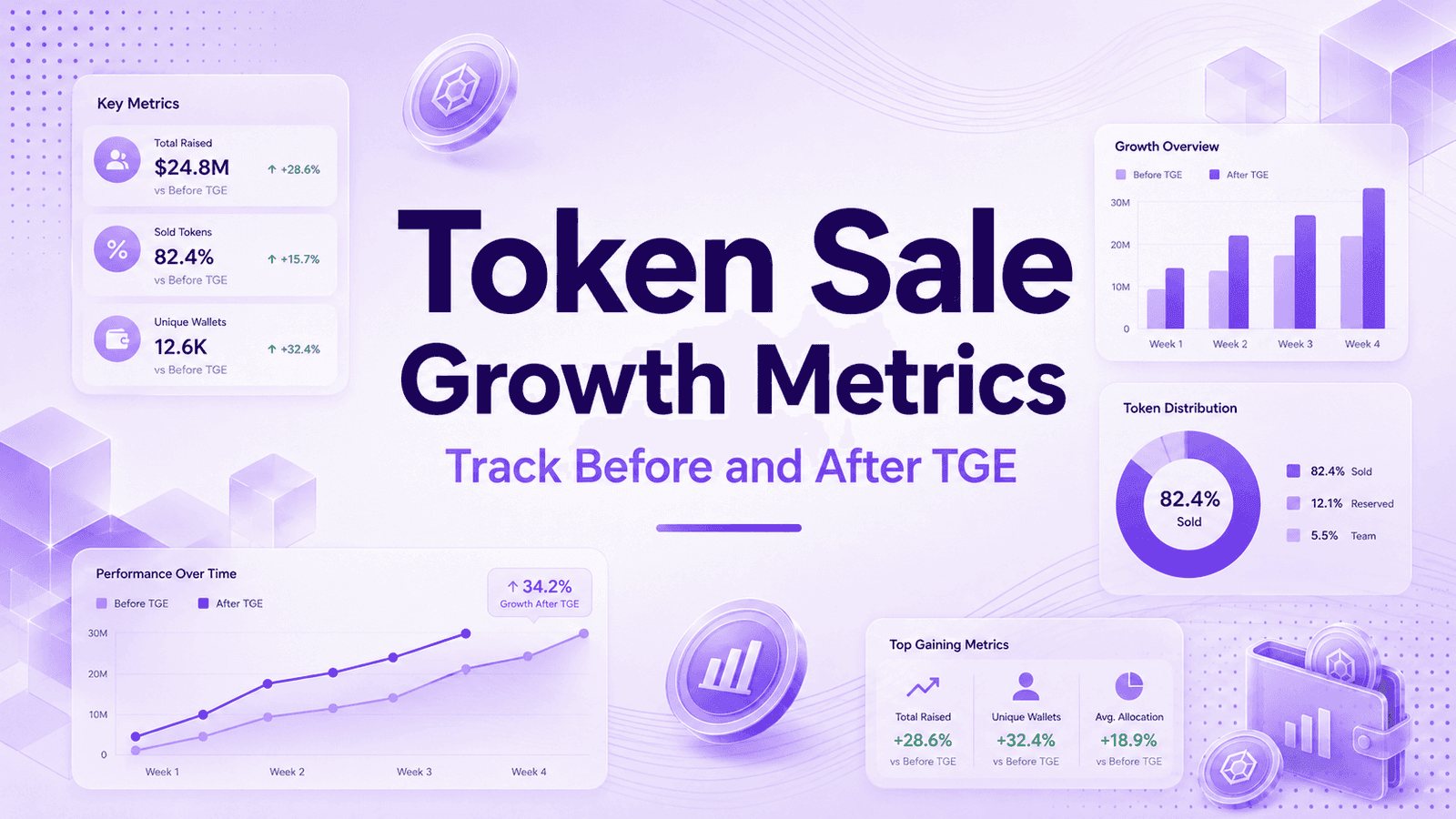
Token sale growth metrics show how attention becomes intent. They also show conversion and retention. They do not only count followers, wallets, or holders. Those totals show only the activity. But they do not always show the quality. The useful question is simple. Which signals show real participation?

Before TGE, that question starts with intent. Founders need to know:
- Before TGE, founders measure intent.
- During TGE, they measure conversion.
- After launch, they measure retention.
Why Token Sale Growth Needs a Crypto-Specific Dashboard
To evaluate token sale growth, teams need a crypto-specific dashboard. This dashboard should connect campaign activity with user behavior. It should not only collect separate reports from social, website, community, and wallet tools.
A useful dashboard should contain:
- Pre-TGE intent signals, such as awareness quality and waitlist quality.
- Wallet onboarding signals, such as connect rate and failed steps.
- TGE conversion signals, such as sale participation and source attribution.
- Post-launch retention signals, such as retained wallets and active users.
- Capital quality signals, such as TVL duration and staking behavior.
- Community signals, such as useful replies, referrals, and support activity.
Crypto growth is not only awareness, engagement, or conversion. It also includes wallets, on-chain actions, token incentives, and community behavior. The a16z growth framework also explains that crypto dashboards need different adaptations. Token mechanics can distort raw results. The goal of this dashboard is not to track more numbers. The goal is to see which stage needs action.
What Metrics Matter Before TGE?
Before TGE, teams should measure intent quality. Founders need to know whether the right users are learning, preparing, and moving closer to participation.
Below are the key token sale growth metrics to track before TGE:
Metric | What it shows | What to check |
|---|---|---|
Awareness quality | The right audience sees the project | Source fit, not only reach |
Qualified traffic | Visitors show relevant interest | Page depth, return visits, source |
Waitlist quality | Users show early commitment | Wallet connection, actions completed |
Wallet onboarding | Users can enter the sale flow | Connect rate, failed steps |
Education engagement | Users understand the project | FAQ views, guide reads, quiz results |
Community contribution | Users add useful activity | Questions, feedback, peer support |
Referral source quality | Users bring relevant users | Referred user quality and retention |
For wider KPI prioritization, founders can review TokenMinds’ guide on which KPI matters most for token sale performance.
Core Growth Metrics Every Token Sale Team Should Understand
Some metrics apply across every token sale stage. They help teams measure growth cost, user value, and retention. They also help teams compare paid growth with organic demand.
Below are the core growth token sale marketing metrics every token sale team should understand:
Metric | What it means | How teams use it |
|---|---|---|
Customer Acquisition Cost, CAC | Cost to acquire one user or wallet | Compare channel efficiency |
Paid CAC | Cost from paid campaigns only | Review ads, KOLs, and rewards |
Blended CAC | Cost across all acquisition sources | Review total campaign efficiency |
Lifetime Value, LTV | Value a user or wallet creates over time | Compare acquisition cost with long-term value |
LTV:CAC Ratio | Value returned compared with acquisition cost | Check whether growth spend makes sense |
Retention Rate | Users or wallets that remain active | Measure post-launch quality |
Churn Rate | Users or wallets that stop activity | Find weak cohorts after launch |
Cost per Qualified Wallet | Cost to acquire a wallet with real intent | Review pre-TGE onboarding quality |
Cost per Sale Participant | Cost to acquire one sale participant | Review TGE conversion efficiency |
The a16z crypto growth framework treats CAC, LTV, ARPU, and LTV:CAC as baseline metrics. It then adapts them for wallets, token incentives, and crypto-specific value creation.
What Should Founders Track During TGE?
During TGE, growth moves from intent to conversion. The dashboard should now show which attention becomes participation.
This stage needs fewer vanity metrics. It needs cleaner conversion signals. It should also show where users fail inside the sale path.
Below are the key token sale growth metrics to track during TGE:
Metric | What it should reveal | Founder action |
|---|---|---|
Wallet connection rate | Qualified users reach the sale flow | Fix wallet friction |
Sale participation rate | Intent becomes sale action | Review weak cohorts |
Channel attribution | Sources drive real participation | Shift budget and focus |
Conversion quality | Participants match the target profile | Compare post-sale behavior |
Drop-off points | Users fail at specific steps | Fix the broken step |
Founders should not ask only, how much was sold? They should ask which source produced better participants. That question prevents teams from rewarding noisy acquisition.
How to Measure Which Channels Drive Token Sale Participation
During TGE, each channel should be judged by qualified participation. Traffic volume is not enough. A KOL post may bring clicks but weak wallets. A smaller community post may bring fewer users but better participants.
Teams should measure attribution across:
- KOL attribution: wallet connects and sale participants from each creator.
- Community attribution: Discord, Telegram, and X activity that leads to wallet actions.
- Referral attribution: referred wallets, sale participation, and retained users.
- Paid media attribution: cost per qualified wallet and sale participant.
- Wallet-level attribution: wallet source, campaign tag, sale action, and post-TGE activity.
A channel should not win because it brings traffic. It should win because it brings qualified wallets, sale participants, and retained users.
What Should Founders Track After Token Launch?
After token launch, the dashboard should measure retention quality. The question changes again. Before TGE, founders ask who looks ready. During TGE, founders ask who converts. After launch, founders ask who stays.
Below are the key token sale growth metrics to track after TGE:
Metric | What it should reveal | Risk to watch |
|---|---|---|
Retained wallets | Users return after launch | One-time wallet activity |
Active users | Holders use the product | Passive holding only |
TVL quality | Capital stays beyond incentives | Temporary deposits |
Staking behavior | Users show longer commitment | Reward-only staking |
Holder distribution | Ownership looks healthy | Whale dependency |
Churn | Users leave after rewards end | Silent wallet drop-off |
Post-TGE metrics should bring one answer. Who stayed when launch rewards stopped?
Why Raw Growth Numbers Can Mislead Founders

Raw growth numbers can look strong. They can still hide weak user quality. This is why each metric needs a quality filter. Key risks include:
- Bots can inflate impressions.
High reach does not always mean real audience interest. - Sybil wallets can inflate waitlists.
More wallets do not always mean more real users. - Airdrop farmers can inflate onboarding.
Users may connect wallets only for rewards. - Paid rewards can inflate community activity.
More replies do not always mean useful participation. - Short-term incentives can inflate TVL.
Capital may leave once rewards decrease. - Holder growth can hide low usage.
More holders do not always mean product adoption.
The problem is not incentives themselves. Incentives can help users try the product. The risk starts when teams treat rewarded actions as organic demand. A better growth review should ask:
- Did users return after the reward?
- Did wallets stay active after launch?
- Did holders use the product?
- Did community members add useful value?
- Did referred users stay engaged?
Community size needs this quality filter too. TokenMinds explores this further in: How do we measure community quality, not just community size?
Why Wallet Quality Matters More Than Wallet Quantity
Wallet count can look like growth. It can also hide weak user quality. One user can create multiple wallets. Farmers can connect wallets for rewards. Sybil activity can inflate waitlists. Incentivized tasks can also create short-term activity.
Teams should review wallet quality through:
- Qualified wallet rate
- Wallet source
- Completed sale steps
- Repeat wallet activity
- Post-TGE retention
- Sybil or duplicate wallet checks
A strong wallet signal should show intent, action, and return behavior. A weak wallet signal only shows that a wallet appeared.
How Do We Build a Crypto Growth Dashboard?
A crypto growth dashboard should start with the token sale journey. The team should not begin with a long metric list. That creates noise. The dashboard should show what needs action before TGE, during TGE, and after launch.

Below are the steps to build a crypto growth dashboard:
- Map the token sale stages
Separate the journey into pre-TGE, TGE, and post-launch. Pre-TGE should measure intent. TGE should measure conversion. Post-launch should measure retention. - Choose the main metric for each stage
Each stage needs a few useful signals. Pre-TGE may use waitlist quality and wallet onboarding. TGE may use sale participation and attribution. Post-launch may use retained wallets and churn. - Connect the right data sources
Token sale data often sits across many tools. These include ads, KOL reports, website analytics, quest tools, wallets, and community platforms. The dashboard should bring those signals into one readable view. - Add quality filters
Raw totals need context. Wallet growth needs a Sybil check. Community growth needs a contribution check. TVL needs a duration check. - Turn each metric into an action
A weak wallet connection rate should trigger UX review. Weak retention should trigger cohort review. Low-quality referrals should trigger source review. - Review the dashboard weekly
The dashboard should help teams decide what to fix next. Each review should produce one owner and one next step.
Some teams can build this internally. Others need outside support across token sale GTM, tokenomics, UX, and community growth.
Token Sale Growth Dashboard Blueprint
A dashboard should also show what each metric connects to. The team needs more than a metric name. It needs the data source, quality filter, and action trigger. This makes the dashboard easier to use during weekly reviews.
Below is a simple dashboard blueprint for token sale teams:
Dashboard area | Main metric | Data source | Quality filter | Action trigger |
|---|---|---|---|---|
Pre-TGE intent | Waitlist quality | CRM, landing page, wallet flow | Completed actions | Improve education flow |
Wallet onboarding | Connect rate | Wallet analytics | Failed steps | Fix onboarding friction |
TGE conversion | Sale participation | Sale dashboard | Source quality | Shift budget |
Post-TGE retention | Retained wallets | On-chain data | Repeat activity | Review weak cohorts |
Capital quality | TVL duration | Protocol analytics | Incentive expiry | Review reward design |
Community quality | Useful contribution | Discord, Telegram, X | Sentiment and support value | Improve community tasks |
Related TokenMinds guide: In-house vs hire an agency for token sale GTM, tokenomics, UX, and community growth.
Weekly Founder Checklist for Token Sale Growth
After the dashboard is built, the weekly review should turn metrics into decisions. The review should not ask which number looks best. It should ask which stage needs action next: intent, conversion, retention, community quality, or referral quality.
Use these questions:
- Which source brought qualified users?
- Which waitlist cohort showed real intent?
- Where did wallet onboarding lose users?
- Which channel produced sale participation?
- Which users stayed after launch?
- Which metric changed after incentives ended?
- Which community members created useful work?
- Which growth issue needs action this week?
The answer should produce one owner and one next step. That keeps measurement connected to execution.
Build a Token Sale Growth Dashboard With TokenMinds
Token sale teams collect data across many tools. These include ads, PR, KOL reports, CRMs, quest tools, website analytics, and wallet dashboards. The harder task is turning those signals into one clear view.
TokenMinds helps founders review the full token sale funnel. This includes campaign tracking, wallet onboarding, conversion quality, retention, and weekly growth decisions. The goal is simple. Teams should know which stage needs action before TGE, during TGE, and after launch.
Book a growth analytics dashboard setup with TokenMinds.
TokenMinds helps token sale teams connect campaign, wallet, community, and retention data into one growth dashboard.
FAQs
- What are the most important token sale growth metrics?The most important metrics are waitlist quality, wallet onboarding, sale participation, attribution, retention, TVL quality, holder distribution, and churn. These metrics show growth quality across each token sale stage.
- How do you measure token sale success?Token sale success should measure more than tokens sold. Teams should review qualified wallets, sale participation, conversion quality, retained users, community contribution, and post-TGE activity.
- What metrics matter before a TGE?Before TGE, teams should measure intent quality. Key metrics include awareness quality, qualified traffic, waitlist quality, wallet onboarding, education engagement, and community contribution.
- How can founders measure wallet quality?Founders can measure wallet quality through source, completed actions, repeat activity, sale participation, and post-TGE retention. Sybil checks also help filter weak wallet signals.
- What is a good token sale participation rate?There is no universal good rate. A useful rate depends on audience fit, sale structure, wallet flow, and traffic quality. Teams should compare participation by source and cohort.
- How do you track post-TGE retention?Teams can track post-TGE retention through retained wallets, active users, repeat transactions, staking duration, TVL duration, and churn. The key question is simple. Who stayed after launch?