
Web3 & AI

SOLUTIONS

Products

Services

Web3 & AI

SOLUTIONS

Services

Products

Industries

Become Our Client

About Us

Resources

Web3 & AI

SOLUTIONS

Services

Products

Industries

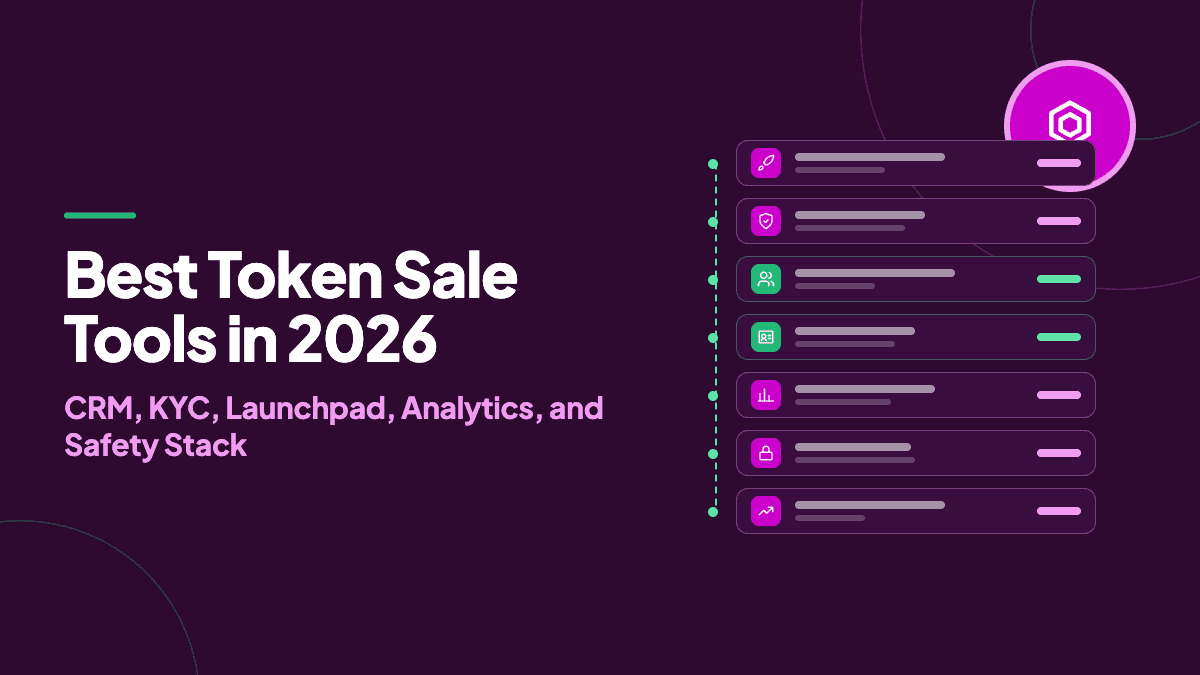
Best Token Sale Tools in 2026: CRM, KYC, Launchpad, Analytics, and Safety Stack

Best Token Sale Tools in 2026: CRM, KYC, Launchpad, Analytics, and Safety Stack

TL;DR: A token sale works best on one connected stack, not a set of separate tools. The stack has seven layers, covering launch, compliance, community, CRM, analytics, safety, and reporting. Each layer passes data to the next, so the team can follow every buyer from first visit to claim. RWA and asset tokenization sales use the same stack, with stricter compliance.

Running a token sale is harder in 2026. Public token sales raised only $58 million in Q2 2026 as of mid-June, according to CryptoRank. That put the quarter on track for an 85% drop from the quarter before. With fewer buyers in the market, every buyer lost before the sale closes hurts the raise.

Scams are still a real threat too. Wallet drainers stole $83.85 million from about 106,000 victims in 2025, as reported by Cointelegraph based on Scam Sniffer data. The report found that losses rise when on-chain activity rises. A live token sale brings that kind of activity to one project.

At the same time, more real-world assets are moving on-chain. Tokenized RWAs reached $33.5 billion in mid-2026, according to Yellow Research. That growth brings more asset tokenization projects into token sales with stricter rules.

Each trend points to one need. Fewer buyers means the funnel must convert. More scams mean claims must be safe. Stricter rules mean compliance must start early. This guide shows which token sale tools founders need in 2026 and how they fit into one stack.

What Tools Does a Token Sale Need?

A token sale needs tools in three groups. Each group covers a different part of the buyer journey.

  • Sale tools run the sale and check who can buy. This group covers the launch and compliance layers.

  • People tools build the allowlist and manage investor and community relationships. This group covers the community and CRM layers.

  • Data and safety tools track buyers, protect claims, and report results after launch. This group covers the analytics, safety, and reporting layers.


What Tools Does a Token Sale Need?.png

Together, these tools form a token sale stack. The stack only works when each tool shares data with the next one. If the KYC tool and the launchpad are not connected, the team cannot see where buyers drop off. Teams new to the process can start with TokenMinds' token sales consulting.

The sale format itself is now settled. IDOs made up nearly 75% of public token sales between Q1 2024 and Q2 2026, according to CryptoRank data reported by Grafa. That means the real difference now comes from the tools around the sale.

The Token Sale Tools Stack at a Glance

The table below breaks the three groups down into layers. For each layer, it shows the main job, what to look for, and the tools covered in this guide.

Tool Group

Layer

Job

What to Look For

Example Tools

Sale tools

Launch (landing page)

Bring buyers in and explain the sale

Fast publishing, CMS, clear link to the portal

Framer, Webflow

Sale tools

Launch (sale portal)

Take commitments and handle claims

Non-custodial, team owns buyer data, built-in KYC

Sonar by Echo, Tokensoft, TMX TGE

Sale tools

Launch (launchpad)

Add reach from an existing audience

Sale model, chains, audits, fees, what the team keeps

DAO Maker, Polkastarter, Seedify, Binance Launchpad, CoinList, Legion

Sale tools

Compliance

Verify buyers and wallets

Geo-blocking, wallet screening, API handoff to portal and CRM

Sumsub, Persona, Chainalysis, TRM Labs

People tools

Community

Build a clean allowlist

Sybil filtering, clean export to CRM

Galxe, Zealy, Human Passport

People tools

CRM

Track investors, KOLs, and buyer segments

Wallet-to-contact linking, KYC status sync

Holder, Absolute Labs

Data and safety tools

Analytics

Link campaigns to committed wallets

Wallet-level attribution from visit to claim

Formo, Spindl, Cookie3

Data and safety tools

Safety

Protect buyers at claim

Audited contracts, branded claim domain

Magna, Tokensoft Distribute, Scam Sniffer

Data and safety tools

Reporting

Show what happens after TGE

Unlock tracking, holder distribution

Tokenomist, Dune

The launch layer comes first, because every other layer connects to it.

Launch Layer: Where the Token Sale Runs

The launch layer is where buyers land, commit, and claim. It uses three tools in order: a landing page, a token sale portal, and, if needed, a launchpad.

Landing Page

The landing page explains the sale and sends buyers to the next step. Below are two site builders that fit a token sale landing page.

  • Framer. It is a no-code site builder with a built-in CMS, analytics, and SEO, according to Framer. Best for teams that want to publish fast without developers.

  • Webflow. It is a visual site builder with a CMS, localization, and managed hosting, according to Webflow. Best for larger sale sites with many pages or languages.

Before launch, a crypto presale landing page checklist helps teams confirm the page is ready.

Sale Portal

The sale portal is where buyers connect a wallet and commit funds. An owned portal keeps buyer data with the team for future raises. Below are three sale portal tools.

  • Sonar by Echo. It handles KYC, wallet screening, and jurisdiction rules, while funds sit in a contract the project owns, according to Echo's documentation. Coinbase acquired Echo in October 2025, in a deal worth about $375 million in cash and stock, as reported by CryptoMeter.

  • Tokensoft. It offers white-labeled, non-custodial sales with KYC, KYB, and accredited investor checks, according to Tokensoft. Best for compliance-heavy raises, including RWA sales.

  • TMX TGE. It is TokenMinds' own white-label token sale platform for ICOs, STOs, and private sales, with crypto and fiat payments, according to TokenMinds. Best for teams that want an all-in-one branded portal.

Launchpad

A launchpad lists the token next to other projects and brings its own audience. It adds reach, but the team keeps little after the sale. Below are the main launchpads.

  • DAO Maker. It runs Strong Holder Offerings, which give priority to experienced investors, according to CoinMarketCap. Best for projects that want long-term holders.

  • Polkastarter. It uses fixed-price pools that help block bots, as reported by CoinGecko. Best for early-stage projects that want a fair IDO.

  • Seedify. It is an incubator and launchpad for Web3 games and AI projects, according to Alchemy. Best for gaming and AI teams that want incubation support.

  • Binance Launchpad. It vets each project, and buyers commit BNB to take part, as reported by Coin Bureau. Best for projects that want exchange-level reach.

  • CoinList. It is the largest launchpad by capital raised, at $1.37 billion, according to CryptoRank data reported by Grafa. Best for compliance-first sales.

  • Legion. It allocates tokens with a merit-based score and says its sales are MiCA-compliant, as reported by The Block. Best for curated sales with Kraken reach.

Before choosing a launchpad, teams should check its model, chains, audits, fees, and what they keep after the sale.

The choice between a launchpad and an owned portal comes down to reach versus ownership. A launchpad brings an existing audience, but it keeps the buyer data and takes fees or a share of the allocation. An owned portal keeps the data and the buyer relationship for future raises, but the team must bring its own traffic. Many teams use both, with a launchpad for reach and an owned portal for everything else.

Compliance Layer: KYC, AML, and Wallet Screening

The compliance layer decides who can buy. It checks both the person and the wallet, and it works best early in the funnel, before buyers reach the commit step. It also blocks restricted jurisdictions through geo-blocking at the portal level.

KYC and AML Tools

Below are two KYC tools with features built for crypto.

  • Sumsub. It provides KYC, KYB, AML screening, and transaction monitoring for crypto businesses, according to Sumsub. Best for teams that want one provider for identity checks.

  • Persona. It verifies ID with a selfie check and screens wallets against crypto watchlists, according to Persona's help center. Best for teams that want identity and wallet checks in one flow.

Wallet Screening Tools

Below are two wallet screening tools.

  • Chainalysis. It offers free sanctions screening through an API and an on-chain oracle, as reported by Cointelegraph. Best for teams that want a free first check.

  • TRM Labs. It screens wallets for risk in under 400 milliseconds across more than 30 blockchains, according to TRM Labs. Best for multi-chain sales that need custom risk rules.

Extra Checks for RWA and Asset Tokenization Sales

RWA and asset tokenization sales need stricter checks. US banking regulators said a tokenized security should get the same capital treatment as its traditional form, according to PYMNTS. Putting an asset on-chain does not remove its rules. These sales need investor eligibility checks, jurisdiction rules, and transfer restrictions where the offering requires them.

Community and CRM Layers: From Allowlist to Investor Pipeline

These two layers manage people before the sale. The community layer builds the allowlist, and the CRM layer tracks every relationship that can move the raise.

Allowlist and Sybil Filtering Tools

Below are three tools for building a clean allowlist.

  • Galxe. It runs no-code quest campaigns with sybil prevention features, according to Solana Compass. Best for teams that want quests and identity checks in one place.

  • Zealy. It is a gamified quest platform with rewards and analytics, according to Solana Compass. Best for keeping the community active before the sale.

  • Human Passport. It gives each wallet a Unique Humanity Score to filter out bots and fake accounts, according to Human Passport. Best as an extra sybil filter on top of quests.

CRM Tools for Investors, KOLs, and Participants

Below are two Web3 CRM tools that link wallets to contacts.

  • Holder. It builds segments from wallet and social data and sends updates by XMTP, email, and SMS, according to Holder. Best for teams that want to segment and message buyers in one tool.

  • Absolute Labs. It is a wallet CRM with over 1.1 billion wallet profiles, according to Absolute Labs. Best for teams that want deep wallet insight for targeting.

Segments such as allowlisted, KYC-passed, and committed shape the message each group receives. If the KYC tool and CRM don't sync, the team cannot segment messaging by pass or fail status, so rejected buyers receive the same follow-up as approved ones, wasting budget and damaging trust. Strong pre-sale marketing strategies build on clean segment data.

Consider a common failure. A team runs its allowlist on Galxe and KYC on Sumsub, with no sync between them. The CRM sends the same presale reminder to every allowlisted wallet, including wallets that failed KYC. Those buyers reach a portal that blocks them, which creates support tickets and public complaints. The fix is to test the KYC-to-CRM handoff at least 30 days before launch, tag rejected wallets in the CRM, and send a dry-run email to a test segment.

Analytics Layer: How to Track the Token Sale Funnel

The analytics layer tracks five stages: visit, allowlist, KYC pass, commit, and claim. Wallet-level attribution links each visit to the wallet that later commits, so the team can see which channel brought in real capital. A clear token sale attribution strategy connects this data.

Below are three wallet-level analytics tools.

  • Formo. It links website visits to wallet connections and on-chain events, according to Formo. Best for one view from first visit to commit.

  • Spindl. It is an on-chain ads and attribution platform that now operates under Base after Coinbase acquired it, according to Coinbase. Best for teams launching on Base.

  • Cookie3. It tracks each visitor and wallet from first touch to on-chain actions, including token sales, according to Linea's developer docs. Best for teams that run many KOL and social campaigns.

Safety Layer: Official Links, Claim Portal, and Vesting

The safety layer protects buyers on claim day. The largest single phishing theft of 2025 took $6.5 million through one malicious signature, as reported by Cointelegraph based on Scam Sniffer data. One official links page, verified contract addresses, and an owned claim portal close most of that risk.

Below are three tools that help protect claims.

  • Magna. It handles vesting, airdrops, and white-label token claims. Payward, Kraken's parent company, acquired Magna in February 2026, according to Payward. Best for a branded claim portal.

  • Tokensoft Distribute. It offers white-labeled claims and vesting with time-based and price-based unlocks, according to Tokensoft. Best for teams already selling on Tokensoft.

  • Scam Sniffer. It tracks phishing sites and wallet drainers, and offers an API for teams, according to Scam Sniffer. Best for spotting fake claim sites early.

For more detail, see this guide on protecting token claims from fake links and wallet drainers.

Reporting Layer: What to Track After TGE

Reporting keeps the stack useful after the token generation event. Investors ask harder questions after launch, so teams need clear data on unlocks, holders, and liquidity. An owned claim portal keeps the claim link under the team's control, so buyers are less likely to follow fake links or lose access after the launchpad moves on.

Investors also expect regular updates after TGE. A monthly update on unlocks, holder distribution, and liquidity keeps trust high, and a CRM like Holder can send it to each investor segment.

Below are two tools for post-TGE reporting.

  • Tokenomist. It tracks unlock schedules and shows which holder groups receive new supply, according to Alchemy. Best for a clear, public unlock calendar.

  • Dune. It lets teams query public blockchain data with SQL and turn it into dashboards, according to Dune's documentation. Best for custom holders and liquidity dashboards.

How to Choose the Right Token Sale Stack

The right stack depends on the raise size, the asset type, and whether the team plans to raise again.

Selection Criteria

  • Integrations. Tools pass data to each other, from allowlist to KYC to commit.

  • Chain support. Every tool supports the chain the token runs on, including any L2 used for claims.

  • Audits. Sale, claim, and vesting contracts are independently audited.

  • Data ownership. Buyer and wallet data stay with the team.

  • Cost. Fees are clear before the sale starts.

Lean Stack vs Full Stack

Layer

Lean Stack

Full Stack

RWA and Asset Tokenization Stack

Launch

Launchpad and a simple landing page

Owned sale portal, plus launchpad reach

Owned portal with eligibility gates

Compliance

Launchpad KYC and sanctions screening

Dedicated KYC plus wallet screening

Full KYC/KYB and investor eligibility

Community and CRM

One quest campaign

Quests, sybil filter, and Web3 CRM

Allowlist limited to eligible investors

Analytics

UTM tracking

Wallet-level attribution

Attribution plus compliance reporting

Safety and reporting

Official links page and unlock calendar

Owned claim portal and dashboards

Claim portal with transfer restrictions

A lean stack suits a smaller first raise. A full stack suits larger raises or teams that plan more than one sale. RWA and asset tokenization sales need the full stack with stricter compliance from day one.

Get a Token Sale Stack Audit With TokenMinds

A token sale in 2026 is won by the stack behind it, not by any single tool. The sections above show that launch, compliance, community, CRM, analytics, safety, and reporting only work when each layer passes clean data to the next.

TokenMinds has run token sales end to end since 2016, and works on token sale strategy, tokenomics, and go-to-market for Web3 and asset tokenization projects. The work covers launchpad and exchange coordination, PR and KOL campaigns, and post-launch tracking and reporting. TokenMinds also builds dedicated token sale portals with live sale status, KYC flows, wallet checks, and conversion analytics from traffic to allocation. Its token sale stack audit reviews a project's current tools against every layer in one pass. The team walks in with a tool list and walks out with the gaps, the weak links, and a plan to connect the stack before launch.

Book a token sale stack audit with TokenMinds.

FAQs

What tools are needed for a token sale?
A token sale needs tools across seven layers: a launch platform, KYC and wallet screening, an allowlist tool, a CRM, funnel analytics, a safe claim portal, and post-TGE reporting. The layers work best when they share data.

Which tools help with KYC, CRM, analytics, and claim safety?
Sumsub and Persona handle KYC, while Chainalysis and TRM Labs screen wallets. Holder and Absolute Labs are Web3 CRMs. Formo and Spindl track wallet-level attribution, and Magna and Scam Sniffer help protect claims.

How do teams build a token sale marketing stack for 2026?
Teams start with the launch model, then add compliance, allowlist, CRM, analytics, safety, and reporting. A lean stack fits a smaller first raise, and a full stack fits larger or repeat raises. RWA and asset tokenization sales need the full stack plus investor eligibility checks.

TL;DR: A token sale works best on one connected stack, not a set of separate tools. The stack has seven layers, covering launch, compliance, community, CRM, analytics, safety, and reporting. Each layer passes data to the next, so the team can follow every buyer from first visit to claim. RWA and asset tokenization sales use the same stack, with stricter compliance.

Running a token sale is harder in 2026. Public token sales raised only $58 million in Q2 2026 as of mid-June, according to CryptoRank. That put the quarter on track for an 85% drop from the quarter before. With fewer buyers in the market, every buyer lost before the sale closes hurts the raise.

Scams are still a real threat too. Wallet drainers stole $83.85 million from about 106,000 victims in 2025, as reported by Cointelegraph based on Scam Sniffer data. The report found that losses rise when on-chain activity rises. A live token sale brings that kind of activity to one project.

At the same time, more real-world assets are moving on-chain. Tokenized RWAs reached $33.5 billion in mid-2026, according to Yellow Research. That growth brings more asset tokenization projects into token sales with stricter rules.

Each trend points to one need. Fewer buyers means the funnel must convert. More scams mean claims must be safe. Stricter rules mean compliance must start early. This guide shows which token sale tools founders need in 2026 and how they fit into one stack.

What Tools Does a Token Sale Need?

A token sale needs tools in three groups. Each group covers a different part of the buyer journey.

  • Sale tools run the sale and check who can buy. This group covers the launch and compliance layers.

  • People tools build the allowlist and manage investor and community relationships. This group covers the community and CRM layers.

  • Data and safety tools track buyers, protect claims, and report results after launch. This group covers the analytics, safety, and reporting layers.


What Tools Does a Token Sale Need?.png

Together, these tools form a token sale stack. The stack only works when each tool shares data with the next one. If the KYC tool and the launchpad are not connected, the team cannot see where buyers drop off. Teams new to the process can start with TokenMinds' token sales consulting.

The sale format itself is now settled. IDOs made up nearly 75% of public token sales between Q1 2024 and Q2 2026, according to CryptoRank data reported by Grafa. That means the real difference now comes from the tools around the sale.

The Token Sale Tools Stack at a Glance

The table below breaks the three groups down into layers. For each layer, it shows the main job, what to look for, and the tools covered in this guide.

Tool Group

Layer

Job

What to Look For

Example Tools

Sale tools

Launch (landing page)

Bring buyers in and explain the sale

Fast publishing, CMS, clear link to the portal

Framer, Webflow

Sale tools

Launch (sale portal)

Take commitments and handle claims

Non-custodial, team owns buyer data, built-in KYC

Sonar by Echo, Tokensoft, TMX TGE

Sale tools

Launch (launchpad)

Add reach from an existing audience

Sale model, chains, audits, fees, what the team keeps

DAO Maker, Polkastarter, Seedify, Binance Launchpad, CoinList, Legion

Sale tools

Compliance

Verify buyers and wallets

Geo-blocking, wallet screening, API handoff to portal and CRM

Sumsub, Persona, Chainalysis, TRM Labs

People tools

Community

Build a clean allowlist

Sybil filtering, clean export to CRM

Galxe, Zealy, Human Passport

People tools

CRM

Track investors, KOLs, and buyer segments

Wallet-to-contact linking, KYC status sync

Holder, Absolute Labs

Data and safety tools

Analytics

Link campaigns to committed wallets

Wallet-level attribution from visit to claim

Formo, Spindl, Cookie3

Data and safety tools

Safety

Protect buyers at claim

Audited contracts, branded claim domain

Magna, Tokensoft Distribute, Scam Sniffer

Data and safety tools

Reporting

Show what happens after TGE

Unlock tracking, holder distribution

Tokenomist, Dune

The launch layer comes first, because every other layer connects to it.

Launch Layer: Where the Token Sale Runs

The launch layer is where buyers land, commit, and claim. It uses three tools in order: a landing page, a token sale portal, and, if needed, a launchpad.

Landing Page

The landing page explains the sale and sends buyers to the next step. Below are two site builders that fit a token sale landing page.

  • Framer. It is a no-code site builder with a built-in CMS, analytics, and SEO, according to Framer. Best for teams that want to publish fast without developers.

  • Webflow. It is a visual site builder with a CMS, localization, and managed hosting, according to Webflow. Best for larger sale sites with many pages or languages.

Before launch, a crypto presale landing page checklist helps teams confirm the page is ready.

Sale Portal

The sale portal is where buyers connect a wallet and commit funds. An owned portal keeps buyer data with the team for future raises. Below are three sale portal tools.

  • Sonar by Echo. It handles KYC, wallet screening, and jurisdiction rules, while funds sit in a contract the project owns, according to Echo's documentation. Coinbase acquired Echo in October 2025, in a deal worth about $375 million in cash and stock, as reported by CryptoMeter.

  • Tokensoft. It offers white-labeled, non-custodial sales with KYC, KYB, and accredited investor checks, according to Tokensoft. Best for compliance-heavy raises, including RWA sales.

  • TMX TGE. It is TokenMinds' own white-label token sale platform for ICOs, STOs, and private sales, with crypto and fiat payments, according to TokenMinds. Best for teams that want an all-in-one branded portal.

Launchpad

A launchpad lists the token next to other projects and brings its own audience. It adds reach, but the team keeps little after the sale. Below are the main launchpads.

  • DAO Maker. It runs Strong Holder Offerings, which give priority to experienced investors, according to CoinMarketCap. Best for projects that want long-term holders.

  • Polkastarter. It uses fixed-price pools that help block bots, as reported by CoinGecko. Best for early-stage projects that want a fair IDO.

  • Seedify. It is an incubator and launchpad for Web3 games and AI projects, according to Alchemy. Best for gaming and AI teams that want incubation support.

  • Binance Launchpad. It vets each project, and buyers commit BNB to take part, as reported by Coin Bureau. Best for projects that want exchange-level reach.

  • CoinList. It is the largest launchpad by capital raised, at $1.37 billion, according to CryptoRank data reported by Grafa. Best for compliance-first sales.

  • Legion. It allocates tokens with a merit-based score and says its sales are MiCA-compliant, as reported by The Block. Best for curated sales with Kraken reach.

Before choosing a launchpad, teams should check its model, chains, audits, fees, and what they keep after the sale.

The choice between a launchpad and an owned portal comes down to reach versus ownership. A launchpad brings an existing audience, but it keeps the buyer data and takes fees or a share of the allocation. An owned portal keeps the data and the buyer relationship for future raises, but the team must bring its own traffic. Many teams use both, with a launchpad for reach and an owned portal for everything else.

Compliance Layer: KYC, AML, and Wallet Screening

The compliance layer decides who can buy. It checks both the person and the wallet, and it works best early in the funnel, before buyers reach the commit step. It also blocks restricted jurisdictions through geo-blocking at the portal level.

KYC and AML Tools

Below are two KYC tools with features built for crypto.

  • Sumsub. It provides KYC, KYB, AML screening, and transaction monitoring for crypto businesses, according to Sumsub. Best for teams that want one provider for identity checks.

  • Persona. It verifies ID with a selfie check and screens wallets against crypto watchlists, according to Persona's help center. Best for teams that want identity and wallet checks in one flow.

Wallet Screening Tools

Below are two wallet screening tools.

  • Chainalysis. It offers free sanctions screening through an API and an on-chain oracle, as reported by Cointelegraph. Best for teams that want a free first check.

  • TRM Labs. It screens wallets for risk in under 400 milliseconds across more than 30 blockchains, according to TRM Labs. Best for multi-chain sales that need custom risk rules.

Extra Checks for RWA and Asset Tokenization Sales

RWA and asset tokenization sales need stricter checks. US banking regulators said a tokenized security should get the same capital treatment as its traditional form, according to PYMNTS. Putting an asset on-chain does not remove its rules. These sales need investor eligibility checks, jurisdiction rules, and transfer restrictions where the offering requires them.

Community and CRM Layers: From Allowlist to Investor Pipeline

These two layers manage people before the sale. The community layer builds the allowlist, and the CRM layer tracks every relationship that can move the raise.

Allowlist and Sybil Filtering Tools

Below are three tools for building a clean allowlist.

  • Galxe. It runs no-code quest campaigns with sybil prevention features, according to Solana Compass. Best for teams that want quests and identity checks in one place.

  • Zealy. It is a gamified quest platform with rewards and analytics, according to Solana Compass. Best for keeping the community active before the sale.

  • Human Passport. It gives each wallet a Unique Humanity Score to filter out bots and fake accounts, according to Human Passport. Best as an extra sybil filter on top of quests.

CRM Tools for Investors, KOLs, and Participants

Below are two Web3 CRM tools that link wallets to contacts.

  • Holder. It builds segments from wallet and social data and sends updates by XMTP, email, and SMS, according to Holder. Best for teams that want to segment and message buyers in one tool.

  • Absolute Labs. It is a wallet CRM with over 1.1 billion wallet profiles, according to Absolute Labs. Best for teams that want deep wallet insight for targeting.

Segments such as allowlisted, KYC-passed, and committed shape the message each group receives. If the KYC tool and CRM don't sync, the team cannot segment messaging by pass or fail status, so rejected buyers receive the same follow-up as approved ones, wasting budget and damaging trust. Strong pre-sale marketing strategies build on clean segment data.

Consider a common failure. A team runs its allowlist on Galxe and KYC on Sumsub, with no sync between them. The CRM sends the same presale reminder to every allowlisted wallet, including wallets that failed KYC. Those buyers reach a portal that blocks them, which creates support tickets and public complaints. The fix is to test the KYC-to-CRM handoff at least 30 days before launch, tag rejected wallets in the CRM, and send a dry-run email to a test segment.

Analytics Layer: How to Track the Token Sale Funnel

The analytics layer tracks five stages: visit, allowlist, KYC pass, commit, and claim. Wallet-level attribution links each visit to the wallet that later commits, so the team can see which channel brought in real capital. A clear token sale attribution strategy connects this data.

Below are three wallet-level analytics tools.

  • Formo. It links website visits to wallet connections and on-chain events, according to Formo. Best for one view from first visit to commit.

  • Spindl. It is an on-chain ads and attribution platform that now operates under Base after Coinbase acquired it, according to Coinbase. Best for teams launching on Base.

  • Cookie3. It tracks each visitor and wallet from first touch to on-chain actions, including token sales, according to Linea's developer docs. Best for teams that run many KOL and social campaigns.

Safety Layer: Official Links, Claim Portal, and Vesting

The safety layer protects buyers on claim day. The largest single phishing theft of 2025 took $6.5 million through one malicious signature, as reported by Cointelegraph based on Scam Sniffer data. One official links page, verified contract addresses, and an owned claim portal close most of that risk.

Below are three tools that help protect claims.

  • Magna. It handles vesting, airdrops, and white-label token claims. Payward, Kraken's parent company, acquired Magna in February 2026, according to Payward. Best for a branded claim portal.

  • Tokensoft Distribute. It offers white-labeled claims and vesting with time-based and price-based unlocks, according to Tokensoft. Best for teams already selling on Tokensoft.

  • Scam Sniffer. It tracks phishing sites and wallet drainers, and offers an API for teams, according to Scam Sniffer. Best for spotting fake claim sites early.

For more detail, see this guide on protecting token claims from fake links and wallet drainers.

Reporting Layer: What to Track After TGE

Reporting keeps the stack useful after the token generation event. Investors ask harder questions after launch, so teams need clear data on unlocks, holders, and liquidity. An owned claim portal keeps the claim link under the team's control, so buyers are less likely to follow fake links or lose access after the launchpad moves on.

Investors also expect regular updates after TGE. A monthly update on unlocks, holder distribution, and liquidity keeps trust high, and a CRM like Holder can send it to each investor segment.

Below are two tools for post-TGE reporting.

  • Tokenomist. It tracks unlock schedules and shows which holder groups receive new supply, according to Alchemy. Best for a clear, public unlock calendar.

  • Dune. It lets teams query public blockchain data with SQL and turn it into dashboards, according to Dune's documentation. Best for custom holders and liquidity dashboards.

How to Choose the Right Token Sale Stack

The right stack depends on the raise size, the asset type, and whether the team plans to raise again.

Selection Criteria

  • Integrations. Tools pass data to each other, from allowlist to KYC to commit.

  • Chain support. Every tool supports the chain the token runs on, including any L2 used for claims.

  • Audits. Sale, claim, and vesting contracts are independently audited.

  • Data ownership. Buyer and wallet data stay with the team.

  • Cost. Fees are clear before the sale starts.

Lean Stack vs Full Stack

Layer

Lean Stack

Full Stack

RWA and Asset Tokenization Stack

Launch

Launchpad and a simple landing page

Owned sale portal, plus launchpad reach

Owned portal with eligibility gates

Compliance

Launchpad KYC and sanctions screening

Dedicated KYC plus wallet screening

Full KYC/KYB and investor eligibility

Community and CRM

One quest campaign

Quests, sybil filter, and Web3 CRM

Allowlist limited to eligible investors

Analytics

UTM tracking

Wallet-level attribution

Attribution plus compliance reporting

Safety and reporting

Official links page and unlock calendar

Owned claim portal and dashboards

Claim portal with transfer restrictions

A lean stack suits a smaller first raise. A full stack suits larger raises or teams that plan more than one sale. RWA and asset tokenization sales need the full stack with stricter compliance from day one.

Get a Token Sale Stack Audit With TokenMinds

A token sale in 2026 is won by the stack behind it, not by any single tool. The sections above show that launch, compliance, community, CRM, analytics, safety, and reporting only work when each layer passes clean data to the next.

TokenMinds has run token sales end to end since 2016, and works on token sale strategy, tokenomics, and go-to-market for Web3 and asset tokenization projects. The work covers launchpad and exchange coordination, PR and KOL campaigns, and post-launch tracking and reporting. TokenMinds also builds dedicated token sale portals with live sale status, KYC flows, wallet checks, and conversion analytics from traffic to allocation. Its token sale stack audit reviews a project's current tools against every layer in one pass. The team walks in with a tool list and walks out with the gaps, the weak links, and a plan to connect the stack before launch.

Book a token sale stack audit with TokenMinds.

FAQs

What tools are needed for a token sale?
A token sale needs tools across seven layers: a launch platform, KYC and wallet screening, an allowlist tool, a CRM, funnel analytics, a safe claim portal, and post-TGE reporting. The layers work best when they share data.

Which tools help with KYC, CRM, analytics, and claim safety?
Sumsub and Persona handle KYC, while Chainalysis and TRM Labs screen wallets. Holder and Absolute Labs are Web3 CRMs. Formo and Spindl track wallet-level attribution, and Magna and Scam Sniffer help protect claims.

How do teams build a token sale marketing stack for 2026?
Teams start with the launch model, then add compliance, allowlist, CRM, analytics, safety, and reporting. A lean stack fits a smaller first raise, and a full stack fits larger or repeat raises. RWA and asset tokenization sales need the full stack plus investor eligibility checks.

GET SUCCESS IN WEB3

  • Trusted Web3 partner since 2017

  • Full-stack Web3 development team

  • Performance-driven Web3 marketing

Get A Free Consultation

Get A Free Consultation

MEET US AT

RECENT TRAININGS

Follow us

get web3 business updates

Email invalid

  • Access global liquidity for your RWA project with TMX Tokenize’s Canton Network integration

DISCOVER NOW

  • Access global liquidity for your RWA project with TMX Tokenize’s Canton Network integration

    JOIN NOW

DISCOVER

  • Access global liquidity for your RWA project with TMX Tokenize’s Canton Network integration