
TL;DR
A crypto presale landing page should answer buyer questions before wallet connection. It needs clear token purpose, sale terms, official links, security references, supported network, wallet steps, claim rules, vesting details, support channels, and scam-risk warnings. The page should not only sell the presale. It should help buyers verify the project before taking wallet action.
What Is a Crypto Presale?
A crypto presale is an early token sale before wider public access. It usually happens before a public sale, ICO, IDO, exchange listing, or token generation event. Buyers may receive access under stated rules, such as price, timing, accepted tokens, network, claim process, and vesting.
Where the Crypto Presale Landing Page Fits

A crypto presale usually sits between early fundraising and wider public access. The exact order can vary by project, but a common flow looks like this:
Seed round: early capital from close investors or strategic backers
Private sale: restricted token access for selected buyers or partners
Crypto presale: early public-facing sale before wider launch
Public sale, ICO, or IDO: broader market access through a defined sale model
TGE: the token generation event or token distribution stage
Exchange listing: market trading starts on selected venues
Why the Presale Landing Page Matters
Unbounce found that the median landing page conversion rate is 6.6% across industries, based on 464 million visits, 41,000 landing pages, and 57 million conversions. That means most visitors still leave without taking action, even after reaching a campaign page.
A crypto presale page has an even harder job. It does not only ask visitors to read. It asks them to connect a wallet, choose the right network, review a transaction, and trust the sale terms. That is a much bigger action than clicking a normal signup button.
This is why the landing page matters. It is the place where interest becomes trust, or trust turns into hesitation. A buyer should understand the token, sale terms, official links, and wallet steps from the page itself. They should not need to search through Telegram, Discord, or old X posts to find basic details.
When those details are missing, traffic can turn into hesitation. A strong token sale funnel connects the landing page and conversion action in one clear journey. For the full buyer journey, read TokenMinds’ guide to building a token sale funnel from landing page to wallet connection.
Quick Crypto Presale Landing Page Checklist
Page Element | What Buyers Need to See |
Utility | Why the token exists |
Tokenomics | Supply, allocation, unlocks, and demand logic |
Sale terms | Price, dates, caps, accepted tokens, and eligibility |
Official links | Website, docs, socials, and pinned channels |
Audit or KYC | Proof links, if available |
Wallet flow | Network, token, gas, transaction steps, and claim timing |
Scam warnings | Fake domains, DMs, claim pages, and seed phrase warnings |
Support | Official help channel and response process |
What Buyers Need to Verify Before Connecting a Wallet
Once buyers reach the presale page, the next step is verification. They are no longer only reading the project story. They are checking whether the page is real, whether the sale terms are clear.
This is where a presale page should slow the process down. It should help buyers confirm the basics of the project. A token buyer usually wants to verify three things:
The first layer is the official source. The domain, docs, and pinned community links should match.
The second layer is the sale detail. Timing, caps, accepted tokens, KYC or geo limits, and claim rules should be visible.
The third layer is the wallet path. The required network, payment token, and contract details should match the published sources.
CryptoSlate’s presale guidance also supports this flow. It tells buyers to confirm the official domain, read published sale terms, check accepted tokens, review KYC or geo limits, and cross-check contract details where available. It also recommends using primary sources, such as official docs, published terms, and block explorers.
For founders, this table should work as a buyer-verification map. It shows what the landing page must make clear before the connect button asks for action:
Verification Area | What the Page Should Make Clear |
Official source | Domain, docs, socials, and pinned links |
Sale terms | Timing, stage, caps, and accepted tokens |
Buyer eligibility | KYC rules, geo limits, and contribution limits |
Wallet path | Required network, payment token, and transaction steps |
Contract details | Contract address and block explorer link, if available |
After payment | Claim timing, TGE details, and vesting rules |
Support | Official help channel and scam-warning rules |
A presale page should not push buyers straight into the connect button. It should first give them enough information to trust the page, understand the sale, and follow the correct wallet path.
Recommended Crypto Presale Landing Page Structure
A crypto presale landing page should guide buyers in the right order. It should not lead with the connect button too early. The page should first explain the project, prove the source, and show the sale details.
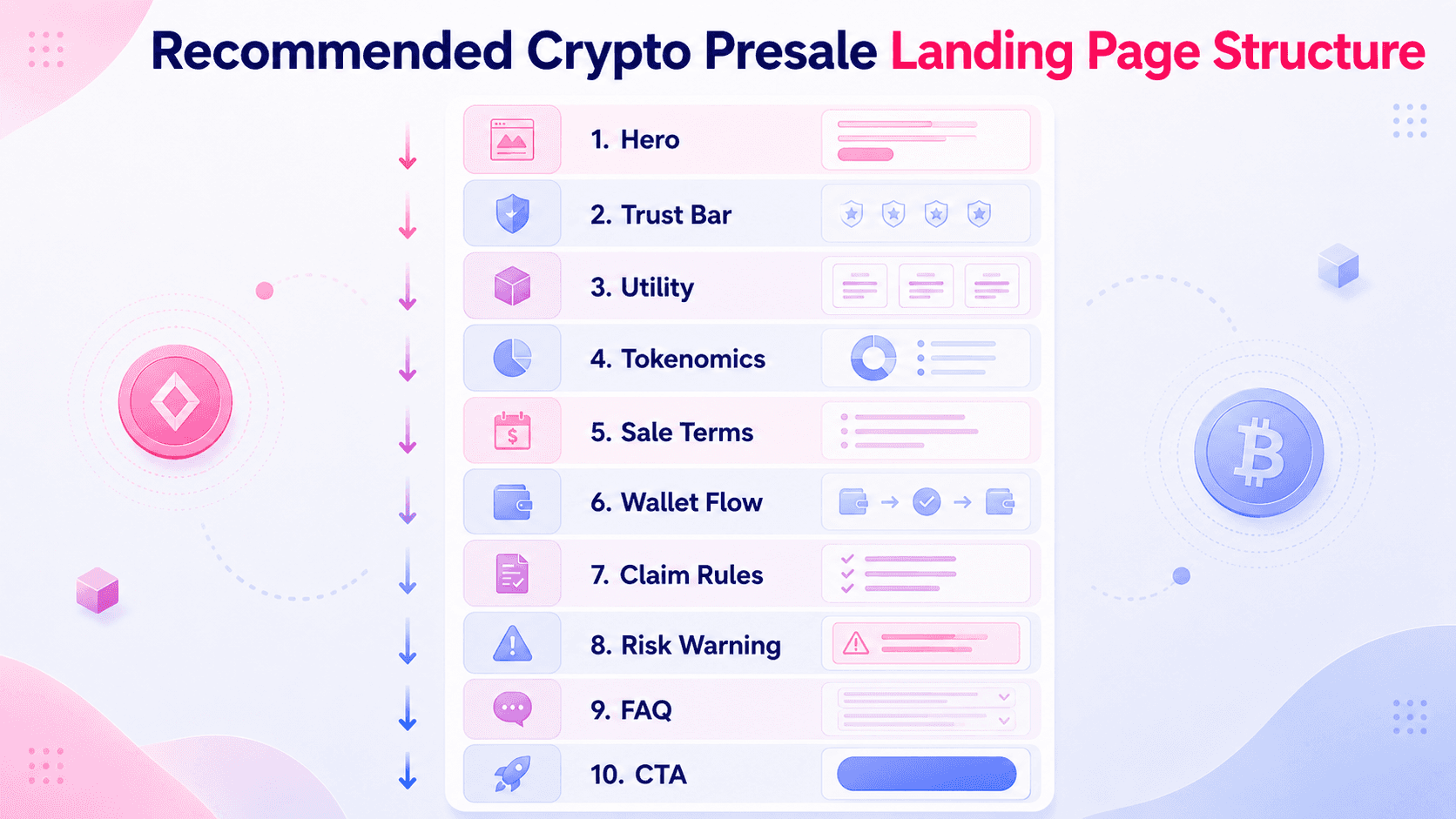
A clear page flow can look like this:
Hero
Explain the token value, sale status, and main action.Trust bar
Show official links, docs, audit or KYC status, and support.Utility section
Explain why the token exists and what it is used for.Tokenomics section
Show supply, allocation, vesting, and unlock summary.Presale details section
Show price, dates, caps, accepted tokens, network, and eligibility.Wallet flow section
Explain the wallet, network, gas, token, and transaction steps.Claim section
Explain TGE timing, claim rules, and unlock schedule.Risk warning section
Warn against fake links, DMs, fake claim pages, and seed phrase requests.FAQ section
Answer common buyer questions.CTA section
Ask for wallet connection only after the key details are clear.
This structure makes the page easier to follow. The FAQ section deserves special attention, since it answers the questions buyers still have right before they act. To decide which questions belong there, read TokenMinds' guide to the questions buyers ask before connecting a wallet.
What the Crypto Presale Page Must Prove
After buyers know what to verify, the page must help them do it. The first job is to explain what the token is. The second job is to prove that the page, links, and sale details are official.
1. Project and Token Clarity
A buyer should understand the project before they convert. The page should explain the token in plain language. It should show what the project does, who it serves, and why the token exists. This does not require a long explanation. It requires a clear first layer.

The page should show:
Token purpose
Core utility
Product or protocol context
Roadmap summary
Whitepaper or docs link
Tokenomics summary
Allocation and vesting visibility
Binance Academy describes a crypto whitepaper as a document that explains project goals, technology, tokenomics, and roadmap. It also notes that whitepapers can vary in quality and should not be treated as proof alone.
CoinGecko defines tokenomics around supply, distribution, vesting, inflation, utility, and incentives. Its guide says investors use tokenomics to assess a project beyond price movement.
For a presale landing page, this means tokenomics should not stay hidden inside a PDF. The page should summarize the key points, then link to the full details. Buyers should not need to guess who receives tokens, when unlocks happen, or why the token has demand.
2. Official Links and Trust Signals
The next layer is verification. A presale page should make official sources easy to confirm. Buyers need to know which domain, links, and support channels are safe.
Many presale pages show partner logos, large numbers, and countdowns. These items may support attention, but they do not replace verification.

The stronger trust layer includes:
Official website and presale domain
Whitepaper or docs
Pinned community announcements
Verified X, Telegram, Discord, or Medium links
Audit or KYC references, if available
Contract address, if available
Block explorer link, where relevant
Official support channel
CryptoSlate’s presale reviews highlight official presale links, audit references, KYC signals, contract information, claim rules, vesting details, and accepted tokens as buyer verification points. It also warns that audit claims should match the relevant report and contract address.
Audit or KYC labels should link to real reports or provider pages. The landing page should not use vague badges without proof. If no audit or KYC exists, the page should state what has been completed and what remains pending.
Crypto Presale Details the Page Must Show
After the page explains the project and verifies official links, it needs one more layer. It must explain the presale details.
A presale page should not show only a token price and a connect button. That leaves too many open questions. Buyers still need to know when the sale runs, which asset they can use, which network applies, and when tokens become available.
The page should bring the main details into one place:
Presale Detail | What the Page Should Show |
Sale stage | The current round and sale status |
Start and end dates | The sale window and deadline |
Token price | The price in the current stage |
Accepted tokens | The assets buyers can use |
Supported network | The chain buyers must use |
Contribution limits | Minimum, maximum, and cap rules |
Eligibility rules | KYC or geo limits, if they apply |
Claim or TGE timing | When tokens become accessible |
Vesting or unlock rules | How tokens release after the sale |
CryptoSlate recommends checking sale terms before sending funds. This includes caps, accepted tokens, KYC or geo rules, claim timing, and vesting. It also notes that wrong site, wrong network, and unclear claim rules can create buyer risk.
Wallet Flow Every Crypto Presale Page Must Explain
After the page shows the presale details, the next step is practical. The page must explain how wallet action works. Buyers should know which wallet, network, payment token, and transaction steps apply.

It helps buyers understand what they are approving. It also helps founders reduce fear around the wallet step.
The page should explain:
Supported wallets
Required network
Accepted payment token
Gas fee requirement
Contribution limits
Transaction review step
TXID or confirmation guidance
Claim timing
Disconnect guidance
Trust Wallet’s WalletConnect guide also recommends verifying dapp URLs, reviewing transaction details, approving every transaction explicitly, and disconnecting sessions when finished.
For a crypto presale page, this means wallet instructions should appear before the button. Buyers should not discover the required chain or payment token only after opening the wallet modal. They should understand the basic path before the page asks them to act.
This is practical conversion work. A clear wallet path reduces avoidable friction before the transaction step. For wallet friction, read TokenMinds’ guide to reducing wallet onboarding drop-off before a token sale.
Scam-Risk Warnings the Page Should Not Hide
Risk warnings do not weaken a presale page. They can make it more credible. Crypto presale buyers already know scams exist. A page that ignores this reality can feel less trustworthy, not more.
The page should warn buyers about:
Fake domains
Sponsored phishing ads
Fake claim pages
Impersonator support accounts
Seed phrase requests
Unverified audit claims
Guaranteed-return claims
Links shared through unsolicited DMs
Cloned websites, fake claim pages, impersonator support accounts, and audit claims without reports are common presale risks. Buyers should use official docs and pinned posts to verify real links. A serious presale page should avoid guaranteed-return language. It should also state that the team will never ask for seed phrases.
Crypto Presale Landing Page Checklist
By this point, the page has covered the main trust layers. It has explained the project, verified official links, shown presale details, clarified the wallet flow, and warned buyers about common risks.
To sum up, a crypto presale landing page should make these essentials easy to find:
Utility
Tokenomics
Audit or KYC status
Wallet flow
Vesting rules
Claim timing
Official links
Scam warnings
Founders, CMOs, and growth teams can use it before sending PR, KOL, SEO, community, or paid traffic to the page. The goal is to check whether the page can answer buyer questions before they convert.
The full checklist turns those essentials into a practical page review:
Area | What Must Be Clear |
Project clarity | Token purpose, utility, roadmap, and docs |
Tokenomics | Supply, allocation, utility, and vesting summary |
Official links | Website, docs, socials, and pinned channels |
Security proof | Audit, KYC, and contract references, if available |
Sale terms | Price, timing, accepted tokens, caps, and limits |
Network setup | Required chain, wallet, gas, and payment token |
Wallet flow | Connect, review, confirm, save TXID, and claim |
Claim rules | TGE date, unlock rules, and vesting schedule |
Support | Official help channel and response process |
Scam warnings | Fake sites, DMs, claim pages, and seed phrases |
The checklist should be reviewed from a buyer’s view.
Can the buyer confirm the official page? Can they understand the token? Can they prepare the right network and asset? Can they know what happens after payment?
If the page cannot answer these questions, more traffic may only expose more friction.
Improve Presale Page Readiness With TokenMinds
TokenMinds helps token sale teams review presale pages before public promotion starts. The audit focuses on the buyer path from page visit to conversion. It checks:
Buyer trust signals
Tokenomics and vesting clarity
Presale details and eligibility rules
Official-link consistency
Wallet-flow instructions
Scam-risk warnings
Support readiness
Conversion gaps
The goal is not to replace founder-owned strategy. The goal is to make the page clearer, safer, and more conversion-ready before traffic arrives.
FAQs
Where should the connect wallet CTA appear on a presale page?
The connect wallet CTA should appear after key trust details are visible. Buyers should first see the token purpose, sale terms, official links, supported network, wallet steps, claim timing, and scam warnings.
How can buyers verify that a crypto presale is legitimate?
No single item proves legitimacy. Buyers should check the official domain, docs, socials, pinned links, audit or KYC references, contract details, and support channel. These details should match across all official sources.
Why are tokenomics and vesting important in a crypto presale?
Tokenomics explains how the token supply, utility, and allocation work. Vesting explains when tokens unlock after the sale. Both help buyers understand what they are buying and when tokens may become available.
How do we improve crypto presale conversion?
Improve conversion by reducing uncertainty. Show the token value, sale terms, official links, network setup, wallet flow, claim timing, and support process before asking buyers to connect.
What trust elements do token buyers need before connecting a wallet?
Buyers need official domains, verified social links, docs, audit or KYC references, contract details where available, claim rules, vesting details, and clear warnings against fake links or seed phrase requests.