TL;DR
Tokenomics design drives retention when rewards support real product use, commitment, and contribution. Strong token sales should reward users who stay active after TGE. Many token sales attract buyers before real users. This often appears after TGE. Some participants join for allocation, rewards, or listing upside. They leave when rewards end or prices weaken. Strong and sustainable tokenomics design reduces this risk before launch. It connects token incentives with real ecosystem actions. It also controls dump pressure through allocation and unlock planning. Projects need clear token utility before public promotion. Without it, crypto marketing may attract the wrong audience. Better design helps a token launch retain real participants.
Retention Tokenomics Framework: What to Design Before TGE
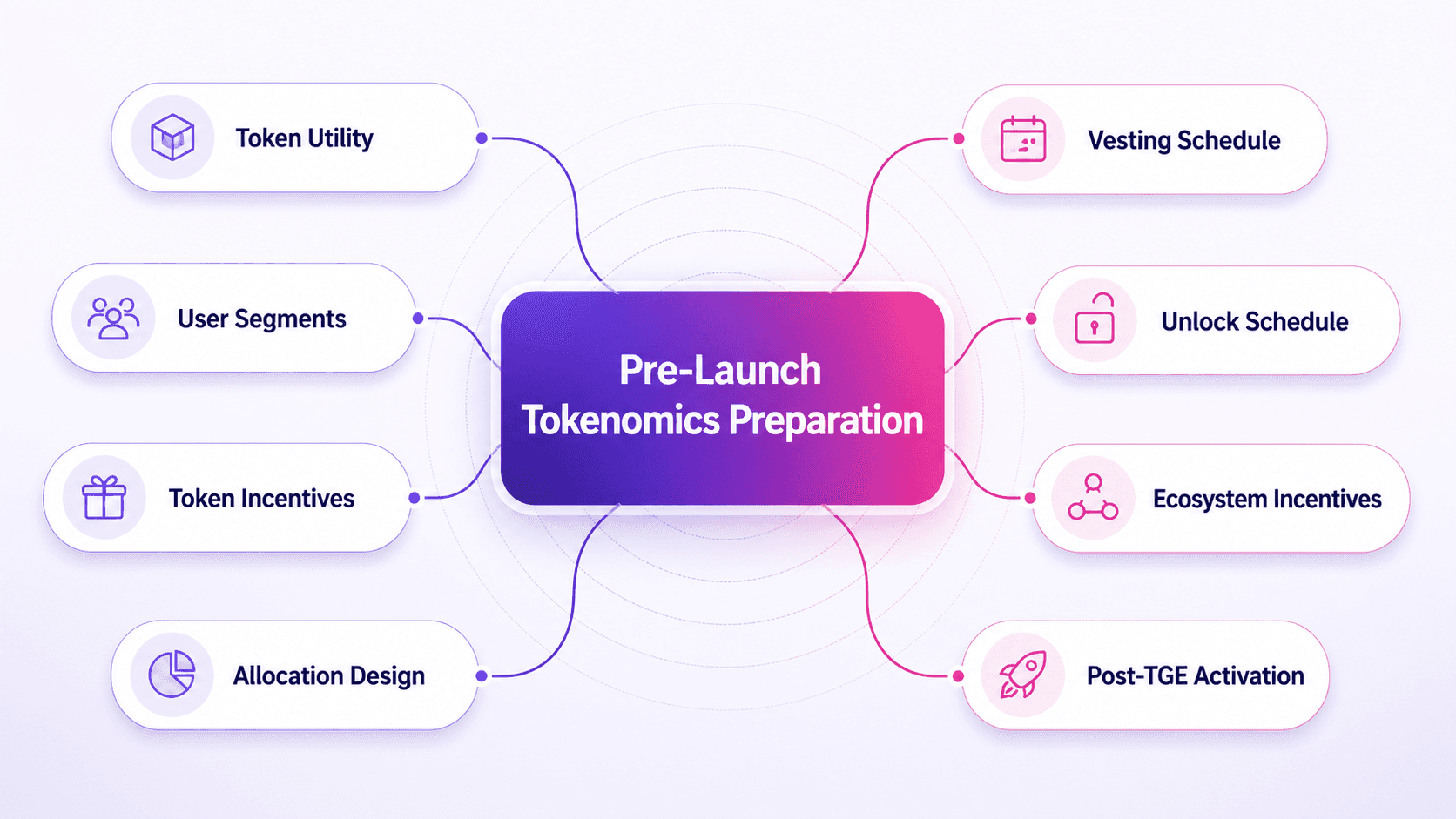
Tokenomics design should start with retention logic. It should not start with rewards, hype, or short-term demand. Founders need to define why users should stay after TGE. That means defining how the token creates value. It also means defining who deserves tokens. Then teams must define when supply enters circulation. For token sales, this process should reduce extraction. It should also guide users toward repeat participation.
Retention Tokenomics Framework
Framework Area | Question to Answer |
Value action | What behavior creates product or ecosystem value? |
Reward match | What incentive rewards that behavior without overpaying farmers? |
Time commitment | What mechanism encourages repeated participation? |
Supply control | How do allocation, vesting, float, and unlocks reduce sell pressure? |
Post-TGE activation | What should users do after receiving or buying the token? |
Measurement | Which retention metrics prove the model is working? |
Before launching, founders should define these core items:
Token utility
Defines why users should hold, use, or participate.User segments
Separates real users, contributors, investors, and partners.Token incentives
Rewards actions that support repeat usage and contribution.Allocation design
Gives tokens to users with stronger long-term alignment.Vesting schedule
Reduces early exits from teams, investors, and contributors.Unlock schedule
Controls new supply and reduces avoidable dump pressure.Ecosystem incentives
Keeps growth resources available after the first campaign.Post-TGE activation
Gives users clear actions after buying or receiving tokens.
Read more: How Do We Position a Token Around Utility and Ecosystem Value Instead Of Hype?
What Token Incentives Drive Real User Retention
Token incentives should reward useful behavior. Many token sales attract users through rewards and early access. That can help awareness before TGE. But awareness does not always create retention. A good tokenomics design should reward actions that support product value. Those actions should keep users active after the token launch.
The strongest incentives usually fall into four groups:
Usage-based Incentives
Reward users for real product actions. These actions may include payments, staking, trading, or platform usage. The reward should connect with clear token utility.
Example:
A DeFi platform rewards users for repeated protocol activity. The reward depends on useful activity, not wallet signups.
Contribution-based Incentives
Reward users who support ecosystem growth. This can include feedback, content, onboarding, or integrations. Quality should matter more than volume.
Example:
A project rewards users who submit useful product feedback. It does not reward generic comments or copied content.
Commitment-based Incentives
Reward users who stay active for longer periods. This can include delayed claims, access, or status benefits. The structure should avoid guaranteed return language.
Example:
A project gives added access to users with delayed claims. This encourages longer participation after TGE.
Community-based Incentives
Reward users who strengthen the community. Strong users educate, support, and onboard others. This makes community allocation more useful.
Example:
A project rewards trusted members who onboard new users. The reward depends on verified community contribution.
What Tokenomics Reduce Dump Pressure and Churn After TGE
Dump pressure starts when supply grows faster than demand. That risk often appears after TGE. For token sales, supply mechanics should not only protect price. They should also help retain users after launch. According to Binance Research, low float can weaken post-TGE upside. It also links future unlocks with selling pressure. Tokenomist also links allocation, initial float, and release schedules. These factors decide who can sell and when.
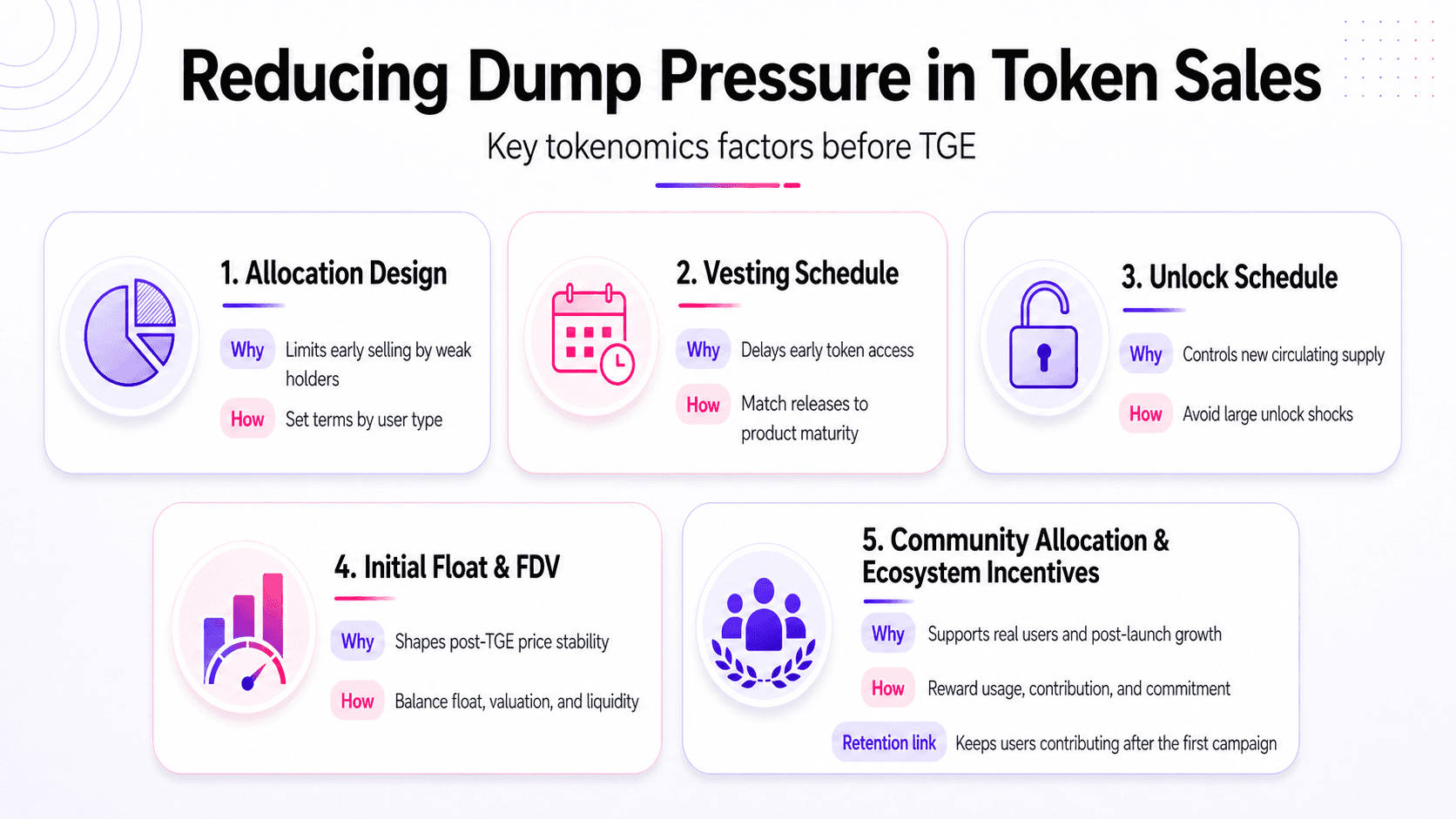
Founders should review these five areas before token sales begin:
Allocation Design
Why :
Allocation decides who receives tokens first. It also decides who can sell early. Weak allocation gives supply to short-term participants. That can increase dump pressure after TGE.
How:
Projects should separate each participant group. Investors, users, contributors, and partners need different terms. Real users should receive allocation through meaningful participation. Passive farmers should face stricter qualification rules. This helps tokenomics design support stronger user quality.
Retention link:
Better allocation gives tokens to users with stronger reasons to stay.
Vesting Schedule
Why:
A vesting schedule delays early token access. It aligns teams, investors, and advisors over time. Without vesting, early holders may exit too quickly. That can damage trust after a token launch.
How:
Projects should match vesting with product maturity. Large unlocks should not arrive before usage grows. Team and investor cliffs should support long-term delivery. Contributor rewards should also follow clear release rules. This reduces sudden selling and supports retention.
Retention link:
Better vesting keeps key stakeholders active while users build trust.
Unlock Schedule
Why:
An unlock schedule controls new circulating supply. Sudden unlocks can create fear before release dates. That fear can increase selling before tokens unlock. It can also weaken community confidence after TGE.
How:
Projects should publish clear unlock timing before launch. They should explain how supply enters circulation. They should avoid major unlocks during weak demand periods. They should also monitor liquidity near unlock dates. This makes supply planning easier to understand.
Retention link:
Clear unlocks reduce uncertainty, which helps users stay engaged.
Initial Float and FDV
Why:
Initial float means circulating supply at launch. FDV shows valuation across total token supply. Low float with high FDV can create fragile pricing. It can also leave limited upside after TGE. That makes early selling more rational.
How:
Projects should test float and valuation together. They should avoid inflated launch valuations. They should compare FDV with realistic market demand. They should also consider liquidity depth at listing. This helps the token launch avoid early pressure.
Retention link:
Balanced valuation gives real users more confidence after launch.
Community Allocation and Ecosystem Incentives
Why:
Community allocation can support real users. But poor rules can attract fast extraction. Ecosystem incentives can fund growth after launch. But unclear rewards can create farming behavior.
How:
Projects should tie rewards to useful participation. They should reward usage, contribution, and commitment. They should avoid one-time rewards without product actions. They should keep growth reserves for post-TGE activation. This helps reduce churn after token sales.
Retention link:
Better incentives keep users contributing after the first campaign.
How Tokenomics Design Helps Token Sales Avoid Mercenary Users After TGE
Mercenary users often appear when rewards are easy to extract. They join before TGE, then leave after rewards end. This is usually found when a project holds an airdrop campaign. Airdrop farming often turns rewards into extraction. This happens when users chase eligibility before real product use. That behavior creates mercenary users after a token launch.
Typical Tokenomics Design That Attracts Mercenary Users:
Bad incentive | Why it attracts farmers | Better retention alternative |
Attention-first rewards | Users chase early activity without product use. | Reward repeated product actions after TGE. |
Surface-level task rewards | Follows, reposts, referrals, and wallet signups are easy to farm. | Reward verified usage, contribution, or onboarding quality. |
Airdrop farming incentives | Users complete tasks only to qualify for rewards. | Use product-linked eligibility and phased claims. |
Allocation without commitment | A crowded whitelist can hide short-term sellers. | Add contribution rules, delayed claims, or activity checks. |
Weak token utility after launch | Users lack reasons to hold, use, or participate. | Define clear product roles before the token launch. |
Disconnected reward logic | Rewards go to activity that creates little ecosystem value. | Connect token incentives with usage, contribution, and commitment. |
Marketing before incentive alignment | Crypto marketing scales farmers if incentives attract farmers. | Align campaigns with tokenomics design before promotion. |
This is why many token sales look strong before launch. A large community can still hide weak retention. A strong campaign can still hide poor token quality. The gap becomes visible after TGE. Real users stay when incentives match product value. Farmers leave when extraction becomes less profitable.
1. Use Ecosystem Incentives Beyond the First Campaign
Ecosystem incentives are token reserves for post-launch growth. They support users, builders, partners, and contributors.
Why it helps:
They stop projects from spending all rewards before TGE. They also support continued activity after the token launch.
2. Tie Rewards to Real Product Actions
Product-linked rewards connect tokens with actual platform use. This can include usage, staking, trading, feedback, or integrations.
Why it helps:
Farmers prefer easy tasks. Real users respond better to product-linked value. This supports real user retention after token sales.
3. Make Community Allocation Contribution-Based
Community allocation gives tokens to active community participants. It should reward quality contribution, not only early arrival.
Why it helps:
It reduces passive claiming. It also rewards users who educate, support, and onboard others. A stronger launch reserved meaningful supply for community and ecosystem use from day one.
4. Build Clear Post-TGE Activation
Post-TGE activation tells users what to do after launch. It can guide usage, governance, contribution, or ecosystem participation.
Why it helps:
Users need clear next steps after receiving tokens. Without them, users may sell, leave, or become inactive.
5. Align Crypto Marketing With Incentive Rules
Crypto marketing should explain participation, not only access. Campaigns should show why users should stay after TGE.
Why it helps:
Marketing can scale the wrong users. Clear incentive rules help campaigns attract better users.
Why Crypto Marketing Cannot Fix Weak Tokenomics Design
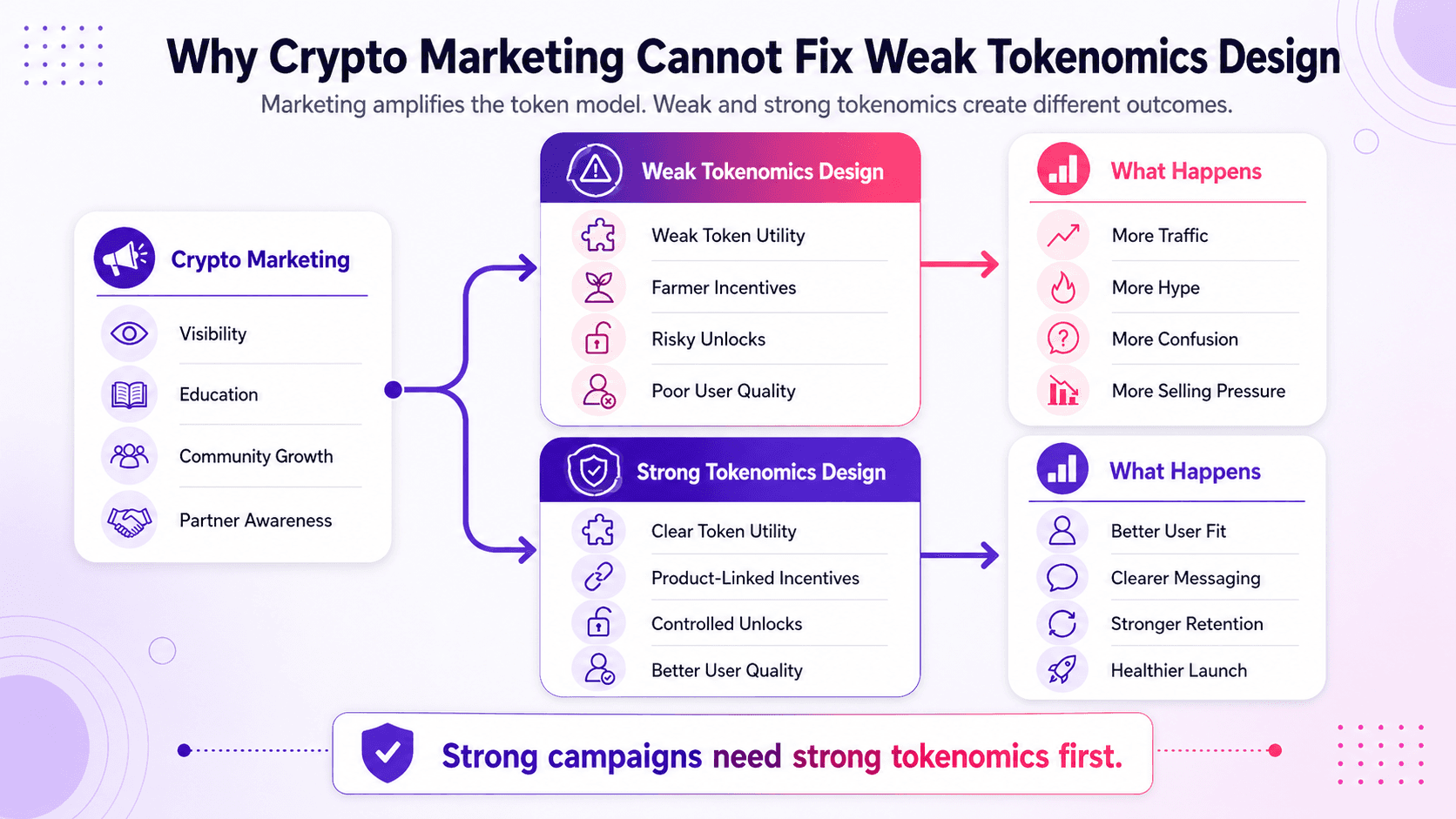
Crypto marketing amplifies the token model. It does not repair a weak one. If a project has weak tokenomics design, marketing scales weak outcomes. That usually means more traffic, more hype, more confusion, and more selling pressure.
If a project has strong tokenomics design, marketing scales better outcomes. That usually means better user fit, clearer messaging, stronger retention, and a healthier token launch. This is why token sales need strategy before promotion. The project should define token utility, incentives, and unlock logic first. Then crypto marketing can amplify the right message.
Campaign Guidance for Retention-Focused Token Sales
Retention-focused campaigns should guide users toward useful actions. They should not only promote allocation access.
Ads should promote education, not just whitelist urgency.
Creator content should explain token utility and participation rules.
Community campaigns should reward onboarding, feedback, and support.
Discord or email flows should guide users after TGE.
Retargeting should focus on users with real product interest.
Tokenomics Retention Checklist Before TGE
Founders should review these items before token sales. This checklist helps connect tokenomics design with retention, supply control, and post-launch execution.
Area | What to check | Why it matters | Risk if weak |
Token Utility | Does the token have a clear product role? | Clear token utility gives users reasons to hold, use, or participate. | Users lose interest after the token launch. |
User Segments | Are investors, users, contributors, and partners separated clearly? | Different groups need different incentive structures. | The project rewards the wrong participants. |
Token Incentives | Do rewards support usage, contribution, and commitment? | Strong token incentives improve real user retention. | Rewards attract mercenary users and airdrop farming. |
Allocation Design | Who receives tokens first, and under what terms? | Better allocation reduces weak-holder selling. | Early supply goes to short-term participants. |
Vesting Schedule | Do team and investor releases match product maturity? | A clear vesting schedule reduces early exit pressure. | Insiders can sell before real demand grows. |
Unlock Schedule | Are unlock dates gradual and easy to understand? | A strong unlock schedule controls new circulating supply. | Sudden unlocks increase dump pressure. |
Ecosystem Incentives | Is there enough supply for growth after launch? | Ecosystem incentives support users, builders, and partners. | The project spends all rewards before traction forms. |
Post-TGE Activation | Do users know what to do after receiving tokens? | Strong post-TGE activation keeps users engaged after TGE. | Users claim, sell, and leave. |
Float and FDV | Are float, valuation, and liquidity balanced? | Better balance supports healthier price behavior. | Low float and high FDV increase fragility. |
Crypto Marketing Alignment | Does promotion match the incentive model? | Crypto marketing should attract users who fit the product. | Campaigns scale attention, not retention. |
Tokenomics Design Metrics to Track After TGE
Strong tokenomics design needs measurable signals after TGE. These metrics show whether token sales attracted real users. They also show whether incentives created extraction risk.
Metric | Segment by cohort | How to measure | Healthy signal | Warning signal |
90-day holder retention | Public sale, community, airdrop, investors | Wallets holding after 90 days ÷ wallets at TGE | 40%+ still hold meaningful balance | Most wallets exit within 30 days |
Active wallet retention | New users, repeat users, reward users | Active wallets in D30, D60, and D90 cohorts | Usage stays stable across cohorts | Activity drops after rewards end |
Governance participation % | Retail holders, contributors, long-term holders | Voters ÷ eligible holders | 10%+ join key votes | Holders ignore governance |
Reward-to-utility ratio | Stakers, product users, contributors | Rewards paid ÷ useful product actions | Rewards create repeated usage | Rewards create only claims |
Mercenary-user ratio | Airdrop users, campaign users, whitelist users | Reward-only wallets ÷ active product users | Ratio declines after launch | Farmers outnumber users |
Token velocity trend | Short-term holders, long-term holders, active users | 30-day transfer volume ÷ circulating supply | Velocity matches product usage | Velocity rises while usage falls |
Post-TGE participation KPI | Buyers, claimers, stakers, contributors | Staking, usage, referrals, contribution, governance | Users take next actions | Users claim, sell, and leave |
These benchmarks should be adjusted by protocol category, token utility, liquidity profile, launch stage, and user segment. For early-stage projects, trend direction often matters more than a universal threshold.
Case Study: Tokenomics Design for Ape in Poker
TokenMinds helped Ape in Poker structure its tokenomics design. The project needed fair token distribution across stakeholders. It also needed a release model that reduced market flooding. TokenMinds planned and structured:
Token distribution across seed investors, public sale, team, staking rewards, and treasury.
Staking rewards to support long-term participation.
Treasury allocation to support liquidity and operational flexibility.
Vesting schedule across team, advisors, investors, and developers.
Gradual token release across a 36-month schedule.
This structure reflects a retention flywheel:
Utility → Commitment Locking → Contribution Rewards → Demand Reinforcement
This structure reduced churn risk by delaying short-term supply, preserving incentives for post-launch participation, and giving the project enough treasury flexibility to support liquidity, staking, and ecosystem growth after TGE.
Read more Ape in Poker’s Tokenomics Advisory Case Study here.
Review Your Tokenomics Design Before Token Sales
Review your tokenomics before the TGE. TokenMinds can help evaluate your incentive model, allocation, vesting, unlock schedule, ecosystem rewards, and post-TGE activation plan. We’ll help identify potential speculative behavior, mass selling pressure, or user churn rates. Book a Tokenomics Review Service before your token sale.
FAQs
What tokenomics help reduce dump pressure after TGE?
Clear allocation, gradual unlocks, fair valuation, and strong token utility help reduce dump pressure.
How should vesting schedules be designed for token sales?
Vesting schedules should match product maturity, stakeholder roles, and expected demand growth.
What causes mercenary users in token launches?
Mercenary users appear when rewards favor extraction over real product participation.
How does low float high FDV affect token sales?
Low float high FDV can create fragile pricing and early selling pressure.
What token incentives improve retention?
Usage-based, contribution-based, and commitment-based token incentives improve real user retention.
How do we avoid mercenary users after TGE?
Projects should reward product usage, contribution, and commitment. They should avoid simple task rewards.
What token incentives drive retention?
Usage-based, contribution-based, commitment-based, and community-based token incentives drive retention.
What tokenomics reduce dump pressure and churn?
Clear allocation, gradual unlocks, balanced FDV, and strong token utility reduce churn.