TLDR
TokenMinds is a strong fit for teams building payment apps, tokenization platforms, or enterprise-grade Polygon systems, while LeewayHertz, PixelPlex, and Innowise are better suited for large infrastructure or corporate deployments, and Rapid Innovation, Blaize, EvaCodes, IdeaSoft, Blockchain App Factory, and Webisoft fit well for DeFi, NFT, gaming, or mid-size Polygon projects with different budgets and technical scope.
Polygon is where enterprise Web3 is being built right now, as referenced in this blockchain development company guide. Deutsche Telekom runs a validator node on it. AWS made it a native option in its Blockchain Node Service. Stripe, Mastercard, and Immutable have all built on top of it.
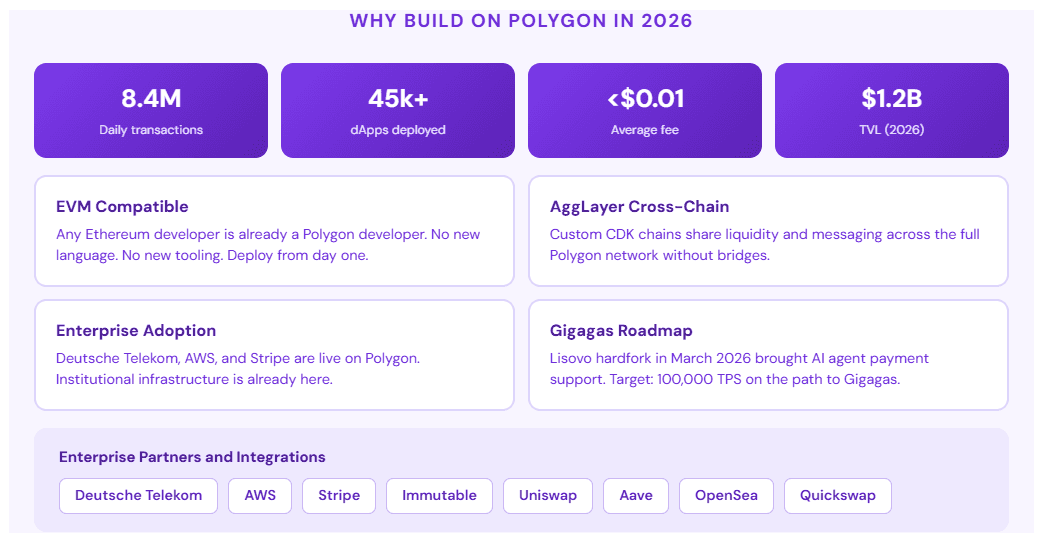
The Lisovo hardfork in March 2026 reduced gas costs for AI agent payments and pushed the network toward 100,000 TPS. Over 45,000 dApps run on Polygon today, processing millions of transactions at fees most businesses would consider negligible.
Polygon has the liquidity, the tooling, the institutional backing, and the throughput that serious projects require.
Quick Comparison
Rank | Company | Key Services | Rate | Founded |
1 | TokenMinds | Polygon dApps, DeFi, NFT, AI-Native, Tokenization, Payment Rails | $50-$79/hr | 2017 |
2 | LeewayHertz | Polygon dApps, Smart Contracts, NFT, DeFi, Wallets, CDK | $50-$99/hr | 2007 |
3 | PixelPlex | Smart Contracts, DeFi, NFT, Gaming, Enterprise Polygon, Wallets | Custom | 2007 |
4 | Rapid Innovation | Polygon dApps, TRC-20, DeFi, DEX, NFT, Wallets, Cross-chain | Custom | 2019 |
5 | Blaize | Polygon Audit, Smart Contract Security, DeFi, Token Dev | Custom | 2017 |
6 | Innowise Group | Polygon Smart Contracts, DeFi, Tokenization, dApps, Enterprise | $50-$100/hr | 2007 |
7 | EvaCodes | Polygon dApps, Smart Contracts, DeFi, NFT, Wallets, CDK | Custom | 2019 |
8 | IdeaSoft | Polygon dApps, Smart Contracts, DeFi, Compliance, Cross-chain | $50-$99/hr | 2016 |
9 | Blockchain App Factory | Polygon Tokens, NFT, DeFi, dApps, DEX, Wallets, Gaming | Custom | 2017 |
10 | Webisoft | Polygon dApps, Smart Contracts, NFT, DeFi, Cross-chain, Wallets | Custom | 2018 |
What Is Polygon Blockchain Development?
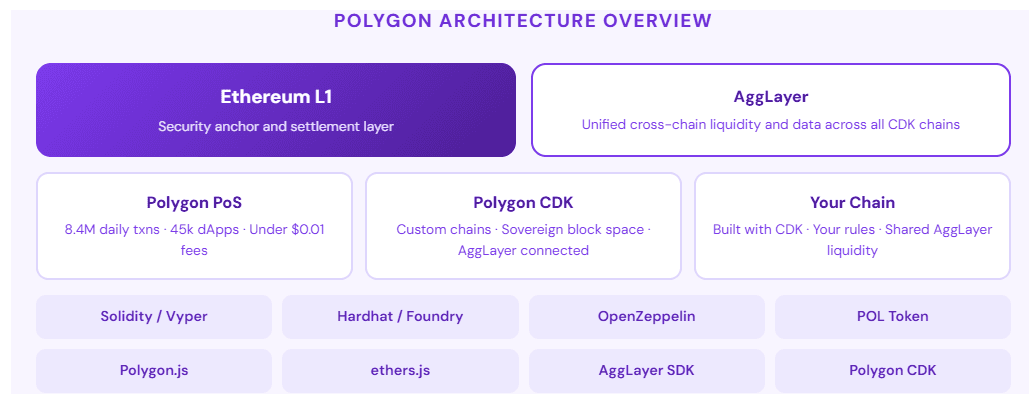
Polygon is an Ethereum Layer 2 scaling solution. It runs EVM-ready Solidity contracts at a fraction of Ethereum's cost.
Builders choose between two main paths. Deploying on Polygon PoS gives access to 45,000+ dApps and deep liquidity. It holds the biggest stablecoin base on any L2. Building with Polygon CDK gives sovereign block space. It connects to the AggLayer for cross-chain liquidity and data.
Key tools in the Polygon development stack:
Polygon PoS: The main chain. Fast, low-cost, EVM-ready. Handles the bulk of transactions and TVL.
Polygon CDK: Chain Development Kit. Lets teams launch custom chains that plug into the AggLayer for shared liquidity and cross-chain messaging.
AggLayer: Polygon's cross-chain aggregation layer. Connects CDK chains and PoS into a unified liquidity environment.
Solidity / Vyper: Smart contract languages. Any Ethereum developer is already a Polygon developer.
Hardhat / Foundry: Development and testing frameworks. Standard EVM tooling applies directly.
POL Token: Replaced MATIC in 2024 as the native network token for staking and gas.
Polygon.js / ethers.js / web3.js: Developer APIs for interacting with Polygon chains.
OpenZeppelin: Smart contract library. Security-audited contract templates widely used on Polygon.
How We Ranked These Companies
Each company was scored on five points:
Polygon-specific track record: Did they deploy real contracts, dApps, or CDK builds on Polygon mainnet?
Stack depth: Do they know Solidity, Hardhat, Foundry, OpenZeppelin, CDK, and AggLayer?
Service breadth: Can they handle the full build, from smart contract to frontend, wallet, and post-launch?
Track record: Do they have case studies, Clutch reviews, or third-party rankings with named clients?
Pricing clarity: Do they publish their rates, or hide them behind a contact form?
Polygon Blockchain Developments
1. TokenMinds
Website: tokenminds.co | Founded: 2017 | Rate: $50-$79/hr | Location: Singapore
TokenMinds builds enterprise-grade payment and DeFi infrastructure on Polygon. Their focus is on projects that move real value at scale: cross-border payments, asset tokenization, and on-chain treasury systems where Polygon's low fees and high throughput make a measurable difference to the business case.
Clients include Khan Bank; Euromoney and The Banker both name it Best Bank in Mongolia. OKX is also a verified client, one of the world's leading crypto exchanges by volume and derivatives activity.
Three products underpin every engagement. TMX Payments handles multi-chain transfers, KYC/AML compliance, stablecoin settlement, and ERP sync. On Polygon, that means near-instant USDT transfers at sub-cent cost with full compliance controls built in. TMX Tokenize covers the issuance of real-world assets including real estate, securities, and loyalty programs on-chain. TMX Agentic Finance brings AI automation to treasury management: reserve tracking, approved transaction execution, and anomaly detection without manual steps.
Best For: Enterprise Polygon payment apps · High-volume DeFi and NFT platforms · Compliance-first builds
Awards: Hackernoon (2019) · NewsBTC (2022) · MSN (2024) · Coinranking (2025) · Finbold (2026) · Clutch 5/5 (perfect score)
2. LeewayHertz
Website: leewayhertz.com | Founded: 2007 | Rate: $50-$99/hr | Location: San Francisco, CA
LeewayHertz is a verified Polygon strategic partner. They build on Polygon PoS and CDK using Solidity and Vyper. Their services cover NFT marketplaces, DeFi platforms, dApps, wallets, and smart contracts. The team runs 250+ developers and has shipped 80+ smart contracts and 60+ blockchain projects. The Hackett Group acquired LeewayHertz, adding generative AI depth to the practice. Clutch shows a 4.7/5 rating. Clients include ESPN, 3M, McKinsey, and the US Army.
Best For: Enterprise Polygon dApps, full-cycle builds from contract to frontend, NFT marketplaces
3. PixelPlex
Website: pixelplex.io | Founded: 2007 | Rate: Custom pricing | Location: New York, USA
PixelPlex has shipped 450+ blockchain projects with a zero exploit record. Client projects have raised over $1.2 billion and reached 50 million end users. Their Polygon work covers dApps, smart contracts, DeFi, NFT, gaming, and enterprise builds. Every solution gets gas-checked and audited by both internal and external teams before launch. They show up regularly in Clutch's top blockchain development firms in the USA.
Best For: Gas-optimized Polygon contracts, enterprise and gaming builds, NFT marketplaces with security-first delivery
4. Rapid Innovation
Website: rapidinnovation.io | Founded: 2019 | Rate: Custom pricing | Location: USA and India
Rapid Innovation focuses on Polygon dApp builds on Layer 2. Their work covers dApps, smart contracts, NFT, DeFi, DEX, wallets, bridges, and P2E gaming. Token design covers supply, vesting, staking, and gas tuning, all done before any code is written. One verified review notes the CEO joined early calls to learn the project first. They show up in multiple 2025 and 2026 blockchain rankings.
Best For: Full-service Polygon builds, P2E and GameFi projects, cross-chain Polygon bridges
5. Blaize
Website: blaize.tech | Founded: 2017 | Rate: Custom pricing | Location: Ukraine (Kyiv and Dnipro)
Blaize is the most security-focused firm on this list. They audit and build smart contracts across 25+ chains, with Polygon among their supported networks. Their security team has worked with 130+ clients and secured 210+ protocols. Their full audit library is public at audits.blaize.tech, which is rare. Most firms keep that kind of record behind a contact form.
Every engagement includes post-audit work: follow-up reviews, patches, and deploy support. That makes them useful well beyond the audit itself. Clutch shows a perfect 5.0/5.0 rating. Client feedback points to strong smart contract review work and a team that tends to go beyond what was asked.
Stack: Solidity, Polygon PoS, smart contract audits, token development, formal verification, post-audit support
Best For: Polygon smart contract audits before mainnet, DeFi protocol security, builds needing security-first delivery
6. Innowise Group
Website: innowise.com | Founded: 2007 | Rate: $50-$100/hr | Location: Warsaw, Poland
Innowise is the biggest firm on this list. They have 3,500+ staff and a blockchain team of 50+ developers. They hold CMMI Level 5 status, the top rating in software engineering process maturity. Smart contract work covers design, build, audit, and performance tuning.
Enterprise clients include the Commercial Bank of Qatar, NTT DATA, and SPAR. A 93% client return rate backs up their delivery record. For large Polygon builds that need big teams, formal process, and compliance-aware development, Innowise fits that brief well.
Best For: Enterprise Polygon builds, large-team projects, regulated financial apps
7. EvaCodes
Website: evacodes.com | Founded: 2019 | Rate: Custom pricing | Location: Ukraine
EvaCodes builds on Polygon. Hacken and CertiK handle their audits. They cover dApps, smart contracts, wallets, NFTs, DeFi, and tokens. Clutch named them the top blockchain agency in Ukraine in 2022. They have shipped 150+ projects. Clients include AliumSwap, a multi-chain DEX, and Nebeus, a crypto finance platform.
Best For: Security-audited Polygon DeFi, NFT marketplaces, Polygon dApp builds with audit partners
8. IdeaSoft
Website: ideasoft.io | Founded: 2016 | Rate: $50-$99/hr | Location: Tallinn, Estonia
IdeaSoft builds on Polygon, Ethereum, BNB, Avalanche, Polkadot, and Solana. They have shipped 250+ projects for enterprise and government clients. Clutch shows a 4.9/5.0 from 27 reviews. AML/CFT and FATF-compliant DeFi are proven strengths. Third-party reviews back this up. Clients include First Abu Dhabi Bank and Breaking Equity.
Best For: Regulated Polygon builds, government and bank clients, FATF-compliant DeFi
9. Blockchain App Factory
Website: blockchainappfactory.com | Founded: 2017 | Rate: Custom pricing | Location: Chennai, India
Blockchain App Factory covers a wide range of Polygon services. Token builds, NFT projects, DeFi, DEX platforms, wallets, P2E gaming, and node setup are all part of their offer. Token work includes burnable, mintable, and governance ERC-20 contracts. Named clients include Amepay, Evai, and DasCoin.
Best For: Full-service Polygon token builds, NFT and GameFi projects, high-volume token issuance
10. Webisoft
Website: webisoft.com | Founded: 2018 | Rate: Custom pricing | Location: Canada
Webisoft builds cross-chain dApps and smart contracts on Polygon. Audits run before deployment. Post-launch review is a standard service. Their stack covers Ethereum, Cosmos, Polkadot, and Polygon. Verified client reviews confirm delivery quality.
Best For: Cross-chain Polygon dApps · Long-term post-launch support · NFT and DeFi builds
Polygon Development Pricing in 2026
Polygon is the most cost-friendly EVM chain to build on. Solidity developers move to Polygon with no learning curve. The main cost factors are scope, audit needs, and CDK chain size.
ERC-20 Token: Smart contract, tests, and Polygon mainnet deploy. Takes 1-2 weeks. Costs $3,000-$12,000.
Advanced Token : Adds governance, vesting, staking, burning, and an audit. Takes 2-3 weeks. Costs $12,000-$35,000.
Polygon dApp MVP: Smart contracts, frontend, wallet connect, and basic UI. Takes 4-8 weeks. Costs $20,000-$60,000.
NFT Marketplace: ERC-721/1155 contracts, minting UI, royalties, and wallet. Takes 6-10 weeks. Costs $30,000-$80,000.
DeFi Protocol: Staking, lending, liquidity pools, DEX, and audit. Takes 2-4 months. Costs $50,000-$150,000.
CDK Custom Chain: Sovereign chain, AggLayer link, governance, and audit. Takes 4-8 months. Costs $100,000-$400,000+.
Why Build on Polygon in 2026?
Polygon processes 8.4 million transactions daily at under $0.01 per transaction. Over 45,000 dApps run on it. Deutsche Telekom, AWS, and Stripe have all joined the network.
How to Choose the Right Polygon Development Partner
Ask for a Polygon mainnet deployment: Generic blockchain experience does not transfer to production Polygon builds. Ask for a verified contract address on Polygon PoS mainnet or a CDK chain. Published guides on gas tuning or AggLayer link are a secondary signal.
Clarify PoS vs. CDK: Not every project needs a custom CDK chain. Most are better served by deploying on Polygon PoS. A good partner helps you make that call before scoping a full build. CDK chains make sense for projects needing sovereign block space, custom fee models, or dedicated throughput.
Budget the audit separately: Smart contracts on Polygon hold real value. A missed audit is not a process gap. It is a liability. Budget $5,000-$25,000 for an independent Polygon smart contract audit before mainnet. Never skip it.
Confirm gas tuning depth: Poorly written Solidity contracts waste gas on every user interaction. Ask how the firm profiles and optimizes gas before deployment. This is a basic skill for any serious Polygon team.
Ask about AggLayer readiness: If your build involves cross-chain liquidity or messaging via CDK, the partner needs real AggLayer experience. Ask for a concrete example. This is a newer capability and not every firm has shipped it.
Match the firm to your use case: NFT platforms, DeFi protocols, payment rails, and gaming dApps have different architecture requirements on Polygon. Match the firm's track record to your category before engaging.
Conclusion
$85 billion in USDT runs on Polygon. Mastercard, Stripe, Deutsche Telekom, and AWS are here. Your users are too.
The question is not whether Polygon fits your business. It is whether you build it right. The right partner cuts gas use from the first line. They test on Mumbai before touching the mainnet. They bake compliance into contract logic before launch. They audit before launch, not after.
The wrong partner ships contracts that burn gas on every call. They skip the audit. They miss the AggLayer link. Your CDK chain loses shared liquidity from day one.
Polygon's rails are fast, cheap, and proven. The only variable is who builds on them for you. Choose on mainnet work, not proposals.
FAQ
What is Polygon blockchain development?
Polygon development means building on the Polygon network. This covers ERC-20 tokens, NFT contracts, dApp builds, DeFi, CDK chains, and AggLayer link.
How much does Polygon development cost in 2026?
A basic ERC-20 token starts at $3,000. An advanced token with governance and staking runs $12,000-$35,000. A dApp MVP runs $20,000-$60,000. An NFT marketplace runs $30,000-$80,000. A DeFi protocol runs $50,000-$150,000. A custom CDK chain can exceed $400,000.
What language is used for Polygon smart contracts?
Polygon smart contracts use Solidity or Vyper. Both compile to EVM bytecode. Any Ethereum developer can write Polygon contracts. No change needed. Polygon is fully EVM-ready.
What is Polygon CDK?
Polygon CDK stands for Chain Development Kit. It lets teams launch custom chains that connect to the Polygon AggLayer. CDK chains share liquidity and messaging across the Polygon network. They suit projects that need their own block space or fee rules.
What is the AggLayer?
The AggLayer is Polygon's cross-chain data layer. It links CDK chains and Polygon PoS into one shared liquidity pool. AggLayer chains share liquidity and send cross-chain messages. No bridges needed.
Is Polygon still a good choice in 2026?
Yes. Polygon PoS processes 8.4 million transactions daily. Fees stay under $0.01. Over 45,000 dApps run on it. Polygon zkEVM Mainnet Beta closes in 2026. Polygon PoS and CDK are the active focus. The Gigagas plan targets 100,000 TPS.
What is the difference between Polygon PoS and Polygon CDK?
Polygon PoS is the main public chain. It is shared infra with deep liquidity and 45,000+ dApps. Polygon CDK builds custom chains with private block space. CDK chains link to the AggLayer for shared liquidity. PoS suits most projects. CDK suits projects that need their own throughput or governance rules.