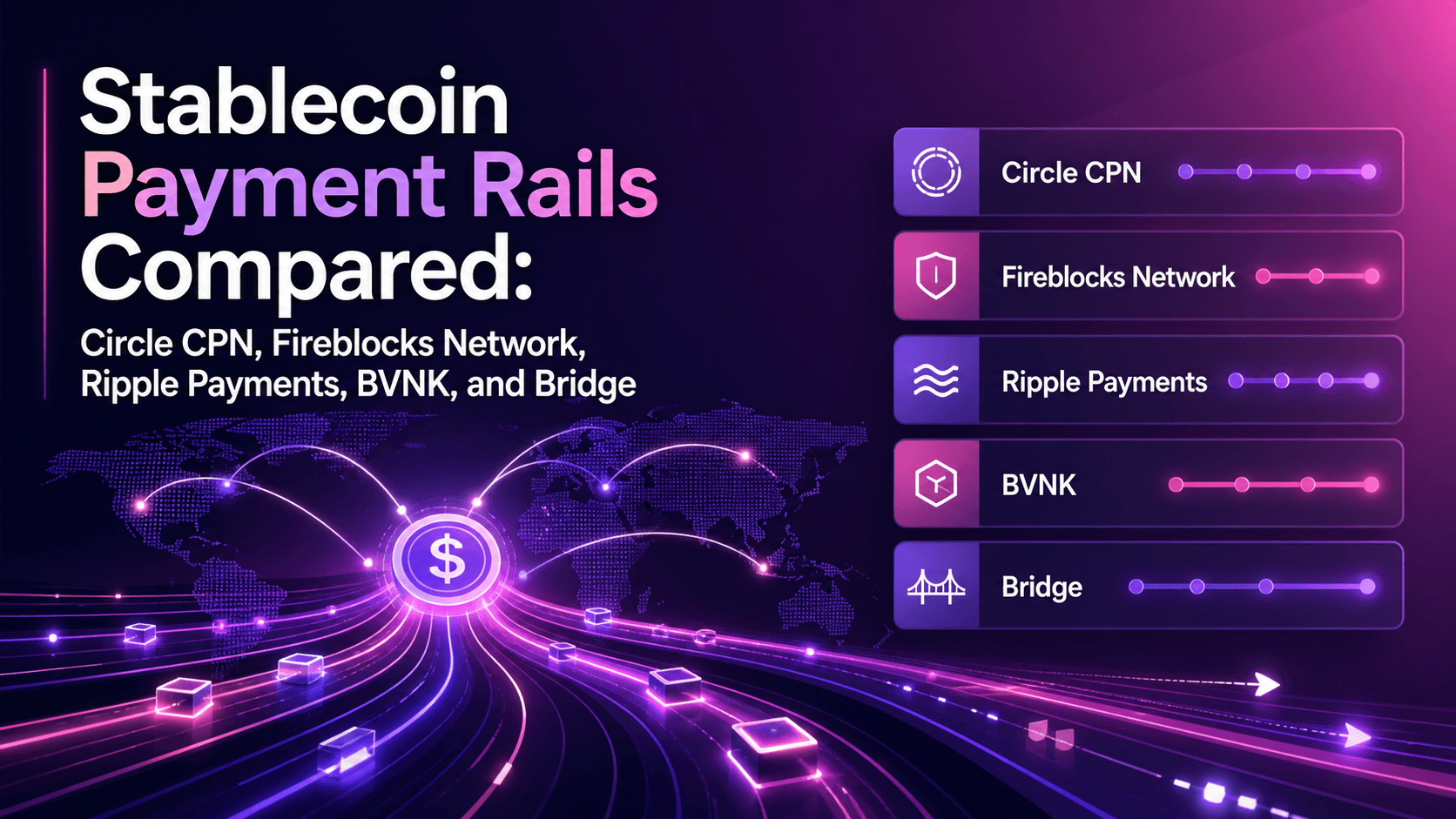
Featured answer: Financial institutions evaluating stablecoin payment rails should compare five distinct models: governed network (Circle CPN), orchestration layer (Fireblocks), end-to-end suite (Ripple), full-stack infrastructure (BVNK), and developer API layer (Bridge). The right choice depends on existing infrastructure, desired vendor relationship depth, and whether independence or acquirer roadmap alignment is prioritized.
EXECUTIVE SUMMARY:
Three major stablecoin infrastructure deals. Eighteen months. Mastercard's agreement to acquire BVNK for up to $1.8 billion. Stripe's reported $1.1 billion acquisition of Bridge. Ripple's $1.25 billion acquisition of prime broker Hidden Road (Hidden Road/Ripple Announcement, 2025). That is not a market experimenting with stablecoins. That is a market pricing infrastructure at scale. The five vendors covered here represent genuinely different models, not different brands of the same product. Choosing between them is an architecture decision as much as a vendor decision. This article gives payments leads, enterprise architects, and transaction banking strategists a neutral framework for making that call.
Five Vendors. Five Different Models.
When institutions start shortlisting stablecoin payment vendors, the conversation often starts in the wrong place. The question becomes which vendor has the most corridors, or the best compliance story, or the fastest settlement. Those are real evaluation criteria, but they miss the more important question first: what kind of infrastructure model does your institution actually need?
The five vendors covered here: Circle CPN, Fireblocks Network, Ripple Payments, BVNK, and Bridge are not competing versions of the same product. Circle CPN is a governed network. Fireblocks is an orchestration layer. Ripple Payments is an end-to-end suite with a native stablecoin. BVNK is a full-stack infrastructure platform entering the Mastercard ecosystem pending regulatory closing. Bridge is a developer API layer embedded inside Stripe. Each model has a different integration footprint, a different compliance architecture, and a different relationship between the institution and the underlying infrastructure.
The acquisition activity of the last 18 months makes this comparison more urgent. Mastercard's definitive agreement to acquire BVNK, Stripe's reported acquisition of Bridge, and Ripple's acquisition of Hidden Road all signal the same thing: the infrastructure layer is consolidating fast, and the vendor you select today is a bet on who controls that infrastructure in three years.
What Each Vendor Actually Is
### Circle CPN
Circle CPN operates as a network, not a payments processor. Circle Technology Services acts as the governing and standard-setting body, defining the protocol and providing developer APIs, but does not hold funds or move money directly. Originating and beneficiary financial institutions settle directly with each other. The value proposition is network access: a single API and agreement that connects a bank or PSP to a growing list of institutional participants globally, with compliance embedded at the network layer through Travel Rule enforcement, participant vetting, and a Trust Engine that lets participants define transaction criteria aligned to their own risk appetite.
Circle now also offers CPN Managed Payments, a managed settlement product where Circle manages the digital asset lifecycle, payment orchestration, compliance controls, and blockchain infrastructure for customers that prefer not to hold or manage digital assets directly. This distinction separates the core governed network from the managed adoption path for PSPs, fintechs, and platforms.
Banking advisors shaping the network's design include Santander, Deutsche Bank, Société Générale, and Standard Chartered, which signals the institutional tier Circle is targeting. CPN mainnet launched in May 2025, with USDC and EURC as settlement assets across Ethereum, Polygon, Solana, and EVM-compatible chains.
### Fireblocks Network
Fireblocks approaches the problem differently. Where Circle is a network institution joins, Fireblocks is an orchestration layer institutions integrate. The Fireblocks Network for Payments sits on top of on/off-ramps, liquidity providers, compliance vendors, and counterparty networks, routing payment flows across all of them from a single integration point. More than 300 payment companies are live on the network, processing over $200 billion in monthly stablecoin flows according to Fireblocks-reported data.
Compliance is handled through named integrations with Notabene, Elliptic, and Chainalysis for Travel Rule and KYT. Custody uses Fireblocks' MPC architecture, which gives institutions direct control over key management and transaction approvals. For banks with complex multi-rail, multi-corridor requirements, the orchestration model is a natural fit: it abstracts infrastructure complexity without removing institutional control.
### Ripple Payments
Ripple Payments has been repositioning from a corridor-specific payments network into a broader institutional suite. The platform now covers payouts, custody, collections, liquidity, and compliance through a single API, following the acquisitions of Palisade for custody and treasury automation and Rail for virtual accounts and collections infrastructure. Ripple Payments operates across 90 payout markets covering more than 55 currencies, with processed volume exceeding $95B as of its latest disclosures. The native stablecoin, RLUSD, is now integrated into payment flows with select customers, operating under a New York State DFS limited purpose trust company charter.
AMINA Bank, a FINMA-regulated Swiss crypto bank, became the first European bank to integrate Ripple Payments in late 2025, using it to handle both fiat and stablecoin rails simultaneously for cross-border transactions. The end-to-end suite model is strongest for institutions that want a single vendor relationship covering the full payment value chain.
### BVNK
BVNK's market position shifted significantly in March 2026 when Mastercard announced a definitive agreement to acquire the company for up to $1.8 billion. That acquisition changes how BVNK fits into an institutional evaluation. The standalone infrastructure story becomes an infrastructure-inside-Mastercard story, with a stated goal of delivering interoperability between fiat and digital currencies across the Mastercard network.
Before the acquisition, BVNK had built strong traction as a full-stack stablecoin infrastructure platform processing $30 billion in annualized volume across 130 countries, with banking partners including Barclays, BBVA, and Deutsche Bank providing fiat on/off-ramp coverage. Its two-model approach is worth understanding: Managed Payments is a turnkey solution where BVNK handles licensing, custody, and compliance; Layer1 is a self-custody infrastructure product for enterprises that want to run their own stablecoin stack internally. Citi Ventures and Visa Ventures both invested in BVNK before the Mastercard acquisition, reflecting the traditional finance sector's recognition of stablecoins as strategic infrastructure.
On the compliance side, BVNK holds UK EMI/fiat permissions via System Pay Services; its crypto and stablecoin services are subject to jurisdiction-specific regulatory treatment rather than direct FCA oversight (BVNK Compliance Page).
### Bridge
Bridge, now a Stripe company following Stripe's reported $1.1 billion acquisition completed in early 2025, is the most developer-oriented model of the five. The core product is a set of composable APIs covering orchestration, stablecoin issuance, and card issuing, designed so that financial complexity is abstracted away and institutions interact with clean API surfaces. Bridge became the backbone of Stripe's Stablecoin Financial Accounts, now accessible in more than 100 countries (Stripe Sessions 2025), supporting USDC and Bridge's own USDB stablecoin. The Visa card issuing partnership, which started with Latin America and is expanding to Europe, Africa, and Asia, allows developers to issue stablecoin-linked Visa cards through a single API integration (Stripe, 2025).
Bridge received conditional OCC approval to organize a federally chartered national trust bank, subject to final approval before full operation as a national trust bank. This conditional status strengthens its regulatory positioning in the US market. Open Issuance, launched in September 2025, allows any business to launch and manage its own branded stablecoin in days, with reserves managed by BlackRock, Fidelity, and Superstate. For developer-first teams building within the Stripe ecosystem, or institutions wanting stablecoin issuance capabilities, Bridge is the natural starting point.
How to Use This Comparison
Use this framework to evaluate vendors by model type, corridor reach, custody dependency, and implementation ownership. The matrix below maps each vendor across the dimensions that matter for institutional selection. But the matrix alone does not make the decision. What makes it is understanding which institutional profile you are starting from.
A bank with existing custody infrastructure, a live FX desk, and established correspondent relationships is not buying a full stack. It is buying a specific capability: corridor extension, network access, or compliance architecture. Circle CPN and Fireblocks are the natural candidates here, because neither requires the bank to replace what it already has. Circle adds network access and a governed settlement protocol. Fireblocks adds orchestration across rails the bank may already partially own.
A payments-first fintech building net-new stablecoin products has different requirements. It needs licensing coverage, compliance infrastructure, and fiat on/off-ramp access it does not already have. BVNK's Managed Payments model is designed exactly for this profile, as is Bridge for teams building within or alongside the Stripe ecosystem. Both abstract the compliance and custody complexity that a fintech cannot easily build from scratch.
An institution building an end-to-end cross-border payments capability and wanting a single vendor relationship covering the full lifecycle is the profile Ripple Payments targets most directly. The suite model trades flexibility for simplicity: one vendor, one API, one relationship covering payouts, custody, liquidity, and compliance across 90 payout markets.
Vendor comparison matrix:
Use Table 1 to evaluate model fit and custody preference. Use Table 2 to compare corridor reach and compliance ownership. Use Table 3 to understand operational workflows and implementation responsibility.
Table 1: Core Model & Integration Fit
Vendor | Primary Model | One-to-Many Integration | Custody Dependency | Best-Fit Buyer |
Circle CPN | Governed network | Yes: single API unlocks multi-party settlement | Managed by OFI/BFI participants | Banks & PSPs wanting network access without bilateral agreements |
Fireblocks Network | Orchestration layer | Yes: routes across multiple rails/partners | MPC-based, institution-controlled | Banks with complex multi-rail, multi-corridor architecture needs |
Ripple Payments | End-to-end suite | Limited: single-vendor lifecycle | Integrated custody via Palisade | Institutions wanting one vendor for end-to-end cross-border payments |
BVNK | Full-stack infra | Yes: managed + self-custody options | Segregated; Layer1 for self-custody model | Fintechs/enterprises building stablecoin products, now via Mastercard |
Bridge | Developer API layer | Yes: composable APIs across Stripe ecosystem | Bridge/Stripe as custodian; USDC/USDB | Developer-first teams building on Stripe or wanting branded stablecoin issuance |
Table 2: Corridor, Compliance & Risk
Vendor | On/Off-Ramp Coverage | Fiat Corridor Coverage | Compliance Responsibility | Watch-Outs |
Circle CPN | Via OFI/BFI partner network | Multi-chain USDC/EURC; fiat payouts via partners | Native: Travel Rule, Trust Engine, participant vetting | Dependent on participant liquidity; not a full-stack payout engine |
Fireblocks Network | Via integrated partner network | Global corridors via partner routing | Integrated: Notabene, Elliptic, Chainalysis | Requires internal orchestration maturity; partner quality varies by region |
Ripple Payments | Built-in via Ripple/Palisade/Rail | 90+ payout markets, 55+ currencies | Built-in across fiat and RLUSD flows | RLUSD adoption and liquidity roadmap still maturing; suite model is less flexible than mix-and-match architectures |
BVNK | Built-in via banking partners | 130+ countries; Barclays/BBVA/Deutsche Bank ramps | EMI-licensed fiat; crypto subject to jurisdictional treatment | Pending Mastercard closing; regulatory treatment of crypto varies by market |
Bridge | Via Stripe Financial Accounts | 100+ countries via Stripe network | Compliance-by-design; conditional OCC trust charter | OCC charter still conditional; tightly coupled to Stripe roadmap |
Table 3: Operations & Implementation Ownership
Vendor | Operational Workflow | Implementation Owner |
Circle CPN | Settlement, network access, governed protocol | Circle/OFI/BFI joint |
Fireblocks Network | Multi-rail routing, compliance orchestration, MPC custody | Institution + Fireblocks |
Ripple Payments | Payouts, collections, liquidity, custody, compliance | Ripple (full suite) |
BVNK | Managed payouts, self-custody stack, fiat conversion | BVNK (Managed) or Institution (Layer1) |
Bridge | Stablecoin issuance, card issuing, embedded finance | Stripe/Bridge |
*This matrix reflects publicly available vendor positioning as of April 2026. Each cell can be updated directly in this table as vendor capabilities evolve.
For detailed due diligence on liquidity providers, FX corridors, and on/off-ramp risk, see CM-34: Vendor Due Diligence for Stablecoin Liquidity, On/Off-Ramp, and FX Partners.
What the Acquisition Activity Tells You
Three major stablecoin infrastructure deals in 18 months is not coincidence. It is the infrastructure layer consolidating around institutions that have the distribution, the regulatory standing, and the balance sheet to own stablecoin rails at scale.
Mastercard's agreement to acquire BVNK would bring chain-agnostic stablecoin orchestration into a global network spanning 200+ countries and territories, pending regulatory review and closing. Stripe acquires Bridge and gets a developer-first stablecoin stack that makes Stripe Financial Accounts competitive with bank treasury products globally. Ripple acquires Hidden Road and gets prime brokerage relationships that put RLUSD into institutional trading and clearing workflows.
For institutions evaluating vendors now, the consolidation has two implications. First, the vendor you select is increasingly a bet on the acquirer's roadmap, not just the vendor's current product. If the transaction closes, BVNK's roadmap will increasingly be shaped by Mastercard's priorities, not only BVNK's original standalone positioning. Bridge's trajectory inside Stripe will reflect Stripe's ambition to become infrastructure for the global internet economy. Second, the vendors that have not yet been acquired, notably Circle and Fireblocks, are competing on independence as a feature. Both can credibly argue that neutrality and openness are part of their value proposition in ways that a Mastercard-owned or Stripe-owned infrastructure product cannot.
None of this makes any vendor better or worse. It makes the selection decision more dimensional than a feature comparison suggests.
The Right Question Before You Shortlist
The vendors covered here are all operating at institutional scale and all credible choices for serious evaluation. The question that determines which one belongs on your shortlist is not which vendor has the best product. It is which model fits the architecture your institution is building, and which acquirer, partner, or independent operator you want controlling that infrastructure over the next three to five years.
For a deeper procurement framework covering licensing requirements, Travel Rule due diligence, SLA scrutiny, and implementation planning, see RFP Checklist for Stablecoin and Crypto Payment API Vendors. For the full vendor category taxonomy that underpins this comparison, see Crypto Payment Integration for Banks: Vendor Landscape and Decision Framework.
Need to pressure-test Circle CPN, Fireblocks, Ripple, BVNK, and Bridge against your payment architecture? Book a Stablecoin Vendor Comparison Workshop. https://tokenminds.co/tmx-payments
Frequently Asked Questions
Q: Circle CPN vs Fireblocks Network for stablecoin payments — which is right for a bank?
Circle CPN is a governed network: a bank joins and gains access to a growing pool of institutional participants for settlement, with compliance embedded at the network level. Fireblocks is an orchestration layer: a bank integrates it as middleware to route flows across multiple rails, ramps, and liquidity sources it already works with or wants to access. A bank that wants network reach without bilateral agreements looks at CPN. A bank with complex multi-rail requirements and existing infrastructure it wants to orchestrate looks at Fireblocks. The two are not direct substitutes.
Q: How does Ripple Payments compare to Circle CPN and Fireblocks for financial institutions?
Ripple Payments is a more vertically integrated product than either CPN or Fireblocks. It covers the full payment lifecycle — payouts, custody, collections, liquidity, and compliance — through a single API, across 90 payout markets and 55 currencies. Circle CPN and Fireblocks both require institutions to source some of those capabilities elsewhere. Ripple's suite model trades the flexibility of mixing and matching vendors for the simplicity of a single relationship. Institutions that want one vendor for end-to-end cross-border payment infrastructure and are comfortable with RLUSD as part of their stablecoin stack are the natural Ripple Payments audience.
Q: What does Mastercard's agreement to acquire BVNK mean for institutions evaluating stablecoin infrastructure?
Mastercard's agreement to acquire BVNK changes BVNK's trajectory from an independent infrastructure provider to a capability inside one of the world's largest payment networks. For institutions already in the Mastercard ecosystem, it signals deeper stablecoin infrastructure integration ahead. For institutions evaluating BVNK independently, the acquisition means the roadmap will increasingly reflect Mastercard's priorities rather than BVNK's original positioning. The core infrastructure, including its 130-country reach, Managed Payments and Layer1 models, and banking partnerships with Barclays, BBVA, and Deutsche Bank, remains intact. The strategic context around it has changed.
Q: Ripple vs BVNK for cross-border stablecoin payouts — which is better?
Ripple is stronger when the institution wants a single end-to-end vendor covering payment orchestration, liquidity, custody, compliance, and payout execution across 90+ markets. BVNK is stronger when the institution wants full-stack stablecoin infrastructure with managed and self-custody options, especially where fiat on/off-ramp reach and the Mastercard roadmap are strategically relevant. The right choice depends less on "best vendor" and more on whether the institution wants a suite relationship or infrastructure layer.
Q: What are the best stablecoin payment rails for financial institutions?
There is no single best rail. Circle CPN fits institutions prioritizing governed network access, Fireblocks fits multi-rail orchestration, Ripple fits end-to-end cross-border payment flows, BVNK fits full-stack stablecoin infrastructure, and Bridge fits API-first stablecoin issuance and embedded finance use cases. Match the rail to your custody preference, corridor strategy, and tolerance for acquirer-roadmap dependency.
References:
Circle Payments Network: Network model, governance structure, banking advisors, compliance architecture, supported chains and stablecoins. https://www.circle.com/cpn
Fireblocks Network for Payments: Orchestration model, 300+ payment companies, $200B monthly flows, Travel Rule compliance partners. https://www.fireblocks.com/blog/the-fireblocks-network-for-payments-is-here
Ripple Payments / OpenPayd partnership: 90+ payout markets, 55+ currencies, $95B+ volume, RLUSD integration, Palisade and Rail acquisitions. https://www.openpayd.com/announcements/ripple-and-openpayd-partner-to-deliver-enterprise-ready-stablecoin-and-payment-infrastructure/
AMINA Bank / Ripple integration: First European bank on Ripple Payments; simultaneous fiat and stablecoin rail handling. https://www.pymnts.com/cryptocurrency/2025/amina-bank-integrates-ripple-payments-to-facilitate-cross-border-stablecoin-transactions/
Mastercard / BVNK acquisition: Definitive agreement for up to $1.8B, chain-agnostic stablecoin orchestration, digital currency use cases. https://www.mastercard.com/global/en/news-and-trends/press/2026/march/Mastercard-to-acquire-BVNK-to-connect-on-chain-payments-and-fiat-rails.html
BVNK 2025 year in review: $30B annualized volume, 130+ countries, Citi Ventures and Visa Ventures investment, Layer1 launch. https://bvnk.com/blog/stablecoins-core-financial-infrastructure-2025
Circle CPN Managed Payments product page or launch. https://www.circle.com/pressroom/circle-launches-cpn-managed-payments-a-full-stack-platform-for-seamless-stablecoin-settlement
Stripe’s “Stripe completes Bridge acquisition. https://stripe.com/newsroom/news/stripe-completes-bridge-acquisition
Reuters — Stripe's reported $1.1B Bridge acquisition: Forbes-reported value, unconfirmed by Stripe. https://www.reuters.com/technology/stripe-acquire-crypto-firm-bridge-11-billion-sources-2024-10-21/
10. Bridge — OCC conditional approval announcement: Bridge receives OCC conditional approval to organize a federally chartered national trust bank. https://www.bridge.xyz/blog/bridge-receives-occ-conditional-approval-to-organize-a-federally-chartered-national-trust-bank
Stripe Treasury stablecoin docs, which state Bridge acts as custodian and balances are held in USDC or USDB. https://docs.stripe.com/treasury/stablecoins
Stripe’s Open Issuance blog or Sessions 2025 announcement. https://stripe.com/blog/introducing-open-issuance-from-bridge
Ripple’s official AMINA Bank press release. https://ripple.com/ripple-press/ripple-payments-sees-first-european-bank-adoption-with-amina-bank/