
Web3 & AI

SOLUTIONS

Products

Services

Web3 & AI

SOLUTIONS

Services

Products

Industries

Become Our Client

About Us

Resources

Web3 & AI

SOLUTIONS

Services

Products

Industries

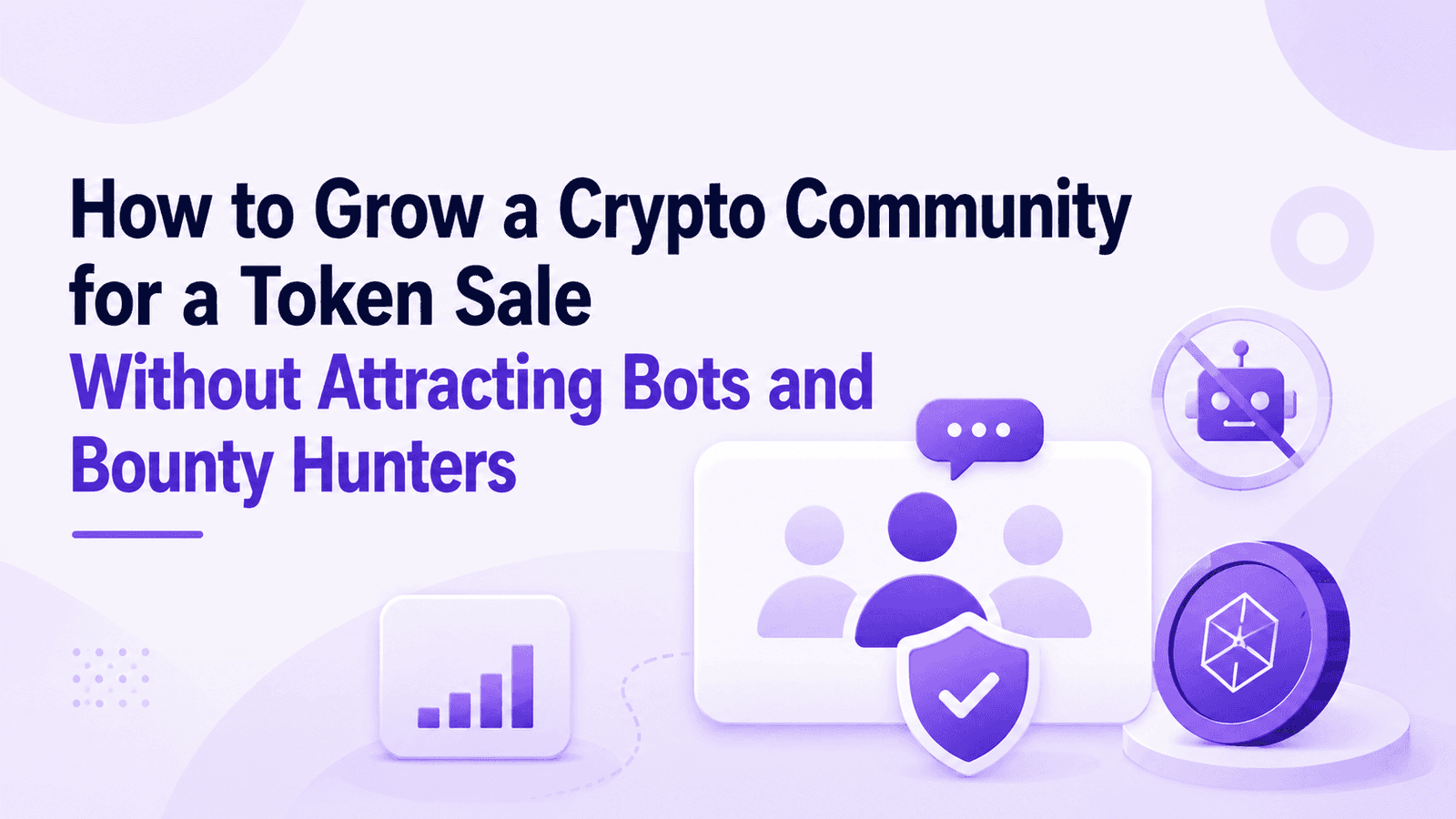
How to Grow a Crypto Community for a Token Sale Without Attracting Bots and Bounty Hunters

How to Grow a Crypto Community for a Token Sale Without Attracting Bots and Bounty Hunters

TL;DR
A crypto community for a token sale should show real intent before TGE. Channel size alone can hide weak demand, fake activity, and reward-only participation. Strong teams build community growth around education, repeated participation, useful feedback, user-generated proof, role progression, and product-linked behavior. This approach does not slow growth. It protects growth from bots and bounty hunters that inflate metrics. The goal is simple. Build a community that understands the project, returns without constant rewards, and gives clearer launch signals.

What Is a Fake Crypto Community?

A fake crypto community is a community that looks active but shows weak real interest. The community may have many members, comments, reactions, and campaign entries. But those numbers may come from bots, bounty hunters, or reward-only users. These users may join the channel and engage. Some may also complete tasks. But they rarely help the team understand real demand before a token sale.


That signal can hurt a token sale campaign. When user intent is unclear, the team cannot read demand properly. It cannot see who cares about the project. It also cannot see who only follows the reward. This affects whitelist quality, campaign decisions, and launch confidence. This is where token sale teams need better filters. They need to know which participants understand the project.

Why Fake Crypto Community Growth Hurts a Token Sale

Fake crypto community growth creates weak signals for a token sale campaign. Fake growth can affect the campaign in several ways:

  • Whitelist quality becomes weaker.
    The whitelist may fill with bots, duplicated users, or low-intent participants. This can reduce the quality of token sale access.

  • Community feedback becomes less useful.
    Bots and reward hunters rarely give product feedback. The team may miss real questions about utility, roadmap, and sale mechanics.

  • Campaign data becomes harder to trust.
    High engagement may look positive. But the team cannot clearly see which users care about the project.

  • Budget decisions become riskier.
    The team may scale ads, KOLs, or quests based on noisy metrics. This can waste the budget before the token sale.

  • Launch confidence becomes weaker.
    A large community should support the token sale. But fake growth can hide weak demand until the campaign reaches conversion.

What a Real Crypto Community Looks Like Before TGE

During the TGE process, a project may get high traffic across X, Telegram, Discord, website pages, and whitelist forms. But high traffic does not always mean strong community quality.

A real crypto community shows clear interest before the token sale. Members ask about token utility, vesting, roadmap, product access, and token sale mechanics. They also return after updates because they want to follow the project.

This is the difference. a16z’s “first 1,000 true fans” framing fits this point. Token sale teams often chase large channel numbers too early. The stronger goal is a smaller group that asks questions, tests ideas, and gives feedback.

This makes early community work more useful for launch planning. The team can see what users understand before TGE, not only how many people entered the funnel.

Real Community Signal

What It Shows

Members ask project questions

They want to understand the project

Members return after updates

They follow the progress

Members give useful feedback

They care beyond rewards

Members create explainers

They understand the message

Members test product flows

They move from discussion into action

A real crypto community gives the team clearer signals before the token sale. Once that signal is visible, the team can filter bots and bounty hunters with more confidence.

How Token Sale Teams Can Filter Bots and Bounty Hunters

After the team knows what real interest looks like, the next step is filtering. Filtering does not mean every user must pass a strict check from day one. That can make the community harder to join. It can also block real users too early.

A better approach is simple. Keep the public community open. Then ask for stronger proof before whitelist or token sale access. Basic tasks can still help the campaign grow. A follow, repost, or form can bring people into the funnel. But these tasks should not decide who gets sale access. They are too easy to farm.

The team should map each filter to an access decision. Simple tasks can support awareness. Stronger signals should unlock deeper campaign steps.

Filter

Simple Use

What It Helps Find

Access Decision

Project quiz

Ask basic project questions

Users who understand the project

Move to learner role

Return check

Track repeated activity

Users who keep following updates

Unlock deeper tasks

Wallet check

Review wallet patterns

Duplicate or suspicious users

Send to manual review

Feedback review

Check useful comments

Users who contribute real input

Move to contributor role

Role history

Review community progress

Users who earned access over time

Priority whitelist review

This keeps the crypto community easy to enter. But it makes token sale access harder to fake.

Read more: What content formats actually grow X, Discord, Telegram, and Farcaster before a token launch? (TM-19)

How Education Filters Serious Participants From Reward Hunters

Education helps token sale teams filter users without making the community harder to join.

A reward hunter can follow, repost, join, and submit forms. But it is harder to fake basic project understanding. That is why education should happen before whitelist review or deeper campaign tasks.

This does not mean the team needs long documents. The education should be short, clear, and useful. It should answer the questions a serious participant would naturally ask before joining a token sale.

The team can start with these points:

  • Problem solved
    Explain what problem the project solves and why it matters. This helps users understand the project beyond the token sale.

  • Product use case
    Explain who the product is built for and how it works. Serious users should know what the project is trying to build.

  • Token role
    Explain how the token supports the product. This helps filter users who only care about rewards, not utility.

  • Sale process
    Explain the whitelist steps, key dates, eligibility rules, and official participation flow. This reduces confusion and limits fake entries.

  • Official channels
    Explain where users should get updates. This helps reduce scams, fake groups, and misinformation during the campaign.

After that, the team can use simple education formats. A short explainer can cover the project basics. An AMA recap can show the main questions and answers. A short quiz before whitelist review can check whether users paid attention.

The quiz should not feel like school. It should ask practical questions. For example:

  • What problem does the project solve?

  • Who is the product built for?

  • How does the token support the product?

  • What are the whitelist rules?

  • Where are official sale updates shared?

These questions are simple. But they help the team see who took time to understand the project.

How Repeated Participation Filters Real Users

One task can show awareness. But it does not prove real interest. A user can repost once, join once, or submit one form. These actions can help early reach, but they should not decide deeper access. Repeated participation gives a stronger signal because users show up more than once.

Token sale teams can track actions like:

  • Reads the project overview, then joins a discussion

  • Attends an AMA, then asks a follow-up question

  • Completes one learning step, then returns for the next update

  • Tests a product flow, then shares useful feedback

  • Joins a campaign task, then stays active after rewards end

These actions show more than quick clicks. They help the team decide who should move toward deeper access before the token sale.

How User-Generated Content Builds Trust

User-generated content can become proof when it shows real understanding. This does not mean random posts, paid comments, or copied slogans. It means content that helps other users understand the project before the token sale.


For example, a real community member may create:

  • AMA recap
    The member summarizes key answers from a founder or team session.

  • Product explanation
    The member explains how the product works in simple terms.

  • Token utility breakdown
    The member explains how the token connects to the product.

  • Community guide
    The member helps new users follow official channels and sale steps.

  • Product feedback post
    The member shares useful feedback after testing a demo or feature.

This type of content is valuable because it helps new users learn faster. It also gives the team public proof that the message is clear.

How Role Progression Separates Contributors From Low-Quality Traffic

Role progression helps token sale teams see who keeps adding value over time.

Without clear roles, every user can look the same. A bot, a bounty hunter, and a real contributor may all sit in the same channel. That makes community quality harder to read.

Below is a simple role progression model that teams can use before whitelist or token sale access:

Role Stage

Requirement

Purpose

New member

Joins official channels

Basic access

Learner

Completes education

Tests understanding

Contributor

Gives useful feedback

Finds real interest

Advocate

Creates helpful proof

Builds trust

Priority participant

Meets quality criteria

Supports sale readiness

Role progression should stay transparent. Clear rules reduce complaints, farming behavior, and manual confusion. This structure helps the team avoid rewarding speed alone. It also turns participation history into a clearer access path.

Learn more on: Quest campaigns, ambassador programs, or KOLs: what should come first? (TM-20)

A Simple Framework for Real Crypto Community Growth

Token sale teams need a simple system to separate real users from noisy activity. A useful framework is:


Each step helps the team filter users without blocking real community growth.

  • Educate
    Teach users the project basics before deeper campaign access.

  • Engage
    Create discussions that reveal real questions and user intent.

  • Prove
    Encourage user-generated content that shows project understanding.

  • Progress
    Use role progression to reward useful participation over time.

  • Validate
    Connect community activity with wallet, product, or campaign behavior.

This framework helps token sale teams avoid a common mistake. They do not need to choose between growth and quality. The final step is validation, where community actions are compared with product or wallet behavior.

How to Connect Offchain Community Work With Onchain Behavior

Community activity usually starts offchain. Users join Telegram, ask questions on Discord, attend AMAs, complete education, or create content on X. These actions can show interest, but they should not stand alone before a token sale.

Token sale teams need to compare community signals with product or wallet signals. This does not mean every user needs heavy checks. It means the team should look for simple links between what users say and what users do.

Below is a simple way to connect offchain community activity with product or wallet behavior:

Community Signal

Product / Wallet Signal

What It Means

Completed education

Connected wallet once

Basic intent

Asked useful questions

Tested product flow

Higher quality user

Created helpful UGC

Returned after update

Stronger contributor

Joined whitelist

Clean wallet pattern

Lower bot risk

Stayed active after rewards

Used product again

Better pre-TGE signal

This helps the team avoid judging users from social activity alone.

A user who asks strong questions and tests a product flow gives a stronger signal than a user who only reposts a campaign link. A user who stays active after rewards end also gives a cleaner pre-TGE signal.

How to Score Community Quality Before Whitelist Access

Token sale teams should not treat every action equally. A repost, a quiz answer, a wallet connection, and product feedback all show different levels of intent. The team needs a simple scoring logic before whitelist access.

A basic scoring flow can look like this:

  • Low intent
    The user joins channels, follows X, or submits a form.

  • Basic intent
    The user completes education and connects a wallet once.

  • Medium intent
    The user asks useful questions and joins more than one discussion.

  • High intent
    The user creates helpful content, gives feedback, or tests a product flow.

  • Priority review
    Users show repeated activity, clean wallet patterns, and product-linked behavior.

This scoring flow helps the team avoid one common mistake. This scoring flow helps the team avoid rewarding every action equally before whitelist access.

What Community Metrics Matter Before a Token Sale

Token sale teams should measure community quality, not only community size. The right metrics should explain intent, understanding, and readiness. They should also show where fake growth enters the funnel.

Metric

What It Shows

Returning active members

Retention inside the community

Education completion

Project understanding

Useful feedback

Contributor quality

UGC quality

Public trust signal

Suspicious account ratio

Bot exposure

Product-linked behavior

Real pre-TGE intent

These metrics help the team score community quality before scaling campaigns.

Learn more on: How do we measure community quality, not just community size? (TM-21)

Build a Crypto Community That Supports the Token Sale

A token sale does not need the loudest community. It needs a community that shows real intent before launch.

TokenMinds helps token sale teams build stronger community quality through education flows, contributor filtering, anti-bot checks, and campaign readiness reviews. We can audit the community funnel, participation quality, and anti-bot filters before a token sale campaign scales.

Schedule a community growth audit call now.

FAQs

  1. How do crypto projects filter bots before a token sale?

Crypto projects filter bots through education checks, repeated participation, wallet review, and role progression. These filters help teams separate real users from low-effort or duplicated accounts.

  1. What makes a strong Web3 community before TGE?

A strong Web3 community shows real interest before TGE. Members ask useful questions, return after updates, understand the project, and contribute without needing constant rewards.

  1. How do whitelist systems prevent sybil attacks?

Whitelist systems reduce sybil attacks by checking user behavior, wallet patterns, task quality, and repeated participation. Strong systems avoid giving access based on one simple task.

  1. Why do token sale communities fail after launch?

Token sale communities often fail after launch because many users only joined for rewards. If the community lacks education, product interest, and real participation, users leave after incentives end.

  1. What metrics matter before a token launch?

Important metrics include returning members, education completion, useful feedback, user-generated content quality, suspicious account ratio, and product-linked activity. These metrics show quality, not only size.

TL;DR
A crypto community for a token sale should show real intent before TGE. Channel size alone can hide weak demand, fake activity, and reward-only participation. Strong teams build community growth around education, repeated participation, useful feedback, user-generated proof, role progression, and product-linked behavior. This approach does not slow growth. It protects growth from bots and bounty hunters that inflate metrics. The goal is simple. Build a community that understands the project, returns without constant rewards, and gives clearer launch signals.

What Is a Fake Crypto Community?

A fake crypto community is a community that looks active but shows weak real interest. The community may have many members, comments, reactions, and campaign entries. But those numbers may come from bots, bounty hunters, or reward-only users. These users may join the channel and engage. Some may also complete tasks. But they rarely help the team understand real demand before a token sale.


That signal can hurt a token sale campaign. When user intent is unclear, the team cannot read demand properly. It cannot see who cares about the project. It also cannot see who only follows the reward. This affects whitelist quality, campaign decisions, and launch confidence. This is where token sale teams need better filters. They need to know which participants understand the project.

Why Fake Crypto Community Growth Hurts a Token Sale

Fake crypto community growth creates weak signals for a token sale campaign. Fake growth can affect the campaign in several ways:

  • Whitelist quality becomes weaker.
    The whitelist may fill with bots, duplicated users, or low-intent participants. This can reduce the quality of token sale access.

  • Community feedback becomes less useful.
    Bots and reward hunters rarely give product feedback. The team may miss real questions about utility, roadmap, and sale mechanics.

  • Campaign data becomes harder to trust.
    High engagement may look positive. But the team cannot clearly see which users care about the project.

  • Budget decisions become riskier.
    The team may scale ads, KOLs, or quests based on noisy metrics. This can waste the budget before the token sale.

  • Launch confidence becomes weaker.
    A large community should support the token sale. But fake growth can hide weak demand until the campaign reaches conversion.

What a Real Crypto Community Looks Like Before TGE

During the TGE process, a project may get high traffic across X, Telegram, Discord, website pages, and whitelist forms. But high traffic does not always mean strong community quality.

A real crypto community shows clear interest before the token sale. Members ask about token utility, vesting, roadmap, product access, and token sale mechanics. They also return after updates because they want to follow the project.

This is the difference. a16z’s “first 1,000 true fans” framing fits this point. Token sale teams often chase large channel numbers too early. The stronger goal is a smaller group that asks questions, tests ideas, and gives feedback.

This makes early community work more useful for launch planning. The team can see what users understand before TGE, not only how many people entered the funnel.

Real Community Signal

What It Shows

Members ask project questions

They want to understand the project

Members return after updates

They follow the progress

Members give useful feedback

They care beyond rewards

Members create explainers

They understand the message

Members test product flows

They move from discussion into action

A real crypto community gives the team clearer signals before the token sale. Once that signal is visible, the team can filter bots and bounty hunters with more confidence.

How Token Sale Teams Can Filter Bots and Bounty Hunters

After the team knows what real interest looks like, the next step is filtering. Filtering does not mean every user must pass a strict check from day one. That can make the community harder to join. It can also block real users too early.

A better approach is simple. Keep the public community open. Then ask for stronger proof before whitelist or token sale access. Basic tasks can still help the campaign grow. A follow, repost, or form can bring people into the funnel. But these tasks should not decide who gets sale access. They are too easy to farm.

The team should map each filter to an access decision. Simple tasks can support awareness. Stronger signals should unlock deeper campaign steps.

Filter

Simple Use

What It Helps Find

Access Decision

Project quiz

Ask basic project questions

Users who understand the project

Move to learner role

Return check

Track repeated activity

Users who keep following updates

Unlock deeper tasks

Wallet check

Review wallet patterns

Duplicate or suspicious users

Send to manual review

Feedback review

Check useful comments

Users who contribute real input

Move to contributor role

Role history

Review community progress

Users who earned access over time

Priority whitelist review

This keeps the crypto community easy to enter. But it makes token sale access harder to fake.

Read more: What content formats actually grow X, Discord, Telegram, and Farcaster before a token launch? (TM-19)

How Education Filters Serious Participants From Reward Hunters

Education helps token sale teams filter users without making the community harder to join.

A reward hunter can follow, repost, join, and submit forms. But it is harder to fake basic project understanding. That is why education should happen before whitelist review or deeper campaign tasks.

This does not mean the team needs long documents. The education should be short, clear, and useful. It should answer the questions a serious participant would naturally ask before joining a token sale.

The team can start with these points:

  • Problem solved
    Explain what problem the project solves and why it matters. This helps users understand the project beyond the token sale.

  • Product use case
    Explain who the product is built for and how it works. Serious users should know what the project is trying to build.

  • Token role
    Explain how the token supports the product. This helps filter users who only care about rewards, not utility.

  • Sale process
    Explain the whitelist steps, key dates, eligibility rules, and official participation flow. This reduces confusion and limits fake entries.

  • Official channels
    Explain where users should get updates. This helps reduce scams, fake groups, and misinformation during the campaign.

After that, the team can use simple education formats. A short explainer can cover the project basics. An AMA recap can show the main questions and answers. A short quiz before whitelist review can check whether users paid attention.

The quiz should not feel like school. It should ask practical questions. For example:

  • What problem does the project solve?

  • Who is the product built for?

  • How does the token support the product?

  • What are the whitelist rules?

  • Where are official sale updates shared?

These questions are simple. But they help the team see who took time to understand the project.

How Repeated Participation Filters Real Users

One task can show awareness. But it does not prove real interest. A user can repost once, join once, or submit one form. These actions can help early reach, but they should not decide deeper access. Repeated participation gives a stronger signal because users show up more than once.

Token sale teams can track actions like:

  • Reads the project overview, then joins a discussion

  • Attends an AMA, then asks a follow-up question

  • Completes one learning step, then returns for the next update

  • Tests a product flow, then shares useful feedback

  • Joins a campaign task, then stays active after rewards end

These actions show more than quick clicks. They help the team decide who should move toward deeper access before the token sale.

How User-Generated Content Builds Trust

User-generated content can become proof when it shows real understanding. This does not mean random posts, paid comments, or copied slogans. It means content that helps other users understand the project before the token sale.


For example, a real community member may create:

  • AMA recap
    The member summarizes key answers from a founder or team session.

  • Product explanation
    The member explains how the product works in simple terms.

  • Token utility breakdown
    The member explains how the token connects to the product.

  • Community guide
    The member helps new users follow official channels and sale steps.

  • Product feedback post
    The member shares useful feedback after testing a demo or feature.

This type of content is valuable because it helps new users learn faster. It also gives the team public proof that the message is clear.

How Role Progression Separates Contributors From Low-Quality Traffic

Role progression helps token sale teams see who keeps adding value over time.

Without clear roles, every user can look the same. A bot, a bounty hunter, and a real contributor may all sit in the same channel. That makes community quality harder to read.

Below is a simple role progression model that teams can use before whitelist or token sale access:

Role Stage

Requirement

Purpose

New member

Joins official channels

Basic access

Learner

Completes education

Tests understanding

Contributor

Gives useful feedback

Finds real interest

Advocate

Creates helpful proof

Builds trust

Priority participant

Meets quality criteria

Supports sale readiness

Role progression should stay transparent. Clear rules reduce complaints, farming behavior, and manual confusion. This structure helps the team avoid rewarding speed alone. It also turns participation history into a clearer access path.

Learn more on: Quest campaigns, ambassador programs, or KOLs: what should come first? (TM-20)

A Simple Framework for Real Crypto Community Growth

Token sale teams need a simple system to separate real users from noisy activity. A useful framework is:


Each step helps the team filter users without blocking real community growth.

  • Educate
    Teach users the project basics before deeper campaign access.

  • Engage
    Create discussions that reveal real questions and user intent.

  • Prove
    Encourage user-generated content that shows project understanding.

  • Progress
    Use role progression to reward useful participation over time.

  • Validate
    Connect community activity with wallet, product, or campaign behavior.

This framework helps token sale teams avoid a common mistake. They do not need to choose between growth and quality. The final step is validation, where community actions are compared with product or wallet behavior.

How to Connect Offchain Community Work With Onchain Behavior

Community activity usually starts offchain. Users join Telegram, ask questions on Discord, attend AMAs, complete education, or create content on X. These actions can show interest, but they should not stand alone before a token sale.

Token sale teams need to compare community signals with product or wallet signals. This does not mean every user needs heavy checks. It means the team should look for simple links between what users say and what users do.

Below is a simple way to connect offchain community activity with product or wallet behavior:

Community Signal

Product / Wallet Signal

What It Means

Completed education

Connected wallet once

Basic intent

Asked useful questions

Tested product flow

Higher quality user

Created helpful UGC

Returned after update

Stronger contributor

Joined whitelist

Clean wallet pattern

Lower bot risk

Stayed active after rewards

Used product again

Better pre-TGE signal

This helps the team avoid judging users from social activity alone.

A user who asks strong questions and tests a product flow gives a stronger signal than a user who only reposts a campaign link. A user who stays active after rewards end also gives a cleaner pre-TGE signal.

How to Score Community Quality Before Whitelist Access

Token sale teams should not treat every action equally. A repost, a quiz answer, a wallet connection, and product feedback all show different levels of intent. The team needs a simple scoring logic before whitelist access.

A basic scoring flow can look like this:

  • Low intent
    The user joins channels, follows X, or submits a form.

  • Basic intent
    The user completes education and connects a wallet once.

  • Medium intent
    The user asks useful questions and joins more than one discussion.

  • High intent
    The user creates helpful content, gives feedback, or tests a product flow.

  • Priority review
    Users show repeated activity, clean wallet patterns, and product-linked behavior.

This scoring flow helps the team avoid one common mistake. This scoring flow helps the team avoid rewarding every action equally before whitelist access.

What Community Metrics Matter Before a Token Sale

Token sale teams should measure community quality, not only community size. The right metrics should explain intent, understanding, and readiness. They should also show where fake growth enters the funnel.

Metric

What It Shows

Returning active members

Retention inside the community

Education completion

Project understanding

Useful feedback

Contributor quality

UGC quality

Public trust signal

Suspicious account ratio

Bot exposure

Product-linked behavior

Real pre-TGE intent

These metrics help the team score community quality before scaling campaigns.

Learn more on: How do we measure community quality, not just community size? (TM-21)

Build a Crypto Community That Supports the Token Sale

A token sale does not need the loudest community. It needs a community that shows real intent before launch.

TokenMinds helps token sale teams build stronger community quality through education flows, contributor filtering, anti-bot checks, and campaign readiness reviews. We can audit the community funnel, participation quality, and anti-bot filters before a token sale campaign scales.

Schedule a community growth audit call now.

FAQs

  1. How do crypto projects filter bots before a token sale?

Crypto projects filter bots through education checks, repeated participation, wallet review, and role progression. These filters help teams separate real users from low-effort or duplicated accounts.

  1. What makes a strong Web3 community before TGE?

A strong Web3 community shows real interest before TGE. Members ask useful questions, return after updates, understand the project, and contribute without needing constant rewards.

  1. How do whitelist systems prevent sybil attacks?

Whitelist systems reduce sybil attacks by checking user behavior, wallet patterns, task quality, and repeated participation. Strong systems avoid giving access based on one simple task.

  1. Why do token sale communities fail after launch?

Token sale communities often fail after launch because many users only joined for rewards. If the community lacks education, product interest, and real participation, users leave after incentives end.

  1. What metrics matter before a token launch?

Important metrics include returning members, education completion, useful feedback, user-generated content quality, suspicious account ratio, and product-linked activity. These metrics show quality, not only size.

GET SUCCESS IN WEB3

  • Trusted Web3 partner since 2017

  • Full-stack Web3 development team

  • Performance-driven Web3 marketing

Get A Free Consultation

Get A Free Consultation

MEET US AT

RECENT TRAININGS

Follow us

get web3 business updates

Email invalid

  • Access global liquidity for your RWA project with TMX Tokenize’s Canton Network integration

DISCOVER NOW

  • Access global liquidity for your RWA project with TMX Tokenize’s Canton Network integration

    JOIN NOW

DISCOVER

  • Access global liquidity for your RWA project with TMX Tokenize’s Canton Network integration