Web3 & AI

SOLUTIONS

Products

Services

Web3 & AI

SOLUTIONS

Services

Products

Industries

Become Our Client

About Us

Resources

Web3 & AI

SOLUTIONS

Services

Products

Industries

How to Design Crypto Payment Systems Without Native Gas Fees

How to Design Crypto Payment Systems Without Native Gas Fees

Written by:

Written by:

Mar 5, 2026

Mar 5, 2026

Key takeaways:

  • EIP-8141 introduces Paymasters that sponsor gas in stablecoins and let users pay both the transaction and gas in one token, removing the need to hold ETH.

  • Businesses run these systems with account abstraction, automate reconciliation and stablecoin as the main payment asset; but they still need to rely on payment infrastructure to manage settlement and compliance

Crypto payment adoption is growing fast. The problem is that most crypto payment systems make users jump through hoops before they spend a single dollar.

The biggest hoop is the gas fee.

In 2025, Ethereum transaction fees surged to $50 per swap during a period of high network usage. A user who wants to pay $10 in USDC still needs ETH in their wallet just to send it. If they do not have ETH, the payment fails. The user leaves. The business loses the sale.

Gas fee issues lead to 25% fewer transactions during peak fee hours. That is one in four payments failing because of a cost the user never agreed to pay. And it is not just a user experience problem. Gas fees spike without warning, are paid in a volatile asset, and do not fit neatly into standard billing and reconciliation systems, a friction point reduced through this payments infrastructure.

That is the fee problem in one sentence: it hurts users at the front and finance teams at the back.

What Gasless Crypto Payment Actually Means
A gasless payment system does not mean blockchain transactions are free. Every transaction still costs gas. Gasless means the user does not pay it and does not need to hold the native token to pay it.

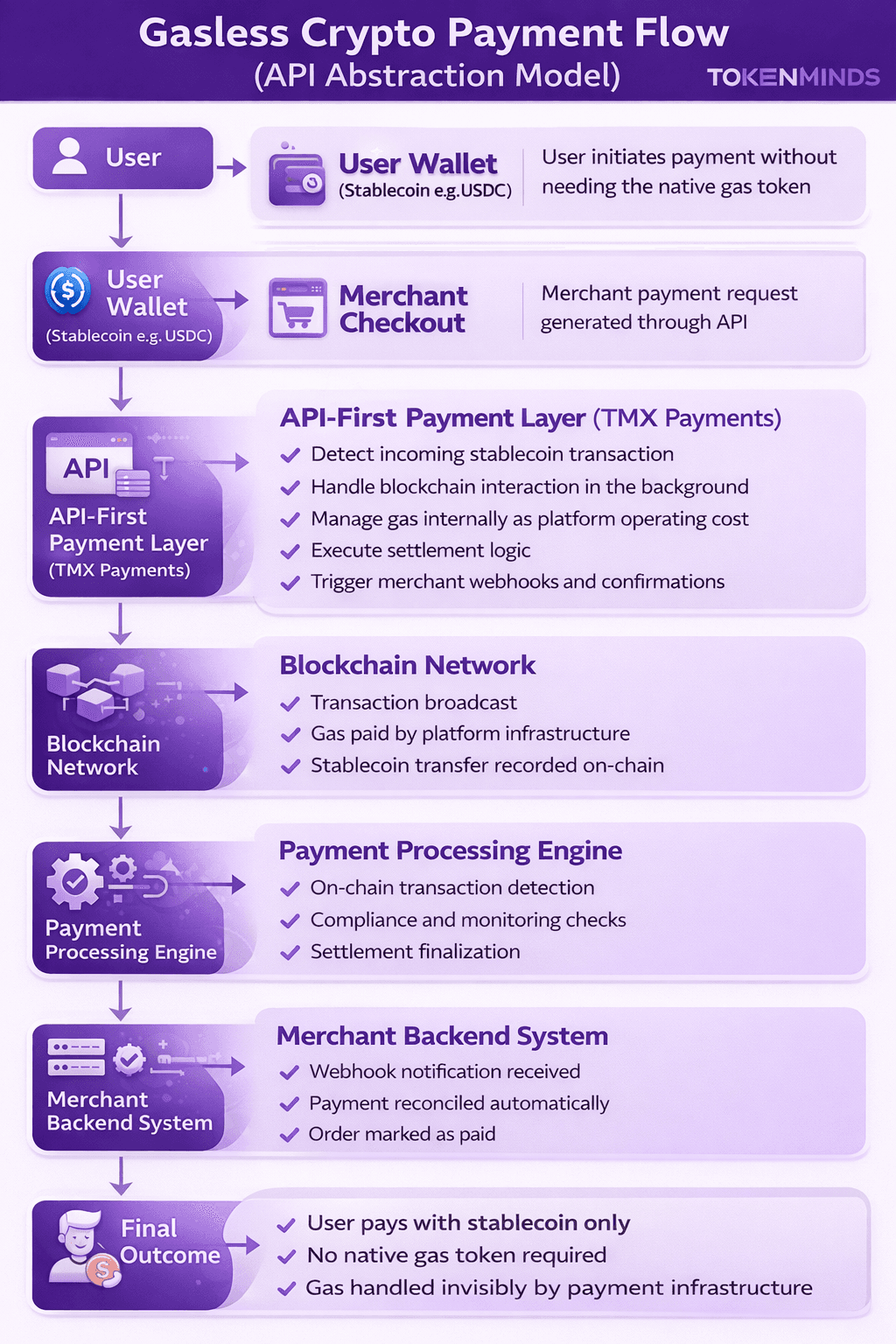
The cleanest approach for businesses is an abstracted payment layer that sits above the blockchain. Users and merchants interact through standard APIs. The payment layer handles everything on-chain in the background. Gas is an operating cost of the platform. The user never sees it.

This is exactly how traditional payment systems work. Merchants do not pay Visa's network costs directly. Those costs are built into the processing fee invisibly.

TMX Payments platform uses this approach. It puts an API-first payment layer above the blockchain. Merchants connect through REST APIs and webhooks. Users pay with stablecoins from any wallet. The platform handles all on-chain detection, settlement, and reconciliation. Gas is never visible to either side.

What EIP-8141 Changes for Payment Systems
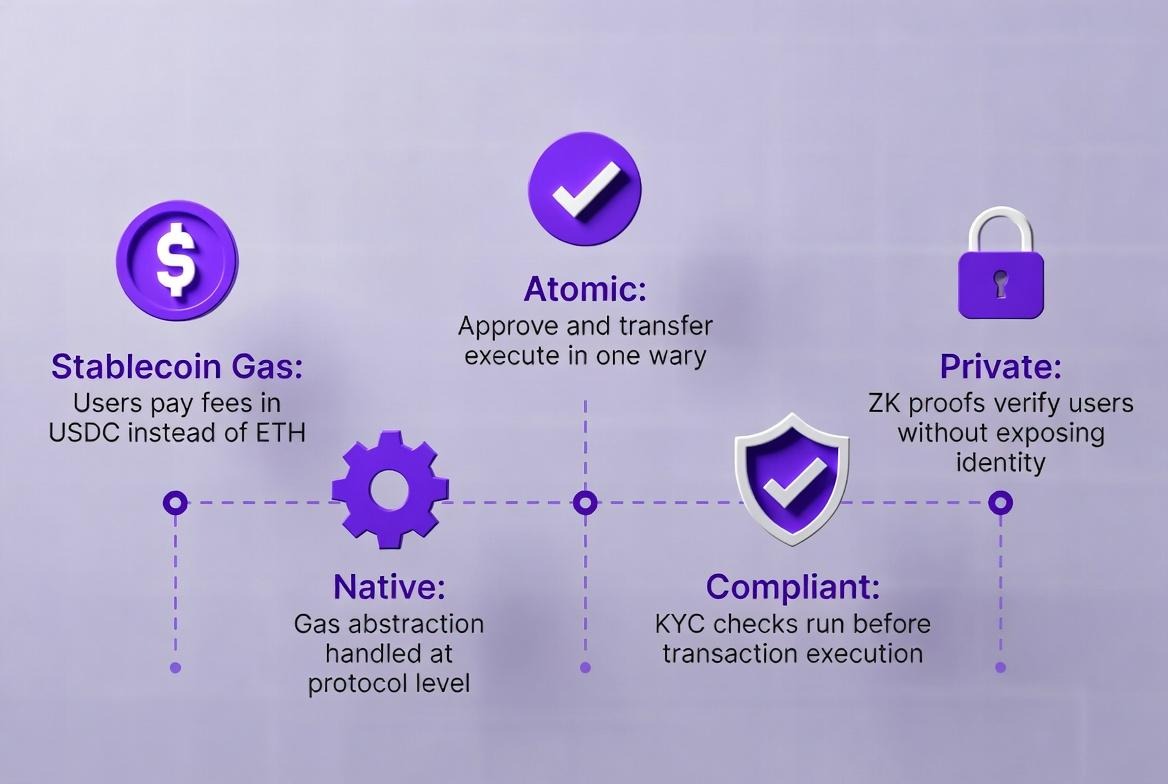
EIP-8141 is a draft Ethereum proposal that lets users pay gas fees in stablecoins instead of ETH, removing the need to hold a second token just to send a transaction.

Right now, removing gas fees from the user experience requires workarounds. Relayers, meta-transactions, and abstracted payment layers exist because Ethereum's base protocol requires users to hold ETH to send any transaction. These workarounds work. But they add complexity.

EIP-8141, announced February 28, 2026, changes this at the protocol level. It is still a draft proposal targeting the Hegota fork. It is not live yet. But it is important to understand what it means.

EIP-8141 introduces Frame Transactions and Paymasters. A Paymaster is a smart contract that sponsors gas on behalf of the user. The user pays in stablecoins. The Paymaster converts and covers the gas in real time. No ETH required. No relayer. The protocol handles it natively.

1. Gas paid in stablecoins

Once Paymasters are live, a user paying in USDC can also have their gas covered in USDC. One token. One step. The dual-token problem disappears at the protocol level.

2. Batched transactions

EIP-8141 allows approve and transfer actions to happen in one atomic transaction instead of two. The user clicks once. Gas is paid once. Payment clears in one step.

3. Compliance embedded in the transaction

EIP-8141's validation frames allow KYC and sanctions checks to run before execution, not as a separate application-layer step. Compliance becomes part of the transaction itself.

4. Privacy-preserving verification

One EIP-8141 option allows a Paymaster to verify a zero-knowledge proof before sponsoring gas. A wallet can prove it passed KYC without revealing who the holder is. The compliance check happens. The data stays private.

Every workaround that payment systems use now to hide gas will eventually be replaced by native protocol features that do the same thing more cleanly and cheaply.

Design Principles for Gasless Crypto Payment Systems

A gasless crypto payment system hides blockchain complexity from the user. The platform handles the technical work. Users focus on making the payment.

  1. Abstract the blockchain layer

Users and merchants use simple APIs. They do not touch the blockchain directly. Platforms like TMX Payments handle gas, confirmations, and settlement automatically. The user sees none of it.

  1. Use stablecoins as the main payment asset

Stablecoins cut price swings. They make payments easier for businesses to manage.

  1. Treat gas as a platform cost

The platform pays gas fees. It is part of operating costs. Users do not need to hold native tokens.

  1. Automate reconciliation

Every payment gets a unique ID. That ID matches the transaction to its invoice. It happens automatically.

  1. Control settlement with rules

Payments release only after confirmations or compliance checks are done. Nothing moves until the rules are met.

The EIP-8141 Business Impact

Stablecoin usage in transactions rose 75% between 2024 and 2025 as businesses favored stable payment rails. Stablecoins now represent 76% of all crypto payments globally. The market has already moved toward stablecoin-first payment flows. The infrastructure just needs to catch up.

Metric

Data Point

Merchants planning to accept crypto within 2 years

75% of U.S. merchants

Business adoption growth YoY

55% in 2023

Transactions lost during gas fee spikes

25% fewer transactions at peak hours

Merchants citing high fees as a major challenge

72% in 2025 UK survey

Stablecoin share of all crypto payments

76% globally

Stablecoin usage growth 2024 to 2025

75% increase

Crypto payment gateway market size 2025

$2 billion

Projected market size by 2030

$4.82 billion

Merchants demanding multi-currency and multi-chain support

90% of gateway clients

Reduction in failed settlements via confirmation-based release

20 to 30%

Reduction in manual reconciliation time

30 to 40%

Reduction in audit preparation effort

25 to 35%


Traditional Crypto Payments vs. Gasless Payments

Area

Traditional Crypto Payments

Gasless via Abstracted Layer

After EIP-8141

Gas fee exposure

User pays ETH on every transaction

Platform absorbs gas invisibly

Paymasters sponsor gas natively in stablecoins

Tokens needed

Payment token plus ETH

Payment token only

One token covers payment and gas

Transaction steps

Two steps: approve then transfer

Platform batches where possible

One atomic Frame Transaction

Compliance screening

Manual or separate application layer

Platform screens before settlement

ZK proof validation frames in the transaction

Reconciliation

Manual invoice matching

Automatic via unique payment IDs

Payment and metadata arrive in one atomic event

Settlement control

Instant release, no rules

Programmable confirmation rules

Validation frames enforce rules at protocol level

What This Looks Like for an Institution
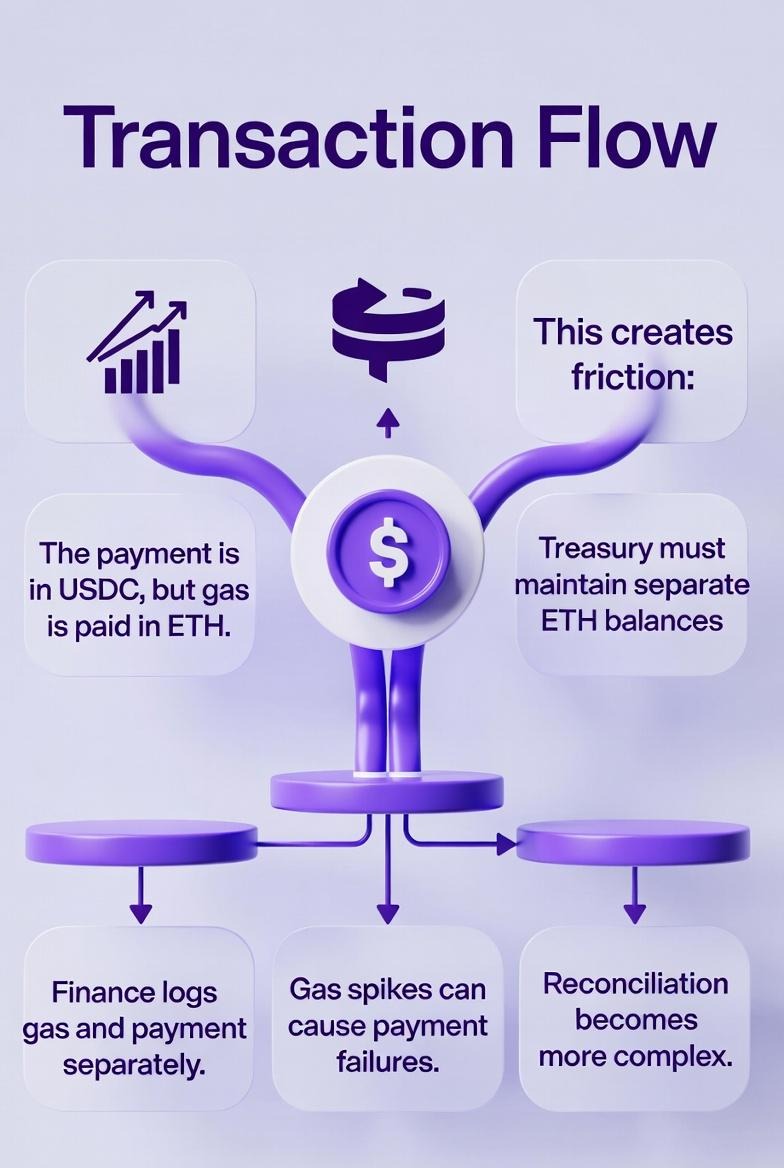
Institutions settling cross-border payments on a stablecoin rail run into the same wall every time. The payment is in USDC. The gas is in ETH. Finance logs them separately. Reconciliation doubles. Compliance reviews delays manually. The rail is faster than SWIFT but the operational overhead is just as bad.

For treasury teams, this means every settlement run carries hidden costs that do not appear in the payment amount itself. 

  • ETH balances have to be maintained separately, monitored for volatility, and replenished when they run low

  • A treasury operation that moves $2 million in USDC cross-border still needs a standing ETH float just to keep transactions moving

  • When gas spikes, payments fail. When payments fail, accounting teams open exception queues. When exception queues grow, payment failure rates climb and counterparty relationships take the hit.

EIP-8141 fixes the root cause. Once Paymasters are live, gas gets paid in the same stablecoin as the payment. One token. One transaction. No ETH wallet to manage. No split ledger entries. The institution sends USDC and the protocol handles everything underneath.

TMX Payments fits directly into this picture. It is built for institutions that need controlled crypto payment operations without the engineering burden of managing blockchain infrastructure themselves. Stablecoin payments come in, auto-convert to fiat, and settle through a programmable engine that holds funds until compliance and confirmation rules pass. Wallet screening runs before any leg releases. Reconciliation matches every payment to its invoice automatically. The finance team gets one clean export, structured for audit and regulatory review.

As EIP-8141 moves gas sponsorship to the protocol level, institutions running on TMX Payments benefit without changing anything. The stablecoin payment rail they already use becomes cheaper and simpler to operate because the protocol does more of the underlying work. Cross-border settlement gets faster. Operational overhead gets lower. The compliance and reporting layer stays exactly the same.

Step

Standard Crypto Setup

TMX Payments + EIP-8141 Direction

Gas cost

ETH required, logged separately from payment

Native stablecoin gas after EIP-8141, no split ledger

Settlement

One transaction per leg manually triggered

Programmable engine handles all legs automatically

Confirmation tracking

Manual status checks

Webhooks push real-time status to internal systems

Reconciliation

Manual matching, doubled line items

Auto-matched via unique payment IDs

Compliance screening

Manual review after the fact

Wallet screening before each leg releases

Audit trail

Assembled on request

One-click export, structured for regulators


Gas Economics Modeling

The cost difference between a standard crypto payment setup and a gasless abstracted layer is not theoretical. It compounds across every transaction volume tier.

Monthly Transactions

Avg Gas Cost Per Tx (ETH)

Total Gas Spend (Standard)

Gas Spend (Gasless Layer)

Monthly Saving

500

$12

$6,000

$0 visible to business

$6,000

2,500

$12

$30,000

$0 visible to business

$30,000

10,000

$12

$120,000

$0 visible to business

$120,000

50,000

$12

$600,000

$0 visible to business

$600,000

After EIP-8141, the platform's own cost of sponsoring gas drops further because Paymasters handle it at the protocol level in stablecoins. The saving the business sees stays the same. The cost to run the infrastructure underneath shrinks.

Architecture Diagram
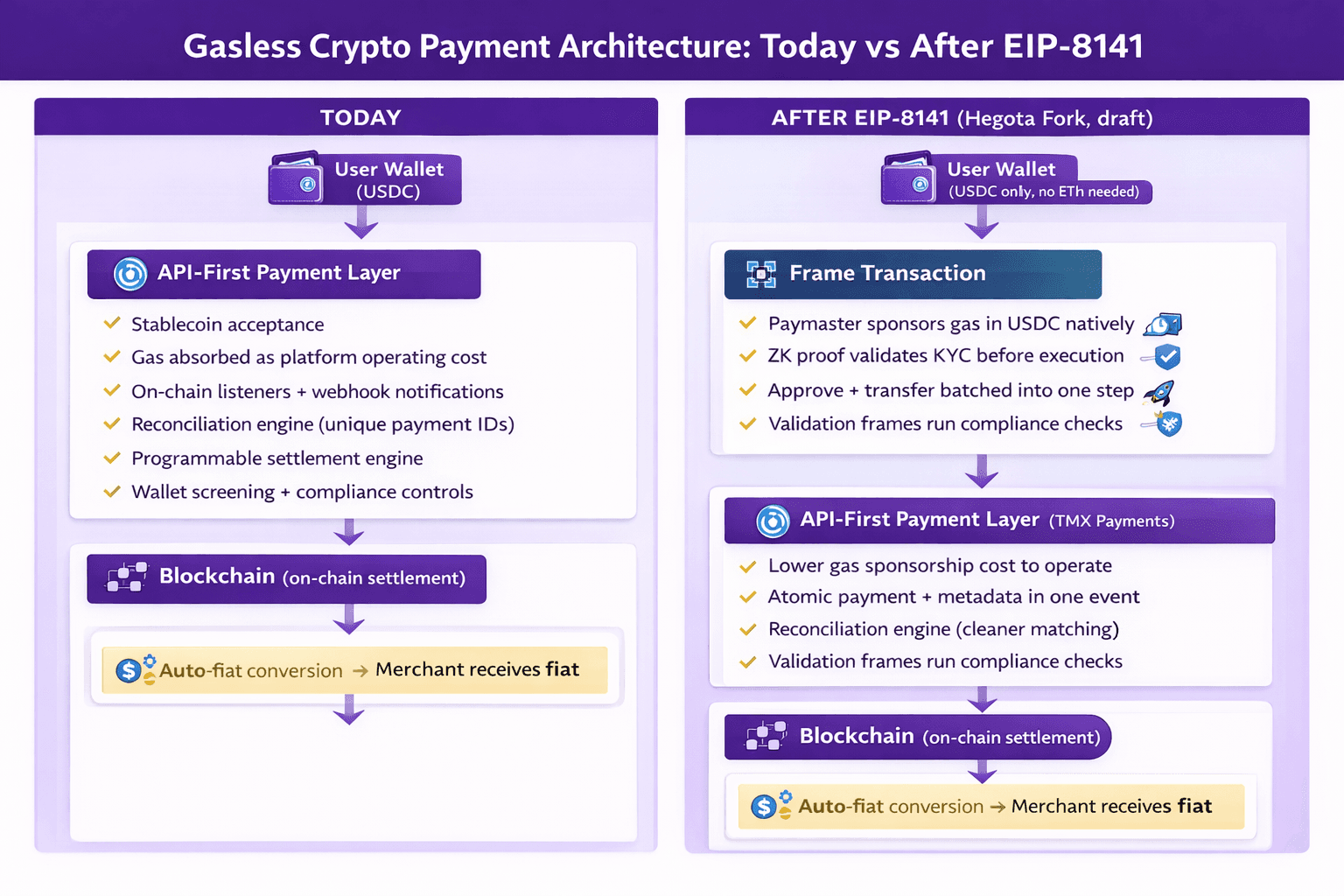
Key difference: Today, TMX Payments absorbs gas above the blockchain. After EIP-8141, the protocol absorbs it underneath. The merchant experience does not change. The infrastructure cost goes down.

Conclusion

Gas fees are a design problem, not a technical one. A payment system built around how blockchains work is not built around how payments work.

The fix is to remove gas from the user experience at the platform level today. Use stablecoins as the payment currency. Detect payments on-chain automatically. Match invoices without manual work. Control settlement with programmable rules. Screen wallets before funds move.

EIP-8141 will bring some of this to the protocol level when it ships. But the businesses that move first will already be running compliant, gasless payment infrastructure long before the fork goes live. They will not be catching up. They will be pulling ahead.

FAQ

What is a gas fee in crypto payments?

A gas fee is the cost required to process a transaction on a blockchain. It pays the network for validating and recording the transaction.

Why are gas fees a problem for crypto payments?

Gas fees can be expensive and unpredictable. Sometimes a small payment still requires a high fee, which can cause users to cancel the transaction.

Why do users normally need ETH to send stablecoins like USDC?

On Ethereum, gas fees must usually be paid in ETH. Even if someone wants to send USDC, they still need ETH in their wallet to complete the transaction.

What does “gasless payment” mean?

Gasless payments do not mean transactions are free. It means the user does not have to pay the gas fee directly or hold the native token to send a payment.

How can businesses offer gasless crypto payments?

Businesses can use a payment platform that handles blockchain activity in the background. The platform pays the gas fees and manages the transaction process.

What is an abstracted payment layer?

An abstracted payment layer is a system that sits between the user and the blockchain. It manages transactions, gas fees, and settlement automatically through APIs.


Key takeaways:

  • EIP-8141 introduces Paymasters that sponsor gas in stablecoins and let users pay both the transaction and gas in one token, removing the need to hold ETH.

  • Businesses run these systems with account abstraction, automate reconciliation and stablecoin as the main payment asset; but they still need to rely on payment infrastructure to manage settlement and compliance

Crypto payment adoption is growing fast. The problem is that most crypto payment systems make users jump through hoops before they spend a single dollar.

The biggest hoop is the gas fee.

In 2025, Ethereum transaction fees surged to $50 per swap during a period of high network usage. A user who wants to pay $10 in USDC still needs ETH in their wallet just to send it. If they do not have ETH, the payment fails. The user leaves. The business loses the sale.

Gas fee issues lead to 25% fewer transactions during peak fee hours. That is one in four payments failing because of a cost the user never agreed to pay. And it is not just a user experience problem. Gas fees spike without warning, are paid in a volatile asset, and do not fit neatly into standard billing and reconciliation systems, a friction point reduced through this payments infrastructure.

That is the fee problem in one sentence: it hurts users at the front and finance teams at the back.

What Gasless Crypto Payment Actually Means

A gasless payment system does not mean blockchain transactions are free. Every transaction still costs gas. Gasless means the user does not pay it and does not need to hold the native token to pay it.

The cleanest approach for businesses is an abstracted payment layer that sits above the blockchain. Users and merchants interact through standard APIs. The payment layer handles everything on-chain in the background. Gas is an operating cost of the platform. The user never sees it.

This is exactly how traditional payment systems work. Merchants do not pay Visa's network costs directly. Those costs are built into the processing fee invisibly.

TMX Payments platform uses this approach. It puts an API-first payment layer above the blockchain. Merchants connect through REST APIs and webhooks. Users pay with stablecoins from any wallet. The platform handles all on-chain detection, settlement, and reconciliation. Gas is never visible to either side.

What EIP-8141 Changes for Payment Systems

EIP-8141 is a draft Ethereum proposal that lets users pay gas fees in stablecoins instead of ETH, removing the need to hold a second token just to send a transaction.

Right now, removing gas fees from the user experience requires workarounds. Relayers, meta-transactions, and abstracted payment layers exist because Ethereum's base protocol requires users to hold ETH to send any transaction. These workarounds work. But they add complexity.

EIP-8141, announced February 28, 2026, changes this at the protocol level. It is still a draft proposal targeting the Hegota fork. It is not live yet. But it is important to understand what it means.

EIP-8141 introduces Frame Transactions and Paymasters. A Paymaster is a smart contract that sponsors gas on behalf of the user. The user pays in stablecoins. The Paymaster converts and covers the gas in real time. No ETH required. No relayer. The protocol handles it natively.

1. Gas paid in stablecoins

Once Paymasters are live, a user paying in USDC can also have their gas covered in USDC. One token. One step. The dual-token problem disappears at the protocol level.

2. Batched transactions

EIP-8141 allows approve and transfer actions to happen in one atomic transaction instead of two. The user clicks once. Gas is paid once. Payment clears in one step.

3. Compliance embedded in the transaction

EIP-8141's validation frames allow KYC and sanctions checks to run before execution, not as a separate application-layer step. Compliance becomes part of the transaction itself.

4. Privacy-preserving verification

One EIP-8141 option allows a Paymaster to verify a zero-knowledge proof before sponsoring gas. A wallet can prove it passed KYC without revealing who the holder is. The compliance check happens. The data stays private.

Every workaround that payment systems use now to hide gas will eventually be replaced by native protocol features that do the same thing more cleanly and cheaply.

Design Principles for Gasless Crypto Payment Systems

A gasless crypto payment system hides blockchain complexity from the user. The platform handles the technical work. Users focus on making the payment.

  1. Abstract the blockchain layer

Users and merchants use simple APIs. They do not touch the blockchain directly. Platforms like TMX Payments handle gas, confirmations, and settlement automatically. The user sees none of it.

  1. Use stablecoins as the main payment asset

Stablecoins cut price swings. They make payments easier for businesses to manage.

  1. Treat gas as a platform cost

The platform pays gas fees. It is part of operating costs. Users do not need to hold native tokens.

  1. Automate reconciliation

Every payment gets a unique ID. That ID matches the transaction to its invoice. It happens automatically.

  1. Control settlement with rules

Payments release only after confirmations or compliance checks are done. Nothing moves until the rules are met.

The EIP-8141 Business Impact

Stablecoin usage in transactions rose 75% between 2024 and 2025 as businesses favored stable payment rails. Stablecoins now represent 76% of all crypto payments globally. The market has already moved toward stablecoin-first payment flows. The infrastructure just needs to catch up.

Metric

Data Point

Merchants planning to accept crypto within 2 years

75% of U.S. merchants

Business adoption growth YoY

55% in 2023

Transactions lost during gas fee spikes

25% fewer transactions at peak hours

Merchants citing high fees as a major challenge

72% in 2025 UK survey

Stablecoin share of all crypto payments

76% globally

Stablecoin usage growth 2024 to 2025

75% increase

Crypto payment gateway market size 2025

$2 billion

Projected market size by 2030

$4.82 billion

Merchants demanding multi-currency and multi-chain support

90% of gateway clients

Reduction in failed settlements via confirmation-based release

20 to 30%

Reduction in manual reconciliation time

30 to 40%

Reduction in audit preparation effort

25 to 35%


Traditional Crypto Payments vs. Gasless Payments

Area

Traditional Crypto Payments

Gasless via Abstracted Layer

After EIP-8141

Gas fee exposure

User pays ETH on every transaction

Platform absorbs gas invisibly

Paymasters sponsor gas natively in stablecoins

Tokens needed

Payment token plus ETH

Payment token only

One token covers payment and gas

Transaction steps

Two steps: approve then transfer

Platform batches where possible

One atomic Frame Transaction

Compliance screening

Manual or separate application layer

Platform screens before settlement

ZK proof validation frames in the transaction

Reconciliation

Manual invoice matching

Automatic via unique payment IDs

Payment and metadata arrive in one atomic event

Settlement control

Instant release, no rules

Programmable confirmation rules

Validation frames enforce rules at protocol level

What This Looks Like for an Institution

Institutions settling cross-border payments on a stablecoin rail run into the same wall every time. The payment is in USDC. The gas is in ETH. Finance logs them separately. Reconciliation doubles. Compliance reviews delays manually. The rail is faster than SWIFT but the operational overhead is just as bad.

For treasury teams, this means every settlement run carries hidden costs that do not appear in the payment amount itself. 

  • ETH balances have to be maintained separately, monitored for volatility, and replenished when they run low

  • A treasury operation that moves $2 million in USDC cross-border still needs a standing ETH float just to keep transactions moving

  • When gas spikes, payments fail. When payments fail, accounting teams open exception queues. When exception queues grow, payment failure rates climb and counterparty relationships take the hit.

EIP-8141 fixes the root cause. Once Paymasters are live, gas gets paid in the same stablecoin as the payment. One token. One transaction. No ETH wallet to manage. No split ledger entries. The institution sends USDC and the protocol handles everything underneath.

TMX Payments fits directly into this picture. It is built for institutions that need controlled crypto payment operations without the engineering burden of managing blockchain infrastructure themselves. Stablecoin payments come in, auto-convert to fiat, and settle through a programmable engine that holds funds until compliance and confirmation rules pass. Wallet screening runs before any leg releases. Reconciliation matches every payment to its invoice automatically. The finance team gets one clean export, structured for audit and regulatory review.

As EIP-8141 moves gas sponsorship to the protocol level, institutions running on TMX Payments benefit without changing anything. The stablecoin payment rail they already use becomes cheaper and simpler to operate because the protocol does more of the underlying work. Cross-border settlement gets faster. Operational overhead gets lower. The compliance and reporting layer stays exactly the same.

Step

Standard Crypto Setup

TMX Payments + EIP-8141 Direction

Gas cost

ETH required, logged separately from payment

Native stablecoin gas after EIP-8141, no split ledger

Settlement

One transaction per leg manually triggered

Programmable engine handles all legs automatically

Confirmation tracking

Manual status checks

Webhooks push real-time status to internal systems

Reconciliation

Manual matching, doubled line items

Auto-matched via unique payment IDs

Compliance screening

Manual review after the fact

Wallet screening before each leg releases

Audit trail

Assembled on request

One-click export, structured for regulators


Gas Economics Modeling

The cost difference between a standard crypto payment setup and a gasless abstracted layer is not theoretical. It compounds across every transaction volume tier.

Monthly Transactions

Avg Gas Cost Per Tx (ETH)

Total Gas Spend (Standard)

Gas Spend (Gasless Layer)

Monthly Saving

500

$12

$6,000

$0 visible to business

$6,000

2,500

$12

$30,000

$0 visible to business

$30,000

10,000

$12

$120,000

$0 visible to business

$120,000

50,000

$12

$600,000

$0 visible to business

$600,000

After EIP-8141, the platform's own cost of sponsoring gas drops further because Paymasters handle it at the protocol level in stablecoins. The saving the business sees stays the same. The cost to run the infrastructure underneath shrinks.

Architecture Diagram

Key difference: Today, TMX Payments absorbs gas above the blockchain. After EIP-8141, the protocol absorbs it underneath. The merchant experience does not change. The infrastructure cost goes down.

Conclusion

Gas fees are a design problem, not a technical one. A payment system built around how blockchains work is not built around how payments work.

The fix is to remove gas from the user experience at the platform level today. Use stablecoins as the payment currency. Detect payments on-chain automatically. Match invoices without manual work. Control settlement with programmable rules. Screen wallets before funds move.

EIP-8141 will bring some of this to the protocol level when it ships. But the businesses that move first will already be running compliant, gasless payment infrastructure long before the fork goes live. They will not be catching up. They will be pulling ahead.

FAQ

What is a gas fee in crypto payments?

A gas fee is the cost required to process a transaction on a blockchain. It pays the network for validating and recording the transaction.

Why are gas fees a problem for crypto payments?

Gas fees can be expensive and unpredictable. Sometimes a small payment still requires a high fee, which can cause users to cancel the transaction.

Why do users normally need ETH to send stablecoins like USDC?

On Ethereum, gas fees must usually be paid in ETH. Even if someone wants to send USDC, they still need ETH in their wallet to complete the transaction.

What does “gasless payment” mean?

Gasless payments do not mean transactions are free. It means the user does not have to pay the gas fee directly or hold the native token to send a payment.

How can businesses offer gasless crypto payments?

Businesses can use a payment platform that handles blockchain activity in the background. The platform pays the gas fees and manages the transaction process.

What is an abstracted payment layer?

An abstracted payment layer is a system that sits between the user and the blockchain. It manages transactions, gas fees, and settlement automatically through APIs.
GET SUCCESS IN WEB3

  • Trusted Web3 partner since 2017

  • Full-stack Web3 development team

  • Performance-driven Web3 marketing

Get A Free Consultation

Get A Free Consultation

RECENT TRAININGS

Follow us

get web3 business updates

Email invalid

  • Access global liquidity for your RWA project with TMX Tokenize’s Canton Network integration

DISCOVER NOW

  • Access global liquidity for your RWA project with TMX Tokenize’s Canton Network integration

    JOIN NOW

DISCOVER

  • Access global liquidity for your RWA project with TMX Tokenize’s Canton Network integration