
Who Buys Your Company’s Token? Where Traditional Businesses Find Token Sale Investors
Written by: Rob Eijgenraam
The public token sale market has thinned out. According to CryptoRank’s research on public token sales, only 13 public token sales were recorded in May 2026, the lowest monthly figure since November 2020. The same research finds that capital has become more concentrated and investors more selective. That matches what TokenMinds sees in its own campaigns, which currently raise between half a million and 5 million dollars. In a crypto bear market the initial amount stays on the lower side, and many investors are cautious about any new project.
The rules and infrastructure are moving too. In August 2026, the SEC proposed Regulation Crypto Assets, a framework that would let some token sales reach buyers beyond accredited investors. In November 2026, Coinbase described one integrated service for token issuers that covers sales, distribution, listings, custody and liquidity.
Buyers are more careful, but the routes to reach them are becoming clearer. Still, none of this answers the first question a CEO faces when planning a token launch, which is who will actually buy.
These buyers exist, and most of them can be identified before the raise starts. The real gap is the investor network. This guide maps the five buyer groups and matches them to the token model and legal route. It then compares the compliant sale platforms of 2026 and sets out the order in which to approach each group.
Why Do Traditional Companies Struggle to Reach Token Sale Buyer Groups?

Traditional companies struggle because their investor network was built for equity and debt, not tokens. Shareholders and lenders know the business well, but most of them do not buy or hold tokens. The company has credibility, yet no list of people who can and will buy.
Most of the planning goes into the token itself. Teams design the tokenomics, meaning the supply, allocation and use of the token, then set a date for the token generation event (TGE), when the token is created and delivered. The buyer list often comes last.
The result is easy to predict. Teams pitch groups that cannot legally buy, fall short of the target, or attract buyers who sell as soon as the token trades. A token sale is a crypto capital raise without giving up equity, and like any raise, it starts with knowing who the investors are. The next step is to name them.
Who Buys a Company’s Token? The 5 Realistic Buyer Groups
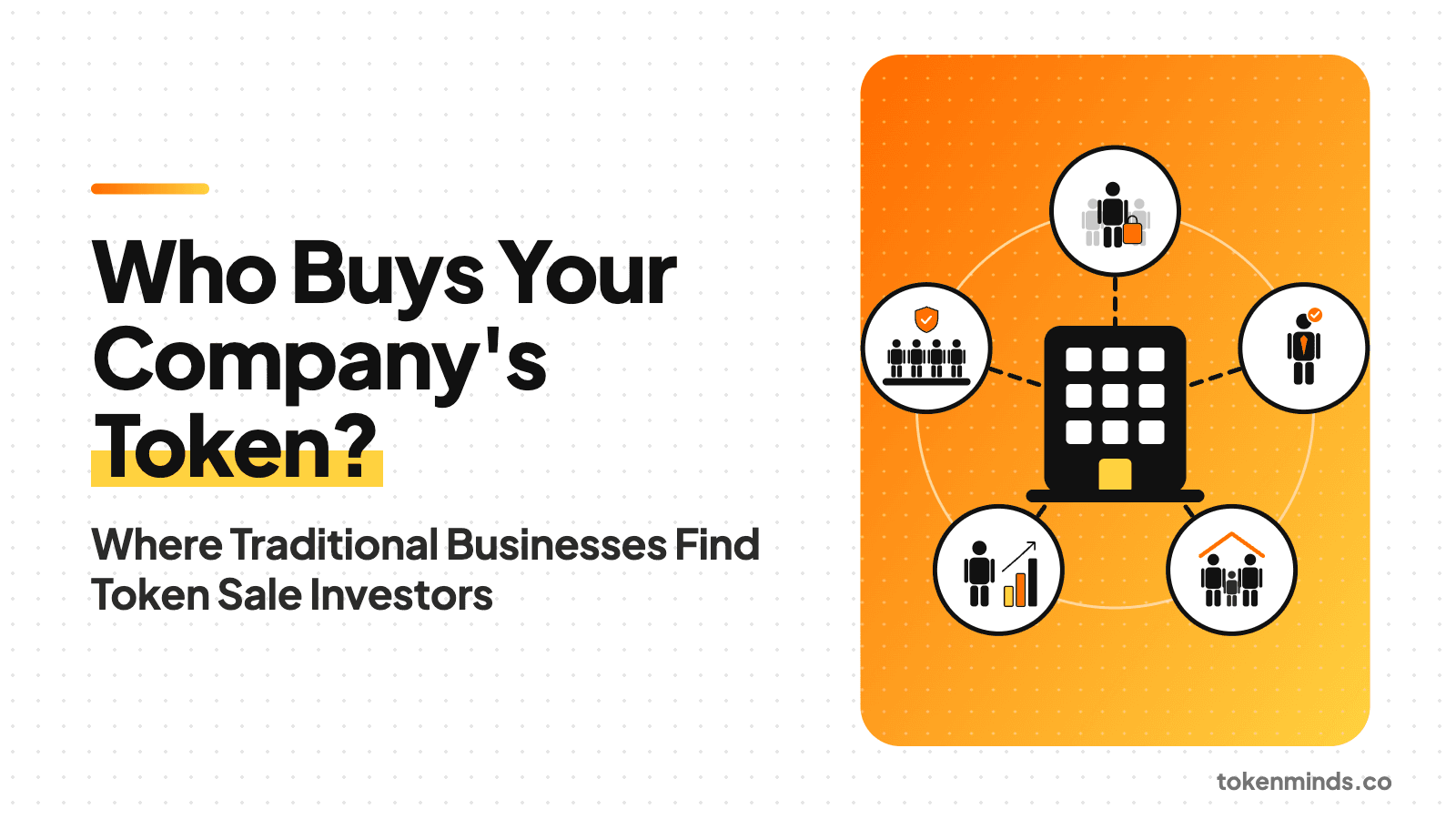
A company’s token is usually bought by five groups. Each one has different reasons to buy and different limits on what it is allowed to buy.

1. Existing Customers and Community
Customers already know the product, so they may be a natural fit for a token that unlocks access, discounts or rewards. Demand differs by company and is worth testing before the raise. They buy smaller amounts, but the token’s use gives them a reason to hold.
Their limit is legal rather than financial. A practical limit is the wallet, because customers who have never held a token may not have one. In the Artfi tokenization platform, users sign up with an email and get a custodial wallet inside their account, so non-crypto buyers can take part in fractional ownership without a crypto setup. The Artfi case study sets out the build. In the US, selling to the general public requires a route that allows non-accredited buyers, as the legal section below explains.
2. Accredited and Professional Investors
An accredited investor is a person or entity that meets wealth or professional tests set by the SEC. According to the SEC’s guide to accredited investors, an individual qualifies with a net worth above $1 million, not counting the main home. Income above $200,000 in each of the past two years, or $300,000 with a spouse or partner, also qualifies. So do holders of the Series 7, 65 or 82 licenses.
These buyers matter because many US offering exemptions are limited to them. Under the SEC’s accredited investor definition, directors and executive officers of the company selling the securities also qualify, so the company’s own leadership network is often the first list to build. These investors look for clear terms and a fair entry price.
3. Family Offices
A family office manages the wealth of one family or a small group of families. The SEC’s guide to accredited investors counts family offices with at least $5 million in assets under management, and their family clients, as accredited investors.
They can commit more capital than most individuals, and they look closely at governance, reporting and the people behind the business. That makes them a strong fit for an established company. Teams new to this group can start with this guide on preparing a token sale for family office investors.
4. Crypto Funds
Crypto funds are investment funds that buy tokens, either in private rounds or on the market. They bring capital and links to exchanges and market makers, the firms that keep buy and sell orders in the market so a token can trade smoothly.
They are also demanding. A fund will ask about its allocation size, its unlock dates and the path to a listing. For a traditional company, the pitch works best when it leads with the revenue and customers of the existing business.
5. Buyers on Compliant Sale Platforms
A token sale platform, often called a launchpad, runs the sale and brings its own pool of verified buyers. Most platforms run KYC checks to confirm each buyer’s identity, and many limit access by country or investor status.
They give a company reach it could not build alone, but less control over who buys. Platform buyers also check how their money is handled. TokenMinds' work on the TenCap Launch App reflects this, since its investors are wary of rug pulls and contributions go from the investor's wallet straight to the deal contract. TenCap never takes deposits. The platform then indexes and reconciles each receipt, and investors can verify vesting, on-chain receipts and multisig controls. Buyers also connect a wallet and complete KYC before any contribution, and the app lists token launches only, because equity or revenue-right offerings need a licensed route.
Buyer group | What they want | What they bring | Main limit |
Customers and community | Use, access or rewards | Real demand | Route must allow non-accredited buyers |
Accredited and professional investors | Clear terms, fair price | Early capital | Must meet SEC tests |
Family offices | Strong governance | Larger commitments | Deeper checks |
Crypto funds | Allocation, unlocks, listing path | Market connections | Highly selective |
Platform buyers | Fair access | Broad reach | Less control over holders |
Knowing the groups is only half of the map. The token itself decides which groups fit.
Which Token Sale Buyer Groups Fit Which Token Model?
The token model decides the buyer, because it decides what the buyer receives. In March 2026, the SEC set out a five-part classification of crypto assets. As Orrick’s summary of the SEC interpretation explains, digital tools, meaning utility tokens that give access to or functions within a network or application, are not securities. A token that carries a passive yield or rights to a business’s future income, profits or assets does not fit that profile.
For a traditional company, this leaves three practical token models.
Token model | What the holder gets | Best-fit buyers |
Utility or access token | Access to a product, service or network | Customers, community, platform buyers, crypto funds |
Membership or loyalty token | Status, discounts or rewards | Customers and community |
Revenue-share or asset-backed token | A claim on income, profits or assets | Accredited investors and family offices |
A utility token can reach the widest group of buyers, but only if it does something real for its holders. A revenue-share or asset-backed token speaks to investors who want a return, and it usually brings securities rules with it. ConcentricDAO shows the asset-backed model in practice. It converted real-world assets, such as patented systems, into digital tokens on a tokenization platform and promoted them on social media to drive participation. The tokens were offered through its foundation, and the proceeds were routed to a Panama LLC, as the ConcentricDAO case study describes. Classification can also change as the facts change, so counsel should confirm it before marketing starts. This guide to token creation for non-crypto companies covers the choice in more depth.
Once the token model is clear, the legal route sets the final boundary on who may buy.
Does a Token Sale Have to Be Limited to Accredited Investors?
No, not always. The legal route decides who may buy, so the answer depends on which route the company uses. In the US today, the main private placement route, Regulation D, is built around accredited investors. That may change if the SEC adopts the token offering rules it proposed in 2026. Until then, TokenMinds recommends that clients incorporate offshore, in places such as Panama, Cayman or BVI, because no license is needed there and a bank account can be opened. Counsel should confirm how that structure interacts with any US buyers the company still wants to reach.
A company planning a US token sale has two routes to weigh. The first is Regulation D, which is available today. The second is the SEC’s proposed Regulation Crypto Assets, which is not yet final. Each route sets a different limit on who can buy, as the two subsections below explain.
The Current US Route: Regulation D
Regulation D is the SEC’s set of rules for private offerings. According to the SEC’s investor bulletin on Regulation D private placements, it offers two main paths under Rule 506.
- Rule 506(b). The company may sell to unlimited accredited investors and to no more than 35 non-accredited investors in any 90-day period. It may not use general solicitation, meaning public advertising of the offering.
- Rule 506(c). The company may advertise publicly, but every buyer must be an accredited investor, and the company must take reasonable steps to verify that status.
In practice, a US token sale under Regulation D reaches accredited investors and family offices well, but it cannot be marketed openly to most customers.
What the SEC’s Proposed Regulation Crypto Assets Would Change
The SEC’s August 2026 proposal would add two routes designed for crypto assets. According to Stinson’s analysis of Regulation Crypto Assets, they would work as follows.
- Startup exemption. A company could raise up to $5 million over up to four years, once, with no accredited investor condition, no limit per investor and public marketing allowed.
- Fundraising exemption. A company could raise up to $20 million in 12 months under Tier 1, or up to $75 million under Tier 2 with audited financial statements. Non-accredited buyers would be capped at 10% of their income or net worth.
For a company with an existing customer base, this would make customers a legal target for a US token sale. However, the rules are a proposal and are not final. The fundraising exemption would also carry a US nexus test: the issuer must be organized in the United States, most of its executive officers or directors must be US citizens or residents, and more than 50% of its assets must be in the United States. Stinson adds that the proposal does not say whether platforms trading these tokens must register as exchanges, brokers or dealers, so resale routes remain open questions. Stinson also notes that neither exemption applies if the token is itself a security, such as tokenized stock.
Outside the US, each region sets its own rules, so counsel has to confirm the route for every market. With the legal boundary set, the next question is where the sale takes place.
Where Can a Company Run a Compliant Token Sale?
A company can run a compliant token sale through three types of platforms. Each reaches a different pool of buyers, so the choice should follow the buyer map.
Platform type | Example | Who buys there | Best fit |
Exchange-run sale | Coinbase token sales | Verified retail users, including in the US | Broad holder base and a listing |
Curated or accredited-only | CoinList, Legion | Accredited or selected investors | Raises on the accredited route |
Self-hosted sale with KYC | Company’s own sale page | Customers and invited investors | Large existing customer base |
Exchange-run sales are the newest option. When Coinbase launched its token sales platform, it opened public token sales to US retail users for the first time since 2018. Its first sale, for Monad, drew 85,800 participants and $269 million in commitments. Buyers who sell within 30 days of listing may receive smaller allocations in future sales, a rule that favors long-term holders.
Curated platforms trade reach for selection. In 2025, CoinList brought token sales back to the US with a product for accredited investors. Tiger Research describes Legion as a platform that selects participants based on investment experience. Self-hosted sales give the most control but the least reach, so they suit companies with a large customer base. The control comes with work. In TokenMinds' builds, buyers connect a wallet and pass KYC before any contribution, and the sale, vesting and staking logic sits in audited contracts rather than in the backend. TokenMinds coordinates onboarding and tracks KYC status, while the identity checks run through a KYC provider or the company's counsel.
Platforms answer where the sale happens. The order of the rounds decides who sets the price and who ends up holding the token.
In What Order Should a Company Approach Token Buyers?
A company should approach token buyers in three rounds, from the smallest and best-informed group to the widest. Each round gives the next one something to build on. Before the first round, TokenMinds typically runs an investor survey: it presents the token concept, including the allocation and the token's utility, to likely buyers and asks how much they would invest. The result is a read on market intent at a small cost, taken before any spending on promotion or a full launch.

- Private round with accredited investors and family offices. These buyers test the terms and set the first price. Their commitment shows later buyers that informed investors have checked the business.
Output: anchor commitments and a reference price. - Strategic round with crypto funds and ecosystem partners. These buyers bring links to exchanges and market makers. Their terms usually include lockups, so their entry should fit the unlock schedule.
Output: wider distribution and support for trading after launch. - Community or public round with customers and a compliant platform. This round spreads the token across many holders, ideally people who will use it.
Output: a broad holder base that supports trading after the TGE.
Reversing the order tends to add risk. In this guide's planning view, a public round without anchor investors has no reference price, and short-term buyers can turn into selling pressure at launch. Each round also needs time for legal work, KYC and marketing, as this token launch timeline for a traditional company shows.
Whatever the round, every buyer group asks for proof before it commits.
What Do Token Buyers Check Before They Commit?
Every token buyer checks the same core items, though the depth varies. A customer may read a summary, while a family office will expect a full data room. Platforms ask for the same material, and Coinbase requires issuers to give detailed disclosures and accept a six-month lockup.
- Tokenomics.
Total supply, how tokens are allocated, and how the money raised will be used. - Vesting and lockups.
When the team, early investors and partners can sell. Vesting releases tokens over time, while a lockup blocks sales for a set period. Length affects price. The Block’s secondary-market research, as cited by FinDaS, puts the average discount on locked-token secondaries at 40 to 46 percent, and unlock schedules longer than two years are now penalised in OTC pricing. - Legal route.
Who may buy, under which exemption, and with what limits on resale. - Disclosure pack.
Financial statements, management, risks and token rights. As Stinson’s analysis of Regulation Crypto Assets notes, proposed Rule 103 would also require this narrative to stay consistent with the issuer’s website, official social media and whitepapers, so marketing copy would be treated as part of the disclosure. The SEC’s proposal would require similar disclosures, including token economics, allocations and governance. - Liquidity plan.
Which exchange will list the token and which market maker will support trading. - The business behind the token.
Revenue, customers and track record. For a traditional company, this is the strongest asset in the room. In TokenMinds' conversations with private investors, the request is for something concrete to present, such as a working product, and a domain name or a concept deck alone does not meet it.
Buyers judge the company as much as the token, as this guide on what token investors look for in a company explains. Before outreach starts, a token sale readiness checklist helps confirm that each item is ready.
Is Your Company Ready to Approach Token Sale Buyer Groups? A Yes/No Checklist
Answer each question with yes or no. Each one maps to a section above.
- Buyer list. Can you name at least one realistic buyer in each of the five buyer groups?
- Token model. Does the token give holders a real use, such as access, discounts or rewards, or a clearly defined claim on income or assets?
- Legal route. Has counsel confirmed the route (Regulation D today) and who may buy under it?
- Accredited access. Does your leadership network include accredited investors or family offices who would take a first call?
- Disclosure pack. Are tokenomics, vesting, lockups, financial statements and risks written down?
- Business proof. Can you show revenue, customers and track record in one page?
Scorecard: Mostly yes answers suggest the company can start with the private round. Several no answers, especially on the legal route or the disclosure pack, point to preparation first and outreach later.
Scoring guide: Give one point for each yes answer, for a total out of six. Treat the bands as a planning aid, not a proven formula.
- 5 to 6 points. The company can open the private round with accredited investors and family offices.
- 3 to 4 points. The company should close the gaps first, starting with the legal route and the disclosure pack.
- 0 to 2 points. The company should finish the buyer list, token model and legal review before any outreach.
Get an Investor Access Strategy Call With TokenMinds
A token sale is won on the buyer map, not on the token design. The sections above show that the right investors depend on the token model, the legal route and the order of the rounds, and that each group needs the right material at the right time.
TokenMinds has run token sales since 2017 across more than 150 projects, and helps traditional companies work out who can realistically buy their token before the raise starts. The work covers matching buyer groups to the token model and the legal route chosen with counsel, and building the pipeline across customers, accredited investors, family offices, crypto funds and compliant sale platforms. It also covers the tokenomics, vesting terms, disclosure pack and data room each group checks. Its investor access strategy call reviews the token model, legal route and investor list in one pass. Leadership walks in with a target raise and walks out with a buyer map, a round sequence and the gaps to close before outreach.
Book an investor access strategy call with TokenMinds.
FAQs
Who invests in a token sale from a traditional company?
Five groups usually invest, namely existing customers and community, accredited and professional investors, family offices, crypto funds, and buyers on compliant sale platforms. Which groups fit depends on what the token gives its holders and which legal route the company uses.
Where can a business find investors for a token raise?
The first investors are usually close to the business, such as its leadership network, accredited investors and family offices. Crypto funds and ecosystem partners follow in a strategic round. A compliant platform or the company’s own sale page then reaches customers and the wider public.
Do token sales have to be limited to accredited investors?
Not always. In the US, Regulation D sales are built around accredited investors, and, as the SEC’s investor bulletin on Regulation D private placements explains, Rule 506(c) allows public marketing only if every buyer is accredited. The SEC’s proposed Regulation Crypto Assets would allow non-accredited buyers within set limits, but it is not yet final.
How many rounds does a token sale need, and how long does it take?
Most projects run between three and six rounds, according to FinDaS’s guide to token sale rounds. The span from the first private round to a public listing varies by project, because each round needs time for legal work, KYC and marketing. This token launch timeline for a traditional company sets out how those steps are usually sequenced. One common approach is to stagger vesting by round, so that early buyers cannot all sell into the listing at the same time. The exact schedule depends on the token model and on the terms each round agrees, and counsel should review it.
In what order should a company approach token sale buyer groups?
A common sequence starts with a private round for accredited investors and family offices. A strategic round for crypto funds and ecosystem partners follows, and a community or public round for customers and a compliant platform comes last. This order gives later buyers a reference price and reduces selling pressure at launch.
What drives the legal cost of a token sale?
The cost depends mainly on the legal route, the number of markets and the disclosure work. Regulation D needs verification of buyer status under Rule 506(c). The proposed Regulation Crypto Assets would require audited financial statements for its larger fundraising tier. Counsel can confirm the scope and budget before outreach starts.
Do token sale buyers have to pass KYC?
In most cases, yes. Most compliant sale platforms run KYC checks to confirm each buyer's identity, and many limit access by country or investor status. In TokenMinds' builds, buyers connect a wallet and complete KYC before any contribution, so the company should plan this step for every buyer group.