
Protecting Credibility in a Token Sale: Red Flags That Make Traditional Companies Look Like a Hype Presale
Written by: Rob Eijgenraam
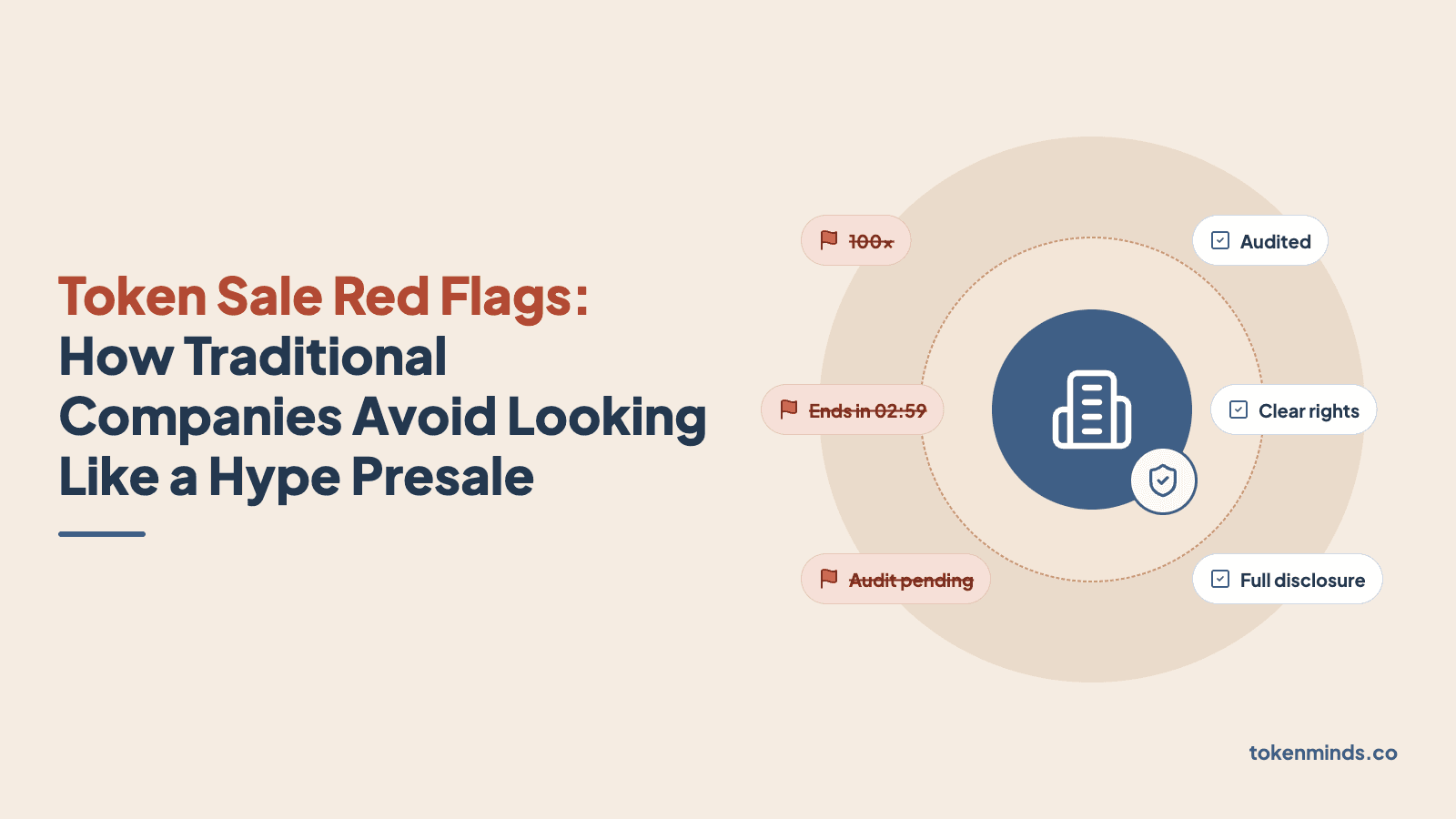
More established companies now see a token sale as a serious way to raise money for growth. For many of them, it is a crypto capital raise that helps them raise capital with a token without giving up equity. However, the way a company markets its sale decides how investors judge the company.
Recent market data shows what investors now support. In May 2026, Circle became the first publicly listed company to run a token presale. It raised $222 million for its Arc blockchain at a $3 billion fully diluted valuation.
Its investors included a16z crypto, BlackRock, Apollo and Intercontinental Exchange. Circle shared the raise together with its first-quarter results. It also published the token’s whitepaper on the same day.
Retail presales moved in the opposite direction. Public token sales raised about $40 million across 47 sales in Q2 2026. According to CryptoRank data, this was the lowest level in four years.
This tells founders and CMOs something important. Investors now put money into companies that can prove their claims. TokenMinds sees the same caution in its own conversations with investors: many are very wary of any new project, so raising money is harder than it was before. This article explains the seven red flags that make a token sale look like a hype presale, and what to remove before launch.
Why Hype Costs a Traditional Company More Than a Crypto Startup

A crypto startup that uses hype puts one fundraising round at risk. A traditional company puts its whole business at risk. Its customers, lenders, partners and regulators all see the same campaign, and they link it to the company’s name.
The risk is even bigger for a listed or pre-IPO company running a token sale. Shareholders and the stock market also watch how the company promotes its token.
Regulators have acted on this in the past. In 2017, the SEC warned investors about public companies that announced token news to raise their share price. It also stopped trading in four companies because of questions about their token offerings.
Investors are also careful from the start. Chainalysis estimates that crypto scams took a record $17 billion in 2025. When a company’s campaign looks like those scams, investors treat it with the same doubt.
How Investors Screen a Token Sale in the First Few Minutes
A first review comes down to three basic questions. Guidance from regulators follows the same logic, and each question points to a group of red flags.
- How is the token sold?
Investors look at the marketing first. The SEC created a fake token sale website, HoweyCoins, to teach investors the warning signs of a fraudulent offering. This question reveals the marketing red flags. - What does a token holder actually receive?
Investors want to know the holder’s rights in legal terms. NASAA, the North American Securities Administrators Association, tells investors to ask whether a token is a security and whether its offering is registered. This question reveals red flags in the token rights and the disclosures. - Who stands behind the claims?
Investors check the people and the evidence behind the sale. NASAA also advises investors to check the people who promote an offering. This question reveals red flags in the audit and in how closely the token is tied to the real business.
If a company cannot answer these questions well, the review can stop early. The sections below explain each red flag, starting with the marketing.
Marketing Red Flags That Hurt Credibility in a Token Sale and Make It Look Like a Scam
Marketing red flags are the first things an investor notices. They come from the retail presale model, which focuses on price and speed. A crypto presale for an established company works in a different way. It uses selected investors, a fixed price and a vesting schedule, which releases tokens over time.

Red Flag 1: “100x” Language, Return Promises and Buzzwords
Many investors treat any promise of price growth as a possible warning sign, even when the company means well. The SEC’s HoweyCoins website lists claims of high, guaranteed returns as a red flag.
NASAA also warns that bad actors use popular buzzwords about AI and crypto to attract investors into scams. A traditional company sends the same warning sign when its campaign uses many trend words but explains little about the token. Finance Magnates, reporting on an analysis by crypto PR firm Chainstory, notes that releases often use terms such as AI, DeFi or Web3 whatever the project does. It adds that some trading bots scrape news feeds for words like “partnership” or “launch”, so a buzzword-heavy paid release can trigger automated buying before anyone checks the source.
The better approach is to explain what the token does inside the business. Sale materials should not include price predictions, return multiples or trend words.
Red Flag 2: Undisclosed Paid Promotion
PR and influencer marketing are normal parts of a token sale. The red flag is paid promotion that hides the fact that it is paid. Investors read it as an attempt to buy credibility instead of earning it. The concern has a long record. Data from 2002 to 2015, cited by Finance Magnates, showed press releases in 73% of 150 pump-and-dump cases targeting penny stocks. In September 2021, a fake release claiming Walmart would accept Litecoin ran on a traditional newswire, according to Finance Magnates, which reports on a Chainstory analysis. The report says Reuters and CNN initially reported it, and Litecoin rose roughly 30% in minutes before Walmart denied the claim. Chainstory draws the lesson that if a fake release could fool both outlets, retail investors who see paid announcements on aggregator sites or social media can easily be misled by items that look like real news.
Crypto PR firm Chainstory reviewed 2,893 crypto press releases published between June and November 2025. By Chainstory's own classification, 62% came from projects it marked as high-risk or scams. In cloud mining, 90% of issuers fell into those categories. Only 58 releases, about 2%, covered substantive news such as funding rounds, mergers or research reports.
Chainstory's published analysis reports that only around 10% of releases were written in a neutral, matter-of-fact tone. Chainstory works in crypto PR itself, so these figures come from its own analysis.
The study also shows how the problem works. Services such as Business Wire or PR Newswire syndicate announcements to journalists for review. Crypto newswires instead sell guaranteed placement on partner websites, which bypasses editorial filters. Some of those websites then show the paid releases under a “Press Release” label instead of a “Sponsored Content” label. Finance Magnates reports that the study calls this a “false hierarchy”, in which paid announcements shed the stigma of advertising and look like news.
The same applies to influencers. The SEC has warned that a celebrity endorsement may be a paid promotion by someone who knows little about the offering. A credible company labels paid content clearly, works with media that apply editorial review, and chooses influencers who disclose the partnership and explain the business, not the price. TokenMinds applies a similar test when it selects creators. Their engagement must be real rather than bot-heavy, their audience should have a history of engaging with token launches, and they must avoid token price or ROI claims in posts.
Red Flag 3: Countdown Timers and Artificial Urgency
Urgency pushes investors to decide before they check the facts, so investors distrust it. The SEC’s fake website used a countdown clock as one of its teaching examples. Lori Schock, who led the SEC’s investor education office at the time, named countdown clocks and disappearing discounts as red flags of fraud.
A credible sale publishes a clear timeline with fixed dates and terms. This way, the process sets the pace, not pressure. The same logic applies to community incentives. In the SenturoPay airdrop, TokenMinds kept entry barriers low, because a community campaign should support interaction without aggressive incentives. Rewards that are hard to earn or expire fast push people to act before they check the facts.
Structural Red Flags That Stop Investor Due Diligence
After the marketing, investors look at the structure of the sale. These red flags are found in the smart contract, the legal terms and the disclosure documents. They decide whether the review continues.

Red Flag 4: Unaudited Smart Contracts
The smart contract is the computer code that creates the token and controls its rules. Without an independent audit, investors have no outside check on this code.
This risk is real. Security firm Hacken counted $1.18 billion stolen across 107 incidents in Q3 2026. Smart contract attacks caused 48% of those losses.
An audit does not remove every risk. However, a missing audit shows that the team skipped a basic step. TokenMinds also runs an internal smart contract audit and exchange-readiness review before any token sale goes live, whether it runs through a launchpad, an IEO (initial exchange offering) or an IDO (initial DEX offering). The aim is to catch technical, operational and exchange-onboarding issues early. This internal pass is a first check and does not replace the public independent report. The audit report should be public before the sale opens, as part of the work to create a compliant, audited token.
Red Flag 5: Vague Token Rights and Unexplained “Compliant” Claims
Investors need to know what a token holder owns in legal terms. When a company only calls its token a “utility” or “community” token, this question stays open. Compliance claims without any explanation make the problem worse.
The SEC’s 2017 alert warned about public companies that called their token offering “SEC-compliant” without explaining how. A label is not a legal analysis. A credible company publishes a simple summary of token rights that its lawyers have reviewed.
Red Flag 6: Missing Disclosures on Allocations, Vesting and Use of Funds
Missing numbers raise doubts for investors. Investors expect to see how tokens are shared out, when insiders can sell, how the money will be used and what risks exist. NASAA warns in an investor bulletin that unregistered offerings may not provide key information that investors need to make informed decisions.
A single disclosure pack solves this problem. It is one set of documents that covers all of these points, linked from every sale page and press release. In the EU, MiCA already sets disclosure and marketing rules for token offerings, including Article 7 on marketing communications. The section on regulators below gives more detail.
Case Study: Ape in Poker's Vesting Disclosure
Ape in Poker, a poker platform, is a practical example of clear vesting disclosure for this red flag.
Its core challenge was a fair token distribution between seed investors and the core team, without flooding the market. TokenMinds set these terms:
- Overall schedule. A 36-month vesting schedule so tokens release gradually.
- Team and advisors. A 12-month lock, then 18 months of vesting.
- Seed and private investors. Tokens release over 15 months to prevent early dumping.
Terms this specific give investors numbers they can check against the disclosure pack.
Red Flag 7: More Promotion Than Business
The last red flag is about balance. NASAA sees it as a red flag when a company seems more focused on attracting investors through promotion than on building its business.
For a traditional company, this risk appears when the token story moves away from the real business. The campaign talks about community and upside, but the product, the revenue and the role of the token remain unclear.
The better approach is to link every claim to the product, the revenue or the role of the token. TokenMinds tests this before it supports a project. It checks whether the concept fits web3 and the current market, because a weak concept may fail to sell to public investors and can waste the founders' budget. The launch budget should then buy focused launch awareness, not broad unfocused traffic. Regulators now expect the same discipline from token marketing.
Where Regulators Draw the Line on Token Sale Marketing
Regulators in the EU, the UK and the US already limit how companies can promote a token sale. The EU is also working on stricter rules. The table below shows what each set of rules means for a marketing team.
Region | Rule | What it means for marketing |
EU (MiCA) | Under Article 7 of MiCA, marketing must be easy to recognize as marketing, fair and consistent with the white paper. It must also include a set disclaimer. When a white paper is required, no marketing can be published before it. | Every claim must match the white paper. No promotion can start before the white paper is published. |
EU (proposals) | In September 2026, ESMA proposed a ban on some misleading crypto marketing methods and new rules for marketing by third parties. It also said current rules do not cover predictions well when they are not clearly false. These are proposals, not law yet. | Influencer posts and price predictions may face closer checks. |
UK (FCA) | Crypto promotions to UK consumers must use one of four legal routes. A promotion outside these routes is a criminal offence. In February 2026, the FCA started its first enforcement action under these rules, against the exchange HTX. | Campaigns aimed at the UK need an approved route before launch. |
US (SEC) | SEC investor education lists guaranteed returns, celebrity endorsements and unexplained “SEC compliant” claims as warning signs. | Return claims, undisclosed endorsements, and compliance labels can attract attention from regulators. |
These rules are only the minimum. They do not form a full compliance plan, and this summary is not legal advice. Lawyers should confirm the legal route in each target market. In TokenMinds' experience, selling to US investors is hard for now because SEC regulation has to be cleared first, so it targets global investors for the sale instead.
This legal check belongs in every stage of a token sale. It should not wait until the last week before launch.
What a Credible Token Sale Does Instead
A credible token sale replaces each hype signal with a fact that investors can check. It treats the crypto capital raise like a professional investment offer, not a retail campaign.
Circle’s Arc presale followed this approach. It had institutional investors, a published whitepaper and a disclosure together with its quarterly results.
Hype presale signal | What a credible token sale does instead |
“100x” language and buzzwords | Explains the token’s role in the business clearly |
Paid press releases and influencer pushes | Uses independent media coverage and disclosed partnerships |
Countdown timers and artificial urgency | Publishes a timeline with fixed dates and terms |
Unaudited smart contract | Publishes an independent audit report before the sale |
Unclear rights and “compliant” labels | Publishes a simple summary of token rights reviewed by lawyers |
Missing disclosures | Shares one disclosure pack on allocation, vesting, use of funds and risks |
More promotion than business | Links every claim to the product, revenue and token role |
The order of the work matters as much as the content. In a structured token launch process, the audit, tokenomics and whitepaper come before any public sale. TokenMinds starts a project with the tokenomics design, which covers token allocation and the token's utility, and checks that the design is feasible. It then presents the concept to investors in a survey that asks how much they would invest. This gives a read on real market interest before any money goes into promotion, and it keeps a client from spending the full launch budget before the project has proved itself. The marketing then repeats only what the documents already prove.
Pre-Launch Red Flag Audit: A Checklist for the CEO and CMO
The checklist below turns the seven red flags into simple questions. The CEO is responsible for structure and disclosure. The CMO is responsible for every public message, and both lists should pass before any announcement.

CEO Checklist: Structure, Rights and Disclosures
- Have lawyers reviewed a simple summary of the token rights?
- Is the independent audit complete, and is the report ready to publish?
- Does one disclosure pack cover allocation, vesting, use of funds and risks?
- Does the token have a clear role in the product or revenue model?
- Is the legal route confirmed for every market where the token will be sold?
CMO Checklist: Messaging, PR and Promotion
- Is all sale material free of return multiples, price predictions and trend words?
- Is every paid placement and influencer post clearly labeled as paid?
- Have all countdown timers and artificial deadlines been removed?
- Does every claim match the whitepaper and the disclosure pack?
- Are risk statements easy to see wherever the sale is promoted?
If any answer is “no”, the launch is not ready. For a wider view of company readiness, the token sale readiness checklist scores cash flow, legal structure and documents before a sale is planned.
Get a Token Sale Credibility Review With TokenMinds
A traditional company wins its token sale through credibility, not through promises of upside. The sections above show that trust comes from removing hype signals and publishing token rights, audits and disclosures before the campaign goes public.
TokenMinds has run token sales end to end since 2017. It works on token sale strategy, tokenomics and go-to-market for traditional companies that enter Web3. The work covers token rights and tokenomics linked to the business model, whitepapers and token sale pages built on clear disclosure, and PR and influencer campaigns that are clearly disclosed and built on facts. TokenMinds does this work together with the company’s legal, audit and compliance partners. Its token sale credibility review checks a company’s launch copy, PR plan, sale page and disclosures against the seven red flags in one review. The team starts with a draft and leaves with a list of claims to remove, gaps to disclose, and a plan to fix both.
Book a token sale credibility review with TokenMinds.
FAQs
How can a company make its token sale look credible, not like a crypto presale scam?
It removes hype signals and replaces them with facts that investors can check. This means an independent audit, a simple summary of token rights, full disclosure of allocation and vesting, and marketing that matches the whitepaper. Return promises, unlabeled paid content and countdown timers should not appear anywhere.
What token sale practices damage a company’s reputation?
The most harmful practices are return promises, campaigns full of buzzwords, paid content disguised as news, undisclosed influencer deals and artificial urgency. They put the company in the same group as high-risk projects. For a traditional company, customers, lenders, partners and regulators all see the same campaign.
What red flags do investors look for in a token launch?
Investors look for seven red flags. These are return promises, undisclosed paid promotion, artificial urgency, unaudited contracts, unclear token rights, missing disclosures, and more promotion than business. One red flag can be enough to stop a review before investors read the documents.
How do you judge a KOL or influencer quote for a token sale?
Start with what the quote includes. A credible partner discloses the paid relationship, explains the business instead of the token price, and agrees to clear labels on every post. If a quote promises price moves or returns, treat it as a red flag, because investors and regulators read those claims as warning signs.
How can a company keep influencers active after the sale without hype?
Tie payments to continued, disclosed activity instead of a single upfront fee. Each post should still match the whitepaper and the disclosure pack. This keeps the campaign factual after launch and avoids the sudden silence that makes a project look abandoned.
How much of a token sale marketing budget should go to KOLs?
No fixed share suits every project. The budget should follow a demand check, so spending starts only after investors show real interest. It should buy focused launch awareness, not broad traffic. Payments should be staged against disclosed posts, and results should be judged by buyers reached, not views.