Web3 & AI

SOLUTIONS

Products

Services

Web3 & AI

SOLUTIONS

Services

Products

Industries

Become Our Client

About Us

Resources

Web3 & AI

SOLUTIONS

Services

Products

Industries

NFT Mint Readiness Checklist: Wallets, Funding, Gas, Deadlines, and Scam Warnings

NFT Mint Readiness Checklist: Wallets, Funding, Gas, Deadlines, and Scam Warnings

TL;DR
An NFT sale can build strong interest and still lose buyers on mint day. The issue is often not demand. It is readiness. Buyers may use the wrong wallet, miss the allowlist window, lack gas, click a fake link, or panic after a failed transaction. This article gives project teams one practical NFT mint readiness checklist. It covers wallet setup, funding, gas, deadlines, official links, scam warnings, support channels, and post-mint next steps before the mint window opens.

What Is NFT Mint Readiness?

NFT mint readiness is the process of preparing buyers to complete an NFT mint without last-minute confusion.

It covers the wallet, chain, mint price, required currency, gas buffer, sale window, official mint link, and support path.

Recent market data shows why this matters. DappRadar reported that NFT trading volume reached $546 million in October 2025, up 30% month over month. NFT sales also reached 10.1 million, the highest level of 2025. The report also noted that users were becoming more selective.

This data shows that NFT buyers are still active. It also reflects a market where projects cannot rely on attention alone. Buyers need clear mint instructions before they act.

For an NFT sale, readiness should be checked before the allowlist or public sale window starts. Buyers should know what to prepare, where to mint, and what to avoid.

Common Reasons NFT Buyers Drop Off Before Minting

NFT buyers often drop off before minting because the final step is unclear. The most common causes are simple but costly:

  1. Wrong wallet: The buyer connects a wallet that is not eligible or not supported.

  2. Wrong chain: The buyer has funds, but not on the network used for the NFT sale.

  3. Insufficient funds: The wallet does not have enough for the mint price and gas.

  4. Gas misunderstanding: The buyer does not know that gas changes and sits outside the mint price.

  5. Missed allowlist window: The buyer is eligible but misses the correct mint time.

  6. Scam links: The buyer clicks an unofficial mint link or fake support message.

  7. Failed transactions: The buyer sees an error and does not know what to do next.

The NFT Buyer Readiness Gap Before Mint Day

An NFT sale can build demand and still lose buyers at the final step. Mint day compresses conversion, support, and trust into a short window. Once the mint opens, the team has little time to explain wallet setup, funding, gas, timing, and safety.

Before mint day, the team should answer four practical questions:

  1. Can buyers connect the right wallet?

  2. Do buyers have the right funds and gas?

  3. Do buyers know the correct mint window?

  4. Can buyers identify the official link and support channel?

If the answer is unclear, the sale is not fully ready. NFT mint readiness is the last-mile conversion layer. It helps buyers know what to do before they reach the mint page, not after support channels are already full.

At the broader funnel level, readiness should connect with the full sale plan. For that wider view, see NFT Sale Strategy in 2026: How to Build a Community-to-Mint Funnel.

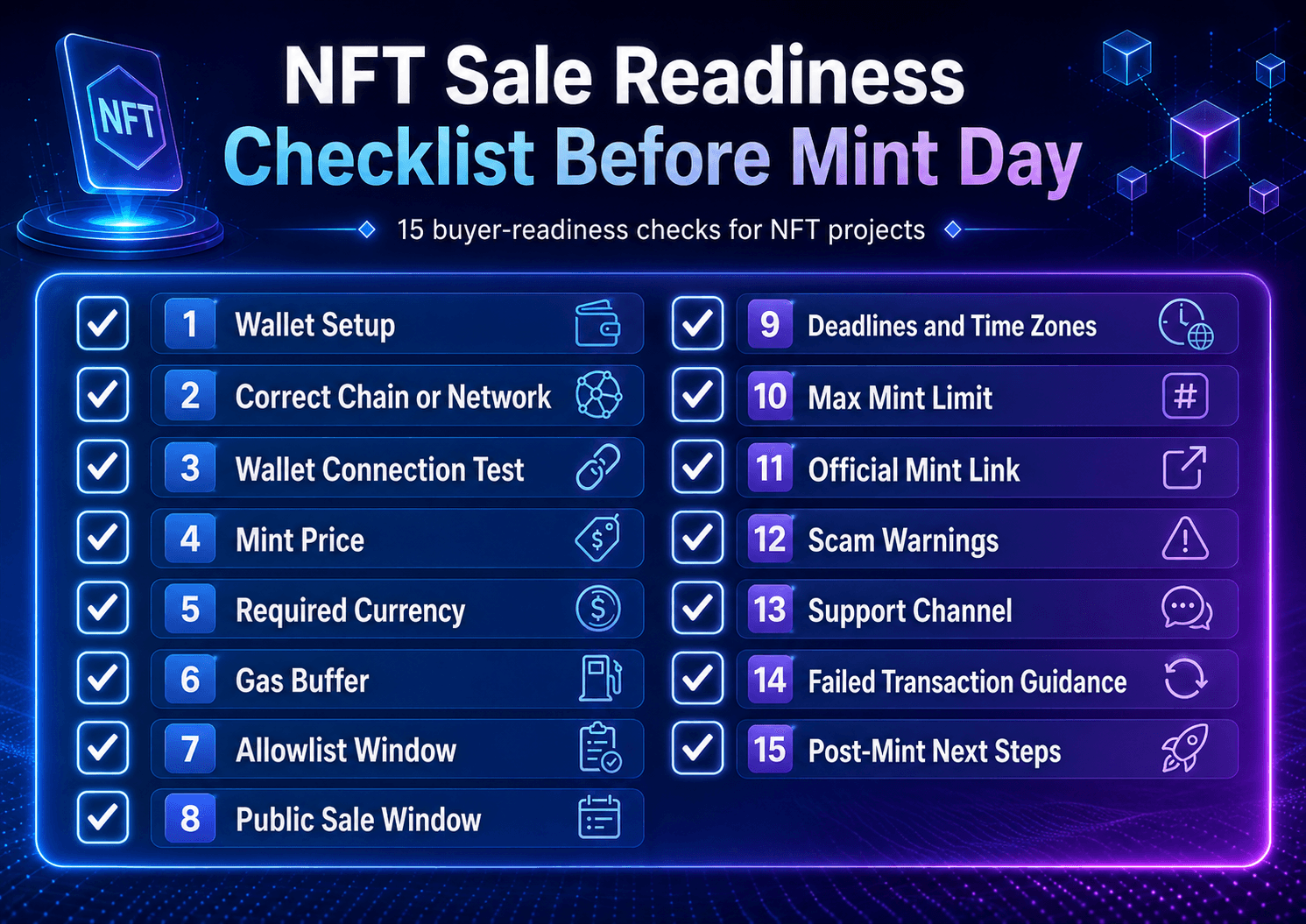
NFT Mint Readiness Checklist Before Mint Day

The strongest approach is one checklist, not scattered reminders.

A good checklist turns mint instructions into a clear buyer path. It shows what buyers should prepare, what the project should publish, and what outcome the team should expect before the mint window opens.

Each item should be clear on the mint page, Discord, X, email reminders, and the project FAQ.

1. Wallet Setup

Buyers should know which wallet is required before they reach the mint page. Wallet setup should not become a last-minute support issue.

  • What Projects Should Prepare
    A short wallet guide with supported wallet types, setup steps, and the correct place to connect.

  • The Output
    Buyers arrive with the right wallet installed and ready to use.

2. Correct Chain or Network

The NFT sale should make the required chain clear. Buyers may hold funds, but still fail if those funds sit on the wrong network.

  • What Projects Should Prepare
    Chain details on the mint page, FAQ, Discord, X, and email reminders.

  • The Output
    Buyers know which network to use before moving funds or connecting a wallet.

3. Wallet Connection Test

The first wallet connection should not happen during the sale window. A simple pre-mint test can reduce pressure on mint day.

  • What Projects Should Prepare
    A safe preview step, test connection flow, or short connection guide.

  • The Output
    Buyers confirm that their wallet connects before the mint starts.

Wallet and funding items deserve special care. A buyer can be convinced by the project but still fail because the wallet is not ready. A similar issue appears in token onboarding flows, where poor wallet instructions create drop-off before conversion. See Reduce Wallet Onboarding Drop-Off Before Token Sale for a deeper wallet-readiness angle.

4. Mint Price

Buyers should know the exact mint price before the sale starts. If the sale has more than one phase, each phase needs clear pricing.

  • What Projects Should Prepare
    Mint price by phase, including allowlist, reserved, or public sale pricing.

  • The Output
    Buyers understand the cost before they fund the wallet.

5. Required Currency

The mint price should always show the required currency. Price alone is not enough if buyers do not know what asset to prepare.

  • What Projects Should Prepare
    Currency labels beside the price across the mint page, FAQ, reminders, and support replies.

  • The Output
    Buyers prepare the correct asset before the mint window opens.

6. Gas Buffer

Buyers should prepare funds beyond the mint price. Gas is separate, can change, and should not be presented as a fixed cost. OpenSea explains that NFT minting costs gas, and gas may apply to attempted blockchain transactions even when the buyer does not successfully mint.

  • What Projects Should Prepare
    A plain-language gas reminder that avoids exact gas promises.

  • The Output
    Buyers understand that the wallet needs the mint price plus extra funds for gas.

7. Allowlist Window

Allowlisted buyers should know when they can mint and which wallet is eligible. An allowlist is not useful if buyers are unsure how to use it. OpenSea explains that NFT drops can include allowlist phases, where selected wallet addresses can mint before the wider public sale.

  • What Projects Should Prepare
    Allowlist timing, eligible wallet rules, claim steps, and deadline reminders.

  • The Output
    Allowlisted buyers know when to mint and which wallet to use.

This is also where How to Convert NFT Allowlist Signups Into Real Mint Buyers in 2026 fits naturally.

8. Public Sale Window

Public buyers need a clear opening time and sale rule set. They should not depend on chat updates to understand when minting starts.

  • What Projects Should Prepare
    Public mint time, time zone, supply rules, and queue notes where relevant.

  • The Output
    Public buyers know when the sale opens and what conditions apply.

9. Deadlines and Time Zones

Mint deadlines should be written in a clear time zone. A countdown can help, but it should not replace the actual date and time.

  • What Projects Should Prepare
    Date, time, time zone, countdown reminders, and final close-window messages.

  • The Output
    Buyers know the exact mint window and avoid missing the sale because of timing confusion.

10. Max Mint Limit

Buyers should know how many NFTs each wallet can mint. This should be clear for each sale phase.

  • What Projects Should Prepare
    Wallet limits by phase and a simple explanation of what happens when limits are reached.

  • The Output
    Buyers understand the mint cap before they start the transaction.

11. Official Mint Link

Buyers need one verified mint link. They should not search Discord replies or random posts for the correct page.

  • What Projects Should Prepare
    One official mint link pinned across the website, Discord, X, email, and FAQ.

  • The Output
    Buyers know where to mint and avoid unofficial links.

12. Scam Warnings

Scam warnings should be short, direct, and repeated often. Buyers should know that official support will not ask for seed phrases or send random mint links through DMs. OpenSea’s safety guidance tells users not to share seed phrases and to be careful with wallet actions. It also warns that suspicious offers and links should be treated carefully.

  • What Projects Should Prepare
    Repeated warnings about fake links, DMs, seed phrase requests, and risky wallet approvals.

  • The Output
    Buyers know the basic safety rules before the sale begins.

13. Support Channel

Buyers should know where official help happens. Support should not move into random DMs, especially during mint pressure.

  • What Projects Should Prepare
    Pinned support channel, assigned support roles, and clear response rules.

  • The Output
    Buyers know where to ask for help without exposing themselves to fake support.

14. Failed Transaction Guidance

A failed transaction can confuse buyers. The team should explain common causes before panic starts.

  • What Projects Should Prepare
    Short guidance for gas errors, wallet rejection, sold-out notices, wrong-wallet issues, and page refresh steps.

  • The Output
    Buyers understand what to check before opening a support ticket.

15. Post-Mint Next Steps

The buyer path should not end after the transaction. Buyers need to know what happens after minting. OpenSea explains that some NFT projects reveal artwork or metadata after minting is complete, so reveal expectations should be clear before buyers ask about them.

  • What Projects Should Prepare
    Confirmation steps, holder access instructions, reveal expectations, and next community actions.

  • The Output
    Buyers know what to do after minting and where to follow updates.

This checklist should not ask buyers to interpret project logic. It should turn the NFT sale setup into simple actions. Buyers should know which wallet to use, how much to prepare, when to mint, where to find the official link, and what to do if something fails.

For sales that rely on allowlist demand, this work becomes even more important. Allowlist signups only matter if eligible buyers are ready to mint when their window opens. For a deeper guide, see How to Convert NFT Allowlist Signups Into Real Mint Buyers in 2026.

How to Turn the Checklist Into Buyer Instructions

The checklist above gives the project team the control points. That is not enough on its own. Each item needs to become a clear buyer-facing instruction. The goal is not to show buyers an internal project checklist. The goal is to turn that checklist into the right messages before, during, and after the mint window.

The mint page should act as the source of truth. It should show the chain, price, currency, phase timing, official link, and support channel. Discord, X, email, and community reminders should all point back to the same page.

Below is a simple timing guide for moving the checklist into buyer communication:

Timing

Buyer Question to Answer

Message Focus

Project Action

7 days before mint

What should be prepared first?

Wallet setup, chain, and funding

Share the wallet guide, supported network, mint currency, and funding reminder.

3 days before mint

Am I eligible and when can I mint?

Allowlist status, time zone, and max mint limit

Remind buyers to check eligibility, wallet address, mint window, and wallet cap.

1 day before mint

Where should I mint safely?

Official link, gas buffer, and support channel

Point buyers to the mint page, repeat gas guidance, and pin the help channel.

1 hour before mint

What should I check now?

Final link, scam warning, and transaction guidance

Repeat the official link, warn against DMs, and explain common transaction issues.

During mint

What is happening right now?

Live updates, supply status, and failed transaction notes

Post factual updates, confirm sale status, and guide buyers through common errors.

After mint

What happens next?

Confirmation, reveal, and holder access

Explain next steps, holder channels, reveal timing, and where updates will appear.

This timing keeps the checklist active without overwhelming the community. It also reduces repeated support questions.

The wording should stay consistent across channels. If the mint page says “allowlist,” Discord should not call the same phase “premint” while X calls it “early access.” Buyers may think these are different windows.

The language should also stay simple. “Connect the wallet used for allowlist registration” is clearer than “make sure the eligible wallet is ready.” “Do not use links from DMs” is clearer than a long safety explanation.

What to Prepare During the Mint Window

The timing plan above prepares buyers before the mint starts. Once the window opens, that plan becomes live support. The team is no longer introducing new instructions. It is keeping the right instructions visible, consistent, and safe while buyers act. Mint-day support should not be improvised. The project needs clear roles, factual updates, scam warnings, and fast guidance for common transaction issues.
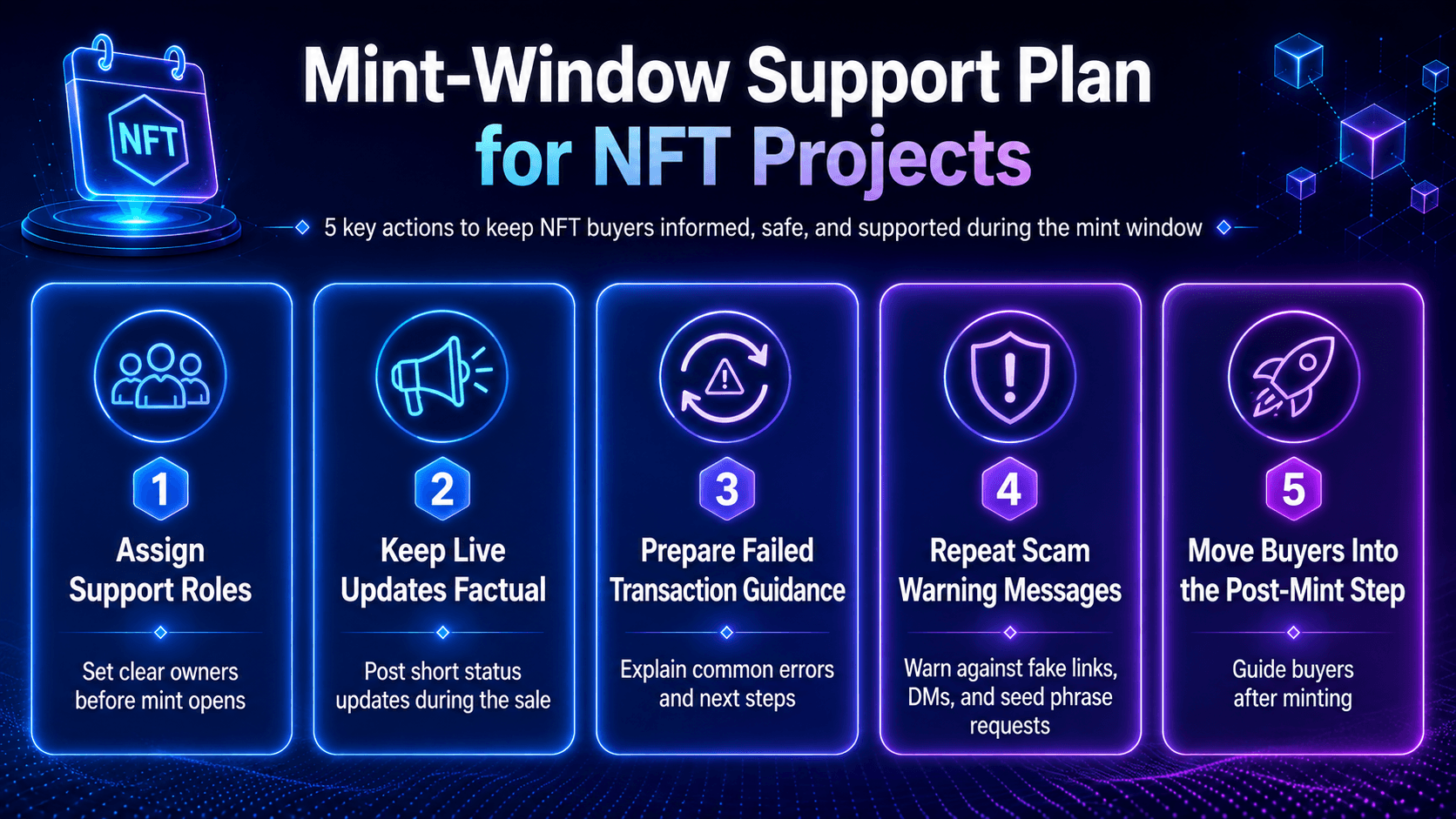
1. Assign Support Roles Before the Mint Opens

The team should know who owns each part of the mint window. One person should manage official updates. One person should monitor common buyer issues. One person should watch for fake links, impersonators, and suspicious DMs. This avoids scattered replies during the most active sale period.

Mint-window roles to prepare:

  • Official update owner

  • Support channel lead

  • Scam and impersonation monitor

  • Technical issue coordinator

  • Post-mint update owner

2. Keep Live Updates Factual

Live updates should stay short and factual. The team should post when the allowlist opens, when the public sale opens, when supply changes, and when the mint ends. If an issue appears, the message should explain what is known and what buyers should avoid doing.

The goal is not to over-explain. The goal is to reduce confusion while buyers are trying to act.

3. Prepare Failed Transaction Guidance

Failed transactions can create panic fast. A buyer may think the project took funds, the wallet is broken, or the mint page failed. The team should explain common causes before support channels fill up.

Failed transaction notes should cover:

  • Gas changes

  • Wallet rejection

  • Network congestion

  • Wrong wallet

  • Wrong chain

  • Sold-out supply

  • Page refresh steps

OpenSea explains that gas fees can apply to attempted blockchain transactions, including mint attempts. It also notes that buyers may still pay gas even if they do not successfully mint.

4. Repeat Scam Warning Messages

Scam warnings should continue during the sale. The warning should be direct. Buyers should not rely on DMs, unofficial links, or unknown support accounts.

Mint-window scam warnings should cover:

  • Use only the official mint link

  • Do not share a seed phrase

  • Do not trust mint links sent by DM

  • Do not send funds to “support”

  • Check every wallet approval before confirming

Users should not share seed phrases. They should also watch for phishing through social media messages and DMs. Projects should remind buyers to check every site before connecting a wallet.

5. Move Buyers Into the Post-Mint Step

The buyer path should not stop after the transaction. After minting, buyers need to know what happens next. This may include viewing the NFT, checking reveal timing, joining holder channels, or waiting for metadata updates.

NFT Mint Readiness QA Pass Before Launch

Before launch, the team should run one final QA pass across the mint page, community channels, and support flow. Every buyer-facing instruction should be clear, consistent, and ready before the mint window opens.

The team should check:

  1. Is the official mint link pinned everywhere?

  2. Are wallet, chain, currency, and gas instructions consistent?

  3. Are allowlist and public sale windows written with time zones?

  4. Are support roles assigned before the mint opens?

  5. Are scam warnings pinned in every active channel?

  6. Is failed transaction guidance ready?

  7. Are post-mint instructions already published?

Mint readiness is not only a checklist. It is the final QA layer that helps buyers act with less confusion.

Build an NFT Mint Readiness Checklist With TokenMinds

An NFT sale needs more than awareness. It needs a buyer path that removes last-step friction before the mint window opens.

TokenMinds helps NFT teams turn community interest and allowlist demand into mint-ready buyers through buyer education, wallet-readiness content, reminder sequences, official-link systems, FAQs, and mint-day communication planning.

Founders still own the sale strategy, supply design, and community promise. TokenMinds supports the readiness system that helps qualified buyers reach the mint page ready to act.

Book a call with TokenMinds to prepare the buyer-readiness checklist, mint-day communication plan, and support flow before the NFT sale opens.

FAQs

  1. What is an NFT sale?
    An NFT sale is a planned window where a project lets buyers mint or purchase NFTs under defined rules. Those rules usually cover eligibility, price, timing, wallet requirements, mint limits, and support.

  2. How should projects prepare buyers before an NFT mint?
    Projects should give buyers one clear readiness checklist before mint day. It should explain the wallet, chain, mint price, required currency, gas buffer, sale window, official link, and support channel.

  3. Why do NFT buyers fail during minting?
    NFT buyers often fail because the final step is unclear. Common causes include wrong wallet, wrong chain, low funds, gas confusion, missed allowlist windows, scam links, and failed transactions.

  4. What should buyers know before an NFT sale starts?
    Buyers should know when to mint, where to mint, which wallet to use, what funds to prepare, how gas works, what the mint limit is, and where official support happens.

  5. How much gas should NFT buyers prepare?
    Projects should not promise an exact gas amount. Gas changes based on network conditions, so buyers should prepare extra funds beyond the mint price and check the fee before confirming.


TL;DR
An NFT sale can build strong interest and still lose buyers on mint day. The issue is often not demand. It is readiness. Buyers may use the wrong wallet, miss the allowlist window, lack gas, click a fake link, or panic after a failed transaction. This article gives project teams one practical NFT mint readiness checklist. It covers wallet setup, funding, gas, deadlines, official links, scam warnings, support channels, and post-mint next steps before the mint window opens.

What Is NFT Mint Readiness?

NFT mint readiness is the process of preparing buyers to complete an NFT mint without last-minute confusion.

It covers the wallet, chain, mint price, required currency, gas buffer, sale window, official mint link, and support path.

Recent market data shows why this matters. DappRadar reported that NFT trading volume reached $546 million in October 2025, up 30% month over month. NFT sales also reached 10.1 million, the highest level of 2025. The report also noted that users were becoming more selective.

This data shows that NFT buyers are still active. It also reflects a market where projects cannot rely on attention alone. Buyers need clear mint instructions before they act.

For an NFT sale, readiness should be checked before the allowlist or public sale window starts. Buyers should know what to prepare, where to mint, and what to avoid.

Common Reasons NFT Buyers Drop Off Before Minting

NFT buyers often drop off before minting because the final step is unclear. The most common causes are simple but costly:

  1. Wrong wallet: The buyer connects a wallet that is not eligible or not supported.

  2. Wrong chain: The buyer has funds, but not on the network used for the NFT sale.

  3. Insufficient funds: The wallet does not have enough for the mint price and gas.

  4. Gas misunderstanding: The buyer does not know that gas changes and sits outside the mint price.

  5. Missed allowlist window: The buyer is eligible but misses the correct mint time.

  6. Scam links: The buyer clicks an unofficial mint link or fake support message.

  7. Failed transactions: The buyer sees an error and does not know what to do next.

The NFT Buyer Readiness Gap Before Mint Day

An NFT sale can build demand and still lose buyers at the final step. Mint day compresses conversion, support, and trust into a short window. Once the mint opens, the team has little time to explain wallet setup, funding, gas, timing, and safety.

Before mint day, the team should answer four practical questions:

  1. Can buyers connect the right wallet?

  2. Do buyers have the right funds and gas?

  3. Do buyers know the correct mint window?

  4. Can buyers identify the official link and support channel?

If the answer is unclear, the sale is not fully ready. NFT mint readiness is the last-mile conversion layer. It helps buyers know what to do before they reach the mint page, not after support channels are already full.

At the broader funnel level, readiness should connect with the full sale plan. For that wider view, see NFT Sale Strategy in 2026: How to Build a Community-to-Mint Funnel.

NFT Mint Readiness Checklist Before Mint Day

The strongest approach is one checklist, not scattered reminders.

A good checklist turns mint instructions into a clear buyer path. It shows what buyers should prepare, what the project should publish, and what outcome the team should expect before the mint window opens.

Each item should be clear on the mint page, Discord, X, email reminders, and the project FAQ.


1. Wallet Setup

Buyers should know which wallet is required before they reach the mint page. Wallet setup should not become a last-minute support issue.

  • What Projects Should Prepare
    A short wallet guide with supported wallet types, setup steps, and the correct place to connect.

  • The Output
    Buyers arrive with the right wallet installed and ready to use.

2. Correct Chain or Network

The NFT sale should make the required chain clear. Buyers may hold funds, but still fail if those funds sit on the wrong network.

  • What Projects Should Prepare
    Chain details on the mint page, FAQ, Discord, X, and email reminders.

  • The Output
    Buyers know which network to use before moving funds or connecting a wallet.

3. Wallet Connection Test

The first wallet connection should not happen during the sale window. A simple pre-mint test can reduce pressure on mint day.

  • What Projects Should Prepare
    A safe preview step, test connection flow, or short connection guide.

  • The Output
    Buyers confirm that their wallet connects before the mint starts.

Wallet and funding items deserve special care. A buyer can be convinced by the project but still fail because the wallet is not ready. A similar issue appears in token onboarding flows, where poor wallet instructions create drop-off before conversion. See Reduce Wallet Onboarding Drop-Off Before Token Sale for a deeper wallet-readiness angle.

4. Mint Price

Buyers should know the exact mint price before the sale starts. If the sale has more than one phase, each phase needs clear pricing.

  • What Projects Should Prepare
    Mint price by phase, including allowlist, reserved, or public sale pricing.

  • The Output
    Buyers understand the cost before they fund the wallet.

5. Required Currency

The mint price should always show the required currency. Price alone is not enough if buyers do not know what asset to prepare.

  • What Projects Should Prepare
    Currency labels beside the price across the mint page, FAQ, reminders, and support replies.

  • The Output
    Buyers prepare the correct asset before the mint window opens.

6. Gas Buffer

Buyers should prepare funds beyond the mint price. Gas is separate, can change, and should not be presented as a fixed cost. OpenSea explains that NFT minting costs gas, and gas may apply to attempted blockchain transactions even when the buyer does not successfully mint.

  • What Projects Should Prepare
    A plain-language gas reminder that avoids exact gas promises.

  • The Output
    Buyers understand that the wallet needs the mint price plus extra funds for gas.

7. Allowlist Window

Allowlisted buyers should know when they can mint and which wallet is eligible. An allowlist is not useful if buyers are unsure how to use it. OpenSea explains that NFT drops can include allowlist phases, where selected wallet addresses can mint before the wider public sale.

  • What Projects Should Prepare
    Allowlist timing, eligible wallet rules, claim steps, and deadline reminders.

  • The Output
    Allowlisted buyers know when to mint and which wallet to use.

This is also where How to Convert NFT Allowlist Signups Into Real Mint Buyers in 2026 fits naturally.

8. Public Sale Window

Public buyers need a clear opening time and sale rule set. They should not depend on chat updates to understand when minting starts.

  • What Projects Should Prepare
    Public mint time, time zone, supply rules, and queue notes where relevant.

  • The Output
    Public buyers know when the sale opens and what conditions apply.

9. Deadlines and Time Zones

Mint deadlines should be written in a clear time zone. A countdown can help, but it should not replace the actual date and time.

  • What Projects Should Prepare
    Date, time, time zone, countdown reminders, and final close-window messages.

  • The Output
    Buyers know the exact mint window and avoid missing the sale because of timing confusion.

10. Max Mint Limit

Buyers should know how many NFTs each wallet can mint. This should be clear for each sale phase.

  • What Projects Should Prepare
    Wallet limits by phase and a simple explanation of what happens when limits are reached.

  • The Output
    Buyers understand the mint cap before they start the transaction.

11. Official Mint Link

Buyers need one verified mint link. They should not search Discord replies or random posts for the correct page.

  • What Projects Should Prepare
    One official mint link pinned across the website, Discord, X, email, and FAQ.

  • The Output
    Buyers know where to mint and avoid unofficial links.

12. Scam Warnings

Scam warnings should be short, direct, and repeated often. Buyers should know that official support will not ask for seed phrases or send random mint links through DMs. OpenSea’s safety guidance tells users not to share seed phrases and to be careful with wallet actions. It also warns that suspicious offers and links should be treated carefully.

  • What Projects Should Prepare
    Repeated warnings about fake links, DMs, seed phrase requests, and risky wallet approvals.

  • The Output
    Buyers know the basic safety rules before the sale begins.

13. Support Channel

Buyers should know where official help happens. Support should not move into random DMs, especially during mint pressure.

  • What Projects Should Prepare
    Pinned support channel, assigned support roles, and clear response rules.

  • The Output
    Buyers know where to ask for help without exposing themselves to fake support.

14. Failed Transaction Guidance

A failed transaction can confuse buyers. The team should explain common causes before panic starts.

  • What Projects Should Prepare
    Short guidance for gas errors, wallet rejection, sold-out notices, wrong-wallet issues, and page refresh steps.

  • The Output
    Buyers understand what to check before opening a support ticket.

15. Post-Mint Next Steps

The buyer path should not end after the transaction. Buyers need to know what happens after minting. OpenSea explains that some NFT projects reveal artwork or metadata after minting is complete, so reveal expectations should be clear before buyers ask about them.

  • What Projects Should Prepare
    Confirmation steps, holder access instructions, reveal expectations, and next community actions.

  • The Output
    Buyers know what to do after minting and where to follow updates.

This checklist should not ask buyers to interpret project logic. It should turn the NFT sale setup into simple actions. Buyers should know which wallet to use, how much to prepare, when to mint, where to find the official link, and what to do if something fails.

For sales that rely on allowlist demand, this work becomes even more important. Allowlist signups only matter if eligible buyers are ready to mint when their window opens. For a deeper guide, see How to Convert NFT Allowlist Signups Into Real Mint Buyers in 2026.

How to Turn the Checklist Into Buyer Instructions

The checklist above gives the project team the control points. That is not enough on its own. Each item needs to become a clear buyer-facing instruction. The goal is not to show buyers an internal project checklist. The goal is to turn that checklist into the right messages before, during, and after the mint window.

The mint page should act as the source of truth. It should show the chain, price, currency, phase timing, official link, and support channel. Discord, X, email, and community reminders should all point back to the same page.

Below is a simple timing guide for moving the checklist into buyer communication:

Timing

Buyer Question to Answer

Message Focus

Project Action

7 days before mint

What should be prepared first?

Wallet setup, chain, and funding

Share the wallet guide, supported network, mint currency, and funding reminder.

3 days before mint

Am I eligible and when can I mint?

Allowlist status, time zone, and max mint limit

Remind buyers to check eligibility, wallet address, mint window, and wallet cap.

1 day before mint

Where should I mint safely?

Official link, gas buffer, and support channel

Point buyers to the mint page, repeat gas guidance, and pin the help channel.

1 hour before mint

What should I check now?

Final link, scam warning, and transaction guidance

Repeat the official link, warn against DMs, and explain common transaction issues.

During mint

What is happening right now?

Live updates, supply status, and failed transaction notes

Post factual updates, confirm sale status, and guide buyers through common errors.

After mint

What happens next?

Confirmation, reveal, and holder access

Explain next steps, holder channels, reveal timing, and where updates will appear.

This timing keeps the checklist active without overwhelming the community. It also reduces repeated support questions.

The wording should stay consistent across channels. If the mint page says “allowlist,” Discord should not call the same phase “premint” while X calls it “early access.” Buyers may think these are different windows.

The language should also stay simple. “Connect the wallet used for allowlist registration” is clearer than “make sure the eligible wallet is ready.” “Do not use links from DMs” is clearer than a long safety explanation.

What to Prepare During the Mint Window

The timing plan above prepares buyers before the mint starts. Once the window opens, that plan becomes live support. The team is no longer introducing new instructions. It is keeping the right instructions visible, consistent, and safe while buyers act. Mint-day support should not be improvised. The project needs clear roles, factual updates, scam warnings, and fast guidance for common transaction issues.

1. Assign Support Roles Before the Mint Opens

The team should know who owns each part of the mint window. One person should manage official updates. One person should monitor common buyer issues. One person should watch for fake links, impersonators, and suspicious DMs. This avoids scattered replies during the most active sale period.

Mint-window roles to prepare:

  • Official update owner

  • Support channel lead

  • Scam and impersonation monitor

  • Technical issue coordinator

  • Post-mint update owner

2. Keep Live Updates Factual

Live updates should stay short and factual. The team should post when the allowlist opens, when the public sale opens, when supply changes, and when the mint ends. If an issue appears, the message should explain what is known and what buyers should avoid doing.

The goal is not to over-explain. The goal is to reduce confusion while buyers are trying to act.

3. Prepare Failed Transaction Guidance

Failed transactions can create panic fast. A buyer may think the project took funds, the wallet is broken, or the mint page failed. The team should explain common causes before support channels fill up.

Failed transaction notes should cover:

  • Gas changes

  • Wallet rejection

  • Network congestion

  • Wrong wallet

  • Wrong chain

  • Sold-out supply

  • Page refresh steps

OpenSea explains that gas fees can apply to attempted blockchain transactions, including mint attempts. It also notes that buyers may still pay gas even if they do not successfully mint.

4. Repeat Scam Warning Messages

Scam warnings should continue during the sale. The warning should be direct. Buyers should not rely on DMs, unofficial links, or unknown support accounts.

Mint-window scam warnings should cover:

  • Use only the official mint link

  • Do not share a seed phrase

  • Do not trust mint links sent by DM

  • Do not send funds to “support”

  • Check every wallet approval before confirming

Users should not share seed phrases. They should also watch for phishing through social media messages and DMs. Projects should remind buyers to check every site before connecting a wallet.

5. Move Buyers Into the Post-Mint Step

The buyer path should not stop after the transaction. After minting, buyers need to know what happens next. This may include viewing the NFT, checking reveal timing, joining holder channels, or waiting for metadata updates.

NFT Mint Readiness QA Pass Before Launch

Before launch, the team should run one final QA pass across the mint page, community channels, and support flow. Every buyer-facing instruction should be clear, consistent, and ready before the mint window opens.

The team should check:

  1. Is the official mint link pinned everywhere?

  2. Are wallet, chain, currency, and gas instructions consistent?

  3. Are allowlist and public sale windows written with time zones?

  4. Are support roles assigned before the mint opens?

  5. Are scam warnings pinned in every active channel?

  6. Is failed transaction guidance ready?

  7. Are post-mint instructions already published?

Mint readiness is not only a checklist. It is the final QA layer that helps buyers act with less confusion.

Build an NFT Mint Readiness Checklist With TokenMinds

An NFT sale needs more than awareness. It needs a buyer path that removes last-step friction before the mint window opens.

TokenMinds helps NFT teams turn community interest and allowlist demand into mint-ready buyers through buyer education, wallet-readiness content, reminder sequences, official-link systems, FAQs, and mint-day communication planning.

Founders still own the sale strategy, supply design, and community promise. TokenMinds supports the readiness system that helps qualified buyers reach the mint page ready to act.

Book a call with TokenMinds to prepare the buyer-readiness checklist, mint-day communication plan, and support flow before the NFT sale opens.

FAQs

  1. What is an NFT sale?
    An NFT sale is a planned window where a project lets buyers mint or purchase NFTs under defined rules. Those rules usually cover eligibility, price, timing, wallet requirements, mint limits, and support.

  2. How should projects prepare buyers before an NFT mint?
    Projects should give buyers one clear readiness checklist before mint day. It should explain the wallet, chain, mint price, required currency, gas buffer, sale window, official link, and support channel.

  3. Why do NFT buyers fail during minting?
    NFT buyers often fail because the final step is unclear. Common causes include wrong wallet, wrong chain, low funds, gas confusion, missed allowlist windows, scam links, and failed transactions.

  4. What should buyers know before an NFT sale starts?
    Buyers should know when to mint, where to mint, which wallet to use, what funds to prepare, how gas works, what the mint limit is, and where official support happens.

  5. How much gas should NFT buyers prepare?
    Projects should not promise an exact gas amount. Gas changes based on network conditions, so buyers should prepare extra funds beyond the mint price and check the fee before confirming.

GET SUCCESS IN WEB3

  • Trusted Web3 partner since 2017

  • Full-stack Web3 development team

  • Performance-driven Web3 marketing

Get A Free Consultation

Get A Free Consultation

MEET US AT

RECENT TRAININGS

Follow us

get web3 business updates

Email invalid

  • Access global liquidity for your RWA project with TMX Tokenize’s Canton Network integration

DISCOVER NOW

  • Access global liquidity for your RWA project with TMX Tokenize’s Canton Network integration

    JOIN NOW

DISCOVER

  • Access global liquidity for your RWA project with TMX Tokenize’s Canton Network integration