
TL;DR: Public buyers judge a token sale by how clearly its private sale terms are explained. A discount for early investors is normal and expected. Trust breaks when that discount is hidden or poorly explained. Founders should publish round pricing, SAFT terms, cliffs, vesting, and the public allocation in one place. Clear disclosure is what token sale fairness means in practice, and it turns insider economics into a trust signal instead of a red flag. This guide explains how to communicate each item before the public sale opens.
Public sale capital has become scarce and selective. Q2 2026 closed with 47 ICOs, IDOs, and IEOs raising a combined $40 million, the lowest level in four years, according to CryptoRank data reported by Crypto Briefing. CryptoRank's August analysis then reported $121 million raised in July, the second-strongest month of the year. Capital still reaches public sales, but only for launches buyers trust. Private capital is just as selective. Galaxy Research counted $5.68 billion in crypto venture funding in Q2 2026, with about 78% going to later-stage companies. Early-stage projects compete for a smaller share, so the public sale carries more weight.
That is where the private-to-public transition gets tested. Public buyers want to know why insiders paid less and on different terms. The sections below answer that question one term at a time. Founders new to the format can start with how a token sale works before reading on.
Why Do Private Sale Terms Affect Public Sale Trust?
Private sale terms decide whether public buyers see a fair entry or exit liquidity. To see why, the two sale stages need defining first.
Private Sale vs Public Sale: What Is the Difference?
A private sale is a token round sold to selected investors before launch. Buyers are usually funds, angels, or strategic partners. They commit capital early, often through a SAFT, and receive tokens at TGE under agreed terms.
A public sale is the round open to the general market. It typically runs through a launchpad (a platform that vets projects and enforces fairness standards), an exchange, or the project's own portal. Buyers pay a fixed or market-discovered price and receive tokens at or shortly after TGE.
Private sale | Public sale | |
Who buys | Funds, angels, strategic partners | Anyone eligible under the sale rules |
When | Months or years before launch | At or near TGE |
Price | Discounted, negotiated per round | Public price, fixed or market-discovered |
Agreement | SAFT | Sale terms and conditions |
Unlock | Cliff and vesting | Mostly at TGE, sometimes short vesting |
Main risk | Product may never launch | Insider supply may reach the market first |
The transition between the two is where trust is won or lost. Public buyers enter last, pay the most, and unlock first. So they read the private terms closely before they commit.
Which Private Sale Terms Do Public Buyers Scrutinize?
Private sale terms are the conditions early investors accept when they buy. The five that public buyers check most are:
Price and discount. What early investors paid compared with the public price.
Allocation. The share of total supply sold to each private round.
TGE unlock. The portion of tokens investors can access at launch.
Cliff and vesting. How long tokens stay locked, and how fast they release afterward.
Insider restrictions. Any limits on OTC sales or hedging before unlock.
Each term changes how much supply can reach the market, and when. The last cycle taught buyers to check. Binance Research's 2024 low-float, high-FDV analysis showed how this plays out. Scarce circulating supply pushes launch prices and FDVs up. Insider unlocks later add sell pressure, and long-term holders absorb the correction.
The lesson is simple. Fairness comes from disclosure, not price parity. Nobody expects a public buyer to pay the seed price. They expect to know what the seed price was, and why. The discount is the first term to explain.
How to Explain Private Sale Discounts Before a Public Token Sale
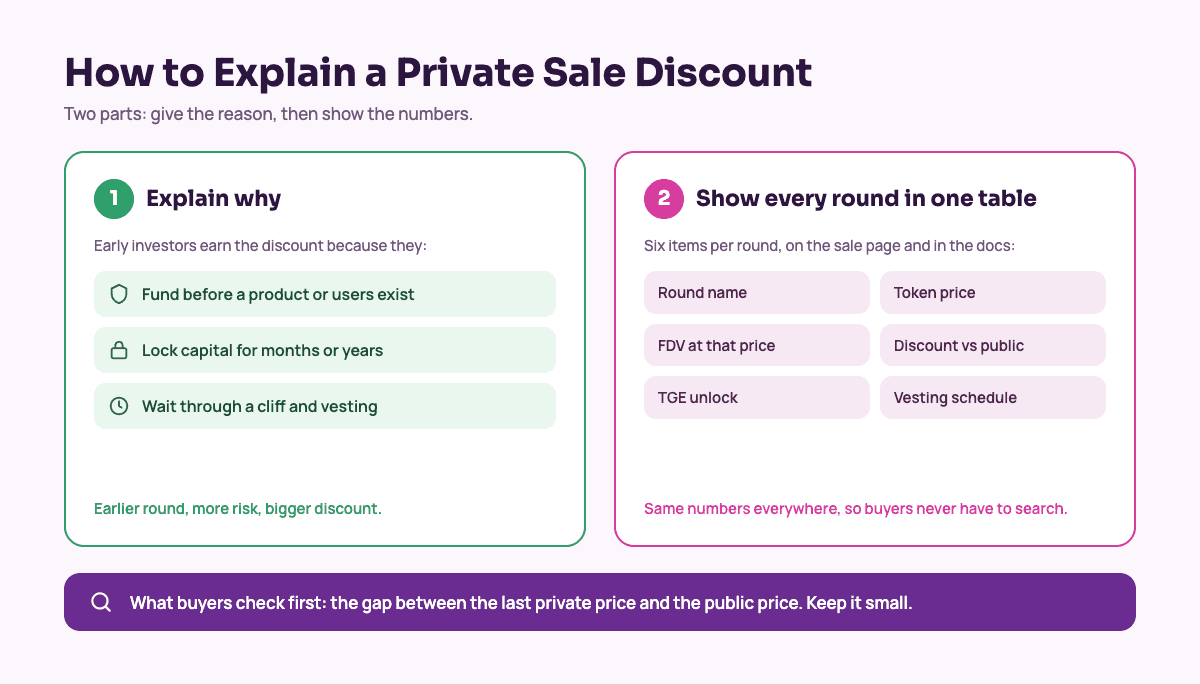
A private sale discount is the lower price early investors paid compared with the public price. Founders should explain it in two parts. First, state why early investors earned the discount. Second, publish the price of every round in one table. The explanation gives buyers the reasoning behind the discount. The table gives them the actual numbers, so they do not have to search for them elsewhere.
Why Do Early Investors Get a Discount?
Early investors typically take on risks that public buyers do not. They fund the project before it has a product, users, or liquidity, which is why private rounds command lower prices and longer lockups. Their capital is then locked for months or years under a cliff and vesting schedule. The discount compensates for that risk and waiting time.
Public buyers accept this reasoning when it is stated openly. They reject it when they have to discover the discount on their own. This is why pre-sale marketing for crypto projects should introduce the round terms early, before any campaign scales.
What Should a Round-by-Round Pricing Table Include?
A round-by-round pricing table should show six items for every round. These are the round name, the token price, the FDV at that price, the discount against the public price, the TGE unlock, and the vesting schedule. The table belongs on the sale page and in the docs. The example below is illustrative only.
Round | Price | FDV | Discount vs public | TGE unlock | Vesting |
Seed | $0.020 | $20M | 60% | 0% | 12-month cliff, 24-month linear |
Private | $0.035 | $35M | 30% | 0% | 6-month cliff, 18-month linear |
Public | $0.050 | $50M | 0% | 50% | 6-month linear |
Illustrative table
Buyers focus on the gap between the last private round and the public round. A small gap signals that the public price is aligned with recent private pricing. A large gap signals that insider gains depend on public buyers paying up. Keeping the public FDV close to the last private round is the simplest fairness signal a project can send.
When the public price sits above the last private round, explain the step openly. Using the table above, the sale page could read as follows. "Private investors paid $0.035 and accepted a 6-month cliff with 18 months of vesting. Public buyers pay $0.050 for a live product, user traction, and liquidity at TGE. The 43% step-up reflects the risk and waiting time public buyers avoid." Then point to the vesting schedule that shows private investors cannot sell at launch. Buyers accept a step-up when the reasoning is clear and the lockup is real.
How to Communicate SAFT Terms in Plain Language
The pricing table shows what each round paid. The SAFT holds the terms behind that price. A SAFT (Simple Agreement for Future Tokens) is a contract where investors fund a project now and receive tokens when the network launches. TokenMinds explains the structure in detail in its guide to the SAFT agreement, and compares it with equity-style options in SAFT vs SAFE for crypto fundraising.
Public buyers do not need to read the contract. They need a plain summary of its economic terms for each round. The table below separates what to publish from what can stay private.
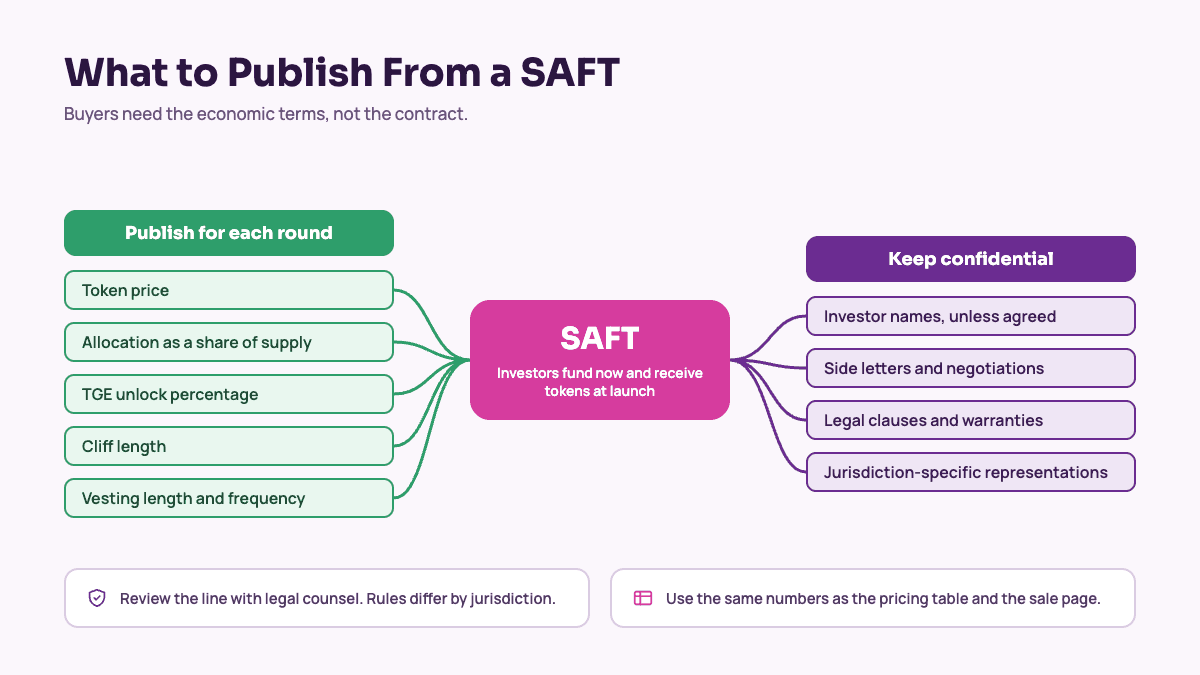
A short paragraph per round is enough to cover the five public items. It should use the same numbers as the pricing table and the sale page. Any mismatch between documents is the fastest way to lose buyer trust.
The line between public and confidential should be reviewed with legal counsel. Disclosure rules differ by jurisdiction, and some terms may need to be published in full. The token sale marketing compliance checklist covers how those rules affect the sale messaging.
The confidential terms could be summarized as follows. "All seed and private investors signed identical SAFT agreements covering price, allocation, cliff, and vesting as published above. No side letters modify these core economic terms. Investor names are confidential unless they agree to public disclosure." This framing acknowledges that confidential terms exist while assuring buyers that economic terms are uniform and published. It prevents the appearance of hidden deals that could undermine fairness perception. Use this template only if it is true. Any side letter that changes price, allocation, cliff, or vesting must be disclosed, since it is no longer a confidential term but an economic one.
How to Explain Lockups, Cliffs, and Vesting to Public Buyers
The SAFT summary tells buyers when insider tokens unlock. This section shows how to present those terms so buyers can see the supply impact. The goal is to show the unlock schedule as a supply curve, not as a legal clause.
What Is the Difference Between a Lockup, a Cliff, and Vesting?
A lockup holds tokens until a set date or condition is met. A cliff is the waiting period before the first release. Vesting is the schedule that releases tokens gradually after the cliff ends.
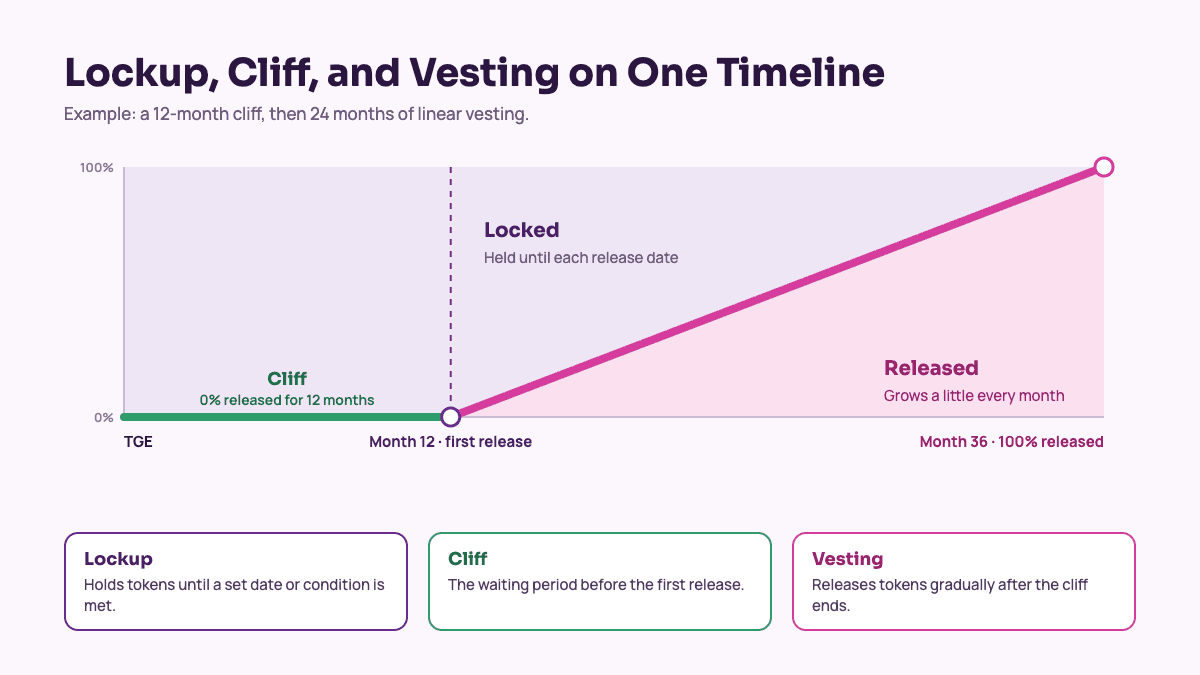
The three work together. A twelve-month cliff with twenty-four-month linear vesting means no tokens for a year, then equal monthly releases for two years. Two projects with the same allocation can produce very different supply curves through these settings alone.
How Should Projects Show Circulating Supply Over Time?
Projects should publish the circulating supply at TGE, month 6, month 12, and month 24. The figures should show which allocations sit behind cliffs and which vest linearly. This projection belongs next to the pricing table, so buyers read price and supply together.
Schedule shape matters as much as totals. A large single-day cliff releases new supply all at once. Monthly or daily linear release spreads that supply over time. The full method is covered in how to design vesting and unlocks after a token sale.
Why Do Early Backers Not Create Immediate Sell Pressure?
Early backers cannot sell tokens they cannot access. Four proofs make this credible to public buyers:
A 0% TGE unlock for seed and private rounds.
Vesting enforced by on-chain contracts, not by promises.
Insider restrictions such as no OTC sales or hedging before unlock.
A public vesting dashboard that tracks every release.
The published schedule and the on-chain contract must match. When they differ, buyers trust neither.
How to Make the Public Sale Allocation Feel Fair
Insider terms show what early backers cannot do. The public allocation shows what public buyers actually receive. It is the share of total supply sold in the public round, together with the rules that decide who can buy it and at what price. Three factors decide whether buyers see it as fair. These are the size of the allocation, the float at TGE, and the access rules.
Allocation size is the first check. Buyers compare the public share against the insider share. According to Streamflow's 2026 allocation guide, which cites DEXTools benchmarks, early investors typically hold 10-20% of supply and public sale participants also 10-20%. The same guide notes that informed holders treat insider allocations above 50% as a red flag. A public share that sits within the benchmark range signals that the round was built for buyers, not only for capital.
Float at TGE is the second check. Float is the share of total supply that circulates at launch. When too little circulates, the opening price reflects scarcity rather than demand. The first unlocks then correct that price downward. A float large enough for real price discovery protects public buyers from that correction.
Access rules are the third check. The rules that make a public round feel fair are:
Per-wallet caps, so no single buyer can take most of the round.
Tiered or Sybil-filtered access, so allocations reach real participants.
Market-based price discovery, such as auctions or liquidity bootstrapping pools, so demand sets the public price rather than the team.
Claim and refund terms published before the sale opens.
Token Sale Fairness Disclosure Checklist
Use this table to audit the sale page, docs, and community channels before launch. The public token sale terms checklist expands each row.
Item | What to disclose | Where it lives |
Round pricing | Price, FDV, and discount per round | Sale page, docs |
SAFT summary | Allocation, TGE unlock, cliff, vesting | Docs, FAQ |
Supply curve | Circulating supply at TGE, M6, M12, M24 | Sale page, dashboard |
Insider rules | OTC and hedging restrictions | Docs, AMA |
Public allocation | Share of supply, float, caps, access | Sale page |
Sale mechanics | Price discovery, claim, and refund terms | Sale page, FAQ |
A practical timeline is to publish round pricing and SAFT summaries at least two weeks before the public sale opens, then put supply curves and vesting dashboards live one week before. This gives buyers time to review the terms without feeling rushed. It also gives the team time to answer questions before capital commits.
Common Mistakes That Break Public Buyer Trust
Four mistakes can undo every disclosure above. Each one is easy to avoid once it is named.
Hiding the discount.
Buyers find private round prices on their own, and a discount discovered later reads as a cover-up.Calling tokens "locked" without a schedule.
A lock with no published cliff, vesting, or dashboard is a promise, not a proof.Publishing numbers that differ across channels.
When the deck, the sale page, and the docs disagree, buyers assume the worst version is true.Changing terms after the sale closes.
Any change to price, allocation, or vesting after buyers commit breaks the trust the sale was built on.
Each mistake turns a fair structure into an unfair story. The fix in every case is the same. Publish the terms once, keep them consistent, and do not change them after the sale.
Case Study: How HyperDEX Filled a 10,000,000 USDT Presale
HyperDEX shows what consistent sale communication looks like in practice. TokenMinds set the narrative and product logic before launch planning began. The website, sale mechanics, and community messaging were then aligned so every channel carried the same terms and the same story.
The results followed that consistency. The presale filled its 10,000,000 USDT hard cap, with every channel carrying the same terms and the same story. X followers grew from zero to nearly 6,000, and AMA and giveaway campaigns reached more than 2,500 participants combined.
Read more: HyperDEX Case Study
Get a Sale Fairness Communication Review With TokenMinds
A private-to-public token sale is won on disclosure, not discount size. The sections above show that trust comes from explaining discounts, SAFT terms, lockups, and the public allocation before the sale opens.
TokenMinds has run token sales end to end since 2016. The work covers tokenomics across sale stages, one consistent private-to-public narrative across every channel, and structured disclosure for launchpad and exchange reviews. The sale fairness communication review checks a project's sale page, deck, and tokenomics docs against the checklist above. The team leaves knowing which terms are unclear, which will not survive buyer scrutiny, and how to fix both.
Book a sale fairness communication review with TokenMinds.
FAQs
How do projects explain private sale discounts before a public token sale?
Frame the discount as payment for early risk and locked capital. Then publish a round-by-round table with price, FDV, discount, TGE unlock, and vesting. Keep the public FDV close to the last private round.
How should projects communicate SAFT terms and lockups?
Publish a plain-language summary of each round's price, allocation, TGE unlock, cliff, and vesting. Keep legal clauses private. Show the resulting circulating supply at TGE and at 6, 12, and 24 months.
How can a token launch avoid public buyers feeling disadvantaged?
Give the public a meaningful allocation and an honest float. Enforce 0% TGE unlocks and on-chain vesting for insiders. Disclose every term in one place before the sale opens.