Web3 & AI

SOLUTIONS

Products

Services

Web3 & AI

SOLUTIONS

Services

Products

Industries

Become Our Client

About Us

Resources

Web3 & AI

SOLUTIONS

Services

Products

Industries

Regional Token Launch Marketing: How to Localize TGE Campaigns for SEA, MENA, LATAM, and Korea

Regional Token Launch Marketing: How to Localize TGE Campaigns for SEA, MENA, LATAM, and Korea

TL;DR

Localizing a token generation event means adapting messaging, channels, and compliance framing to each region, not translating one press release four times. SEA rewards community-led channels and careful timing. MENA needs stronger trust and compliance signals. LATAM requires local pricing and payment context. Korea depends on exchange relationships and local media. CMOs with limited budgets should pick one or two regions first. Base the choice on verified community traction and compliance readiness. Then compare visibility, verified participant costs, contribution conversion, and retention by region.

Why Regional Localization Determines TGE Outcomes

A generic TGE campaign treats every market as one audience. Markets rarely behave that way. Search habits, trust signals, and community platforms vary by region. Direct translation rarely addresses local search intent or entity coverage.

According to Campaign Asia, one regional strategy often misses local market needs. Local context can outweigh polished English content.

Token communities across SEA, MENA, LATAM, and Korea behave differently. They use different channels, disclosures, and proof points. A Telegram-led plan may work in one market. Another may require KakaoTalk, local media, or regional KOLs.

CMOs face a clear pressure. Budgets remain limited, but leadership expects measurable regional visibility. Activity alone does not prove campaign performance. Without clear priorities, localization spreads resources across too many markets.

The practical fix is sequencing. Projects should prioritize community demand and compliance readiness. Market excitement alone should not determine regional spend. For a wider campaign timeline, read how founders should sequence partnerships, KOLs, PR, and community before a token sale.

What "Localization" Actually Means for a Token Launch

Localization is not a translation task. For a token launch, this means three things happen at once: language shifts, regulatory framing shifts, and search intent shifts. Each of these needs separate attention, or the campaign fails to reach the market it targets.

Below are the three dimensions of localization that matter most for a TGE:

How Language Localization Differs From Translation

A project might only translate a campaign into a target language. That is not what each audience expects. Projects need to tailor content to each audience's context, proof points, and legal expectations.

  • Korean readers expect exchange-specific detail, such as listing status and audit information.

  • MENA readers expect explicit risk disclosure and conservative language around returns.

  • LATAM readers expect local currency references, not only USD.

  • Local search users expect local terminology.

That is why literal translation fails. Terms like "vesting schedule" or "airdrop eligibility" carry different local phrasing, and a direct translation misses local search intent and breaks entity coverage.

How Regulatory and Disclosure Rules Differ by Region

Regulatory posture shapes what a campaign can say, and how directly.

  • MENA markets generally require conservative language around returns and guarantees.

  • LATAM regulation varies significantly by country, from Brazil to Argentina to Mexico.

  • Korea has specific exchange listing and disclosure norms shaped by past enforcement actions.

  • SEA regulation is fragmented across Singapore, Indonesia, Vietnam, and the Philippines, each with different token classification rules.

This is not a legal analysis. It is a reminder that messaging must be reviewed locally before publication.

How AI Search and Local Search Intent Diverge

AI search tools increasingly answer token launch questions directly, without a click-through. Local search intent often uses different phrasing than the English-language original.

  • A Vietnamese user searching for "cách tham gia airdrop" is not searching the English equivalent term-for-term.

  • English-only content may be less likely to match local-language queries or provide enough regional context for AI-generated answers. Local-language pages can improve relevance when they use accurate terminology and verified market information.

  • Entity coverage also matters: local content should reference local exchanges, local regulators, and local community channels by name.

  • Accurate references to local exchanges, regulators, payment providers, and community platforms can strengthen regional context. Projects should only name entities when the relationship or reference is relevant and verifiable.

How to Build a Region-Specific Token Launch Marketing Campaign
ChatGPT Image Jul 20, 2026, 03_51_34 PM.png

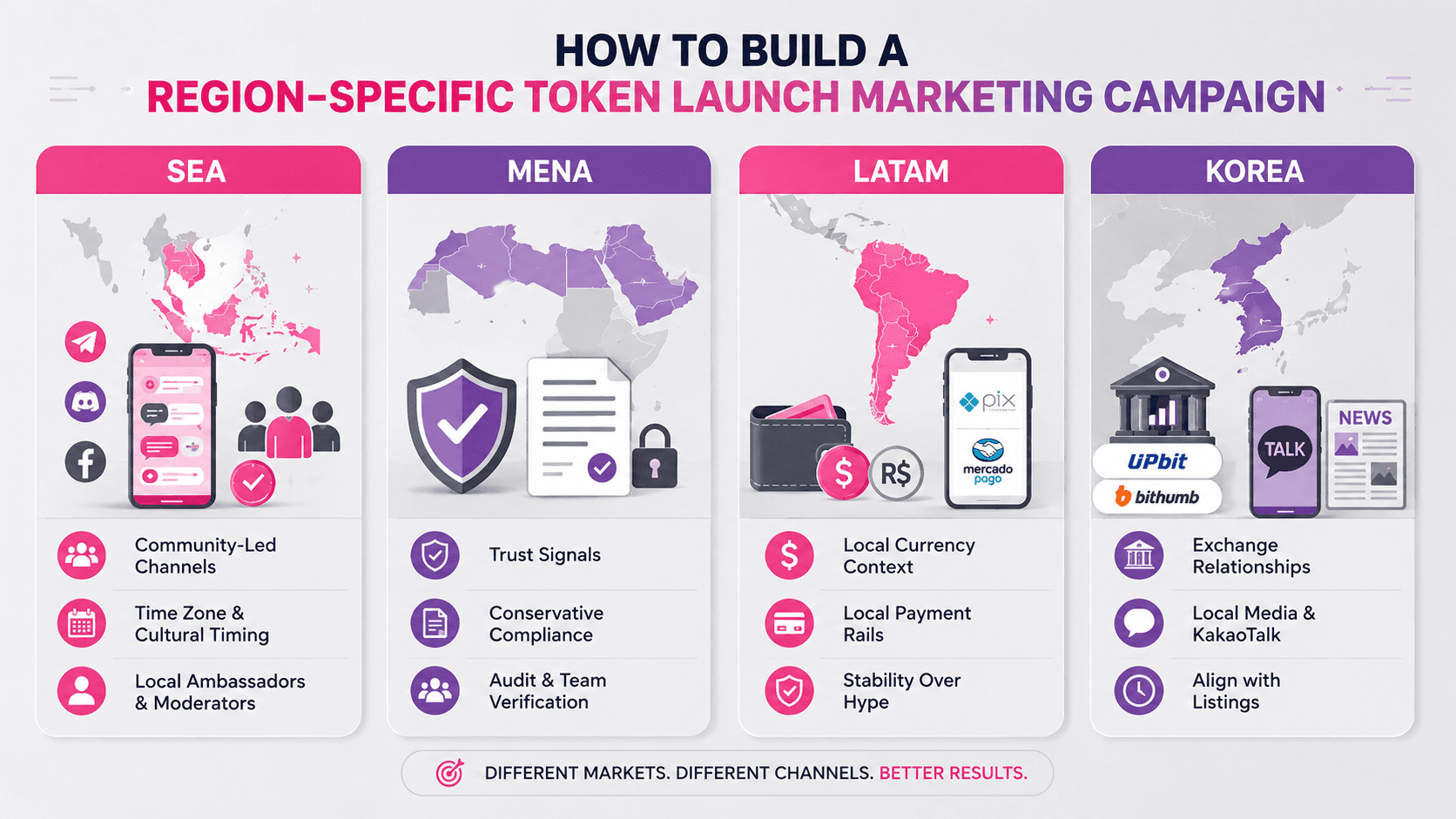
The following patterns are regional starting points, not universal rules. Projects should validate channels, audience behavior, payment access, and compliance requirements at country level.

SEA: Community-Led Channels and Timing

Many SEA token communities rely heavily on community-led channels. Telegram, Discord, and local Facebook groups often drive more engagement than press coverage.

Timing matters because SEA spans multiple time zones and major cultural calendars, including Ramadan and Eid schedules in Indonesia and Malaysia. Launch timing should account for these windows, not ignore them.

Local moderators and ambassadors can build stronger community trust in many SEA campaigns. Projects should confirm their impact through referral and engagement data.

Illustrative scenario:
Coordinate major announcements and Telegram AMAs with local Ramadan and Eid schedules. Use community activity data to identify suitable publishing times in Indonesia and Malaysia.

MENA: Trust Signals and Compliance Framing

MENA audiences respond to credibility signals: named team members, audited contracts, and clear risk disclosure.

Compliance framing should be conservative. Some MENA jurisdictions impose strict virtual asset marketing requirements. For example, Dubai-facing campaigns must avoid guaranteed-return language under VARA rules. Each campaign should still undergo market-specific legal review before publication. Someone familiar with regional regulatory tone should review Arabic-language content. Don't rely on machine translation alone. See TokenMinds' token sale compliance checklist for the source-of-truth documents this review should reference.

Trust-building content may be more suitable where audiences and regulators expect stronger verification.

Illustrative scenario:
Lead Arabic-language content with a link to the audit report and named team bios, not a projected return figure.

LATAM: Localized Pricing and Payment Context

Many LATAM audiences evaluate token pricing in local currency, even when the token is priced in USD or stablecoins.

Reference Pix, Mercado Pago, or another local payment method only when the project's approved payment provider supports it. Confirm settlement, KYC, refund, currency conversion, and jurisdictional requirements before promoting the method. Pricing examples should show local currency equivalents alongside USD. Where local currency equivalents appear, show the conversion time and explain that rates may change.

Messaging should also account for currency volatility. LATAM audiences are often more attentive to stability language than speculative upside language.

Illustrative scenario:
List the token price in BRL alongside USD for a Brazil-facing campaign, and mention Pix as a funding option only if the project's payment provider supports it.

Korea: Exchange Relationships and Local Media

Exchange listings are a major token discovery driver in Korea. A confirmed listing on a major Korean exchange can materially increase local token discovery. Korean exchange requirements vary by platform and asset. Projects should confirm technical review, disclosure, market integrity, and liquidity expectations directly with the exchange. Marketing teams should never announce or imply a listing before receiving formal authorization.

Local media outlets and KakaoTalk communities carry significant weight. English-language press releases have limited reach without a Korean-language version distributed through local crypto media.

Campaigns should align messaging timing with exchange listing announcements, since Korean traders often follow listings closely.

Illustrative scenario:
Publish a Korean-language listing campaign only after the exchange releases its announcement or authorizes coordinated communication.

Match Regional Messaging With Audience and KOL Fit

Channels alone do not determine regional campaign fit. Projects must also choose suitable audiences, creators, and content formats.

The right KOL should explain the token through familiar language and formats.

Region

Audience Pattern to Validate

Suitable KOL Profile

Useful Content Formats

SEA

Community-led users seeking clear, practical explanations

Local-language community hosts, micro-KOLs, and crypto educators

Telegram AMAs, short explainers, onboarding guides

MENA

Audiences seeking proof, risk context, and team credibility

Arabic-speaking finance, technology, and founder-interview creators

Audit explainers, team interviews, compliance-focused content

LATAM

Users focused on access, pricing, currency, and payments

Spanish or Portuguese educators and YouTube creators

Pricing explainers, local use cases, payment walkthroughs

Korea

Exchange-active audiences seeking formal updates and disclosures

Korean-language analysts, media hosts, and exchange-aware creators

Listing updates, disclosure summaries, local media interviews

These are starting patterns, not fixed audience rules. Projects should validate them through regional search, community, and conversion data.

Regional Token Launch Marketing Readiness Framework

Before allocating budget across four regions, compare them on the variables that actually change campaign execution.

Illustrative scenario: A project with proven Telegram traction in SEA may localize there first. It can delay its Korean campaign until exchange, disclosure, and local media readiness are confirmed. This sequencing pattern reflects the prioritization logic below.

Comparison Table: Channels, Compliance Review Complexity, and Planning Allowance

Compare each market across channel fit, compliance review complexity, and internal planning allowance.

Region

Primary Channels

Compliance Review Complexity

Internal Planning Allowance

SEA

Telegram, Discord, local Facebook groups, ambassadors

Moderate, fragmented by country

3-4 weeks for community setup

MENA

Arabic media, X, trust-signal content

High, conservative disclosure required

4-6 weeks including compliance review

LATAM

WhatsApp groups, local crypto media, YouTube

Moderate, varies by country

3-5 weeks for payment rail integration

Korea

Exchange listings, KakaoTalk, local crypto press

High, exchange-driven scrutiny

6-8 weeks for exchange alignment

These ranges are internal planning estimates, not external benchmarks. Adjust them for each project’s legal, community, payment, and exchange requirements.

Prioritization Checklist for Limited Resources

  • Check existing community size by region before choosing where to invest first.

  • Confirm which regions already show organic search or social traction.

  • Assess regulatory review capacity before committing to MENA or Korea timelines.

  • Match launch timing to regional calendars and exchange listing schedules.

  • Start with one region for a full localization cycle before scaling to a second.

Before using community size as a demand signal, review which content formats grow X, Discord, Telegram, and Farcaster without relying on bots.

Measure Regional TGE Performance Across the Full Funnel

Each regional dashboard should track:

  1. Qualified local-language traffic

  2. Regional wallet or whitelist starts

  3. KYC completion rate

  4. Cost per verified participant

  5. Contribution conversion rate

  6. Regional referral conversion by KOL or media source

  7. Community quality and active member rate

  8. Post-TGE holder retention by region

Common Mistakes and Trade-Offs in Regional TGE Marketing

These four errors commonly weaken regional TGE campaigns. Each one is avoidable with earlier planning.

  • Literal Translation
    Word-for-word translation misses local search intent and reduces regional entity coverage. It damages trust and search visibility.

  • Ignoring Local Exchanges
    Skipping local exchange relationships removes a major discovery channel, particularly in Korea.

  • Compliance Gaps
    One market may allow ad wording that another blocks. This can cause ad rejection, campaign corrections, or regulatory review.

  • Speed vs. Review Trade-Off
    Rushing a launch to hit a date often skips regional compliance review. A short delay is usually cheaper than a correction after publication.

Build review time into the launch schedule up front, not after a mistake surfaces.

Build a Regional Launch Market Map With TokenMinds

Regional expansion should start with evidence, not assumptions. Projects need to understand where demand already exists and what each market requires before allocating budget.

TokenMinds maps target regions across:

  • Community and search demand

  • Local audience profiles

  • Language requirements

  • KOL and media fit

  • Compliance review

  • Payment and exchange dependencies

  • Campaign lead time

  • Regional conversion KPIs

The result is a prioritized launch plan for SEA, MENA, LATAM, and Korea.

Request a regional launch market map to prioritize the right markets, channels, and campaign sequence.

This article is educational only. It is not financial or legal advice.

FAQs

What does a regional token launch marketing strategy require?

A regional token launch marketing strategy requires separate language, compliance, and search-intent adjustments for each target market. It is not one campaign translated four times, but four coordinated campaigns built on shared source documents.

Which region should a token project localize for first?

Start with the region where the project already has community traction or organic search visibility. Regulatory readiness matters too. Projects with limited review capacity should defer markets requiring deeper legal, exchange, or disclosure preparation.

How does regional localization affect TGE search visibility?

Local-language content matches local search intent and improves entity coverage for regional exchanges and platforms. Local-language pages give search and AI systems stronger regional relevance signals.

What compliance checks are needed for MENA-facing token campaigns?

Requirements vary across MENA jurisdictions. Conservative risk language is often the safer starting point. Promotional claims common in other markets may draw regulatory attention here. Legal review of Arabic-language content before publication reduces this risk.

How do you measure ROI on regional TGE campaigns?

Track qualified local-language traffic, wallet or whitelist starts, KYC completion, cost per verified participant, contribution conversion, regional referral conversion, and post-TGE retention. Compare those results against regional localization and media spend.

Do SEA and LATAM require different influencer strategies?

Many SEA campaigns use Telegram, Discord, local-language educators, and X Spaces. LATAM campaigns often use Spanish or Portuguese YouTube creators, WhatsApp groups, and payment-focused explainers. Projects should compare referral conversion by creator and platform.

How much planning time should a regional token launch reserve?

Internal planning allowances vary by campaign scope. The ranges in this article are starting estimates, not external benchmarks. Adjust them for legal review, translation, payment setup, KOL contracting, community staffing, and exchange dependencies.

How should token sale messaging change across SEA, MENA, LATAM, and Korea?

SEA campaigns often need stronger community participation and local timing. MENA-facing campaigns need careful risk and compliance framing. LATAM campaigns should explain local currency and supported payment access. Korean campaigns require formal disclosure, local media, and exchange-aligned communication. Each pattern still requires country-level validation.


TL;DR

Localizing a token generation event means adapting messaging, channels, and compliance framing to each region, not translating one press release four times. SEA rewards community-led channels and careful timing. MENA needs stronger trust and compliance signals. LATAM requires local pricing and payment context. Korea depends on exchange relationships and local media. CMOs with limited budgets should pick one or two regions first. Base the choice on verified community traction and compliance readiness. Then compare visibility, verified participant costs, contribution conversion, and retention by region.

Why Regional Localization Determines TGE Outcomes

A generic TGE campaign treats every market as one audience. Markets rarely behave that way. Search habits, trust signals, and community platforms vary by region. Direct translation rarely addresses local search intent or entity coverage.

According to Campaign Asia, one regional strategy often misses local market needs. Local context can outweigh polished English content.

Token communities across SEA, MENA, LATAM, and Korea behave differently. They use different channels, disclosures, and proof points. A Telegram-led plan may work in one market. Another may require KakaoTalk, local media, or regional KOLs.

CMOs face a clear pressure. Budgets remain limited, but leadership expects measurable regional visibility. Activity alone does not prove campaign performance. Without clear priorities, localization spreads resources across too many markets.

The practical fix is sequencing. Projects should prioritize community demand and compliance readiness. Market excitement alone should not determine regional spend. For a wider campaign timeline, read how founders should sequence partnerships, KOLs, PR, and community before a token sale.

What "Localization" Actually Means for a Token Launch

Localization is not a translation task. For a token launch, this means three things happen at once: language shifts, regulatory framing shifts, and search intent shifts. Each of these needs separate attention, or the campaign fails to reach the market it targets.

Below are the three dimensions of localization that matter most for a TGE:

How Language Localization Differs From Translation

A project might only translate a campaign into a target language. That is not what each audience expects. Projects need to tailor content to each audience's context, proof points, and legal expectations.

  • Korean readers expect exchange-specific detail, such as listing status and audit information.

  • MENA readers expect explicit risk disclosure and conservative language around returns.

  • LATAM readers expect local currency references, not only USD.

  • Local search users expect local terminology.

That is why literal translation fails. Terms like "vesting schedule" or "airdrop eligibility" carry different local phrasing, and a direct translation misses local search intent and breaks entity coverage.

How Regulatory and Disclosure Rules Differ by Region

Regulatory posture shapes what a campaign can say, and how directly.

  • MENA markets generally require conservative language around returns and guarantees.

  • LATAM regulation varies significantly by country, from Brazil to Argentina to Mexico.

  • Korea has specific exchange listing and disclosure norms shaped by past enforcement actions.

  • SEA regulation is fragmented across Singapore, Indonesia, Vietnam, and the Philippines, each with different token classification rules.

This is not a legal analysis. It is a reminder that messaging must be reviewed locally before publication.

How AI Search and Local Search Intent Diverge

AI search tools increasingly answer token launch questions directly, without a click-through. Local search intent often uses different phrasing than the English-language original.

  • A Vietnamese user searching for "cách tham gia airdrop" is not searching the English equivalent term-for-term.

  • English-only content may be less likely to match local-language queries or provide enough regional context for AI-generated answers. Local-language pages can improve relevance when they use accurate terminology and verified market information.

  • Entity coverage also matters: local content should reference local exchanges, local regulators, and local community channels by name.

  • Accurate references to local exchanges, regulators, payment providers, and community platforms can strengthen regional context. Projects should only name entities when the relationship or reference is relevant and verifiable.

How to Build a Region-Specific Token Launch Marketing Campaign

ChatGPT Image Jul 20, 2026, 03_51_34 PM.png

The following patterns are regional starting points, not universal rules. Projects should validate channels, audience behavior, payment access, and compliance requirements at country level.

SEA: Community-Led Channels and Timing

Many SEA token communities rely heavily on community-led channels. Telegram, Discord, and local Facebook groups often drive more engagement than press coverage.

Timing matters because SEA spans multiple time zones and major cultural calendars, including Ramadan and Eid schedules in Indonesia and Malaysia. Launch timing should account for these windows, not ignore them.

Local moderators and ambassadors can build stronger community trust in many SEA campaigns. Projects should confirm their impact through referral and engagement data.

Illustrative scenario:
Coordinate major announcements and Telegram AMAs with local Ramadan and Eid schedules. Use community activity data to identify suitable publishing times in Indonesia and Malaysia.

MENA: Trust Signals and Compliance Framing

MENA audiences respond to credibility signals: named team members, audited contracts, and clear risk disclosure.

Compliance framing should be conservative. Some MENA jurisdictions impose strict virtual asset marketing requirements. For example, Dubai-facing campaigns must avoid guaranteed-return language under VARA rules. Each campaign should still undergo market-specific legal review before publication. Someone familiar with regional regulatory tone should review Arabic-language content. Don't rely on machine translation alone. See TokenMinds' token sale compliance checklist for the source-of-truth documents this review should reference.

Trust-building content may be more suitable where audiences and regulators expect stronger verification.

Illustrative scenario:
Lead Arabic-language content with a link to the audit report and named team bios, not a projected return figure.

LATAM: Localized Pricing and Payment Context

Many LATAM audiences evaluate token pricing in local currency, even when the token is priced in USD or stablecoins.

Reference Pix, Mercado Pago, or another local payment method only when the project's approved payment provider supports it. Confirm settlement, KYC, refund, currency conversion, and jurisdictional requirements before promoting the method. Pricing examples should show local currency equivalents alongside USD. Where local currency equivalents appear, show the conversion time and explain that rates may change.

Messaging should also account for currency volatility. LATAM audiences are often more attentive to stability language than speculative upside language.

Illustrative scenario:
List the token price in BRL alongside USD for a Brazil-facing campaign, and mention Pix as a funding option only if the project's payment provider supports it.

Korea: Exchange Relationships and Local Media

Exchange listings are a major token discovery driver in Korea. A confirmed listing on a major Korean exchange can materially increase local token discovery. Korean exchange requirements vary by platform and asset. Projects should confirm technical review, disclosure, market integrity, and liquidity expectations directly with the exchange. Marketing teams should never announce or imply a listing before receiving formal authorization.

Local media outlets and KakaoTalk communities carry significant weight. English-language press releases have limited reach without a Korean-language version distributed through local crypto media.

Campaigns should align messaging timing with exchange listing announcements, since Korean traders often follow listings closely.

Illustrative scenario:
Publish a Korean-language listing campaign only after the exchange releases its announcement or authorizes coordinated communication.

Match Regional Messaging With Audience and KOL Fit

Channels alone do not determine regional campaign fit. Projects must also choose suitable audiences, creators, and content formats.

The right KOL should explain the token through familiar language and formats.

Region

Audience Pattern to Validate

Suitable KOL Profile

Useful Content Formats

SEA

Community-led users seeking clear, practical explanations

Local-language community hosts, micro-KOLs, and crypto educators

Telegram AMAs, short explainers, onboarding guides

MENA

Audiences seeking proof, risk context, and team credibility

Arabic-speaking finance, technology, and founder-interview creators

Audit explainers, team interviews, compliance-focused content

LATAM

Users focused on access, pricing, currency, and payments

Spanish or Portuguese educators and YouTube creators

Pricing explainers, local use cases, payment walkthroughs

Korea

Exchange-active audiences seeking formal updates and disclosures

Korean-language analysts, media hosts, and exchange-aware creators

Listing updates, disclosure summaries, local media interviews

These are starting patterns, not fixed audience rules. Projects should validate them through regional search, community, and conversion data.

Regional Token Launch Marketing Readiness Framework

Before allocating budget across four regions, compare them on the variables that actually change campaign execution.

Illustrative scenario: A project with proven Telegram traction in SEA may localize there first. It can delay its Korean campaign until exchange, disclosure, and local media readiness are confirmed. This sequencing pattern reflects the prioritization logic below.

Comparison Table: Channels, Compliance Review Complexity, and Planning Allowance

Compare each market across channel fit, compliance review complexity, and internal planning allowance.

Region

Primary Channels

Compliance Review Complexity

Internal Planning Allowance

SEA

Telegram, Discord, local Facebook groups, ambassadors

Moderate, fragmented by country

3-4 weeks for community setup

MENA

Arabic media, X, trust-signal content

High, conservative disclosure required

4-6 weeks including compliance review

LATAM

WhatsApp groups, local crypto media, YouTube

Moderate, varies by country

3-5 weeks for payment rail integration

Korea

Exchange listings, KakaoTalk, local crypto press

High, exchange-driven scrutiny

6-8 weeks for exchange alignment

These ranges are internal planning estimates, not external benchmarks. Adjust them for each project’s legal, community, payment, and exchange requirements.

Prioritization Checklist for Limited Resources

  • Check existing community size by region before choosing where to invest first.

  • Confirm which regions already show organic search or social traction.

  • Assess regulatory review capacity before committing to MENA or Korea timelines.

  • Match launch timing to regional calendars and exchange listing schedules.

  • Start with one region for a full localization cycle before scaling to a second.

Before using community size as a demand signal, review which content formats grow X, Discord, Telegram, and Farcaster without relying on bots.

Measure Regional TGE Performance Across the Full Funnel

Each regional dashboard should track:

  1. Qualified local-language traffic

  2. Regional wallet or whitelist starts

  3. KYC completion rate

  4. Cost per verified participant

  5. Contribution conversion rate

  6. Regional referral conversion by KOL or media source

  7. Community quality and active member rate

  8. Post-TGE holder retention by region

Common Mistakes and Trade-Offs in Regional TGE Marketing

These four errors commonly weaken regional TGE campaigns. Each one is avoidable with earlier planning.

  • Literal Translation
    Word-for-word translation misses local search intent and reduces regional entity coverage. It damages trust and search visibility.

  • Ignoring Local Exchanges
    Skipping local exchange relationships removes a major discovery channel, particularly in Korea.

  • Compliance Gaps
    One market may allow ad wording that another blocks. This can cause ad rejection, campaign corrections, or regulatory review.

  • Speed vs. Review Trade-Off
    Rushing a launch to hit a date often skips regional compliance review. A short delay is usually cheaper than a correction after publication.

Build review time into the launch schedule up front, not after a mistake surfaces.

Build a Regional Launch Market Map With TokenMinds

Regional expansion should start with evidence, not assumptions. Projects need to understand where demand already exists and what each market requires before allocating budget.

TokenMinds maps target regions across:

  • Community and search demand

  • Local audience profiles

  • Language requirements

  • KOL and media fit

  • Compliance review

  • Payment and exchange dependencies

  • Campaign lead time

  • Regional conversion KPIs

The result is a prioritized launch plan for SEA, MENA, LATAM, and Korea.

Request a regional launch market map to prioritize the right markets, channels, and campaign sequence.

This article is educational only. It is not financial or legal advice.

FAQs

What does a regional token launch marketing strategy require?

A regional token launch marketing strategy requires separate language, compliance, and search-intent adjustments for each target market. It is not one campaign translated four times, but four coordinated campaigns built on shared source documents.

Which region should a token project localize for first?

Start with the region where the project already has community traction or organic search visibility. Regulatory readiness matters too. Projects with limited review capacity should defer markets requiring deeper legal, exchange, or disclosure preparation.

How does regional localization affect TGE search visibility?

Local-language content matches local search intent and improves entity coverage for regional exchanges and platforms. Local-language pages give search and AI systems stronger regional relevance signals.

What compliance checks are needed for MENA-facing token campaigns?

Requirements vary across MENA jurisdictions. Conservative risk language is often the safer starting point. Promotional claims common in other markets may draw regulatory attention here. Legal review of Arabic-language content before publication reduces this risk.

How do you measure ROI on regional TGE campaigns?

Track qualified local-language traffic, wallet or whitelist starts, KYC completion, cost per verified participant, contribution conversion, regional referral conversion, and post-TGE retention. Compare those results against regional localization and media spend.

Do SEA and LATAM require different influencer strategies?

Many SEA campaigns use Telegram, Discord, local-language educators, and X Spaces. LATAM campaigns often use Spanish or Portuguese YouTube creators, WhatsApp groups, and payment-focused explainers. Projects should compare referral conversion by creator and platform.

How much planning time should a regional token launch reserve?

Internal planning allowances vary by campaign scope. The ranges in this article are starting estimates, not external benchmarks. Adjust them for legal review, translation, payment setup, KOL contracting, community staffing, and exchange dependencies.

How should token sale messaging change across SEA, MENA, LATAM, and Korea?

SEA campaigns often need stronger community participation and local timing. MENA-facing campaigns need careful risk and compliance framing. LATAM campaigns should explain local currency and supported payment access. Korean campaigns require formal disclosure, local media, and exchange-aligned communication. Each pattern still requires country-level validation.

GET SUCCESS IN WEB3

  • Trusted Web3 partner since 2017

  • Full-stack Web3 development team

  • Performance-driven Web3 marketing

Get A Free Consultation

Get A Free Consultation

MEET US AT

RECENT TRAININGS

Follow us

get web3 business updates

Email invalid

  • Access global liquidity for your RWA project with TMX Tokenize’s Canton Network integration

DISCOVER NOW

  • Access global liquidity for your RWA project with TMX Tokenize’s Canton Network integration

    JOIN NOW

DISCOVER

  • Access global liquidity for your RWA project with TMX Tokenize’s Canton Network integration