
Token Launch Event Strategy: How Founders Use Events, AMAs, and Hackathons Before TGE
Written by: TokenMinds Team
Why Web3 Events Matter Before Token Launch in 2026
Major Web3 events still attract concentrated industry audiences. For its 2026 Singapore edition, TOKEN2049 lists over 25,000 attendees. It also lists 7,000 companies, 300 speakers, and 500 exhibitors. More than 60% are expected to hold C-level roles. Consensus Hong Kong also reported 11,000 attendees from 122 countries and regions.
These events give token projects direct access to partners, media, and industry decision-makers. However, visibility alone has limited value. Projects need clear goals, conversion paths, and follow-up plans before committing a budget.
What Events Should Token Projects Use Before TGE?
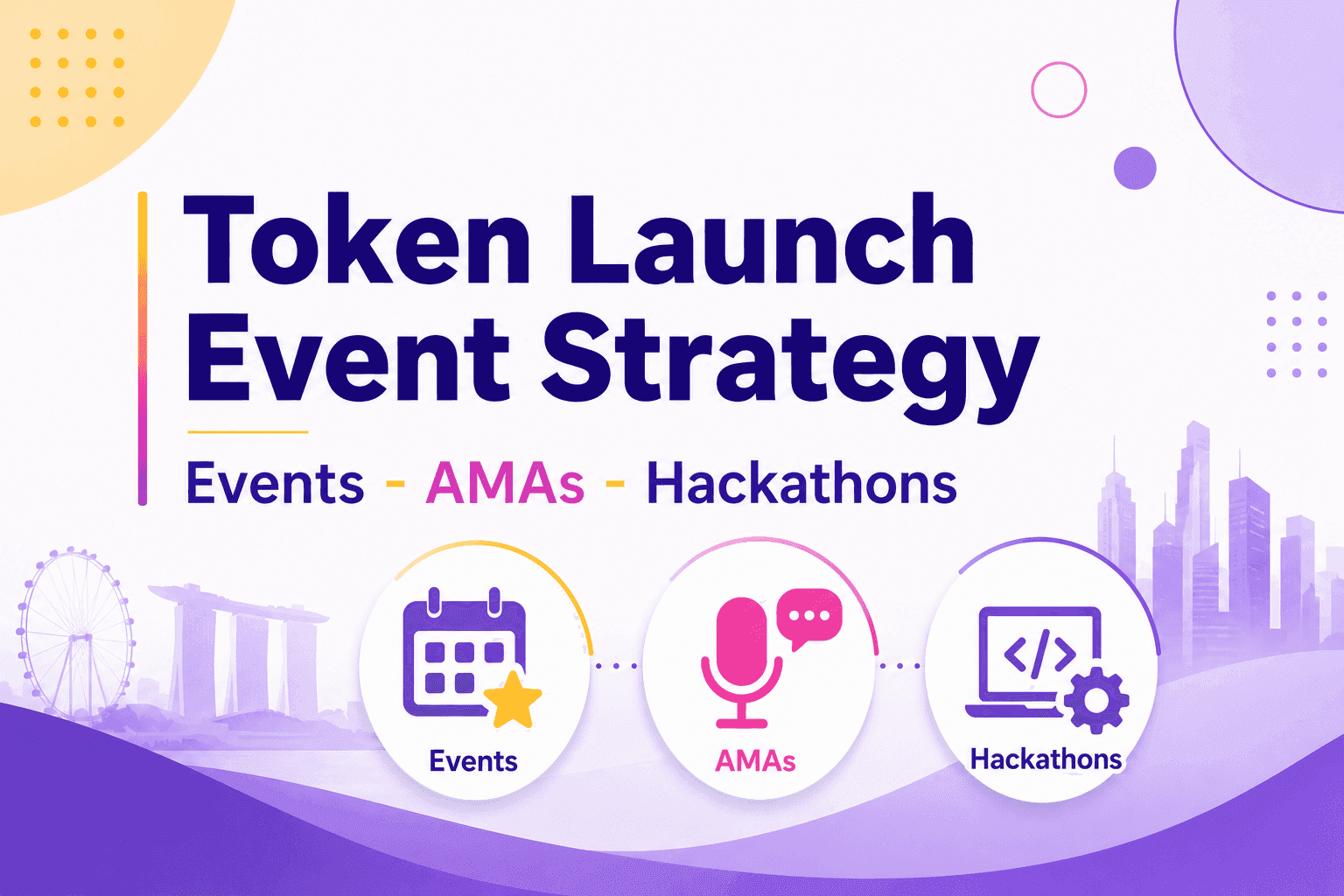
Common pre-TGE activities include conferences, side events, AMAs, and hackathons. Each format serves a different audience and launch objective.
- Attending conferences:
Projects can build meetings, gather market insights, and meet partners. - Sponsoring events:
Projects can increase visibility and access selected audiences. - Speaking at sessions:
Founders can build authority through useful market insights. - Hosting side events:
Projects can create focused conversations with selected guests. - Running AMAs:
Teams can answer questions and clarify launch details. - Organizing hackathons:
Projects can attract developers and generate working prototypes.
Event format | Best use before TGE | Primary output to target |
|---|---|---|
Conference attendance | Partner and market conversations | Qualified meetings and follow-ups |
Sponsorship | Broader visibility and access | Relevant contacts and brand exposure |
Speaking session | Founder authority and education | Content, media interest, and inquiries |
Private side event | Focused relationship building | Deeper partner discussions |
AMA or town hall | Community communication | Answered questions and reusable content |
Hackathon | Developer activation | Demos, repositories, and integrations |
Founders should choose formats by primary output to target, not event popularity. An early-stage project may attract better prospects through a focused investor dinner. This can work better than competing with larger brands on the exhibition floor.
How Do Events Support Token Launch Goals?
Once teams select the right format, they should define its intended outcome. Events support token launches when they create measurable pre-TGE evidence across five areas:
- Qualified demand:
Relevant prospects take a clear next step. This may include booking meetings, joining a waitlist, or requesting sale details. - Partner validation:
Exchanges, ecosystems, KOLs, or service partners confirm discussions or campaign involvement. - Community trust:
Founders answer material questions, explain risks, and clarify launch details directly. - Developer proof:
Builders produce prototypes, integrations, repositories, or technical feedback around the product. - Public relations assets:
Teams capture interviews, panel recordings, and announcements for later campaigns.
To turn these outcomes into a practical plan, teams should define eight points for every event:
- Audience
- Objective
- Message
- Proof asset
- Call to action
- Owner
- KPI
- Follow-up

This structure connects each activity to the wider token launch campaign. It also helps teams measure results beyond attendance.
Why Do Events Matter at Different TGE Stages?
Event goals should change as the token generation event approaches. A format that works during early validation may not suit the launch window.
- Early planning stage:
Events help teams test messaging, meet potential partners, and gather market feedback.
- Pre-TGE growth stage:
Conferences, AMAs, and side events build visibility, community trust, and qualified interest.
- TGE preparation stage:
Events clarify launch details, address concerns, and direct audiences toward approved conversion paths.
- TGE window:
Speaking sessions, interviews, and community events can amplify a launch that is already ready.
- Post-TGE stage:
Follow-up events support holder communication, developer activity, and partner relationships.
Teams should select event goals based on the token launch stage. Early events validate the plan. Later events convert attention and maintain engagement.
How Event Strategy Changes by Token Sale Stage
Sale stage | Best event approach | Main goal |
|---|---|---|
Seed | Closed demos, investor meetings, technical workshops | Validate the project and attract early backers |
Private sale | Invite-only dinners, partner meetings, private roundtables | Secure qualified investors and strategic partners |
Public sale | AMAs, community town halls, educational livestreams | Explain sale terms and prepare wider participation |
TGE | Media interviews, launch events, partner sessions | Amplify the launch and support public communication |
The key difference is audience access. Seed and private-sale events remain targeted. Public-sale and TGE events require broader, approved communication.
Should Founders Attend, Sponsor, Speak, or Host?
The right conference role depends on the desired outcome. Budget should follow access, audience fit, and follow-up capacity.

Attend for Targeted Meetings
Attending a major crypto or Web3 conference works best for exchange, media, and ecosystem meetings. Teams should build the meeting list before travel. General networking should remain secondary.
Sponsor for Access, Not Logos
Sponsoring a crypto or Web3 event makes sense when the package creates relevant access. Useful benefits include speaking slots, meeting support, lead capture, and content rights. Logo placement alone rarely justifies a large commitment.
Speak to Educate and Create Proof
Speaking at a conference should explain a real market or technical problem. It should not become a token sales pitch. Strong sessions can later support social content, media outreach, and community education.
Host for Controlled Conversations
Hosting a private side event gives the project more control. The team selects the topic, guest list, format, and follow-up process. This works well for partner dinners, technical workshops, and regional community meetings.
Decision Scenario: Should a Project Announce TGE Around TOKEN2049?
As discussed above, events can support token sale promotion. However, teams should not blindly align TGE with an event date.
Consider a project planning to announce TGE during TOKEN2049. The timing can increase visibility when launch preparations are complete. It can also create risk when the conference becomes an artificial deadline.
Why the timing can work:
- The event brings relevant partners, media, investors, and communities together.
- Pre-booked meetings can support immediate launch follow-up.
- Panels and interviews can reinforce the token launch narrative.
- Approved materials can direct attention toward clear conversion paths.
- Support teams can answer questions during the announcement period.
Why the timing may not work:
- Legal, tokenomics, or security work remains incomplete.
- The project relies on event traffic instead of scheduled meetings.
- The announcement competes with many other industry updates.
- The team lacks a clear post-event follow-up process.
- The event date forces TGE before the project is ready.
TOKEN2049 can amplify a prepared launch. It should not determine the launch date.
How Should Projects Run a Pre-TGE AMA?
Once a conference creates awareness, an AMA can turn that attention into direct community communication. A pre-TGE AMA should answer real questions and document unresolved concerns. It should not operate as a scripted promotional broadcast.
Reddit’s official AMA guidance separates the process into preparation, promotion, and moderation. It also recommends genuine interaction instead of pure marketing.
- Before the AMA
Set one clear objective. Select the right founder, product lead, or technical speaker. Appoint a moderator and prepare for difficult questions.
The team should also gather supporting links. These may include tokenomics, audits, sale terms, product demos, and official announcements. Speakers need clear boundaries for confidential or unapproved information.
- During the AMA
Open with a concise update and explain the format. Prioritize genuine community questions. Separate confirmed facts from future plans.
Avoid price predictions, guaranteed outcomes, and unsupported listing claims. Record unanswered questions and assign owners. End with one relevant next step.
- After the AMA
Close the session clearly. Publish a summary, transcript, or selected clips. Answer material questions that remain unresolved.
The team should also track recurring objections. Those concerns can improve FAQs, landing pages, moderator scripts, and later TGE communications.
How Can Hackathons Support a Token Sale?
AMAs can strengthen community trust. Hackathons can add technical proof before TGE.
A hackathon gives developers a reason to test the project. Builders may create prototypes, integrations, tools, or product feedback. These outputs can support demos, partner discussions, PR, and launch communications.
The basic flow is:
Challenge → Builder participation → Working outputs → Public proof → Continued development
A hackathon should not promote the token directly. It should demonstrate what developers can build around the product. This makes the token utility easier to understand.
The Hackathon Planning Kit emphasizes clear goals, suitable participants, mentoring, and post-event continuity.
How Projects Can Run the Hackathon
- Choose a relevant challenge: Connect the task to the product or token utility.
- Recruit suitable builders: Target developers with the required technical experience.
- Prepare technical resources: Provide documentation, sample code, tools, and support.
- Define useful outputs: Request demos, integrations, repositories, or technical feedback.
- Promote the results: Reuse strong projects in content and community updates.
- Support promising teams: Offer mentoring, grants, introductions, or roadmap discussions.
The hackathon should create evidence that continues after the event. The prize ceremony should not end the builder relationship.
How Do Side Events and Ecosystem Events Support Token Launches?
Large conferences create reach. Smaller events often create more focused engagement.
- Side events:
Private dinners, workshops, and meetups target selected partners, investors, or communities. They allow deeper conversations and clearer follow-up.
- Ecosystem events:
Events hosted by launchpads or wallets connect projects with relevant builders and partners. They can support integrations, grants, and technical validation.
Projects should choose these events based on audience fit. A focused ecosystem workshop may create more value than broad conference exposure.
How Can Teams Build an Event-to-TGE Timeline?
An event timeline should work backward from readiness milestones. The exact schedule depends on the event and project stage.
Phase | Main actions |
|---|---|
8–12 weeks before | Select formats, audiences, goals, budgets, and owners |
4–8 weeks before | Secure speakers, meetings, moderators, mentors, and partners |
1–4 weeks before | Promote activities, approve messages, and test conversion paths |
Event period | Capture questions, contacts, content, and technical outputs |
After the event | Complete follow-up and update TGE materials |
Events should sit inside a wider sequence of partnerships, KOLs, PR, and community activity before the token sale. Read this article to learn more about that token sale channel sequence.
Teams directing event interest toward a sale need tested conversion paths. These may include waitlist, whitelist, registration, or approved onboarding actions. Where the CTA includes a wallet action, teams should test the wallet onboarding flow before the event.

Before directing event attention toward a token sale, teams should approve all public messages. This includes audience restrictions, claims, risk language, and partner announcements. Speakers, moderators, and follow-up owners should use the same approved information.
Pre-Event, Live-Event, and Post-Event Checklist
The timeline defines when work should happen. This checklist defines the required actions at each stage.
Phase | Required actions |
|---|---|
Before the event | Define the audience and objective. Pre-book meetings, approve messages, test the CTA, configure lead capture, assign owners, and schedule partner or media activity. |
During the event | Capture contacts and meeting notes. Record community questions, collect content, document technical outputs, assign next steps, and update the CRM daily. |
Within 72 hours | Segment contacts and send tailored follow-ups. Publish approved content, update FAQs and TGE materials, schedule partner actions, and report qualified outcomes. |
One to two weeks later | Review pipeline progression, content performance, developer retention, partner commitments, and cost per qualified outcome. |
How Should Projects Measure Event Results Before TGE?
Projects should separate activity metrics from launch outcomes. Attendance shows reach. Follow-up actions show whether the event created value.
The following figures are internal planning ranges, not guaranteed results. Actual outcomes depend on event fit, audience quality, project readiness, offer relevance, and follow-up execution.
Format | Activity metric | Outcome | TokenMinds planning benchmark | Definition |
|---|---|---|---|---|
Conference | Meetings held | Qualified next steps | 30–50% of qualified meetings progress | A qualified meeting includes a relevant decision-maker, clear fit, and agreed next step. Progress includes a second meeting, proposal, pilot, or due diligence. |
Sponsorship | Leads captured | Partner conversions | 5–15% of qualified discussions convert | A conversion requires a documented pilot, integration, campaign, or commercial commitment. |
Speaking | Verified attendees | Defined audience actions | 5–10% take a defined action | Use verified live attendees. Actions include meeting requests, content requests, or approved signups. |
AMA | Questions and live attendees | Defined post-AMA actions | 5–15% attendee action rate | Calculate from unique live attendees. Count the approved CTA, such as a waitlist signup, partner inquiry, community join, documentation visit, or sale onboarding step. |
Hackathon | Registered teams | Valid projects and retained builders | 20–40% submit; 10–25% remain active | A valid project meets submission rules. Active builders contribute code, updates, or technical work within 90 days. |
Follow-up | Qualified contacts | Completed next steps | 80–95% contacted within 72 hours | A qualified contact matches the target audience and shows relevant interest. |
These are internal planning ranges, not guaranteed results. Actual outcomes depend on event fit, audience quality, project readiness, offer relevance, and follow-up execution.
Campaign-level KPIs can track follow-up completion and qualified outcomes. They can also track partner actions, content assets, and continued developer activity. Cost per qualified outcome helps compare formats.
What Token Launch Event Mistakes Should Founders Avoid?
Common mistakes include:
- Choosing events because competitors attend
- Sponsoring without scheduling meetings
- Treating AMAs as one-way promotion
- Avoiding difficult community questions
- Running hackathons without usable documentation
- Setting TGE around a conference deadline
- Measuring attendance without measuring outcomes
- Ending follow-up when the event closes
The real work often starts after the room empties.
Build an Event-to-TGE Campaign With TokenMinds
Events create value when they produce qualified meetings, partner actions, community answers, technical proof, and reusable content.
TokenMinds helps projects build event-to-TGE campaign plans covering event selection, audience mapping, meeting outreach, AMA and hackathon design, content capture, lead management, KPIs, and post-event follow-up.
Schedule an event-to-TGE planning session with TokenMinds.
FAQs
- How early should a project plan token launch events before TGE?Start at least 8–12 weeks before TGE. Larger events may require more time for budgeting, sponsorships, and partner outreach.
- Are conferences or side events better for token launches?Conferences offer broader visibility and more industry access. Side events support deeper conversations with selected investors, partners, or communities.
- What KPIs should founders use to measure token launch events?
Track qualified next steps, partner actions, community questions, approved registration actions, reusable content, developer outputs, follow-up completion, and cost per qualified outcome. - How should projects use events before token launch?
Use events to create qualified meetings, partner validation, community trust, and reusable content. Each event needs a clear audience, goal, CTA, and follow-up plan. - How do AMAs and hackathons support token sales?AMAs clarify community questions and strengthen trust. Hackathons create developer participation, prototypes, and technical proof before TGE.
- Should a project announce TGE around TOKEN2049?
Only when legal, tokenomics, security, messaging, and operational preparations are complete. TOKEN2049 can amplify a prepared launch, but it should not determine the launch date.