
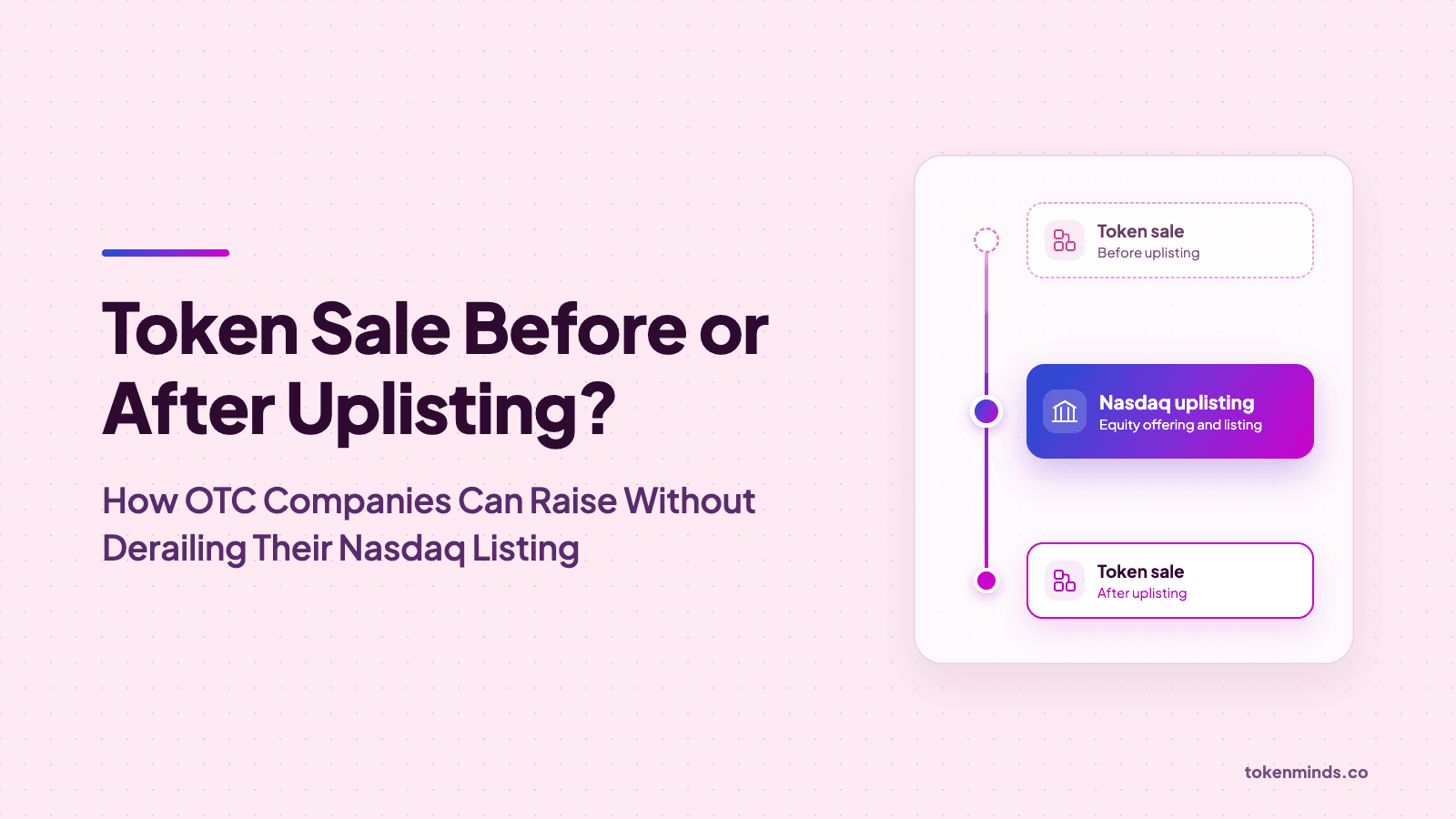
Token Sale Before or After Uplisting? How OTC Companies Can Raise Without Derailing Their Nasdaq Listing
Written by: Rob Eijgenraam
Moving from the OTC market to a national exchange is becoming more common, which raises the question of where an OTC company token sale fits. Lucosky Brookman counted six uplisting and cross-listing deals in Q1 2026, up from two a year earlier, while only five microcap IPOs closed across Nasdaq and the NYSE.
Listing standards are also getting stricter. As of October 25, 2026, Nasdaq removed its $2 and $3 listing price alternatives, so every new Nasdaq Capital Market listing now needs a share price of at least $4.00. On the token side, the SEC proposed Regulation Crypto Assets on August 18, 2026, a dedicated route for token fundraising that is still only a proposal.
For an OTC company, these trends make one idea attractive. A token sale could fund audits, governance upgrades and listing costs without issuing more shares. Still, a token sale held at the wrong time can complicate the listing it was meant to fund.
None of this rules out an OTC company token sale. The real question is timing, meaning which raise comes first, and this guide shows how proceeds, disclosure, accounting and the investor base decide whether a token sale belongs before or after the uplist.
Why Consider an OTC Company Token Sale Before Uplisting?
OTC companies consider a token sale because uplisting, the move from the OTC market to a national exchange such as Nasdaq or the NYSE, requires spending long before it brings in new capital. The reward is real. Many institutional investors, index funds and investment banks have mandates or policies that limit how much they can hold in OTC securities, so a listing gives the company access to more investors.
The preparation is expensive. According to Hamilton & Associates’ 2026 uplisting guide, applicants need U.S. GAAP financial statements audited by a PCAOB-registered firm, a majority-independent board with independent committees, and SEC reporting status. Paying for that work by selling new shares dilutes existing shareholders while the company is still on the OTC market.
A token sale is an offering of digital tokens, recorded on a blockchain, that give buyers a defined use or right in the company’s product or network rather than ownership of the company. This form of crypto capital raising without equity leaves the share count unchanged. It only works when the token has a genuine job in the business, as explained in this guide to token creation for non-crypto companies.
The harder question is whether that money also helps the company pass Nasdaq’s listing test.
Can a Token Sale Help an OTC Company Meet Nasdaq Uplisting Requirements?
A token sale can help cover uplisting costs, but it cannot satisfy the exchange’s offering-based listing test. The reason becomes clear from what Nasdaq checks.
What Nasdaq and NYSE Check at Uplisting
The table below summarises the main checks for the Nasdaq Capital Market, which Hamilton & Associates describes as often the most relevant tier for companies uplisting from the OTC market.
Check | What Nasdaq looks for |
Share price | At least $4.00 for new Capital Market listings |
Stockholders’ equity | At least $5 million under the equity standard |
Public float value | A minimum market value of freely tradable public shares, met from the offering for companies using the underwritten route |
Liquidity | Enough OTC trading volume, or a firm commitment underwritten offering of at least $5 million |
Financial reporting | SEC reporting status and audited U.S. GAAP financial statements |
Governance | A majority-independent board with independent audit and compensation committees |
The public float value is known as MVUPHS, short for the market value of unrestricted publicly held shares. The NYSE follows a similar logic, and the NYSE American’s $15 million public float must now come only from unrestricted securities.
Why Token Sale Proceeds Do Not Count Toward the Offering Minimum
The key rule is part of the liquidity check. Since April 11, 2025, OTC companies that do not meet Nasdaq’s trading volume test and uplist through a firm commitment underwritten offering must raise at least $5 million for the Capital Market or $8 million for the Global Market. As Hamilton & Associates explains in its analysis of the Nasdaq minimum offering rule, the MVUPHS requirement must then be met from the proceeds of that offering.
The calculation is narrow. MVUPHS equals the offering price multiplied by the unrestricted shares sold to the public in the offering. At a $4.00 offering price, an OTC company needs to sell at least 1,250,000 shares to reach $5 million. At $2.00, it needs at least 2,500,000 shares. A token raise of any size leaves both figures unchanged, because no token counts as an unrestricted share sold in the offering. Shares held by officers, directors or 10% holders do not count, and even resale shares registered alongside the offering cannot replace offering proceeds.
The rule does not mention tokens, but its logic is clear. A token is not a share, so a token sale adds nothing to MVUPHS, however large the raise. Token trading is also not trading in the company’s shares, so it cannot help with the volume test either.
Token proceeds can still pay for the audit and listing preparation. Whether they add to stockholders’ equity depends on how the auditor records them, which is the next issue.
How Does a Token Launch Affect an Uplisting Application?
A token launch adds three sets of questions to an uplisting application. The company must show what it has disclosed, explain how the auditor has recorded the token, and manage two different investor groups.

The Token Must Appear Consistently in Disclosures
Disclosure starts before the uplisting. OTC Markets requires timely disclosure of major crypto-related events, including token launches, filed as material event reports. Hamilton & Associates also lists what digital-asset issuers must disclose, from token economics and supply to custody and regulatory status, and names undisclosed token supply as a common mistake.
The token must then be described the same way in the company’s SEC filings and listing application. Counsel has to document whether the token is a security, and the token sale page and the whitepaper must match those filings. A whitepaper is the document that explains what a token does and how it works.
That consistency will matter even more if the SEC’s proposal is adopted. Croke Fairchild's client alert on the proposal warns that under it, roadmap and milestone language in whitepapers, websites and offering documents would carry direct legal consequences.
Token Proceeds Become an Accounting Question
Accounting is the second issue. Architect Partners observes that crypto issuers tend to face tougher SEC scrutiny on token activities and digital asset accounting. Any token sale during the audited period is included in the financial statements the auditor reviews.
How those proceeds are recorded is a decision for the auditor and counsel, based on the token’s terms. That classification can affect reported equity, so it needs to be settled before the listing application goes in. Entity structure is part of the same question. ConcentricDAO, a project tokenizing real-world assets, set up a foundation to hold those assets, and TokenMinds helped it establish a Panama LLC to manage the proceeds of its token sale. The proceeds were routed to that LLC, which gave the project one defined entity to account for them. Whether such a structure suits a US issuer with SEC reporting duties is a matter for counsel and the auditor. The details are in the ConcentricDAO case study.
Token Holders and Shareholders Are Two Different Investor Groups
The third question is the investor base. A token holder does not own shares in the company. This differs from tokenized shares, such as the blockchain-based version of its stock that Canton Strategic Holdings announced in October 2026, which carry the same rights as its Nasdaq-listed shares.
The two groups check different things. Shareholders look at earnings, governance and dilution. Token buyers look at the token’s use, supply and vesting, the schedule that controls when locked tokens can be sold. These checks are covered in this guide on what token investors look for in a company, and some buyers bring their own process, as shown in this guide to token sale preparation for family office investors.
Geography is a further difference. TokenMinds currently targets global investors for token sales, because selling tokens to US investors depends on the SEC rules being cleared first. For a US company, that narrows the likely buyer pool, and many investors are also cautious about new projects at present. Unlock schedules therefore belong in the disclosure plan. With these three questions in view, the timing decision becomes clearer.
Should an OTC Company Run a Token Sale Before or After Uplisting?
For most OTC companies, the safer path is to run the token sale after the uplisting. A token sale before uplisting can work, but only where the token is simple, modest in size and fully disclosed.
When a Token Sale Before Uplisting Can Work
A token sale before uplisting fits best when the token already has a clear job in the product, the raise is modest, and the offering uses a legal route chosen with counsel under current rules. TokenMinds applies a similar screen before taking a project on. It works only with existing companies that have a good track record, a reliable management team and a reputation at stake. It also checks whether the concept fits web3 and the current market, because a weak concept may fail to sell to public investors and waste the founders’ budget. The SEC’s proposed token exemptions cannot be relied on until they are adopted. The equity side also needs its own plan, either through the trading volume test or a parallel underwritten offering of at least $5 million. For scale, the token campaigns TokenMinds currently runs raise between half a million and 5 million dollars, so even a full token raise sits at or below the equity minimum. Token sales are also usually split into two rounds: a private round with the deepest discounts for crypto funds and high-net-worth investors, and a public round through launchpad partners for retail buyers. Each round creates its own disclosure and investor-base questions during exchange review.
What goes wrong is usually a matter of overlap. Nasdaq Rule 5101 lets the exchange deny or suspend a listing on public-interest grounds, including misleading promotions, manipulative trading and unresolved SEC or FINRA matters. Token marketing can start to promote the stock as well, which puts a company's promotional record under that review. Hamilton & Associates also warns that attempts to manufacture price, public float, shareholder count or trading volume create serious securities-law risks during an uplisting. Hamilton’s advice on the offering rule also applies here, since issues left until the application is under review can lead to delays, revised offering terms and more dilution.
When Waiting Until After the Uplist Is the Safer Path
Waiting is safer when the company still has work to do on audits, governance or share price. After listing, the equity offering is complete, SEC reporting is routine, and audited financial statements and an independent board are in place. Token buyers then review a company that has passed the exchange’s checks. Market conditions point the same way. TokenMinds is running token sales in a crypto bear market, which keeps initial raises on the lower side, and it treats a token sale as a complement to traditional fundraising rather than a replacement. Raising tens of millions through a token sale is slow and difficult, so the equity offering stays the main source of listing capital.
A listed company may also be better placed if the SEC’s proposal is adopted, since its larger Tier 2 token offerings would carry a two-year lookback for annual financial statements. The terms remain a proposal, and the proposal has not been adopted, so they may change.
Listed companies face their own rules too. Since July 2026, Nasdaq applies a hard $5 million market value floor for continued listing with no grace period, so a token sale should never distract management from meeting these listing rules.
Factor | Token sale before uplisting | Token sale after uplisting |
Listing test | Does not count toward MVUPHS or the offering minimum | Already met through the equity offering |
Disclosure | OTC material event reports, carried into SEC filings | Handled through existing SEC reporting |
Accounting | Proceeds fall within the audited period reviewed for listing | Recorded under an audit process already in place |
Investor base | Two investor groups form during exchange review | Token holders join an established shareholder base |
Timing risk | Token questions can arise during review | Separate from the listing decision |
How to Sequence an OTC Company Token Sale Around Uplisting Milestones
The safest sequence ties the token sale to the uplisting calendar. Hamilton & Associates recommends that issuers begin an uplisting readiness assessment at least 12 months in advance, which is also the right moment to decide where the token fits. The token side is set out in this token launch timeline for a traditional company.

- Choose the listing route. Confirm the tier, the listing standard, and whether the company will use the volume test or an underwritten offering.
Output: a clear listing route and an early decision on the token’s timing. - Get reporting and audits ready. Become an SEC reporting company if needed and complete PCAOB audits under U.S. GAAP.
Output: audited financial statements that include the token’s accounting treatment. - Fix governance and share price. Build an independent board and committees, and plan any reverse stock split needed to reach $4.00.
Output: a board and share price that meet Nasdaq’s checks. - Complete the equity offering and listing. Run the offering if required and file the application. Hamilton & Associates’ 2026 uplisting guide says review typically takes six to ten weeks before conditional approval.
Output: a Nasdaq listing with the offering minimum met from share proceeds. - Design the token and its disclosures. Set the tokenomics, meaning the rules for how tokens are created, shared and released, along with vesting and a disclosure pack reviewed by counsel and auditors.
Before the design work begins, TokenMinds typically runs due diligence on whether a blockchain solution is feasible for the project and gauges market interest through an investor survey. This lets the company validate the opportunity at a smaller cost before committing to a full launch.
Output: a validated token plan consistent with the company’s filings. - Launch the token sale. Open the raise to buyers who fit the token and the legal route.
Output: a second source of capital that does not affect the listing application.
On the before-uplisting path, steps 5 and 6 move earlier, but they must still be disclosed and reflected in the audit before step 4. TokenMinds advises staging that spend. It starts with a tokenomics phase, so a client does not use the full launch budget before seeing whether the project works. It then recommends completing a private raise on a SAFT (simple agreement for future tokens) before choosing one chain and quoting the public launch. That way the company does not pay for smart contract development and public sale setup while the private round is still unfunded. The CEO and the uplisting advisor should answer the same questions, and this token sale readiness checklist covers the wider review.
- The token’s role. Does the token do a real job in the business, or is it only a funding tool?
- The listing route. Will the company meet the volume test, or does it need an underwritten offering of $5 million or more?
- The audit view. Has the auditor confirmed how token proceeds would be recorded?
- The disclosure trail. Do the whitepaper, the token sale page and the OTC filings tell the same story?
Get a Token Fundraising Fit Assessment With TokenMinds
A token sale before a Nasdaq listing is won on timing, not speed. The sections above show that token proceeds can fund uplisting costs but cannot replace the equity offering, and that disclosure, accounting and a second investor base all need a plan before the listing application goes in.
TokenMinds has run token sales end to end since 2017 across 150+ projects, and works with established companies on token sale strategy, tokenomics and go-to-market. For OTC companies on the way to uplisting, the work covers timing the token sale around listing milestones, tokenomics and vesting designed so token unlocks do not weigh on the stock, and token disclosures prepared with the company’s counsel and auditors so the token reads the same in every filing. Its token fundraising fit assessment, built for the company or for an uplisting advisor’s client, checks the uplisting plan, capital needs and token concept in one pass, so leadership walks in with a token idea and out with a clear before-or-after decision, the risks to the listing application, and a plan to sequence both raises.
Book a token fundraising fit assessment with TokenMinds.
FAQs
Should an OTC company do a token sale before or after uplisting to Nasdaq?
For most OTC companies, after is the simpler order. The equity offering and the listing come first, and the token sale follows once audits, governance and SEC reporting are in place. A token sale before uplisting can work when it is modest, fully disclosed and planned alongside the equity raise.
Will a token launch affect an uplisting application?
Yes. OTC Markets expects token launches to be disclosed as material events, the token must be described consistently in SEC filings, and the auditor has to decide how token proceeds are recorded.
Can token fundraising help an OTC company meet uplisting requirements?
It can fund the preparation, but it cannot meet the offering-based test. OTC companies using the underwritten route must raise at least $5 million for the Nasdaq Capital Market, and the public float test must be met from that share offering. Token proceeds do not count, because a token is not a share.
What is an OTC company token sale?
An OTC company token sale is an offering of digital tokens, recorded on a blockchain, by a company whose shares trade on the OTC market. Buyers receive a defined use or right in the company's product or network, not ownership of the company, so the share count stays unchanged.
What legal and audit costs should an OTC company budget for a token sale?
The main cost lines are securities counsel to document whether the token is a security, auditor review of how token proceeds are recorded, and preparation of the whitepaper and disclosures so they match SEC and OTC filings. Since the equity offering and uplisting audits come first, most companies stage the token spend, starting with a tokenomics phase before committing to a full launch.
Does a non-crypto CEO need a token to raise capital?
No. A token fits only where it has a genuine job in the business, such as access or use within the company's product. Where the token would be only a funding tool, the equity offering and the listing remain the more direct route.