
Token Sale Content Calendar 2026: What to Publish 12 Weeks Before TGE
Written by: TokenMinds Team
Most founders plan the token generation event in detail. The smart contract is audited, the listing is booked, and the launch date is set. The content runway to that date rarely gets the same care. Teams often start publishing three to four weeks before launch. By then, it is too late for narrative, trust signals, and search discovery to compound. This article lays out a token sale content calendar for 2026, week by week, so the story is ready before the market starts watching.
Why Token Sale Content Must Start 12 Weeks Before TGE
Many projects start promoting their token close to the launch day. Some begin four weeks before the token generation event, others two weeks, and some just one. In marketing, there is no fixed formula for when content should start. Still, 12 weeks before launch day has proven to be the ideal runway.
Why 12 weeks? Because content compounds slowly. A narrative needs repetition before the market retells it. Trust signals such as audits need time to circulate. Search engines and AI assistants also need indexed pages before they can recommend a project. None of that happens in a two-week sprint.

Buyers in 2026 also reward projects that show up prepared, not projects that appear days before listing. That shift is visible in recent coverage. Leading venture investors describe this year's token sale environment as increasingly selective. Even so, public token sales have still raised over $1.4 billion in 2026. The capital is there, but it goes to teams that earned trust early.
All the reasons above point to one conclusion. A pre-TGE content calendar has to start before the pressure peaks, because that is when the thinking is still calm. Tokenomics messaging, risk language, and FAQ answers all improve when written in week 12, not rushed in week 2. Teams comparing broader approaches can review these token sale marketing strategies before locking the plan.
The 12-Week Pre-TGE Content Calendar Overview
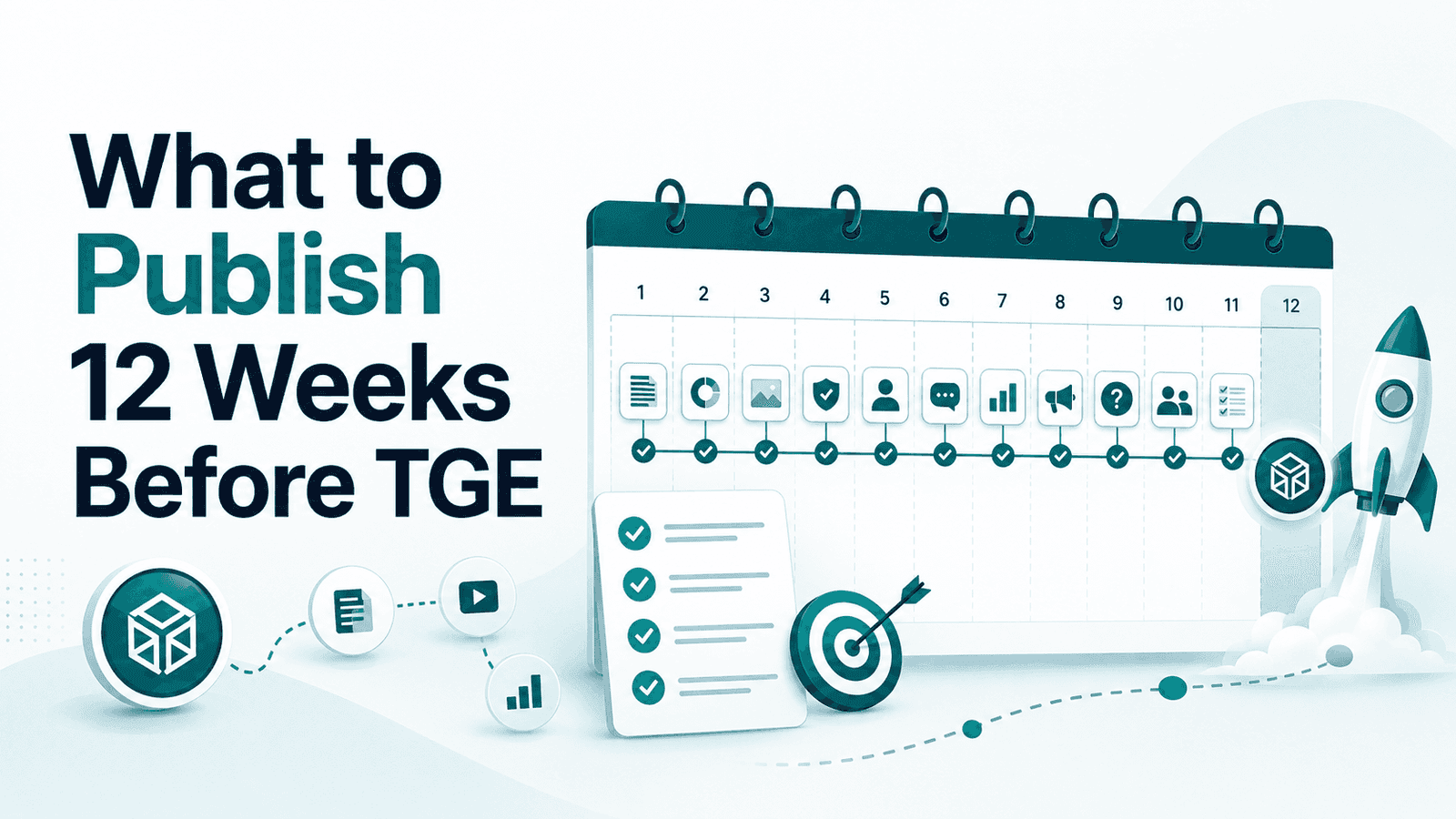
Knowing the runway should be 12 weeks is one thing. Knowing what to publish across those weeks is the harder part. The answer is not 12 separate plans, but one calendar split into three phases, each with one job.
Phase | Weeks | Job | Core content |
|---|---|---|---|
Foundation | 12 to 9 | Build the narrative | Story, litepaper, community setup |
Momentum | 8 to 5 | Prove the project | Utility, tokenomics, audits, partnerships |
Activation | 4 to 1 | Convert attention | Exchange news, FAQs, risk language, countdown |
The split follows how buyers actually make decisions:
- Foundation comes first because nobody buys what they do not understand. The market needs the story before it can care about the proof.
- Momentum comes second because interest without evidence dies fast. This phase turns a good story into a credible project.
- Activation comes last because conversion content only works on an audience that already trusts the project. It gives ready buyers a clear path to act.
Each phase becomes the foundation for the next phase. The narrative gives the proof content something to attach to, and the proof gives the activation phase credibility when attention peaks. Skipping a phase breaks that chain, which is why late-starting projects struggle to convert launch-week traffic.
Pre-TGE Content Calendar Breakdown
The three phases above set the direction. The breakdown below turns them into an actual publishing plan, phase by phase, with the content each one needs to prepare and publish.
Foundation Phase: Week 12 to 9

The first month answers one question. Why does this project need to exist, and why now? Everything published here frames the problem, the thesis, and the team behind it. These pieces rarely trend, and that is fine. They become the pages every later post links back to.
This phase is also where the token sale fundamentals get locked in writing. A stranger should be able to explain the project's purpose after ten minutes of reading. If that test fails at week 9, no later announcement will fix it.
Content to prepare and publish:
- Week 12: Core narrative article and problem thesis. Published on the blog, amplified on X.
- Week 11: Litepaper or docs hub release, written in plain language. Blog and email.
- Week 10: Founder story and team introduction. Blog, X, and LinkedIn.
- Week 9: Community launch content, welcome threads, and channel guides. Telegram and Discord.
Before moving into Momentum, the phase should close with every box below ticked. Foundation readiness:
- Narrative approved
- Litepaper or documentation hub published
- Founder and team information available
- Community channels live and moderated
- Compliance review underway
Momentum Phase: Week 8 to 5

With the narrative set, the middle month proves it. This phase publishes the evidence a serious buyer looks for before committing capital. The sequence matters. Understanding comes first, then the numbers, then the trust signals, because audits and partnerships only land once readers know what is being trusted.
Distribution also starts here. Micro-KOL seeding and PR outreach begin in this phase, giving smaller voices time to build familiarity before bigger names amplify. Since AI assistants now shape how buyers research projects, a token sale PR strategy built for AI search visibility makes those placements surface in the answers buyers actually read.
Content to prepare and publish:
- Week 8: Utility deep dive showing what the token does inside the product. Blog and X.
- Week 7: Tokenomics breakdown covering supply, allocations, vesting, and unlocks. Blog and email.
- Week 6: Audit results and security overview. Blog, PR, and X.
- Week 5: Partnership announcements and first micro-KOL content. PR, X, and KOL channels.
The phase is complete when the proof is not just published but cleared for what comes next. Momentum readiness:
- Utility explained with product evidence
- Tokenomics and vesting approved
- Audit findings ready for publication
- Partnership permissions confirmed
- KOL and PR materials prepared
Activation Phase: Week 4 to 1

The final month converts attention into participation. Nothing new should be invented here. Every piece repackages the narrative and proof already published, aimed at people deciding this week. A structured token launch readiness review before this phase starts confirms the earlier weeks left no gaps.
The most important timing decision of the whole calendar sits in this phase. Exchange and listing announcements should go out two to three weeks before the token generation event, not on launch day, so search and social discovery peak before listing rather than after it.
Content to prepare and publish:
- Week 4: Exchange and listing announcement. PR, X, and email.
- Week 3: Full FAQ plus clear risk and compliance language. Blog and docs.
- Week 2: Whitelist instructions and participation guide. Email, Telegram, and Discord.
- Week 1: Countdown content and a final recap thread. X, Telegram, and Discord.
The final gate matters most, because there is no next phase to absorb what slipped. Activation readiness
- Exchange communication approved
- FAQ and risk language published
- Eligibility and participation journey tested
- Support coverage scheduled
- First 30 days of post-TGE content prepared
The 12-Week Pre-TGE Content Calendar at a Glance
For teams that want the whole plan on one screen, the table below compresses the three phases into a single publishing schedule. Channel order matters as much as content order, and the logic behind it is covered in this guide to token sale channel sequencing.
Week | What to publish | Primary channels |
|---|---|---|
12 | Core narrative article, problem thesis | Blog, X |
11 | Litepaper or docs hub release | Blog, email |
10 | Founder story, team introduction | Blog, X, LinkedIn |
9 | Community launch content, channel guides | Telegram, Discord |
8 | Utility deep dive | Blog, X |
7 | Tokenomics breakdown, vesting explainer | Blog, email |
6 | Audit results, security overview | Blog, PR, X |
5 | Partnership announcements, micro-KOL content | PR, X, KOL channels |
4 | Exchange and listing announcement | PR, X, email |
3 | Full FAQ, risk and compliance language | Blog, docs |
2 | Whitelist instructions, participation guide | Email, Telegram, Discord |
1 | Countdown content, final recap thread | X, Telegram, Discord |
Treat the table as a floor, not a ceiling. Strong teams repurpose each anchor piece into threads, clips, and community posts across the same week.
After TGE: Proof Content That Keeps Attention
Beyond the 12-week content plan above, teams also need a plan for what comes after launch day. The buyers and community members the calendar worked so hard to win still need a reason to stay. Retention deserves the same planning that acquisition received.
This is where many projects slip. The countdown thread goes out, the token lists, and the channels slowly go quiet. The market reads that silence as the story being over, and attention moves to the next launch.
Keeping the audience requires a shift in content, not just more of it. Pre-TGE content makes promises, while post-TGE content shows receipts. A launch metrics recap shows what actually happened, roadmap delivery updates prove the team ships after raising, and regular ecosystem content gives holders a reason to stay rather than exit.
The practical step is simple. Write the first month of post-launch content before TGE week, because launch weeks leave no room for writing. The proof calendar must already exist when the token goes live.
Pre-TGE Content Mistakes to Avoid in a Token Sale
Even with a full calendar in hand, execution can still go wrong. The failures below appear in almost every rushed launch, and each one is a timing failure rather than a content failure. The content existed, but it landed in the wrong week.
- Announcing the exchange listing on launch day.
The impact: the discovery window is wasted, because listing news drives the biggest search and social spike of the campaign, and it arrives after the moment it was meant to build.
The fix: lock the announcement at week 4, two to three weeks before the token generation event, so discovery peaks while buyers can still act on it. - Paying macro-KOLs before a real community exists.
The impact: expensive traffic with nowhere to land, as big-name mentions send curious buyers to empty channels and thin docs.
The fix: follow the calendar's order, community setup by week 9 and micro-KOLs from week 5, so a living community is ready before large audiences arrive. - Going silent after token listing.
The impact: the market assumes the story is over, attention leaves quietly, and holders follow it out.
The fix: write the first month of post-TGE proof content before launch week, so publishing continues the day trading starts.
Prevention in all three cases is the same discipline. Nothing here needs extra budget, just the right content in the right week, which is exactly what the calendar enforces.
Build Your 12-Week Token Sale Content Calendar With TokenMinds
The content calendar decides how prepared a project looks when the market starts watching, how much trust is banked before listing day, and whether attention survives past TGE.
TokenMinds runs token sales end to end and treats the 12-week pre-TGE content calendar as launch infrastructure, not an afterthought. The build sequences narrative, tokenomics content, audits, partnerships, KOL and PR timing, and post-launch proof into one launch plan. Projects receive a full 12-week content calendar build mapped to channels, anchor content ready per phase, and a post-TGE proof plan written before launch week.
Book a 12-week content calendar build call with TokenMinds.
FAQs
What content should a project publish before TGE?
Projects should publish narrative and litepaper content first, then utility, tokenomics, audits, and partnerships, then FAQs, risk language, and countdown content. The sequence runs across 12 weeks in three phases, ending with pre-written post-launch proof content.
How should a team build a 12-week token sale content calendar?
Split the runway into foundation, momentum, and activation phases. Assign each week one anchor piece and its primary channels, as in the table above. Write post-TGE content before launch week so publishing never stops at listing.
What should a project say 90 days before a token launch?
At 90 days out, the project should explain why it exists, what problem it solves, and who is building it. Proof and sales content come later. Starting the story 90 days early is what lets trust and discovery compound by TGE.