
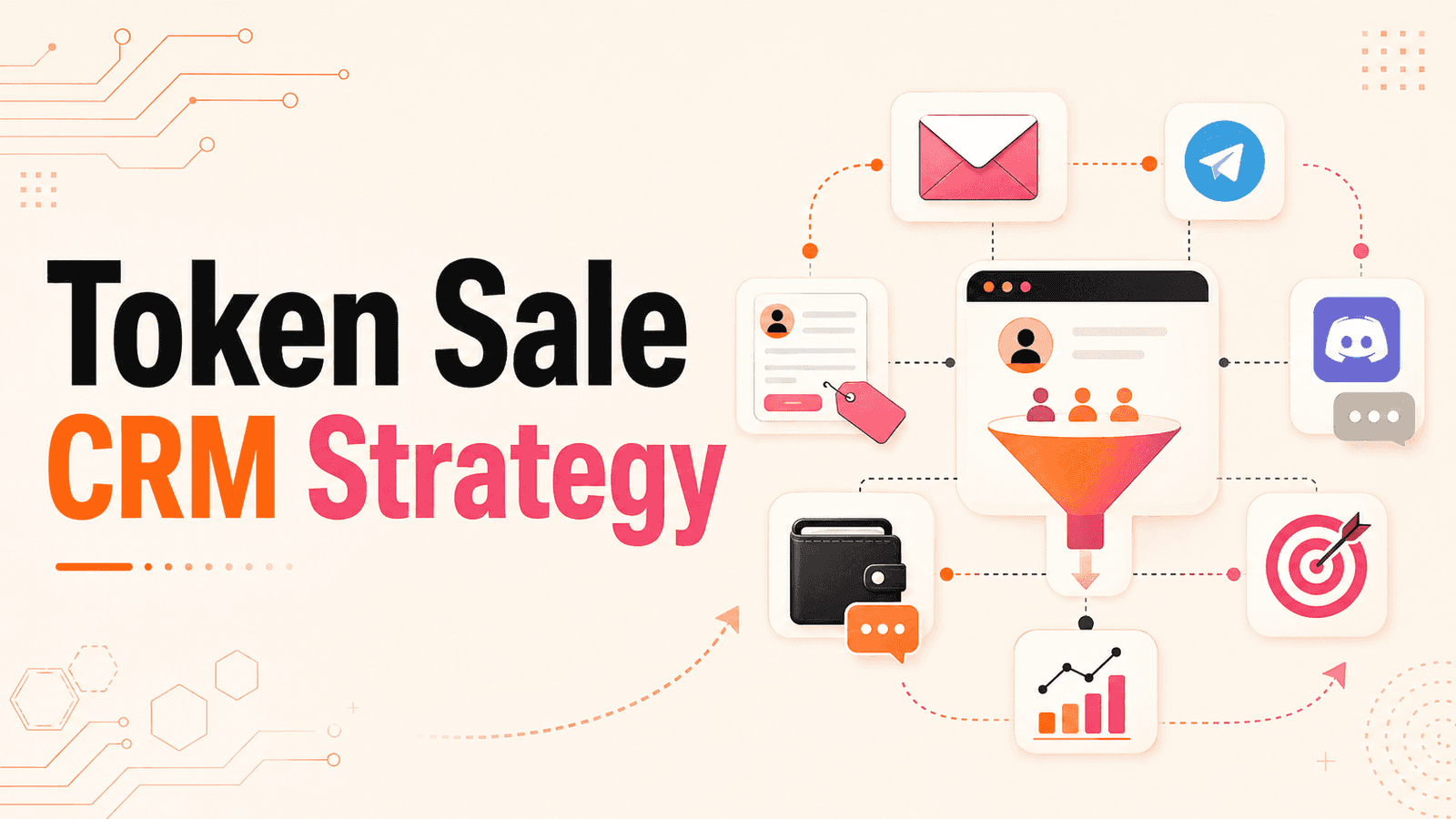
Token Sale CRM Strategy: Email, Telegram, Discord, Wallet Messages, and Retargeting Before TGE
Written by: TokenMinds Team
Most crypto projects heading into a token sale already have the signups. The email waitlist is growing, Telegram is active, and Discord adds new members every day. Then the sale opens, and only a small fraction of those people actually buy. The gap is rarely a lack of interest. It is usually the absence of a CRM that connects all those channels to one lead record. Follow-up stays scattered, warm leads go cold, and each channel starts telling a slightly different story.
This guide walks through a pre-TGE CRM flow that fixes that. It covers what the system needs, what each channel should do, and how to know which one produced real buyers.
Why Token Sale Conversion Is a Lifecycle Problem, Not a Traffic Problem
More traffic will not fix broken follow-up. A project can double its waitlist and still convert poorly if nothing happens after the signup. Think of every signup, community join, and form fill as a lifecycle lead. Each person sits somewhere on a journey, from first touch to wallet-ready buyer. Treating them as one-time impressions wastes the ad budget that brought them in.
Here is what that journey looks like when nobody manages it:
Signs up on the waitlist → gets one welcome email → silence for three weeks → generic blast during sale week → ignored |
|---|
So why do interested users leak out before the sale? Three reasons show up in almost every project:
- Fragmented channels tell different stories.
Email follows up with leads over days, Telegram pushes quick announcements, and the two are rarely connected. One channel mentions a whitelist deadline, the other never does, and the Discord mods improvise a third answer. - Nobody knows which leads are close to buying.
Without stages, everyone receives the same generic blast. Engaged users get annoyed, and silent leads never get the nudge that would move them forward. - Messaging breaks under pressure.
When the sale gets close and there is no approved copy per stage, someone eventually makes a claim that should never have been made.
A CRM exists to prevent those three issues. The system provides stages for each prospect, messages tailored to each stage, and a consistent narrative across all channels.
What a Pre-TGE CRM Needs
Fixing those three leaks takes more than a mailing list with extra fields. A traditional CRM tracks emails and job titles, but token sale leads live on-chain. So the system itself has to be crypto-native, starting with wallet-based profiles instead of email-only records.
According to Formo's Web3 CRM features guide, a Web3 CRM rests on three pillars:
- Multi-chain tracking.
The CRM follows users across Ethereum, Solana, Polygon, Arbitrum, and other EVM chains. Ethereum dominates token sales by volume, but Solana attracts projects with lower gas costs, so leads often act on more than one network. One caveat matters here. Separate wallets should only merge into one lead record after a verified action links them, such as a wallet signature, a verified account connection, or the user registering the wallets themselves. One lead can hold several verified wallets, but the CRM should never assume ownership from on-chain activity alone. - Real-time attribution.
Marketing touchpoints get tied directly to on-chain actions. When a wallet connects or buys, the CRM knows which campaign brought that person in. - Wallet intelligence.
Leads get segmented by what their wallets do, not by demographics. Holdings, transaction history, and wallet age say far more about buying intent than a job title ever will. A wallet that already holds USDC or USDT on the sale chain is a very different lead from an empty one. Stablecoin holdings indicate funding readiness. A wallet with zero balance cannot transact when the sale opens, no matter how engaged the owner is. Wallets holding governance tokens or NFTs from similar projects signal higher intent and need different nurture messaging than wallets with no on-chain history.
Two more features earn their place before TGE. Token-gated forms verify leads with on-chain data instead of self-reported answers, which filters out bots and airdrop farmers early. Before TGE the project's own token does not exist yet, so a token-gated form checks for other signals instead, such as a stablecoin balance, a partner or ecosystem asset, or an NFT that marks the audience the sale wants to reach. Airdrop farmers are wallets created solely to claim free tokens, and they typically show little transaction history or holdings. Verification steps like signing a message or completing a project-tied CAPTCHA filter out most low-effort bots, though sophisticated operators can pass them. Verification results work best as one input to a risk score rather than a final verdict. This early filtering still keeps the nurture list signal-rich and prevents wasted sends to accounts that will never convert. Event-based automation can respond to off-chain events such as email verification, wallet connection, KYC approval, and allowlist status, as well as on-chain events such as wallet funding, purchase, and token claim. There is a privacy bonus too. Wallet-based profiles reduce how much personal data a project collects, which supports a privacy-by-design setup under GDPR. Regulatory expectations also differ by market. Projects reaching EU users deal with MiCA (Markets in Crypto-Assets Regulation), US-facing projects deal with SEC guidance, and other markets add their own advertising and financial-promotion rules. What a project can safely claim depends on the token structure, the offering terms, the target jurisdictions, and who is eligible to participate. Legal counsel should approve the claims list, disclaimers, eligibility rules, and campaign copy before any of it goes live.
The Role of Each CRM Channel Before Token Generation Event
A CRM with wallet-based profiles is only half the setup. The other half is deciding what each channel actually does with those profiles, because this is where most teams create the confusion described earlier.
One principle governs everything here. One lead record, five channels, one approved claims list. Each channel gets a job, and no two channels should do the same job:
Channel | Best for | Typical trigger | Cadence | Owner |
|---|---|---|---|---|
Personalized nurture and follow-up | Waitlist signup or form fill | 1 to 2 per week | CRM or lifecycle marketing lead | |
Telegram | Announcements and time-sensitive pushes | Sale milestones and deadlines | Event-driven | Community manager |
Discord | Community support and role-gated access | Questions and verification | Always on | Community and support lead |
Wallet messages | Reaching users with no email on file | On-chain events and inactivity | Sparingly | CRM operator with product or engineering support |
Retargeting | Re-engaging visitors who never signed up | Site visit without conversion | Campaign flights | Paid growth lead |
Two more ownership assignments sit outside the table. The approved claims list belongs to a legal or compliance approver together with one project owner, and escalations need a named support owner with a response-time target, so no question waits on 'whoever sees it first.
In practice, the split works like this. The website and whitepaper hold the full story, but almost nobody absorbs it in one visit. Email is the channel that brings leads back to that material step by step, and it is the only broadcast channel here that can be personalized from the CRM record. A lead who never connected a wallet gets a walkthrough, while a funded but silent lead gets a deadline reminder. The same channel also handles direct outreach to bigger prospects, where a personal message lands better than any announcement.
Telegram works the opposite way. People check it fast and scroll past anything long, which makes it the right place for deadlines, milestones, and anything that expires. If a message would still matter next week, it probably belongs in email instead.
Discord plays a support role rather than a broadcast role. It is where the community asks questions and where access gets gated by role, for example a verified whitelist role that unlocks a private channel.
Wallet messages cover a gap the other channels cannot. Many on-chain users prefer not to share email addresses, which makes wallet-based messaging the most direct route to them. Wallet messaging depends on the selected messaging protocol, supported wallets, verified wallet ownership, and user consent. A wallet address alone does not guarantee that a message can be delivered, so teams should confirm reachability per segment before building sequences on this channel.
Retargeting is the odd one out because it targets people who are not leads yet. Most visitors leave the sale page without joining anything, and retargeting ads bring them back into the token sale funnel from landing page to wallet connection for a second chance at capture. Because it runs on paid platforms rather than owned channels, it needs tighter rules.
Retargeting audiences should be suppressed the moment a visitor signs up, connects a wallet, purchases, becomes ineligible, or the sale closes, so nobody pays to chase a converted or restricted user. Creative should change by lifecycle stage, with cold visitors seeing the project story and returning visitors seeing sale dates and eligibility. Frequency caps prevent the ad from following people everywhere, click-through and view-through conversions get reported separately, and tracking only runs where consent and jurisdiction rules allow it.
The Pre-TGE CRM Flow: From Capture to Sale Window
Once you understand what each channel is for, the next step is understanding the order they run in. Channels only produce buyers when they sit inside one flow, and that flow before TGE runs in six stages. Each stage has a trigger, a message set, and an exit condition, so you always know what a lead should receive next.

- Capture every lead into one database using tagged entry points.
Landing pages, token-gated forms, and community joins should all feed the same CRM. Tag each lead with its source the moment it enters. That tag looks like a small detail now, but it becomes the backbone of attribution later. - Verify and segment leads using on-chain data.
Run every new lead through a verification pass to separate real prospects from bots. Then sort them by wallet behavior into simple segments, something like high-intent, curious, and cold. Fancier segments can wait until the data justifies them. - Nurture leads by stage until the sale gets close.
Use email to bring people back to the website and whitepaper step by step, personalized by what their wallet has or has not done. Let Telegram and Discord build trust in parallel. The exit condition is a connected wallet. - Push intent-showing leads toward wallet readiness.
Target the people who engage but cannot buy yet, and clear whatever blocks them. This stage usually decides the conversion rate, so it gets its own section below. - Sequence the sale window across every channel.
Coordinate open, milestone, and close moments so all five channels tell the same story at the same time. Write and approve these messages before the window opens. Sale week is the worst possible time to improvise copy. - Hand off buyers and keep nurturing everyone else.
Move buyers into claim instructions and support right after purchase. Send non-buyers into a post-TGE nurture track instead of discarding them. They already showed interest once, which makes them the warmest audience for whatever comes next.
How to Move Waitlist Users Toward Wallet Readiness
Of the six stages above, this section breaks down the wallet-readiness step further. This stage is critical because it is where most token sales quietly lose the majority of their conversion.
Problems in the earlier stages (a broken signup form, an email sequence that never sends, a quiet Telegram) are easy to spot. But a waitlist full of interested people who cannot transact yet looks completely fine until sale day, and by then it is too late to fix.
Wallet readiness means a lead can actually transact the moment the sale opens. A signup without a connected wallet is interest, not a pipeline. A wallet-ready lead has completed four things:
- Connected a wallet to the sale platform
- Funded it on the correct chain
- Completed whitelist or allowlist registration
- Passed KYC where the sale requires it
The waitlist should be segmented by whichever step blocks each person. Someone with no connected wallet needs a simple walkthrough with one call to action. Someone connected but unfunded needs a short funding guide for the token sale chain.
Segmentation also requires decision rules for what to do when a lead stalls. A simple decision tree prevents nurture waste and catches problems early:
- Wallet connected, funded, on the allowlist, but silent for 7+ days before sale: Pause educational sends and switch to deadline reminders. Send them through the channels the lead has opted into, leading with Telegram and wallet messages where consent exists and falling back to email otherwise. Urgency often leads to action.
- Wallet connected, but unfunded 5+ days before sale: Send one final funding guide with a link to the exchange or bridge for the sale chain. If still unfunded 48 hours before open, shift them to low-priority messaging rather than cutting them off. Funding takes minutes, so they still receive the sale-open notice, just not the high-frequency countdown pushes.
- No wallet connected 3 days before sale: Escalate to the community manager, who offers help through a channel the lead has already opted into or invites them to request support. Unsolicited direct messages tend to read as spam and can breach consent rules. If no response within 24 hours, move to low-priority nurture
- Wallet created but appears to be a bot or sybil: Run a re-verification check (sign a message, complete a CAPTCHA, or answer a security question tied to the project). Treat a failed check as a risk signal, not proof of fraud, since sophisticated bots can pass and legitimate users sometimes fail. Combine it with wallet age, balances, and behavior patterns into a risk score, and flag high-risk leads for review instead of removing them automatically.
These decision points prevent burnout sends and keep support focused on leads that can actually convert.
Ready but silent leads are different. They need urgency, not more education. Deadline reminders through Telegram and wallet messages work best for this group. There is a full playbook on converting waitlist users into token sale purchases for teams that want the sequences step by step.
All of this becomes visible in the CRM through connected on-chain and off-chain data.
What Happens to Leads Who Never Reach Wallet Readiness
Based on TokenMinds' experience across token sale projects, 60 to 80 percent of waitlist signups typically never reach wallet-ready status. They sign up, see an email or two, and disappear. That attrition is normal, but the leads themselves are not worthless.
Three strategies handle this majority:
- Nurture track into post-sale products. Non-buyers and non-ready leads who showed any engagement (opened an email, joined Telegram, answered a poll) move into a post-TGE nurture sequence. Where the project offers them, and where legal counsel approves the framing, early access to platform features, governance participation, or staking programs give these leads a reason to stay involved without buying at presale. Not every project has these mechanics, so the nurture offer should match what actually exists. Either way, these leads already know the project, which makes them cheaper to convert to users than cold traffic. The case study later in this article shows this in practice, with 22% of non-buyers re-engaging within three months.
- Segment by engagement level and deprioritize low-signal leads. Leads with zero opens, zero clicks, and no Discord activity after 14 days move to a low-priority sunset segment with minimal sends, since circumstances change and a quiet lead is not always a dead one. Leads with at least one engagement signal (opened an email, joined the community, answered a verification form) stay in active post-sale nurture. The signal-to-noise ratio matters more than total list size.
- Analyze why they stalled and adjust future campaigns. Pull the wallets that connected but never funded and ask: Was the funding guide unclear? Was the sale chain unfamiliar to them? Did the presale price feel too high? Survey a sample or check their transaction history on-chain for clues. Each campaign teaches you what blocks the next one, so future sales improve incrementally.
The key insight: a lead who did not buy is still a lead. Discarding them wastes the acquisition cost that brought them in the first place.
Messaging Safety: Compliant Claims Across Every CRM Channel
Everything covered so far involves sending more messages, across more channels, to more segments. More sends across more channels increase compliance risk. Every message creates potential compliance exposure.

A claim is any statement about the token or the sale that could influence a buying decision. "The sale opens on March 3," "supply is capped at 100 million," and "the token unlocks governance voting" are all claims. So are the dangerous ones, like "early buyers always profit" or "the price will only go up from here." The first group states facts the project controls. The second group promises outcomes nobody can guarantee.
That is why every channel must draw from one approved claims list. This list holds the vetted statements about the token, the sale terms, and the roadmap. If a line is not on the list, it does not get sent.
Three rules keep the list safe. No price predictions, no promises of returns, and identical sale terms everywhere. From there, each channel needs its own guardrail, because each one breaks in a different way:
- Email is the easiest to control since sequences are written in advance. The risk is staleness. When sale terms change, every scheduled email needs a re-check before it goes out.
- Telegram moves fast, and admins answer in real time. Give them a pinned FAQ built from the claims list, so the honest answer to a price question is always ready and always the same.
- Discord mods field questions all day, which makes improvisation the main danger. An approved answer bank covers the common questions, and anything outside it gets escalated instead of guessed.
- Wallet messages are short, so there is no room for nuance or disclaimers. Keep them purely factual, a deadline, a step to complete, nothing that could read as financial advice.
- Retargeting ads are public and easy to screenshot. Ad copy sticks to approved claims only, with no urgency phrasing that implies the price will go up.
This discipline matters most right before TGE. Excitement peaks, questions surge, and moderators improvise when they have no approved answers ready. The CRM helps by attaching approved copy to each lifecycle stage, so every send starts from vetted language.
Claim safety covers what gets said. The CRM also has to control who can receive it, so that an ineligible user never gets a purchase prompt. That takes a few compliance fields on every lead record:
- Consent and unsubscribe status per channel, so opted-out users are excluded automatically
- Jurisdiction status, eligible or restricted, checked before any sale-related send
- KYC and eligibility status, so purchase prompts only reach approved leads
- Automatic suppression the moment a lead becomes ineligible, across every channel at once
- A version history of legal approvals, so the team knows which claims list each send used
With these fields in place, a restricted-jurisdiction lead can still receive general project updates where permitted, but the sale-window sequences skip them entirely.
Sample Approved Copy Templates and Claim Safety Rules
Here is what this looks like in practice. These templates come directly from approved claims lists used in live presales, paired with the safety rules each channel enforces.
Safe Claims (approved for all channels)
- "The presale opens on [Date] at [Time] UTC."
- "You need [X] USDC per token. Supply is capped at [Y] tokens."
- "Tokens unlock [X] percent at TGE and [Y] percent monthly for [Z] months."
- "The presale is limited to whitelisted wallets. Check your eligibility here: [Link]."
- "Visit our roadmap to see what we're building: [Link]."
Unsafe Claims (never approved, all channels reject)
- "Early buyers always profit." (Promise of returns, restricted or prohibited in many jurisdictions.)
- "The price will only go up from here." (Price prediction, high risk under securities and financial-promotion rules in many markets.)
- "Buy now before it's too late." (Artificial urgency that can read as market manipulation.)
- "This is a limited opportunity, don't miss out." (Pressure tactic, carries the same risk as above.)
- "Guaranteed 10x returns by Q3." (Outcome promise that nobody can guarantee.)
Email: Wallet Readiness Nudge (for connected-but-unfunded leads, 5 days before sale)
Subject: You're one step away from [Project Name] presale
Hi [First Name],
You've connected your wallet to [Project Name], which is great. To buy when the presale opens on [Date], you'll need [X] USDC on [Chain Name]. Here's a quick guide to bridge or swap your funds: [Link]. Questions? Join our Discord for step-by-step support: [Link]. The presale opens in 5 days.
Thanks,
[Project Name] Team
Telegram: Deadline Reminder (for wallet-ready leads, 24 hours before close)
Presale closes in 24 hours. If you're ready to participate, connect your wallet here: [Link]. Any questions? Ask in #presale-support. See you on the other side.
Discord FAQ: "Will the price go up after launch?"
We cannot predict or comment on future token prices. Please review the official sale terms, token utility, risk disclosures, eligibility requirements, and roadmap before deciding whether to participate: [Link].
How Each Channel Catches Claim Violations
Email sequences are written before launch, so the CRM can run every scheduled send through a claims-list check 24 hours before it goes out. If a claim appears that is not on the approved list, the sequence pauses and flags it for review.
Telegram moves fast, so the bot itself enforces the rule. Set up a command that displays the approved FAQ when admins get a price question. This prevents improvisation and keeps every answer identical across all admins.
Discord mods get a pinned answer bank in each channel. Anything outside it gets a templated response: "Great question. Here's the official answer." Then link to the FAQ. If a mod answers from memory, they cannot deviate from what is written.
Wallet messages are too short for nuance, so restrict them to factual claims only: deadlines, wallet actions, and links. Never include any judgment or prediction.
Retargeting ads are public and permanent, so they go through legal review before launch. Ad copy pulls from the safe claims list only, with no urgency language like "now" or "don't miss."
The key is consistency. Every team member uses the same language, every channel tells the same story, and nothing claims outcomes nobody can guarantee. Consistency also protects trust. Buyers compare messages across channels, and a Telegram admin quoting different terms than the website is a real legal risk, not a cosmetic one.
Measuring Which Channel Produced Actual Buyers
The conversion that matters happens on-chain, not on a landing page. So attribution needs to connect marketing touchpoints to wallet actions. Formo calls this real-time attribution, where campaigns link directly to smart contract events.
Click-based thinking falls apart here. A lead might click an email, ask questions in Discord, then buy days later from a Telegram reminder. Last-click credit would crown Telegram and starve the channels that did the actual persuading.
Multi-touch attribution across the whole journey gives a fairer picture (Formo). Contribution should be reviewed by stage, meaning which channel captured leads and which one moved them to wallet readiness. A dedicated token sale attribution strategy shows how to set this up before launch.
Knowing what to measure is only half the job. The numbers also need context, since a 3% click rate is excellent for a retargeting ad and worrying for a sale-week email. The table below shows the ranges a healthy pre-TGE campaign tends to land in:
Channel | Metric to track | Healthy range before TGE |
|---|---|---|
Open rate on nurture sequence | 30 to 45% | |
Click rate on wallet-readiness emails | 5 to 10% | |
Telegram | Views per announcement (share of members) | 40 to 60% |
Telegram | Clicks on deadline reminders | 5 to 10% |
Discord | Members active in sale-related channels | 10 to 20% |
Wallet messages | Action rate on segmented sends | 3 to 8% |
Retargeting | Click-through rate on sale ads | 0.5 to 1.5% |
Overall funnel | Waitlist users reaching wallet readiness | 25 to 40% |
Overall funnel | Waitlist users becoming buyers | 5 to 15% |
These ranges reflect TokenMinds campaign experience across token sale projects. Email open rates vary significantly by campaign type (promotional campaigns average 30-45% including Apple Mail Privacy Protection inflation, while automated flows average higher). A different project can land outside these ranges and still be healthy, since audience size, chain, sale structure, market conditions, and email type all move the numbers. Treat them as orientation, not absolute targets.
The two funnel rows matter most. Channel metrics show activity, but wallet readiness and buyer conversion show results. A campaign can sit comfortably inside every channel range and still fail if the funnel rows stay low.
Budget shifts toward channels that produce buyers, not just engagement.
Real-World CRM Conversion Impact: A Token Sale Case Study
The framework above can sound abstract, so here is what it produced in practice.
TokenMinds deployed this six-stage CRM flow with an anonymized DeFi project during a four-week pre-sale preparation period. The project came in with 8,500 email signups, which was the total unfiltered waitlist before verification, and 2,100 Telegram members. The channels ran separately with no segmentation and no approved answer bank. The first three stages took four weeks: leads captured, tagged by source, and segmented by wallet behavior, with high-intent wallets getting different messaging than cold leads.
The results at the sale window:
- 12% waitlist-to-buyer conversion (1,020 purchases from 8,500 signups), recorded after the CRM workflow was implemented, compared with TokenMinds' 4 to 6% internal historical range for broadly comparable campaigns. This is directional evidence rather than a controlled causal test, since no parallel campaign ran without the CRM for comparison.
- 2,240 connected-but-unfunded leads received one targeted sequence via email and wallet messages, with deadline reminders sent to the ready segment only
- Attribution was reviewed through separate models rather than one split. By first-touch source, email brought in 38% of eventual buyers. By readiness assist, the wallet-readiness push moved 31% of connected leads to ready status. By final conversion touch, Telegram deadline reminders were the last touchpoint for 18% of buyers, and Discord plus retargeting assisted a further 13% under multi-touch credit. These come from different models, so they should not be read as one 100% distribution
- 22% of non-buyers re-engaged within three months through a nurture track (defined as opening an email, joining Discord, or interacting with platform features), instead of being discarded after the sale
That is the pattern this article describes. Every lead in one record, every channel with a clear job, and attribution tied to real outcomes.
Implementation Timeline: 4 to 6 Weeks Before TGE
The case study above used four weeks of pre-sale prep to hit those results. Here is the week-by-week breakdown so your team can plan dependencies and allocate resources.
Weeks before TGE | Stage | Deliverables | Owner / Blocker |
|---|---|---|---|
T-6 | CRM model and approvals | CRM data model (wallet fields, segmentation rules), verification rules, lead source tags, claims list approved by legal, platform choice | CRM operator + growth lead. Blocker: none |
T-5 | Build and test sequences | Channel sequences, wallet-readiness decision rules, approval workflow, test sends to the internal team, all copy from the approved claims list | Sequence lead + CRM operator. Blocker: T-6 |
T-4 | Load and segment leads, train moderators | Import historical leads (email list, Telegram members, Discord users, prior whitelist data), tag each by source, run verification and segment by wallet behavior and engagement level. Identify high-risk records, send uncertain cases for review, and suppress accounts confirmed as fraudulent. | CRM operator + community manager. Blocker: T-6 |
T-3 | Launch nurture | First email sequence live, Telegram announcements active, Discord support open, engagement monitored and segments adjusted weekly | Community manager + CRM operator. Blocker: T-5 and T-4 |
T-2 | Activate wallet-readiness sequences | Segment by blocking step, run targeted connection, funding, and KYC pushes, track connection rates and adjust messaging | Community manager + CRM operator + growth lead. Blocker: T-3 |
T-1 to TGE | Run sale-window messaging | Coordinated open, milestone, and close sends across all channels, using only pre-approved copy | Channel owners per the ownership table above |
Team size is three full-time equivalent roles through T-4. From T-3 onward, the community manager leads daily execution, while the CRM operator monitors automation and data quality. The growth lead rejoins at T-2 for the wallet-readiness push.
Smaller teams compress by combining roles. The growth lead can own sequences plus training, or the CRM operator can field early Discord questions.
Do not skip stages. Staffing, lead loading, and moderator training can partly run in parallel once the CRM model and claims list are approved, which is how the case study team fit this into four weeks. What cannot compress is nurture time. Launching nurture at T-3 leaves roughly three weeks to move leads toward wallet readiness, which is the window where most projects see 25 to 40 percent of the waitlist reach ready status.
Implementation required four weeks of pre-sale prep. A team of three (one CRM operator, one content/sequence lead, one community manager) can execute this. The payoff is measurable. Using the 5% midpoint of TokenMinds' historical range as the baseline, the increase to 12% conversion represented 595 additional buyers from the 8,500-signup waitlist.
Set Up Your Pre-TGE CRM With TokenMinds
The CRM decides how much of the waitlist actually converts, how consistent the sale looks across channels, and what attribution data the team holds after TGE.
TokenMinds runs token sales end to end and treats pre-TGE CRM setup as sale infrastructure, not an afterthought. The setup covers wallet-based lead records, behavior-based segmentation, nurture and wallet-readiness sequences per channel, one approved claims list, and attribution wired to on-chain results. Projects receive a working CRM flow from capture to sale window, channel playbooks with approved copy per stage, and a clear view of which channel produced actual buyers.
Preparing for TGE in the next four to eight weeks? Book a pre-TGE CRM setup call with TokenMinds.
FAQs
How should token projects follow up with presale leads?
Treat every presale lead as a lifecycle lead with one CRM record. Segment by on-chain behavior, then follow up by stage. New signups get education by email, engaged leads get wallet-readiness steps, and ready leads get deadline reminders.
What CRM flow should a token project use before TGE?
A six-stage flow works best. Capture, verify and segment, nurture, wallet-readiness push, sale window sequencing, and post-sale handoff. Each stage needs a trigger, approved messaging, and a clear exit condition.
How do teams move waitlist users toward wallet readiness?
Segment the waitlist by blocking step. Guide unconnected users to connect a wallet, help connected users fund on the right chain, and remind ready users of deadlines. Every step is trackable, on-chain or in the project's own systems, so progress is measurable.