
TL;DR: Referral marketing can multiply demand before a token generation event, but broad bounty campaigns attract airdrop farmers instead of buyers. Research shows referred customers stay longer and spend more, yet that quality only appears when programs reward verified actions. Projects should pay referrers for KYC-passed, contribution-ready participants, not raw signups. That takes qualified action triggers, vesting-locked rewards, anti-sybil filters, and attribution that tracks contribution volume instead of clicks.
Token sale referral campaigns are often used to pull a larger audience into the sale process. They usually deliver on that first promise. Projects can see real increases in followers, community channel members, and whitelist signups.
But once the token sale opens, many cases prove that this audience does not buy. The gap shows that referral volume and real purchase intent are two different things. A program can win attention while attracting almost no actual buyers.
The sybil filtering wave made this measurable. According to Coinlaw, LayerZero flagged more than 803,000 wallets as sybils in its 2024 distribution, nearly 59% of all applicants. Incentive campaigns that pay for presence attract that same crowd, and the reward budget goes to users who were never going to contribute.
The fix is not abandoning referral marketing. It is redesigning the program so rewards only flow to qualified participation.
Why Broad Bounty Campaigns Fail Token Sales
Broad bounties fail because they pay for presence, not intent. When a campaign rewards anyone who joins a channel or shares a post, it naturally attracts users who only want free tokens. There are four main reasons this breaks a token sale:
Bounties attract the wrong audience
The reward structure pulls in airdrop farmers and sybil wallets, not buyers. Real buyers join because of the project, not the bounty.One person can run hundreds of wallets
A single operator can run hundreds of wallets, complete the tasks with each one, collect the rewards, and disappear at listing. The project ends up paying real token allocation for fake demand.Signup data becomes unreliable
Inflated signups distort demand forecasts before the TGE. Decisions about pricing, allocation, and timing get made on data that was never real.Community quality drops
Mercenary accounts drown out real supporters, a problem covered in more depth in this guide to growing a crypto community without bots and bounty hunters.
So if signups are the wrong target, what should a referral program actually pay for? The short answer is qualified participation, meaning verified actions that prove someone can and intends to buy. The next section breaks down what those actions look like before a TGE.
What Qualified Participation Means Before TGE
So what does qualified participation actually look like? Put simply, a qualified participant is someone who is ready and serious about buying the token. Before a TGE, there are four markers that prove this.
KYC passed
Confirms the person is real and removes duplicate identities.Whitelist completed
Shows real effort and intent to join the sale.Genuine wallet history
Exposes fresh sybil accounts with no real activity.Contribution committed
The strongest signal of all, because it is the sale outcome itself.
The table below shows how these markers separate a bounty signup from a qualified participant.
Signal | Bounty signup | Qualified participant |
Identity | Unverified, often duplicated | KYC passed |
Effort | One click or task | Whitelist completed |
Wallet | Fresh or empty | Real transaction history |
Intent | Reward collection | Contribution committed |
These markers map directly to the stages of a standard token sale process, which makes them easy to track and verify. Once a team has defined them, the next question is how to attach rewards to them.
How Action-Based Referral Rewards Work
A common mistake projects make when leveraging a referral campaign is rewarding the wrong target. Projects should reward clear, verified actions instead of rewarding signups that anyone can farm in seconds. The difference is easiest to see in two scenarios:
Scenario 1: Rewarding the signup

User clicks referral link → joins the channel or registers → referrer gets paid instantly → no purchase ever happens
One operator can repeat this flow with hundreds of wallets. The reward budget drains fast, and none of it reaches a real buyer.
Scenario 2: Rewarding the qualified action
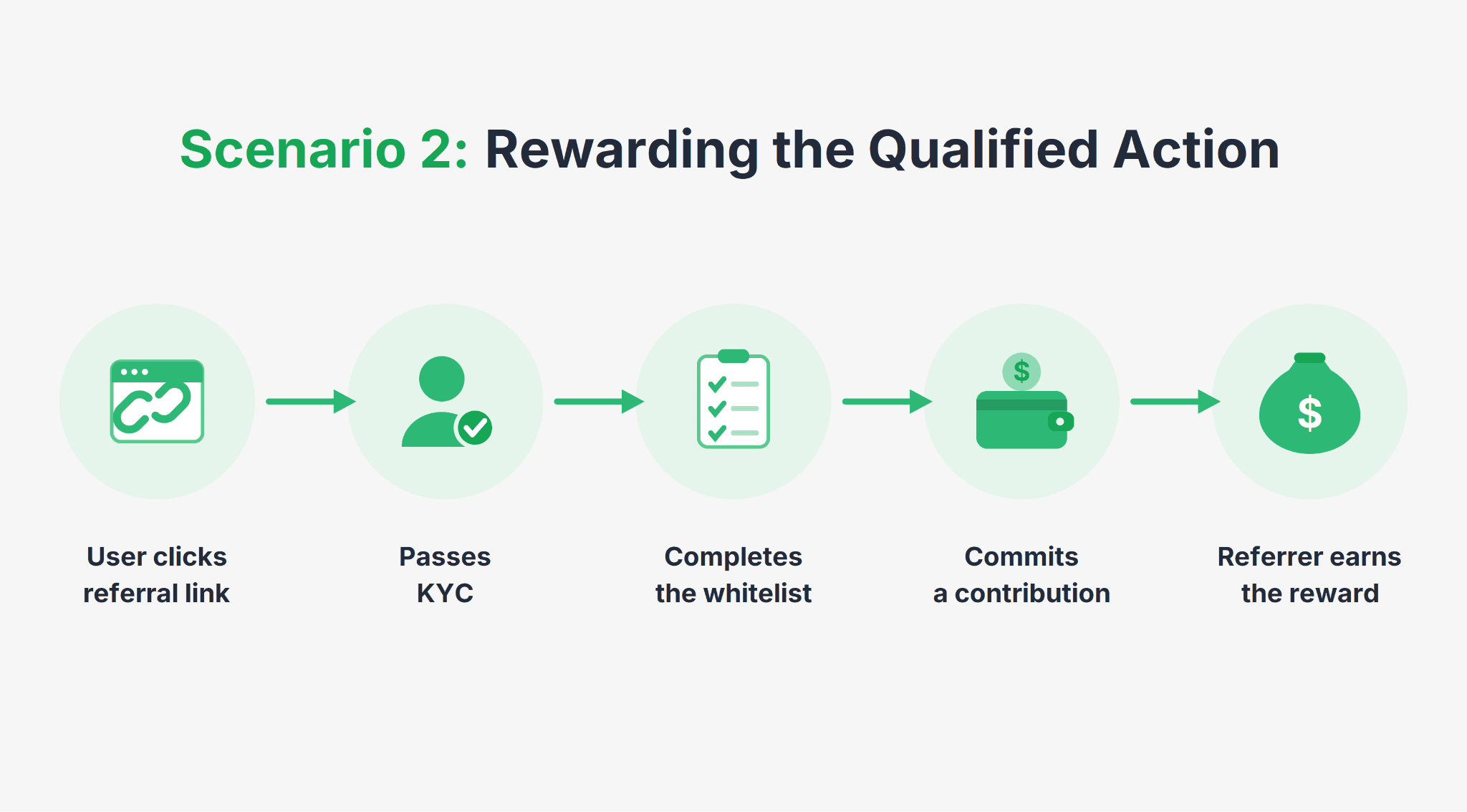
User clicks referral link → passes KYC → completes the whitelist → commits a contribution → referrer earns the reward
Every paid reward in this flow maps to a real, verified buyer. Faking a KYC pass and a funded contribution costs more than the reward is worth, so fraud stops being profitable.
From these two flows, one thing becomes clear. The reward trigger decides the quality of the entire campaign. The economics back this up. A Wharton School study published in the Journal of Marketing found that referred customers deliver about 16% higher lifetime value and are 18% less likely to churn, and research from Deloitte puts referred customer retention 37% higher than other channels.
That quality compounds over time. Verified buyers hold longer, refer to other real buyers, and stabilize the post-listing market. A program that pays for signups buys none of that.
Token Sale Reward Structures That Work
The scenarios above show which actions deserve a reward. The next step is choosing the right reward structure for those actions. The structures that work before TGE share two traits. They scale with the quality of the referred action, and they discourage instant selling.
Three structures meet both requirements. The table below explains how each one works and what to watch out for.
Structure | How it works | Example | Main trade-off |
Tiered allocation | The bonus grows as the referred user moves deeper into the funnel, so shallow referrals earn little and completed purchases earn the most | 10 USDT worth of tokens for a KYC-passed referral, 50 USDT worth for a completed contribution | Needs more tracking, since every funnel stage must be verified before payout |
Milestone bonus | Referrers unlock extra rewards after hitting cumulative targets, which pushes them to keep bringing quality over time | An extra 5% allocation once five referred users contribute, another at fifteen | Slower early momentum, because rewards arrive later than in flat-fee programs |
Vesting-locked bonus | Referral rewards unlock on the same vesting schedule as sale tokens, so referrers only profit if they stay through listing | A referrer's bonus vests monthly over six months alongside buyer allocations | Less attractive to reward hunters, which lowers raw referral volume |
That last trade-off works in the project's favor. Losing reward hunters is exactly what a quality-focused program wants. Teams that want extra engagement on top of this can layer it through quest and loyalty campaigns designed for token sales, which reward repeated genuine actions rather than one-off tasks.
Good reward design still needs enforcement behind it. That is where fraud filters come in.
Anti-Sybil and Fraud Filters in Token Sale Referral Campaigns
Even a well-designed reward structure can still be exploited by professional farmers. To prevent that, projects can take preventive action by deploying a layered filter stack. These filters catch what the reward logic alone cannot. The essential layers are:
Wallet screening that flags fresh wallets, zero-balance accounts, and clusters funded from one source
On-chain proof of activity requiring a minimum transaction history or asset age before rewards count
Contribution caps per wallet and per referrer, so one actor cannot dominate the reward pool
Duplicate detection across KYC data, devices, and IP ranges to collapse multi-account identities
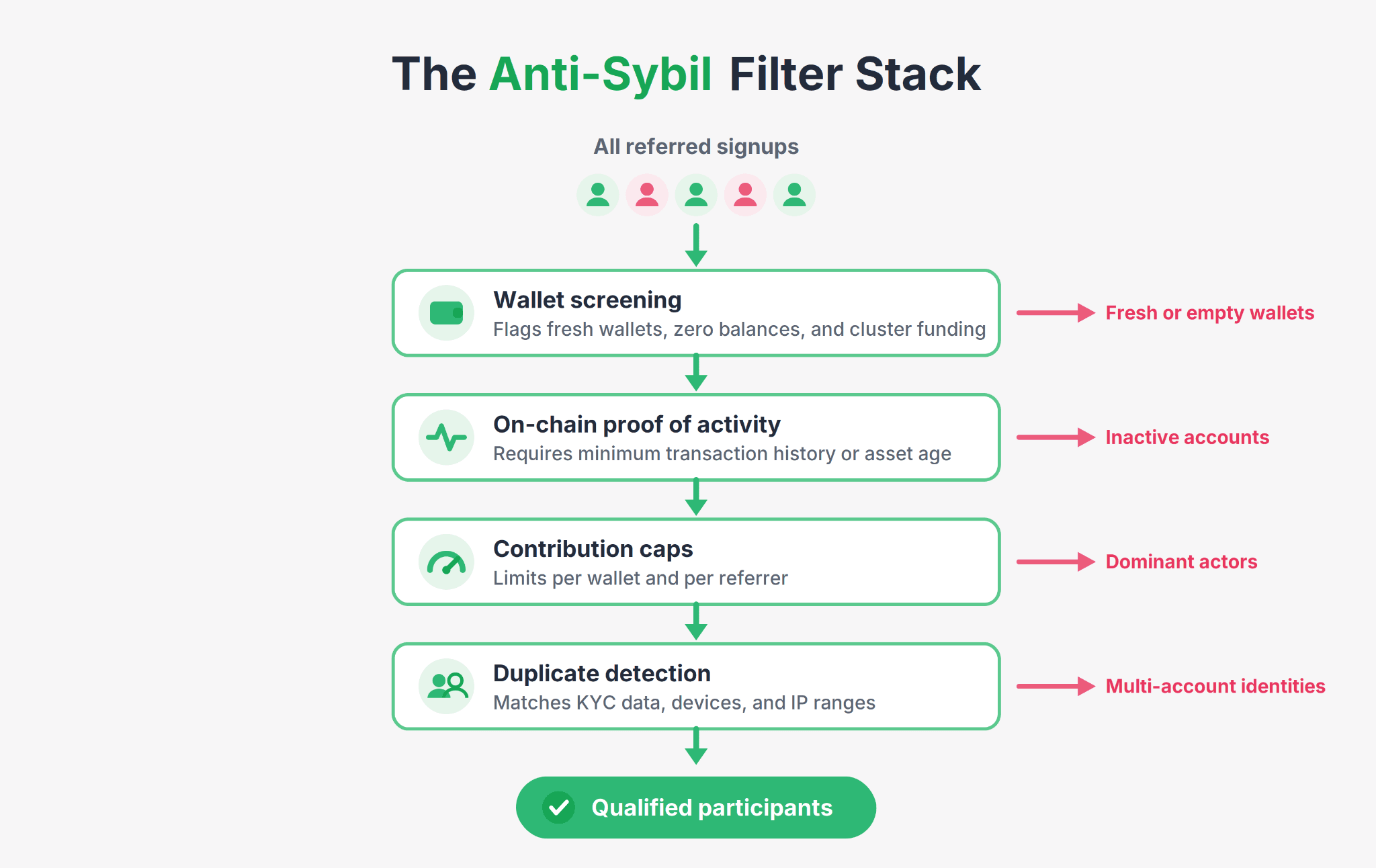
No single layer is decisive on its own. Together they raise the cost of fraud above the value of the reward, which is the practical definition of sybil resistance.
With the budget protected, the remaining question is whether the program is actually delivering buyers. That is what tracking and attribution answer.
How to Track Referral Quality in a Token Sale
To run a referral campaign well, a project needs to set metrics that measure whether the campaign is actually succeeding. That starts with the tracking setup. Each referrer gets a unique code or link, and each conversion should be verifiable on-chain, so attribution ties to wallets and contributions rather than cookies.
Once tracking is in place, three metrics show the real health of the campaign.
Metric | What it shows | Benchmark |
Referred KYC pass rate | Whether referrers bring real, verifiable people instead of duplicate accounts | 60% or higher, and at least matching the organic pass rate |
Referred contribution conversion rate | The share of referred signups that end in a contribution, per referrer | 10–15% of referred signups |
Referred contribution volume | Whether referred users actually become buyers, measured in committed funds | 15–25% of the total raise for a healthy program |
These benchmarks reflect TokenMinds' experience across past token sale campaigns. Different projects, sale sizes, and markets can land on different numbers.
Raw clicks, signups, and channel joins belong on the ignore list. They measure spam efficiency, not sale demand. A dashboard built on the three metrics above tells a team within days which referrers deserve their rewards, and weak referrers can be cut before the budget drains.
Measurement also has a legal dimension, because paying for referrals is regulated activity in many markets.
Compliance Guardrails for Incentivized Referrals
Paying people for referrals is not just a marketing decision. In several jurisdictions, it counts as regulated promotion of an investment product. Some markets ban it outright, while others allow it as long as referrers clearly disclose that they are compensated.
Three guardrails cover most of the risk:
Geo-gate the program. Block users from restricted jurisdictions before they can join, not after.
Require KYC before any payout. Most quality-focused programs already do this, so compliance comes almost for free.
Require disclosure from referrers. Anyone promoting the sale publicly must state that they earn a reward for it.
These steps do not replace legal counsel for the specific sale structure. But they show a useful overlap. Compliance and quality filtering reinforce each other, because both depend on knowing who participants really are.
At this point, every piece of the system has been covered. The next section puts them together into a step-by-step framework.
A Step-by-Step Token Sale Referral Campaign Framework
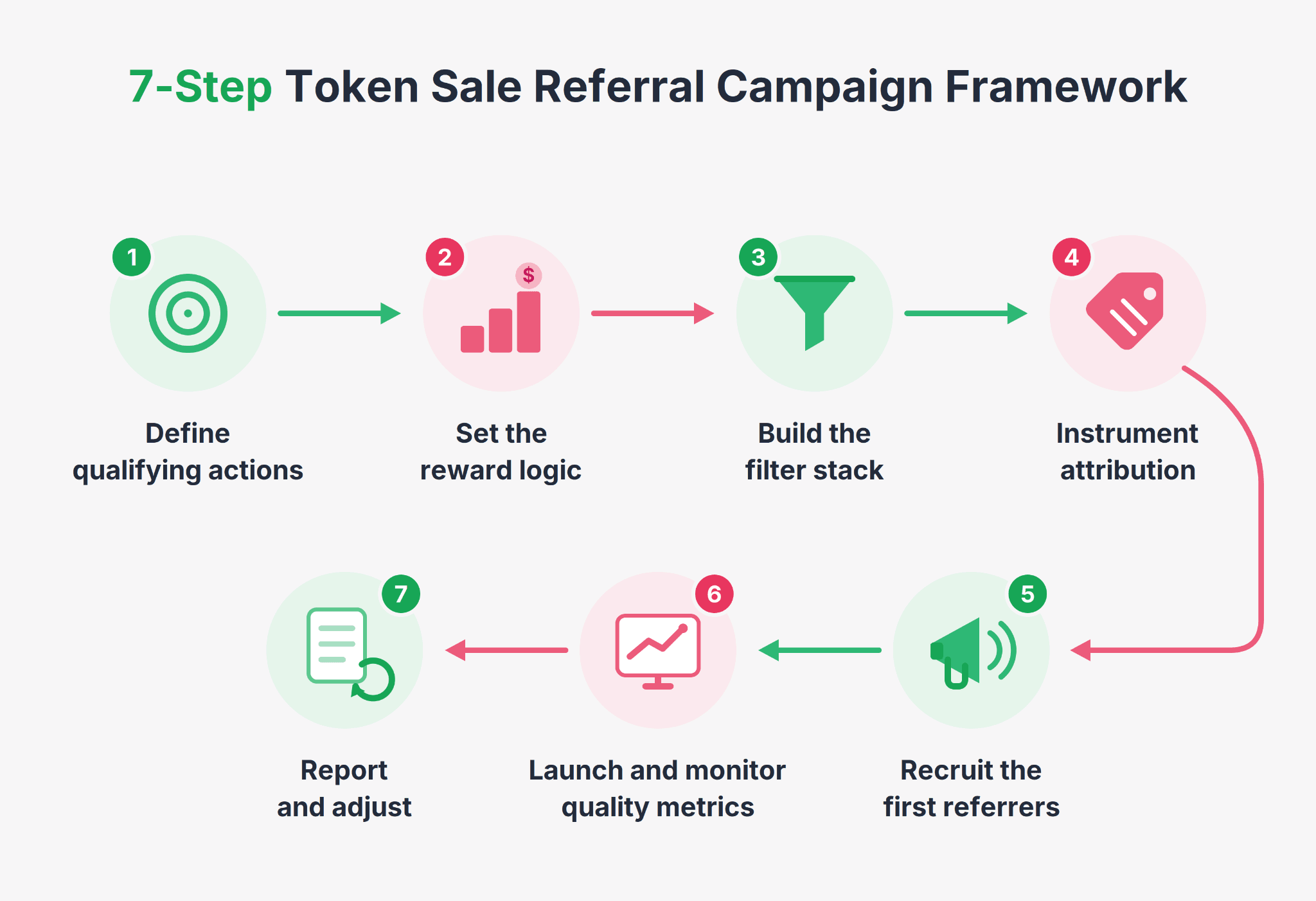
A qualified-participation referral campaign comes together in seven steps:
Define qualifying actions.
Pick the two or three verified actions that trigger rewards, typically KYC pass and minimum contribution.Set the reward logic.
Choose tiered or milestone structures, and lock rewards to the sale's vesting schedule.Build the filter stack.
Deploy wallet screening, activity thresholds, caps, and duplicate detection before launch, not after abuse appears.Instrument attribution.
Issue unique referral codes and connect them to on-chain contribution data.Recruit the first referrers.
Start with existing waitlist members and community contributors, who already show intent. The approach in converting waitlists into token sale purchases pairs naturally with this step.Launch and monitor quality metrics.
Watch referred KYC pass rate and referred contribution volume weekly, and cut referrers whose traffic fails the filters.Report and adjust.
Compare referred contribution volume against other channels and rebalance budget toward what converts.
Useful benchmarks are directional. A referred KYC pass rate well below the organic rate signals farming. Referral leads that convert meaningfully better than paid traffic, as referral research consistently finds, signal the program is doing its job. Broader distribution tactics that surround the sale are covered in these token sale marketing strategies for crypto pre-sales.
Design Your Token Sale Referral Campaign With TokenMinds
The referral program decides where the reward budget ends up. It either converts into committed buyers or drains into bounty spam. It also decides whether the demand signals before TGE can be trusted at all.
TokenMinds has structured token sales end to end since 2016. The work spans sale architecture, tokenomics, and participant acquisition. Its referral campaign design sprint builds the full qualified-participation system in one pass.
The sprint covers reward logic tied to verified sale actions, anti-sybil filtering, vesting-aligned incentives, and attribution dashboards. Projects receive a reward structure mapped to their sale stages, a fraud filter stack ready before launch, and quality benchmarks for managing referrers from day one.
Book a referral campaign design sprint call with TokenMinds.
FAQs
How do teams run a token sale referral campaign?
Start by defining the qualifying actions, usually a KYC pass and a minimum contribution. Reward only those actions and lock the bonuses to the sale's vesting schedule. Then deploy anti-sybil filters and track results through unique referral codes with on-chain attribution.
How do crypto referral programs avoid bounty spam?
By paying for verified behavior instead of signups. KYC-gated rewards, wallet screening, contribution caps, and duplicate detection raise the cost of farming. Once fraud costs more than the reward, the spam stops.
What referral rewards work before TGE?
Three structures work best. Tiered bonus allocations grow as the referred user moves deeper into the funnel. Milestone bonuses reward sustained referrer performance, and vesting-locked rewards keep referrers aligned beyond listing day.