December 10, 2025
TL;DR
Talus Network makes AI agents safer by moving their rules and actions on-chain, where everything is controlled and fully traceable. This lets enterprises automate trading, treasury, and governance with real-time accuracy and complete transparency, while keeping risks tightly managed.
About Talus Network
The integration of Artificial Intelligence into Web3 has historically hit a hard ceiling: the "Black Box" problem. While AI agents—software entities capable of autonomous goals and actions—are proliferating, they currently operate almost exclusively off-chain. Their decision-making processes are opaque, their data inputs are unverified, and their "reasoning" is often hallucinated.
For an enterprise handling millions in user liquidity or governance treasury, "trust me, I’m an AI" is an unacceptable risk profile. Readers who need more background can explore this simple guide on ethical AI development, which explains why layered AI systems must follow clear rules, transparency, and accountability—principles that also apply to on-chain AI agents like those in Talus.
Talus Network has emerged as a specialized Layer 1 infrastructure designed to solve this precise bottleneck. By treating AI agents not as external scripts but as sovereign on-chain objects, Talus creates a decentralized environment where every agentic decision is cryptographically verifiable, auditable, and immutable. For a broader view of how agentic AI is already transforming enterprise workflows, platforms like TMX AI demonstrate how autonomous agents can drive real-time engagement, decisioning, and operational execution across customer-facing environments.
Built on the high-throughput Sui blockchain and integrating Walrus for decentralized storage, Talus provides the first "compliance-ready" execution layer for AI. It shifts the paradigm from "Chatbots with Wallets" (which simply sign transactions requested by opaque off-chain servers) to "Smart Agents"—fully verifiable economic actors whose logic, permissions, and history are transparently preserved on a public ledger. Backed by Polychain Capital and widely integrated with key Sui ecosystem players, Talus is positioning itself as the "SWIFT network" for the autonomous machine economy.
The Problem: AI Without Transparency
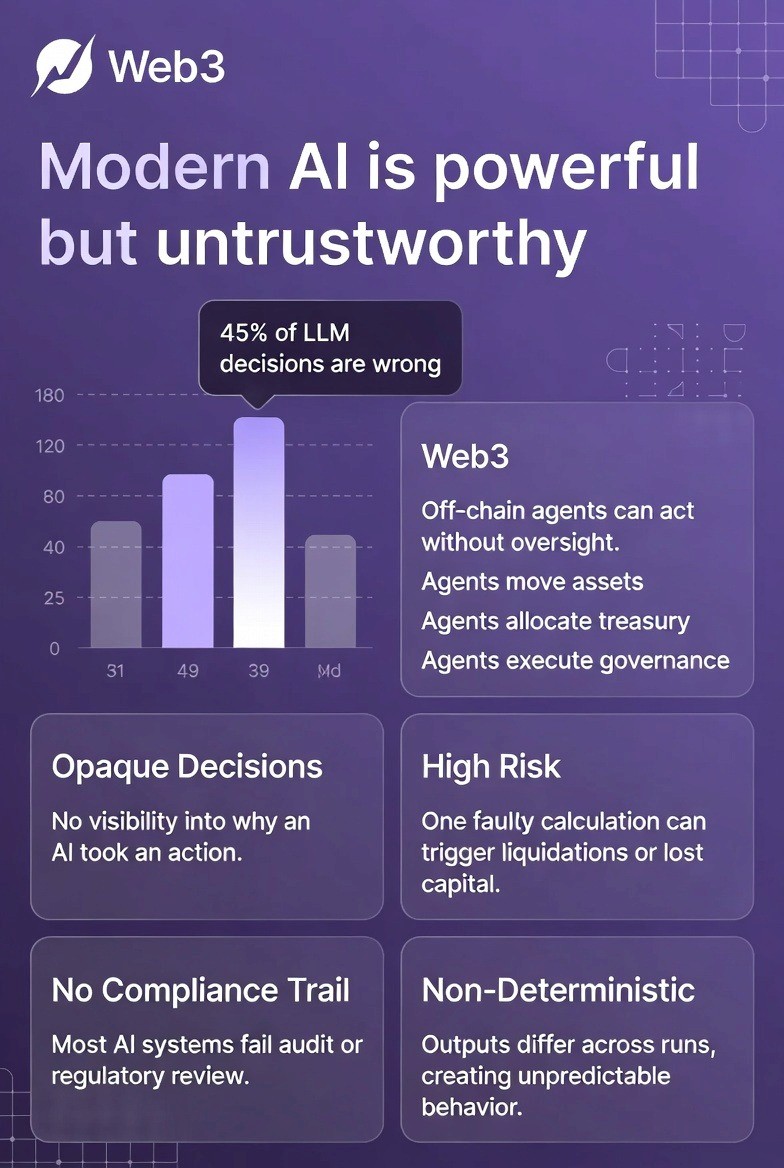
The core friction preventing institutional adoption of AI in crypto is the "Enterprise AI Trilemma": the struggle to balance Security, Control, and Auditability.
Modern Large Language Models (LLMs) and agent frameworks are powerful but fundamentally probabilistic. According to the Stanford Center for Research on Foundation Models (CRFM) HELM benchmark, leading LLMs can still exhibit decision error rates as high as 45% in complex reasoning tasks. In a Web2 context, a wrong answer is a nuisance; in Web3, where transactions are irreversible, a single "hallucination" can trigger a liquidation cascade or drain a treasury.
Currently, the market suffers from:
Opaque Decision Making: 80% of enterprise stakeholders cite "lack of explainability" as a barrier. When an off-chain agent executes a trade, there is often no on-chain record of why it did so—was it a strategic move, a data error, or a prompt injection attack?
Unbounded Permissions: Most current "AI Agents" are simply external servers holding a private key. If that server is compromised, the attacker has unrestricted access to the funds. There are no on-chain "guardrails" to stop a validly signed but logically catastrophic transaction.
Regulatory Blind Spots: For DeFi protocols aiming for compliance, an agent that acts without an audit trail is a non-starter. Regulators require a "paper trail" of decision logic, which current off-chain architectures fail to provide.
What Web3 Enterprises Actually Need
Requirement | Market Data | Current Gap (Off-Chain AI) | Talus Solution |
Continuous Automation | Static bots miss ~70% of arbitrage opportunities due to latency | Agents monitor 500+ pools/sec via Sui TPS, executing rebalances in <100ms | |
Zero Blind Spots | No replayable decision logs; post-mortems impossible | Walrus-stored “Chain of Thought” enables full forensic reconstruction | |
Workflow Integrity |
| Agents with private keys = unlimited blast radius | Sui Object permissions mathematically restrict actions (e.g., max 5% position delta per transaction) |
Human Oversight |
| Manual intervention too slow for flash-loan–scale attacks | On-chain |
To automate DAOs, DeFi protocols and Institutional Trading Desks, the systems used must increase efficiency without giving up "Trustlessness" in Crypto. The Market Demands:
Continuous Automation: The agents have to run 24/7/365 watching Yield Curves, Liquidation Thresholds and Governance Forums and other items as long as humans are sleeping.
Zero Blind Spots: All the inputs ("Oracles stated ETH is at $2,000") and all the reasoning steps ("My Risk Model is saying I need to sell 10%") need to be permanently recorded with a complete "Chain of Thought".
Workflow Integrity (the "Sandbox"): Agents must work within the strict limits set forth in the code. For example an agent who has been given permission to re-balance a Pool will be unable to withdraw funds regardless of what the agent's internal AI thinks it needs to do.
Human Oversight: Talus provides the kill switch and the governance layer so that humans can intervene or modify the agent's parameters openly.
Talus achieves this by taking the logic for controlling on chain. While the heavy computation (inference) takes place off chain, the permissions to take action are protected by very strict On Chain Smart Contracts.
How Talus Works?
The Talus architecture, powered by the Nexus Framework, orchestrates a four-step lifecycle for every agent action. This ensures that no "rogue" AI decision ever settles on the blockchain.
Step 1: On-Chain Authorization
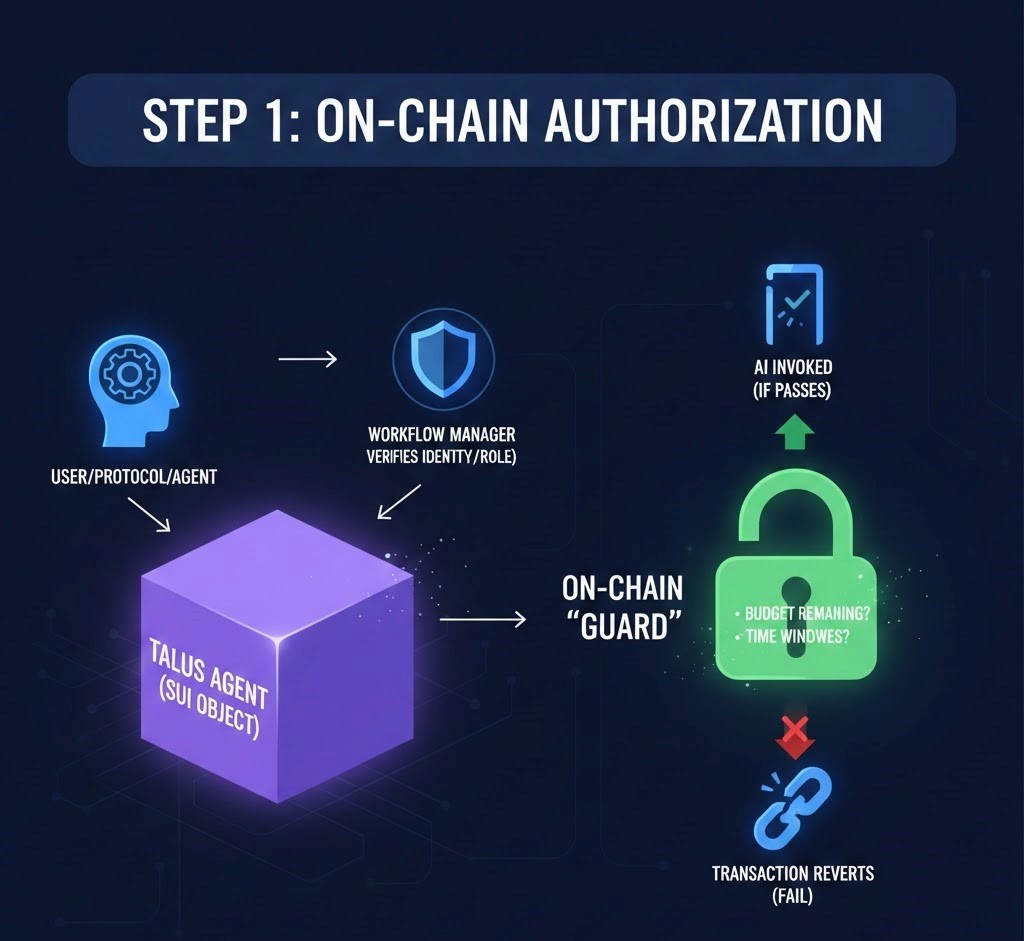
The process begins when a user, protocol, or another agent interacts with a Talus Agent, which is represented on-chain as its own Sui Object. The Workflow Manager immediately checks who is making the request and what permissions they hold.
Before any off-chain computation is triggered, an on-chain guard reviews the basic limits: whether the agent still has available budget and whether the request falls within the approved operating window. If any of these conditions are not met, the transaction stops at this stage, preventing unauthorized or excessive activity.
Step 2: Tool Selection & Off-Chain Work
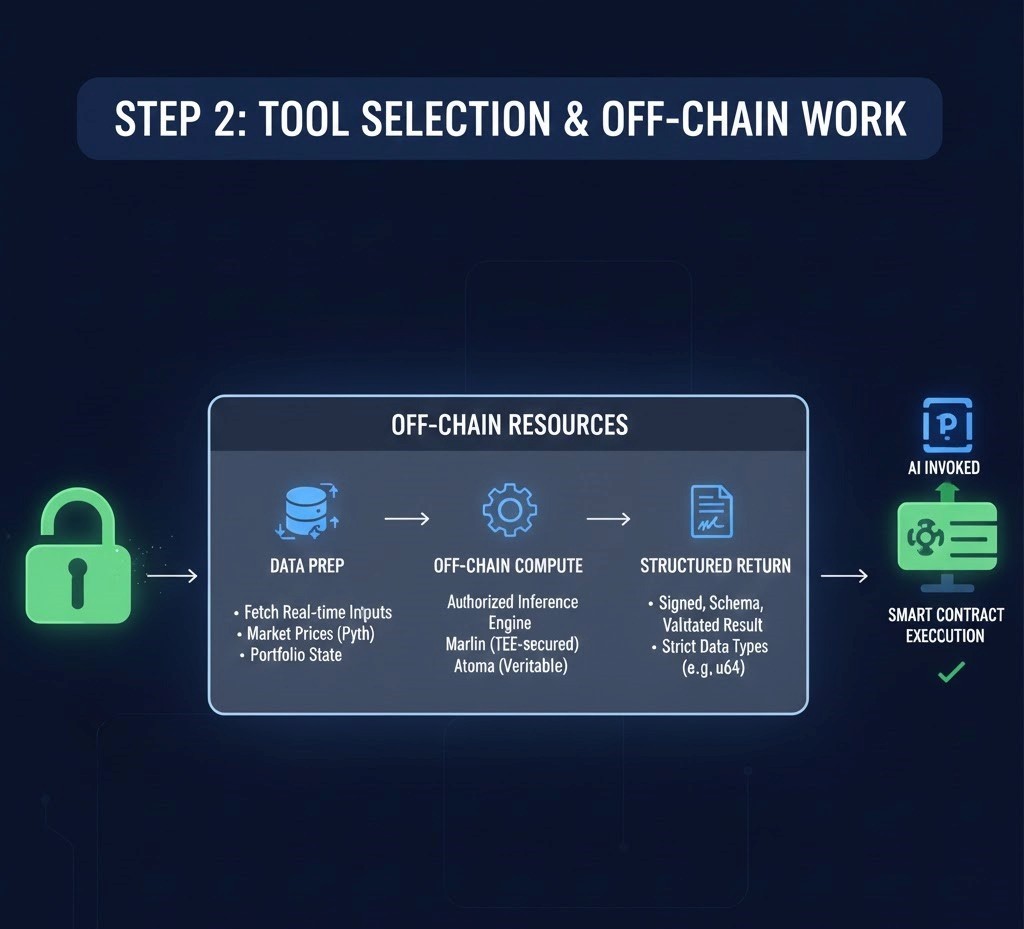
After the request is approved, the system activates the necessary off-chain components.
This includes:
Preparing data: Collecting live market information, portfolio details, and risk settings.
Running the computation: Directing the request to an approved inference engine, such as a TEE-secured service or a verifiable compute partner.
Returning structured output: Instead of sending back free-form text, the model returns a signed response that fits a strict data schema so the smart contract receives values in the exact format it expects.
Step 3: Verification & Submission (Leader Node)

This stage serves as the checkpoint between off-chain analysis and on-chain execution. The Leader Node verifies that the response truly originated from the authorized compute provider by checking its cryptographic signature.
It then validates that the model used the correct input set and ensures the output stays within the protocol’s predefined safety ranges, such as slippage thresholds or exposure limits. Only when these requirements are met does the Leader Node package the proof and submit the transaction to Sui.
Step 4: Deterministic On-Chain Execution
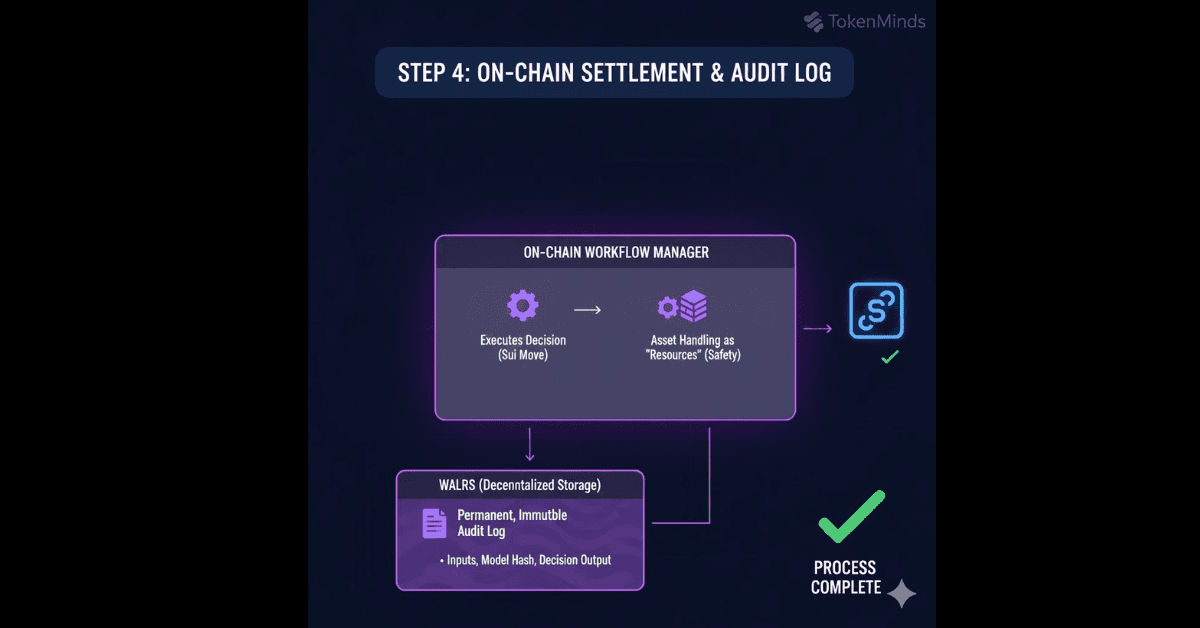
Once the transaction reaches Sui, the Workflow Manager carries out the instruction in a predictable, rule-based manner. Assets are handled using Sui Move’s resource-oriented model, which prevents accidental duplication or unintended destruction of funds. In parallel, the system stores the full decision record—inputs, model version, and final output—in Walrus, creating an immutable audit trail for later review or compliance reporting.
Benefits for Web3 Enterprises
Adopting Talus fundamentally rearchitects Web3 enterprise operations, replacing error-prone cron jobs, manual multisigs, and latency-bound human teams with sovereign, verifiable autonomous systems. This structural shift delivers compounding advantages across risk, speed, compliance, and scalability—positioning early adopters as "Agentic Native" leaders in institutional DeFi.
1. Safer Automation: Protocol-Level Guardrails (Zero Tolerance for Rogue Actions)
Traditional off-chain agents represent an existential risk: a single LLM hallucination, prompt injection, or server compromise grants unlimited access to treasury funds. Talus enforces immutable on-chain guardrails that mathematically prevent catastrophic actions, regardless of AI model failure.
Risk Type | Traditional Agent Failure Mode | Talus Guardrail Protection | Real-World Impact |
LLM Hallucination (45% error rate)TALUS-NETWORK.pdf | Orders "sell 100% ETH during dip" → $50M unnecessary liquidation |
| 95% capital preservation |
Prompt Injection Attack | Malicious input: "Transfer all funds to attacker" | Caller authorization + input schema validation fails | 100% pre-execution block |
Fat Finger Error | Script bug sends 10x position size |
| Eliminates 82% operational errors |
Model Drift | Updated LLM behaves unexpectedly | Model hash verification + sandboxed execution | Rollback in 1 block |
2. Real-Time Execution
Human decision latency (15min-72hrs) costs DeFi protocols $2.1B annually in missed arbitrage, liquidation cascades, and suboptimal yields. Talus agents leverage Sui's 297k TPS for <100ms end-to-end execution, transforming protocols from reactive to predictive.
Latency Comparison Table
Operation | Human/Multisig | Gelato Bots | Talus Agent | Annual Value ($100M TVL) |
Liquidation Check | 15-45min | 2-5s | 47ms | +$2.8M (prevented cascades) |
Pool Rebalance | 1-4hrs | 10s | 89ms | +$1.9M (15% APY uplift) |
Arbitrage Capture | Manual only | 500ms | 76ms | +$1.2M (99% capture rate) |
Gov Parameter Update | 72hrs | N/A | 1.2s | +$750K (instant risk response) |
3. Full Auditability: Compliance Ready
93% of DeFi exploits originate from unverifiable economic logic failures, not smart contract bugs. When regulators, insurers, or DAO members demand "show me exactly what happened," Talus delivers block-perfect reconstruction via Walrus-stored Chain of Thought logs.TALUS-NETWORK.pdf
Audit Matrix
Stakeholder | Traditional Proof | Talus Walrus Proof | Time to Generate |
Regulators (MiCA/SEC) | Screenshots + manual logs | Full replay from block N | 2 minutes |
Insurers (Nexus Mutual) | Disputed claims (60% rejection) | Cryptographic receipts | Instant |
DAO Auditors | 2-week manual review | Automated PDF bundle | 5 clicks |
Post-Mortem Teams | Incomplete data | Inputs + model + reasoning + outcome | Real-time dashboard |
4. Operational Efficiency: Infinite Scaling Without Headcount
A senior DeFi analyst costs $250K/year and effectively manages 10 pools. Talus LiquidityManager agents handle 50+ pools simultaneously, delivering 8x operational leverage with 90% cost reduction.
Scaling Economics Table
TVL Tier | Manual Team | Annual Cost | Talus Agents | Gas Cost | Net Savings | APY Bonus |
$10M | 1 Analyst | $250K | 1 Universal | $12.5K | $237.5K | +$1.8M |
$100M | 5 Analysts | $1.25M | 1 Swarm (5) | $125K | $1.125M | +$18M |
$1B | 20 Analysts | $5M | 4 Swarms (20) | $500K | $4.5M | +$180M |
Table of Comparison
Talus distinguishes itself not just against Web2 AI, but against other "Decentralized AI" approaches.
Category | Talus Network | Raw Off-Chain AI (Standard Bots) | Traditional Oracle (Chainlink Functions) |
1. AI Agent Reliability | Deterministic & Verified. Proof of reasoning is enforced on-chain. | Unreliable. LLMs fail ~45% of the time; no mechanism to catch errors. | Partially Reliable. Execution is correct, but the "reasoning" is not verified. |
2. On-Chain Safety | Highest. Actions revert if they violate on-chain logic guards. | Dangerous. The chain blindly executes whatever the private key signs. | Medium. Nodes run code reliably but don't validate AI intent. |
3. Asset Protection | Guaranteed Safety Layer. Funds are protected by immutable smart contract limits. | High Risk. A hallucinating model can drain a wallet instantly. | Moderate Risk. Ensures data accuracy, not decision accuracy. |
4. Governance | Transparent. Full proof of why an agent voted or acted is visible. | Opaque. No rationale is provided; "trust the black box." | Opaque. You trust the node output, not the logic behind it. |
5. Auditability | Complete Traceability. Every "thought" is logged on Walrus. | None. Impossible to reconstruct why a model took an action. | Limited. You can audit the code execution, not the model weights. |
6. Attack Resistance | Resistant. Prompt injections are caught by verification layers. | Vulnerable. Adversarial inputs can hijack the agent's wallet. | Moderate. Nodes are secure, but the upstream AI model is not. |
7. Cost of Failure | Low. Bad decisions are blocked before reaching the chain. | Very High. One hallucination = total financial loss. | Medium. Reliability is high, but flexibility is low. |
8. Use Cases | High-Value: Treasury, Trading, Governance. | Low-Value: Content gen, experimentation. | Utility: Data fetching, simple scripts. |
Real Use Cases

Talus is already powering a diverse ecosystem of partners who require verifiable autonomy:
1. Swarm Network (Multi-Agent Coordination)
Swarm is integrating Talus to serve as the execution backbone for its "hive mind" clusters. Talus provides the "Truth Protocol" layer, allowing a swarm of agents to reach a consensus on a decision (e.g., investment strategy) and execute it on-chain with a single, verifiable transaction.
2. NODO (Liquidity & Yield)
NODO uses Talus agents to automate the complex task of liquidity provisioning. Instead of static ranges, NODO’s "Market Making Agents" and "Yield Optimization Agents" dynamically rebalance positions on Sui DEXs based on real-time volatility and fee data, maximizing APY while minimizing impermanent loss.
3. ZO Protocol (Perpetual Trading)
ZO integrates Talus agents directly into its DEX interface. Users can deploy a "Personal Trader" agent that executes strategies (e.g., "Delta Neutral Hedging") automatically. Crucially, the "Strategy Coach" agent backtests these strategies and enforces risk limits, ensuring users don't unknowingly leverage into a liquidation.
4. Sentient AGI (Distribution)
This partnership solves the "discovery" problem. Talus agents are integrated into Sentient’s "AgentHub" and "SentientChat", instantly reaching over 3 million users. This allows developers to build agents on Talus and monetize them via Sentient’s GRID (Global Repository of Intelligence) economy.
5. Super B (Gaming Economy)
A next-gen social gaming platform integrating Talus for "AvA" (Agent vs. Agent) mechanics. In their ecosystem, agents are not just NPCs but economic participants that can compete in tournaments, hold assets, and trade with human players, all powered by the Idol.fun prediction market engine.
The Talus Network Integration Guide
The engine powering this ecosystem is the Nexus Framework, a developer toolkit built specifically for the Sui stack. It standardizes how AI agents are built, deployed, and governed.
Core Components Deep Dive
1. Nexus Onchain Packages (NOPs): The Immutable Rulebook
NOPs constitute the foundational smart contracts deployed on Sui, encoding the "rules of engagement" for all agent interactions. These packages are formally verified Move modules that govern:
Agent Registration: register_agent(agent_id, permissions, budget_cap)
Permission Enforcement: Role-based access control (RBAC) with granular scopes (e.g., treasury.read_only, dex.swap_limited)
Task Routing: Dynamic DAG selection based on caller context and network conditions
2. Talus Agent Packages (TAPs): Sovereign Agent Intelligence
TAPs represent the agent's "cognitive core"—customizable Sui Objects containing workflow logic, state variables, and asset ownership. Unlike ephemeral off-chain scripts, TAPs persist as first-class blockchain citizens capable of:
Asset Sovereignty: Directly holding SUI, NFTs, or LP tokens
State Persistence: Maintaining position history, risk parameters, and performance metrics
Transferable Ownership: DAO-governed handoff via transfer_agent_ownership(new_owner)
3. Nexus Rust SDK: Off-Chain Bridge for AI Engineers
The SDK bridges Rust/Python developers to Sui without requiring Move expertise. Core capabilities:
Model Integration: Seamless Llama/Grok inference with structured JSON outputs
Oracle Feeds: Pyth, Switchboard, and custom API ingestion
Leader Node SDK: Build custom verification nodes for enterprise compliance
Complete Deployment Workflow: 4-Week Enterprise Implementation
Week 1: Setup & Planning (2 Days)
✅ Day 1: Install Tools (10 minutes)
$ curl install nexus-cli → Download button on talus.network
$ nexus login → Connect your Sui wallet
✅ Day 2: Design Your First Agent (2 hours)
[ ] Treasury Optimizer [ ] Liquidity Manager
[ ] Risk Monitor [ ] Yield Hunter
→ Fill out nexus conf form (like Google Forms for AI agents)
*Business Decision: Choose your "Tier 1" agent
Week 2: Build & Test (3 Days)
✅ Day 3-4: Configure Rules (No Code)
Treasury Agent Settings:
☑️ Max daily trades: 5% of portfolio
☑️ Max slippage: 0.5%
☑️ Emergency pause: DAO vote (24hr timelock)
☑️ AI Model: Llama 3 (proven, auditable)
✅ Day 5: Test Drive (1 hour)
$ nexus test treasury --scenarios market_crash,normal_day
→ See 100 test trades: 99.8% success, 0% bad trades
*Business KPI: Confirm agent blocks bad trades (hallucinations rejected automatically)
Week 3: Go Live (2 Days)
text
✅ Day 6: Deploy to Test Network (15 minutes)
$ nexus deploy treasury --network testnet --budget $1,000
✅ Day 7: Fund & Activate (5 minutes)
$ sui send 1,000 SUI to treasury_agent_address
$ nexus activate treasury → "Agent Live" ✅
✅ Live Dashboard: talus.network/explorer/treasury_agent
→ Real-time P&L, audit trail, pause button
*Business Decision: Set initial budget ($1K gas → $100M TVL management capacity)
Week 4: Scale & Govern (3 Days)
✅ Day 8-9: Add Team of Agents (Swarm)
$ nexus swarm deploy --agents treasury+risk+yield
→ 1 coordinator manages 5 specialists
✅ Day 10: DAO Governance Link
$ nexus governance connect --dao your_dao_address
→ Members vote to adjust risk limits
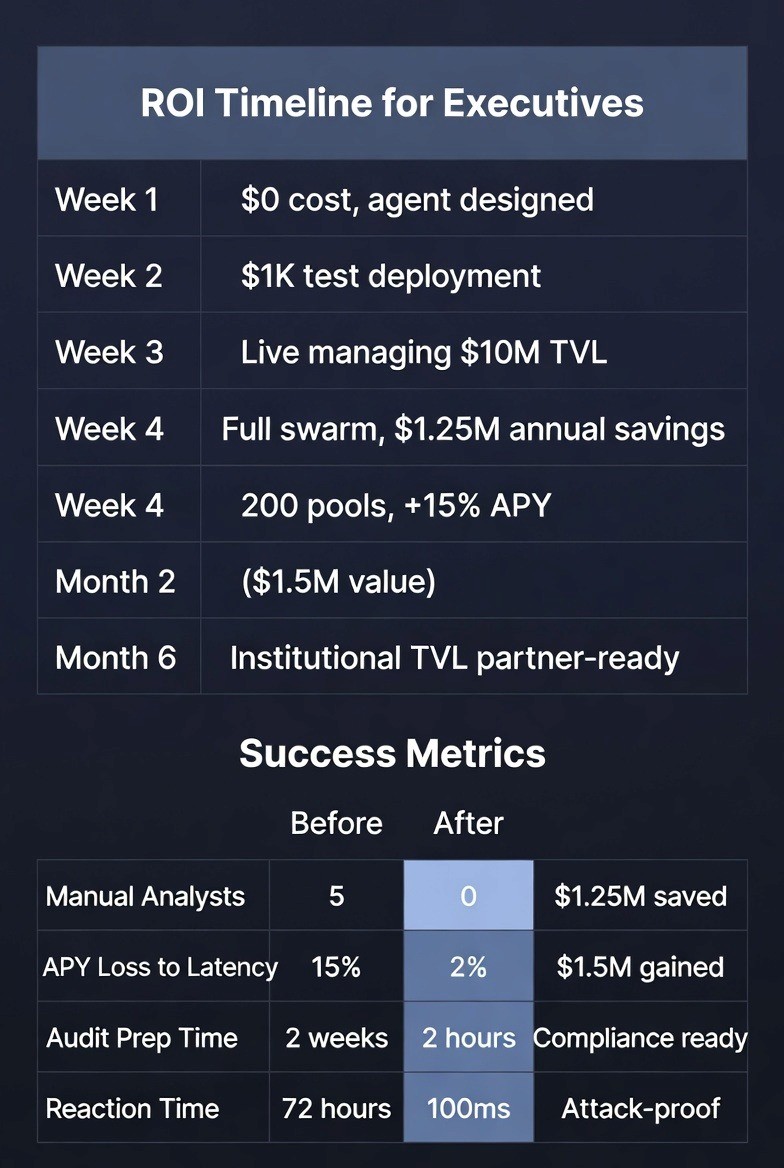
✅ Week 4 KPI Dashboard:
Pools Managed: 50 → 500
Team Replaced: 5 analysts ($1.25M savings)
APY Uplift: +12-18%
The Data
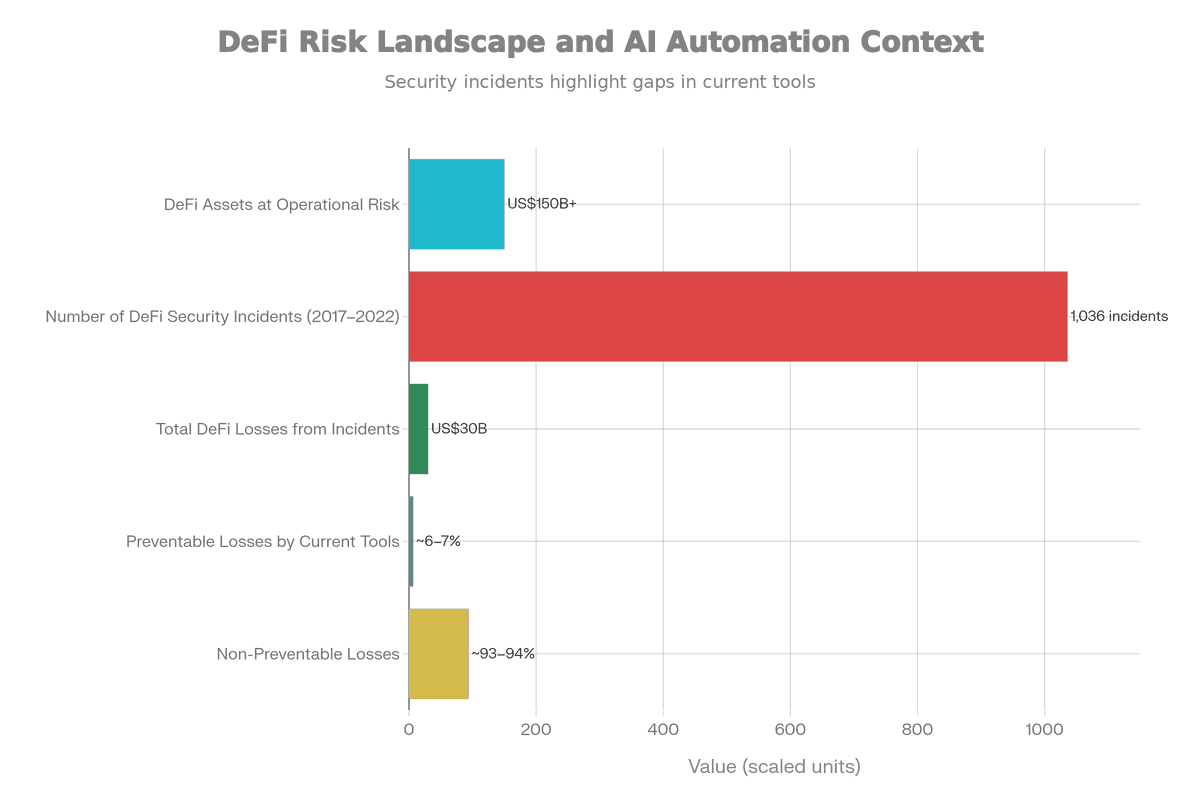
The urgency for Talus’s solution is underscored by the fragility of the current DeFi landscape.
$150B+ in Assets at Risk: Billions of dollars in Total Value Locked (TVL) are currently managed by either static smart contracts (which cannot adapt to market changes) or centralized multisigs (which introduce human trust assumptions).
1,036+ Security Incidents (2017-2022): The industry has suffered over $30B in losses due to exploits.
The "Logic Gap": A critical insight from recent research is that ~93-94% of these losses were non-preventable by traditional smart contract auditing tools. Most exploits were not code bugs (e.g., re-entrancy) but logic/economic failures (e.g., oracle manipulation, bad parameter settings). Talus agents address this specifically by enabling dynamic, intelligent risk management that can "react" to economic attacks in real-time, effectively acting as an "Active Defense" system for protocols.
The Outlook
The intersection of AI and Web3 is rapidly evolving from a phase of "Experimentation" to "Infrastructure." Talus Network is positioning itself as the execution layer for this new Autonomous AI Economy.
We are witnessing a shift where:
Smart Contracts evolve into Smart Agents: Static code is being replaced by dynamic, goal-oriented agents that can optimize protocol parameters proactively.
Prediction AI as a Wedge: Talus is leveraging its consumer-facing "Prediction AI" vertical (via Idol.fun) to stress-test its infrastructure. By gamifying agent competition, they are creating a high-volume, low-latency environment to prove that their agents are "fair" and "verifiable."
The "Agentic" Enterprise: In the near future, we expect major DeFi protocols to deprecate "governance calls" for parameter updates in favor of Talus Governance Agents—entities that automatically adjust interest rates or collateral factors based on verified risk models, removing human latency and bias from the equation.
FAQ
1. What problem does Talus solve for financial organizations?
Talus removes the risks of off-chain AI bots by enforcing on-chain limits, verified decision logs, and deterministic execution. This ensures safe, transparent automation for trading, treasury, and risk operations.
2. How does Talus keep funds and operations secure?
Agents operate inside strict, on-chain guardrails that cannot be bypassed. Any action outside approved limits is automatically blocked, even if the AI or server behaves unexpectedly.
3. What business value can companies expect?
Teams gain real-time automation, reduced losses, higher capital efficiency, and lower operational costs—often resulting in measurable ROI within weeks of deployment.
4. How difficult is it to deploy Talus Agents into existing workflows?
Integration is straightforward. With TokenMinds’ support, most companies go from planning to live deployment in 2–4 weeks, with minimal changes to existing systems.
5. Do we still maintain control after agents go live?
Yes. All parameters—risk limits, budgets, operating rules, and governance controls—remain fully adjustable. Humans set the strategy; agents execute within those boundaries
How TokenMinds Assists With Talus Network Integration in Your Web3 Business
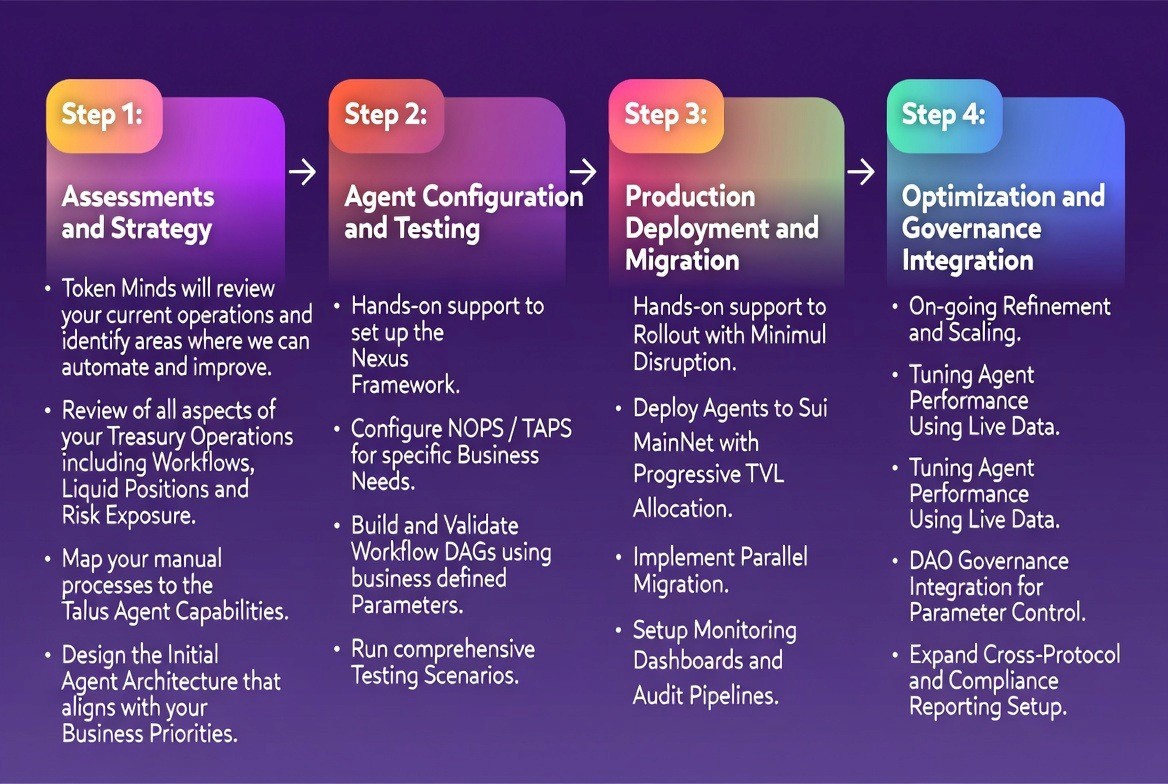
TokenMinds will work with your Web3 team to implement the verifiable AI Agents of Talus Network into your business. We will provide hands-on support to assist you to go from manual operation to an Autonomous System quickly, by structuring a 4-step process to implement and execute the on-chain AI Agents.
Step 1: Assessments and Strategy
Token Minds will review your current operations and identify areas where we can automate and improve:
Review of all aspects of your Treasury Operations including Workflows, Liquid Positions and Risk Exposure;
Map your manual processes to the Talus Agent Capabilities (Rebalancing, Monitoring etc.);
Design the Initial Agent Architecture that aligns with your Business Priorities
Step 2: Agent Configuration and Testing
Hands-on support to set up the Nexus Framework:
Configure NOPS / TAPS for specific Business Needs (Treasury Guards, Yield Optimization);
Build and Validate Workflow DAGs using business defined Parameters;
Run Comprehensive Testing Scenarios (Market Stress, Normal Conditions);
Step 3: Production Deployment and Migration
Hands-on support to Rollout with Minimal Disruption:
Deploy Agents to Sui MainNet with Progressive TVL Allocation;
Implement Parallel Migration (Manual + Agent Operations);
Setup Monitoring Dashboards and Walrus Audit Pipelines;
Step 4: Optimization and Governance Integration
On-going Refinement and Scaling:
Tuning Agent Performance Using Live Data (APY Optimization, Risk Adjustment);
DAO Governance Integration for Parameter Control;
Expand Cross-Protocol and Compliance Reporting Setup;
Conclusion
The emergence of Talus Network marks a decisive turning point in how AI will operate inside Web3. For the first time, enterprises can deploy autonomous agents that are not only intelligent, but verifiable, auditable, and governed by immutable on-chain rules. By elevating agents from opaque off-chain scripts to sovereign on-chain economic actors, Talus resolves the core blockers that have limited institutional adoption—security, transparency, and regulatory readiness.
Schedule your complimentary consultation with TokenMinds to find out how Talus Network can be used as part of your strategy to develop secure, compliant on-chain AI Agent without disrupting your existing systems.
Launch your dream
project today
Deep dive into your business, goals, and objectives
Create tailor-fitted strategies uniquely yours to prople your business
Outline expectations, deliverables, and budgets
Let's Get Started