TLDR
TokenMinds suits teams building cross-chain payment systems, asset tokenization platforms, or enterprise parachain infrastructure, while PixelPlex, LeewayHertz, and Innowise fit large-scale or protocol-level builds, and LimeChain, EvaCodes, Blaize, Rapid Innovation, IdeaSoft, and Webisoft work well for parachains, dApps, audits, or specialized Polkadot projects with different scope and technical depth.
Polkadot is the infrastructure layer that makes multi-chain Web3 possible, as outlined in this research. Over 550 projects run on it. Parachain coretime replaced auction slots in 2024, opening the network to more builders at lower cost. JAM, Polkadot's next-generation compute layer, is in active development. The Polkadot SDK now supports EVM and Wasm in the same environment. Every serious multi-chain project eventually asks the same question: who builds this?
Finding the right team matters. Substrate is written in Rust. Parachain runtime logic is complex. XCM messaging between chains has its own attack surface. A team that only knows Solidity will hit a wall fast.
This guide ranks the best Polkadot blockchain development companies in 2026. Rankings are based on verified Polkadot experience, stack depth, track record, and client outcomes.
Quick Comparison: Best Polkadot Blockchain Development Companies 2026
Rank | Company | Key Services | Rate | Founded |
1 | TokenMinds | Parachain Strategy, XCM, Substrate, DeFi, AI-Native, Tokenization | $50-$79/hr | 2017 |
2 | PixelPlex | Substrate, Parachain, XCM, Smart Contracts, DeFi, Wallets | Custom | 2011 |
3 | LeewayHertz | Parachain, Substrate, ink!, Rust, XCM, Pallets, DeFi | $50-$99/hr | 2007 |
4 | LimeChain | Substrate, Parachain, Cross-chain Bridges, Protocol Dev, ZK | Custom | 2017 |
5 | EvaCodes | Parachain, XCM, ink!, Substrate, DeFi, NFT, Wallets | Custom | 2019 |
6 | Blaize | Substrate Audit, Smart Contract Security, Polkadot Dev | Custom | 2017 |
7 | Rapid Innovation | Substrate, Parachain, XCM, dApps, DeFi, Wallets | Custom | 2019 |
8 | Innowise Group | Substrate, Parachain, Smart Contracts, DeFi, Tokenization | $50-$100/hr | 2007 |
9 | IdeaSoft | Polkadot dApps, Substrate, Smart Contracts, DeFi, Compliance | $50-$99/hr | 2016 |
10 | Webisoft | Substrate, Parachain, XCM, dApps, Smart Contracts, Wallets | Custom | 2018 |
What Is Polkadot Blockchain Development?
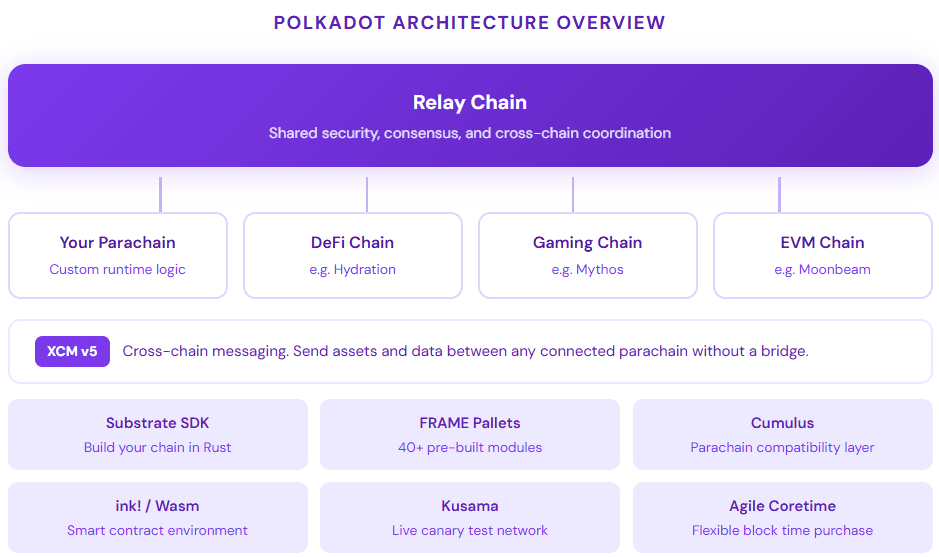
Polkadot development covers two main paths. The first is building on an existing parachain. The second is launching your own parachain using the Polkadot SDK.
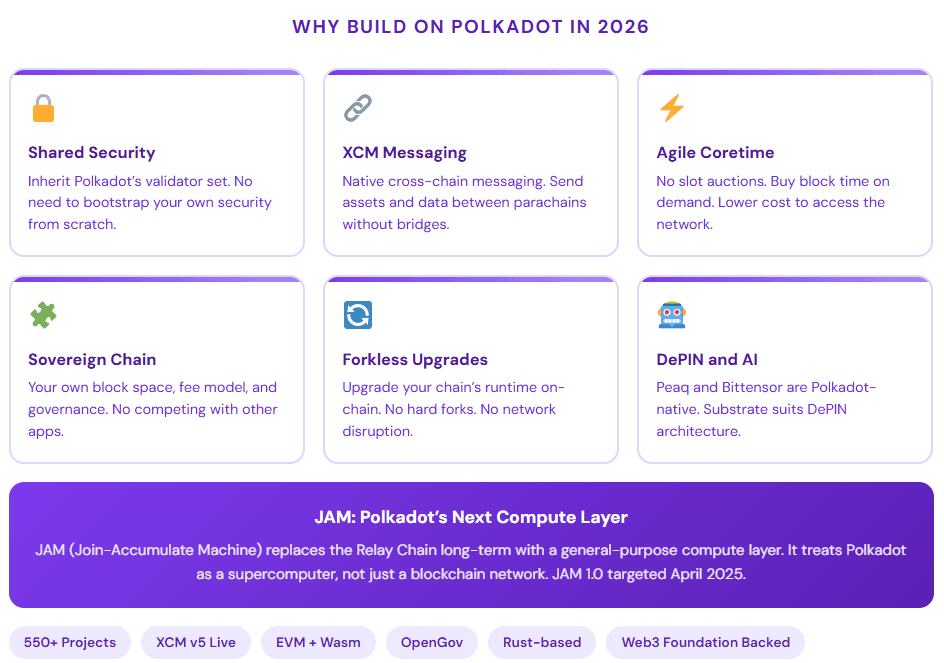
The Relay Chain sits at the center of Polkadot. It handles shared security and consensus for all connected parachains. Parachains are application-specific blockchains that run in parallel. They inherit Relay Chain security without running their own validator set. This is the core value proposition. You get sovereign chain logic without bootstrapping your own security from scratch.
Key tools in the Polkadot development stack:
Substrate / Polkadot SDK: The Rust-based framework for building custom blockchains. Every parachain is built on it. It provides over 40 pre-built runtime modules called pallets. Developers compose and extend them to build chain logic.
FRAME: The modular pallet system inside Substrate. It handles balances, governance, staking, identity, and more. Custom pallets add business-specific logic.
Cumulus: The extension that turns a Substrate chain into a Polkadot-compatible parachain. It handles relay chain communication, block validation, and collation.
XCM (Cross-Consensus Messaging): Polkadot's cross-chain messaging format. It lets parachains send assets and arbitrary messages to each other without bridges. XCM v5 launched in 2025 with major interoperability upgrades.
ink!: Rust-based smart contract language for Substrate chains. Compiles to WebAssembly. Used on parachains that support smart contracts, like Astar and Aleph Zero.
Kusama: Polkadot's canary network. Projects test parachains on Kusama before launching on Polkadot mainnet. Kusama is live and functional, not just a testnet.
Agile Coretime: Replaced parachain slot auctions in 2024. Builders now purchase block time directly. More flexible and accessible than the old auction model.
JAM (Join-Accumulate Machine): Polkadot's next-generation compute protocol. Designed to replace the Relay Chain long-term with a more scalable, general-purpose compute layer.
Polkadot.js / PAPI: Developer APIs for interacting with Polkadot chains. PAPI (Polkadot-API) is the newer light-client-first approach.
Polkadot runtime is built in Rust. Smart contracts use ink! or Solidity (on EVM parachains like Moonbeam). Developers with only Ethereum experience face a learning curve. The pallet system, Wasm runtime, and XCM messaging model all require hands-on Polkadot knowledge.
How We Ranked These Companies
Each company was evaluated on five points:
Polkadot-specific track record: Real parachain deployments, Substrate builds, or XCM integrations
Stack depth: Substrate, Rust, ink!, FRAME pallets, Cumulus, and XCM proficiency
Service breadth: Full-cycle builds from chain architecture to frontend and post-launch support
Track record: Published case studies, Clutch reviews, or third-party recognition with named clients
Pricing clarity: Clear rate ranges where published
Full Company Profiles
1. TokenMinds
Website: tokenminds.co | Founded: 2017 | Rate: $50-$79/hr | Location: Singapore
Polkadot's core promise is sovereign chains that talk to each other. TokenMinds has published deep technical work on exactly this. Their team covers parachain architecture, XCM integration, and cross-chain DeFi design. Their published guide on Polkadot parachains and XCM covers coretime allocation, XCM composability, and cross-chain NFT transfer patterns. That is working knowledge, not marketing copy. This is not surface-level content. It reflects working knowledge of how the ecosystem fits together.
Khan Bank is a verified client. Khan Bank is Mongolia's largest commercial bank. It serves 2.9 million customers across 548 branches and covers 82% of the population. Euromoney and The Banker both name it Best Bank in Mongolia. BitGet, a top global crypto exchange and leading derivatives platform, is another client. UXLINK is also a client. The Web3 social platform has 54 million users and OKX as a partner. Projects at this scale need cross-chain infrastructure that holds under enterprise load.
Three live products back every TokenMinds engagement. TMX Payments handles multi-network transfers, KYC/AML compliance, stablecoin settlement controls, and ERP sync. On Polkadot, this means XCM-native asset flows between parachains without bridge risk. TMX Tokenize covers real estate, commodities, securities, and loyalty programs. The Polkadot SDK handles the issuance layer with full compliance controls built into the runtime. TMX Agentic Finance adds AI automation to on-chain treasury control: reserve monitoring, approved transaction execution, and anomaly detection. Documented results include 97% KYC completion and settlement cut from 48 hours to under five minutes.
Singapore puts TokenMinds inside MAS regulatory frameworks. For Polkadot projects targeting Southeast Asian financial markets, this compliance depth is practical, not decorative.
Stack: Substrate SDK · XCM · Parachain architecture · Rust · ink! · FRAME pallets · KYC/AML · AI treasury automation
Best For: Cross-chain DeFi and payment platforms · XCM-native enterprise builds · Compliance-first Polkadot projects
Awards: Hackernoon (2019) · NewAffinity (2020) · NewsBTC (2022) · Entrepreneurship Life (2023) · MSN (2024) · Coinranking (2025) · Finbold (2026)
2. PixelPlex
Website: pixelplex.io | Founded: 2011 | Rate: Custom pricing | Location: Global
PixelPlex has one of the most detailed verified Polkadot case studies on this list. They built Rio Chain, a Substrate-based blockchain protocol for Rio DeFi. The project involved forking Substrate and integrating the EVM. They built a blockchain explorer, a Web3 browser extension, and deployed 13 smart contracts. The result: 2-second block creation, up to 3,000 TPS, customizable consensus, and the ability to communicate with other chains. This is a full parachain-level build, not a contract deployment.
Services span DeFi platforms, NFT marketplaces, wallets, explorers, and audit trail systems. The Rio DeFi case includes a Uniswap-based DEX fork, an OAuth keyless sign-in system, and a hybrid database system. This shows full-stack Substrate depth across multiple build types.
Stack: Substrate · Rust · EVM integration · XCM · Parachain builds · Custom consensus · DeFi · NFT · Wallets
Best For: Full Substrate chain builds · EVM-on-Substrate hybrid projects · Polkadot DeFi ecosystems
Credentials: Rio DeFi case study (Substrate fork, EVM, 13 contracts) · HELO blockchain build · Clutch-reviewed
3. LeewayHertz
Website: leewayhertz.com | Founded: 2007 | Rate: $50-$99/hr | Location: San Francisco, CA
LeewayHertz runs Polkadot and Substrate development as a core practice, not a side offering. They build parachains, Relay Chain integrations, and pallets using the Substrate framework in Rust. Their team works with ink! smart contracts, FRAME pallets, and Cumulus for parachain compatibility. Before any mainnet deployment, they run parachain testing on Kusama. Slot leasing, coretime allocation, and end-to-end parachain modeling are all part of their documented service offering.
The Polkadot SDK runtime environment runs on Rust, C++, and Golang. Their team covers all three. Consulting on parachain model design, including runtime logic and token economics, is a specific service they offer. They also published a step-by-step guide on building Polkadot parachains, covering the Substrate parachain template, Cumulus integration, and Rococo testnet deployment.
The broader team runs 250+ developers across Ethereum, Hyperledger, Polkadot, TRON, Stellar, and EOS, with 60+ blockchain projects delivered. The Hackett Group acquired LeewayHertz, adding generative AI depth to the practice. Clutch shows a 4.7/5 rating. Clients include ESPN, 3M, McKinsey, and the US Army.
Stack: Substrate, Rust, ink!, FRAME pallets, Cumulus, XCM, Golang, parachain modeling, Kusama testing
Best For: Full parachain builds with consulting, Kusama-tested launches, enterprise teams needing runtime and token economics design
Awards: Clutch 4.7/5, acquired by The Hackett Group
Credentials: 250+ developers, 60+ blockchain projects, parachain build guide published
4. LimeChain
Website: limechain.tech | Founded: 2017 | Rate: Custom pricing | Location: Sofia, Bulgaria
LimeChain has contributed to Polkadot at the protocol level, and there is public evidence to back it up. In late 2022, they secured a Polkadot Treasury grant to build Gosemble, a framework for Substrate-compatible runtimes written in Go. Phase one delivered a working runtime using the AuRa consensus algorithm. They also built Fruzhin, a Polkadot Host implementation in Java, and created the Parachain Validation Conformance Testing kit that parachain developers across the ecosystem now use.
On the tools side, they built Polkadot devGround using the new PAPI light-client-first approach. Their GiantSquid indexer covers Polkadot data. The Polkadot Conformance Testing Suite is an open tool that the developer community actively uses. These are not blog posts or landing pages dressed up as contributions. They are real tools that real developers depend on.
Their services cover core protocol development, cross-chain bridges, DeFi builds, dApp development, ZK tech, and smart contracts on Polkadot and Ethereum. Clutch shows a perfect 5.0/5.0 rating. A verified case study shows 176 million tokens staked on a platform they built, 10,000 unique users onboarded, and 20 million tokens paid out in rewards.
Stack: Substrate, Rust, Go, Java, Polkadot SDK, XCM, cross-chain bridges, ZK proofs, PAPI
Best For: Protocol-level Polkadot work, Treasury-funded builds, cross-chain bridge development
Awards: Clutch 5.0/5.0, Global Blockchain Leader (Clutch)
Credentials: Polkadot Treasury Grant (Gosemble), Polkadot devGround tool, Conformance Testing Suite, 176 million tokens staked on client platform
5. EvaCodes
Website: evacodes.com | Founded: 2019 | Rate: Custom pricing | Location: Ukraine
EvaCodes has built a serious Polkadot practice. Their work covers parachain builds, XCM integration, and ink! smart contracts. They handle everything from slot leasing through to mainnet deployment, building custom parachains with shared security and on-chain governance. One thing that sets them apart is that they actually understand the architecture. The Relay Chain does not process smart contracts directly. EvaCodes builds those environments on top of the parachain layer, which is where that capability belongs.
Their Polkadot work covers DeFi apps, digital wallets, IoT applications, gaming apps, and Web3 infrastructure. DEX platforms run on multi-chain Substrate for cross-parachain token trading. Lending and borrowing platforms use Polkadot's low-cost model for passive income protocols. The same Hacken and CertiK audit partnerships they use for TRON builds carry over to Polkadot. Every ink! smart contract goes through a security review before mainnet deployment.
Clutch named them the number one blockchain agency in Ukraine in 2022. Their 150+ delivered projects include AliumSwap, a multi-chain DEX with hybrid liquidity, and Nebeus, a crypto-backed financial platform.
Stack: Substrate, Rust, ink!, XCM, Cumulus, parachain builds, DeFi, NFT, wallets, IoT
Best For: Parachain builds with smart contract layers, Polkadot DeFi and DEX protocols, security-audited ink! contracts
Awards: Clutch Top Blockchain Agency Ukraine 2022
Credentials: 150+ projects, Hacken and CertiK audit partners, AliumSwap DEX
6. Blaize
Website: blaize.tech | Founded: 2017 | Rate: Custom pricing | Location: Ukraine (Kyiv and Dnipro)
Blaize lists Polkadot as a supported chain in their development and audit practice. They are listed as a blockchain auditing company in Alchemy's Polkadot ecosystem directory. Their security department has worked with 130+ clients and secured 210+ protocols. Polkadot smart contract and runtime audits are in scope through their Blaize.Security division.
Their audit library is public at audits.blaize.tech. Every engagement runs post-audit checks: secondary audits, code reviews, safety patches, and deployment support. The Breaker case study shows a smart contract system that distributes payments from video consumers to content editors automatically. Polkadot's architecture suits exactly this kind of programmable payment logic between chains.
Clutch shows a perfect 5.0/5.0 rating. Clients describe them as exceeding expectations and worth recommending for smart contract reviews. Blaize and IdeaSoft are confirmed strategic partners, combining development and security depth.
Stack: Substrate · Polkadot smart contracts · ink! · Rust · Formal verification · Post-audit support
Best For: Polkadot smart contract audits · Runtime security reviews · Builds that need security-first delivery
Awards: Clutch 5.0/5.0 (perfect score)
Credentials: 130+ clients · 210+ protocols secured · Polkadot ecosystem directory listing · Public audit library
7. Rapid Innovation
Website: rapidinnovation.io | Founded: 2019 | Rate: Custom pricing | Location: USA and India
Rapid Innovation builds on Polkadot across the full development stack: Substrate, FRAME pallets, Rust, ink!, XCM, and Cumulus. Their Polkadot services cover custom parachain builds, dApp development, DEX platforms, DeFi protocols, wallets, and consulting. They appear in multiple 2025 and 2026 blockchain development rankings.
Their token design practice starts before any code is written. Supply, vesting, staking rewards, and governance parameters are set at the architecture stage. On Polkadot, where parachain tokenomics integrate with DOT bonding and coretime pricing, this design-first approach reduces post-launch corrections. A verified client review notes the CEO joined initial calls to understand the project vision. The team is praised for technical understanding and proactive communication.
Their cross-chain capability covers Polkadot to Ethereum bridges as well as XCM-native messaging between parachains. This suits projects that need both EVM compatibility and native Polkadot interoperability.
Stack: Substrate · Rust · ink! · XCM · Cumulus · FRAME pallets · DeFi · DEX · Wallets · Cross-chain bridges
Best For: Parachain builds with token design before code · Cross-chain Polkadot-Ethereum bridges · DeFi and DEX protocols
Credentials: Multiple 2025 and 2026 blockchain rankings · Verified CEO-level client engagement
Here are all three rewritten at Hemingway Grade 8:
8. Innowise Group
Website: innowise.com | Founded: 2007 | Rate: $50-$100/hr | Location: Warsaw, Poland
Innowise is the biggest firm on this list. Over 3,500 staff work across their operation, with a dedicated blockchain hub of 50+ developers. Their stack includes Polkadot, Substrate, Ethereum, BNB, EOS, and Hyperledger. They hold CMMI Level 5 accreditation. That is the highest maturity rating in software engineering, and not many firms have it.
Their smart contract work covers design, development, audit, and optimization. One recent project is Haust Network, a Layer-2 solution built with cross-chain logic and liquidity controls. Enterprise clients include the Commercial Bank of Qatar, NTT DATA, and SPAR. A 93% client retention rate over 12+ months tells you something real about how they deliver.
If your Polkadot build needs a large team, a formal process, and compliance-aware development, Innowise fits that brief. They are big enough to staff a full Substrate team without pulling developers off other active work.
Stack: Substrate, Polkadot SDK, smart contracts, DeFi, tokenization, Rust, parachain architecture
Best For: Enterprise Polkadot builds, large-team projects, regulated financial apps on Polkadot
Awards: CMMI Level 5, Clutch 4.9/5
Credentials: 3,500+ staff, 93% client retention, clients include Commercial Bank of Qatar and NTT DATA
9. IdeaSoft
Website: ideasoft.io | Founded: 2016 | Rate: $50-$99/hr | Location: Tallinn, Estonia
IdeaSoft has done 250+ blockchain projects for corporate, enterprise, and government clients. Their chain list covers Polkadot, Ethereum, BNB, Avalanche, Tezos, Cardano, Near, Polygon, and Solana. In 2021, they joined Sigma Software Group, a Swedish IT firm. This grew their team and added more compliance muscle. Clutch shows a 4.9/5.0 rating from 27 reviews.
Compliance is their edge. AML/CFT work and FATF-compliant DeFi builds show up in third-party reviews. Clients include Breaking Equity, TradeLeaf, and First Abu Dhabi Bank. They partner with Blaize for security audits, so dev and audit work stay in one pipeline.
Services cover DeFi, DEXs, wallets, tokenization, and smart city apps. For regulated Polkadot builds, few firms on this list come close.
Stack: Substrate, Polkadot SDK, ink!, DeFi tooling, smart contracts, dApps, cross-chain builds, compliance layer
Best For: Regulated Polkadot builds, government and enterprise clients, FATF-compliant DeFi
Awards: Clutch 4.9/5.0 from 27 reviews, part of Sigma Software Group
Credentials: 250+ projects, clients include First Abu Dhabi Bank and Breaking Equity, strategic partner with Blaize
10. Webisoft
Website: webisoft.com | Founded: 2018 | Rate: Custom pricing | Location: Canada
Webisoft builds on Polkadot with a focus on cross-chain dApps and smart contract security. Their work covers dApp builds, XCM integration, audits, and post-launch support. They know how Substrate's modular setup works, and their technical content shows it.
Their goal is to make it easier to connect new builds to existing chain infrastructure. Audits run before deployment so bugs get caught early. Post-launch support comes standard.
Their stack also covers CosmWasm, IBC, Ethereum L2, Rust, and Polkadot SDK. Client reviews back up their delivery and response time.
Stack: Substrate, Polkadot SDK, XCM, Rust, smart contracts, dApps, wallets, cross-chain integration
Best For: Cross-chain dApp builds, Polkadot smart contract development, long-term post-launch support
Credentials: Verified client reviews, multi-chain stack including Cosmos and Polkadot, REVERB top Polkadot firm listing
Polkadot Development Pricing in 2026
Polkadot builds cost more than equivalent EVM builds. Rust expertise is scarcer than Solidity. Parachain architecture adds design and testing time that simple contract deployments do not. Pricing below reflects verified market rate benchmarks and Polkadot-specific build complexity.
Build Type | What You Get | Timeline | Cost Range |
ink! Smart Contract | Rust contract, unit tests, Rococo testnet, audit | 1-3 weeks | $8,000-$30,000 |
Polkadot dApp MVP | ink! contracts, Substrate integration, Polkadot.js UI, wallet | 4-8 weeks | $25,000-$70,000 |
Custom Pallet | FRAME pallet design, runtime integration, tests | 2-5 weeks | $15,000-$45,000 |
XCM Integration | Cross-chain channel setup, message handling, testing | 3-6 weeks | $20,000-$55,000 |
Kusama Parachain | Substrate chain, FRAME pallets, Cumulus, Kusama launch | 3-5 months | $80,000-$220,000 |
Polkadot Parachain | Full parachain, governance, tokenomics, coretime, audit | 4-8 months | $150,000-$500,000+ |
Enterprise Polkadot Platform | Custom chain, compliance, ERP integration, multi-chain | 6-12 months | $300,000-$1,000,000+ |
Why Build on Polkadot in 2026?
How to Choose the Right Polkadot Development Partner
Ask for a mainnet parachain deployment: Generic blockchain experience does not transfer to Substrate. Ask for a Polkadot chain address or a Kusama parachain ID. Published technical work on XCM or FRAME pallets is a secondary signal.
Clarify parachain vs. smart contract: Not every project needs its own parachain. Many are better served by deploying ink! contracts on an existing chain like Astar or Aleph Zero. A good partner helps you make that call before pricing a full build.
Budget Kusama testing: Every serious Polkadot parachain should run on Kusama first. Skipping this step to save time is how costly mainnet issues happen. Kusama is live. The test is real.
Understand their XCM depth: XCM is what makes Polkadot valuable. Ask if they have built XCM channels, handled cross-parachain asset transfers, or integrated XCM into contract logic. Ask for a concrete example.
Treat the audit as non-negotiable: ink! contracts and custom pallets are in Rust. Rust prevents memory errors but not logic errors or access control flaws. A Polkadot-native audit firm reviews different attack vectors than an EVM auditor. Budget separately and hire before mainnet.
Ask about JAM readiness: If your build timeline extends into 2026 or 2027, your architecture may need to account for JAM. Partners who understand JAM's compute model can design systems that migrate cleanly.
Conclusion
$85 billion in USDT runs on TRC-20 rails. Mastercard, Revolut, PayPal, and World Liberty Financial are all here. Your users are too.
The real question is not whether to build on Polkadot. It is whether you build it right. The right partner turns a complex multi-chain architecture into a competitive advantage. They designed for XCM from the start. They test on Kusama before touching the mainnet. They audit the runtime, not just the contracts.
The wrong partner ships a parachain that cannot upgrade cleanly. They waste coretime on inefficient pallet design. They skip the XCM security review. On a live network where 550+ projects interconnect, a poorly built chain is a liability for every chain it touches.
TokenMinds leads this list because XCM-native payment rails match their work for Khan Bank, BitGet, and UXLINK. TMX Payment handles the settlement layer. TMX Tokenize handles the asset layer. TMX Agentic Finance runs the AI treasury layer.
The other nine bring specific depth. PixelPlex built the Rio Chain on Substrate from scratch. LimeChain holds a Polkadot Treasury grant and built protocol-level tooling. LeewayHertz brings full parachain consulting from architecture to Kusama launch. EvaCodes builds parachain-plus-smart-contract stacks with audit partners. Blaize leads on runtime and ink! security audits. Rapid Innovation designs tokenomics before the first line of Rust. Innowise suits large-team enterprise builds. IdeaSoft handles regulated government and bank clients. Webisoft covers cross-chain dApp builds with long-term support.
Ask for a Polkadot chain address. Budget the Kusama test. Hire the auditor before the build starts.
Frequently Asked Questions
What is Polkadot blockchain development?
Polkadot development covers building on the Polkadot network. This includes deploying ink! smart contracts on existing parachains and building custom parachains with the Polkadot SDK. XCM cross-chain messaging and dApp development are also core use cases. Core tools are Substrate, Rust, FRAME pallets, Cumulus, and XCM.
How much does Polkadot development cost in 2026?
An ink! smart contract starts at $8,000. A dApp MVP runs $25,000-$70,000. A custom FRAME pallet runs $15,000-$45,000. A Kusama parachain launch runs $80,000-$220,000. A full Polkadot parachain runs $150,000-$500,000. Enterprise platforms with compliance and ERP integration can exceed $1,000,000.
What language is used for Polkadot smart contracts?
Polkadot smart contracts use ink!, a Rust-based language that compiles to WebAssembly. Substrate runtime modules (pallets) are also written in Rust. EVM parachains like Moonbeam support Solidity. The Polkadot SDK itself is written in Rust, C++, and Golang.
What is a parachain?
A parachain is a sovereign blockchain connected to the Polkadot Relay Chain. It inherits Polkadot's shared security and can communicate with other parachains via XCM. Each parachain has its own runtime logic, governance, and tokenomics. It runs in parallel with other parachains, which is where the name comes from.
What is XCM?
XCM stands for Cross-Consensus Messaging. It is Polkadot's native format for sending messages between parachains and the Relay Chain. XCM carries assets, instructions, and arbitrary data. It does not require external bridges. XCM v5 launched in 2025 with improved composability and error handling.
What is Substrate?
Substrate is the Rust-based framework used to build Polkadot parachains. It provides the networking layer, consensus mechanisms, Wasm runtime, and FRAME pallet system. Any blockchain built with Substrate can connect to Polkadot as a parachain via Cumulus. Polkadot's own Relay Chain is built on Substrate.
What is Kusama?
Kusama is Polkadot's live canary network. It runs with the same codebase but with faster governance and lower economic thresholds. Projects test parachains on Kusama before launching on Polkadot mainnet. Kusama is not a testnet. Real value transacts on it.
What is ink!?
ink! is a Rust-based smart contract language for Substrate chains. Contracts compile to WebAssembly. ink! runs on parachains that support smart contracts, including Astar, Aleph Zero, and Phala. It prevents common memory errors at the language level. Logic and access control audits are still required.