
Web3 & AI

SOLUTIONS

Products

Services

Web3 & AI

SOLUTIONS

Services

Products

Industries

Become Our Client

About Us

Resources

Web3 & AI

SOLUTIONS

Services

Products

Industries

Low-Float, High-FDV Token Launches: How Founders Rebuild Trust Before TGE

Low-Float, High-FDV Token Launches: How Founders Rebuild Trust Before TGE

TL;DR

  • Low-float, high-FDV (fully diluted valuation) launches are read by buyers as scheduled insider sell pressure, not as product risk.

  • The structure is not malicious, it comes from private fundraising rounds that set high valuations before public listing.

  • Buyers punish uncertainty, not the structure itself. The fix has two parts: design fixes (raise float, tie vesting to milestones, build demand sinks) and visibility (publish everything pre-TGE).

  • Stress-test vesting against trading volume before launch. An unlock above a full month of expected volume requires redesign, not communication.

  • Post-TGE silence kills tokens faster than any unlock does. A 30-60-90 communication plan survives the first quarter; projects that go quiet lose credibility within weeks.

A token sale in 2026 faces a more skeptical buyer than in any previous cycle. The reason is access. Every number a project once controlled is now public. Buyers can pull allocation data, follow unlock trackers, and run the dilution math in minutes.

That access has changed how launches get judged. A project that lists with a small float and a large valuation no longer gets the benefit of the doubt. Buyers assume the worst until the team proves otherwise. Public sale appetite confirms the shift. CryptoRank data shows public token sale volumes remain far below the previous cycle's peak, which means every launch now competes for a smaller and more selective pool of buyers.

This article explains why the market reads that structure as future sell pressure. It then covers how founders can fix both the design and the story before TGE. The starting point is the two numbers buyers judge first: float and FDV.

What Low Float and High FDV Mean in a Token Launch

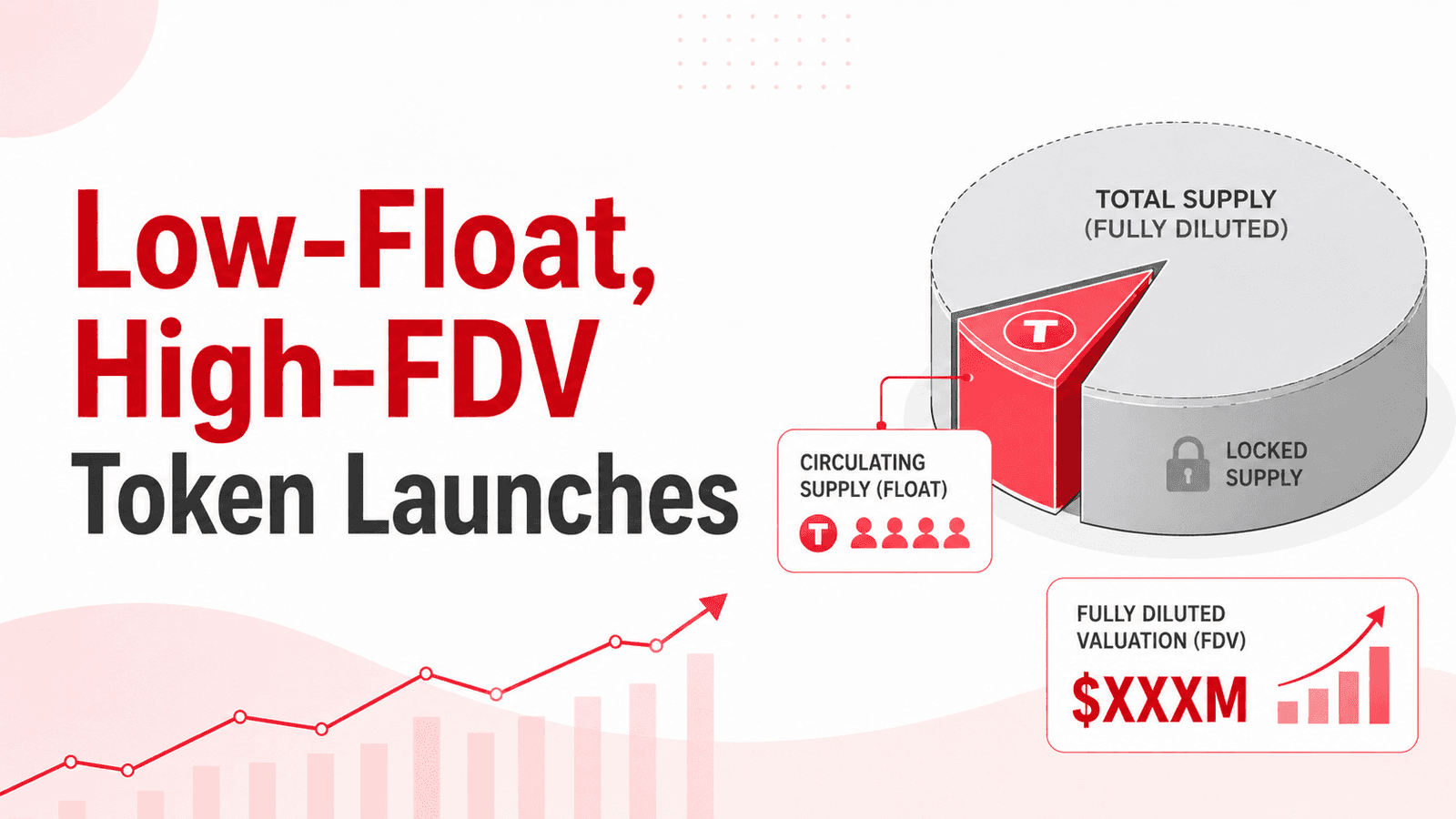
A low-float, high-FDV launch sells a small share of total supply at a large implied valuation. Three numbers define that structure:

  1. Float is the portion of tokens circulating at launch. 

  2. Market cap is the token price multiplied by circulating supply. 

  3. Fully diluted valuation, or FDV, is the price multiplied by total supply.

The relationship between these numbers is what buyers actually watch. When a float is small, the market cap says very little about real value. FDV becomes the number buyers use to judge future dilution.

Low Float, High FDV Explained.png

Recent launches show how extreme that relationship has become. Binance Research found that tokens launched in 2024 averaged a market cap to FDV ratio of just 12.3%, the lowest in years, with some projects listing as little as 6% of supply circulating and none exceeding 20%.

Those ratios have a direct meaning. If only 12.3% of tokens circulate at launch, then nearly 88% will enter the market later. Buyers see that future supply on day one and treat it as selling pressure that is already scheduled.

This is the real message of a low-float, high-FDV launch. Buyers are not judging the product, the team, or the token trading today. They are judging the large amount of tokens that will arrive later. This structure did not happen by chance. It came from the way projects raised money before their tokens ever went public.

How Token Sales Ended Up Low-Float and High-FDV

The structure is a side effect of how crypto projects raise money before launch. The path looks like this:

  1. A project raises several private rounds. According to The Block Research, crypto projects have received over $90 billion in cumulative funding since 2017.

  2. Each round values the project higher than the last. In Q2 2024, median pre-money valuations for crypto startups surged to $37 million, up 94% from $19 million in Q1, according to Galaxy's Q2 2024 Crypto and Blockchain Venture Capital Review.

  3. The last round sets the launch price. At TGE, the token's valuation must reflect what private investors already paid. This is why FDV is high.

  4. Investor and team tokens are locked by vesting. Only a small share of supply is free to trade on day one. This is why float is low.

In short: private fundraising → rising valuations → high FDV at launch, while vesting locks → few circulating tokens → low float.

None of this requires bad intent. It is the default path a funded project follows. But buyers cannot see intent. They only see the structure this path leaves behind.

Why Buyers Read Low-Float, High-FDV Token Launches as Sell Pressure

The previous section showed that low float and high FDV are usually a side effect, not a plan. Buyers do not read it that way. They judge a launch by what the structure allows insiders to do, not by what the team intends.

The logic behind that judgment is simple. A small float means insiders hold most of the supply. A high FDV means those tokens are already valued far above what insiders paid. Together, the structure looks like a plan to sell into demand, even when it is not.

That reading shapes every decision a buyer makes:

What buyers see

What they conclude

How they react

Float under 10%

Insiders control when supply hits the market

Buy less, or skip the sale

Large gap between market cap and FDV

Future dilution is not priced in yet

Discount the token's real value

Cliff unlocks in months two and three

Sell pressure is already scheduled

Sell before the unlock date arrives

No unlock communication

The team has something to hide

Exit at the first sign of trouble

This behavior is evident in market structure. Unlock trackers like Messari's Token Unlocks are now standard tools in token analysis, and early exits before major unlock dates are common patterns in token price action, suggesting serious buyers position around these events much as stock investors track earnings reports.

Analysis of 236 token unlock events by Unlocks.app found that the one-month pre-unlock median price decline was −14.7%, indicating that most price adjustment occurs before the unlock date, not on it. This pattern confirms that serious buyers anticipate supply releases well in advance and position accordingly.

The pattern points to one conclusion. The market does not punish the structure itself. It punishes the uncertainty around it. That is good news for founders, because uncertainty can be removed. The removal starts with the token design.

Why the Market Reads Low-Float Launches as Future Failure, Not Just Sell Pressure

The buyers' skepticism has hard data behind it. When a token launches with low float and high FDV, the mechanical failure modes are predictable. Thin liquidity cannot absorb the early selling. Vesting cliffs scheduled for months two and three hit before the project has had time to build momentum. A token with no real utility inside the product gets treated as pure speculation, and speculative assets bleed holders the moment initial excitement fades. Teams that go quiet after TGE lose the market's benefit of the doubt within weeks. A token that survives its first 90 days almost never does so by accident, it survives because the founder made specific design choices before launch and then communicated them.

This is why pre-TGE trust is not an optional marketing exercise. It is the difference between a launch that absorbs early selling and one that collapses under it. Trust built before TGE is the only signal that tells buyers the team saw these failure modes coming and designed around them.

Rebuilding Trust Through Tokenomics: Float, Vesting, and Demand

Every reaction in the table above can be prevented. Each buyer's fear traces back to one design choice, which means each fix removes one fear. This is why rebuilding trust starts with the token design itself, not with messaging.

Rebuilding Trust Through Tokenomics.png

Four levers matter most, and all of them only work before launch:

  1. Raise the initial float.
    This means letting more tokens circulate on day one, through larger allocations to the public sale, the community, and exchange liquidity.According to Binance Research, teams can mitigate low-float risks by "aligning vesting schedules with set milestones, and to increase the initial circulating supply during TGE." The effect is direct. When more supply already trades, less waits in locked wallets, and the float stops reading as an insider exit plan.

  2. Tie vesting to milestones.
    This means unlocking insider tokens when the project ships products or reaches revenue targets, not only when calendar dates pass. A date-based cliff tells buyers exactly when selling arrives. A milestone-based schedule tells them insiders only get paid when the project delivers. That changes scheduled sell pressure into shared upside. Binance Research recommends aligning vesting schedules with milestones as one way to mitigate these concerns. A detailed framework covers vesting, unlocks, emissions, and float after a token sale.

  3. Build demand sinks before launch.
    A demand sink is a working reason to buy or hold the token, such as paying platform fees, staking for access, or burning. Without one, every unlocked token has only one place to go, which is the sell side of the order book. With one, new supply meets real demand. Communities abandon tokens that lack a functional role. Before TGE, confirm that at least one demand sink is operational and measurable. This means: the feature is shipped and users can interact with it; adoption metrics exist (fees collected, stake locked, burn volume); and the team has a target for the first 30 days. A project listing without a working demand sink is betting that price speculation alone will hold the token—a bet that almost always loses after launch day.

  4. Secure honest liquidity.
    This means order-book depth and market-maker terms that can absorb early selling. Thin books are the most common mechanical cause of post-TGE collapse. When the order book cannot handle normal volume, every early exit becomes a sharp price move, which triggers more holders to sell, which accelerates the decline. A token with strong fundamentals collapses in its first month if spreads are too wide and depth is too shallow. Serious investors now check market-maker terms before they allocate, so a weak liquidity plan fails twice: first in diligence, then at listing. Guidance on how to launch a token covers this sequencing in depth.

Design fixes remove the reasons for fear, but they do not announce themselves. Buyers only trust the structure they can actually see. That makes communication the second half of the rebuild.

A case study: Tiered Vesting in Practice, and Why Milestones Go Further


Screenshot 2026-08-05 at 15.37.13.png

Ape in Poker, a decentralized poker platform on Solana, structured vesting to lock insiders for different periods based on stakeholder type. Seed and private investors saw tokens released over 15 months to prevent early dumping while supporting development. Team members faced a 12-month lock followed by 18-month vesting to align long-term incentives with platform growth. Developers locked for 3 months then vested over 24 months to incentivize continuous contributions. Public sale tokens unlocked immediately. The tiers did not gate unlocks behind metrics. They spaced releases so each one arrived after the platform had time to show traction. The platform's rake, meaning transaction fees collected, grew from $456,250 in Q1 to $2.2 million by Q4. Each release that followed landed against visible execution. The trigger was time, but the context made every unlock read as backed by delivery rather than as scheduled selling.

Tiered scheduling reduces the risk. Milestone-based vesting removes it. Buyers allocate higher valuations to projects where founder payoff links to execution directly. A tiered schedule relies on timing working out. A milestone gate guarantees the link, because tokens only move when the metric is hit. That is the standard founders should design toward, and the stress-test below assumes it.

Stress-Testing Vesting Against Trading Volume

A milestone-based vesting schedule is only credible if the market can absorb each unlock without collapsing. The test is simple: model each major unlock as a percentage of a month of expected trading volume in the surrounding period. If the answer is alarming, redesign the schedule before launch.

How to Stress-Test

Start with three inputs. The size of each unlock in token count, the expected token price at unlock, and the realistic weekly trading volume at that stage. Multiply tokens by price to get the unlock value. Then compare it to four weeks of expected volume.

The thresholds are direct. Below 25% of monthly volume, the market can absorb the unlock with pre-announcement. Between 25% and 100%, the unlock needs a staged release and provisioned market-maker depth. Above 100% of monthly volume, redesign is required. Raise the float, extend the vesting, or gate the tranche behind a milestone.

Worked Example: A project unlocks 10 million tokens at an expected price of $2. That is a $20 million unlock event. If expected weekly volume is $5 million, monthly volume is $20 million. The unlock equals 100% of a month of trading, the very top of the staged-release band. The project can absorb it, but only with staged tranches, pre-announcement, and market-maker depth already provisioned. Any shortfall in volume pushes it into redesign territory. If weekly volume is only $1 million, monthly volume is $4 million. The same unlock now equals 500% of monthly volume, or twenty weeks of trading. No staging plan absorbs that. The schedule needs redesign before launch: raise the float, extend the vesting, or gate the tranche behind a milestone. The project that models this in advance fixes it on paper. The project that discovers it on unlock day fixes it in the chart.

This framework prevents the mechanical failure that has claimed most low-float launches: insiders own too much supply, that supply enters the market on a predictable date, and the order book has no depth to handle it.

Making Milestones Verifiable, Not Gamed

Milestone definitions matter as much as the milestones themselves. A poorly defined target becomes an excuse to unlock tokens anyway. Buyers distinguish between three types of proof:

  • On-chain metrics. User count, transaction volume, locked value, or token burns recorded in smart contracts. These cannot be changed retroactively.

  • Third-party audits. Revenue verified by an accounting firm or trading volume confirmed by exchange reporting. Requires cost but removes founder discretion.

  • Self-reported with time lag. Progress reports published weeks after the milestone period closes, with enough delay that reputational damage from false claims exceeds the unlock benefit. Weakest but faster.

Ape in Poker published betting volume and rake, both on-chain and immediate, as public proof of traction. Year 1 Q4 betting volume hit $54 million against $11 million projected, so each time-based release landed against verified delivery.

Read the full Ape in Poker tokenomics advisory case study.

Rebuilding Trust Before the Token Sale: A Communication Playbook

The design fixes from the previous section are invisible on their own. Buyers cannot trust what they cannot see. Communication is how founders show the work.

The rule is simple. Share every number before buyers find it somewhere else. Free trackers already display the float, the FDV, and the unlock dates. When buyers discover a number the team never mentioned, they assume the team hid it on purpose.

Rebuilding Trust Through A Communication Playbook.png

Five practices put that rule to work:

  1. Publish float, FDV, and the full unlock schedule.
    This means putting the numbers on the project website before listing. The float at TGE, the FDV at the sale price, and every unlock date with its amount. Buyers will find these numbers anyway through free trackers. Publishing them first signals confidence. Making buyers dig signals risk.

  2. Explain why each allocation exists.
    This means adding a short reason next to every pool. What it funds, and why it is sized that way. Percentages alone invite suspicion, because a number without a reason looks like a number someone negotiated for themselves. A written rationale shows the allocation was designed, not taken.

  3. Pre-announce unlocks and give them context.
    This means confirming each unlock ahead of time. The date, the amount, who receives the tokens, and what the project expects to happen. Keyrock's analysis of 16,000+ token unlocks shows prices decline consistently in the 30 days before major unlocks, with declines accelerating in the final week. Holders exiting before the unlock add to this pressure, making pre-announcement communication critical to managing expectations. A token unlock communication plan turns each unlock from a feared surprise into a scheduled, explained event.

  4. Communicate delayed or missed milestones upfront.
    Not every project hits every target. When a milestone delays, silence kills trust faster than transparency. The communication rule is simple: announce the miss, explain why, and publish a revised unlock date tied to the new milestone definition. Buyers tolerate execution delays. They do not tolerate surprises. A project that goes quiet before a scheduled unlock, then suddenly cancels it or extends it without warning, trains the market to sell before each unlock date—turning the entire vesting schedule into a liability.
    By contrast, a project that explains delays in real time—'We hit 150K users instead of 200K, so the Q2 unlock moves to Q3'—signals that milestones were real targets, not theater. The market discounts the delay but credits the transparency. The unlock still happens, but when it does, it reads as earned, not as a rescue from a failed deadline.

  5. Keep reporting after TGE.
    This means holding the same communication rhythm after launch as before it. Progress updates, milestone status, and treasury moves on a regular schedule. Teams that go quiet lose the market's benefit of the doubt within weeks. Regular reporting treats token holders the way public companies treat shareholders.

TokenMinds' work with HyperDEX shows the mechanical effect. The project published a clear narrative, token economics explanation, and vesting timeline on its website before launch. This disclosure became the foundation for organic and influencer-led content that reached 2.5K participants in AMA sessions and 2.5K Telegram members, backing a 10,000,000 USDT presale hard cap. The pattern mirrors what serious buyers now expect: a project confident enough to publish everything upfront will follow through with the same rigor post-launch. That confidence becomes allocation.

Pre-TGE Trust Checklist for Token Launch Founders

A launch is ready when every item below has a public answer.

  • Initial float exceeds 15% of total supply and is stated in plain numbers on the project website before any sale opens.

  • The full unlock schedule is published and easy to find—visible on the main site, not buried in a whitepaper, and updated on every major platform tracker (Messari, unlocks.app) within 48 hours of TGE.

  • Each allocation has a written fairness rationale—a 1-2 sentence explanation of what it funds and why it is sized that way, published alongside the percentage.

  • Vesting links to milestones, not only to dates—at least 50% of insider tokens are locked behind measurable product or traction targets, with on-chain or third-party proof of achievement.

  • At least one demand sink is operational and measurable at launch—users can interact with it on day one, and adoption metrics (fees collected, stakes locked, burn volume) are tracked and reported weekly.

  • Market-maker terms support 5–10% of expected trading volume on day one and all planned venues have provisioned liquidity within 24 hours of listing.

  • The first two unlocks have announcement plans published 30 days before each event—date, amount, recipient, and expected market impact are pre-disclosed to give holders time to position.

  • Post-TGE communication has an owner and a weekly calendar—specific team member responsible, scheduled updates every 7 days for the first 90 days, covering product milestones, unlock status, and treasury moves.

Teams can pressure-test these answers against a token sale due diligence checklist before listing.

Exchange Listing Strategy: Venue Tier and Timing

Where a token lists matters as much as when. A mismatch between project stage and exchange tier leaves tokens without the visibility or depth they need. Worse, listing on too many low-tier venues at once fragments liquidity and creates arbitrage gaps that bleed value.

Matching Project Stage to Venue Tier
Tier 1 exchanges, such as Binance, Coinbase, Kraken, and OKX, are destination listings, not launch pads. They pair the deepest liquidity with the strictest listing standards. A project with a complete product, a transparent team, and proven traction can justify a Tier 1 listing. These listings also carry longer diligence cycles and stricter disclosure requirements that most early-stage projects cannot yet satisfy. Tier 2 venues, such as MEXC and Gate.io, offer meaningful liquidity with listing requirements an earlier-stage project can realistically meet, while it builds the track record a Tier 1 listing demands. Tier 3 venues, meaning smaller DEXs and CEXs, can serve as secondary liquidity or community venues. They should never be the primary launch venue for a project seeking serious buyers.

Coordination Timing
Launch listings should be coordinated around product momentum and market conditions, not calendar convenience. Ideally, the first major exchange listing coincides with a meaningful product milestone or user traction data release. This gives buyers a reason to allocate beyond the listing event itself. Secondary listings should follow within 7–14 days, before early holders have had time to exit, and should be announced in advance so arbitrage traders can position rather than panic-sell.

Liquidity and Market Maker Coordination
The exchange listing plan must be aligned with the market-maker plan. Professional market makers need 5–7 days of advance notice and knowledge of all planned listing venues. They will provision liquidity on all venues where the token is trading to maintain consistent pricing and tight spreads across the market. A token that lists on an exchange without its market maker in place will experience wide spreads and erratic pricing on that venue, damaging the project's credibility across all venues.

The projects that survive the post-TGE window treat exchange listings as coordinated events, not isolated venue appearances.

Rebuild Tokenomics Trust With TokenMinds

Tokenomics design affects more than launch day. It determines how buyers judge the token sale, how unlocks land after TGE, and whether the market treats the project as credible or as scheduled sell pressure.

TokenMinds helps projects run a tokenomics trust review before the sale opens. This covers assessing float and FDV from the buyer's perspective, structuring vesting and unlock schedules, identifying demand sinks, and documenting allocation fairness. The review includes stress-testing the full unlock schedule against projected trading volume, so redesign happens before launch rather than after the first cliff. Projects receive a recommended float and vesting structure, a full disclosure package for float, FDV, and unlocks, and a communication plan covering pre-TGE publication and post-launch reporting.

Book a tokenomics trust review with TokenMinds.

FAQs

How should founders explain FDV before TGE?
Define FDV as token price multiplied by total supply. Then show the path from market cap to FDV through the unlock schedule. Publishing both numbers with dates removes the guesswork that drives distrust.

Why do low-float, high-FDV tokens get backlash?
Buyers read the structure as scheduled sell pressure. Memento Research tracked 118 token launches in 2025 and found 84.7% traded below TGE valuation, with a median FDV decline of 71.1%. That track record makes skepticism the default.

How can founders reduce tokenomics trust risk before launch?
Raise the initial float, tie vesting to milestones, and build demand sinks that work at launch. Then publish the full float, FDV, and unlock schedule before the market finds it.

How do CMOs measure tokenomics trust impact on launch performance?
Track three metrics. First, allocation participation rate, meaning the share of the public sale hard cap filled. It signals buyer confidence in the design. Second, post-TGE price retention, meaning the token price at day 30 compared to the TGE price, adjusted for market conditions. Third, unlock absorption, meaning trading volume in the week before and after each major unlock. A volume spike around an unlock points to panic selling. Projects that publish clear tokenomics before TGE tend to fill more of their hard cap and hold price better in the first month than opaque peers. These three metrics show whether trust rebuilding actually moved launch outcomes.

Sources

TL;DR

  • Low-float, high-FDV (fully diluted valuation) launches are read by buyers as scheduled insider sell pressure, not as product risk.

  • The structure is not malicious, it comes from private fundraising rounds that set high valuations before public listing.

  • Buyers punish uncertainty, not the structure itself. The fix has two parts: design fixes (raise float, tie vesting to milestones, build demand sinks) and visibility (publish everything pre-TGE).

  • Stress-test vesting against trading volume before launch. An unlock above a full month of expected volume requires redesign, not communication.

  • Post-TGE silence kills tokens faster than any unlock does. A 30-60-90 communication plan survives the first quarter; projects that go quiet lose credibility within weeks.

A token sale in 2026 faces a more skeptical buyer than in any previous cycle. The reason is access. Every number a project once controlled is now public. Buyers can pull allocation data, follow unlock trackers, and run the dilution math in minutes.

That access has changed how launches get judged. A project that lists with a small float and a large valuation no longer gets the benefit of the doubt. Buyers assume the worst until the team proves otherwise. Public sale appetite confirms the shift. CryptoRank data shows public token sale volumes remain far below the previous cycle's peak, which means every launch now competes for a smaller and more selective pool of buyers.

This article explains why the market reads that structure as future sell pressure. It then covers how founders can fix both the design and the story before TGE. The starting point is the two numbers buyers judge first: float and FDV.

What Low Float and High FDV Mean in a Token Launch

A low-float, high-FDV launch sells a small share of total supply at a large implied valuation. Three numbers define that structure:

  1. Float is the portion of tokens circulating at launch. 

  2. Market cap is the token price multiplied by circulating supply. 

  3. Fully diluted valuation, or FDV, is the price multiplied by total supply.

The relationship between these numbers is what buyers actually watch. When a float is small, the market cap says very little about real value. FDV becomes the number buyers use to judge future dilution.

Low Float, High FDV Explained.png

Recent launches show how extreme that relationship has become. Binance Research found that tokens launched in 2024 averaged a market cap to FDV ratio of just 12.3%, the lowest in years, with some projects listing as little as 6% of supply circulating and none exceeding 20%.

Those ratios have a direct meaning. If only 12.3% of tokens circulate at launch, then nearly 88% will enter the market later. Buyers see that future supply on day one and treat it as selling pressure that is already scheduled.

This is the real message of a low-float, high-FDV launch. Buyers are not judging the product, the team, or the token trading today. They are judging the large amount of tokens that will arrive later. This structure did not happen by chance. It came from the way projects raised money before their tokens ever went public.

How Token Sales Ended Up Low-Float and High-FDV

The structure is a side effect of how crypto projects raise money before launch. The path looks like this:

  1. A project raises several private rounds. According to The Block Research, crypto projects have received over $90 billion in cumulative funding since 2017.

  2. Each round values the project higher than the last. In Q2 2024, median pre-money valuations for crypto startups surged to $37 million, up 94% from $19 million in Q1, according to Galaxy's Q2 2024 Crypto and Blockchain Venture Capital Review.

  3. The last round sets the launch price. At TGE, the token's valuation must reflect what private investors already paid. This is why FDV is high.

  4. Investor and team tokens are locked by vesting. Only a small share of supply is free to trade on day one. This is why float is low.

In short: private fundraising → rising valuations → high FDV at launch, while vesting locks → few circulating tokens → low float.

None of this requires bad intent. It is the default path a funded project follows. But buyers cannot see intent. They only see the structure this path leaves behind.

Why Buyers Read Low-Float, High-FDV Token Launches as Sell Pressure

The previous section showed that low float and high FDV are usually a side effect, not a plan. Buyers do not read it that way. They judge a launch by what the structure allows insiders to do, not by what the team intends.

The logic behind that judgment is simple. A small float means insiders hold most of the supply. A high FDV means those tokens are already valued far above what insiders paid. Together, the structure looks like a plan to sell into demand, even when it is not.

That reading shapes every decision a buyer makes:

What buyers see

What they conclude

How they react

Float under 10%

Insiders control when supply hits the market

Buy less, or skip the sale

Large gap between market cap and FDV

Future dilution is not priced in yet

Discount the token's real value

Cliff unlocks in months two and three

Sell pressure is already scheduled

Sell before the unlock date arrives

No unlock communication

The team has something to hide

Exit at the first sign of trouble

This behavior is evident in market structure. Unlock trackers like Messari's Token Unlocks are now standard tools in token analysis, and early exits before major unlock dates are common patterns in token price action, suggesting serious buyers position around these events much as stock investors track earnings reports.

Analysis of 236 token unlock events by Unlocks.app found that the one-month pre-unlock median price decline was −14.7%, indicating that most price adjustment occurs before the unlock date, not on it. This pattern confirms that serious buyers anticipate supply releases well in advance and position accordingly.

The pattern points to one conclusion. The market does not punish the structure itself. It punishes the uncertainty around it. That is good news for founders, because uncertainty can be removed. The removal starts with the token design.

Why the Market Reads Low-Float Launches as Future Failure, Not Just Sell Pressure

The buyers' skepticism has hard data behind it. When a token launches with low float and high FDV, the mechanical failure modes are predictable. Thin liquidity cannot absorb the early selling. Vesting cliffs scheduled for months two and three hit before the project has had time to build momentum. A token with no real utility inside the product gets treated as pure speculation, and speculative assets bleed holders the moment initial excitement fades. Teams that go quiet after TGE lose the market's benefit of the doubt within weeks. A token that survives its first 90 days almost never does so by accident, it survives because the founder made specific design choices before launch and then communicated them.

This is why pre-TGE trust is not an optional marketing exercise. It is the difference between a launch that absorbs early selling and one that collapses under it. Trust built before TGE is the only signal that tells buyers the team saw these failure modes coming and designed around them.

Rebuilding Trust Through Tokenomics: Float, Vesting, and Demand

Every reaction in the table above can be prevented. Each buyer's fear traces back to one design choice, which means each fix removes one fear. This is why rebuilding trust starts with the token design itself, not with messaging.

Rebuilding Trust Through Tokenomics.png

Four levers matter most, and all of them only work before launch:

  1. Raise the initial float.
    This means letting more tokens circulate on day one, through larger allocations to the public sale, the community, and exchange liquidity.According to Binance Research, teams can mitigate low-float risks by "aligning vesting schedules with set milestones, and to increase the initial circulating supply during TGE." The effect is direct. When more supply already trades, less waits in locked wallets, and the float stops reading as an insider exit plan.

  2. Tie vesting to milestones.
    This means unlocking insider tokens when the project ships products or reaches revenue targets, not only when calendar dates pass. A date-based cliff tells buyers exactly when selling arrives. A milestone-based schedule tells them insiders only get paid when the project delivers. That changes scheduled sell pressure into shared upside. Binance Research recommends aligning vesting schedules with milestones as one way to mitigate these concerns. A detailed framework covers vesting, unlocks, emissions, and float after a token sale.

  3. Build demand sinks before launch.
    A demand sink is a working reason to buy or hold the token, such as paying platform fees, staking for access, or burning. Without one, every unlocked token has only one place to go, which is the sell side of the order book. With one, new supply meets real demand. Communities abandon tokens that lack a functional role. Before TGE, confirm that at least one demand sink is operational and measurable. This means: the feature is shipped and users can interact with it; adoption metrics exist (fees collected, stake locked, burn volume); and the team has a target for the first 30 days. A project listing without a working demand sink is betting that price speculation alone will hold the token—a bet that almost always loses after launch day.

  4. Secure honest liquidity.
    This means order-book depth and market-maker terms that can absorb early selling. Thin books are the most common mechanical cause of post-TGE collapse. When the order book cannot handle normal volume, every early exit becomes a sharp price move, which triggers more holders to sell, which accelerates the decline. A token with strong fundamentals collapses in its first month if spreads are too wide and depth is too shallow. Serious investors now check market-maker terms before they allocate, so a weak liquidity plan fails twice: first in diligence, then at listing. Guidance on how to launch a token covers this sequencing in depth.

Design fixes remove the reasons for fear, but they do not announce themselves. Buyers only trust the structure they can actually see. That makes communication the second half of the rebuild.

A case study: Tiered Vesting in Practice, and Why Milestones Go Further


Screenshot 2026-08-05 at 15.37.13.png

Ape in Poker, a decentralized poker platform on Solana, structured vesting to lock insiders for different periods based on stakeholder type. Seed and private investors saw tokens released over 15 months to prevent early dumping while supporting development. Team members faced a 12-month lock followed by 18-month vesting to align long-term incentives with platform growth. Developers locked for 3 months then vested over 24 months to incentivize continuous contributions. Public sale tokens unlocked immediately. The tiers did not gate unlocks behind metrics. They spaced releases so each one arrived after the platform had time to show traction. The platform's rake, meaning transaction fees collected, grew from $456,250 in Q1 to $2.2 million by Q4. Each release that followed landed against visible execution. The trigger was time, but the context made every unlock read as backed by delivery rather than as scheduled selling.

Tiered scheduling reduces the risk. Milestone-based vesting removes it. Buyers allocate higher valuations to projects where founder payoff links to execution directly. A tiered schedule relies on timing working out. A milestone gate guarantees the link, because tokens only move when the metric is hit. That is the standard founders should design toward, and the stress-test below assumes it.

Stress-Testing Vesting Against Trading Volume

A milestone-based vesting schedule is only credible if the market can absorb each unlock without collapsing. The test is simple: model each major unlock as a percentage of a month of expected trading volume in the surrounding period. If the answer is alarming, redesign the schedule before launch.

How to Stress-Test

Start with three inputs. The size of each unlock in token count, the expected token price at unlock, and the realistic weekly trading volume at that stage. Multiply tokens by price to get the unlock value. Then compare it to four weeks of expected volume.

The thresholds are direct. Below 25% of monthly volume, the market can absorb the unlock with pre-announcement. Between 25% and 100%, the unlock needs a staged release and provisioned market-maker depth. Above 100% of monthly volume, redesign is required. Raise the float, extend the vesting, or gate the tranche behind a milestone.

Worked Example: A project unlocks 10 million tokens at an expected price of $2. That is a $20 million unlock event. If expected weekly volume is $5 million, monthly volume is $20 million. The unlock equals 100% of a month of trading, the very top of the staged-release band. The project can absorb it, but only with staged tranches, pre-announcement, and market-maker depth already provisioned. Any shortfall in volume pushes it into redesign territory. If weekly volume is only $1 million, monthly volume is $4 million. The same unlock now equals 500% of monthly volume, or twenty weeks of trading. No staging plan absorbs that. The schedule needs redesign before launch: raise the float, extend the vesting, or gate the tranche behind a milestone. The project that models this in advance fixes it on paper. The project that discovers it on unlock day fixes it in the chart.

This framework prevents the mechanical failure that has claimed most low-float launches: insiders own too much supply, that supply enters the market on a predictable date, and the order book has no depth to handle it.

Making Milestones Verifiable, Not Gamed

Milestone definitions matter as much as the milestones themselves. A poorly defined target becomes an excuse to unlock tokens anyway. Buyers distinguish between three types of proof:

  • On-chain metrics. User count, transaction volume, locked value, or token burns recorded in smart contracts. These cannot be changed retroactively.

  • Third-party audits. Revenue verified by an accounting firm or trading volume confirmed by exchange reporting. Requires cost but removes founder discretion.

  • Self-reported with time lag. Progress reports published weeks after the milestone period closes, with enough delay that reputational damage from false claims exceeds the unlock benefit. Weakest but faster.

Ape in Poker published betting volume and rake, both on-chain and immediate, as public proof of traction. Year 1 Q4 betting volume hit $54 million against $11 million projected, so each time-based release landed against verified delivery.

Read the full Ape in Poker tokenomics advisory case study.

Rebuilding Trust Before the Token Sale: A Communication Playbook

The design fixes from the previous section are invisible on their own. Buyers cannot trust what they cannot see. Communication is how founders show the work.

The rule is simple. Share every number before buyers find it somewhere else. Free trackers already display the float, the FDV, and the unlock dates. When buyers discover a number the team never mentioned, they assume the team hid it on purpose.

Rebuilding Trust Through A Communication Playbook.png

Five practices put that rule to work:

  1. Publish float, FDV, and the full unlock schedule.
    This means putting the numbers on the project website before listing. The float at TGE, the FDV at the sale price, and every unlock date with its amount. Buyers will find these numbers anyway through free trackers. Publishing them first signals confidence. Making buyers dig signals risk.

  2. Explain why each allocation exists.
    This means adding a short reason next to every pool. What it funds, and why it is sized that way. Percentages alone invite suspicion, because a number without a reason looks like a number someone negotiated for themselves. A written rationale shows the allocation was designed, not taken.

  3. Pre-announce unlocks and give them context.
    This means confirming each unlock ahead of time. The date, the amount, who receives the tokens, and what the project expects to happen. Keyrock's analysis of 16,000+ token unlocks shows prices decline consistently in the 30 days before major unlocks, with declines accelerating in the final week. Holders exiting before the unlock add to this pressure, making pre-announcement communication critical to managing expectations. A token unlock communication plan turns each unlock from a feared surprise into a scheduled, explained event.

  4. Communicate delayed or missed milestones upfront.
    Not every project hits every target. When a milestone delays, silence kills trust faster than transparency. The communication rule is simple: announce the miss, explain why, and publish a revised unlock date tied to the new milestone definition. Buyers tolerate execution delays. They do not tolerate surprises. A project that goes quiet before a scheduled unlock, then suddenly cancels it or extends it without warning, trains the market to sell before each unlock date—turning the entire vesting schedule into a liability.
    By contrast, a project that explains delays in real time—'We hit 150K users instead of 200K, so the Q2 unlock moves to Q3'—signals that milestones were real targets, not theater. The market discounts the delay but credits the transparency. The unlock still happens, but when it does, it reads as earned, not as a rescue from a failed deadline.

  5. Keep reporting after TGE.
    This means holding the same communication rhythm after launch as before it. Progress updates, milestone status, and treasury moves on a regular schedule. Teams that go quiet lose the market's benefit of the doubt within weeks. Regular reporting treats token holders the way public companies treat shareholders.

TokenMinds' work with HyperDEX shows the mechanical effect. The project published a clear narrative, token economics explanation, and vesting timeline on its website before launch. This disclosure became the foundation for organic and influencer-led content that reached 2.5K participants in AMA sessions and 2.5K Telegram members, backing a 10,000,000 USDT presale hard cap. The pattern mirrors what serious buyers now expect: a project confident enough to publish everything upfront will follow through with the same rigor post-launch. That confidence becomes allocation.

Pre-TGE Trust Checklist for Token Launch Founders

A launch is ready when every item below has a public answer.

  • Initial float exceeds 15% of total supply and is stated in plain numbers on the project website before any sale opens.

  • The full unlock schedule is published and easy to find—visible on the main site, not buried in a whitepaper, and updated on every major platform tracker (Messari, unlocks.app) within 48 hours of TGE.

  • Each allocation has a written fairness rationale—a 1-2 sentence explanation of what it funds and why it is sized that way, published alongside the percentage.

  • Vesting links to milestones, not only to dates—at least 50% of insider tokens are locked behind measurable product or traction targets, with on-chain or third-party proof of achievement.

  • At least one demand sink is operational and measurable at launch—users can interact with it on day one, and adoption metrics (fees collected, stakes locked, burn volume) are tracked and reported weekly.

  • Market-maker terms support 5–10% of expected trading volume on day one and all planned venues have provisioned liquidity within 24 hours of listing.

  • The first two unlocks have announcement plans published 30 days before each event—date, amount, recipient, and expected market impact are pre-disclosed to give holders time to position.

  • Post-TGE communication has an owner and a weekly calendar—specific team member responsible, scheduled updates every 7 days for the first 90 days, covering product milestones, unlock status, and treasury moves.

Teams can pressure-test these answers against a token sale due diligence checklist before listing.

Exchange Listing Strategy: Venue Tier and Timing

Where a token lists matters as much as when. A mismatch between project stage and exchange tier leaves tokens without the visibility or depth they need. Worse, listing on too many low-tier venues at once fragments liquidity and creates arbitrage gaps that bleed value.

Matching Project Stage to Venue Tier
Tier 1 exchanges, such as Binance, Coinbase, Kraken, and OKX, are destination listings, not launch pads. They pair the deepest liquidity with the strictest listing standards. A project with a complete product, a transparent team, and proven traction can justify a Tier 1 listing. These listings also carry longer diligence cycles and stricter disclosure requirements that most early-stage projects cannot yet satisfy. Tier 2 venues, such as MEXC and Gate.io, offer meaningful liquidity with listing requirements an earlier-stage project can realistically meet, while it builds the track record a Tier 1 listing demands. Tier 3 venues, meaning smaller DEXs and CEXs, can serve as secondary liquidity or community venues. They should never be the primary launch venue for a project seeking serious buyers.

Coordination Timing
Launch listings should be coordinated around product momentum and market conditions, not calendar convenience. Ideally, the first major exchange listing coincides with a meaningful product milestone or user traction data release. This gives buyers a reason to allocate beyond the listing event itself. Secondary listings should follow within 7–14 days, before early holders have had time to exit, and should be announced in advance so arbitrage traders can position rather than panic-sell.

Liquidity and Market Maker Coordination
The exchange listing plan must be aligned with the market-maker plan. Professional market makers need 5–7 days of advance notice and knowledge of all planned listing venues. They will provision liquidity on all venues where the token is trading to maintain consistent pricing and tight spreads across the market. A token that lists on an exchange without its market maker in place will experience wide spreads and erratic pricing on that venue, damaging the project's credibility across all venues.

The projects that survive the post-TGE window treat exchange listings as coordinated events, not isolated venue appearances.

Rebuild Tokenomics Trust With TokenMinds

Tokenomics design affects more than launch day. It determines how buyers judge the token sale, how unlocks land after TGE, and whether the market treats the project as credible or as scheduled sell pressure.

TokenMinds helps projects run a tokenomics trust review before the sale opens. This covers assessing float and FDV from the buyer's perspective, structuring vesting and unlock schedules, identifying demand sinks, and documenting allocation fairness. The review includes stress-testing the full unlock schedule against projected trading volume, so redesign happens before launch rather than after the first cliff. Projects receive a recommended float and vesting structure, a full disclosure package for float, FDV, and unlocks, and a communication plan covering pre-TGE publication and post-launch reporting.

Book a tokenomics trust review with TokenMinds.

FAQs

How should founders explain FDV before TGE?
Define FDV as token price multiplied by total supply. Then show the path from market cap to FDV through the unlock schedule. Publishing both numbers with dates removes the guesswork that drives distrust.

Why do low-float, high-FDV tokens get backlash?
Buyers read the structure as scheduled sell pressure. Memento Research tracked 118 token launches in 2025 and found 84.7% traded below TGE valuation, with a median FDV decline of 71.1%. That track record makes skepticism the default.

How can founders reduce tokenomics trust risk before launch?
Raise the initial float, tie vesting to milestones, and build demand sinks that work at launch. Then publish the full float, FDV, and unlock schedule before the market finds it.

How do CMOs measure tokenomics trust impact on launch performance?
Track three metrics. First, allocation participation rate, meaning the share of the public sale hard cap filled. It signals buyer confidence in the design. Second, post-TGE price retention, meaning the token price at day 30 compared to the TGE price, adjusted for market conditions. Third, unlock absorption, meaning trading volume in the week before and after each major unlock. A volume spike around an unlock points to panic selling. Projects that publish clear tokenomics before TGE tend to fill more of their hard cap and hold price better in the first month than opaque peers. These three metrics show whether trust rebuilding actually moved launch outcomes.

Sources

GET SUCCESS IN WEB3

  • Trusted Web3 partner since 2017

  • Full-stack Web3 development team

  • Performance-driven Web3 marketing

Get A Free Consultation

Get A Free Consultation

MEET US AT

RECENT TRAININGS

Follow us

get web3 business updates

Email invalid

  • Access global liquidity for your RWA project with TMX Tokenize’s Canton Network integration

DISCOVER NOW

  • Access global liquidity for your RWA project with TMX Tokenize’s Canton Network integration

    JOIN NOW

DISCOVER

  • Access global liquidity for your RWA project with TMX Tokenize’s Canton Network integration