Web3 & AI

SOLUTIONS

Products

Services

Web3 & AI

SOLUTIONS

Services

Products

Industries

Become Our Client

About Us

Resources

Web3 & AI

SOLUTIONS

Services

Products

Industries

Token Sale Due Diligence Checklist: What Serious Buyers Check Before They Buy

Token Sale Due Diligence Checklist: What Serious Buyers Check Before They Buy

TL;DR
Serious buyers review legal structure, team credibility, token utility, tokenomics, vesting, technical security, liquidity, official channels, KYC, buyer protection, and post-launch delivery. This guide shows founders what evidence supports each check, which red flags to fix before promotion, and how to package proof for faster review. Educational content only — nothing here is financial or legal advice.

What "Due Diligence" Actually Covers in a Token Sale

A legal analysis of the token and sale structure is often an early diligence request. Preparing it before outreach can reduce avoidable questions about the issuer, target jurisdictions, sale restrictions, and regulatory treatment.

Why This Is a Content Operations Problem, Not Just a Legal One

For a CMO or Head of Growth running a token launch, diligence proof is a content operations problem. Someone has to produce, structure, and keep six categories of documentation current before buyers ask for it.

For marketing and community teams, diligence readiness is a proof-management task. Every public claim should trace to a current document, contract, repository, or on-chain record.

With limited resources, prioritize the proof points buyers check first: legal standing and team verification. That sequencing is easier to defend to leadership than an even spread across all six categories.

Token sale due diligence covers six core areas: legal standing, team credibility, utility, tokenomics, technical security, and liquidity. Buyers also run four cross-cutting checks covering official channels and KYC, buyer protection, listing readiness, and post-launch delivery.
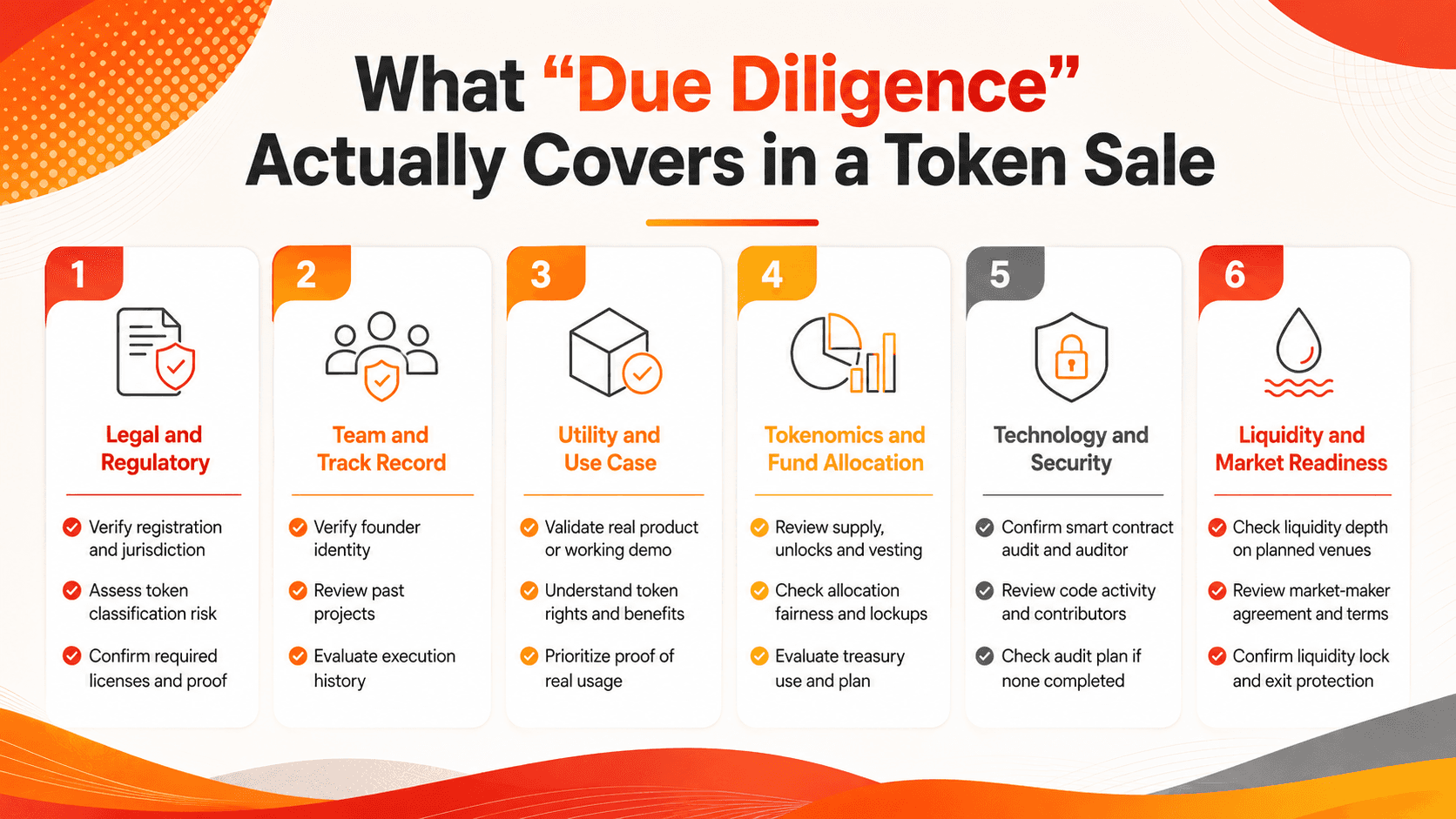
crypto due diligence.png

1. Legal and Regulatory Standing

Buyers check where the project is registered and if that country has clear rules for securities. A weak or unclear registration slows the whole review. Projects should register in a suitable location and keep proof ready, so buyers can confirm this without having to ask.

In the US, counsel should apply the Howey test to the transaction, not only the underlying crypto asset. The question is whether the transaction involves an investment of money in a common enterprise with a reasonable expectation of profits derived from others’ efforts. A token sale may satisfy that test even when the underlying crypto asset is not itself a security.

Legal review should identify the issuing entity, sale structure, target jurisdictions, eligibility rules, and applicable registrations or exemptions. For US-facing sales, counsel should analyze both the crypto asset and the transaction under the March 2026 SEC/CFTC crypto-asset interpretation and Howey. For EU-facing activity, the team should determine whether MiCA or existing financial-services law applies and whether any service provider requires CASP authorization under ESMA's MiCA guidance. FinCEN's virtual-currency guidance and state money-transmission requirements depend on the activities the project actually performs.

If projects want to check how marketing claims hold up against these same compliance requirements, TokenMinds' token sale marketing compliance checklist covers that overlap in detail.

2. Team and Track Record

Buyers verify founder identity through public records, LinkedIn history, and prior company filings. Anonymous teams raise the risk profile significantly.

They look at prior projects the founders shipped. A history of abandoned or failed launches is a signal worth weighing.

Execution history matters more than credentials alone. Buyers ask: did this team deliver what they promised before?

3. Utility and Use Case

Buyers check the usefulness of a token, or how much real benefit it gives holders. For product-tied tokens, buyers check if the product works. Projects should show a testnet, beta, or working demo, so buyers see real usage instead of a roadmap slide.

For tokens that don't sit on one specific product, such as governance or protocol tokens, utility still matters. Many of these tokens govern a Decentralized Autonomous Organization (DAO), where holders vote on treasury spending, protocol upgrades, or parameter changes through on-chain proposals. Buyers check what rights the token gives, like voting power, fee sharing, or staking rewards, and how many holders actually use those rights. For DAO structures specifically, they also check proposal turnout, since low voter participation weakens the governance claim.

In both cases, buyers weigh proof of real use over projected use. Partnerships, API integrations, and on-chain transaction volume count as proof. Plans and forecasts do not.

For a deeper framework on demonstrating product-linked demand, read How to Position Token Utility Around Ecosystem Value Instead of Hype.

4. Tokenomics and Fund Allocation

Tokenomics and fund allocation are central proof points of the main proof points of a token sale. This is where a project explains how supply, incentives, allocations, and treasury use are structured over time, not just at launch. Buyers will review the full supply schedule: total supply, circulating supply at launch, and future unlock dates.

Vesting terms matter as much as allocation percentages. A short team lockup next to a long investor lockup is a red flag.

They also check the treasury use plan. Vague language like "ecosystem growth" without a spending breakdown invites scrutiny.

For guidance on explaining cliffs, recipient groups, and unlock timing, read Token Unlock Communication Plan: How to Explain Vesting and Protect Holder Trust.

Buyers compare the sale price with circulating supply and total supply. This shows both the implied market capitalization at launch and the fully diluted valuation. They also compare private-round prices, vesting differences, and expected unlocks. A low initial float combined with a high FDV can make the post-launch market fragile even when total allocation percentages appear reasonable.

Case study example:
ape in poker case study.png

Ape in Poker's distribution plan tied each stakeholder bucket to a distinct vesting length:

  • Team and advisors: 12-month lock, then 18-month vesting

  • Seed and private investors: 15-month vesting

  • Public sale: unlocked immediately

  • Developers: 3-month lock, then 24-month vesting

  • Liquidity/treasury: tied to a stated use (platform liquidity and staking rewards), not a generic label

A buyer checks two things: does each group's lockup match its role, and does the treasury line up with a stated use. A single shared vesting date across all groups, or an unstated treasury use, is the failure pattern this check catches.

See the Ape in Poker Tokenomics Advisory case study.

5. Technology and Security

Crypto projects rely heavily on technology, and a smart contract is one of the most basic technical pieces a project should have in place. Buyers usually check if the smart contract has already been audited. They rate a project higher when it also states who ran the audit, since naming the firm adds a clear credibility layer. Firms like CertiK, Hacken, and OpenZeppelin are common benchmarks buyers look for, since each publishes a public audit methodology. Self-reported audits carry little weight.

Buyers inspect minting, pausing, blacklist, ownership, and upgrade functions because these privileges can alter token behavior. Their presence is not automatically disqualifying. The red flag is an undisclosed or unilateral control with weak access restrictions, no timelock, or no coverage in the audit.

They also review the public code repository for activity, contributor count, and commit history.

When no audit exists yet, buyers look for a clear plan and timeline for one before treating the sale as investable.

6. Liquidity and Market Readiness

Liquidity determines whether buyers can exit a position without heavy losses, so it is one of the last checks before a sale closes. Buyers check liquidity depth on planned DEX liquidity pools or CEX order books. Thin liquidity means high slippage on exit.

They ask whether a market-maker agreement exists and what terms govern it. Lockup terms on liquidity pool tokens matter too. Buyers confirm the team cannot pull liquidity shortly after launch.

How Projects Can Prepare for Token Sale Due Diligence

Buyers typically move through four stages: document review, team interviews, on-chain analysis, and community checks.

  1. Document review:
    Buyers read the whitepaper, legal opinion, tokenomics sheet, and audit report. Projects should have all four ready and current before the first request.

  2. Team interviews:
    Buyers want direct conversation with founders, not just a deck. Projects should prepare founders to answer execution and track-record questions directly.

  3. On-chain analysis:
    Buyers check wallet concentration, contract verification, and transaction history, usually with tools like Etherscan for contract verification, Nansen for wallet labeling, and Arkham for fund-flow tracing. Projects should verify this data looks clean before buyers pull it themselves.

  4. Community and reputation checks:
    Buyers look at third-party mentions, prior investor feedback, and social channel authenticity. Projects should audit their own public presence for bot activity or inflated numbers before buyers do.

By following these steps, projects can close gaps before buyers find them and move through review faster.

Verification Techniques Buyers Actually Run

Beyond reading documents, experienced buyers run specific technical checks:

  • Reverse-image search on team photos: Buyers run founder and advisor headshots through a reverse-image search to catch stock photography or AI-generated faces.

  • Wayback Machine whitepaper comparison: Buyers pull earlier archived versions of the whitepaper to see which claims, dates, or figures changed quietly over time.

  • Honeypot and token-safety scans: Buyers run the contract address through a honeypot scanner to confirm tokens can actually be sold after purchase, not just bought.

  • Contract-to-audit matching: Buyers compare the deployed contract’s bytecode with the version covered by the audit report, because code changes after an audit can invalidate its findings.

Preparing this evidence in advance can reduce clarification requests, but it does not replace independent buyer verification.

The Token Sale Due Diligence Checklist

The sections above cover what buyers usually check before investing in a token sale. The checklist below turns those checks into a practical list: what each category covers, and what projects should have ready.

Category

What buyers verify

What founders should prepare

Legal and sale structure

Entity, jurisdiction, classification, sale restrictions

Corporate records, legal analysis, sale terms

Team and track record

Identity, roles, prior outcomes

Bios, filings, prior project evidence

Utility and product

Working product, token role, real usage

Demo, testnet, usage data, integration evidence

Tokenomics and valuation

Supply, allocation, sale price, FDV, treasury

Tokenomics sheet, valuation comparison, wallet map

Vesting and unlocks

Cliffs, release schedules, insider alignment

Published schedule and verifiable vesting mechanism

Technology and security

Audit scope, deployed code, admin controls

Audit report, verified contract, remediation record

Liquidity readiness

DEX liquidity, order-book plan, MM terms, LP controls

Liquidity plan, agreement summary, lock evidence

Official channels and KYC

Domain, contract address, eligibility, identity checks

Official-link registry, KYC flow, restricted-market rules

Buyer protection and delivery

Refunds, token delivery, support, cancellation terms

Sale terms, refund triggers, claim process

Listing and roadmap

Publicly supportable listing status and dated delivery

Readiness plan, confirmed announcements, roadmap

Legal Checklist Items

  • Corporate registration documents for the issuing entity.

  • Legal opinion on token classification in the target jurisdiction.

  • Terms of sale and refund policy, if any.

Disclosure of any prior regulatory action against founders or the entity.

If a project wants a closer look at how to structure sale terms and refund policy, TokenMinds' public token sale terms checklist breaks that document down in more detail.

Financial and Tokenomics Checklist Items

  • Circulating supply at launch versus total supply.

  • Vesting schedule for team, advisors, and early investors.

  • Treasury allocation breakdown by category and spending timeline.

  • Published audit report from a named security firm.

Team and Community Checklist Items

  • Founder identity verified against public records.

  • Advisor credibility checked against their stated role and history.

  • Community engagement quality reviewed for authentic activity, not bot volume.

  • Prior project outcomes disclosed, including failures.

Official Channels and KYC Verification

Buyers confirm the official website domain matches the one referenced in legal documents. They cross-check the contract address against the one published on the project's verified social channels.

KYC in a token sale covers two separate checks, and projects should treat them as distinct.

Buyers review three related controls:

  • Founder KYC verifies the natural persons behind the project.

  • Project KYB verifies the issuing entity, its ownership structure, and its beneficial owners.

  • Participant KYC and AML separately determine who may join the sale, which jurisdictions are restricted, how sanctions screening works, and what happens after failed verification.

Participant KYC and AML is a separate control. It confirms who may join the sale, which jurisdictions are excluded, how sanctions checks run, and what happens after a failed verification. Projects should publish this process alongside the founder-level check, not in place of it.

Eligibility and KYC terms should also stay identical across every channel a buyer might read: the sale page, FAQs, community replies, KOL briefs, email, and support messages. A mismatch between any two of these raises the same red flag a missing KYC check does.

Diligence Proof Is Not a Go-to-Market Plan

A clean audit report doesn't answer how the sale will actually run. Buyers who clear the checklist above still ask about launch mechanics — direct sale, launchpad, or exchange listing — before they wire funds. Founders should settle three things alongside diligence prep:

  1. Match the launch route (direct sale, launchpad such as Binance Launchpad or CoinList, or exchange-led listing) to the buyer quality the project needs.

  2. Weigh the compliance risk each route carries, since a launchpad and a private sale face different exposure.

  3. Plan campaign timing and post-launch retention before the sale opens, not after.

Read TokenMinds' full guide to token sale GTM models for the full breakdown.

Buyer Protection and Token Delivery

Buyers check what happens when the sale does not proceed as planned. Sale terms should explain cancellation conditions, refund triggers, failed transaction handling, failed-KYC treatment, token delivery dates, claim procedures, official payment addresses, and support channels. Projects should publish these rules before contributions begin and keep them consistent across the sale terms, FAQ, onboarding flow, and community responses.

Presale Red Flags Founders Should Fix First

Buyers flag the same issues repeatedly. Founders can fix most of them before the sale opens.

Red Flag

Fix Before Launch

Unverifiable team bios

Publish full names, LinkedIn profiles, and prior project links

Vague use-of-funds language

Publish a line-item treasury spending plan

Missing audit reports

Commission a named third-party audit before the sale, not after

Unclear vesting terms

Publish an on-chain vesting contract with dates and amounts

Missing valuation or FDV disclosure

Publish sale price, launch circulation, circulating market capitalization, FDV, and round-price differences

Undisclosed administrator or liquidity controls

Publish the privilege structure, multisig or timelock controls, and LP-lock evidence

Conflicting contract addresses or KYC terms

Maintain one official-link registry and one approved eligibility policy

Unsupported listing or refund claims

Use only publicly supportable listing information and publish refund and token-delivery rules

Fixing these before launch, not after a buyer flags them. Fixing these issues before launch helps buyers verify claims more efficiently.

Give Buyers the Inputs Needed to Assess Risk

Founders cannot decide how buyers size a position. They can publish the information needed for that decision. The minimum inputs include the sale price, circulating supply, FDV, wallet concentration, unlock schedule, liquidity plan, market-maker role, refund terms, and token-delivery timeline. Publishing these inputs keeps the project focused on disclosure rather than investment recommendations.

Listing Plan and Post-Launch Roadmap

The checklist above covers proof up to the sale itself. Buyers also look past the sale, at how the team plans to deliver after funds are raised. Two checks carry the most weight:

  • Track record:
    Buyers compare the stated exchange listing timeline against the team's track record on prior milestones. A team that missed earlier deadlines faces more scrutiny on new listing promises.

  • Specificity:
    Buyers check whether the project has a realistic listing route, completed technical requirements, sufficient liquidity preparation, and a supportable timeline. A project should name a venue only after public confirmation and permission to disclose it. An application, discussion, or signed preliminary document should not be presented as a guaranteed listing.

Run a Token Sale Trust Audit Before Promotion

TokenMinds reviews the evidence buyers are likely to verify across legal readiness, team credibility, utility, tokenomics, vesting, security, liquidity, official channels, KYC, sale terms, and post-launch planning.

The review identifies missing documents, conflicting public claims, weak verification paths, and launch-readiness gaps. Legal opinions and jurisdiction-specific advice remain the responsibility of qualified counsel.

Request a Token Sale Trust Audit with TokenMinds.

Educational content only. Nothing in this article is financial or legal advice.

FAQs

What do investors check before joining a token sale?

Investors verify team identity, product utility, tokenomics, audit reports, liquidity terms, official channels, and KYC status. They weigh documented evidence more heavily than pitch deck claims.

How do we make our token sale look trustworthy?

Publish diligence proof proactively instead of waiting for buyers to request it. Back every trust claim with documentation — audit reports, vesting contracts, KYC/KYB attestations, and published eligibility ruless — rather than marketing language.

What presale red flags should founders address?

Verify team bios with public records, replace vague use-of-funds language with a line-item plan, publish audit reports before launch, and lock down vesting terms in an on-chain contract before the sale opens.

Is this token a security?

In the US, counsel should analyze the transaction under Howey and the current SEC/CFTC crypto-asset interpretation. The underlying crypto asset and the transaction involving it may receive different treatment. For EU-facing activity, the team should determine whether MiCA or existing financial-services law applies. Project-specific classification should be confirmed by qualified legal counsel.

How do buyers spot a rug pull before it happens?

Buyers usually assess several signals together: unusually short insider vesting, unlocked or team-controlled liquidity, undisclosed minting or upgrade privileges, concentrated treasury control, conflicting contract addresses, and avoidance of questions about fund use or unlocks. No single signal proves misconduct. Several unresolved signals together indicate a higher-risk structure.


TL;DR
Serious buyers review legal structure, team credibility, token utility, tokenomics, vesting, technical security, liquidity, official channels, KYC, buyer protection, and post-launch delivery. This guide shows founders what evidence supports each check, which red flags to fix before promotion, and how to package proof for faster review. Educational content only — nothing here is financial or legal advice.

What "Due Diligence" Actually Covers in a Token Sale

A legal analysis of the token and sale structure is often an early diligence request. Preparing it before outreach can reduce avoidable questions about the issuer, target jurisdictions, sale restrictions, and regulatory treatment.

Why This Is a Content Operations Problem, Not Just a Legal One

For a CMO or Head of Growth running a token launch, diligence proof is a content operations problem. Someone has to produce, structure, and keep six categories of documentation current before buyers ask for it.

For marketing and community teams, diligence readiness is a proof-management task. Every public claim should trace to a current document, contract, repository, or on-chain record.

With limited resources, prioritize the proof points buyers check first: legal standing and team verification. That sequencing is easier to defend to leadership than an even spread across all six categories.

Token sale due diligence covers six core areas: legal standing, team credibility, utility, tokenomics, technical security, and liquidity. Buyers also run four cross-cutting checks covering official channels and KYC, buyer protection, listing readiness, and post-launch delivery.

crypto due diligence.png

1. Legal and Regulatory Standing

Buyers check where the project is registered and if that country has clear rules for securities. A weak or unclear registration slows the whole review. Projects should register in a suitable location and keep proof ready, so buyers can confirm this without having to ask.

In the US, counsel should apply the Howey test to the transaction, not only the underlying crypto asset. The question is whether the transaction involves an investment of money in a common enterprise with a reasonable expectation of profits derived from others’ efforts. A token sale may satisfy that test even when the underlying crypto asset is not itself a security.

Legal review should identify the issuing entity, sale structure, target jurisdictions, eligibility rules, and applicable registrations or exemptions. For US-facing sales, counsel should analyze both the crypto asset and the transaction under the March 2026 SEC/CFTC crypto-asset interpretation and Howey. For EU-facing activity, the team should determine whether MiCA or existing financial-services law applies and whether any service provider requires CASP authorization under ESMA's MiCA guidance. FinCEN's virtual-currency guidance and state money-transmission requirements depend on the activities the project actually performs.

If projects want to check how marketing claims hold up against these same compliance requirements, TokenMinds' token sale marketing compliance checklist covers that overlap in detail.

2. Team and Track Record

Buyers verify founder identity through public records, LinkedIn history, and prior company filings. Anonymous teams raise the risk profile significantly.

They look at prior projects the founders shipped. A history of abandoned or failed launches is a signal worth weighing.

Execution history matters more than credentials alone. Buyers ask: did this team deliver what they promised before?

3. Utility and Use Case

Buyers check the usefulness of a token, or how much real benefit it gives holders. For product-tied tokens, buyers check if the product works. Projects should show a testnet, beta, or working demo, so buyers see real usage instead of a roadmap slide.

For tokens that don't sit on one specific product, such as governance or protocol tokens, utility still matters. Many of these tokens govern a Decentralized Autonomous Organization (DAO), where holders vote on treasury spending, protocol upgrades, or parameter changes through on-chain proposals. Buyers check what rights the token gives, like voting power, fee sharing, or staking rewards, and how many holders actually use those rights. For DAO structures specifically, they also check proposal turnout, since low voter participation weakens the governance claim.

In both cases, buyers weigh proof of real use over projected use. Partnerships, API integrations, and on-chain transaction volume count as proof. Plans and forecasts do not.

For a deeper framework on demonstrating product-linked demand, read How to Position Token Utility Around Ecosystem Value Instead of Hype.

4. Tokenomics and Fund Allocation

Tokenomics and fund allocation are central proof points of the main proof points of a token sale. This is where a project explains how supply, incentives, allocations, and treasury use are structured over time, not just at launch. Buyers will review the full supply schedule: total supply, circulating supply at launch, and future unlock dates.

Vesting terms matter as much as allocation percentages. A short team lockup next to a long investor lockup is a red flag.

They also check the treasury use plan. Vague language like "ecosystem growth" without a spending breakdown invites scrutiny.

For guidance on explaining cliffs, recipient groups, and unlock timing, read Token Unlock Communication Plan: How to Explain Vesting and Protect Holder Trust.

Buyers compare the sale price with circulating supply and total supply. This shows both the implied market capitalization at launch and the fully diluted valuation. They also compare private-round prices, vesting differences, and expected unlocks. A low initial float combined with a high FDV can make the post-launch market fragile even when total allocation percentages appear reasonable.

Case study example:

ape in poker case study.png

Ape in Poker's distribution plan tied each stakeholder bucket to a distinct vesting length:

  • Team and advisors: 12-month lock, then 18-month vesting

  • Seed and private investors: 15-month vesting

  • Public sale: unlocked immediately

  • Developers: 3-month lock, then 24-month vesting

  • Liquidity/treasury: tied to a stated use (platform liquidity and staking rewards), not a generic label

A buyer checks two things: does each group's lockup match its role, and does the treasury line up with a stated use. A single shared vesting date across all groups, or an unstated treasury use, is the failure pattern this check catches.

See the Ape in Poker Tokenomics Advisory case study.

5. Technology and Security

Crypto projects rely heavily on technology, and a smart contract is one of the most basic technical pieces a project should have in place. Buyers usually check if the smart contract has already been audited. They rate a project higher when it also states who ran the audit, since naming the firm adds a clear credibility layer. Firms like CertiK, Hacken, and OpenZeppelin are common benchmarks buyers look for, since each publishes a public audit methodology. Self-reported audits carry little weight.

Buyers inspect minting, pausing, blacklist, ownership, and upgrade functions because these privileges can alter token behavior. Their presence is not automatically disqualifying. The red flag is an undisclosed or unilateral control with weak access restrictions, no timelock, or no coverage in the audit.

They also review the public code repository for activity, contributor count, and commit history.

When no audit exists yet, buyers look for a clear plan and timeline for one before treating the sale as investable.

6. Liquidity and Market Readiness

Liquidity determines whether buyers can exit a position without heavy losses, so it is one of the last checks before a sale closes. Buyers check liquidity depth on planned DEX liquidity pools or CEX order books. Thin liquidity means high slippage on exit.

They ask whether a market-maker agreement exists and what terms govern it. Lockup terms on liquidity pool tokens matter too. Buyers confirm the team cannot pull liquidity shortly after launch.

How Projects Can Prepare for Token Sale Due Diligence

Buyers typically move through four stages: document review, team interviews, on-chain analysis, and community checks.

  1. Document review:
    Buyers read the whitepaper, legal opinion, tokenomics sheet, and audit report. Projects should have all four ready and current before the first request.

  2. Team interviews:
    Buyers want direct conversation with founders, not just a deck. Projects should prepare founders to answer execution and track-record questions directly.

  3. On-chain analysis:
    Buyers check wallet concentration, contract verification, and transaction history, usually with tools like Etherscan for contract verification, Nansen for wallet labeling, and Arkham for fund-flow tracing. Projects should verify this data looks clean before buyers pull it themselves.

  4. Community and reputation checks:
    Buyers look at third-party mentions, prior investor feedback, and social channel authenticity. Projects should audit their own public presence for bot activity or inflated numbers before buyers do.

By following these steps, projects can close gaps before buyers find them and move through review faster.

Verification Techniques Buyers Actually Run

Beyond reading documents, experienced buyers run specific technical checks:

  • Reverse-image search on team photos: Buyers run founder and advisor headshots through a reverse-image search to catch stock photography or AI-generated faces.

  • Wayback Machine whitepaper comparison: Buyers pull earlier archived versions of the whitepaper to see which claims, dates, or figures changed quietly over time.

  • Honeypot and token-safety scans: Buyers run the contract address through a honeypot scanner to confirm tokens can actually be sold after purchase, not just bought.

  • Contract-to-audit matching: Buyers compare the deployed contract’s bytecode with the version covered by the audit report, because code changes after an audit can invalidate its findings.

Preparing this evidence in advance can reduce clarification requests, but it does not replace independent buyer verification.

The Token Sale Due Diligence Checklist

The sections above cover what buyers usually check before investing in a token sale. The checklist below turns those checks into a practical list: what each category covers, and what projects should have ready.

Category

What buyers verify

What founders should prepare

Legal and sale structure

Entity, jurisdiction, classification, sale restrictions

Corporate records, legal analysis, sale terms

Team and track record

Identity, roles, prior outcomes

Bios, filings, prior project evidence

Utility and product

Working product, token role, real usage

Demo, testnet, usage data, integration evidence

Tokenomics and valuation

Supply, allocation, sale price, FDV, treasury

Tokenomics sheet, valuation comparison, wallet map

Vesting and unlocks

Cliffs, release schedules, insider alignment

Published schedule and verifiable vesting mechanism

Technology and security

Audit scope, deployed code, admin controls

Audit report, verified contract, remediation record

Liquidity readiness

DEX liquidity, order-book plan, MM terms, LP controls

Liquidity plan, agreement summary, lock evidence

Official channels and KYC

Domain, contract address, eligibility, identity checks

Official-link registry, KYC flow, restricted-market rules

Buyer protection and delivery

Refunds, token delivery, support, cancellation terms

Sale terms, refund triggers, claim process

Listing and roadmap

Publicly supportable listing status and dated delivery

Readiness plan, confirmed announcements, roadmap

Legal Checklist Items

  • Corporate registration documents for the issuing entity.

  • Legal opinion on token classification in the target jurisdiction.

  • Terms of sale and refund policy, if any.

Disclosure of any prior regulatory action against founders or the entity.

If a project wants a closer look at how to structure sale terms and refund policy, TokenMinds' public token sale terms checklist breaks that document down in more detail.

Financial and Tokenomics Checklist Items

  • Circulating supply at launch versus total supply.

  • Vesting schedule for team, advisors, and early investors.

  • Treasury allocation breakdown by category and spending timeline.

  • Published audit report from a named security firm.

Team and Community Checklist Items

  • Founder identity verified against public records.

  • Advisor credibility checked against their stated role and history.

  • Community engagement quality reviewed for authentic activity, not bot volume.

  • Prior project outcomes disclosed, including failures.

Official Channels and KYC Verification

Buyers confirm the official website domain matches the one referenced in legal documents. They cross-check the contract address against the one published on the project's verified social channels.

KYC in a token sale covers two separate checks, and projects should treat them as distinct.

Buyers review three related controls:

  • Founder KYC verifies the natural persons behind the project.

  • Project KYB verifies the issuing entity, its ownership structure, and its beneficial owners.

  • Participant KYC and AML separately determine who may join the sale, which jurisdictions are restricted, how sanctions screening works, and what happens after failed verification.

Participant KYC and AML is a separate control. It confirms who may join the sale, which jurisdictions are excluded, how sanctions checks run, and what happens after a failed verification. Projects should publish this process alongside the founder-level check, not in place of it.

Eligibility and KYC terms should also stay identical across every channel a buyer might read: the sale page, FAQs, community replies, KOL briefs, email, and support messages. A mismatch between any two of these raises the same red flag a missing KYC check does.

Diligence Proof Is Not a Go-to-Market Plan

A clean audit report doesn't answer how the sale will actually run. Buyers who clear the checklist above still ask about launch mechanics — direct sale, launchpad, or exchange listing — before they wire funds. Founders should settle three things alongside diligence prep:

  1. Match the launch route (direct sale, launchpad such as Binance Launchpad or CoinList, or exchange-led listing) to the buyer quality the project needs.

  2. Weigh the compliance risk each route carries, since a launchpad and a private sale face different exposure.

  3. Plan campaign timing and post-launch retention before the sale opens, not after.

Read TokenMinds' full guide to token sale GTM models for the full breakdown.

Buyer Protection and Token Delivery

Buyers check what happens when the sale does not proceed as planned. Sale terms should explain cancellation conditions, refund triggers, failed transaction handling, failed-KYC treatment, token delivery dates, claim procedures, official payment addresses, and support channels. Projects should publish these rules before contributions begin and keep them consistent across the sale terms, FAQ, onboarding flow, and community responses.

Presale Red Flags Founders Should Fix First

Buyers flag the same issues repeatedly. Founders can fix most of them before the sale opens.

Red Flag

Fix Before Launch

Unverifiable team bios

Publish full names, LinkedIn profiles, and prior project links

Vague use-of-funds language

Publish a line-item treasury spending plan

Missing audit reports

Commission a named third-party audit before the sale, not after

Unclear vesting terms

Publish an on-chain vesting contract with dates and amounts

Missing valuation or FDV disclosure

Publish sale price, launch circulation, circulating market capitalization, FDV, and round-price differences

Undisclosed administrator or liquidity controls

Publish the privilege structure, multisig or timelock controls, and LP-lock evidence

Conflicting contract addresses or KYC terms

Maintain one official-link registry and one approved eligibility policy

Unsupported listing or refund claims

Use only publicly supportable listing information and publish refund and token-delivery rules

Fixing these before launch, not after a buyer flags them. Fixing these issues before launch helps buyers verify claims more efficiently.

Give Buyers the Inputs Needed to Assess Risk

Founders cannot decide how buyers size a position. They can publish the information needed for that decision. The minimum inputs include the sale price, circulating supply, FDV, wallet concentration, unlock schedule, liquidity plan, market-maker role, refund terms, and token-delivery timeline. Publishing these inputs keeps the project focused on disclosure rather than investment recommendations.

Listing Plan and Post-Launch Roadmap

The checklist above covers proof up to the sale itself. Buyers also look past the sale, at how the team plans to deliver after funds are raised. Two checks carry the most weight:

  • Track record:
    Buyers compare the stated exchange listing timeline against the team's track record on prior milestones. A team that missed earlier deadlines faces more scrutiny on new listing promises.

  • Specificity:
    Buyers check whether the project has a realistic listing route, completed technical requirements, sufficient liquidity preparation, and a supportable timeline. A project should name a venue only after public confirmation and permission to disclose it. An application, discussion, or signed preliminary document should not be presented as a guaranteed listing.

Run a Token Sale Trust Audit Before Promotion

TokenMinds reviews the evidence buyers are likely to verify across legal readiness, team credibility, utility, tokenomics, vesting, security, liquidity, official channels, KYC, sale terms, and post-launch planning.

The review identifies missing documents, conflicting public claims, weak verification paths, and launch-readiness gaps. Legal opinions and jurisdiction-specific advice remain the responsibility of qualified counsel.

Request a Token Sale Trust Audit with TokenMinds.

Educational content only. Nothing in this article is financial or legal advice.

FAQs

What do investors check before joining a token sale?

Investors verify team identity, product utility, tokenomics, audit reports, liquidity terms, official channels, and KYC status. They weigh documented evidence more heavily than pitch deck claims.

How do we make our token sale look trustworthy?

Publish diligence proof proactively instead of waiting for buyers to request it. Back every trust claim with documentation — audit reports, vesting contracts, KYC/KYB attestations, and published eligibility ruless — rather than marketing language.

What presale red flags should founders address?

Verify team bios with public records, replace vague use-of-funds language with a line-item plan, publish audit reports before launch, and lock down vesting terms in an on-chain contract before the sale opens.

Is this token a security?

In the US, counsel should analyze the transaction under Howey and the current SEC/CFTC crypto-asset interpretation. The underlying crypto asset and the transaction involving it may receive different treatment. For EU-facing activity, the team should determine whether MiCA or existing financial-services law applies. Project-specific classification should be confirmed by qualified legal counsel.

How do buyers spot a rug pull before it happens?

Buyers usually assess several signals together: unusually short insider vesting, unlocked or team-controlled liquidity, undisclosed minting or upgrade privileges, concentrated treasury control, conflicting contract addresses, and avoidance of questions about fund use or unlocks. No single signal proves misconduct. Several unresolved signals together indicate a higher-risk structure.

GET SUCCESS IN WEB3

  • Trusted Web3 partner since 2017

  • Full-stack Web3 development team

  • Performance-driven Web3 marketing

Get A Free Consultation

Get A Free Consultation

MEET US AT

RECENT TRAININGS

Follow us

get web3 business updates

Email invalid

  • Access global liquidity for your RWA project with TMX Tokenize’s Canton Network integration

DISCOVER NOW

  • Access global liquidity for your RWA project with TMX Tokenize’s Canton Network integration

    JOIN NOW

DISCOVER

  • Access global liquidity for your RWA project with TMX Tokenize’s Canton Network integration