
Web3 & AI

SOLUTIONS

Products

Services

Web3 & AI

SOLUTIONS

Services

Products

Industries

Become Our Client

About Us

Resources

Web3 & AI

SOLUTIONS

Services

Products

Industries

Top Digital Currency Development Companies 2026 (with Pricing)

Top Digital Currency Development Companies 2026 (with Pricing)

Written by:

Written by:

Mar 25, 2026

Mar 25, 2026

TLDR

TokenMinds works well for teams building stablecoins, payment tokens, or tokenized asset platforms, while Antier Solutions, LeewayHertz, and Innowise fit large enterprise or banking-level systems, and SoluLab, ScienceSoft, PixelPlex, Blaize, Rapid Innovation, and IdeaSoft are good choices for exchanges, wallets, tokens, or mid-scale digital currency projects with different technical and regulatory needs.

JPMorgan issued its USD deposit token on a public blockchain. Citi integrated token services with 24/7 USD clearing for fast cross-border payments. Four of America's largest banks announced plans to co-develop a stablecoin. The total stablecoin market crossed $300 billion in 2025. Monthly volumes now exceed Visa and Mastercard combined. What started as a fringe experiment is now financial rails. Banks, fintechs, and governments are all building digital currency systems. The firms that build them well are pulling ahead.

This guide ranks the top digital currency firms in 2026. We ranked companies on verified experience, stack depth, rules depth, and client outcomes. Digital currency takes many forms. These include crypto assets, utility tokens, stablecoins, CBDCs, and tokenized real assets.

Quick Comparison

Rank

Company

Key Services

Rate

Founded

1

TokenMinds

Stablecoin, CBDC, Token Dev, DeFi, AI Treasury, RWA

$50-$79/hr

2017

2

Antier Solutions

Crypto Coin Dev, Stablecoin, CBDC, Neo-Banking, RWA, DeFi

Custom

2003

3

LeewayHertz

Token Dev, Stablecoin, DAO, DeFi, Wallets, RWA

$50-$99/hr

2007

4

SoluLab

Stablecoin, CBDC, Remittance, DeFi, Smart Contracts, RWA

Custom

2014

5

ScienceSoft

Custom Crypto, Wallets, Bitcoin/Litecoin APIs, Token Dev

Custom

1989

6

PixelPlex

Stablecoin, Token Dev, DeFi, NFT, Smart Contracts, Wallets

Custom

2007

7

Blaize

Digital Currency Audit, Smart Contract Security, Token Dev

Custom

2017

8

Rapid Innovation

Token Design, Stablecoin, DeFi, Multi-chain, Wallets, DEX

Custom

2019

9

IdeaSoft

Crypto Exchange, Token Dev, DeFi, Compliance, Cross-chain

$50-$99/hr

2016

10

Innowise Group

Token Dev, Stablecoin, RWA, DeFi, Enterprise Digital Currency

$50-$100/hr

2007

What Is Digital Currency Development?

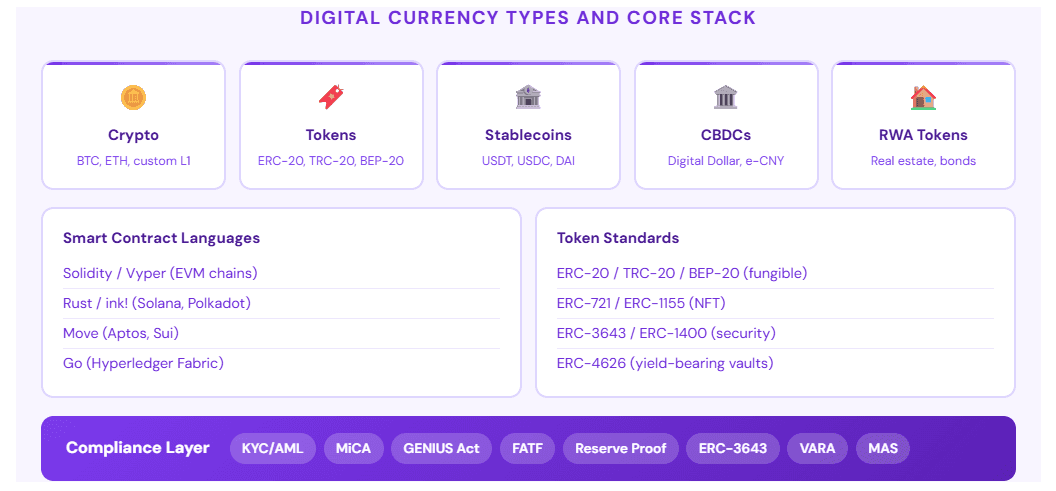
Digital currency development covers building blockchain-based monetary instruments and the systems that run them, as discussed in this stable coin rails guide. It spans five main categories.

Cryptocurrencies are native blockchain assets. Bitcoin, Ether, and Litecoin are the most established. Custom crypto builds involve designing consensus mechanisms, block reward structures, wallet rails, and node networks from scratch or by forking an existing chain.

Tokens run on top of existing blockchains. ERC-20 tokens on Ethereum, TRC-20 tokens on Tron, BEP-20 tokens on BNB Chain. They include utility tokens, governance tokens, security tokens, and reward tokens. Token development covers smart contract design, tokenomics, minting rules, and exchange listing.

Stablecoins are price-stable digital currencies. They are backed by fiat reserves, crypto backing, commodities, or supply algorithm rules. USDT, USDC, and DAI are the most-used examples. Building a stablecoin requires reserve management, KYC/AML integration, price oracle feeds, and rules-based compliance.

CBDCs (Central Bank Digital Currencies) are government-issued digital money. 134 countries now have active CBDC programs. They need top-security rails, identity management, and compliance with central bank mandates.

RWA (Real-World Asset) tokens bring physical assets on-chain. Real estate, bonds, private credit, commodities, and fund shares are all being tokenized. RWA development covers legal structuring, smart contract design, custody links, and secondary market rails.

Key tools in the digital currency builds stack:

  • Solidity / Vyper: Smart contract languages for EVM-compatible chains

  • Rust / ink!: Smart contract languages for Solana, Polkadot, and Cosmos

  • ERC-20 / TRC-20 / BEP-20: Core fungible token standards

  • ERC-3643 / ERC-1400: Security token standards with transfer controls

  • Chainlink / Pyth: Price oracle networks for stablecoin peg maintenance

  • Gnosis Safe / MPC wallets: Multi-signature and enterprise custody

  • OpenZeppelin: Audited smart contract libraries

  • Hardhat / Foundry: Development and testing frameworks

  • KYC/AML modules: Compliance layers for regulated digital currencies

  • Reserve Proof: On-chain attestation of backing assets

How We Ranked These Companies

Each company we scored on five points:

  • Digital currency track record: Verified token builds, stablecoin launches, or CBDC work with named projects

  • Stack depth: Smart contract languages, token standards, compliance modules, and wallet rails

  • Service breadth: Full-cycle from tokenomics design to smart contracts, audit, and exchange listing

  • Track record: Published case studies, client reviews, or third-party recognition with named outcomes

  • Pricing clarity: Clear rate ranges where published

Top Digital Currency Development Companie

1. TokenMinds

Website: tokenminds.co | Founded: 2017 | Rate: $50-$79/hr | Location: Singapore
TokenMinds builds digital currency systems for financial firms and fintech firms where compliance and throughput both matter. They focus on stablecoins, payment tokens, and AI-native treasury systems. Not speculative launches. Singapore puts them inside MAS frameworks. This matters for clients in Asian markets where stablecoin and CBDC adoption moves fastest.

BitGet, a top global crypto derivatives exchange, is a verified client. UXLINK is another client. The Web3 social platform has 54 million users and OKX as a partner. Projects at that scale need digital currency rails built for volume from day one.

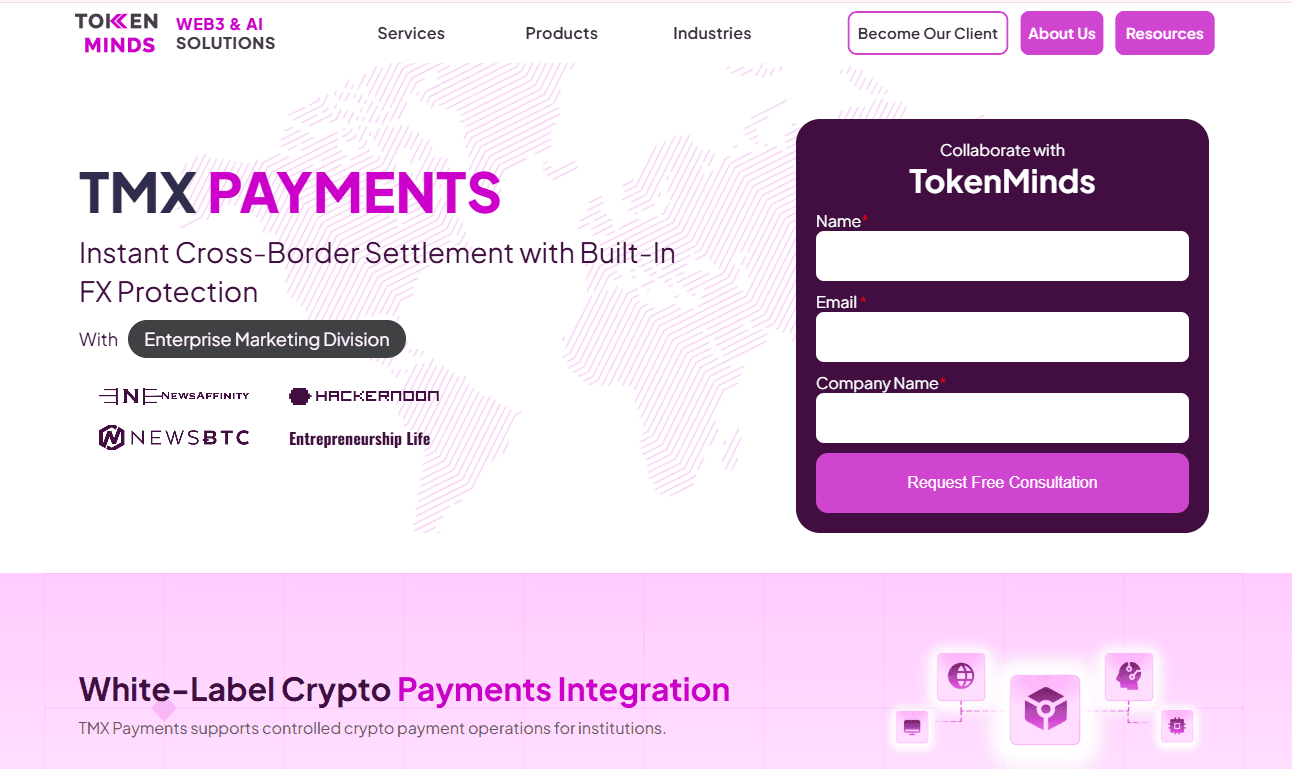
Three products back every project. TMX Payments handles multi-chain transfers, KYC/AML compliance, stablecoin settlement, and ERP sync. It turns raw blockchain throughput into compliant, live payment rails. TMX Tokenize covers on-chain real-world asset issuance: real estate, securities, commodities, and loyalty programs. Rules build into the token logic before launch. TMX Agentic Finance adds AI to treasury work: reserve tracking, approved execution, and alerts. Results: 97% KYC pass rate. Settlement cut from 48 hours to under five minutes.

  • Stack: Solidity · ERC-20 · TRC-20 · Multi-chain rails · KYC/AML · ERC-3643 · AI treasury · RWA tokenizing

  • Best For: Stablecoin and payment token builds · RWA tokenizing for financial firms · AI-native treasury systems

  • Awards & Certification: Hackernoon (2019) · NewsBTC (2022) · Coinranking (2025) · Finbold (2026) · ISO 27001

2. Antier Solutions

Website: antiersolutions.com | Founded: 2003 | Rate: Custom pricing | Location: Mohali, India (+ USA, UAE, UK, Australia)
Antier is among the oldest and largest digital currency firms on this list. They have delivered 500+ crypto projects. These span token launches, stablecoin platforms, CBDC pilots, and neo-banking rails. Their team runs 1,000+ blockchain engineers and domain specialists. A dedicated in-house legal and rules-based division covers multi-region compliance from day one.

Their Stablecoin RaaS platform launched in June 2025. It was the first of its kind built into a crypto neo-banking stack. It replaces SWIFT rails with on-chain settlement in under 60 seconds. Cross-border fees drop by up to 80%. They also build white-label crypto bank platforms. These come with MPC custody, stablecoin rails, on/off ramps, and payroll tools. Intermap Technologies confirmed on Clutch that Antier built Web3 rails for their geospatial firm. Work covered blockchain supply chain mapping and a full ICO strategy.

  • Stack: Solidity · ERC-20 · BEP-20 · CBDC design · MPC custody · KYC/AML · AI fraud analytics · RWA

  • Best For: CBDC pilots and stablecoin neo-banking · Crypto exchange and remittance platforms · Enterprise white-label digital currency

3. LeewayHertz

Website: leewayhertz.com | Founded: 2007 | Rate: $50-$99/hr | Location: San Francisco, CA
LeewayHertz has 15+ years of blockchain work. Their token practice spans enterprise use cases. Their stablecoin practice covers end-to-end delivery: tokenomics, smart contracts, reserve management, and exchange listing. A verified product is their Trust Platform for stablecoins. It lets users check stability and backing in real time. Their token work spans ERC-20 stablecoins, DAO governance models, and tokenized asset systems.

Clients span fintech, healthcare, and supply chain. The Hackett Group acquired LeewayHertz as a leading AI firm. This added AI depth to their digital currency builds. Their 250+ developer team has shipped 60+ projects across Ethereum, Solana, Tron, and Polkadot. Clients include 3M, McKinsey, and the US Army.

  • Stack: Solidity · ERC-20 · ERC-3643 · Stablecoin Trust Platform · DAO governance · RWA · Wallets · Multi-chain

  • Best For: Enterprise stablecoin builds · DAO governance tokens · RWA tokenizing with reserve proof

4. SoluLab

Website: solulab.com | Founded: 2014 | Rate: Custom pricing | Location: USA and India
SoluLab focuses on stablecoin and digital currency builds. CBDC research and remittance platforms are their core strengths. Their work on Singapore's MAS trial shows real CBDC depth. So does their research on the UAE Digital Dirham. They build custom fiat-pegged stablecoins for DeFi platforms, payment gateways, and fintech apps.

SoluLab built a blockchain marketplace for fast global payments on a hardware platform. It is a verified case study. Their stack covers Solidity, Ethereum, Solana, BNB, Polygon, Tron, ERC-20, ERC-721, and KYC/AML. Their remittance platform builds settle cross-border payments in over 30 currencies. They rank as a top stablecoin firm in multiple rankings and dedicated stablecoin guides.

  • Stack: Solidity · ERC-20 · TRC-20 · Price oracles · KYC/AML · CBDC design · Remittance rails · Ethereum · Solana · Tron

  • Best For: Stablecoin and CBDC builds · Cross-border remittance platforms · DeFi payment gateways

5. ScienceSoft

Website: scnsoft.com | Founded: 1989 | Rate: Custom pricing | Location: McKinney, TX, USA (+ global)

ScienceSoft has been in IT since 1989. Their blockchain and digital currency work started in 2020. They are among the most tenured firms on this list outside pure blockchain shops. Their work covers custom crypto assets, multi-coin wallets, and Bitcoin and Litecoin APIs. One verified case study: ready-to-deploy Bitcoin and Litecoin APIs with full docs. Delivered in 8 months. Another case study shows they built the SDK for CoolWallet, a hardware wallet company. A third case study: a multi-chain crypto wallet that converts assets without fees.

Their blockchain practice covers Ethereum, Hyperledger Fabric, Graphene, and Substrate. ISO 9001 and ISO 27001 certs cover quality and data security. They appear in IAOP's 2025 Global Outsourcing 100 for the fourth year running. They won a spot among DeFi leaders at the Global FinTech Awards 2025.

  • Stack: Solidity · EVM chains · Hyperledger Fabric · Graphene · Substrate · Bitcoin/Litecoin APIs · Multi-chain wallets

  • Best For: Custom crypto builds · Bitcoin and Litecoin payment APIs · Multi-chain wallet development

6. PixelPlex

Website: pixelplex.io | Founded: 2007 | Rate: Custom pricing | Location: New York, USA
PixelPlex has delivered 450+ blockchain projects with a zero exploit record. Client projects have raised over $1.2 billion and reached 50 million end users. They build stablecoins with on-chain reserve proof. Their scope also covers ERC-20 and BEP-20 tokens, DeFi, NFT builds, and smart contracts. Every solution goes through in-house and independent security review before launch. They hold verified reserve products by third-party stablecoin build rankings.

Their Rio DeFi case: a Substrate chain. It runs at 3,000 TPS with 2-second blocks and 13 smart contracts. This shows depth beyond EVM token work into protocol-level currency builds.

  • Stack: Solidity · ERC-20 · BEP-20 · Stablecoin reserves · Substrate · DeFi · NFT · Smart contracts

  • Best For: Stablecoin builds with reserve proof · DeFi protocol rails · High-security token launches

7. Blaize

Website: blaize.tech | Founded: 2017 | Rate: Custom pricing | Location: Ukraine (Kyiv and Dnipro)
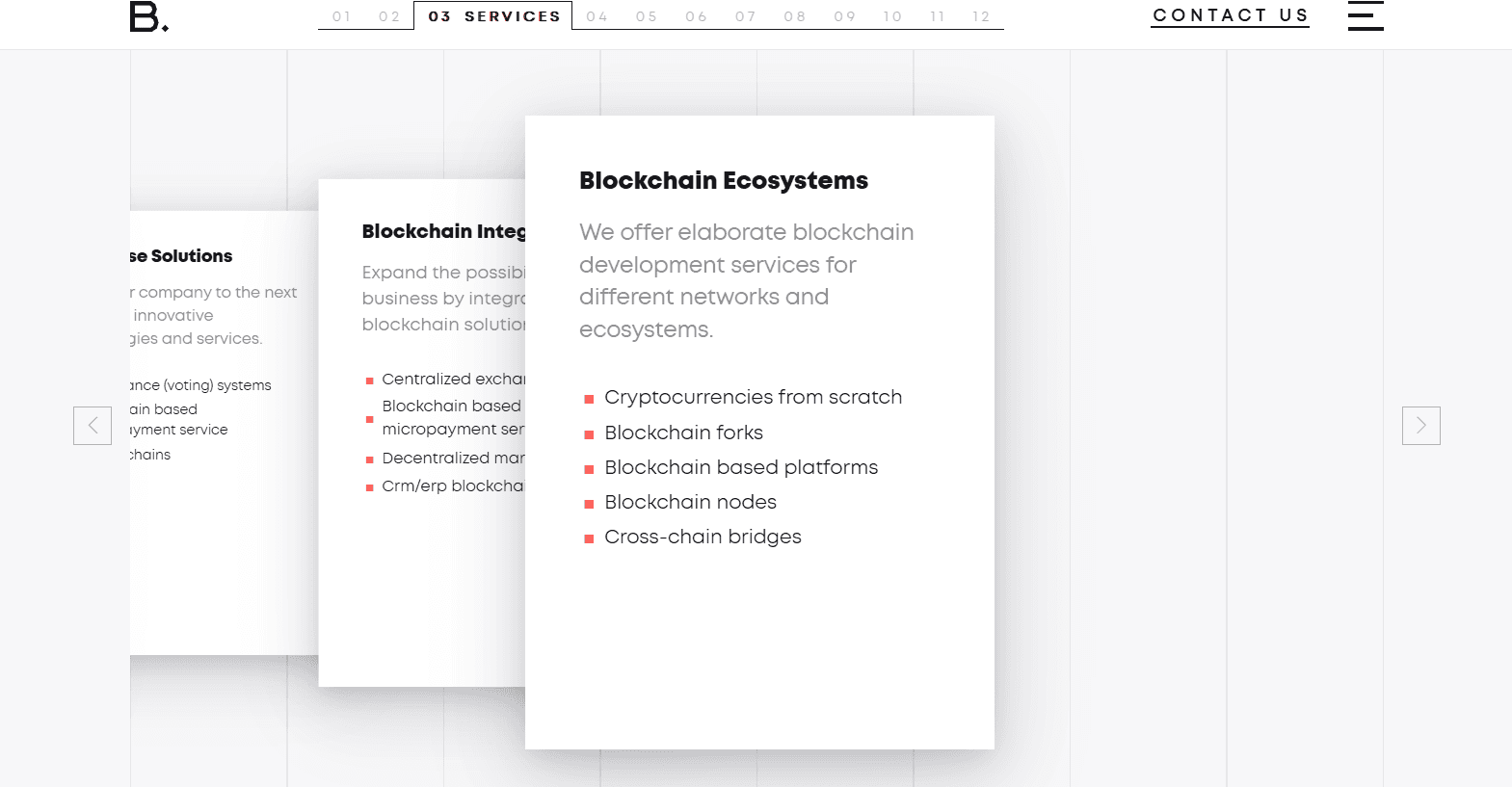
Blaize is the security-first firm on this list. Their digital currency practice focuses on smart contract audits and security reviews. Token and stablecoin protocols are their main targets. Their security team has served 130+ clients and secured 210+ protocols. The public audit library at audits.blaize.tech covers their completed work. Every project includes post-audit follow-up: secondary reviews, patches, and deploy support.

Their Breaker case study is a smart contract. It routes payments from video consumers to editors. Blaize develops token rails alongside auditing. Their stack covers ERC-20, ERC-721, TRC-20, TRC-721, Solidity, Rust, and Substrate. They appear in Alchemy's Polkadot network directory as an auditing firm. Clutch shows a 5.0/5.0 rating.

  • Stack: Solidity · ERC-20 · TRC-20 · Rust · Substrate · Formal review · Smart contract audits · Post-audit support

  • Best For: Digital currency audits before mainnet · Stablecoin smart contract security · Token builds needing security-first delivery

8. Rapid Innovation

Website: rapidinnovation.io | Founded: 2019 | Rate: Custom pricing | Location: USA and India
Rapid Innovation leads with token design before writing code. Their work covers stablecoin builds, custom tokens, DeFi, DEX builds, wallets, and bridges. Token design covers supply schedules, vesting rules, staking rewards, burn mechanics, and gas tuning. All done before the first smart contract is written.

Their team works across Solidity, Rust, TRC-20, ERC-20, TronBox, TronWeb, and Foundry. They appear in multiple 2025 and 2026 digital currency builds rankings. One client review notes the CEO joined early calls to understand the project first. Their cross-chain practice covers Ethereum-to-Tron, Ethereum-to-Polkadot, and Ethereum-to-Solana bridges.

  • Stack: Solidity · ERC-20 · TRC-20 · Rust · Foundry · DeFi · DEX · Wallets · Cross-chain bridges

  • Best For: Token design-first builds · Stablecoin and DeFi protocols · Multi-chain digital currency bridges

9. IdeaSoft

Website: ideasoft.io | Founded: 2016 | Rate: $50-$99/hr | Location: Tallinn, Estonia
IdeaSoft has delivered 250+ blockchain projects for corporate, enterprise, and government clients. In 2021, they joined Sigma Software Group, a Swedish IT firm. This expanded their rules scope. Their work covers crypto exchange builds, token builds, DeFi, and compliance-ready smart contracts. They rank as a top crypto exchange build firm in a third-party 2026 ranking.

Their rules depth is practical. AML/CFT expertise and FATF-compliant DeFi builds show up in third-party reviews. Clients include First Abu Dhabi Bank, Breaking Equity, and TradeLeaf. Few firms match their track record for regulated bank and government digital currency builds.

  • Stack: Solidity · ERC-20 · Multi-chain · DeFi · Smart contracts · Crypto exchange · Compliance layer

  • Best For: Regulated digital currency builds · Crypto exchange platforms · Government and bank clients

10. Innowise Group

Website: innowise.com | Founded: 2007 | Rate: $50-$100/hr | Location: Warsaw, Poland
Innowise is the largest firm on this list. They run 3,500+ staff and a 50+ developer blockchain hub. They hold CMMI Level 5 status. Their work covers token builds, stablecoin design, RWA tokenizing, DeFi, and enterprise platforms. Smart contracts cover design, build, audit, and tuning across Ethereum, Polygon, BNB, and Tron.

A recent project is Haust Network. It is a Layer-2 solution with cross-chain logic and liquidity controls. Enterprise clients include the Commercial Bank of Qatar, NTT DATA, and SPAR. A 93% client return rate shows strong delivery. For enterprise digital currency builds needing large teams and formal process, Innowise fits well.

  • Stack: Solidity · ERC-20 · BEP-20 · TRC-20 · Stablecoin architecture · RWA · DeFi · Tokenizing · Multi-chain

  • Best For: Enterprise digital currency platforms · RWA tokenizing at scale · Large-team regulated builds

Digital Currency Development Pricing in 2026

Pricing varies by digital currency type, rules scope, and chain complexity. Stablecoins and CBDCs cost more than utility tokens. Multi-chain builds cost more than single-chain. Audit costs are always separate.

Build Type

What You Get

Timeline

Cost Range

Utility / Governance Token

ERC-20 contract, tokenomics, deploy, basic audit

1-3 weeks

$5,000-$20,000

Security Token (ERC-3643)

Transfer controls, whitelist, rules layer, audit

3-6 weeks

$20,000-$60,000

Fiat-Backed Stablecoin

Smart contract, KYC/AML, reserve proof, oracle, audit

4-8 weeks

$40,000-$120,000

Crypto-Backed Stablecoin

Over-backing logic, liquidation engine, oracle, audit

6-10 weeks

$60,000-$150,000

RWA Tokenizing Platform

Asset onboarding, ERC-3643, custody link, secondary market

2-4 months

$80,000-$250,000

Custom Crypto (L1)

Chain fork or custom L1, wallets, explorers, node infra

3-6 months

$100,000-$400,000

CBDC Platform

Central bank infra, identity management, retail/wholesale rails

6-18 months

$300,000-$2,000,000+

What drives cost up:

  • CBDC builds require top-grade security, central bank integration, and multi-year support. They are priced as custom engagements.

  • Multi-jurisdiction compliance adds legal review cost on top of development. MiCA, GENIUS Act, and VARA each require separate legal mapping.

  • Smart contract audits run $8,000-$40,000 on top of build cost. Budget apart. Never skip for live digital currency.

  • Multi-chain stablecoin builds cost 40-60% more than single-chain. Each chain requires separate contracts, testing, and audits.

  • Proof of reserves rails adds 2-4 weeks and separate tooling cost.

  • Algorithmic stablecoins require deep protocol expertise. Only a few firms on this list have shipped them safely.

Why Build a Digital Currency in 2026?
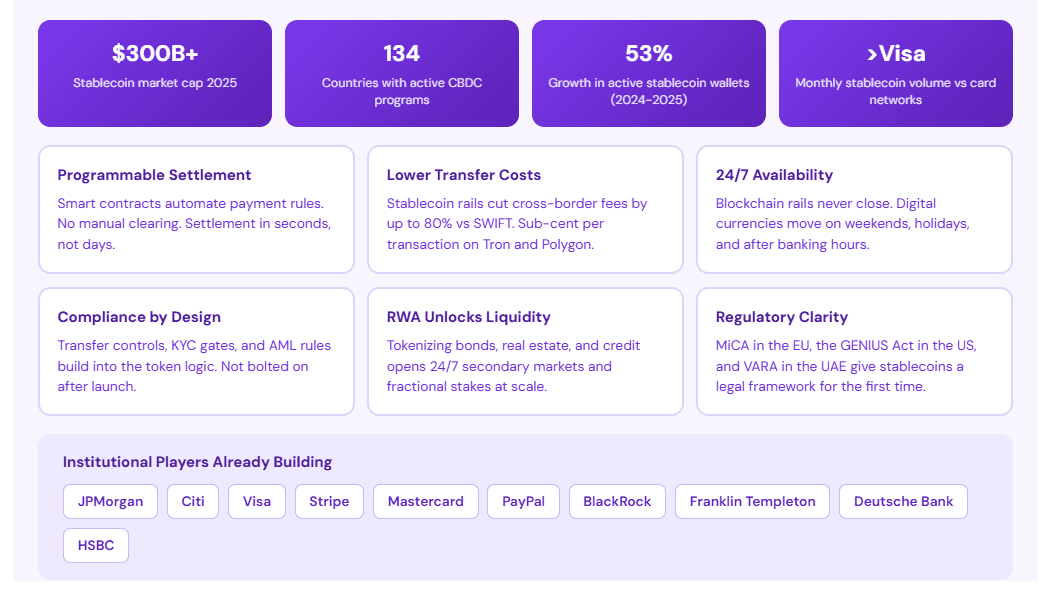
The case for firms is clear. JPMorgan, Citi, Visa, and Stripe are all building with digital money. So are four of America's largest banks. Stablecoin volumes surpass Visa and Mastercard combined. CBDC pilots live in 134 countries.

How to Choose the Right Digital Currency Development Partner

  1. Match the firm to your currency type: Stablecoin, CBDC, utility token, and security token builds all need different expertise. Ask for a named project that matches your type. A firm that only builds utility tokens should not lead your stablecoin launch.

  2. Confirm rules depth before engaging: KYC/AML is the floor, not the ceiling. Ask about MiCA readiness, GENIUS Act compliance, and FATF travel rule support. For CBDC work, ask which central bank mandates they have worked with. Firms without a dedicated compliance practice will slow your launch.

  3. Budget the audit as a separate line item: Any digital currency holding real value needs an independent smart contract audit. Budget $8,000-$40,000 apart. Never share this cost with the build firm. Use a third party: CertiK, Hacken, Trail of Bits, or Blaize.

  4. Ask about reserve proof: Any fiat-backed stablecoin needs verifiable reserves from launch day. Ask how the firm builds this. Ask for a live example. This is non-negotiable for any regulated stablecoin.

  5. Check their tokenomics practice: Poor token design causes more post-launch failures than poor code. Ask if they design supply, vesting, burn mechanics, and staking rewards before writing contracts. Firms that start with code and work backward on tokenomics create avoidable problems.

  6. Understand their multi-chain approach: Most digital currencies need to run on more than one chain. Ask how they handle contract deployment, liquidity bridging, and audit coverage across chains. Each chain is a separate audit.

Conclusion

The firms are not waiting. JPMorgan, Citi, BlackRock, and Franklin Templeton are all building digital currency rails now. Stablecoin volumes exceed Visa and Mastercard. CBDC pilots live in 134 countries. The window to build and launch is open, but it is not unlimited. Regulatory frameworks are tightening. MiCA is live. The GENIUS Act passed. VARA is enforced in the UAE.

The firms that build digital currencies well treat compliance as architecture, not an afterthought. They design tokenomics before writing code. They use independent auditors, build reserve proof from day one, and understand which rules apply to your region before pricing the project.

FAQ

What is digital currency development?

Digital currency development covers building blockchain-based monetary instruments. This includes utility tokens, governance tokens, security tokens, stablecoins, CBDCs, and RWA tokens. It spans tokenomics design, smart contracts, rules layers, wallet builds, and exchange listing.

How much does digital currency development cost in 2026?

A utility token starts at $5,000. A security token with transfer controls runs $20,000-$60,000. A fiat-backed stablecoin runs $40,000-$120,000. An RWA platform runs $80,000-$250,000. A custom L1 crypto runs $100,000-$400,000. CBDC builds start at $300,000 and scale into the millions.

What is a stablecoin?

A stablecoin is a digital currency with a fixed price peg. It runs on fiat reserves, crypto backing, commodities, or supply algorithm control. USDT and USDC follow the fiat-backed model. DAI uses crypto backing. Stablecoins let businesses move value on-chain without price risk.

What is a CBDC?

A CBDC is a central bank digital currency. It is government-issued digital money runs on blockchain or shared ledger tech. 134 countries now have active CBDC programs. They require central bank-grade security, identity management, and legal backing from the issuing government.

What is RWA tokenizing?

RWA tokenizing converts physical assets into digital tokens on a blockchain. Real estate, bonds, private credit, commodities, and fund shares can all move on-chain. Tokenizing opens 24/7 markets, enables fractional stakes, and cuts settlement from days to seconds.

What smart contract standards are used for digital currencies?

ERC-20 is the main fungible token standard on EVM chains. ERC-3643 adds transfer controls for security tokens. ERC-1400 is another security token standard. TRC-20 is the main standard on Tron. BEP-20 is the main standard on BNB Chain. CBDCs often use custom standards or private blockchain frameworks like Hyperledger Fabric.

What compliance frameworks apply to digital currencies in 2026?

MiCA (Markets in Crypto-Assets Regulation) covers the EU. The GENIUS Act covers stablecoins in the US. VARA covers digital assets in the UAE. FATF travel rule applies worldwide to virtual asset service providers. MAS frameworks apply in Singapore. Each jurisdiction requires separate legal mapping before launch.

Do I need a smart contract audit for my digital currency?

Yes. Any digital currency holding real value needs an independent smart contract audit. Use a third-party firm that does not also build your contracts. CertiK, Hacken, Trail of Bits, and Blaize are strong choices. Budget $8,000-$40,000 apart from build cost.


TLDR

TokenMinds works well for teams building stablecoins, payment tokens, or tokenized asset platforms, while Antier Solutions, LeewayHertz, and Innowise fit large enterprise or banking-level systems, and SoluLab, ScienceSoft, PixelPlex, Blaize, Rapid Innovation, and IdeaSoft are good choices for exchanges, wallets, tokens, or mid-scale digital currency projects with different technical and regulatory needs.

JPMorgan issued its USD deposit token on a public blockchain. Citi integrated token services with 24/7 USD clearing for fast cross-border payments. Four of America's largest banks announced plans to co-develop a stablecoin. The total stablecoin market crossed $300 billion in 2025. Monthly volumes now exceed Visa and Mastercard combined. What started as a fringe experiment is now financial rails. Banks, fintechs, and governments are all building digital currency systems. The firms that build them well are pulling ahead.

This guide ranks the top digital currency firms in 2026. We ranked companies on verified experience, stack depth, rules depth, and client outcomes. Digital currency takes many forms. These include crypto assets, utility tokens, stablecoins, CBDCs, and tokenized real assets.

Quick Comparison

Rank

Company

Key Services

Rate

Founded

1

TokenMinds

Stablecoin, CBDC, Token Dev, DeFi, AI Treasury, RWA

$50-$79/hr

2017

2

Antier Solutions

Crypto Coin Dev, Stablecoin, CBDC, Neo-Banking, RWA, DeFi

Custom

2003

3

LeewayHertz

Token Dev, Stablecoin, DAO, DeFi, Wallets, RWA

$50-$99/hr

2007

4

SoluLab

Stablecoin, CBDC, Remittance, DeFi, Smart Contracts, RWA

Custom

2014

5

ScienceSoft

Custom Crypto, Wallets, Bitcoin/Litecoin APIs, Token Dev

Custom

1989

6

PixelPlex

Stablecoin, Token Dev, DeFi, NFT, Smart Contracts, Wallets

Custom

2007

7

Blaize

Digital Currency Audit, Smart Contract Security, Token Dev

Custom

2017

8

Rapid Innovation

Token Design, Stablecoin, DeFi, Multi-chain, Wallets, DEX

Custom

2019

9

IdeaSoft

Crypto Exchange, Token Dev, DeFi, Compliance, Cross-chain

$50-$99/hr

2016

10

Innowise Group

Token Dev, Stablecoin, RWA, DeFi, Enterprise Digital Currency

$50-$100/hr

2007

What Is Digital Currency Development?

Digital currency development covers building blockchain-based monetary instruments and the systems that run them, as discussed in this stable coin rails guide. It spans five main categories.

Cryptocurrencies are native blockchain assets. Bitcoin, Ether, and Litecoin are the most established. Custom crypto builds involve designing consensus mechanisms, block reward structures, wallet rails, and node networks from scratch or by forking an existing chain.

Tokens run on top of existing blockchains. ERC-20 tokens on Ethereum, TRC-20 tokens on Tron, BEP-20 tokens on BNB Chain. They include utility tokens, governance tokens, security tokens, and reward tokens. Token development covers smart contract design, tokenomics, minting rules, and exchange listing.

Stablecoins are price-stable digital currencies. They are backed by fiat reserves, crypto backing, commodities, or supply algorithm rules. USDT, USDC, and DAI are the most-used examples. Building a stablecoin requires reserve management, KYC/AML integration, price oracle feeds, and rules-based compliance.

CBDCs (Central Bank Digital Currencies) are government-issued digital money. 134 countries now have active CBDC programs. They need top-security rails, identity management, and compliance with central bank mandates.

RWA (Real-World Asset) tokens bring physical assets on-chain. Real estate, bonds, private credit, commodities, and fund shares are all being tokenized. RWA development covers legal structuring, smart contract design, custody links, and secondary market rails.

Key tools in the digital currency builds stack:

  • Solidity / Vyper: Smart contract languages for EVM-compatible chains

  • Rust / ink!: Smart contract languages for Solana, Polkadot, and Cosmos

  • ERC-20 / TRC-20 / BEP-20: Core fungible token standards

  • ERC-3643 / ERC-1400: Security token standards with transfer controls

  • Chainlink / Pyth: Price oracle networks for stablecoin peg maintenance

  • Gnosis Safe / MPC wallets: Multi-signature and enterprise custody

  • OpenZeppelin: Audited smart contract libraries

  • Hardhat / Foundry: Development and testing frameworks

  • KYC/AML modules: Compliance layers for regulated digital currencies

  • Reserve Proof: On-chain attestation of backing assets

How We Ranked These Companies

Each company we scored on five points:

  • Digital currency track record: Verified token builds, stablecoin launches, or CBDC work with named projects

  • Stack depth: Smart contract languages, token standards, compliance modules, and wallet rails

  • Service breadth: Full-cycle from tokenomics design to smart contracts, audit, and exchange listing

  • Track record: Published case studies, client reviews, or third-party recognition with named outcomes

  • Pricing clarity: Clear rate ranges where published

Top Digital Currency Development Companie

1. TokenMinds

Website: tokenminds.co | Founded: 2017 | Rate: $50-$79/hr | Location: Singapore

TokenMinds builds digital currency systems for financial firms and fintech firms where compliance and throughput both matter. They focus on stablecoins, payment tokens, and AI-native treasury systems. Not speculative launches. Singapore puts them inside MAS frameworks. This matters for clients in Asian markets where stablecoin and CBDC adoption moves fastest.

BitGet, a top global crypto derivatives exchange, is a verified client. UXLINK is another client. The Web3 social platform has 54 million users and OKX as a partner. Projects at that scale need digital currency rails built for volume from day one.

Three products back every project. TMX Payments handles multi-chain transfers, KYC/AML compliance, stablecoin settlement, and ERP sync. It turns raw blockchain throughput into compliant, live payment rails. TMX Tokenize covers on-chain real-world asset issuance: real estate, securities, commodities, and loyalty programs. Rules build into the token logic before launch. TMX Agentic Finance adds AI to treasury work: reserve tracking, approved execution, and alerts. Results: 97% KYC pass rate. Settlement cut from 48 hours to under five minutes.

  • Stack: Solidity · ERC-20 · TRC-20 · Multi-chain rails · KYC/AML · ERC-3643 · AI treasury · RWA tokenizing

  • Best For: Stablecoin and payment token builds · RWA tokenizing for financial firms · AI-native treasury systems

  • Awards & Certification: Hackernoon (2019) · NewsBTC (2022) · Coinranking (2025) · Finbold (2026) · ISO 27001

2. Antier Solutions

Website: antiersolutions.com | Founded: 2003 | Rate: Custom pricing | Location: Mohali, India (+ USA, UAE, UK, Australia)

Antier is among the oldest and largest digital currency firms on this list. They have delivered 500+ crypto projects. These span token launches, stablecoin platforms, CBDC pilots, and neo-banking rails. Their team runs 1,000+ blockchain engineers and domain specialists. A dedicated in-house legal and rules-based division covers multi-region compliance from day one.

Their Stablecoin RaaS platform launched in June 2025. It was the first of its kind built into a crypto neo-banking stack. It replaces SWIFT rails with on-chain settlement in under 60 seconds. Cross-border fees drop by up to 80%. They also build white-label crypto bank platforms. These come with MPC custody, stablecoin rails, on/off ramps, and payroll tools. Intermap Technologies confirmed on Clutch that Antier built Web3 rails for their geospatial firm. Work covered blockchain supply chain mapping and a full ICO strategy.

  • Stack: Solidity · ERC-20 · BEP-20 · CBDC design · MPC custody · KYC/AML · AI fraud analytics · RWA

  • Best For: CBDC pilots and stablecoin neo-banking · Crypto exchange and remittance platforms · Enterprise white-label digital currency

3. LeewayHertz

Website: leewayhertz.com | Founded: 2007 | Rate: $50-$99/hr | Location: San Francisco, CA

LeewayHertz has 15+ years of blockchain work. Their token practice spans enterprise use cases. Their stablecoin practice covers end-to-end delivery: tokenomics, smart contracts, reserve management, and exchange listing. A verified product is their Trust Platform for stablecoins. It lets users check stability and backing in real time. Their token work spans ERC-20 stablecoins, DAO governance models, and tokenized asset systems.

Clients span fintech, healthcare, and supply chain. The Hackett Group acquired LeewayHertz as a leading AI firm. This added AI depth to their digital currency builds. Their 250+ developer team has shipped 60+ projects across Ethereum, Solana, Tron, and Polkadot. Clients include 3M, McKinsey, and the US Army.

  • Stack: Solidity · ERC-20 · ERC-3643 · Stablecoin Trust Platform · DAO governance · RWA · Wallets · Multi-chain

  • Best For: Enterprise stablecoin builds · DAO governance tokens · RWA tokenizing with reserve proof

4. SoluLab

Website: solulab.com | Founded: 2014 | Rate: Custom pricing | Location: USA and India

SoluLab focuses on stablecoin and digital currency builds. CBDC research and remittance platforms are their core strengths. Their work on Singapore's MAS trial shows real CBDC depth. So does their research on the UAE Digital Dirham. They build custom fiat-pegged stablecoins for DeFi platforms, payment gateways, and fintech apps.

SoluLab built a blockchain marketplace for fast global payments on a hardware platform. It is a verified case study. Their stack covers Solidity, Ethereum, Solana, BNB, Polygon, Tron, ERC-20, ERC-721, and KYC/AML. Their remittance platform builds settle cross-border payments in over 30 currencies. They rank as a top stablecoin firm in multiple rankings and dedicated stablecoin guides.

  • Stack: Solidity · ERC-20 · TRC-20 · Price oracles · KYC/AML · CBDC design · Remittance rails · Ethereum · Solana · Tron

  • Best For: Stablecoin and CBDC builds · Cross-border remittance platforms · DeFi payment gateways

5. ScienceSoft

Website: scnsoft.com | Founded: 1989 | Rate: Custom pricing | Location: McKinney, TX, USA (+ global)

ScienceSoft has been in IT since 1989. Their blockchain and digital currency work started in 2020. They are among the most tenured firms on this list outside pure blockchain shops. Their work covers custom crypto assets, multi-coin wallets, and Bitcoin and Litecoin APIs. One verified case study: ready-to-deploy Bitcoin and Litecoin APIs with full docs. Delivered in 8 months. Another case study shows they built the SDK for CoolWallet, a hardware wallet company. A third case study: a multi-chain crypto wallet that converts assets without fees.

Their blockchain practice covers Ethereum, Hyperledger Fabric, Graphene, and Substrate. ISO 9001 and ISO 27001 certs cover quality and data security. They appear in IAOP's 2025 Global Outsourcing 100 for the fourth year running. They won a spot among DeFi leaders at the Global FinTech Awards 2025.

  • Stack: Solidity · EVM chains · Hyperledger Fabric · Graphene · Substrate · Bitcoin/Litecoin APIs · Multi-chain wallets

  • Best For: Custom crypto builds · Bitcoin and Litecoin payment APIs · Multi-chain wallet development

6. PixelPlex

Website: pixelplex.io | Founded: 2007 | Rate: Custom pricing | Location: New York, USA

PixelPlex has delivered 450+ blockchain projects with a zero exploit record. Client projects have raised over $1.2 billion and reached 50 million end users. They build stablecoins with on-chain reserve proof. Their scope also covers ERC-20 and BEP-20 tokens, DeFi, NFT builds, and smart contracts. Every solution goes through in-house and independent security review before launch. They hold verified reserve products by third-party stablecoin build rankings.

Their Rio DeFi case: a Substrate chain. It runs at 3,000 TPS with 2-second blocks and 13 smart contracts. This shows depth beyond EVM token work into protocol-level currency builds.

  • Stack: Solidity · ERC-20 · BEP-20 · Stablecoin reserves · Substrate · DeFi · NFT · Smart contracts

  • Best For: Stablecoin builds with reserve proof · DeFi protocol rails · High-security token launches

7. Blaize

Website: blaize.tech | Founded: 2017 | Rate: Custom pricing | Location: Ukraine (Kyiv and Dnipro)

Blaize is the security-first firm on this list. Their digital currency practice focuses on smart contract audits and security reviews. Token and stablecoin protocols are their main targets. Their security team has served 130+ clients and secured 210+ protocols. The public audit library at audits.blaize.tech covers their completed work. Every project includes post-audit follow-up: secondary reviews, patches, and deploy support.

Their Breaker case study is a smart contract. It routes payments from video consumers to editors. Blaize develops token rails alongside auditing. Their stack covers ERC-20, ERC-721, TRC-20, TRC-721, Solidity, Rust, and Substrate. They appear in Alchemy's Polkadot network directory as an auditing firm. Clutch shows a 5.0/5.0 rating.

  • Stack: Solidity · ERC-20 · TRC-20 · Rust · Substrate · Formal review · Smart contract audits · Post-audit support

  • Best For: Digital currency audits before mainnet · Stablecoin smart contract security · Token builds needing security-first delivery

8. Rapid Innovation

Website: rapidinnovation.io | Founded: 2019 | Rate: Custom pricing | Location: USA and India

Rapid Innovation leads with token design before writing code. Their work covers stablecoin builds, custom tokens, DeFi, DEX builds, wallets, and bridges. Token design covers supply schedules, vesting rules, staking rewards, burn mechanics, and gas tuning. All done before the first smart contract is written.

Their team works across Solidity, Rust, TRC-20, ERC-20, TronBox, TronWeb, and Foundry. They appear in multiple 2025 and 2026 digital currency builds rankings. One client review notes the CEO joined early calls to understand the project first. Their cross-chain practice covers Ethereum-to-Tron, Ethereum-to-Polkadot, and Ethereum-to-Solana bridges.

  • Stack: Solidity · ERC-20 · TRC-20 · Rust · Foundry · DeFi · DEX · Wallets · Cross-chain bridges

  • Best For: Token design-first builds · Stablecoin and DeFi protocols · Multi-chain digital currency bridges

9. IdeaSoft

Website: ideasoft.io | Founded: 2016 | Rate: $50-$99/hr | Location: Tallinn, Estonia

IdeaSoft has delivered 250+ blockchain projects for corporate, enterprise, and government clients. In 2021, they joined Sigma Software Group, a Swedish IT firm. This expanded their rules scope. Their work covers crypto exchange builds, token builds, DeFi, and compliance-ready smart contracts. They rank as a top crypto exchange build firm in a third-party 2026 ranking.

Their rules depth is practical. AML/CFT expertise and FATF-compliant DeFi builds show up in third-party reviews. Clients include First Abu Dhabi Bank, Breaking Equity, and TradeLeaf. Few firms match their track record for regulated bank and government digital currency builds.

  • Stack: Solidity · ERC-20 · Multi-chain · DeFi · Smart contracts · Crypto exchange · Compliance layer

  • Best For: Regulated digital currency builds · Crypto exchange platforms · Government and bank clients

10. Innowise Group

Website: innowise.com | Founded: 2007 | Rate: $50-$100/hr | Location: Warsaw, Poland

Innowise is the largest firm on this list. They run 3,500+ staff and a 50+ developer blockchain hub. They hold CMMI Level 5 status. Their work covers token builds, stablecoin design, RWA tokenizing, DeFi, and enterprise platforms. Smart contracts cover design, build, audit, and tuning across Ethereum, Polygon, BNB, and Tron.

A recent project is Haust Network. It is a Layer-2 solution with cross-chain logic and liquidity controls. Enterprise clients include the Commercial Bank of Qatar, NTT DATA, and SPAR. A 93% client return rate shows strong delivery. For enterprise digital currency builds needing large teams and formal process, Innowise fits well.

  • Stack: Solidity · ERC-20 · BEP-20 · TRC-20 · Stablecoin architecture · RWA · DeFi · Tokenizing · Multi-chain

  • Best For: Enterprise digital currency platforms · RWA tokenizing at scale · Large-team regulated builds

Digital Currency Development Pricing in 2026

Pricing varies by digital currency type, rules scope, and chain complexity. Stablecoins and CBDCs cost more than utility tokens. Multi-chain builds cost more than single-chain. Audit costs are always separate.

Build Type

What You Get

Timeline

Cost Range

Utility / Governance Token

ERC-20 contract, tokenomics, deploy, basic audit

1-3 weeks

$5,000-$20,000

Security Token (ERC-3643)

Transfer controls, whitelist, rules layer, audit

3-6 weeks

$20,000-$60,000

Fiat-Backed Stablecoin

Smart contract, KYC/AML, reserve proof, oracle, audit

4-8 weeks

$40,000-$120,000

Crypto-Backed Stablecoin

Over-backing logic, liquidation engine, oracle, audit

6-10 weeks

$60,000-$150,000

RWA Tokenizing Platform

Asset onboarding, ERC-3643, custody link, secondary market

2-4 months

$80,000-$250,000

Custom Crypto (L1)

Chain fork or custom L1, wallets, explorers, node infra

3-6 months

$100,000-$400,000

CBDC Platform

Central bank infra, identity management, retail/wholesale rails

6-18 months

$300,000-$2,000,000+

What drives cost up:

  • CBDC builds require top-grade security, central bank integration, and multi-year support. They are priced as custom engagements.

  • Multi-jurisdiction compliance adds legal review cost on top of development. MiCA, GENIUS Act, and VARA each require separate legal mapping.

  • Smart contract audits run $8,000-$40,000 on top of build cost. Budget apart. Never skip for live digital currency.

  • Multi-chain stablecoin builds cost 40-60% more than single-chain. Each chain requires separate contracts, testing, and audits.

  • Proof of reserves rails adds 2-4 weeks and separate tooling cost.

  • Algorithmic stablecoins require deep protocol expertise. Only a few firms on this list have shipped them safely.

Why Build a Digital Currency in 2026?

The case for firms is clear. JPMorgan, Citi, Visa, and Stripe are all building with digital money. So are four of America's largest banks. Stablecoin volumes surpass Visa and Mastercard combined. CBDC pilots live in 134 countries.

How to Choose the Right Digital Currency Development Partner

  1. Match the firm to your currency type: Stablecoin, CBDC, utility token, and security token builds all need different expertise. Ask for a named project that matches your type. A firm that only builds utility tokens should not lead your stablecoin launch.

  2. Confirm rules depth before engaging: KYC/AML is the floor, not the ceiling. Ask about MiCA readiness, GENIUS Act compliance, and FATF travel rule support. For CBDC work, ask which central bank mandates they have worked with. Firms without a dedicated compliance practice will slow your launch.

  3. Budget the audit as a separate line item: Any digital currency holding real value needs an independent smart contract audit. Budget $8,000-$40,000 apart. Never share this cost with the build firm. Use a third party: CertiK, Hacken, Trail of Bits, or Blaize.

  4. Ask about reserve proof: Any fiat-backed stablecoin needs verifiable reserves from launch day. Ask how the firm builds this. Ask for a live example. This is non-negotiable for any regulated stablecoin.

  5. Check their tokenomics practice: Poor token design causes more post-launch failures than poor code. Ask if they design supply, vesting, burn mechanics, and staking rewards before writing contracts. Firms that start with code and work backward on tokenomics create avoidable problems.

  6. Understand their multi-chain approach: Most digital currencies need to run on more than one chain. Ask how they handle contract deployment, liquidity bridging, and audit coverage across chains. Each chain is a separate audit.

Conclusion

The firms are not waiting. JPMorgan, Citi, BlackRock, and Franklin Templeton are all building digital currency rails now. Stablecoin volumes exceed Visa and Mastercard. CBDC pilots live in 134 countries. The window to build and launch is open, but it is not unlimited. Regulatory frameworks are tightening. MiCA is live. The GENIUS Act passed. VARA is enforced in the UAE.

The firms that build digital currencies well treat compliance as architecture, not an afterthought. They design tokenomics before writing code. They use independent auditors, build reserve proof from day one, and understand which rules apply to your region before pricing the project.

FAQ

What is digital currency development?

Digital currency development covers building blockchain-based monetary instruments. This includes utility tokens, governance tokens, security tokens, stablecoins, CBDCs, and RWA tokens. It spans tokenomics design, smart contracts, rules layers, wallet builds, and exchange listing.

How much does digital currency development cost in 2026?

A utility token starts at $5,000. A security token with transfer controls runs $20,000-$60,000. A fiat-backed stablecoin runs $40,000-$120,000. An RWA platform runs $80,000-$250,000. A custom L1 crypto runs $100,000-$400,000. CBDC builds start at $300,000 and scale into the millions.

What is a stablecoin?

A stablecoin is a digital currency with a fixed price peg. It runs on fiat reserves, crypto backing, commodities, or supply algorithm control. USDT and USDC follow the fiat-backed model. DAI uses crypto backing. Stablecoins let businesses move value on-chain without price risk.

What is a CBDC?

A CBDC is a central bank digital currency. It is government-issued digital money runs on blockchain or shared ledger tech. 134 countries now have active CBDC programs. They require central bank-grade security, identity management, and legal backing from the issuing government.

What is RWA tokenizing?

RWA tokenizing converts physical assets into digital tokens on a blockchain. Real estate, bonds, private credit, commodities, and fund shares can all move on-chain. Tokenizing opens 24/7 markets, enables fractional stakes, and cuts settlement from days to seconds.

What smart contract standards are used for digital currencies?

ERC-20 is the main fungible token standard on EVM chains. ERC-3643 adds transfer controls for security tokens. ERC-1400 is another security token standard. TRC-20 is the main standard on Tron. BEP-20 is the main standard on BNB Chain. CBDCs often use custom standards or private blockchain frameworks like Hyperledger Fabric.

What compliance frameworks apply to digital currencies in 2026?

MiCA (Markets in Crypto-Assets Regulation) covers the EU. The GENIUS Act covers stablecoins in the US. VARA covers digital assets in the UAE. FATF travel rule applies worldwide to virtual asset service providers. MAS frameworks apply in Singapore. Each jurisdiction requires separate legal mapping before launch.

Do I need a smart contract audit for my digital currency?

Yes. Any digital currency holding real value needs an independent smart contract audit. Use a third-party firm that does not also build your contracts. CertiK, Hacken, Trail of Bits, and Blaize are strong choices. Budget $8,000-$40,000 apart from build cost.

GET SUCCESS IN WEB3

  • Trusted Web3 partner since 2017

  • Full-stack Web3 development team

  • Performance-driven Web3 marketing

Get A Free Consultation

Get A Free Consultation

RECENT TRAININGS

Follow us

get web3 business updates

Email invalid

  • Access global liquidity for your RWA project with TMX Tokenize’s Canton Network integration

DISCOVER NOW

  • Access global liquidity for your RWA project with TMX Tokenize’s Canton Network integration

    JOIN NOW

DISCOVER

  • Access global liquidity for your RWA project with TMX Tokenize’s Canton Network integration