Web3 & AI

SOLUTIONS

Products

Services

Web3 & AI

SOLUTIONS

Services

Products

Industries

Become Our Client

About Us

Resources

Web3 & AI

SOLUTIONS

Services

Products

Industries

Social Login, Embedded Wallets, or WalletConnect: What Converts Best Before a Token Sale?

Social Login, Embedded Wallets, or WalletConnect: What Converts Best Before a Token Sale?

TL;DR
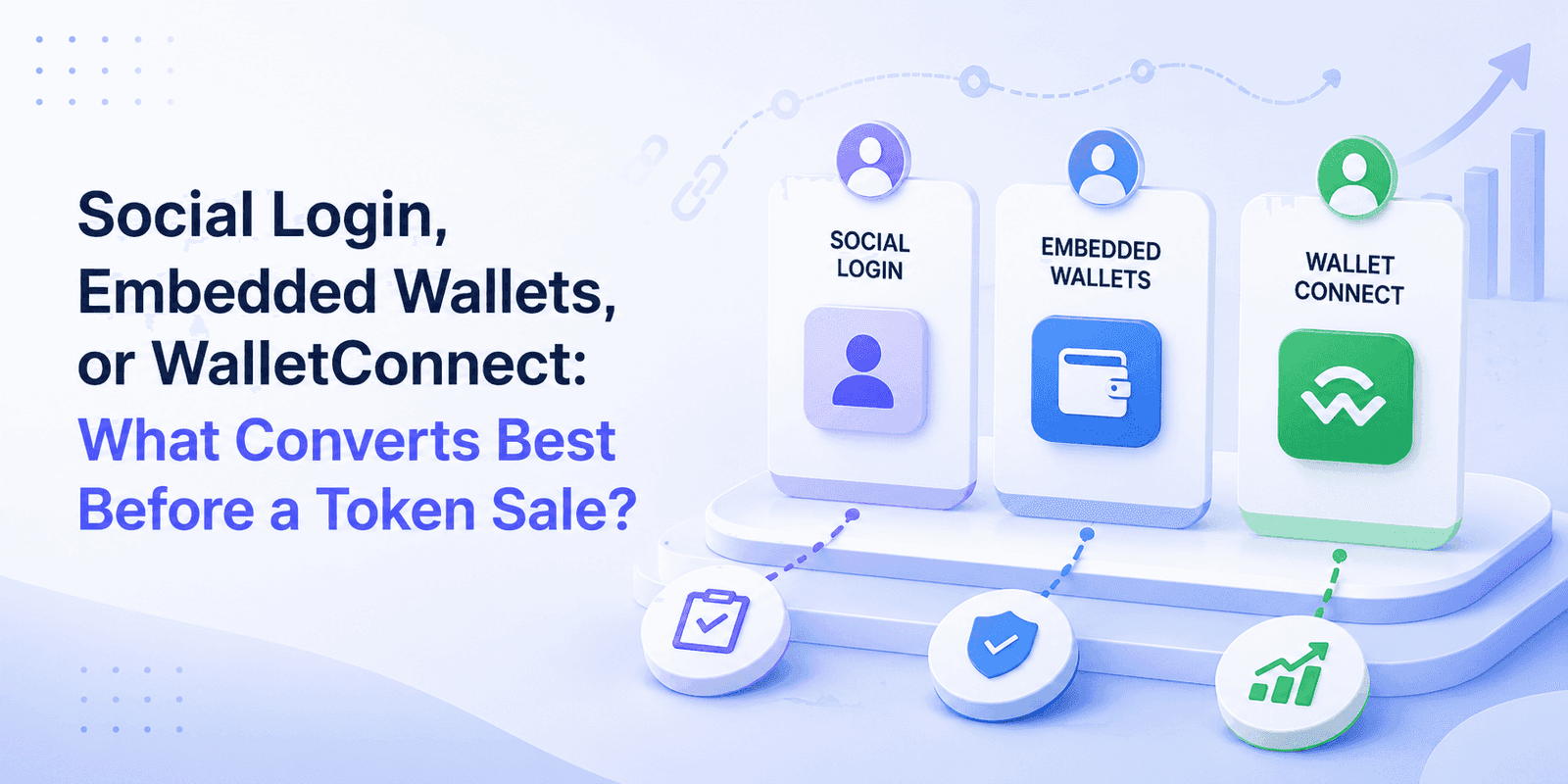
Social login, embedded wallets, and WalletConnect solve different onboarding problems before a token sale. Social login reduces account setup friction, but it does not always create a wallet. Embedded wallets help mainstream users start with email, passkeys, or OAuth before they interact with blockchain actions. WalletConnect fits crypto-native buyers who already use external wallets. No model always converts best. Token sale teams should choose the model based on audience readiness, security needs, chain coverage, recovery, funding guidance, and support workload. In this article, native wallet connection refers to users bringing an external wallet. WalletConnect is the most common example of this flow.

Why Login and Wallet Onboarding Matters Before a Token Sale

Crypto ownership has grown faster than regular on-chain usage. a16z estimates 40 to 70 million active crypto users last year, while wider crypto ownership is much larger. This gap shows why token sale teams should not assume every participant is wallet-ready.

A token sale process starts before the purchase page. Participants need account access, wallet readiness, funding, and the correct network before they can complete a transaction. That first layer may use social login, embedded wallets, WalletConnect, or a hybrid flow.

The impact usually appears across four conversion points:

  • Account creation, because social login reduces initial access friction.

  • Wallet setup, because embedded wallets simplify entry for newer users.

  • Wallet connection, because WalletConnect fits existing wallet users.

  • Purchase readiness, because users still need funds, networks, and signing.

The wrong model can create drop-off across the token sale funnel. Users may pass signup but fail wallet connection. They may connect a wallet but choose the wrong network. They may pass KYC but still lack funded wallet access.

These issues create support pressure near launch. They also delay first transactions when timing matters most. Token sale teams should treat login and wallet onboarding as one conversion layer. The model should move users from access, to wallet readiness, to purchase.

Read more: How to Reduce Wallet Onboarding Drop-Off Before a Token Sale

The Difference Between Social Login, Embedded Wallets, and WalletConnect in Token Sales

Token sale teams often group these terms together when planning a token sale structure. That creates confusion because each term solves a different onboarding problem. 

What Is Social Login?

Social login is an authentication layer. It lets users access an account through email, OAuth, or passkeys. This can reduce signup friction because users avoid a wallet-first entry point.

  • Best fit: Social login works well for waitlists, dashboards, early qualification, and progressive onboarding.

  • Watch out: Social login does not always create a wallet. A user can create an account and still lack a usable wallet for purchase.

What Is an Embedded Wallet?

An embedded wallet sits inside the product flow. Users usually start with email, passkeys, or OAuth. The application then creates or provides wallet access behind the interface.

  • Best fit: Embedded wallets work well for mainstream users who need fewer setup steps before the first transaction.

  • Watch out: Teams must still review recovery, key control, export options, portability, and provider limits.

What Is WalletConnect?

WalletConnect connects users to an existing wallet. The user connects a wallet, signs a message, and starts a session. Many Ethereum flows also use SIWE to verify wallet control through signatures.

  • Best fit: WalletConnect works well for crypto-native buyers who already use external wallets.

  • Watch out: Newer users may struggle with wallet installation, mobile switching, network selection, signatures, and funding.

Which Wallet Model is Best for Each Token Sale Audience?

Generally, there are three types of audiences a token sale team wants to reach. Different groups have different wallet habits, regulatory tolerances, and support needs. The onboarding model needs to align with these patterns before the sales flow begins.

Crypto-Native Buyers

Crypto-native buyers are familiar with wallet-based actions. Common characteristics include:

  • They already have wallets such as MetaMask, Rabby, Trust Wallet or other wallets.

  • They know what signatures, gas fees, and transaction prompts are.

  • They are able to move between networks with less direction.

  • They might want to have control over their private keys.

  • They might not trust wallets that are generated within an application.

Best fit: WalletConnect.

WalletConnect fits this audience because users can bring their existing wallets. It supports a familiar wallet-first experience for DeFi users, traders, and active crypto participants.

However, crypto-native does not mean friction-free. Teams still need to test mobile behavior, failed connections, wrong-network prompts, and signing errors.

Mainstream Buyers

Mainstream buyers may understand the project but not the wallet process. Common characteristics include:

  • They may not own a crypto wallet yet.

  • They may avoid browser extension setup.

  • They may not understand seed phrase storage.

  • They may prefer email, passkeys, or social login.

  • They need clearer guidance before the first transaction.

Best fit: Embedded wallets with social login.

Embedded wallets fit this audience because users can enter through familiar login methods. The wallet step can happen inside the product flow, instead of forcing setup first.

This does not remove every conversion issue. Teams still need funding guidance, recovery instructions, and clear transaction prompts. A smoother login flow cannot replace sale readiness.

Mixed Audiences

Many token sales attract both crypto-native and mainstream users. Common characteristics include:

  • Some users already have funded wallets.

  • Some users need a simpler entry point.

  • Some users join through community or waitlist campaigns.

  • Some users need education before wallet action.

  • Support needs can vary across user segments.

Best fit: Hybrid onboarding.

A hybrid model gives users the right path based on readiness. Experienced users can connect through WalletConnect. Newer users can start through embedded wallets. Social login can support waitlists, dashboards, and phased onboarding before wallet action.

Read more: What does a high-converting token sale funnel look like?

Social Login vs Embedded Wallets vs WalletConnect: Token Sale Friction Comparison

Each onboarding model creates different friction points along the token sale pipeline. These issues can impact wallet readiness, funding, network selection, and first transactions. The comparison below helps teams identify potential friction points before launch.

Funnel Friction Point

Social Login

Embedded Wallets

WalletConnect

What Teams Should Check

Account access

Usually easier

Usually easier

Can add friction

Can users enter without wallet confusion?

Wallet readiness

Not guaranteed

Usually built into flow

Depends on user wallet

Can users reach a usable wallet before purchase?

Browser extension need

Usually avoided

Usually avoided

Often required

Does the flow work for users without extensions?

Seed phrase friction

Usually avoided

Often reduced

User-managed

Do new users understand recovery requirements?

Mobile experience

Usually simpler

Usually simpler

Can require app switching

Does the flow work across mobile browsers and wallet apps?

Network selection

Not solved alone

Can be simplified

Often user-managed

Can users reach the correct sale network?

Funding readiness

Still required

Still required

Still required

Do users know what asset and network to use?

Support workload

Lower for login

Lower for new users

Higher for new users

Which issues will support teams need to handle?

How Each Wallet Model Affects Recovery and Access Control

A wallet model does not only affect signup. It also affects recovery, key control, session access, and user support after signup. These issues matter because a user can enter the sale flow but still fail before purchase.

  • Key control
    Teams must know whether users control wallets directly or through an embedded setup.

  • Recovery
    Users need a clear way to regain access before the sale window closes.

  • Portability
    Users may need to export or use wallets outside the platform.

  • Session handling
    Expired sessions can interrupt wallet connection or purchase steps.

  • Signature failures
    Failed signing can block authentication or transaction approval.

Wallet Standards Teams Should Review Before Launch

Wallet UX also depends on implementation standards. These standards affect authentication, provider behavior, smart accounts, and future wallet features.

SIWE, ERC-4361

  • Where it matters: Wallet-based login

  • What teams should check: The platform should verify signed messages, nonce, domain, chain ID, and session rules.

EIP-1193

  • Where it matters: Wallet provider behavior

  • What teams should check: The flow should handle provider requests, chain changes, account changes, and provider errors.

ERC-4337

  • Where it matters: Smart account flows

  • What teams should check: The team should confirm smart account support, bundlers, EntryPoint, and paymaster use.

EIP-7702

  • Where it matters: Advanced EOA delegation

  • What teams should check: The team should review batching, sponsorship, and permission limits when supported.

The goal is not to mention every standard. The goal is to know which standards affect the chosen onboarding model. This review helps teams avoid vague wallet planning before implementation.

How to Check Chain Coverage and Wallet Compatibility

The chosen onboarding model must work in the actual token sale setup. It must support the sale chain, target wallets, user devices, and funding paths. A flow can work during internal testing but still fail during live participation.

Teams should check compatibility before launch through a simple readiness review.

How to Check

Expected Output

Test the onboarding flow on the sale chain.

The team confirms that users can reach the correct network.

Test supported wallets on desktop and mobile.

The team identifies which wallets work reliably.

Test WalletConnect from common wallet apps.

The team confirms connection, signing, and reconnection behavior.

Test embedded wallet support for the sale chain.

The team confirms provider compatibility before implementation.

Test funding paths and required assets.

The team confirms users can hold and use the required token.

Test wrong-network scenarios.

The team prepares prompts that guide users to the correct network.

Test failed connection and failed signature cases.

The team prepares support responses before launch.

This check helps teams avoid launch-day friction. It also helps product, engineering, and support teams share the same wallet-readiness plan. The final output should be a clear list of supported wallets, supported chains, known limits, user instructions, and support scripts.

What Converts Best Before a Token Sale?

No wallet onboarding model always converts best. The strongest model depends on the audience and launch design. The right decision should consider user readiness, security needs, chain coverage, recovery, funding, and support workload.

Token Sale Situation

Best-Fit Model

Why It Fits

Crypto-native token sale

WalletConnect

Users already have external wallets

Consumer-facing launch

Embedded wallet

Users need fewer setup steps

Waitlist before sale

Social login

Teams can qualify users first

Mixed buyer base

Hybrid flow

Users choose the fitting path

Mobile-first campaign

Embedded wallet

Flow can reduce extension friction

High-control DeFi sale

WalletConnect

Users keep direct wallet control

New-user onboarding

Embedded wallet with social login

Login and wallet setup feel familiar

The decision should not start with tools. It should start with the expected participant.

Token Sale Wallet Onboarding Best Practices Checklist

Choosing a wallet model is only the first step. Token sale teams also need to prepare the full onboarding path before users enter the sale flow. Use this checklist before launch:

Best Practice

What Teams Should Prepare

Match the flow to the audience

Define whether users are crypto-native, mainstream, or mixed.

Separate login from wallet readiness

Confirm that account access does not replace wallet setup.

Test desktop and mobile flows

Check browsers, wallet apps, app switching, and failed prompts.

Confirm chain compatibility

Make sure the wallet model supports the sale chain.

Prepare wrong-network guidance

Show users how to switch to the correct network.

Add funding instructions

Explain the required asset, network, and purchase steps.

Test recovery paths

Review account recovery, wallet recovery, and session expiry.

Review wallet standards

Check SIWE, EIP-1193, ERC-4337, or EIP-7702 when relevant.

Prepare support scripts

Create responses for failed login, failed connection, and failed signing.

Run a full purchase simulation

Test the journey from signup to first transaction.

This checklist helps teams move from model selection to execution. It also gives product, engineering, growth, and support teams the same launch-readiness view.

Wallet Onboarding Metrics Teams Should Track

Token sale teams should not judge wallet onboarding by final purchases only. They need step-level metrics that show where users lose readiness. This is important because wallet connection, funding, KYC, and first transactions all create separate drop-off points.

External benchmarks should guide context, not fixed targets. HypeLab reports that 15% to 25% of landing page visitors connect wallets on crypto-native sites, while general-audience sites may see 2% to 8%. It also reports that 30% to 50% of wallet connectors complete an onchain action.

Financial onboarding data also shows why step-level measurement matters. Signicat reported that 68% of European consumers abandoned financial applications during onboarding in 2022. The same report lists process complexity, time, and identity credentials as major abandonment factors.

Metric

Benchmark or Reference Point

What Teams Should Watch

Landing page to wallet connect

15% to 25% for crypto-native sites

Low rates may show weak wallet guidance or low buyer readiness.

General audience wallet connect

2% to 8% for broad audiences

Low rates may show the flow asks for wallets too early.

Wallet connect to onchain action

30% to 50%

Low rates may show signing anxiety, gas confusion, or funding gaps.

KYC start to approval

Internal baseline, informed by financial onboarding abandonment risk

Slow or unclear verification can block qualified buyers

Wallet setup abandonment

Internal baseline

Segment by social login, embedded wallet, and WalletConnect.

Correct network selected

Internal baseline

High failure rates show weak network prompts.

Funded wallet rate

Internal baseline

Track token balance, gas, chain, and fiat onramp usage.

Time to sale-ready

Internal baseline

Long delays show unclear steps or support gaps.

Common Mistakes When Choosing Wallet Onboarding

Token sale teams often lose conversion because the onboarding model does not match the user journey. These mistakes usually appear before purchase, when users need access, wallet readiness, funding, and support.

  • Using WalletConnect for every audience
    WalletConnect works for crypto-native users. It can block mainstream users who do not have wallets yet.

  • Treating social login as a complete wallet strategy
    Social login helps users access an account. It does not always make users wallet-ready.

  • Ignoring mobile wallet behavior
    Desktop testing does not reflect every campaign flow. Mobile users may face app switching, browser issues, or wallet prompt failures.

  • Delaying funding guidance
    Wallet connection does not mean purchase readiness. Users still need the correct asset, network, and transaction steps.

  • Ignoring support workload
    Wallet issues often become support issues. Teams should prepare scripts, help content, and failed-state guidance before launch.

  • Forcing one flow for every participant
    Mixed audiences need flexible onboarding. A hybrid flow can support both existing wallet users and newer participants.

Plan the Right Wallet Onboarding Model With TokenMinds

A token sale needs a wallet model that matches its audience. The model should also support the sale chain, funding path, recovery rules, and support capacity.

TokenMinds helps teams review these choices before launch. The process maps social login, embedded wallets, WalletConnect, or a hybrid flow against the buyer journey.

Schedule a Wallet UX decision workshop with TokenMinds.

FAQs

  1. What wallet onboarding method converts best for token sales?

    No single wallet onboarding method always converts best. WalletConnect fits crypto-native buyers with existing wallets. Embedded wallets fit mainstream users who need fewer setup steps. Hybrid onboarding works when the sale targets both groups.

  2. Are embedded wallets safer than WalletConnect?

    Embedded wallets are not safer by default. Safety depends on key control, recovery design, provider security, and implementation quality. Teams should review custody, export options, and recovery rules before launch.

  3. What is SIWE in a token sale?

    SIWE means Sign-In with Ethereum. It lets users prove wallet control through a signed message. Token sale platforms can use it to authenticate wallet users without passwords.

  4. Should token sales support social login?

    Token sales can support social login when users need easier account access. It works well for waitlists, dashboards, and early qualification. However, social login should not replace wallet readiness planning.

  5. Why do users abandon crypto presales before purchase?

    Users often abandon crypto presales because the flow creates avoidable friction. Common issues include wallet setup, wrong networks, funding gaps, failed signatures, and unclear support guidance.

  6. How do embedded wallets work in Web3 onboarding?

    Embedded wallets sit inside the product flow. Users often start with email, passkeys, or OAuth. The application then creates or provides wallet access behind the interface.

TL;DR
Social login, embedded wallets, and WalletConnect solve different onboarding problems before a token sale. Social login reduces account setup friction, but it does not always create a wallet. Embedded wallets help mainstream users start with email, passkeys, or OAuth before they interact with blockchain actions. WalletConnect fits crypto-native buyers who already use external wallets. No model always converts best. Token sale teams should choose the model based on audience readiness, security needs, chain coverage, recovery, funding guidance, and support workload. In this article, native wallet connection refers to users bringing an external wallet. WalletConnect is the most common example of this flow.

Why Login and Wallet Onboarding Matters Before a Token Sale

Crypto ownership has grown faster than regular on-chain usage. a16z estimates 40 to 70 million active crypto users last year, while wider crypto ownership is much larger. This gap shows why token sale teams should not assume every participant is wallet-ready.

A token sale process starts before the purchase page. Participants need account access, wallet readiness, funding, and the correct network before they can complete a transaction. That first layer may use social login, embedded wallets, WalletConnect, or a hybrid flow.

The impact usually appears across four conversion points:

  • Account creation, because social login reduces initial access friction.

  • Wallet setup, because embedded wallets simplify entry for newer users.

  • Wallet connection, because WalletConnect fits existing wallet users.

  • Purchase readiness, because users still need funds, networks, and signing.

The wrong model can create drop-off across the token sale funnel. Users may pass signup but fail wallet connection. They may connect a wallet but choose the wrong network. They may pass KYC but still lack funded wallet access.

These issues create support pressure near launch. They also delay first transactions when timing matters most. Token sale teams should treat login and wallet onboarding as one conversion layer. The model should move users from access, to wallet readiness, to purchase.

Read more: How to Reduce Wallet Onboarding Drop-Off Before a Token Sale

The Difference Between Social Login, Embedded Wallets, and WalletConnect in Token Sales

Token sale teams often group these terms together when planning a token sale structure. That creates confusion because each term solves a different onboarding problem. 

What Is Social Login?

Social login is an authentication layer. It lets users access an account through email, OAuth, or passkeys. This can reduce signup friction because users avoid a wallet-first entry point.

  • Best fit: Social login works well for waitlists, dashboards, early qualification, and progressive onboarding.

  • Watch out: Social login does not always create a wallet. A user can create an account and still lack a usable wallet for purchase.

What Is an Embedded Wallet?

An embedded wallet sits inside the product flow. Users usually start with email, passkeys, or OAuth. The application then creates or provides wallet access behind the interface.

  • Best fit: Embedded wallets work well for mainstream users who need fewer setup steps before the first transaction.

  • Watch out: Teams must still review recovery, key control, export options, portability, and provider limits.

What Is WalletConnect?

WalletConnect connects users to an existing wallet. The user connects a wallet, signs a message, and starts a session. Many Ethereum flows also use SIWE to verify wallet control through signatures.

  • Best fit: WalletConnect works well for crypto-native buyers who already use external wallets.

  • Watch out: Newer users may struggle with wallet installation, mobile switching, network selection, signatures, and funding.

Which Wallet Model is Best for Each Token Sale Audience?

Generally, there are three types of audiences a token sale team wants to reach. Different groups have different wallet habits, regulatory tolerances, and support needs. The onboarding model needs to align with these patterns before the sales flow begins.

Crypto-Native Buyers

Crypto-native buyers are familiar with wallet-based actions. Common characteristics include:

  • They already have wallets such as MetaMask, Rabby, Trust Wallet or other wallets.

  • They know what signatures, gas fees, and transaction prompts are.

  • They are able to move between networks with less direction.

  • They might want to have control over their private keys.

  • They might not trust wallets that are generated within an application.

Best fit: WalletConnect.

WalletConnect fits this audience because users can bring their existing wallets. It supports a familiar wallet-first experience for DeFi users, traders, and active crypto participants.

However, crypto-native does not mean friction-free. Teams still need to test mobile behavior, failed connections, wrong-network prompts, and signing errors.

Mainstream Buyers

Mainstream buyers may understand the project but not the wallet process. Common characteristics include:

  • They may not own a crypto wallet yet.

  • They may avoid browser extension setup.

  • They may not understand seed phrase storage.

  • They may prefer email, passkeys, or social login.

  • They need clearer guidance before the first transaction.

Best fit: Embedded wallets with social login.

Embedded wallets fit this audience because users can enter through familiar login methods. The wallet step can happen inside the product flow, instead of forcing setup first.

This does not remove every conversion issue. Teams still need funding guidance, recovery instructions, and clear transaction prompts. A smoother login flow cannot replace sale readiness.

Mixed Audiences

Many token sales attract both crypto-native and mainstream users. Common characteristics include:

  • Some users already have funded wallets.

  • Some users need a simpler entry point.

  • Some users join through community or waitlist campaigns.

  • Some users need education before wallet action.

  • Support needs can vary across user segments.

Best fit: Hybrid onboarding.

A hybrid model gives users the right path based on readiness. Experienced users can connect through WalletConnect. Newer users can start through embedded wallets. Social login can support waitlists, dashboards, and phased onboarding before wallet action.

Read more: What does a high-converting token sale funnel look like?

Social Login vs Embedded Wallets vs WalletConnect: Token Sale Friction Comparison

Each onboarding model creates different friction points along the token sale pipeline. These issues can impact wallet readiness, funding, network selection, and first transactions. The comparison below helps teams identify potential friction points before launch.

Funnel Friction Point

Social Login

Embedded Wallets

WalletConnect

What Teams Should Check

Account access

Usually easier

Usually easier

Can add friction

Can users enter without wallet confusion?

Wallet readiness

Not guaranteed

Usually built into flow

Depends on user wallet

Can users reach a usable wallet before purchase?

Browser extension need

Usually avoided

Usually avoided

Often required

Does the flow work for users without extensions?

Seed phrase friction

Usually avoided

Often reduced

User-managed

Do new users understand recovery requirements?

Mobile experience

Usually simpler

Usually simpler

Can require app switching

Does the flow work across mobile browsers and wallet apps?

Network selection

Not solved alone

Can be simplified

Often user-managed

Can users reach the correct sale network?

Funding readiness

Still required

Still required

Still required

Do users know what asset and network to use?

Support workload

Lower for login

Lower for new users

Higher for new users

Which issues will support teams need to handle?

How Each Wallet Model Affects Recovery and Access Control

A wallet model does not only affect signup. It also affects recovery, key control, session access, and user support after signup. These issues matter because a user can enter the sale flow but still fail before purchase.

  • Key control
    Teams must know whether users control wallets directly or through an embedded setup.

  • Recovery
    Users need a clear way to regain access before the sale window closes.

  • Portability
    Users may need to export or use wallets outside the platform.

  • Session handling
    Expired sessions can interrupt wallet connection or purchase steps.

  • Signature failures
    Failed signing can block authentication or transaction approval.

Wallet Standards Teams Should Review Before Launch

Wallet UX also depends on implementation standards. These standards affect authentication, provider behavior, smart accounts, and future wallet features.

SIWE, ERC-4361

  • Where it matters: Wallet-based login

  • What teams should check: The platform should verify signed messages, nonce, domain, chain ID, and session rules.

EIP-1193

  • Where it matters: Wallet provider behavior

  • What teams should check: The flow should handle provider requests, chain changes, account changes, and provider errors.

ERC-4337

  • Where it matters: Smart account flows

  • What teams should check: The team should confirm smart account support, bundlers, EntryPoint, and paymaster use.

EIP-7702

  • Where it matters: Advanced EOA delegation

  • What teams should check: The team should review batching, sponsorship, and permission limits when supported.

The goal is not to mention every standard. The goal is to know which standards affect the chosen onboarding model. This review helps teams avoid vague wallet planning before implementation.

How to Check Chain Coverage and Wallet Compatibility

The chosen onboarding model must work in the actual token sale setup. It must support the sale chain, target wallets, user devices, and funding paths. A flow can work during internal testing but still fail during live participation.

Teams should check compatibility before launch through a simple readiness review.

How to Check

Expected Output

Test the onboarding flow on the sale chain.

The team confirms that users can reach the correct network.

Test supported wallets on desktop and mobile.

The team identifies which wallets work reliably.

Test WalletConnect from common wallet apps.

The team confirms connection, signing, and reconnection behavior.

Test embedded wallet support for the sale chain.

The team confirms provider compatibility before implementation.

Test funding paths and required assets.

The team confirms users can hold and use the required token.

Test wrong-network scenarios.

The team prepares prompts that guide users to the correct network.

Test failed connection and failed signature cases.

The team prepares support responses before launch.

This check helps teams avoid launch-day friction. It also helps product, engineering, and support teams share the same wallet-readiness plan. The final output should be a clear list of supported wallets, supported chains, known limits, user instructions, and support scripts.

What Converts Best Before a Token Sale?

No wallet onboarding model always converts best. The strongest model depends on the audience and launch design. The right decision should consider user readiness, security needs, chain coverage, recovery, funding, and support workload.

Token Sale Situation

Best-Fit Model

Why It Fits

Crypto-native token sale

WalletConnect

Users already have external wallets

Consumer-facing launch

Embedded wallet

Users need fewer setup steps

Waitlist before sale

Social login

Teams can qualify users first

Mixed buyer base

Hybrid flow

Users choose the fitting path

Mobile-first campaign

Embedded wallet

Flow can reduce extension friction

High-control DeFi sale

WalletConnect

Users keep direct wallet control

New-user onboarding

Embedded wallet with social login

Login and wallet setup feel familiar

The decision should not start with tools. It should start with the expected participant.

Token Sale Wallet Onboarding Best Practices Checklist

Choosing a wallet model is only the first step. Token sale teams also need to prepare the full onboarding path before users enter the sale flow. Use this checklist before launch:

Best Practice

What Teams Should Prepare

Match the flow to the audience

Define whether users are crypto-native, mainstream, or mixed.

Separate login from wallet readiness

Confirm that account access does not replace wallet setup.

Test desktop and mobile flows

Check browsers, wallet apps, app switching, and failed prompts.

Confirm chain compatibility

Make sure the wallet model supports the sale chain.

Prepare wrong-network guidance

Show users how to switch to the correct network.

Add funding instructions

Explain the required asset, network, and purchase steps.

Test recovery paths

Review account recovery, wallet recovery, and session expiry.

Review wallet standards

Check SIWE, EIP-1193, ERC-4337, or EIP-7702 when relevant.

Prepare support scripts

Create responses for failed login, failed connection, and failed signing.

Run a full purchase simulation

Test the journey from signup to first transaction.

This checklist helps teams move from model selection to execution. It also gives product, engineering, growth, and support teams the same launch-readiness view.

Wallet Onboarding Metrics Teams Should Track

Token sale teams should not judge wallet onboarding by final purchases only. They need step-level metrics that show where users lose readiness. This is important because wallet connection, funding, KYC, and first transactions all create separate drop-off points.

External benchmarks should guide context, not fixed targets. HypeLab reports that 15% to 25% of landing page visitors connect wallets on crypto-native sites, while general-audience sites may see 2% to 8%. It also reports that 30% to 50% of wallet connectors complete an onchain action.

Financial onboarding data also shows why step-level measurement matters. Signicat reported that 68% of European consumers abandoned financial applications during onboarding in 2022. The same report lists process complexity, time, and identity credentials as major abandonment factors.

Metric

Benchmark or Reference Point

What Teams Should Watch

Landing page to wallet connect

15% to 25% for crypto-native sites

Low rates may show weak wallet guidance or low buyer readiness.

General audience wallet connect

2% to 8% for broad audiences

Low rates may show the flow asks for wallets too early.

Wallet connect to onchain action

30% to 50%

Low rates may show signing anxiety, gas confusion, or funding gaps.

KYC start to approval

Internal baseline, informed by financial onboarding abandonment risk

Slow or unclear verification can block qualified buyers

Wallet setup abandonment

Internal baseline

Segment by social login, embedded wallet, and WalletConnect.

Correct network selected

Internal baseline

High failure rates show weak network prompts.

Funded wallet rate

Internal baseline

Track token balance, gas, chain, and fiat onramp usage.

Time to sale-ready

Internal baseline

Long delays show unclear steps or support gaps.

Common Mistakes When Choosing Wallet Onboarding

Token sale teams often lose conversion because the onboarding model does not match the user journey. These mistakes usually appear before purchase, when users need access, wallet readiness, funding, and support.

  • Using WalletConnect for every audience
    WalletConnect works for crypto-native users. It can block mainstream users who do not have wallets yet.

  • Treating social login as a complete wallet strategy
    Social login helps users access an account. It does not always make users wallet-ready.

  • Ignoring mobile wallet behavior
    Desktop testing does not reflect every campaign flow. Mobile users may face app switching, browser issues, or wallet prompt failures.

  • Delaying funding guidance
    Wallet connection does not mean purchase readiness. Users still need the correct asset, network, and transaction steps.

  • Ignoring support workload
    Wallet issues often become support issues. Teams should prepare scripts, help content, and failed-state guidance before launch.

  • Forcing one flow for every participant
    Mixed audiences need flexible onboarding. A hybrid flow can support both existing wallet users and newer participants.

Plan the Right Wallet Onboarding Model With TokenMinds

A token sale needs a wallet model that matches its audience. The model should also support the sale chain, funding path, recovery rules, and support capacity.

TokenMinds helps teams review these choices before launch. The process maps social login, embedded wallets, WalletConnect, or a hybrid flow against the buyer journey.

Schedule a Wallet UX decision workshop with TokenMinds.

FAQs

  1. What wallet onboarding method converts best for token sales?

    No single wallet onboarding method always converts best. WalletConnect fits crypto-native buyers with existing wallets. Embedded wallets fit mainstream users who need fewer setup steps. Hybrid onboarding works when the sale targets both groups.

  2. Are embedded wallets safer than WalletConnect?

    Embedded wallets are not safer by default. Safety depends on key control, recovery design, provider security, and implementation quality. Teams should review custody, export options, and recovery rules before launch.

  3. What is SIWE in a token sale?

    SIWE means Sign-In with Ethereum. It lets users prove wallet control through a signed message. Token sale platforms can use it to authenticate wallet users without passwords.

  4. Should token sales support social login?

    Token sales can support social login when users need easier account access. It works well for waitlists, dashboards, and early qualification. However, social login should not replace wallet readiness planning.

  5. Why do users abandon crypto presales before purchase?

    Users often abandon crypto presales because the flow creates avoidable friction. Common issues include wallet setup, wrong networks, funding gaps, failed signatures, and unclear support guidance.

  6. How do embedded wallets work in Web3 onboarding?

    Embedded wallets sit inside the product flow. Users often start with email, passkeys, or OAuth. The application then creates or provides wallet access behind the interface.

GET SUCCESS IN WEB3

  • Trusted Web3 partner since 2017

  • Full-stack Web3 development team

  • Performance-driven Web3 marketing

Get A Free Consultation

Get A Free Consultation

MEET US AT

RECENT TRAININGS

Follow us

get web3 business updates

Email invalid

  • Access global liquidity for your RWA project with TMX Tokenize’s Canton Network integration

DISCOVER NOW

  • Access global liquidity for your RWA project with TMX Tokenize’s Canton Network integration

    JOIN NOW

DISCOVER

  • Access global liquidity for your RWA project with TMX Tokenize’s Canton Network integration